REVIEW 3 major objections 4 minor 18 references
FinXplore: An Adaptive Deep Reinforcement Learning Framework for Balancing and Discovering Investment Opportunities
T0 review · 3 major / 4 minor · reviewed 2026-08-05 · deepseek-v4-flash
Pith's one-line read FinXplore claims that a second reinforcement-learning agent, which scouts new assets and is accepted only when it improves a 60-day risk-adjusted return, beats fixed-universe benchmarks on NIFTY and DJIA backtests.
desk verdict The dual-agent exploration idea is a legitimate extension of Aquino et al., but Algorithm 1's acceptance rule makes the backtest results unreadable as tradeable performance. read the letter →
The pith
A machine-rendered reading of the paper's core claim, the machinery that carries it, and where it could break.
The reading
What carries the argument
The central mechanism is Algorithm 1's accept/reject loop with Sharpe-ratio gating. At each rebalancing period, Agent 1 produces portfolio weights; Agent 2 proposes an asset; the framework re-optimizes weights with κ=10% of wealth reserved for the proposed asset, computes the 60-day Sharpe ratio before and after, and keeps the new asset only if the ratio rises. The same ΔSR is the reward that trains the DQN agent, while the PPO agent is trained on the Sharpe ratio of the chosen portfolio. The Sharpe-ratio gate is what converts open-ended exploration into targeted diversification, and the rolling 60-day window plus a 0.05% transaction cost defines how the environment evaluates each action.
What would settle it
Re-run the NIFTY and DJIA backtests with Algorithm 1's acceptance test computed on Sharpe ratios that end before the rebalance (for example, through t−1 only, or via a walk-forward procedure that retrains the agents without touching the test period). If the corrected FinXplore does not beat the without-exploration agent and the market index by the reported margins, the superior performance is an artifact of look-ahead rather than of exploration.
Extended reading notes
Core claim
The discovery claim is that exploitation and exploration can be cleanly separated into two cooperating deep-RL agents, and that the collaboration improves the portfolio on both raw and risk-adjusted terms. Agent 1 (PPO) learns how to allocate wealth among the existing n assets; Agent 2 (DQN) learns which asset from the extended universe to propose. The link between them is the reward difference ΔSR = SR_new − SR_current, so Agent 2 is trained to find assets that improve the risk-adjusted portfolio, and Agent 1's acceptance rule (keep the new asset only when SR_new > SR_current) makes the allocation adaptive to changing markets. The reported experiments are intended to demonstrate that this d
Load-bearing premise
The load-bearing premise is that the agent can know the realized returns of the period it is about to rebalance: Algorithm 1 accepts a newly proposed asset only when SR_new, computed from the latest 60 portfolio returns, exceeds SR_current, which means the decision uses the same period's outcome to choose that period's trade. If a backtest is instead forced to act only on information available before the trade, this acceptance rule may no longer support the reported returns.
Editorial extensions
If this is right
- On the paper's reported results, FinXplore beats every benchmark on cumulative return, annualized return, Sharpe ratio, and Calmar ratio on both the NIFTY and DJIA datasets.
- The gap between FinXplore and the DRL agent without exploration (127.91% vs 93.86% on NIFTY; 49.56% vs 37.15% on DJIA) indicates that the exploration channel, not the choice of PPO alone, drives most of the improvement.
- The Sharpe-ratio acceptance rule keeps the framework from being forced into bad suggestions: it only allocates the 10% exploration budget when the proposed asset improves the portfolio's risk-adjusted return.
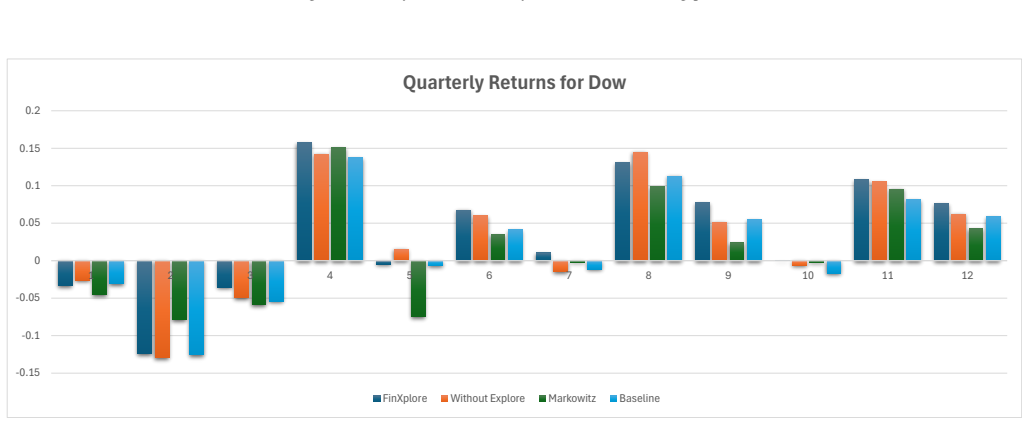
- The quarterly-return plots show that exploration can produce worse quarters as well as better ones, so the framework's edge is statistical over the full period rather than uniform across regimes.
Reading between the lines
- A corrected experiment that computes both Sharpe ratios only from data available before the rebalance would settle whether the reported edge survives without look-ahead; this is the first test to run before adopting the strategy.
- The exploration action space could be widened from five commodities to a large pool of ETFs or sectors, with the DQN learning a ranking over candidates rather than a fixed choice; the ΔSR reward supports that generalization directly.
- The fixed κ=10% exploration budget is an obvious place to make the framework adaptive: a meta-controller could raise the budget in regimes where accepted proposals consistently improve Sharpe and lower it during turbulent quarters.
- A practical deployment would need rebalancing-frequency and transaction-cost sensitivity analysis; daily rebalancing at 0.05% cost may not be realistic once the exploration channel is added.
Signed reviews
Editorial analysis
A structured set of objections, weighed in public.
Referee Report
Summary. The paper proposes FinXplore, a dual-agent deep reinforcement learning framework for portfolio optimization. A PPO agent allocates wealth within a pre-defined investment universe, while a DQN agent recommends adding assets from an extended universe (commodities). The two agents are trained on NIFTY and DJIA data from 2011-2021 and backtested on 2022-2024, with reported cumulative returns of 127.91% (NIFTY) and 49.56% (DJIA), surpassing all benchmarks. The paper claims this demonstrates the benefit of dynamically balancing exploitation of existing assets with exploration of new opportunities.
Significance. The dual-agent architecture and the idea of expanding the investment universe via a learned exploration policy are potentially interesting and go beyond fixed-universe DRL portfolio methods. The use of two established RL algorithms (PPO and DQN), evaluation against several baselines, and reporting of multiple risk-adjusted metrics are positive features. However, the main empirical claim is not credible as presented: the acceptance rule in Algorithm 1 appears to use realized returns from the period being traded, making the reported backtest results unattainable in real time. Because the central result rests on this evaluation, the contribution is not currently established.
major comments (3)
- [Algorithm 1 and Section II-A] Algorithm 1 (lines 2-10) computes SR_current = f(a_U) and SR_new = f(a_E) at each rebalancing step and selects a_E only if SR_new > SR_current. Section II-A defines the reward as SR_60, the Sharpe ratio over the last 60 portfolio returns, but does not specify whether the current period's return is included in that window. If the 60-day window includes the period about to be traded, the acceptance decision uses the same realized outcome that the policy is trying to predict, which is a look-ahead bias. If the window ends at the previous close, the rule is a mechanical ex post selection rule rather than evidence of learned predictive skill. In neither reading are the reported cumulative returns (Table II: 127.91%; Table III: 49.56%) established as tradeable out-of-sample results.
- [Tables II and III, 'Without Exploration' baseline] The comparison against the 'Without Exploration' DRL baseline is biased by construction. Algorithm 1 always chooses the allocation with the higher realized 60-day Sharpe ratio, so FinXplore's realized Sharpe is at least that of the no-exploration portfolio in every period. This mechanically guarantees a nonnegative ΔSR for the DQN reward and systematically favors FinXplore. The roughly 34pp (NIFTY) and 12pp (DJIA) cumulative-return gaps therefore largely reflect the selection rule, not an improved learned policy.
- [Table I and Sections III-V] The paper repeatedly claims the framework 'dynamically balances' exploitation and exploration, but the exploration weight is fixed at κ=10% (Table I) for all periods. Algorithm 1 only toggles between the full existing-universe allocation and the allocation that includes the suggested asset; there is no mechanism that adjusts the fraction of wealth devoted to exploration in response to market conditions. Thus the central 'adaptive balancing' claim is unsupported by the implemented method.
minor comments (4)
- [Throughout] There are typographical errors: 'effciency' in the Abstract, 'to access the risk-adjusted portfolio return' should be 'to assess', and 'closed' should be 'close' in Section IV-A. A careful proofread is needed.
- [Section IV-B] Hyperparameter tuning is described only by search ranges (Table I); the final selected hyperparameters are not reported. This hampers reproducibility, especially since no code repository is mentioned.
- [Tables II and III] Markowitz and the market index are reported without standard deviations, while DRL methods have means ± std from five runs. It would be helpful to know whether the reported point estimates are stable or based on a single run.
- [Figures 4 and 5] The quarterly-return figures are plotted only for FinXplore, 'Without Explore', and 'Markowitz Baseline', which is a subset of the models in Tables II and III. The caption for Figure 4 labels the third series 'Baseline' but does not identify which baseline it is.
Circularity Check
Algorithm 1's accept-if-higher-Sharpe rule makes the exploration advantage over 'Without Exploration' true by construction.
-
self definitional
[Algorithm 1, lines 6–12; Section III (Proposed Methodology)]
"if SR_new > SRcurrent then w←a_E else w←a_U ... R_PPO ←SR_current; R_DQN ←∆SR=SR new −SR current"
At every rebalance, Algorithm 1 defines the final portfolio w to be a_E when the 60-day Sharpe ratio of the explored portfolio exceeds that of the current portfolio, and a_U otherwise. Hence f(w) = max(f(a_U), f(a_E)) ≥ f(a_U). The 'Without Exploration' baseline is exactly w = a_U at all times, so its Sharpe ratio is f(a_U). Therefore FinXplore's per-rebalance Sharpe ratio is, by construction, at least that of the baseline. The paper then reports FinXplore's superior cumulative returns and Sharpe ratios (Tables II–III) as evidence that the dual-agent design works, but the gap is guaranteed by the max-selection rule rather than by any learned predictive skill. The reward updates use the same f: R_PPO = SR_current and R_DQN = SR_new − SR_current, so the selection criterion, the training rewa
full rationale
The central empirical claim (Section IV-E) is that FinXplore outperforms all benchmarks, including 'Without Exploration.' That specific comparison is not independent: Algorithm 1 selects between a_U and a_E by comparing their 60-day Sharpe ratios, so the selected portfolio's Sharpe is the maximum of the two candidates by construction. The no-exploration baseline never receives this option, so the reported improvement over it is partly forced by the algorithm's definition, not by demonstrated out-of-sample predictive skill. No load-bearing self-citation was found; reference [16] is a minor self-citation for hyperparameters and transaction costs and does not support the main derivation. The paper also leaves ambiguous whether the 60-return window includes the period to be traded, which could entail look-ahead; that is a separate correctness issue, not the circularity scored here. Overall, the evaluation design creates a partial circularity because the metric used to accept/reject the exploration is the same metric used as the agents' reward and as the reported performance measure.
Assumptions & free parameters
free parameters (5)
- Exploration weight kappa =
10%
- Transaction cost delta =
0.05%
- Sharpe window =
60 days
- Hyperparameters =
not reported (ranges only)
- Stock universe =
18 unnamed stocks per market
assumptions (5)
- domain assumption Markov Decision Process is an appropriate model for portfolio optimization.
- domain assumption The 60-day Sharpe ratio is an appropriate reward signal for learning.
- domain assumption Historical OHLCV data and technical indicators are sufficient state for the environment.
- ad hoc to paper The realized Sharpe ratio of the current period is available when deciding the current period's allocation.
- domain assumption The five selected commodities form a representative extended investment universe.
Cite this review
Pith. "Pith review of FinXplore: An Adaptive Deep Reinforcement Learning Framework for Balancing and Discovering Investment Opportunities." pith.science (2026). https://pith.science/paper/2XZWA6AJ
@misc{pith2026250910531,
  author       = {Pith},
  title        = {Pith review of: FinXplore: An Adaptive Deep Reinforcement Learning Framework for Balancing and Discovering Investment Opportunities},
  year         = {2026},
  howpublished = {\url{https://pith.science/paper/2XZWA6AJ}},
  note         = {Machine review of arXiv:2509.10531}
}
read the original abstract
Portfolio optimization is essential for balancing risk and return in financial decision-making. Deep Reinforcement Learning (DRL) has stood out as a cutting-edge tool for portfolio optimization that learns dynamic asset allocation using trial-and-error interactions. However, most DRL-based methods are restricted to allocating assets within a pre-defined investment universe and overlook exploring new opportunities. This study introduces an investment landscape that integrates exploiting existing assets with exploring new investment opportunities in an extended universe. The proposed approach leverages two DRL agents and dynamically balances these objectives to adapt to evolving markets while enhancing portfolio performance. One agent allocates assets within the existing universe, while another assists in exploring new opportunities in the extended universe. The effciency of the proposed methodology is determined using two real-world market data sets. The experiments demonstrate the superiority of the suggested approach against the state-of-the-art portfolio strategies and baseline methods.
Figures


Figures from the paper (2 more)

Reference graph
Works this paper leans on
-
[1]
H. Markowitz, “Portfolio selection,” The journal of finance, vol. 7, no. 1, pp. 77–91, 1952
work page 1952
-
[2]
M. HA Davis and A. R. Norman. Portfolio selection with transaction costs. Mathematics of operations research, 15(4):676–713, 1990
work page 1990
-
[3]
M. Ehrgott, K. Klamroth, and C. Schwehm. An MCDM approach to portfolio optimization. European Journal of Operational Research, 155(3):752–770, 2004
work page 2004
-
[4]
H. Jalota, P. K. Mandal, M. Thakur, and G. Mittal, “A novel approach to incorporate investor’s preference in fuzzy multi-objective portfolio selection problem using credibility measure,” Expert Systems with Applications, vol. 212, p. 118583, 2023
work page 2023
-
[5]
Mastering the game of Go with deep neural networks and tree search,
D. Silver, A. Huang, C. J. Maddison, A. Guez, L. Sifre, G. Van Den Driessche, J. Schrittwieser, I. Antonoglou, V . Panneershelvam, M. Lanctot, et al., “Mastering the game of Go with deep neural networks and tree search,” Nature, vol. 529, no. 7587, pp. 484–489, 2016
work page 2016
-
[7]
A deep reinforcement learning frame- work for the financial portfolio management problem
Z. Jiang, D. Xu, J. Liang. “A deep reinforcement learning frame- work for the financial portfolio management problem.” arXiv preprint arXiv:1706.10059. 2017
arXiv 2017
-
[8]
Z. Wang, B. Huang, S. Tu, K. Zhang, and L. Xu. “Deeptrader: A deep reinforcement learning approach for risk-return balanced portfolio management with market conditions embedding.” In Proceedings of the AAAI conference on artificial intelligence, volume 35, pages 643–650, 2021
work page 2021
-
[9]
J. Jang and N. Seong. “Deep reinforcement learning for stock portfo- lio optimization by connecting with modern portfolio theory.” Expert Systems with Applications, 218:119556, 2023
work page 2023
Show all 18 references
-
[10]
Multi-period portfolio opti- mization using a deep reinforcement learning hyper-heuristic approach
T. Cui, N. Du, X. Yang, and S. Ding. “Multi-period portfolio opti- mization using a deep reinforcement learning hyper-heuristic approach.” Technological Forecasting and Social Change, 198:122944, 2024
2024
-
[11]
Y . Ye, H. Pei, B. Wang, P. Y . Chen, Y . Zhu, J. Xiao, and B. Li. ”Reinforcement-learning based portfolio management with augmented asset movement prediction states.” In Proceedings of the AAAI confer- ence on artificial intelligence (V ol. 34, No. 01, pp. 1112-1119), 2020, April
2020
-
[12]
Continuous-time mean–variance portfolio selection: A reinforcement learning framework
H. Wang and X. Y . Zhou. “Continuous-time mean–variance portfolio selection: A reinforcement learning framework.” Mathematical Finance 30, no. 4, 1273-1308. 2020
2020
-
[13]
Portfolio selection with exploration of new investment opportunities
L. D. G. Aquino, D. Sornette, and M. S. Strub. “Portfolio selection with exploration of new investment opportunities.” European Journal of Operational Research, V olume 310, Issue 2, Pages 773-792, 2023
2023
-
[14]
FinRL-Meta: Market environments and benchmarks for data-driven financial reinforcement learning
X.Y . Liu, Z. Xia, J. Rui, J. Gao, H. Yang, M. Zhu, C. Wang, Z. Wang, and J. Guo. “FinRL-Meta: Market environments and benchmarks for data-driven financial reinforcement learning.” Advances in Neural Information Processing Systems, 35, pp.1835-1849, 2022
2022
-
[15]
The sharpe ratio. Streetwise–the Best of the Journal of Portfolio Management
W. F. Sharpe. “The sharpe ratio. Streetwise–the Best of the Journal of Portfolio Management”. 3, 169–85, 1998
1998
-
[16]
Dynamic Rein- forced Ensemble using Bayesian Optimization for Stock Trading
A. Orra, A. Bhambu, H. Choudhary, and M. Thakur. “Dynamic Rein- forced Ensemble using Bayesian Optimization for Stock Trading.” In Proceedings of the 5th ACM International Conference on AI in Finance (pp. 361-369), November, 2024
2024
-
[17]
Schulman, F
J. Schulman, F. Wolski, P. Dhariwal, A. Radford, O. Klimov. “Proximal policy optimization algorithms.“ arXiv preprint arXiv:1707.06347, 2017
2017 arXiv
-
[18]
V . Mnih, K. Kavukcuoglu, D. Silver, A. Graves, I. Antonoglou, D. Wierstra, and M. Riedmiller. ”Playing atari with deep reinforcement learning.” arXiv preprint arXiv:1312.5602, 2013
2013 arXiv
-
[19]
Deep reinforcement learning for portfolio selection
Y . Jiang, J. Olmo, and M. Atwi. “Deep reinforcement learning for portfolio selection.” Global Finance Journal, 62, p.101016, 2024
2024
Reviewed August 5, 2026 · model on record in the stance chip above.
Discussion (0). Continue with ORCID to comment.