REVIEW 3 major objections 5 minor 1 cited by
Subradiant Dimer Excitations of Emitter Chains Coupled to a 1D Waveguide
T0 review · 3 major / 5 minor · reviewed 2026-08-14 · deepseek-v4-flash
Pith's one-line read Dimer states of two nearby excitations in an emitter chain coupled to a 1D waveguide can decay more slowly than even the most subradiant single-excitation state, and become perfectly subradiant in the infinite-chain limit.
desk verdict A solid waveguide-QED paper with a real analytical technique and a genuine subradiant-dimer claim; the printed qII sign is wrong and the k>π/4 domain needs clarification, but the central result holds. read the letter →
The pith
A machine-rendered reading of the paper's core claim, the machinery that carries it, and where it could break.
The reading
What carries the argument
The argument is carried by the effective non-Hermitian Hamiltonian $H_{\mathrm{eff}}$ plus a confinement-localization mapping. Acting on dimer basis states $|K;\Delta\rangle$ with center-of-mass wave number $K$ and separation $\Delta$, $H_{\mathrm{eff}}$ reduces for infinite chains to a matrix $H^K_{\Delta,\Delta'}$ acting only on the relative coordinate. The paper proves that eigenstates of $H^K$ with positive separations are in one-to-one correspondence with even-parity eigenstates of a defect Hamiltonian $H^K_{\mathrm{def}}$, which describes a single excitation localized around an empty site. Since an excited emitter blocks a second excitation on the same site, each excitation acts as a defect that localizes the other, explaining the dimer's stability. The mapping also shows that type-II dimers at $K=\pi/d$ are equivalent to type-I dimers at $K=0$ after replacing $d$ by $2d$ and applying alternating sign flips, and it extends by linearity to Hamiltonians of the form $\int d\mu(k_{1\mathrm{D}})H_{\mathrm{eff}}(k_{1\mathrm{D}})$, covering coupling to 3D free-space modes.
What would settle it
Prepare an $N=48$ emitter chain with spacing $k_{1\mathrm{D}}d=0.1676\pi$, initialize the type-II dimer (two excitations separated by $2d$ with center-of-mass quasimomentum $\pi/d$), and measure the decay rate of the two-excitation population alongside the most subradiant one-excitation state; if the dimer decays faster, the central claim is wrong. The prediction is sharpest at $k_{1\mathrm{D}}d=\pi/6$, where the dimer rate should fall faster than $N^{-3}$ as $N$ grows.
Extended reading notes
Core claim
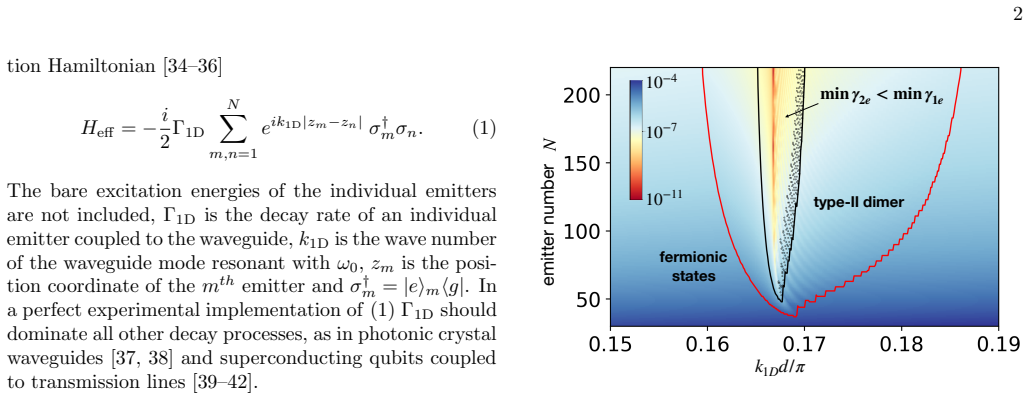
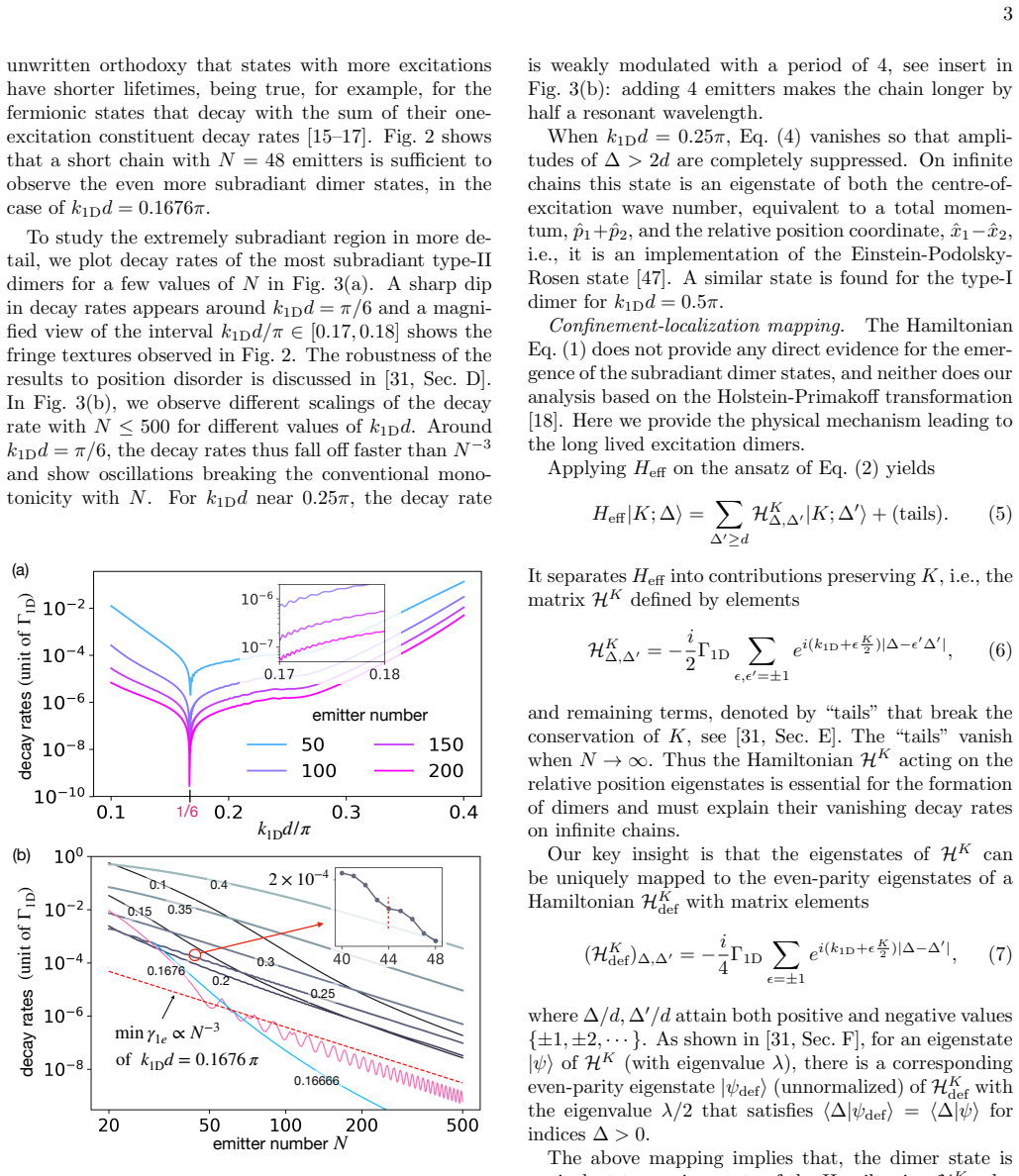
The paper establishes that the non-Hermitian Hamiltonian $H_{\mathrm{eff}} = -\frac{i}{2}\Gamma_{1\mathrm{D}}\sum_{m,n}e^{ik_{1\mathrm{D}}|z_m-z_n|}\sigma_m^\dagger\sigma_n$ has, in the two-excitation sector, two families of subradiant dimer eigenstates. Type-I dimers have center-of-mass wave number $K\approx0$ and dominant separation $\Delta=d$; type-II dimers have $K\approx\pi/d$ and dominant separation $\Delta=2d$. For infinite chains, these eigenvalues are real: $\omega_\mathrm{I}=2\Gamma_{1\mathrm{D}}\cot(k_{1\mathrm{D}}d)$ and $\omega_\mathrm{II}=2\Gamma_{1\mathrm{D}}\cot(2k_{1\mathrm{D}}d)$, with separation distributions $p_\mathrm{I}(\Delta)\propto(\cos k_{1\mathrm{D}}d)^{2\Delta/d}$ and $p_\mathrm{II}(\Delta)\propto(\cos2k_{1\mathrm{D}}d)^{\Delta/d}$ on even separations. On finite chains the decay rates are small but nonzero, and exact diagonalization shows that for $k_{1\mathrm{D}}d\simeq0.1676\pi$ a chain of $N=48$ emitters already supports a type-II dimer whose minimal decay rate is smaller than that of the most subradiant fermionic two-excitation state and of the most subradiant one-excitation state, whose rate at this spacing scales as $N^{-3}$.
Load-bearing premise
The central claim rests on the effective model in which the waveguide is eliminated to give emitters instantaneous, distance-dependent interactions and decay (the Born-Markov approximation with a linear dispersion); if non-Markovian retardation or band curvature is significant, the predicted vanishing dimer decay rates are not guaranteed.
Editorial extensions
If this is right
- A finite chain of about 50 emitters with spacing $k_{1\mathrm{D}}d\simeq0.1676\pi$ should already show a two-excitation state decaying more slowly than the best single-excitation state, giving an experimentally accessible signature of the effect.
- At $k_{1\mathrm{D}}d=\pi/6$ the type-II dimer decay rate dips sharply and falls faster than $N^{-3}$, so increasing chain length can produce a qualitatively stronger lifetime boost than the standard one-excitation scaling.
- At $k_{1\mathrm{D}}d=\pi/4$ the type-II dimer becomes an eigenstate of both total momentum and relative position, a travelling EPR-like two-excitation state with no amplitude for separations beyond $2d$.
- Because the mapping is linear, chains coupled to 3D free-space vacuum fields also support subradiant dimers; their decay rates remain finite in the infinite-chain limit but are strongly suppressed, for both transverse and parallel emitter polarizations.
- Proposed verification: excite emitters around a missing or suitably perturbed site to address the single-defect localized state, or use interactions to prepare correlated dimers; the long-lived state should survive as orthogonal modes decay.
Reading between the lines
- The defect picture suggests a direct experimental test of the mechanism: compare the decay of a single excitation next to a missing site with that of a dimer with the same effective separation; the mapping predicts matching exponential suppression governed by the shorter side of the chain.
- The sharp dip at $k_{1\mathrm{D}}d=\pi/6$ may reflect a commensurability between the dimer bond length and the resonant wavelength, so varying the chain length modulo four emitters (a half-wavelength) could be used to steer the decay rate in finite systems.
- If the confinement-localization equivalence holds in other lattice models with long-range hopping, two-particle bound states in cold-atom, ion, or Rydberg arrays might be designed to inherit defect-mode lifetimes, turning 'anti-blockade' into a resource rather than a loss channel.
- One could test the non-Markovian sensitivity by repeating the exact diagonalization with a finite-bandwidth waveguide dispersion; the dimer decay rates should generically acquire corrections, and the perfect subradiance at $k_{1\mathrm{D}}d=\pi/6$ would be the first quantity to move.
Signed reviews
Editorial analysis
A structured set of objections, weighed in public.
Referee Report
Summary. The manuscript studies two-excitation eigenstates of the effective non-Hermitian Hamiltonian (1) for a chain of two-level emitters coupled to a one-dimensional waveguide. It identifies two families of 'dimer' states, derives exponential separation distributions for their amplitudes, Eqs. (3) and (4), and shows that on infinite chains these states have real eigenvalues, i.e., vanishing decay rates. The authors also present a formal mapping between these confined dimer states and single-excitation states localized around an unoccupied defect site, and they extend the mapping to emitter chains coupled to the three-dimensional free-space field. For finite chains, numerical diagonalization of Heff shows that type-II dimer states can have decay rates below those of the most subradiant fermionic states and even below the most subradiant one-excitation states in a narrow parameter window around k1Dd ≈ 0.1676π, with unusual non-monotonic dependence on emitter number N.
Significance. If the central claims hold, this is a significant result: two-excitation subradiant states that outlive the best single-excitation states challenge a common expectation, and the confinement-localization mapping is elegant and potentially generalizable. The Letter is largely self-contained: the analytical expressions are derived from the stated Hamiltonian without fitted parameters and are compared with direct numerical diagonalization, and the finite-chain benchmark at k1Dd = 0.1676π is clearly identified. However, the infinite-chain claims currently rest on an incorrectly printed exponent and an unstated domain restriction, so the paper needs revision before the result can be fully assessed.
major comments (3)
- [Subradiant dimer excited states, Eq. (4)] The main-text expression qIId = [π + i ln cos(2k1Dd)]/2 has the wrong sign for the imaginary part. With this sign, |e^{iqII Δ/d}| = (cos 2k1Dd)^{-Δ/(2d)}, which grows with Δ and makes the type-II state non-normalizable. The supplemental expression qII = π − (i/2) ln cos(2k1Dd) repairs the sign and is consistent with the stated probability pII(Δ) ∝ (cos 2k1Dd)^{Δ/d}, but the printed main-text formula contradicts its own Eq. (4). This error is load-bearing because the exponential localization of the type-II dimer is the basis for the infinite-chain eigenvalue ωII = 2Γ1D cot(2k1Dd).
- [Subradiant dimer excited states and Figs. 2–3] The type-II ansatz with the real (cos 2k1Dd)^{Δ/d} weighting is defined only when cos(2k1Dd) > 0, i.e., 0 < k1Dd < π/4. The paper states the lattice domain as 0 < k1Dd < π/2 and plots type-II data up to k1Dd = 0.4π in Figs. 2 and 3, while the unqualified claim of perfectly subradiant dimers on infinite chains and the EPR discussion at k1Dd = 0.25π rely on the branch where cos(2k1Dd) < 0. The region k1Dd > π/4 must either be explicitly excluded from the infinite-chain analytical statements and the affected figure ranges, or a continuation analysis must be provided. As written, the statement that these dimers are perfectly subradiant on infinite chains is not supported in that region.
- [Confinement-localization mapping and Supplemental Sec. H] The equivalence H^{π/d}_{def}(k1Dd) ≅ H^{0}_{def}(2k1Dd) used to derive the type-II states inherits the same restriction on 2k1Dd. The supplemental derivation of qII and ωII is therefore valid only for 0 < k1Dd < π/4. The paper should state this restriction explicitly where the type-II asymptotic eigenvalue is quoted, since the unqualified 'vanishing decay rates on infinite chains' statement appears in the main text before the defect mapping is introduced.
minor comments (5)
- [Subradiant dimer excited states] In the sentence introducing Eq. (4), the prime on the summation is said to include only even values of Δ/d, but the notation is not defined until later; please define the prime explicitly at first use.
- [Fig. 2 caption] The caption reads 'emitter number' in the axis label; please write 'emitter number N' or simply 'N' to avoid ambiguity with the separation Δ.
- [References] Ref. [31] is cited as 'Supplemental Material' without an arXiv or journal anchor; please state where the supplement is available or include it as a clearly labelled appendix.
- [Conclusions] The phrase 'unwritten orthodoxy' is informal for a Letter; consider replacing it with 'common expectation' or 'common assumption'.
- [Spin Model, Eq. (1)] The right-hand side of Eq. (1) is an operator expression, but the ordering of σ_m^† and σ_n is conventional; please specify that this is the Born-Markov reduced Hamiltonian with normal ordering and state any sign convention explicitly.
Circularity Check
No significant circularity; the dimer states, their eigenvalues, and the confinement-localization mapping are derived from the effective Hamiltonian and checked against exact diagonalization.
full rationale
I walked the derivation chain from the effective Hamiltonian Heff (Eq. 1) through the dimer ansatze and the confinement-localization mapping. The type-I and type-II wave vectors qI and qII are not fitted or renamed inputs; they are obtained by solving the eigenvector condition derived in Supplement B, where Eq. (3) yields q = -i ln cos(k1Dd) and the analogous type-II solution is obtained by the same construction. These analytical expressions are then compared with exact numerical diagonalization, so the comparison is not circular. The mapping from HK to H^K_def is proved algebraically in Supplement F rather than assumed, and the resulting equivalence is used to explain, not to define, the dimer states. Reference [18] is self-cited but is used for context and for the fermionic-state comparison and the 3D free-space kernel; it does not supply the dimer wavefunctions or eigenvalues, and the paper explicitly notes that the Holstein-Primakoff analysis of [18] does not reveal the dimer mechanism. There are no fitted parameters, and no 'prediction' is constructed from the quantity it claims to predict. The possible domain restriction for type-II states when cos(2k1Dd) < 0 is a mathematical correctness caveat, not a circularity, and does not affect the circularity score.
Assumptions & free parameters
assumptions (4)
- domain assumption Born-Markov approximation and adiabatic elimination of the waveguide modes yield the non-Hermitian spin Hamiltonian Eq. (1).
- domain assumption The waveguide modes have a linear dispersion, so the interaction phase is e^{i k1D |z_m - z_n|}.
- standard math In the infinite-chain limit, the 'tails' in Eq. (5) vanish, so H_K fully determines the two-excitation eigenstates for a given center-of-mass wave number K.
- standard math The localized ansatz with positive imaginary part for q, leading to e^{iqNd} ≈ 0 for large N, gives the correct bound-state solution.
Cite this review
Pith. "Pith review of Subradiant Dimer Excitations of Emitter Chains Coupled to a 1D Waveguide." pith.science (2026). https://pith.science/paper/2Y7QEPZG
@misc{pith2026190801818,
  author       = {Pith},
  title        = {Pith review of: Subradiant Dimer Excitations of Emitter Chains Coupled to a 1D Waveguide},
  year         = {2026},
  howpublished = {\url{https://pith.science/paper/2Y7QEPZG}},
  note         = {Machine review of arXiv:1908.01818}
}
read the original abstract
This Letter shows that chains of optical or microwave emitters coupled to a 1D waveguide support subradiant states with close pairs of excited emitters, which have longer lifetimes than even the most subradiant states with only a single excitation. Exact, analytical expressions for non-radiative excitation dimer states are obtained in the limit of infinite chains. To understand the mechanism underlying these states, we present a formal equivalence between subradiant dimers and single localized excitations around a chain defect (unoccupied site). Our analytical mapping permits extension to emitter chains coupled to the 3D free space vacuum field.
Figures

Figures from the paper (7 more)



Forward citations
Cited by 1 Pith paper
-
Inelastic scattering of photon pairs in qubit arrays with subradiant states
Photon-pair scattering in qubit arrays is resonantly enhanced at double-excited subradiant states, and newly identified twilight states generate long-lived photon-photon correlations.
Reference graph
Works this paper leans on
-
[18]
Zhang and K
Y.-X. Zhang and K. Mølmer, Phys. Rev. Lett. 122, 203605 (2019)
2019
-
[1]
R. H. Dicke, Phys. Rev. 93, 99 (1954)
1954
-
[2]
Guerin, M
W. Guerin, M. O. Ara´ ujo, and R. Kaiser, Phys. Rev. Lett. 116, 083601 (2016)
2016
- [3]
-
[4]
S. D. Jenkins, J. Ruostekoski, N. Papasimakis, S. Savo, and N. I. Zheludev, Phys. Rev. Lett. 119, 053901 (2017)
work page 2017
-
[5]
V. Paulisch, H. Kimble, and A. Gonz´ alez-Tudela, New J. Phys. 18, 043041 (2016)
work page 2016
-
[6]
H. R. Haakh, S. Faez, and V. Sandoghdar, Phys. Rev. A 94, 053840 (2016)
work page 2016
-
[7]
Ruostekoski and J
J. Ruostekoski and J. Javanainen, Phys. Rev. Lett. 117, 143602 (2016)
2016
Show all 50 references
-
[8]
Ruostekoski and J
J. Ruostekoski and J. Javanainen, Phys. Rev. A 96, 033857 (2017)
2017
-
[9]
Zoubi, Phys
H. Zoubi, Phys. Rev. A 89, 043831 (2014)
2014
-
[10]
D. F. Kornovan, A. S. Sheremet, and M. I. Petrov, Phys. Rev. B 94, 245416 (2016)
2016
-
[11]
R. T. Sutherland and F. Robicheaux, Phys. Rev. A 94, 013847 (2016)
2016
-
[12]
Olmos, D
B. Olmos, D. Yu, Y. Singh, F. Schreck, K. Bongs, and I. Lesanovsky, Phys. Rev. Lett. 110, 143602 (2013)
2013
-
[13]
R. J. Bettles, S. A. Gardiner, and C. S. Adams, Phys. Rev. A 94, 043844 (2016)
2016
-
[14]
H. H. Jen, M.-S. Chang, and Y.-C. Chen, Phys. Rev. A 94, 013803 (2016)
2016
-
[15]
Asenjo-Garcia, M
A. Asenjo-Garcia, M. Moreno-Cardoner, A. Albrecht, H. J. Kimble, and D. E. Chang, Phys. Rev. X 7, 031024 (2017)
2017
-
[16]
Albrecht, L
A. Albrecht, L. Henriet, A. Asenjo-Garcia, P. B. Dieterle, O. Painter, and D. E. Chang, New J. Phys. 21, 025003 (2019)
2019
-
[17]
Henriet, J
L. Henriet, J. S. Douglas, D. E. Chang, and A. Albrecht, Phys. Rev. A 99, 023802 (2019)
2019
-
[19]
Solano, P
P. Solano, P. Barberis-Blostein, F. K. Fatemi, L. A. Orozco, and S. L. Rolston, Nat. Commun. 8, 1857 (2017)
2017
- [20]
-
[21]
D. F. Kornovan, N. V. Corzo, J. Laurat, and A. S. Sheremet, arXiv:1906.07423
1906 arXiv
- [22]
-
[23]
B. X. Wang and C. Y. Zhao, Phys. Rev. A 98, 023808 (2018)
2018
-
[24]
Perczel, J
J. Perczel, J. Borregaard, D. E. Chang, H. Pichler, S. F. Yelin, P. Zoller, and M. D. Lukin, Phys. Rev. Lett. 119, 023603 (2017)
2017
-
[25]
Facchinetti, S
G. Facchinetti, S. D. Jenkins, and J. Ruostekoski, Phys. Rev. Lett. 117, 243601 (2016)
2016
-
[26]
Guimond, A
P.-O. Guimond, A. Grankin, D. V. Vasilyev, B. Vermer- sch, and P. Zoller, Phys. Rev. Lett. 122, 093601 (2019)
2019
-
[27]
J. A. Needham, I. Lesanovsky, and B. Olmos, arXiv:1905.00508
1905 arXiv
-
[28]
Moreno-Cardoner, D
M. Moreno-Cardoner, D. Plankensteiner, L. Ostermann, D. E. Chang, and H. Ritsch, Phys. Rev. A 100, 023806 (2019)
2019
-
[29]
P. S. Lee and Y. C. Lee, Phys. Rev. A 8, 1727 (1973)
1973
-
[30]
Porras and J
D. Porras and J. I. Cirac, Phys. Rev. A78, 053816 (2008)
2008
-
[31]
Supplemental Material
-
[32]
This is reminiscent of the recent theoretical discovery of a range of different power law dependences of the decay rates of single excitation states for very specific values of the atomic distances [21]
-
[33]
H. T. Dung, L. Kn¨ oll, and D.-G. Welsch, Phys. Rev. A 66, 063810 (2002)
2002
-
[34]
D. E. Chang, L. Jiang, A. Gorshkov, and H. Kimble, New J. Phys. 14, 063003 (2012)
2012
-
[35]
Caneva, M
T. Caneva, M. T. Manzoni, T. Shi, J. S. Douglas, J. I. Cirac, and D. E. Chang, New J. Phys. 17, 113001 (2015)
2015
-
[36]
D. Roy, C. M. Wilson, and O. Firstenberg, Rev. Mod. Phys. 89, 021001 (2017)
2017
-
[37]
X. Zang, J. Yang, R. Faggiani, C. Gill, P. G. Petrov, J.- P. Hugonin, K. Vynck, S. Bernon, P. Bouyer, V. Boyer, and P. Lalanne, Phys. Rev. Applied 5, 024003 (2016)
2016
-
[38]
D. E. Chang, J. S. Douglas, A. Gonz´ alez-Tudela, C.-L. Hung, and H. J. Kimble, Rev. Mod. Phys. 90, 031002 (2018)
2018
-
[39]
Astafiev, A
O. Astafiev, A. Zagoskin, A. Abdumalikov, Y. Pashkin, T. Yamamoto, K. Inomata, Y. Nakamura, and J. Tsai, Science 327, 840 (2010)
2010
-
[40]
I.-C. Hoi, C. M. Wilson, G. Johansson, T. Palomaki, B. Peropadre, and P. Delsing, Phys. Rev. Lett. 107, 073601 (2011)
2011
-
[41]
A. F. Van Loo, A. Fedorov, K. Lalumi` ere, B. C. Sanders, A. Blais, and A. Wallraff, Science 342, 1494 (2013)
2013
-
[42]
Mirhosseini, E
M. Mirhosseini, E. Kim, X. Zhang, A. Sipahigil, P. B. Dieterle, A. J. Keller, A. Asenjo-Garcia, D. E. Chang, and O. Painter, Nature 569, 692 (2019)
2019
-
[43]
Mølmer, Y
K. Mølmer, Y. Castin, and J. Dalibard, J. Opt. Soc. Am. B 10, 524 (1993)
1993
-
[44]
Hernandez, J
V. Hernandez, J. E. Roman, and V. Vidal, ACM Trans. Math. Software 31, 351 (2005)
2005
-
[45]
Stewart, SIAM J
G. Stewart, SIAM J. Matrix Anal. Appl. 23, 601 (2002)
2002
-
[46]
Saad, Numerical Methods for Large Eigenvalue Prob- lems (Society for Industrial and Applied Mathematics, 2011)
Y. Saad, Numerical Methods for Large Eigenvalue Prob- lems (Society for Industrial and Applied Mathematics, 2011)
2011
-
[47]
Einstein, B
A. Einstein, B. Podolsky, and N. Rosen, Phys. Rev. 47, 6 777 (1935)
1935
-
[48]
J. S. Douglas, T. Caneva, and D. E. Chang, Phys. Rev. X 6, 031017 (2016)
2016
-
[49]
Gonz´ alez-Tudela, V
A. Gonz´ alez-Tudela, V. Paulisch, D. E. Chang, H. J. Kimble, and J. I. Cirac, Phys. Rev. Lett. 115, 163603 (2015)
2015
-
[50]
F. Liu, R. Lundgren, P. Titum, G. Pagano, J. Zhang, C. Monroe, and A. V. Gorshkov, Phys. Rev. Lett. 122, 150601 (2019). 7 SUPPLEMENTAL MATERIAL A. Distributions of the eigenvalues in the two-excitation sector The fermionic states and the dimers constitute all the subradiant st...
2019
Reviewed August 14, 2026 · model on record in the stance chip above.
Discussion (0). Continue with ORCID to comment.