REVIEW 3 major objections 4 minor 91 references
PrivDNN claims that encrypting only a small subset of a DNN's early convolution filters lets a model owner ship a secretly usable, partially encrypted model to clients, cutting private inference time and memory by up to 97% compared with fu
Reviewed by Pith at T0; open to challenge. T0 means a machine referee read the full paper against a public rubric. the ladder, T0–T4 →
T0 review · deepseek-v4-flash
2026-08-01 06:25 UTC pith:2YK372DX
load-bearing objection Solid systems work on filter selection under a broken privacy model: the client gets plaintext activations of the encrypted filters, so the headline claim doesn't hold. the 3 major comments →
PrivDNN: A Secure Multi-Party Computation Framework for Deep Learning using Partial DNN Encryption
The pith
A machine-rendered reading of the paper's core claim, the machinery that carries it, and where it could break.
Core claim
The paper's central claim is that a DNN can be shipped to a client in partially encrypted form—plaintext weights for most filters, homomorphically encrypted weights for a small subset of core filters—and still behave as a secure, usable classifier. The paper lays out two objectives: authorized accuracy A_s must stay close to the original A_o, and unauthorized accuracy A_r must fall far below A_o. It defines a quality score for choosing the core set, and shows with exhaustive ground truth on small networks that the greedy and pruning-then-greedy selection algorithms find top-ranked core sets. Across five datasets and four architectures, encrypting roughly 15–25% of the filters in the first tw
What carries the argument
The central mechanism is partial DNN encryption driven by core-neuron selection. Core neurons are the convolution filters designated for encryption; selection is guided by the quality score s = −sigmoid(A_o − A_s) + sigmoid((A_s − A_r)/5), which rewards small authorized loss and large unauthorized drop. The selection algorithms (greedy, and pruning-then-greedy using static filter-pruning criteria) produce the small filter subset; the encrypted subset is evaluated with an approximate homomorphic encryption scheme (CKKS) in the ciphertext domain, while the rest of the network runs in plaintext at the client. The paper also adds a server-side polymorphic obfuscation layer to resist weight-steal
Load-bearing premise
The model-privacy guarantee rests on the assumption that a client who receives decrypted intermediate activations from the encrypted core neurons on every authorized query still cannot recover the encrypted weights or rebuild an equivalent model, an attack that the paper's security analysis does not test.
What would settle it
A curious client who chooses inputs, receives the de-obfuscated plaintext outputs of the encrypted core neurons for each query, and solves a system of linear equations (or uses gradient-based inversion) to reproduce the encrypted filter weights would refute the privacy claim. The paper's Section 6.1 only tests the delete-and-retrain attack, so a successful activation-oracle extraction—even with fewer than 1,000 labeled samples—would be a concrete counterexample.
If this is right
- Private inference time and memory scale almost linearly with the fraction of encrypted filters, so choosing a small N_e (e.g., 15–25% of early-layer filters) yields an order-of-magnitude speedup while keeping A_s within about 1% of the original.
- Unauthorized users—including those who retrain the visible plaintext parts with up to 1,000 labeled samples—fail to reach the original model's accuracy; for large models with heavily encrypted early layers the recovered accuracy stays well below A_o.
- The approach is independent of the specific FHE scheme or DNN architecture, so any future improvement in homomorphic encryption or any new FHE-friendly network can be dropped into the same partial-encryption pipeline.
- The model owner can tune the number of encrypted filters to trade client-side compute against protection level, which the paper demonstrates by pushing A_r down to 1.01% on GTSRB and 2.50% on Tiny-ImageNet when encrypting only a small fraction of all convolution neurons.
Where Pith is reading between the lines
- The client receives the decrypted output of the encrypted core neurons on every authorized query (after de-obfuscation); this plaintext-activation oracle is not analyzed in the paper's security section, which only studies deleting the encrypted weights and retraining. A determined client could try to invert these activations to recover the encrypted filters—an attack the experiments do not rule ou
- The "core neuron" notion may transfer to other model families: attention heads or embedding dimensions in transformers might serve the same role as early convolution filters, offering a testable extension with a similar partial-encryption pipeline.
- Because the unauthorized-accuracy drop varies by dataset (recovery is notably easier on GTSRB, where classes are visually similar), the encryption budget should be tuned per task rather than fixed per architecture.
- The server-side obfuscation layer resists an all-1s weight-stealing query but does not address the honest-but-curious activation oracle; combining partial encryption with input- or activation-dependent noise could blunt that channel while preserving A_s.
Editorial analysis
A structured set of objections, weighed in public.
Referee Report
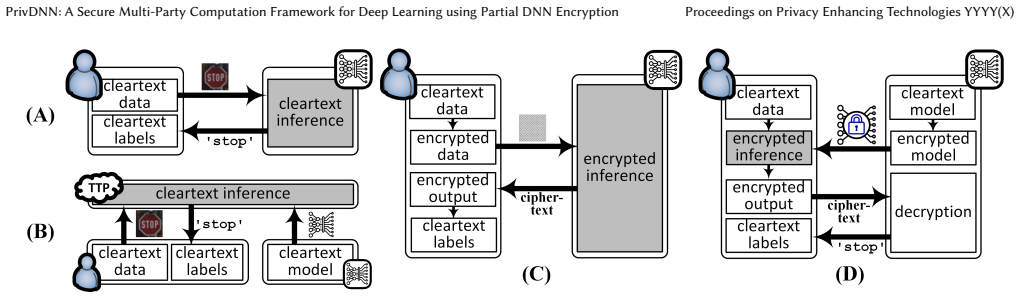
Summary. PrivDNN proposes a two-party framework for privacy-preserving DNN inference in which the server encrypts only a subset of 'core' filters and ships the partially encrypted model to the client. The client evaluates plaintext filters locally, computes the encrypted core filters with CKKS, sends the encrypted outputs to the server for decryption, receives and deobfuscates the plaintext results, and continues the forward pass in plaintext. The authors define a quality score s that trades off authorized accuracy A_s against unauthorized accuracy A_r, and propose random, greedy, pruning-based, and pruning+greedy algorithms for core-filter selection. Experiments on five datasets report A_s close to the original model accuracy while A_r is significantly lower, together with a 29.7x inference speedup over full-model FHE inference and large memory savings. The security analysis focuses on a model-recovery attack in which the client deletes the encrypted weights and retrains with 100–1000 labeled samples.
Significance. If the privacy claim held, this would be a practically relevant contribution: partial FHE encryption is a plausible efficiency direction, and the authors provide a credible experimental methodology. The exhaustive-search ground truth (Table 2), the greedy selection's near-optimal ranking (Table 3), and the operation-count analysis (Figure 5) are careful and useful, and code is promised. However, the central model-privacy claim is not supported. The protocol itself returns plaintext, de-obfuscated intermediate activations of the encrypted core neurons to the client, giving the client a chosen-input oracle for the FHE-encrypted subnetwork. The security analysis in §6.1 does not model this attack, so the headline deliverable—'ensures model accuracy and model privacy'—fails under the stated honest-but-curious adversary. The efficiency results may stand, but the privacy contribution is the core of the paper.
major comments (3)
- [§4.1 (Step B2), §3.2, §6.1] The protocol in Step B2 sends the encrypted core-neuron outputs to S for decryption, then returns them to C, who deobfuscates them. Under the honest-but-curious threat model (§3.2), C legitimately receives exact plaintext activations of the FHE-encrypted filters on every authorized query. This gives C a chosen-input oracle for the encrypted subnetwork. Because the encrypted neurons are linear convolutions (with square activation in the FHE-friendly design, §4.2), the client can solve a linear system for the encrypted filters or train a high-fidelity substitute model without any of S's proprietary data. The security analysis in §6.1 only considers deleting the encrypted weights and retraining with 100–1000 labeled samples; it never considers the oracle that the protocol itself provides. The §6.4 concession that 'more effective model recovery attacks may emerge' does not address this immed
- [§4.3, Eq. (1); Tables 2–6] The quality score s = −sigmoid(A_o−A_s) + sigmoid((A_s−A_r)/α) is exactly the objective maximized by the Greedy and Pruning+Greedy algorithms (Algorithms 2 and 4). Reporting large A_s−A_r gaps and high s values for the selected sets therefore partially restates the optimization objective as evidence of security. The exhaustive-search ground truth is a strong methodological contribution and shows the greedy selection tracks the optimum of s, but it validates only the proxy objective, not the privacy guarantee. The independent recovery-attack experiments (Table 7) are the right category of evidence, but they operate under a different attack model and, as noted above, omit the oracle attack.
- [§6.3, Figure 6] The server-side obfuscation layer proposed in §6.3 does not resolve the oracle problem. In the standard protocol (§4.1 B2), C deobfuscates the returned values herself, so she obtains exact activations. If server-side obfuscation is instead applied in the honest-but-curious setting, the client must still receive enough information to continue the forward pass; the paper does not specify how C inverts the server-side obfuscation, and if she cannot invert it, the protocol becomes a different interactive scheme that is not analyzed. In either reading, the security analysis in §6.1 does not cover the combination of decrypted core outputs with client-side deobfuscation, and the oracle persists.
minor comments (4)
- [§4.1 (Notation)] The sentence 'E_i^j and P_i^j together represent the j-th filter' is confusing; the notation should make clear that E_i and P_i are index sets partitioning the filters at layer i.
- [§4.3, Eq. (1)] The coefficient α=5 is chosen empirically, but no sensitivity analysis is reported. Since the selection algorithms optimize s, results for other α values would clarify how robust the selection quality is to this hyperparameter.
- [Tables 1 and 9] The dataset/model information is repeated in Table 1 and Table 9 with inconsistencies (e.g., GTSRB accuracy is listed as 93.51% in Table 1 but as 93.24% in the note to Table 6). Please unify the tables and correct the value.
- [§6.2] The claim that sample-inference attacks are 'highly challenging, if not impossible' is supported only by two empirical attack evaluations (Figures 8 and 9). A formal argument or a broader attack evaluation would be needed to substantiate this statement.
Circularity Check
Security metric s doubles as both the selection objective and the reported evidence, making the large A_s−A_r gap partly the optimization objective restated as a result.
specific steps
-
self definitional
[Section 4.3 (Eq. 1), Section 4.4 (Algorithm 2), Section 6.1 (Honest Data Owners)]
"The core neuron selection algorithms ensure that A_r is always much lower than A_s (accuracy for the authorized users). This is also demonstrated by experiments in Tables 5 and 6."
In Eq. (1), s is defined as −sigmoid(A_o−A_s)+sigmoid((A_s−A_r)/α), so the security goal G2 (large A_s−A_r) is built into s. Algorithm 2 then selects each core neuron by computing s_j and picking 'the neuron that produces the best s_j'. The §6.1 statement that the selection algorithms 'ensure that A_r is always much lower than A_s' and the Tables 5/6 accuracy gaps are therefore the maximized objective reported as an achieved security property, not an independent consequence. The A_s/A_r values themselves are measured, and the exhaustive-search ground truth and recovery-attack (A_rec) results provide independent support, so the circularity is partial.
full rationale
The paper's efficiency and accuracy claims are not circular: the 29.7x speedup and 97% memory savings are computed from measured ciphertext/plaintext operation distributions and concrete inference times, independent of the selection objective. The core-neuron-selection algorithms are also evaluated against a real exhaustive-search ground truth (Table 2), and the model-recovery attack experiments (Table 7) provide an external, behavior-based check on whether the encrypted parameters are useful to an attacker. Those elements give the central empirical claims genuine content. The main circularity is narrower but real: the security objective s in Eq. (1) is exactly the quantity the greedy and pruning+greedy selection algorithms maximize (Algorithm 2 and Algorithm 4), and the paper then uses the resulting A_s and A_r values as evidence that the selection 'ensures' A_r << A_s. Thus the headline privacy gap is partly the optimization objective restated as a measured outcome. This is not a complete definitional collapse, because the actual accuracies after removing selected filters are computed rather than assumed, and the exhaustive search shows that not all selections achieve the reported gap. The security analysis does not model the chosen-input oracle created by §4.1 B2, where the client receives decrypted intermediate activations of the encrypted core filters; that is a security-modeling gap rather than a circularity, so it does not further raise the circularity score. No load-bearing self-citation or imported uniqueness theorem appears. Overall, the partial conflation of objective and evidence warrants a score of 4.
Axiom & Free-Parameter Ledger
free parameters (4)
- alpha (α) in quality score =
5
- p in Pruning+Greedy selection pool size =
2
- Core-neuron counts/ratios n_i1 per layer =
15%-100% of first two conv layers in experiments
- CKKS parameter instance =
not reported
axioms (6)
- domain assumption Hardness of Ring-LWE and security of the CKKS FHE scheme
- domain assumption Honest-but-curious (semi-honest) parties
- domain assumption Client does not possess the server's proprietary training data
- ad hoc to paper Model privacy can be operationalized as a gap between authorized and unauthorized accuracy (A_s vs A_r)
- ad hoc to paper Returning decrypted intermediate outputs to the client is harmless
- domain assumption FHE-friendly square/linear activations preserve enough accuracy
invented entities (2)
-
Core neuron selection (subset of filters designated as 'core')
no independent evidence
-
Server-side polymorphic obfuscation layer
no independent evidence
Cite this review
Pith. "Pith review of PrivDNN: A Secure Multi-Party Computation Framework for Deep Learning using Partial DNN Encryption." pith.science (2026). https://pith.science/paper/2YK372DX
@misc{pith2026260721895,
  author       = {Pith},
  title        = {Pith review of: PrivDNN: A Secure Multi-Party Computation Framework for Deep Learning using Partial DNN Encryption},
  year         = {2026},
  howpublished = {\url{https://pith.science/paper/2YK372DX}},
  note         = {Machine review of arXiv:2607.21895}
}
read the original abstract
In the past decade, we have witnessed an exponential growth of deep learning models, platforms, and applications. While existing DL applications and Machine Learning as a service (MLaaS) frameworks assume fully trusted models, the need for privacy-preserving DNN evaluation arises. In a secure multi-party computation scenario, both the model and the data are considered proprietary, i.e., the model owner does not want to reveal the highly valuable DL model to the user, while the user does not wish to disclose their private data samples either. Conventional privacy-preserving deep learning solutions ask the users to send encrypted samples to the model owners, who must handle the heavy lifting of ciphertext-domain computation with homomorphic encryption. In this paper, we present a novel solution, namely, PrivDNN, which (1) offloads the computation to the user side by sharing an encrypted deep learning model with them, (2) significantly improves the efficiency of DNN evaluation using partial DNN encryption, (3) ensures model accuracy and model privacy using a core neuron selection and encryption scheme. Experimental results show that PrivDNN reduces privacy-preserving DNN inference time and memory requirement by up to 97% while maintaining model performance and privacy. Codes can be found at https://github.com/LiangqinRen/PrivDNN
Figures


Reference graph
Works this paper leans on
-
[1]
Ahmad Al Badawi, Chao Jin, Jie Lin, Chan Fook Mun, Sim Jun Jie, Benjamin Hong Meng Tan, Xiao Nan, Khin Mi Mi Aung, and Vijay Ramaseshan Chan- drasekhar. 2020. Towards the alexnet moment for homomorphic encryption: Hcnn, the first homomorphic cnn on encrypted data with gpus.IEEE Transactions on Emerging Topics in Computing9, 3 (2020), 1330–1343
2020
-
[2]
Mohammad Al-Rubaie and J Morris Chang. 2019. Privacy-preserving machine learning: Threats and solutions.IEEE Security & Privacy17, 2 (2019), 49–58
2019
-
[3]
Frederik Armknecht, Colin Boyd, Christopher Carr, Kristian Gjosteen, Angela Jäschke, Christian A Reuter, and Martin Strand. 2015. A guide to fully homomor- phic encryption.Cryptology ePrint Archive(2015)
2015
-
[4]
Raphael Bost, Raluca Ada Popa, Stephen Tu, and Shafi Goldwasser. 2014. Machine learning classification over encrypted data.Cryptology ePrint Archive(2014)
2014
-
[5]
Florian Bourse, Michele Minelli, Matthias Minihold, and Pascal Paillier. 2018. Fast homomorphic evaluation of deep discretized neural networks. In38th Annual International Cryptology Conference (CRYPTO). Springer, 483–512
2018
-
[6]
Zvika Brakerski, Craig Gentry, and Vinod Vaikuntanathan. 2014. (Leveled) fully homomorphic encryption without bootstrapping.ACM Transactions on Computation Theory (TOCT)6, 3 (2014), 1–36
2014
-
[7]
Alon Brutzkus, Ran Gilad-Bachrach, and Oren Elisha. 2019. Low latency privacy preserving inference. InInternational Conference on Machine Learning. PMLR, 812–821
2019
-
[8]
Linhang Cai, Zhulin An, Chuanguang Yang, Yangchun Yan, and Yongjun Xu
-
[9]
Hervé Chabanne, Amaury De Wargny, Jonathan Milgram, Constance Morel, and Emmanuel Prouff. 2017. Privacy-preserving classification on deep neural network.Cryptology ePrint Archive(2017)
2017
-
[10]
Varun Chandrasekaran, Kamalika Chaudhuri, Irene Giacomelli, Somesh Jha, and Songbai Yan. 2020. Exploring connections between active learning and model extraction. In29th USENIX Security Symposium (USENIX Security 20). 1309–1326
2020
-
[11]
Shuangshuang Chen and Wei Guo. 2023. Auto-Encoders in Deep Learning—A Review with New Perspectives.Mathematics11, 8 (2023), 1777
2023
-
[12]
Jung Hee Cheon, Andrey Kim, Miran Kim, and Yongsoo Song. 2017. Homo- morphic encryption for arithmetic of approximate numbers. InInternational Conference on the Theory and Applications of Cryptology and Information Security (ASIACRYPT). Springer, 409–437
2017
-
[13]
Edward Chou, Josh Beal, Daniel Levy, Serena Yeung, Albert Haque, and Li Fei-Fei
-
[14]
Gregory Cohen, Saeed Afshar, Jonathan Tapson, and Andre Van Schaik. 2017. EM- NIST: Extending MNIST to handwritten letters. InInternational joint conference on neural networks (IJCNN). IEEE, 2921–2926
2017
-
[15]
Jack LH Crawford, Craig Gentry, Shai Halevi, Daniel Platt, and Victor Shoup
-
[16]
Roshan Dathathri, Olli Saarikivi, Hao Chen, Kim Laine, Kristin Lauter, Saeed Maleki, Madanlal Musuvathi, and Todd Mytkowicz. 2019. CHET: an optimizing compiler for fully-homomorphic neural-network inferencing. InACM PLDI. 142– 156
2019
-
[17]
Jia Deng, Wei Dong, Richard Socher, Li-Jia Li, Kai Li, and Li Fei-Fei. 2009. Imagenet: A large-scale hierarchical image database. In2009 IEEE conference on computer vision and pattern recognition. Ieee, 248–255
2009
-
[18]
InProceedings of the 6th Workshop on Encrypted Computing & Applied Homomorphic Cryptography
Doing real work with FHE: the case of logistic regression. InProceedings of the 6th Workshop on Encrypted Computing & Applied Homomorphic Cryptography. 1–12
-
[19]
Emily L Denton, Wojciech Zaremba, Joan Bruna, Yann LeCun, and Rob Fergus
-
[20]
Danny Dolev and Andrew Yao. 1983. On the security of public key protocols. IEEE Transactions on information theory29, 2 (1983), 198–208
1983
-
[21]
Li Deng. 2012. The mnist database of handwritten digit images for machine learning research.IEEE Signal Processing Magazine29, 6 (2012), 141–142
2012
-
[22]
Abigail English and Carol A. Ford. 2004. The HIPAA Privacy Rule and Adolescents: Legal Questions and Clinical Challenges.Perspectives on Sexual and Reproductive Health36, 2 (2004), 80–86. http://www.jstor.org/stable/3181198
arXiv 2004
-
[23]
Ege Erdoğan, Alptekin Küpçü, and A Ercüment Çiçek. 2022. Unsplit: Data- oblivious model inversion, model stealing, and label inference attacks against split learning. InProceedings of the 21st Workshop on Privacy in the Electronic Society. 115–124
2022
-
[24]
Junfeng Fan and Frederik Vercauteren. 2012. Somewhat practical fully homomor- phic encryption.Cryptology ePrint Archive(2012)
2012
-
[25]
Wenliang Du and Mikhail J Atallah. 2001. Secure multi-party computation problems and their applications: a review and open problems. InProceedings of the 2001 workshop on New security paradigms. 13–22
2001
-
[26]
Ran Gilad-Bachrach, Nathan Dowlin, Kim Laine, Kristin Lauter, Michael Naehrig, and John Wernsing. 2016. Cryptonets: Applying neural networks to encrypted data with high throughput and accuracy. InInternational conference on machine learning. PMLR, 201–210
2016
-
[27]
Xavier Glorot, Antoine Bordes, and Yoshua Bengio. 2011. Deep sparse rectifier neural networks. InProceedings of the fourteenth international conference on artificial intelligence and statistics. JMLR Workshop and Conference Proceedings, 315–323
2011
-
[28]
2009.Foundations of cryptography: volume 2, basic applications
Oded Goldreich. 2009.Foundations of cryptography: volume 2, basic applications. Cambridge university press
2009
-
[29]
Craig Gentry. 2009. Fully homomorphic encryption using ideal lattices. InProceed- ings of the forty-first annual ACM symposium on Theory of computing. 169–178
2009
-
[30]
Jun Han and Claudio Moraga. 1995. The influence of the sigmoid function parameters on the speed of backpropagation learning. InFrom Natural to Artificial Neural Computation: International Workshop on Artificial Neural Networks. 195– 201
1995
-
[31]
Song Han, Jeff Pool, John Tran, and William Dally. 2015. Learning both weights and connections for efficient neural network.Advances in neural information processing systems28 (2015)
2015
-
[32]
Kaiming He, Xiangyu Zhang, Shaoqing Ren, and Jian Sun. 2016. Deep residual learning for image recognition. InProceedings of the IEEE conference on computer vision and pattern recognition. 770–778
2016
-
[33]
Rafael Rodrigo Guillén, Higinio Mora Mora, and Jorge Azorín-López. 2022. A Review of Deep Learning Methods for Detection of Gatherings and Abnormal Events for Public Security. InInternational Conference on Ubiquitous Computing and Ambient Intelligence. Springer, 809–814
2022
-
[34]
Yang He, Ping Liu, Ziwei Wang, Zhilan Hu, and Yi Yang. 2019. Filter pruning via geometric median for deep convolutional neural networks acceleration. InCVPR. 4340–4349
2019
-
[35]
Yang He and Lingao Xiao. 2023. Structured Pruning for Deep Convolutional Neural Networks: A survey.arXiv preprint arXiv:2303.00566(2023)
Pith/arXiv arXiv 2023
-
[36]
Ehsan Hesamifard, Hassan Takabi, and Mehdi Ghasemi. 2017. Cryptodl: Deep neural networks over encrypted data.arXiv preprint arXiv:1711.05189(2017)
Pith/arXiv arXiv 2017
-
[37]
Yang He, Guoliang Kang, Xuanyi Dong, Yanwei Fu, and Yi Yang. 2018. Soft filter pruning for accelerating deep convolutional neural networks.arXiv preprint arXiv:1808.06866(2018)
Pith/arXiv arXiv 2018
-
[38]
Sebastian Houben, Johannes Stallkamp, Jan Salmen, Marc Schlipsing, and Chris- tian Igel. 2013. Detection of Traffic Signs in Real-World Images: The German Traffic Sign Detection Benchmark. InInternational Joint Conference on Neural Networks
2013
-
[39]
Xing Hu, Ling Liang, Shuangchen Li, Lei Deng, Pengfei Zuo, Yu Ji, Xinfeng Xie, Yufei Ding, Chang Liu, Timothy Sherwood, et al. 2020. Deepsniffer: A dnn model extraction framework based on learning architectural hints. InProceedings of the Twenty-Fifth International Conference on Architectural Support for Programming Languages and Operating Systems. 385–399
2020
-
[40]
Zehao Huang and Naiyan Wang. 2018. Data-driven sparse structure selection for deep neural networks. InProceedings of the European conference on computer vision (ECCV). 304–320
2018
-
[41]
Sanghyun Hong, Michael Davinroy, Yigitcan Kaya, Stuart Nevans Locke, Ian Rackow, Kevin Kulda, Dana Dachman-Soled, and Tudor Dumitras. 2018. Security analysis of deep neural networks operating in the presence of cache side-channel attacks. CoRR abs/1810.03487 (2018).arXiv preprint arXiv:1810.03487(2018)
Pith/arXiv arXiv 2018
-
[42]
Takumi Ishiyama, Takuya Suzuki, and Hayato Yamana. 2020. Highly accurate CNN inference using approximate activation functions over homomorphic en- cryption. InIEEE International Conference on Big Data (Big Data). 3989–3995
2020
-
[43]
Nayna Jain, Karthik Nandakumar, Nalini Ratha, Sharath Pankanti, and Uttam Kumar. 2021. Efficient CNN building blocks for encrypted data.arXiv preprint arXiv:2102.00319(2021)
Pith/arXiv arXiv 2021
-
[44]
Mika Juuti, Sebastian Szyller, Samuel Marchal, and N Asokan. 2019. PRADA: protecting against DNN model stealing attacks. In2019 IEEE European Symposium on Security and Privacy (EuroS&P). IEEE, 512–527
2019
-
[45]
Alberto Ibarrondo and Melek Önen. 2018. Fhe-compatible batch normalization for privacy preserving deep learning. InESORICS Workshops on Data Privacy Management, Cryptocurrencies and Blockchain Technology. 389–404
2018
-
[46]
Justin Ker, Lipo Wang, Jai Rao, and Tchoyoson Lim. 2017. Deep learning applica- tions in medical image analysis.Ieee Access6 (2017), 9375–9389
2017
-
[47]
Alex Krizhevsky, Geoffrey Hinton, et al. 2009. Learning multiple layers of features from tiny images. (2009)
2009
-
[48]
Alex Krizhevsky, Ilya Sutskever, and Geoffrey E Hinton. 2017. Imagenet classi- fication with deep convolutional neural networks.Commun. ACM60, 6 (2017), 84–90
2017
-
[49]
Barry L Kalman and Stan C Kwasny. 1992. Why tanh: choosing a sigmoidal function. InInternational Joint Conference on Neural Networks, Vol. 4. IEEE, 578– 581. 14 PrivDNN: A Secure Multi-Party Computation Framework for Deep Learning using Partial DNN Encryption Proceedings on Privacy Enhancing Technologies YYYY(X)
1992
-
[50]
Yann LeCun, John Denker, and Sara Solla. 1989. Optimal brain damage.Advances in neural information processing systems2 (1989)
1989
-
[51]
Joon-Woo Lee, Hyungchul Kang, Yongwoo Lee, Woosuk Choi, Jieun Eom, Maxim Deryabin, Eunsang Lee, Junghyun Lee, Donghoon Yoo, Young-Sik Kim, and Jong- Seon No. 2022. Privacy-Preserving Machine Learning With Fully Homomorphic Encryption for Deep Neural Network.IEEE Access10 (2022), 30039–30054
2022
-
[52]
Hao Li, Asim Kadav, Igor Durdanovic, Hanan Samet, and Hans Peter Graf. 2016. Pruning filters for efficient convnets.arXiv preprint arXiv:1608.08710(2016)
Pith/arXiv arXiv 2016
-
[53]
Yann LeCun, Léon Bottou, Yoshua Bengio, and Patrick Haffner. 1998. Gradient- based learning applied to document recognition.Proc. IEEE86, 11 (1998), 2278– 2324
1998
-
[54]
Ji Lin, Yongming Rao, Jiwen Lu, and Jie Zhou. 2017. Runtime neural pruning. Advances in neural information processing systems30 (2017)
2017
-
[55]
Mingbao Lin, Rongrong Ji, Yan Wang, Yichen Zhang, Baochang Zhang, Yonghong Tian, and Ling Shao. 2020. Hrank: Filter pruning using high-rank feature map. InCVPR. 1529–1538
2020
-
[56]
Zhuang Liu, Mingjie Sun, Tinghui Zhou, Gao Huang, and Trevor Darrell. 2018. Rethinking the value of network pruning.arXiv preprint arXiv:1810.05270(2018)
Pith/arXiv arXiv 2018
-
[57]
Shutao Li, Weiwei Song, Leyuan Fang, Yushi Chen, Pedram Ghamisi, and Jon Atli Benediktsson. 2019. Deep learning for hyperspectral image classification: An overview.IEEE Transactions on Geoscience and Remote Sensing57, 9 (2019), 6690–6709
2019
-
[58]
Shervin Minaee, Yuri Boykov, Fatih Porikli, Antonio Plaza, Nasser Kehtarnavaz, and Demetri Terzopoulos. 2021. Image segmentation using deep learning: A survey.IEEE transactions on pattern analysis and machine intelligence44, 7 (2021), 3523–3542
2021
-
[59]
Mohammed Ali mnmoustafa. 2017. Tiny ImageNet. https://kaggle.com/ competitions/tiny-imagenet
2017
-
[60]
Jianjun Ni, Yinan Chen, Yan Chen, Jinxiu Zhu, Deena Ali, and Weidong Cao
-
[61]
Daniel Lowd and Christopher Meek. 2005. Adversarial learning. InProceedings of the eleventh ACM SIGKDD international conference on Knowledge discovery in data mining. 641–647
2005
-
[62]
Daryna Oliynyk, Rudolf Mayer, and Andreas Rauber. 2023. I know what you trained last summer: A survey on stealing machine learning models and defences. Comput. Surveys(2023)
2023
-
[63]
Tribhuvanesh Orekondy, Bernt Schiele, and Mario Fritz. 2019. Knockoff nets: Stealing functionality of black-box models. InProceedings of the IEEE/CVF confer- ence on computer vision and pattern recognition. 4954–4963
2019
-
[64]
Ahmet Murat Ozbayoglu, Mehmet Ugur Gudelek, and Omer Berat Sezer. 2020. Deep learning for financial applications: A survey.Applied Soft Computing93 (2020), 106384
2020
-
[65]
Soham Pal, Yash Gupta, Aditya Shukla, Aditya Kanade, Shirish Shevade, and Vinod Ganapathy. 2020. Activethief: Model extraction using active learning and unannotated public data. InProceedings of the AAAI Conference on Artificial Intelligence, Vol. 34. 865–872
2020
-
[66]
Srinath Obla, Xinghan Gong, Asma Aloufi, Peizhao Hu, and Daniel Takabi. 2020. Effective Activation Functions for Homomorphic Evaluation of Deep Neural Networks.IEEE Access8 (2020), 153098–153112
2020
-
[67]
Prajit Ramachandran, Barret Zoph, and Quoc V Le. 2017. Searching for activation functions.arXiv preprint arXiv:1710.05941(2017)
Pith/arXiv arXiv 2017
-
[68]
Robert Nikolai Reith, Thomas Schneider, and Oleksandr Tkachenko. 2019. Effi- ciently stealing your machine learning models. InProceedings of the 18th ACM Workshop on Privacy in the Electronic Society. 198–210
2019
-
[69]
Ronald L Rivest, Len Adleman, Michael L Dertouzos, et al. 1978. On data banks and privacy homomorphisms.Foundations of secure computation4, 11 (1978), 169–180
1978
-
[70]
Victor Sanh, Thomas Wolf, and Alexander Rush. 2020. Movement pruning: Adaptive sparsity by fine-tuning.Advances in Neural Information Processing Systems33 (2020), 20378–20389
2020
-
[71]
Li Pengcheng, Jinfeng Yi, and Lijun Zhang. 2018. Query-efficient black-box attack by active learning. In2018 IEEE International Conference on Data Mining (ICDM). IEEE, 1200–1205
2018
-
[72]
Microsoft SEAL (release 4.0)
SEAL 2022. Microsoft SEAL (release 4.0). https://github.com/Microsoft/SEAL. Microsoft Research, Redmond, WA
2022
-
[73]
Dinggang Shen, Guorong Wu, and Heung-Il Suk. 2017. Deep learning in medical image analysis.Annual review of biomedical engineering19 (2017), 221–248
2017
-
[74]
Li Shen, Laurie R Margolies, Joseph H Rothstein, Eugene Fluder, Russell McBride, and Weiva Sieh. 2019. Deep learning to improve breast cancer detection on screening mammography.Scientific reports9, 1 (2019), 12495
2019
-
[75]
Karen Simonyan and Andrew Zisserman. 2014. Very deep convolutional networks for large-scale image recognition.arXiv preprint arXiv:1409.1556(2014)
Pith/arXiv arXiv 2014
-
[76]
Sunandini Sanyal, Sravanti Addepalli, and R Venkatesh Babu. 2022. Towards data-free model stealing in a hard label setting. InProceedings of the IEEE/CVF Conference on Computer Vision and Pattern Recognition. 15284–15293
2022
-
[77]
Jinjiang Wang, Yulin Ma, Laibin Zhang, Robert X Gao, and Dazhong Wu. 2018. Deep learning for smart manufacturing: Methods and applications.Journal of manufacturing systems48 (2018), 144–156
2018
-
[78]
Mengjia Yan, Christopher W Fletcher, and Josep Torrellas. 2020. Cache telepathy: Leveraging shared resource attacks to learn{DNN} architectures. In29th USENIX Security Symposium (USENIX Security 20). 2003–2020
2020
-
[79]
Andrew C Yao. 1982. Protocols for secure computations. In23rd annual sympo- sium on foundations of computer science (sfcs 1982). IEEE, 160–164
1982
-
[80]
Mao Ye, Chengyue Gong, Lizhen Nie, Denny Zhou, Adam Klivans, and Qiang Liu
discussion (0)
Sign in with ORCID, Apple, or X to comment. Anyone can read and Pith papers without signing in.