REVIEW 4 major objections 5 minor 1 cited by
Interface evolution in the two-dimensional quantum Ising model
T0 review · 4 major / 5 minor · reviewed 2026-08-01 · deepseek-v4-flash
Pith's one-line read At large times in the rough phase of the two-dimensional quantum Ising model, an interface between the two ferromagnetic ground states dissolves: the magnetization at any fixed point decays as 1/t, and the late-time profile inside the light
desk verdict First 2D analytical interface profile, but the load-bearing form-factor residue is imported and the vanishing regular term is only argued by symmetry. read the letter →
The pith
A machine-rendered reading of the paper's core claim, the machinery that carries it, and where it could break.
The reading
What carries the argument
The central mechanism is the low-momentum singular part of the one-particle form factor of the order parameter: F^{σ,c}_1(p|q) ≈ c^{(-1)}_σ /(p_x − q_x) with c^{(-1)}_σ = −2iML/N ⟨σ⟩₊ for p_y = q_y and p, q → 0. This kinematical pole, combined with stationary-phase dominance of small momenta, turns the many-quasiparticle integral into a single residue integral over rapidities; the result is the step function outside the lightcone and the linear ramp inside. Regular terms in the form-factor expansion are shown not to contribute in |x| ≪ t.
What would settle it
Simulate the real-time evolution of the 2D transverse-field Ising model from a domain-wall initial state and measure ⟨σ^x(x,t)⟩ at fixed x for h well inside the claimed rough phase: the prediction is a 1/t decay with an x/t-linear profile at intermediate x. Alternatively, compute the pole residue c^{(-1)}_σ directly from the lattice form factor; if it differs from −2iML/N⟨σ⟩₊, or if a regular term contributes at order x/t, Eq. (33) fails.
Extended reading notes
Core claim
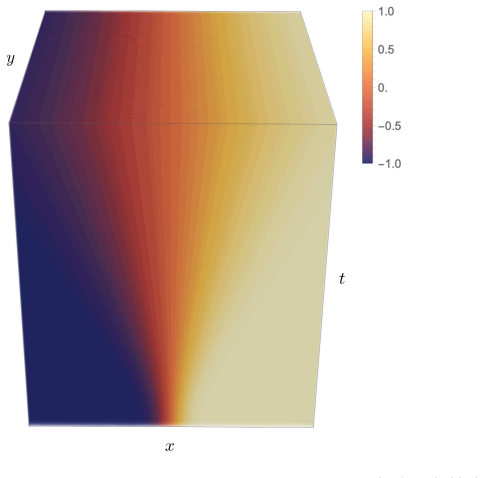
The paper claims that for the 2D transverse-field Ising ferromagnet, starting from any left-right symmetric, y-translation-invariant initial state interpolating between the two ferromagnetic ground states, the large-time longitudinal magnetization in the rough phase is given by Eq. (33): −⟨σ_x⟩₊ for x < −t, A_f ⟨σ_x⟩₊ x/t for |x| ≪ t, and ⟨σ_x⟩₊ for x > t. Consequently, lim_{t→∞} ⟨σ_x(x,t)⟩ = 0 at every fixed x. The profile is universal in the inner region except for the amplitude A_f, which encodes the initial state; the second quasiparticle species only renormalizes this amplitude. The same analysis yields a mechanism for breakdown of the rough phase away from criticality.
Load-bearing premise
The load-bearing premise is that the magnetization's two-quasiparticle matrix element has exactly the quoted 1/(p_x − q_x) pole with the quoted residue in the 2D Ising ferromagnet; the paper takes this from earlier work and relies on all regular terms vanishing in the inner region. If that pole strength is wrong or the regular terms contribute, the predicted profile collapses.
Editorial extensions
If this is right
- At any fixed spatial point, the magnetization tends to zero as 1/t, so the sharp interface dissolves and the interfacial width grows linearly with time.
- For |x| much smaller than t, the magnetization profile is a universal linear ramp, ⟨σ^x⟩/⟨σ^x⟩₊ ≈ A_f x/t, and the details of the initial interpolation survive only in the single amplitude A_f.
- Outside the lightcone x = ±t the magnetization keeps its initial bulk values, so information about the initial state propagates at the quasiparticle speed of light.
- A second stable quasiparticle species (mass about 1.8 times the lightest) does not alter the profile except through a redefinition of A_f, because the pole term is absent in off-diagonal channels.
- The same quasiparticle-density argument identifies when the rough phase breaks down: as the correlation length shrinks away from criticality, the interface becomes smooth below some h_r > 0.
Reading between the lines
- Because the argument uses only the kinematical pole of the one-particle form factor, the same linear-ramp profile should appear for other local operators whose form factors carry the same pole, with only the amplitude changing—a prediction the paper does not spell out.
- The predicted 1/t decay at fixed x is a concrete signature for quantum simulators with two-dimensional spin arrays: a domain-wall initial state should show local magnetization decaying to zero with a 1/t tail above the roughening field, and a different behavior below it.
- The factorization of the profile into x/t times a state-dependent amplitude suggests a scaling form ⟨σ(x,t)⟩ ≈ t^{-1} F(x/t) in the rough phase; checking this data collapse in numerics would test universality more sharply than a single time slice.
- If the smooth phase exists, the transition should be visible as a change in the decay exponent or the appearance of persistent oscillations in ⟨σ(x,t)⟩, since the pole-driven argument would no longer apply.
Signed reviews
Editorial analysis
A structured set of objections, weighed in public.
Referee Report
Summary. The paper studies the unitary time evolution of a domain-wall initial condition in the ferromagnetic phase of the 2D transverse-field Ising model. The initial state interpolates between the two broken-symmetry ground states, with a generic left-right symmetric profile and translation invariance in y. Using the asymptotic quasiparticle basis and a form-factor decomposition of the order parameter, the authors derive the large-time limit of ⟨σ^x(x,t)⟩. The central result is Eq. (33): outside the lightcone the magnetization retains the bulk values ±⟨σ⟩_+, while for |x|≪t it grows linearly as \tilde A_f x/t, with amplitude set by the initial condition. Consequently, at every fixed x the order parameter decays as 1/t, so the interface dissolves. The same formalism is used to argue for a rough phase at small quasiparticle density and for a breakdown of that phase away from criticality.
Significance. If the derivation is complete, this is a valuable extension of the d=1 quench results to two dimensions: it makes a sharp, falsifiable prediction for the lightcone profile of the 2D Ising ferromagnet and identifies which features are universal. The strength of the paper lies in the clean stationary-phase/contour argument in §2.2, the generic treatment of the initial condition (which survives only through one amplitude), and the probabilistic interpretation in terms of quasiparticle trajectories. However, the central result relies on the form-factor residue (16) imported from ref. [7] and on the vanishing of the regular term c^(0)=0; neither is derived here, and no direct numerical verification of Eq. (33) is supplied. These are not cosmetic issues, because the k=0 term is of the same order as the predicted 1/t decay. The result is therefore conditional on external inputs.
major comments (4)
- [§2.2, Eqs. (15)–(16)] The low-momentum expansion and the pole residue c^(−1)_σ = −2iML/N ⟨σ⟩_+ are imported from ref. [7] and not rederived in the present setting. This is the load-bearing input for the entire late-time profile: through Eqs. (21)–(25), the step heights and the linear central region are direct consequences of this residue. The macroscopic factor L/N in a connected matrix element of a local operator is surprising and is not explained; the limiting order L,N→∞ with fixed ratio is only specified later, in Eq. (27). I request a self-contained derivation of Eqs. (15)–(16) in the 2D context, or an independent check (e.g., a cylinder numerical simulation initialized in the same class, or a direct form-factor computation).
- [§2.2, after Eq. (23)] The discard of the regular part of the form factor reduces to the statement c^(0)_σ=0. This is load-bearing. For fixed x, the k=0 contribution is O(1/t), i.e. of the same order as the predicted A_f x/t term; it is not a subleading correction. The paper's only justification is the footnote that the exact d=1 form factor has c^(0)=0, which is not a statement about the 2D model. The additional appeal to oddness of ⟨σ(x,t)⟩ is not sufficient as written: oddness constrains the full expectation value, not individual contributions to an asymptotic expansion, unless all other O(1/t) even terms are proved absent. Please provide a derivation of c^(0)_σ=0, or a calculation of the full O(1/t) coefficient, for the 2D Ising model.
- [§3, second-quasiparticle-species paragraph] The treatment of the M2≈1.8M1 species is qualitative. The statement that the off-diagonal (species 1↔2) form factor has no pole is plausible because annihilation requires equal masses, but the conclusion that its regular part does not contribute for |x|≪t again relies on the unproved c^(0)=0 property for mixed-species matrix elements. Since a regular low-momentum limit would produce an O(1/t) contribution at fixed x, the final Eq. (33) is not fully established without this check. A short low-momentum analysis of the mixed form factor, or a numerical estimate of its low-momentum limit, is needed.
- [§3, last paragraphs and Conclusion] The manuscript explicitly notes that numerical verification in d=2 is difficult and cites only the recent Ref. [25] for the roughening transition. Given that Eqs. (15)–(16) and c^(0)=0 are imported from earlier work, the lack of any direct check of Eq. (33) is a serious gap. The Monte Carlo check in ref. [7] concerns the static interface width, not the time-dependent one-point function. I am not requesting numerics as a substitute for a proof, but the authors should either provide the missing analytic derivations or present a numerical test of the x/t scaling and the 1/t decay.
minor comments (5)
- [§2.2, Eq. (19)] The text says 'This allows us to rewrite (21)' but the displayed equation being rewritten is (17). Please correct the reference.
- [Title, Fig. 1] Typos: 'm odel' in the running title, and 'appearence' in the Figure 1 caption.
- [§3, Eqs. (32)–(33)] The notation σ^x(x,t) uses x both as the operator label (longitudinal Pauli matrix) and as the spatial coordinate. Consider writing σ^L(x,t) or using bold x for the spatial vector, to avoid confusion.
- [§2.1–§2.2] The limits N→∞ and L→∞ are introduced informally. Since Eq. (27) later uses a fixed ratio N/L=κ/ξ, the order of limits should be stated explicitly.
- [§2.3, Eq. (27)] The relation N/L=κ/ξ is stated without derivation in the main text; the reference to ref. [7] appears later. An explicit citation at Eq. (27) and a definition of κ would improve readability.
Circularity Check
No significant circularity: Eq. (33) follows from a stationary-phase evaluation of a generic initial state; the only imported quantity is an exact form-factor residue with independent prior support, and the slope amplitude is an initial-condition parameter, not a fit.
full rationale
The derivation chain is self-contained once standard form-factor input is accepted. The initial state (2) is generic; the large-time evaluation uses stationary phase (10) and the connectedness decomposition (8). The result (25)/(33) has a nonuniversal amplitude A_f (Eq. 24) that is literally defined by the initial wavefunction f, so it is not a fitted parameter relabeled as a prediction. The universal linear ramp A_f x/t and the 1/t decay come from the pole term c^{(-1)} in Eq. (15), whose residue (16) is quoted from [7]. This is a same-group citation, but it is not circular self-support: [7] is prior work containing a parameter-free check against Monte Carlo data, and the pole is identified as a kinematical singularity with external reference [8]. The suppression of the k=0 term follows from the left-right symmetry of the initial condition (oddness of the order parameter), which is an input rather than an output. The generalization to two quasiparticle species in Sec. 3 preserves the profile because the off-diagonal contribution has no pole and regular terms do not contribute at |x| << t. No step fits a parameter to the quantity that it later predicts, and no conclusion is forced by a self-citation chain. Residual concerns about the rigor of the residue import or the neglect of regular terms are correctness or evidence risks, not circularity.
Assumptions & free parameters
free parameters (1)
- Af (or \tilde Af) =
unspecified
assumptions (5)
- domain assumption The ferromagnetic phase of the 2D quantum Ising model is described by a relativistic massive QFT with asymptotic multiparticle quasiparticle states and dispersion E=sqrt(p^2+M^2).
- domain assumption The order-parameter connected form factor F^{σ,c}_1 has the low-momentum pole expansion (15) with residue (16) from [7].
- domain assumption The rough phase is characterized by small quasiparticle density N/L=κ/ξ, so quasiparticle interactions along the interface are negligible; Eq. (33) holds only in this phase.
- domain assumption The initial state is y-translation invariant, symmetric under x→−x with odd magnetization, and has a non-singular rapidly decaying amplitude f.
- standard math Large-time momentum integrals are evaluated by stationary phase; non-pole contributions with k≥0 vanish for |x|≪t.
Cite this review
Pith. "Pith review of Interface evolution in the two-dimensional quantum Ising model." pith.science (2026). https://pith.science/paper/2YKFPPFC
@misc{pith2026260726662,
  author       = {Pith},
  title        = {Pith review of: Interface evolution in the two-dimensional quantum Ising model},
  year         = {2026},
  howpublished = {\url{https://pith.science/paper/2YKFPPFC}},
  note         = {Machine review of arXiv:2607.26662}
}
read the original abstract
We consider the unitary time evolution of an interface in the regime of spontaneously broken symmetry of the two-dimensional quantum Ising model. The interface is induced by an initial condition interpolating between the two degenerate ground states in one of the spatial dimensions. The interpolation is left generic in order to investigate the dependence of the late time dynamics on the initial condition. Exploiting the basis of asymptotic quasiparticle states of the bulk theory, the order parameter is analytically determined at large times in the rough phase. The mechanism allowing the breakdown of this phase as the distance from criticality increases emerges from the theory.
Figures

Forward citations
Cited by 1 Pith paper
-
Interface phases and dynamics in two-dimensional quantum magnets: A "holographic" approach from universality to quantum simulation
Interface fluctuations in 2D quantum magnets are shown to encode the full phase diagram and transport universality classes of 1D spin chains, with a local-measurement protocol for reading out 1D full counting statistics.
Reference graph
Works this paper leans on
-
[7]
Delfino, A
G. Delfino, A. Squarcini and W. Selke, Nucl. Phys. B 958 (20 20) 115139
-
[25]
Krinitsin, N
W. Krinitsin, N. Tausendpfund, M. Rizzi, M. Heyl and M. S chmitt, Phys. Rev. Lett. 134, 240402 (2025)
2025
-
[1]
Delfino and M
G. Delfino and M. Sorba, Nucl. Phys. B 1005 (2024) 116587
2024
-
[2]
Delfino, J
G. Delfino, J. Phys. A 47 (2014) 402001
2014
-
[3]
Delfino and M
G. Delfino and M. Sorba, Nucl. Phys. B 983 (2022) 115910
2022
-
[4]
Delfino, Phys
G. Delfino, Phys. Rev. E 97 (2018) 062138
2018
-
[5]
Delfino and M
G. Delfino and M. Sorba, Nucl. Phys. B 974 (2022) 115643
2022
-
[6]
Sorba, N
M. Sorba, N. Defenu and G. Delfino, Nucl. Phys. B 1019 (2025 ) 117105
2025
Show all 27 references
-
[8]
Smirnov, Form Factors in Completely Integrable Qua ntum Field Theory, World Scientific (1992)
F.A. Smirnov, Form Factors in Completely Integrable Qua ntum Field Theory, World Scientific (1992)
1992
-
[9]
B. Berg, M. Karowski and P. Weisz, Phys. Rev. D 19 (1979) 24 77
1979
-
[10]
Delfino, J
G. Delfino, J. Phys. A 37 (2004) R45
2004
-
[11]
Caselle and M
M. Caselle and M. Hasenbusch, J. Phys. A 30 (1997) 4963
1997
-
[12]
D. Lee, N. Salwen and M. Windoloski, Phys. Lett. B 502 (20 01) 329
-
[13]
Caselle, M
M. Caselle, M. Hasenbusch, P. Provero and K. Zarembo, Nu cl. Phys. B 623 (2002) 474
2002
-
[14]
Dusuel, M
S. Dusuel, M. Kamfor, K.P. Schmidt, R. Thomale and J. Vid al, Phys. Rev. B 81 (2010) 064412
2010
-
[15]
Nishiyama, Physica A 463 (2016) 303
Y. Nishiyama, Physica A 463 (2016) 303
2016
-
[16]
F. Rose, F. Benitez, F. Leonard and B. Delamotte, Phys. R ev. D 93 (2016) 125018. 14
2016
-
[17]
Caselle, M
M. Caselle, M. Hasenbusch and M. Panero, JHEP 09 (2007) 1 17
2007
-
[18]
Burton, N
W.K. Burton, N. Cabrera, and F.C. Frank, Phil. Trans. R. Soc. A 243, 299 (1951)
1951
-
[19]
Chui and J.D
S.T. Chui and J.D. Weeks, Phys. Rev. B 14, 4978 (1976)
1976
-
[20]
Abraham, in Phase Transitions and Critical Phenom ena, edited by C
D.B. Abraham, in Phase Transitions and Critical Phenom ena, edited by C. Domb and J.L. Lebowitz, Vol. 10, p. 1, Academic Press, London, 198 6
-
[21]
Fradkin, Phys
E. Fradkin, Phys. Rev. B 28 (1983) 5338
1983
-
[22]
Zauner, M
V. Zauner, M. Ganahl, H.G. Evertz and T. Nishino, J. Phys .: Condens. Matter 27 (2015) 425602
2015
-
[23]
Eisler, F
V. Eisler, F. Maislinger and H.G. Evertz, SciPost Phys. 1 (2016) 014
2016
-
[24]
Hunyadi, Z
V. Hunyadi, Z. Racz and L. Sasvari, Phys. Rev. E 69 (2004) 066103
2004
-
[26]
Balducci, A
F. Balducci, A. Gambassi, A. Lerose, A. Scardicchio and C. Vanoni, Phys. Rev. Lett. 129, 120601 (2022)
2022
-
[27]
Balducci, A
F. Balducci, A. Gambassi, A. Lerose, A. Scardicchio and C. Vanoni, Phys. Rev. B 107, 024306 (2023). 15
2023
Reviewed August 1, 2026 · model on record in the stance chip above.
Discussion (0). Continue with ORCID to comment.