REVIEW 5 major objections 5 minor 39 references
Enhancing Sports Strategy with Video Analytics and Data Mining: Automated Video-Based Analytics Framework for Tennis Doubles
T0 review · 5 major / 5 minor · reviewed 2026-08-06 · deepseek-v4-flash
Pith's one-line read For tennis doubles video, transfer-learned CNN classifiers predict shot type, player position, and court formation far more accurately than pose-based graph networks, making a fully automated doubles-analytics pipeline practical.
desk verdict A competent engineering dissertation that delivers a useful doubles-tennis annotation schema and tool, but the CNN-over-GCN ranking rests on ground truth whose reliability is not established. read the letter →
The pith
A machine-rendered reading of the paper's core claim, the machinery that carries it, and where it could break.
The reading
What carries the argument
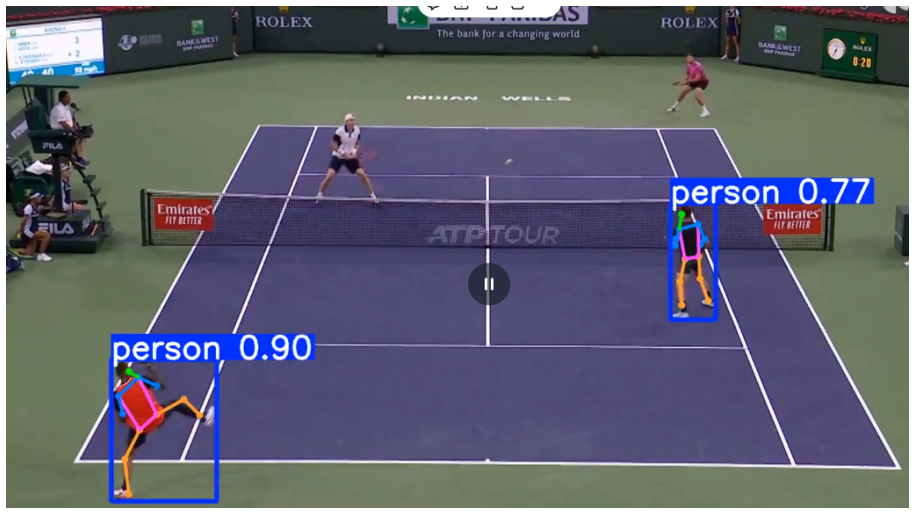
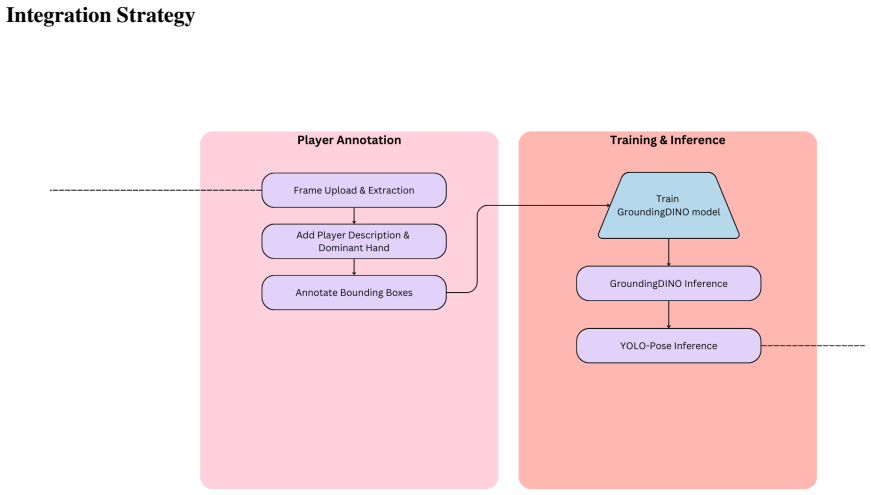
The argument runs on three coupled objects. First, the standardized annotation taxonomy: every hitting moment carries court position (far or near, deuce or advantage), shot side (forehand or backhand), shot type (serve, second-serve, return, volley, lob, smash, swing), shot direction (T, body, or wide for serves; cross-court, down-the-line, inside-in, or inside-out otherwise), formation (conventional, I-formation, Australian, non-serve), and outcome (in, win, error), plus player handedness; this schema is what makes the downstream prediction tasks well-defined and comparable. Second, the two-stage localization pipeline: GroundingDINO uses natural-language prompts such as "tennis player" to output player bounding boxes, and YOLO-Pose extracts 17 body keypoints from each box, replacing a YOLOv11-plus-DeepSORT tracker that loses far-side players in lower-quality footage. Third, the model comparison itself: pose-based GCNs use 17-node skeletons with a custom skeletal adjacency matrix and message passing $H^{(l+1)} = \sigma(D^{-1/2} A D^{-1/2} H^{(l)} W^{(l)})$, trained from scratch, while the CNNs crop the hitter (or hitter plus partner, or current plus a frame ten steps ahead) at twice the bounding-box margin, resize to $224 \times 224$, and fine-tune a pre-trained ResNet-50 with differential learning rates and class-weighted cross-entropy. A rule-based integration workflow then assembles the per-shot predictions into full rally labels, and the best-performing CNN variants are the ones wired into the annotation tool.
What would settle it
Label one additional doubles match with at least two independent annotators whose agreement is reported, then rerun the comparison with GCNs receiving complete, verified poses for all four players on every frame: the central claim fails if CNN serve/non-serve accuracy drops well below the reported 100% on the independent set, or if the Double-Pose GCN's formation AUC, reported around 54%, climbs toward the CNN's roughly 97% once far-player poses are no longer missing.
Extended reading notes
Core claim
The paper claims that the right representation for doubles tennis analytics is a standardized, doubles-specific annotation taxonomy combined with a transfer-learned image classifier, not a skeleton-graph model. Using roughly 2,000 manually labeled hitting events across eight videos, with held-out test videos from each of two sources, the author reports that Single-Image and Double-Image CNN architectures with ResNet-50 backbones substantially outperform Single- and Double-Pose GCN architectures on shot side, shot type, shot direction, formation, and outcome prediction: the Single-Image CNN reached 100% accuracy for serve versus non-serve on professional video and 90.4% on lower-quality collegiate footage, while both GCN models hovered near random for most labels. The paper also claims that a two-stage pipeline of GroundingDINO phrase grounding followed by YOLO-Pose fixes the far-player tracking failures of a YOLOv11-plus-DeepSORT tracker, cutting missing far-player detections from near-total to roughly 16% of frames on lower-quality footage, and that integrating these components into a single annotation tool reduces manual labeling effort to fine-tuning on 10 to 30 annotated frames before full-video inference.
Load-bearing premise
The manual labels covering about 2,000 hitting events across eight videos, produced by the author and two teammates with no reported inter-annotator agreement or external validation, are accurate and consistent enough to serve as ground truth for the model comparison.
Editorial extensions
If this is right
- A doubles-specific dataset built on the taxonomy can directly feed strategic models; the paper cites Markov Decision Process-based formation-transition analysis as the downstream application.
- The tool's workflow, fine-tuning GroundingDINO on 10 to 30 annotated frames and then inferring over the whole video, makes per-match annotation a matter of confirmation rather than full manual labeling.
- Because the CNN label generator is embedded in the tool with a human confirmation page, even imperfect predictions reduce annotation time for coaches and researchers.
- If the framework generalizes, the same annotation schema and pipeline transfer to tennis singles and to other paired sports such as table tennis doubles.
- Pose-based approaches will keep underperforming image-based ones until far-player pose extraction is reliable, since lower-quality footage misses pose data for far players in up to 16% of frames.
Reading between the lines
- The CNN-versus-GCN ranking is partly an input-quality comparison: the GCNs were fed pose estimates that disappear for far players, so the reported gap likely overstates the advantage of images over skeletons; a fair test would give both model families equally complete inputs.
- The headline numbers, such as 100% serve/non-serve accuracy and roughly 97% formation AUC, come from a single held-out professional video with 88 events and a single held-out collegiate video with 177 events, so real-world accuracy on new venues, camera angles, and players is likely lower.
- Shot direction and outcome, the labels most tied to ball and racket trajectories, remain weak in both model families at roughly 60 to 80% AUC, suggesting the next testable step is adding ball and racket cues to the current frames, which the taxonomy's per-shot event captures already make possible.
- A cheap extension the paper does not run is measuring inter-annotator agreement on the shot labels; labels that annotators disagree on would explain residual model error and tell users which automated labels to trust first.
Editorial analysis
A structured set of objections, weighed in public.
Referee Report
Summary. The manuscript presents an end-to-end framework for tennis doubles video analytics: a standardized annotation taxonomy, a custom annotation tool that integrates GroundingDINO, YOLO-Pose, and YOLOv11/DeepSORT, and a comparison of pose-based GCN classifiers with CNN classifiers for shot side, shot type, shot direction, formation, and outcome. Using a self-annotated dataset of eight videos (six train/val, two held-out test videos), the authors report that CNN architectures with ImageNet transfer learning substantially outperform from-scratch GCNs on most tasks, and they integrate the CNN models into the annotation tool for automated label generation.
Significance. If the results hold, the framework is a useful practical contribution: it provides a standardized schema and working tooling for doubles tennis, with released code, standardized hyperparameters, and a reproducible evaluation pipeline. The main scientific value is the comparative evaluation of pose-based versus image-based models on a new doubles-specific labeling task. However, the evaluation currently contains uncontrolled confounds and label-reliability issues: the comparison conflates architecture with transfer learning, the ground-truth labels lack inter-annotator validation, and several reported metrics may be inflated by task construction. The released dataset is a resource, but it is too small and too lightly validated to serve as a benchmark as it stands.
major comments (5)
- [Section 3, Sections 4.2.4-4.2.5, Table 3.1] The ground-truth labels are the load-bearing premise of every supervised comparison, but the paper provides no inter-annotator agreement measure, no external validation, and no audit of the roughly 2,000 annotated events, which were labeled by the author and two teammates. Moreover, the Label Generation and Label Confirmation pages allow Random, CNN, or Gemini models to propose labels that users then confirm, and the manuscript never discloses how many final labels were machine-proposed. If a substantial fraction of the training or test labels were produced or influenced by the same types of CNN models later evaluated, the reported AUC gaps (e.g., Formation 97.79% vs 53.58% in Table 4.10) could reflect annotator-model agreement rather than task performance. The paper should at minimum report label provenance per split and provide an inter-annotator agreement study on a held-out subset; ideally, test-set labels should be re-annotated blindly.
- [Section 4.3.2, Tables 4.6-4.11] The central claim is confounded: the CNN architectures use ImageNet-pretrained ResNet-50 backbones, while the GCN baselines are trained from scratch, with the paper explicitly noting that transfer learning could not be leveraged for pose data. The results therefore do not isolate architecture (CNN vs GCN) from pretraining; they show that a heavily pretrained model beats a from-scratch model. To support the abstract's claim, the authors should add a from-scratch CNN or, better, a GCN trained on ImageNet-pretrained visual features (or self-supervised pose features), or they should rephrase the claim as 'transfer-learned CNNs outperform from-scratch GCNs.'
- [Section 4.1, Tables 4.8-4.10] The Formation prediction task appears to be partly trivial because the annotation schema assigns the label 'Non-serve' to every non-serve shot, as described in Section 4.1 under 'Shot-Direction-Formation Combinations'. Since the CNN also achieves near-perfect serve/non-serve discrimination (100% on the professional test set), a model can obtain high Formation AUC simply by classifying serve versus non-serve, with no need to distinguish Conventional, I-Formation, or Australian. Formation performance should be reported separately on serve-only events, or the 'Non-serve' class should be excluded from the formation evaluation.
- [Section 4.3.2, Tables 4.6-4.11] No uncertainty quantification is reported. The test sets are 88 (professional) and 177 (NCAA) events, and several classes are highly imbalanced (e.g., lob, smash). The 100% serve-versus-non-serve accuracy on the professional test set, with only 88 events, cannot be distinguished from a favorable split without confidence intervals or bootstrap estimates. The authors should report per-class support, confidence intervals, and a significance test (e.g., McNemar's test) for the headline CNN-versus-GCN comparison.
- [Abstract and Section 4.3.2] The abstract claims prediction of 'player positioning', but the experiments do not evaluate the Court Position label (Far/Near Deuce/Advantage) defined in Section 4.1; Tables 4.6-4.11 cover Side, Shot Type, Shot Direction, Formation, and Outcome only. The abstract's claim should be aligned with the evaluated labels, or court-position results should be added.
minor comments (5)
- [Bibliography] Some references appear more than once: [10] and [37] are the same paper, as are [15] and [33], and [16] and [35] for F3Set. These should be consolidated.
- [Section 4.3.1, Figure 4.16] The paper reports that far-player pose estimation is missing in many NCAA frames, but it does not specify how missing keypoints are encoded in the GCN inputs (zero-padding, dropping, or imputation). This matters for interpreting the GCN results, especially because the paper notes that far-court players are frequently undetectable.
- [Section 4.3.2] The temporal horizon n = 10 frames for the Double-Image and Double-Pose architectures is introduced without justification or ablation. Since the Double-Image CNN direction results degrade relative to the Single-Image CNN for several metrics, an ablation on n would help determine whether the temporal window is the cause.
- [Table 4.11] The Double-Image CNN NCAA result of 34.16% AUC for the 5-way shot-direction task is far below the chance level of 50% for macro-averaged AUC; this suggests a training or evaluation anomaly that should be diagnosed or explained.
- [Throughout] There are minor typographical errors, including 'its’' in Section 1.1 and 'V olley' in the shot-type list in Section 4.1.
Circularity Check
No significant circularity: the CNN-over-GCN comparison is an empirical evaluation on held-out videos, not a by-construction reduction; score reflects only minor self-referential reliance and an unquantified label-source overlap.
full rationale
The paper's central claim is that CNN-based models with transfer learning outperform pose-based GCNs for shot type, player positioning, and formation prediction. This is supported by a supervised learning pipeline: ground-truth labels are defined by the annotation framework in Section 4.1, the GCN and CNN architectures are specified in Section 4.3.2, and results are reported on test videos that were explicitly held out. The paper states: 'I will be holding out two unseen videos: Salisbury_Ram vs Krawietz_Puetz _ Toronto 2023 Doubles Semi-Finals for Professional and VUPKfQgXy8g for NCAA.' Because the same labels are used for both model families and the test videos are not used in training, the CNN-over-GCN ranking in Tables 4.10 and 4.11 is not forced by construction. The transfer-learning advantage is attributed to ImageNet-pretrained ResNet backbones, which is an external, independently validated ingredient rather than a self-citation. The paper cites several works from the same research group, including F3Set and the doubles formation strategy paper, but these citations motivate the taxonomy and CNN approach rather than supply the evaluation result. One caveat is that the annotation tool has a label-generation workflow in which 'users can select from different prediction models including Random, CNN, and Gemini' and a confirmation page where 'the final labels can be regarded as a reliable dataset.' The paper does not disclose how many final ground-truth labels were originally machine-proposed, so a partial model-influence loop cannot be ruled out. However, no passage or equation exhibits a by-construction reduction of the reported predictions to these machine-generated labels, so this is a data-reliability concern, not demonstrated circularity. The minor self-referential related-work reliance and unquantified label-source overlap justify a low non-zero score rather than a circularity finding.
Assumptions & free parameters
free parameters (5)
- Temporal window n =
10 frames
- Bounding box margin multiplier =
2
- Differential learning rates =
backbone 1e-5, head 1e-4
- Dropout rate =
0.3
- Early stopping patience =
20 epochs
assumptions (4)
- domain assumption GroundingDINO fine-tuning with 10 to 30 annotated images is sufficient for reliable player localization.
- domain assumption YOLO-Pose keypoints are reliable representations of tennis stroke mechanics.
- domain assumption ImageNet-pretrained ResNet features transfer meaningfully to tennis doubles images.
- ad hoc to paper The annotation schema is complete and consistent for doubles tennis tactics.
Cite this review
Pith. "Pith review of Enhancing Sports Strategy with Video Analytics and Data Mining: Automated Video-Based Analytics Framework for Tennis Doubles." pith.science (2026). https://pith.science/paper/2YPEXLM6
@misc{pith2026250702906,
  author       = {Pith},
  title        = {Pith review of: Enhancing Sports Strategy with Video Analytics and Data Mining: Automated Video-Based Analytics Framework for Tennis Doubles},
  year         = {2026},
  howpublished = {\url{https://pith.science/paper/2YPEXLM6}},
  note         = {Machine review of arXiv:2507.02906}
}
read the original abstract
We present a comprehensive video-based analytics framework for tennis doubles that addresses the lack of automated analysis tools for this strategically complex sport. Our approach introduces a standardised annotation methodology encompassing player positioning, shot types, court formations, and match outcomes, coupled with a specialised annotation tool designed to meet the unique requirements of tennis video labelling. The framework integrates advanced machine learning techniques including GroundingDINO for precise player localisation through natural language grounding and YOLO-Pose for robust pose estimation. This combination significantly reduces manual annotation effort whilst improving data consistency and quality. We evaluate our approach on doubles tennis match data and demonstrate that CNN-based models with transfer learning substantially outperform pose-based methods for predicting shot types, player positioning, and formations. The CNN models effectively capture complex visual and contextual features essential for doubles tennis analysis. Our integrated system bridges advanced analytical capabilities with the strategic complexities of tennis doubles, providing a foundation for automated tactical analysis, performance evaluation, and strategic modelling in professional tennis.
Figures


Figures from the paper (19 more)






Reference graph
Works this paper leans on
-
[1]
AlShami, A., Boult, T., & Kalita, J. (2023). Pose2Trajectory: Using transformers on body pose to predict tennis player’s trajectory.Journal of Visual Communication and Image Representation, 97, 103954. https://doi.org/10.1016/j.jvcir.2023.103954
arXiv 2023
-
[2]
Dartfish. (2025). Dartfish video analysis software. https://www.dartfish.com/
work page 2025
-
[3]
Do, J., & Kim, M. (2024). SkateFormer: Skeletal-Temporal Transformer for Human Action Recog- nition.arXiv preprint arXiv:2403.09508. http://arxiv.org/abs/2403.09508
arXiv 2024
-
[4]
Dutta, A., & Zisserman, A. (2019). The VIA annotation software for images, au- dio and video.Proceedings of the 27th ACM International Conference on Multimedia. https://www.robots.ox.ac.uk/˜vgg/software/via/
work page 2019
-
[5]
Encord. (2025). Data-centric computer vision platform. https://encord.com/
work page 2025
-
[6]
Gao, M., & Ju, B. (2024). Attention-enhanced gated recurrent unit for action recognition in tennis. PeerJ Computer Science, 10, e1804. https://doi.org/10.7717/peerj-cs.1804
-
[7]
Huang, Y .-C., Liao, I.-N., Chen, C.-H.,˙Ik, T.-U., & Peng, W.-C. (2019). TrackNet: A Deep Learn- ing Network for Tracking High-speed and Tiny Objects in Sports Applications.arXiv preprint arXiv:1907.03698. https://arxiv.org/abs/1907.03698
work page Pith review arXiv 2019
-
[8]
HumanSignal. (2025). Label Studio: Open source data labeling platform. https://labelstud.io/
work page 2025
Show all 39 references
-
[9]
Intel. (2025). Computer Vision Annotation Tool (CV AT). OpenCV . https://www.cvat.ai/
2025
-
[10]
Jiang, K., Izadi, M., Liu, Z., & Dong, J. S. (2020). Deep Learning Application in Broadcast Ten- nis Video Annotation.2020 25th International Conference on Engineering of Complex Computer Systems (ICECCS), Singapore, 53-62. doi: 10.1109/ICECCS51672.2020.00014
2020
-
[11]
Khanam, R., & Hussain, M. (2024). YOLOv11: An Overview of the Key Architectural Enhance- ments.arXiv preprint arXiv:2410.17725. http://arxiv.org/abs/2410.17725
2024 arXiv
-
[12]
Kinovea. (2023). Kinovea: Video analysis for sports. https://www.kinovea.org/
2023
-
[13]
Lin, J., & Lee, G. H. (2021). Multi-View Multi-Person 3D Pose Estimation with Plane Sweep Stereo.arXiv preprint arXiv:2104.02273. http://arxiv.org/abs/2104.02273
2021 arXiv
-
[14]
Liu, S., Zeng, Z., Ren, T., Li, F., Zhang, H., Yang, J., Jiang, Q., Li, C., Yang, J., Su, H., Zhu, J., & Zhang, L. (2024). Grounding DINO: Marrying DINO with Grounded Pre-Training for Open-Set Object Detection.arXiv preprint arXiv:2303.05499. http://arxiv.org/abs/2303.05499 52
2024 arXiv
-
[15]
W., Jiang, A
Liu, Z., Dong, C., Chen, J. W., Jiang, A. M. J., Chen, G., Shaikh, A. F., Dong, T. Y ., Wang, C., Jiang, K., & Dong, J. S. (2025). Analyzing the Formation Strategy in Tennis Doubles Game.SN Computer Science, 6(2). https://doi.org/10.1007/s42979-024-03598-3
2025 doi
-
[16]
Liu, Z., Jiang, K., Ma, M., Hou, Z., Lin, Y ., & Dong, J. S. (2024, October 4).F 3Set: Towards Analyzing Fast, Frequent, and Fine-grained Events from Videos.The Thirteenth International Con- ference on Learning Representations. https://openreview.net/forum?id=vlg5WRKHxh
2024
-
[17]
Maji, D., Nagori, S., Mathew, M., & Poddar, D. (2022). YOLO-Pose: Enhancing YOLO for Multi Person Pose Estimation Using Object Keypoint Similarity Loss.arXiv preprint arXiv:2204.06806. http://arxiv.org/abs/2204.06806
2022 arXiv
-
[18]
Mehraban, S., Adeli, V ., & Taati, B. (2023). MotionAGFormer: Enhancing 3D Human Pose Estimation with a Transformer-GCNFormer Network.arXiv preprint arXiv:2310.16288. http://arxiv.org/abs/2310.16288
2023 arXiv
-
[19]
R., Gao, M., Lu, L., Xu, Z., Nogues, I., Yao, J., Mollura, D., & Summers, R
Shin, H.-C., Roth, H. R., Gao, M., Lu, L., Xu, Z., Nogues, I., Yao, J., Mollura, D., & Summers, R. M. (2016). Deep Convolutional Neural Networks for Computer-Aided Detection: CNN Archi- tectures, Dataset Characteristics and Transfer Learning.IEEE Transactions on Medical Imagin...
2016
-
[20]
SwingVision. (2025). AI tennis app for video analysis and shot tracking. https://swing.vision/
2025
-
[21]
V7 Labs. (2025). AI-powered image and video annotation software. https://www.v7labs.com/
2025
-
[22]
Y ., Lai, K
Wang, C. Y ., Lai, K. G., Huang, H. C., & Lin, W. T. (2024). Tennis player actions dataset for human pose estimation.Data in Brief, 55, 110665. doi: 10.1016/j.dib.2024.110665
2024
-
[23]
Wang, Y ., Wu, Y ., Tang, S., He, W., Guo, X., Zhu, F., Bai, L., Zhao, R., Wu, J., He, T., & Ouyang, W. (2024). Hulk: A Universal Knowledge Translator for Human-Centric Tasks.arXiv preprint arXiv:2312.01697. http://arxiv.org/abs/2312.01697
2024 arXiv
-
[24]
Wojke, N., Bewley, A., & Paulus, D. (2017). Simple Online and Realtime Tracking with a Deep Association Metric.arXiv preprint arXiv:1703.07402. http://arxiv.org/abs/1703.07402
2017 arXiv
-
[25]
Xiao, B., Wu, H., Xu, W., Dai, X., Hu, H., Lu, Y ., Zeng, M., Liu, C., & Yuan, L. (2023). Florence-2: Advancing a Unified Representation for a Variety of Vision Tasks.arXiv preprint arXiv:2311.06242. http://arxiv.org/abs/2311.06242
2023 arXiv
-
[26]
Yan, S., Xiong, Y ., & Lin, D. (2018). Spatial Temporal Graph Convolutional Net- works for Skeleton-Based Action Recognition.arXiv preprint arXiv:1801.07455. http://arxiv.org/abs/1801.07455
2018 arXiv
-
[27]
S., Jiang, K., Liu, Z., Dong, C., Hou, Z., Hundal, R
Dong, J. S., Jiang, K., Liu, Z., Dong, C., Hou, Z., Hundal, R. S., Guo, J., & Lin, Y . (2023). Sports analytics using probabilistic model checking and deep learning. In2023 27th International Conference on Engineering of Complex Computer Systems (ICECCS)(pp. 7–11). IEEE. 53
2023
-
[28]
Liu, Z., Jiang, K., Hou, Z., Lin, Y ., & Dong, J. S. (2023). Insight analysis for tennis strategy and tactics. In2023 IEEE International Conference on Data Mining (ICDM)(pp. 1169–1174). IEEE
2023
-
[29]
Liu, Z., Guo, J., Wang, M., Wang, R., Jiang, K., & Dong, J. S. (2023). Recognizing a sequence of events from tennis video clips: addressing timestep identification and subtle class differences. In2023 IEEE 28th Pacific Rim International Symposium on Dependable Computing (PRDC)...
2023
-
[30]
Liu, Z., Ma, M., Jiang, K., Hou, Z., Shi, L., & Dong, J. S. (2024). Pcsp# denotational semantics with an application in sports analytics. InThe Application of Formal Methods: Essays Dedicated to Jim Woodcock on the Occasion of His Retirement(pp. 71–102). Springer
2024
-
[31]
Y ., & Jiang, K
Liu, Z., Dong, C., Wang, C., Dong, T. Y ., & Jiang, K. (2024). Exploring team strategy dynamics in tennis doubles matches. InInternational Sports Analytics Conference and Exhibition(pp. 104– 115). Springer
2024
-
[32]
Liu, Z., Jiang, K., & Dong, J. S. (2023). Sports injury prediction in professional tennis. In2023 IEEE 28th Pacific Rim International Symposium on Dependable Computing (PRDC)(pp. 304– 308). IEEE
2023
-
[33]
W., Jiang, A
Liu, Z., Dong, C., Chen, J. W., Jiang, A. M. J., Chen, G., Shaikh, A. F., Dong, T. Y ., Wang, C., Jiang, K., & Dong, J. S. (2025). Analyzing the Formation Strategy in Tennis Doubles Game.SN Computer Science, 6(2), 100. Springer
2025
-
[34]
Y ., Simon, J.-F., & Deon, T
Liu, Z., Durrani, M., Xuan, L. Y ., Simon, J.-F., & Deon, T. Y . F. (2024). Strategy Analysis in NFL Using Probabilistic Reasoning. InInternational Sports Analytics Conference and Exhibition(pp. 116–128). Springer
2024
-
[35]
Liu, Z., Jiang, K., Ma, M., Hou, Z., Lin, Y ., & Dong, J. S. (2025). F3Set: Towards Analyzing Fast, Frequent, and Fine-grained Events from Videos.arXiv preprint arXiv:2504.08222
2025 arXiv
-
[36]
S., Liu, Z., Wadhwa, B., Hou, Z., Jiang, K., & Dong, J
Hundal, R. S., Liu, Z., Wadhwa, B., Hou, Z., Jiang, K., & Dong, J. S. (2024). Soccer Strategy Analytics Using Probabilistic Model Checkers. InInternational Sports Analytics Conference and Exhibition(pp. 249–264). Springer
2024
-
[37]
Jiang, K., Izadi, M., Liu, Z., & Dong, J. S. (2020). Deep learning application in broadcast tennis video annotation. In2020 25th International Conference on Engineering of Complex Computer Systems (ICECCS)(pp. 53–62). IEEE
2020
-
[38]
Jiang, K., Li, J., Liu, Z., & Dong, C. (2023). Court detection using masked perspective fields net- work. In2023 IEEE 28th Pacific Rim International Symposium on Dependable Computing (PRDC) (pp. 342–345). IEEE
2023
-
[39]
Jiang, K., Liu, Z., Wu, Q., Ma, M., & Dong, J. S. (2024). Tracking Small and Fast Moving Ball in Broadcast Videos Using Transfer Learning and the Enhanced Interactive Multi-motion Model. In International Sports Analytics Conference and Exhibition(pp. 81–96). Springer. 54 A. Ap...
2024
Reviewed August 6, 2026 · model on record in the stance chip above.
Discussion (0). Sign in to comment.