REVIEW 4 major objections 5 minor 45 references
GBFRS: Robust Fuzzy Rough Sets via Granular-ball Computing
T0 review · 4 major / 5 minor · reviewed 2026-08-09 · deepseek-v4-flash
Pith's one-line read Replacing sample points with granular-balls makes fuzzy rough set feature selection more robust under label and attribute noise.
desk verdict A promising granular-ball fuzzy rough set idea with a broken monotonicity guarantee and impossible error bars—revision needed before it can be trusted. read the letter →
The pith
A machine-rendered reading of the paper's core claim, the machinery that carries it, and where it could break.
The reading
What carries the argument
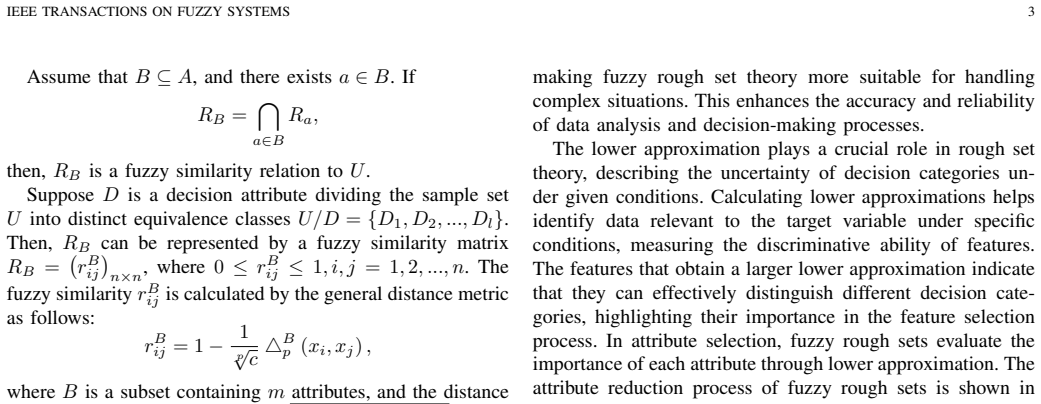
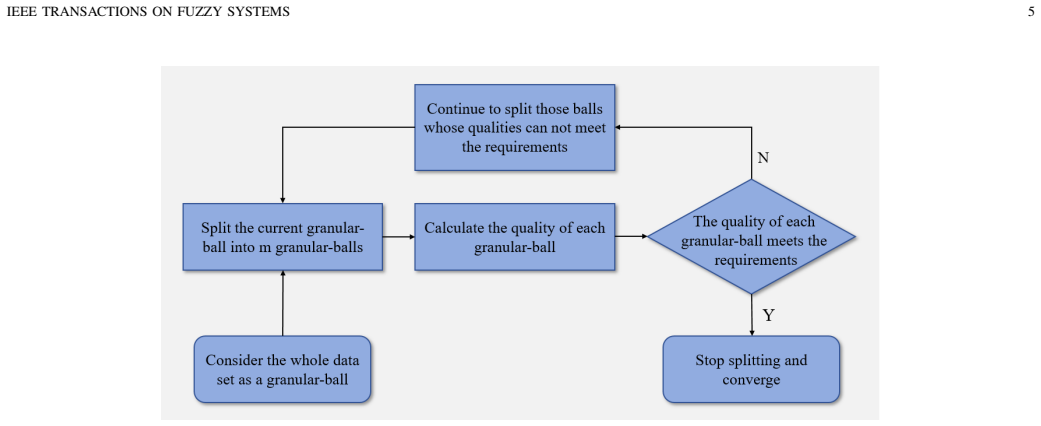
The load-bearing object is the granular-ball, a cluster of samples represented only by its center $c$ and mean radius $r$, with quality controlled by a purity threshold on the majority class. Fuzzy similarity between balls uses only the Euclidean distance between centers, $GBR_a(GB_i, GB_j) = 1 - \Delta^a_2(c_i,c_j)/\sqrt{C}$, and the weighted granular-ball fuzzy dependency $W\partial_B(D) = \sum_i |GB_i| \cdot GBPOS_B(D)(GB_i) / |U|$ is what the forward search maximizes. Theorem 2's identity $W\partial^{i+1}_B = \sqrt{C_i/C_{i+1}} \, W\partial^i_B$ is the computational hinge: it turns a change in the distance parameter $C$ into a scalar rescaling, so attribute significance can be updated incrementally rather than recomputed from scratch.
What would settle it
A synthetic dataset with two classes separated only by feature variance, not by feature mean, would settle it: if GBFRS never selects the variance-only feature while a point-based fuzzy rough set does, the center-only ball representation is discarding discriminative information.
Extended reading notes
Core claim
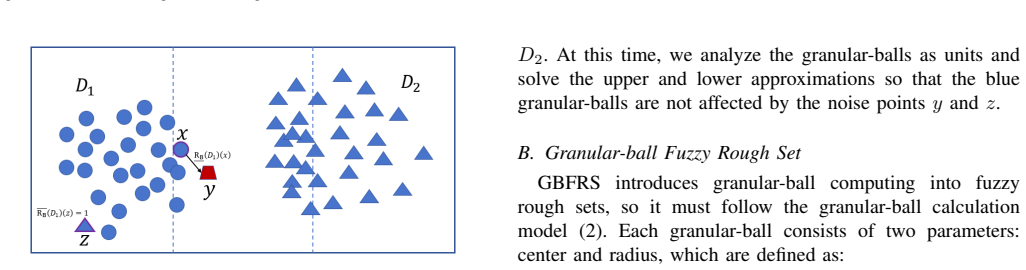
The paper's central discovery is that fuzzy rough set reasoning can be carried out on granular-balls rather than points without losing the formal structure that makes dependence-based attribute reduction work. It defines fuzzy similarity between balls using only the Euclidean distance between their centers (Eq. 3), reproduces the upper and lower approximations in that setting (Definition 5), and introduces a weighted granular-ball fuzzy dependency $W\partial_B(D)$ (Definition 6) that weights each ball's positive-domain membership by the number of original samples it contains. This weighted dependency reduces exactly to the classical fuzzy dependency when every ball is a singleton (Theorem 1), is monotone with attribute-set inclusion (Property 3), and satisfies $W\partial^{i+1}_B = \sqrt{C_i/C_{i+1}} \, W\partial^i_B$ (Theorem 2), letting the forward search reuse prior computations. The empirical claim is that majority-label balls absorb minority noise, so the lower approximation—the part of the model that decides which features matter—stays accurate under heavy label noise and attribute perturbation.
Load-bearing premise
The load-bearing premise is that each granular-ball's center and majority label preserve the information needed for feature selection, so the ball's internal spread, shape, or label distribution can be ignored.
Editorial extensions
If this is right
- Under label noise up to 30%, GBFRS degrades more gracefully than the point-based fuzzy rough set baselines in the reported experiments, often keeping the highest kNN accuracy.
- With 10% attribute perturbation, GBFRS is either the best or the second-best feature selector on most of the ten UCI datasets tested.
- Because the weighted dependency collapses to the classical fuzzy dependency when each ball holds one sample, GBFRS is a strict generalization of point-based fuzzy rough set attribute reduction.
- The scaling identity in Theorem 2 lets the forward search update dependencies after a change in the distance parameter $C$ by a scalar factor, avoiding full recomputation.
- Replacing $n$ sample points with $k$ granular-balls shrinks the similarity matrix from $n \times n$ to $k \times k$, so the method's per-iteration cost depends on the number of balls rather than the number of samples.
Reading between the lines
- The same ball-substitution principle should transfer to other instance-based and prototype-based learners, because the robustness mechanism—majority labels inside a ball absorbing minority noise—is not specific to fuzzy sets.
- A stress test the paper does not run: if a feature's signal lives in within-ball variance rather than the center, GBFRS should fail to select it, which would expose the exact boundary of the center-only approximation.
- The paper's closing limitation—that granular-ball computing is not fully adaptive because of the purity threshold—implies the threshold $T$ must be tuned per dataset, and an automatic rule for $T$ is a natural next step.
- The experiments validate selected features only with kNN, so whether the robustness carries over to other classifiers remains an open check.
Editorial analysis
A structured set of objections, weighed in public.
Referee Report
Summary. The paper proposes GBFRS, a fuzzy rough set model in which sample points are replaced by granular-balls. It defines fuzzy similarity between balls from their centers, introduces upper/lower approximations and a weighted dependency function, and presents a forward-search feature-selection algorithm. The authors claim that the coarse-grained representation improves robustness to label and attribute noise, and they report experiments on UCI datasets comparing GBFRS with five fuzzy-rough/neighborhood feature-selection methods. The main theoretical result is a reduction to the classical dependency when each ball contains one point, and the main empirical claim is that GBFRS achieves the highest accuracy under increasing noise levels.
Significance. The idea of using granular-balls as the atomic units in a fuzzy rough set model is coherent and could be valuable: if the framework is sound, it may offer a principled way to improve the efficiency and noise robustness of fuzzy-rough feature selection while retaining a well-defined dependency measure. Theorem 1 is correct, and the authors provide a public code/data link, which is a strength for reproducibility. However, the significance is currently undercut by load-bearing problems: the central monotonicity argument relies on an inconsistent treatment of the distance parameter C, the convergence theorem has an invalid proof, the pseudocode for the feature-selection algorithm is not executable as stated, and the reported standard deviations in the experiments are impossible for accuracy values from a 5-fold cross-validation. These issues affect both the theoretical guarantee and the empirical support for the paper's central claim.
major comments (4)
- [Definition 4, Eq. (3), Property 1, and Theorem 3 (Section III-B/C)] The distance parameter C is used inconsistently. Definition 4 and Eq. (3) call C a fixed distance parameter, but the paragraph immediately after Definition 4 says 'C is a fixed distance parameter: the number of attribute sets B,' and Theorem 3 sets C = i = |B|. Property 1's proof compares r_B and r_A with the same C, which is valid only if C does not change with the attribute subset. Theorem 3 changes C when going from B to B ∪ {a}, so the monotonicity of Property 3 no longer follows. A concrete failure is: take two balls whose centers differ only in attribute a1 by distance 1 and are equal in a2; for B = {a1}, C = 1 gives similarity 0, while for A = {a1,a2}, C = 2 gives similarity 1 - 1/sqrt(2), violating Property 1. Since the forward-search algorithm in Algorithm 1 and the significance formula in Eq. (19) rest on Property 3, the theoretical guarantee for the feature-selection procedure is unsupported.
- [Theorem 4 (Section III-C)] The proof of Theorem 4 is invalid. The step asserting W∂Ci_B(D) ≤ W∂Ci_{B∪{ajk}}(D) ≤ W∂Ci_{B∪{ajk}∪{ajk+1}}(D) and the diminishing-returns inequality W∂Ci_{B∪{ajk}}(D) - W∂Ci_B(D) ≥ W∂Ci_{B∪{ajk}∪{ajk+1}}(D) - W∂Ci_{B∪{ajk}}(D) is introduced as 'classical fuzzy rough set theory' without proof, and it is not a consequence of any property established earlier in the paper. Additionally, the conclusion 'bounded monotonic, therefore converges to 0' is false: a decreasing sequence bounded below converges to some limit, but not necessarily to 0. The proof also compares significances of different attributes relative to different current sets (a_jk relative to B versus a_jk+1 relative to B∪{a_jk}), which does not establish convergence of SIG(a,B,D) for a fixed attribute a. Therefore Theorem 4, which is used to justify the stopping criterion of the feature-selection algorithm, is not proven.
- [Algorithm 1, lines 15-27] The pseudocode for feature selection contains logical errors. Line 15 gives the loop condition as 'while B' = ∅ or max_W∂ ≤ W∂ do'; with the initial values max_W∂ = 0 and W∂ = 0 this condition is true, and if no attribute improves the dependency, max_W∂ remains 0, W∂ remains 0, and the loop never terminates. Inside the loop, line 19 tests 'if W∂ > W∂''B' and then overwrites W∂ at line 20, so W∂ no longer holds the dependency of the current best subset; the comparison at line 24 between max_W∂ and W∂ is therefore comparing against a value that has already been reassigned. Line 17 already adds every candidate attribute to B'' during the inner loop, and line 25 adds Ni again, so the output set B'' can contain all attributes regardless of whether they improve the dependency. These issues make the algorithm non-reproducible and prevent verification of the claimed forward-search behavior.
- [Tables II and III (Section IV)] The reported standard deviations in Tables II and III are impossible for accuracy values. Accuracy is a proportion in [0,1], and for a 5-fold cross-validation the sample standard deviation across the five fold accuracies cannot exceed about 0.55; yet the tables report values such as 0.7871 ± 0.7888 (lymphography, FAR_FIE, 0% noise), 0.5116 ± 1.9454 (lymphography, FAR_FIE, 20% noise), and multiple entries in Table III exceeding 1.0. These entries cannot arise from the described experimental procedure. Since the central empirical claim of improved robustness rests on these tables, the experimental support is not credible as reported.
minor comments (5)
- [Abstract] There is a typo in the abstract: 'Muiti-garanularty' should be 'Multi-granularity'.
- [Property 2 proof (Section III-B)] The proof of Property 2 says 'according to Property 2, we have ΔB1 ≤ ΔB2,' which is circular; the reference should be to Property 1 or to the definition of the distance.
- [Definition 4, Eq. (3)] The text after Eq. (3) says C places GBRa in the interval '[0.1]'; this should be '[0,1]'.
- [Section IV, Table I] The text says 'we randomly select 9 UCI data sets,' but Table I lists 10 datasets; the count should be corrected.
- [Section I] The sentence 'Since fuzzy rough sets are very sensitive to noise in uncertainty data, the evaluation of uncertainty is not accurate' appears twice in the introduction; one occurrence should be removed.
Circularity Check
No significant circularity: GBFRS's robustness claim is empirically benchmarked and its dependency definitions are derived in-paper; the C-parameter inconsistency is a rigor issue, not a circular reduction.
full rationale
The paper's central claim—that replacing sample points with granular-balls improves robustness to label and attribute noise—is supported by experiments against external baselines (FNRS, HANDI, FAR_FIE, FS_NDEM, FRDMAR) on UCI datasets, not by fitting a parameter to the target accuracy. The weighted dependency W∂B and the granular-ball fuzzy approximations are defined in the manuscript itself (Definitions 5 and 6), and the consistency with classical fuzzy dependency is explicitly checked in Theorem 1 rather than assumed. The authors' prior granular-ball work is cited for background and for the general granular-ball generation model (Eq. 2), but the fuzzy similarity relation (Eq. 3), approximations (Eqs. 8–10), and monotonicity properties are developed in this paper rather than imported as a black-box uniqueness or existence theorem. I find no load-bearing self-citation and no prediction that is forced by construction. The main caveats are correctness risks, not circularity: Definition 4 calls C a fixed distance parameter while Theorem 3 sets C = |B|, and the claim that SIG_i(a,B,D) > 0 for every a ∉ B is asserted from Definition 8's reduction condition rather than established from the model; the conclusion also notes that granular-ball computing is not fully adaptive due to the purity threshold. These issues weaken the rigor of the forward-search guarantee, but they do not make the derivation equivalent to its inputs.
Assumptions & free parameters
free parameters (3)
- purity threshold T =
optimized in [0.6, 1], step 0.05
- initial number of granular-balls =
sqrt(n) (square root of sample count)
- distance parameter C =
|B| (cardinality of attribute subset)
assumptions (3)
- domain assumption Granular-ball computing model (Eq. 2) and its quality constraint (purity threshold) are valid.
- domain assumption Fuzzy similarity between granular-balls can be computed from Euclidean distance between centers only.
- ad hoc to paper The distance parameter C can be set to |B| without changing the nature of the fuzzy rough set model.
invented entities (1)
-
Granular-ball fuzzy rough set (GBFRS) approximations and weighted dependency
independent evidence
Cite this review
Pith. "Pith review of GBFRS: Robust Fuzzy Rough Sets via Granular-ball Computing." pith.science (2026). https://pith.science/paper/2YTJMX6O
@misc{pith2026250118413,
  author       = {Pith},
  title        = {Pith review of: GBFRS: Robust Fuzzy Rough Sets via Granular-ball Computing},
  year         = {2026},
  howpublished = {\url{https://pith.science/paper/2YTJMX6O}},
  note         = {Machine review of arXiv:2501.18413}
}
read the original abstract
Fuzzy rough set theory is effective for processing datasets with complex attributes, supported by a solid mathematical foundation and closely linked to kernel methods in machine learning. Attribute reduction algorithms and classifiers based on fuzzy rough set theory exhibit promising performance in the analysis of high-dimensional multivariate complex data. However, most existing models operate at the finest granularity, rendering them inefficient and sensitive to noise, especially for high-dimensional big data. Thus, enhancing the robustness of fuzzy rough set models is crucial for effective feature selection. Muiti-garanularty granular-ball computing, a recent development, uses granular-balls of different sizes to adaptively represent and cover the sample space, performing learning based on these granular-balls. This paper proposes integrating multi-granularity granular-ball computing into fuzzy rough set theory, using granular-balls to replace sample points. The coarse-grained characteristics of granular-balls make the model more robust. Additionally, we propose a new method for generating granular-balls, scalable to the entire supervised method based on granular-ball computing. A forward search algorithm is used to select feature sequences by defining the correlation between features and categories through dependence functions. Experiments demonstrate the proposed model's effectiveness and superiority over baseline methods.
Figures


Figures from the paper (5 more)



Reference graph
Works this paper leans on
-
[1]
S. An, Q. Hu, W. Pedrycz, P. Zhu, and E. C. Tsang. Data-distribution- aware fuzzy rough set model and its application to robust classification. IEEE Transactions on Cybernetics , 46(12):3073–3085, 2015. IEEE TRANSACTIONS ON FUZZY SYSTEMS 12
work page 2015
-
[2]
S. An, Q. Hu, and C. Wang. Probability granular distance-based fuzzy rough set model. Applied Soft Computing , 102:107064, 2021
work page 2021
-
[3]
S. An, J. Liu, C. Wang, and S. Zhao. A relative uncertainty measure for fuzzy rough feature selection. International Journal of Approximate Reasoning, 139:130–142, 2021
work page 2021
-
[4]
S. An, H. Shi, Q. Hu, X. Li, and J. Dang. Fuzzy rough regression with application to wind speed prediction. Information Sciences , 282:388– 400, 2014
work page 2014
-
[5]
S. An, E. Zhao, C. Wang, G. Guo, S. Zhao, and P. Li. Relative fuzzy rough approximations for feature selection and classification. IEEE Transactions on Cybernetics , 53(4):2200–2210, 2021
work page 2021
-
[6]
D. Chen and Y . Yang. Attribute reduction for heterogeneous data based on the combination of classical and fuzzy rough set models. IEEE Transactions on Fuzzy Systems , 22(5):1325–1334, 2013
work page 2013
-
[7]
D. Chen, L. Zhang, S. Zhao, Q. Hu, and P. Zhu. A novel algorithm for finding reducts with fuzzy rough sets. IEEE Transactions on Fuzzy Systems, 20(2):385–389, 2011
work page 2011
-
[8]
J. Chen, J. Mi, and Y . Lin. A graph approach for fuzzy-rough feature selection. Fuzzy Sets and Systems , 391:96–116, 2020
work page 2020
Show all 45 references
-
[9]
L. Chen. Topological structure in visual perception. Science, 218(4573):699–700, 1982
1982
-
[10]
Chen and Q
L. Chen and Q. Chen. A novel classification algorithm based on kernelized fuzzy rough sets. International Journal of Machine Learning and Cybernetics, 11(11):2565–2572, 2020
2020
-
[11]
Cornelis, N
C. Cornelis, N. Verbiest, and R. Jensen. Ordered weighted average based fuzzy rough sets. In Rough Set and Knowledge Technology: 5th International Conference, RSKT 2010, Beijing, China, October 15-17,
2010
-
[12]
J. Dai, H. Hu, W.-Z. Wu, Y . Qian, and D. Huang. Maximal- discernibility-pair-based approach to attribute reduction in fuzzy rough sets. IEEE Transactions on Fuzzy Systems , 26(4):2174–2187, 2017
2017
-
[13]
Degang and Z
C. Degang and Z. Suyun. Local reduction of decision system with fuzzy rough sets. Fuzzy Sets and Systems , 161(13):1871–1883, 2010
2010
-
[14]
Dubois and H
D. Dubois and H. Prade. Rough fuzzy sets and fuzzy rough sets. International Journal of General System , 17(2-3):191–209, 1990
1990
-
[15]
Y . Guo, L. Jiao, S. Wang, S. Wang, and F. Liu. Fuzzy sparse autoencoder framework for single image per person face recognition. IEEE transactions on cybernetics , 48(8):2402–2415, 2017
2017
-
[16]
M. Hu, Y . Guo, D. Chen, E. C. Tsang, and Q. Zhang. Attribute reduction based on neighborhood constrained fuzzy rough sets. Knowledge-Based Systems, 274:110632, 2023
2023
-
[17]
Q. Hu, S. An, and D. Yu. Soft fuzzy rough sets for robust feature evaluation and selection. Information Sciences , 180(22):4384–4400, 2010
2010
-
[18]
Q. Hu, W. Pedrycz, D. Yu, and J. Lang. Selecting discrete and continuous features based on neighborhood decision error minimization. IEEE Transactions on Systems, Man, and Cybernetics, Part B (Cybernetics) , 40(1):137–150, 2009
2009
-
[19]
Q. Hu, D. Yu, and Z. Xie. Information-preserving hybrid data reduction based on fuzzy-rough techniques. Pattern recognition letters, 27(5):414– 423, 2006
2006
-
[20]
Q. Hu, L. Zhang, S. An, D. Zhang, and D. Yu. On robust fuzzy rough set models. IEEE transactions on Fuzzy Systems , 20(4):636–651, 2011
2011
-
[21]
S. Hu, D. Miao, and W. Pedrycz. Multi granularity based label prop- agation with active learning for semi-supervised classification. Expert Systems with Applications , 192:116276, 2022
2022
-
[22]
Huang, Y
W. Huang, Y . She, X. He, and W. Ding. Fuzzy rough sets-based incremental feature selection for hierarchical classification. IEEE Trans- actions on Fuzzy Systems , 2023
2023
-
[23]
Jensen and Q
R. Jensen and Q. Shen. Fuzzy-rough attribute reduction with application to web categorization. Fuzzy sets and systems , 141(3):469–485, 2004
2004
-
[24]
Mac Parthaláin, R
N. Mac Parthaláin, R. Jensen, and R. Diao. Fuzzy-rough set bireducts for data reduction. IEEE Transactions on Fuzzy Systems , 28(8):1840–1850, 2019
2019
-
[25]
W. Pedrycz. Allocation of information granularity in optimization and decision-making models: towards building the foundations of granular computing. European Journal of Operational Research , 232(1):137– 145, 2014
2014
-
[26]
J. A. Sáez and E. Corchado. Ances: A novel method to repair attribute noise in classification problems. Pattern Recognition, 121:108198, 2022
2022
-
[27]
Shuyin, D
X. Shuyin, D. Dawei, Y . Long, Z. Li, L. Danf, W. Guoy, et al. Graph- based representation for image based on granular-ball. arXiv preprint arXiv:2303.02388, 2023
2023 arXiv
-
[28]
B. Wang, J. Liang, and Y . Yao. A trilevel analysis of uncertainty measuresin partition-based granular computing. Artificial Intelligence Review, 56(1):533–575, 2023
2023
-
[29]
C. Wang, Q. Hu, X. Wang, D. Chen, Y . Qian, and Z. Dong. Feature se- lection based on neighborhood discrimination index. IEEE transactions on neural networks and learning systems , 29(7):2986–2999, 2017
2017
-
[30]
C. Wang, Y . Huang, M. Shao, and X. Fan. Fuzzy rough set-based attribute reduction using distance measures. Knowledge-Based Systems, 164:205–212, 2019
2019
-
[31]
C. Wang, M. Shao, Q. He, Y . Qian, and Y . Qi. Feature subset selection based on fuzzy neighborhood rough sets. Knowledge-Based Systems , 111:173–179, 2016
2016
-
[32]
C. Y . Wang and L. Wan. New results on granular variable precision fuzzy rough sets based on fuzzy (co) implications. Fuzzy Sets and Systems , 423:149–169, 2021
2021
-
[33]
S. Xia, J. Chen, B. Hou, and G. Wang. Granular-ball optimization algorithm. arXiv preprint arXiv:2303.12807 , 2023
2023 arXiv
-
[34]
S. Xia, X. Lian, G. Wang, X. Gao, and Y . Shao. Granular-ball fuzzy set and its implementation in svm. arXiv preprint arXiv:2210.11675, 2022
2022 arXiv
-
[35]
S. Xia, Y . Liu, X. Ding, G. Wang, H. Yu, and Y . Luo. Granular ball computing classifiers for efficient, scalable and robust learning. Information Sciences, 483:136–152, 2019
2019
-
[36]
S. Xia, C. Wang, G. Wang, X. Gao, W. Ding, J. Yu, Y . Zhai, and Z. Chen. Gbrs: A unified granular-ball learning model of pawlak rough set and neighborhood rough set. IEEE Transactions on Neural Networks and Learning Systems, 2023
2023
-
[37]
S. Xia, G. Wang, Z. Chen, Y . Duan, et al. Complete random forest based class noise filtering learning for improving the generalizability of classifiers. IEEE Transactions on Knowledge and Data Engineering , 31(11):2063–2078, 2018
2018
-
[38]
S. Xia, G. Wang, X. Gao, and X. Peng. Gbsvm: granular-ball support vector machine. arXiv preprint arXiv:2210.03120 , 2022
2022 arXiv
-
[39]
S. Xia, H. Zhang, W. Li, G. Wang, E. Giem, and Z. Chen. Gbnrs: A novel rough set algorithm for fast adaptive attribute reduction in classification. IEEE Transactions on Knowledge and Data Engineering , 34(3):1231– 1242, 2020
2020
-
[40]
J. Xie, X. Xiang, S. Xia, L. Jiang, G. Wang, and X. Gao. Mgnr: A multi- granularity neighbor relationship and its application in knn classification and clustering methods. IEEE Transactions on Pattern Analysis and Machine Intelligence, pages 1–17, 2024
2024
-
[41]
J. Xu, X. Meng, K. Qu, Y . Sun, and Q. Hou. Feature selection using relative dependency complement mutual information in fitting fuzzy rough set model. Applied Intelligence, 53(15):18239–18262, 2023
2023
-
[42]
X. Yang, M. A. Loua, M. Wu, L. Huang, and Q. Gao. Multi-granularity stock prediction with sequential three-way decisions. Information Sciences, 621:524–544, 2023
2023
-
[43]
Zhang, H
X. Zhang, H. Gou, Z. Lv, and D. Miao. Double-quantitative dis- tance measurement and classification learning based on the tri-level granular structure of neighborhood system. Knowledge-Based Systems, 217:106799, 2021
2021
-
[44]
Zhang, C
X. Zhang, C. Mei, D. Chen, Y . Yang, and J. Li. Active incremental feature selection using a fuzzy-rough-set-based information entropy. IEEE Transactions on Fuzzy Systems , 28(5):901–915, 2019
2019
-
[2010]
Springer, 2010
Proceedings 5 , pages 78–85. Springer, 2010
2010
Reviewed August 9, 2026 · model on record in the stance chip above.
Discussion (0). Continue with ORCID to comment.