REVIEW 4 major objections 5 minor 1 cited by
Do Language Models Think Consistently? A Study of Value Preferences Across Varying Response Lengths
T0 review · 4 major / 5 minor · reviewed 2026-08-07 · deepseek-v4-flash
Pith's one-line read LLMs' value preferences inferred from short answers barely match those expressed in long-form responses, and alignment helps only modestly.
desk verdict A useful empirical caution on short-form value evaluations, with a long-form preference measure that is plausible but under-validated; worth a serious referee with targeted revisions. read the letter →
The pith
A machine-rendered reading of the paper's core claim, the machinery that carries it, and where it could break.
The reading
What carries the argument
The argument runs on two preference meters built from one value system of 301 values. On the short-form side, TrueSkill (a Bayesian rating algorithm) updates a Gaussian belief $N(\mu_v,\sigma_v^2)$ per value from each binary dilemma choice, and $\mu_v$ becomes the value's preference weight. On the long-form side, the model is instructed to order its $k$ arguments by its own value preferences; gpt-4o extracts the arguments and tags each with values from the same 301-value list, and a value's preference is the negative average normalized position of its first tagged argument. The consistency claim is the low Pearson correlation between these two preference vectors, supported by two attribute metrics: path-based specificity (longest root-to-leaf path in an argument tree) and compression ratio (gZip-based redundancy, the inverse of diversity).
What would settle it
Take a set of long-form responses and infer value preferences both from the original ordering and from the same arguments presented in a reversed or randomly shuffled order. If the inferred preference ranking stays essentially the same when the instruction says 'least preferred first,' then argument order is not carrying preference information; if preferences track the shuffled order, positional artifacts dominate. A second check is to replace gpt-4o value tagging with human annotations on a subset and see whether short-long correlations rise to a level that changes the conclusion.
Extended reading notes
Core claim
The central claim is that an LLM's value preferences are not a stable quantity that survives a change in response format: the same model ranks the same 301-value system differently depending on whether it is choosing an action or writing an ordered list of arguments. Short-form preferences are estimated with a TrueSkill-style Gaussian belief update over the values attached to chosen and unchosen actions in DAILYDILEMMAS; long-form preferences are estimated by prompting the model to generate $k \in \{5,10,20\}$ arguments in its own preferred order, splitting those arguments and tagging them with values using gpt-4o, and taking each value's preference as the negative average normalized position of its first occurrence. The two preference vectors correlate weakly across all five model families, and preferences from different values of $k$ also correlate weakly, especially between $k=5$ and the longer settings. Alignment improves the short-long correlation only modestly and does not reliably improve long-long consistency, while contentious OPINION QA topics show less consistency than everyday DAILYDILEMMAS dilemmas.
Load-bearing premise
The load-bearing premise is that the position of a value's first argument in a long-form response reflects the model's preference for that value; if models do not actually order arguments by preference, or if gpt-4o's argument splitting and value tagging are biased, the weak short-long correlation could be an artifact of the measurement rather than genuine inconsistency in values.
Editorial extensions
If this is right
- Short-form value benchmarks will overstate the stability of a model's ethical stance in real use, because long-form outputs express different value rankings.
- A model's expressed values shift with the requested number of arguments, so verbosity preferences in user interfaces are not value-neutral.
- Alignment methods in current use do not reliably make value expression consistent across response modes or domains, so alignment gains on short tests may not transfer.
- Everyday moral dilemmas produce more stable value rankings than contentious societal topics, so the choice of evaluation domain changes the consistency verdict.
Reading between the lines
- A straightforward test of the paper's mechanism would be to infer preferences from the same arguments presented in reverse order; if rankings do not flip, the ordering instruction is not what drives the measured preference.
- The specificity result may reflect discourse effort rather than value strength: less preferred values receive more supporting and counter-argument detail because they need more persuasion.
- If value preferences are format-dependent, value alignment should be evaluated and optimized on long-form, ordered generations rather than on short-form surveys.
- The pipeline could be extended to non-English outputs or to larger models to see whether value consistency scales with capability and language.
Editorial analysis
A structured set of objections, weighed in public.
Referee Report
Summary. The paper investigates whether value preferences inferred from short-form ethical dilemma responses align with preferences inferred from long-form open-ended responses. Using DAILYDILEMMAS and OPINION QA, the authors elicit short-form choices and long-form argument lists of k=5, 10, or 20 arguments, then derive a 301-dimensional value-preference vector per model and generation mode: TrueSkill latent ratings for short-form and negative normalized first-argument position for long-form. They compute Pearson and Spearman correlations across five base and five instruct models and report weak short-long correlations, weak correlations between different long-form settings, modest alignment gains, and associations between preference strength and argument specificity and diversity. The paper contributes a new evaluation perspective and publicly releases code.
Significance. If the measurement pipeline were validated, the paper would address a real gap: short-form value tests may not transfer to long-form deployment, where verbosity varies. The study is systematic in covering multiple model families, alignment methods, argument counts, and two datasets, and it ships public code. However, the headline claims rest on an unvalidated long-form preference measure and on correlations that may be confounded by frequency and measurement noise, so the significance of the current results is conditional on additional validation.
major comments (4)
- [Section 2.3, Figure 9] The long-form preference vector is defined as the negative normalized position of the first argument tagged with a value, under the explicit prompt instruction that models should order arguments by their own value preferences. The paper provides no evidence that models comply with this instruction; base models in particular may order arguments by rhetorical flow, argument strength, or dataset artifacts rather than by value preference. If the order is not preference-driven, the weak short-long correlations (Figures 3a-b and 12) reflect instruction-following noise rather than genuine value inconsistency. I request a compliance check (e.g., measuring whether the first argument corresponds to the action the model states it agrees with, or comparing long-form order to an explicitly elicited ranking on a sample) and a permutation baseline showing that the observed correlations are above what a random ordering of the same arguments would produce.
- [Section 2.3, Figure 11, Limitations item 2] Value attribution for every extracted argument is performed by a single GPT-4o call that asks for the five closest values from the 301-value list, with no reported inter-annotator agreement, no human validation sample, and no alternative annotator; the Limitations section itself acknowledges that "model bias may lead to ... incorrect value attribution." Because the long-form preference vector is computed from these value assignments, annotation noise and systematic bias can attenuate or inflate the observed correlations with short-form preferences. I request a reliability analysis on a sample (e.g., 100 arguments annotated by a second model or by humans) and a sensitivity analysis restricted to values with high annotation confidence.
- [Sections 5.1-5.2, Figures 6-7] The claimed negative correlation between specificity and preference and positive correlation between diversity and preference are potentially confounded with value frequency. For diversity, the compression ratio is computed over the set of all arguments tagged with a value (Section 3.2); a value that appears in many scenarios will mechanically have a larger and more heterogeneous text set and hence a lower compression ratio (higher diversity). Meanwhile, the TrueSkill mu used as the preference measure (Section 2.2) is also driven by how often a value appears in chosen actions. Thus the diversity-preference correlation may largely reflect frequency. Similarly, specificity is averaged over whatever arguments contain the value, so less frequent values have noisier and possibly biased estimates. Please report partial correlations controlling for the number of arguments per value (or a frequency-matched analysis) and confirm the findings survive.
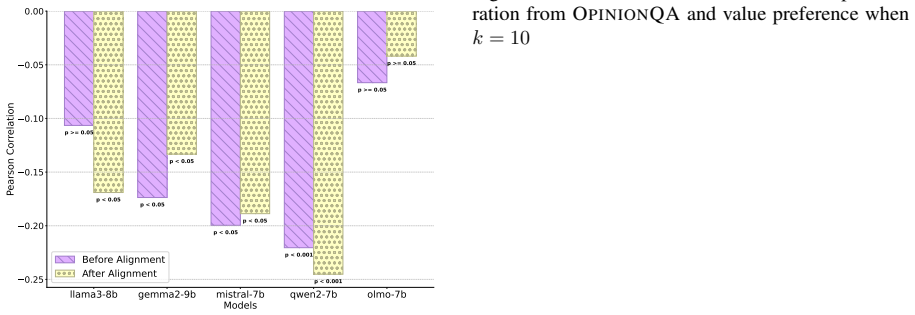
- [Figures 3-7 and Appendix B] Many reported correlations are in the 0.05-0.25 range; with 301 values these can reach p<0.05 while explaining under 6% of the variance. No confidence intervals are given, and no multiple-comparison correction is applied across the many models, k settings, and datasets. More importantly, claims such as "alignment improves consistency" (Section 4.1) are based on visual comparison of point estimates without a test of the difference between independent correlations. Please report confidence intervals for all correlations and, where pre/post alignment or k settings are compared, a proper test (e.g., Fisher's z or bootstrap) for the difference.
minor comments (5)
- [Abstract and Section 1] The text says 'five LLMs' but the study evaluates ten models (five base and five instruct variants); please rephrase to 'five model families' or list all ten models explicitly.
- [Section 4.2, Figures 13-17] Section 4.2 states that p-values are omitted and that results are significant for most models; please report the actual p-values (or confidence intervals) for Figure 4 and Figures 13-17.
- [Figure 17 caption] The caption says 'when k = 5' but the text in Appendix B.2 indicates Figures 15, 16, and 17 correspond to OPINION QA for k=5, 10, and 20; the caption should read k=20.
- [Section 3.2] The diversity metric is defined via compression ratio, but the link to 'representation across scenarios' is asserted rather than derived; please clarify how compression ratio operationalizes cross-scenario breadth.
- [Figure 10] The line 'Format: List supporting values: values that support the given argument' appears to belong to the value-assignment prompt of Figure 11 and is confusing in the argument-extraction prompt; please remove or relocate it.
Circularity Check
No significant circularity: the short/long-form comparison is an empirical correlation between independently elicited measures, and no load-bearing step reduces by construction to its own inputs.
full rationale
The paper's central claim is an empirical comparison between two independently elicited measures: short-form value preferences come from TrueSkill belief updates over binary dilemma decisions (Section 2.2), while long-form preferences come from the normalized position of a value's first argument in prompted outputs (Section 2.3). Neither quantity is fitted to the other, and the observed weak correlations could plausibly have been strong, so the headline result is not forced by construction. The long-form measure is defined as argument order, and the prompt instructs the model to order arguments by its own preferences; this is an operationalization choice rather than a circular derivation, because the short-form measure is obtained through a different procedure and the paper does not claim that order-based scores are validated independently of that instruction. The Limitations section candidly notes that gpt-4o-based value attribution may be biased, but annotation-bias risk concerns construct validity, not circularity; the paper does not use that limitation as evidence for its findings. The diversity and specificity analyses are correlations between separately computed attributes and preference scores, and while they share the same gpt-4o value assignments, there is no equation-level identity or fitted-parameter renaming that would make those correlations true by definition. Citations to prior work, such as Ye et al. (2025) for the vector representation and Chiu et al. (2024) for the dataset, are external sources rather than load-bearing self-citations by the present authors. Overall, the derivation chain is self-contained as an empirical study, and the appropriate finding is no significant circularity.
Assumptions & free parameters
free parameters (4)
- TrueSkill initial mean and variance (mu=25, sigma=8.333) =
mu=25, sigma=8.333
- TrueSkill performance variance beta and dynamics tau =
not specified
- Sampling temperature for long-form generation =
0.9
- GPT-4o model version and annotation prompt settings =
not pinned
assumptions (5)
- domain assumption The DAILYDILEMMAS action-value sets are accurate and exhaustive.
- domain assumption Value preferences can be modeled as Gaussian distributions and updated by TrueSkill.
- domain assumption Models order arguments according to their true value preferences when prompted.
- domain assumption GPT-4o annotations of arguments and values are accurate.
- domain assumption Compression ratio is a valid measure of diversity.
Cite this review
Pith. "Pith review of Do Language Models Think Consistently? A Study of Value Preferences Across Varying Response Lengths." pith.science (2026). https://pith.science/paper/2Z3TIFK4
@misc{pith2026250602481,
  author       = {Pith},
  title        = {Pith review of: Do Language Models Think Consistently? A Study of Value Preferences Across Varying Response Lengths},
  year         = {2026},
  howpublished = {\url{https://pith.science/paper/2Z3TIFK4}},
  note         = {Machine review of arXiv:2506.02481}
}
read the original abstract
Evaluations of LLMs' ethical risks and value inclinations often rely on short-form surveys and psychometric tests, yet real-world use involves long-form, open-ended responses -- leaving value-related risks and preferences in practical settings largely underexplored. In this work, we ask: Do value preferences inferred from short-form tests align with those expressed in long-form outputs? To address this question, we compare value preferences elicited from short-form reactions and long-form responses, varying the number of arguments in the latter to capture users' differing verbosity preferences. Analyzing five LLMs (llama3-8b, gemma2-9b, mistral-7b, qwen2-7b, and olmo-7b), we find (1) a weak correlation between value preferences inferred from short-form and long-form responses across varying argument counts, and (2) similarly weak correlation between preferences derived from any two distinct long-form generation settings. (3) Alignment yields only modest gains in the consistency of value expression. Further, we examine how long-form generation attributes relate to value preferences, finding that argument specificity negatively correlates with preference strength, while representation across scenarios shows a positive correlation. Our findings underscore the need for more robust methods to ensure consistent value expression across diverse applications.
Figures


Figures from the paper (25 more)



Forward citations
Cited by 1 Pith paper
-
Belief-Sim: Towards Belief-Driven Simulation of Demographic Misinformation Susceptibility
Conditioning LLMs on survey-derived demographic belief profiles improves their ability to predict individuals' misinformation judgments, especially when belief modeling is decoupled from susceptibility prediction.
Reference graph
Works this paper leans on
-
[1]
• Nodes are connected with directed edges, where an edge represents how one node supports another
Understand the Directed Tree Structure: • Each sentence or part of the argument is a node. • Nodes are connected with directed edges, where an edge represents how one node supports another. • The root of the tree is the most general statement in the argument, while leaves are the most specific points
-
[2]
• This path determines the specificity of the argument
Evaluate the Depth: • Identify the longest path in the tree from the root (the most general part of the argument) to any leaf (the most specific detail). • This path determines the specificity of the argument
-
[3]
Advances in Neu- ral Information Processing Systems, 36
Direct preference optimization: Your language model is secretly a reward model. Advances in Neu- ral Information Processing Systems, 36. Alexandre Rame, Guillaume Couairon, Corentin Dancette, Jean-Baptiste Gaya, Mustafa Shukor, Laure Soulier, and Matthieu Cord. 2023. Rewarded soups: towards pareto-optimal alignment by inter- polating weights fine-tuned on...
arXiv 2023
-
[4]
Evaluating the moral beliefs encoded in llms. Advances in Neural Information Processing Systems, 36. Chantal Shaib, Joe Barrow, Jiuding Sun, Alexa F Siu, Byron C Wallace, and Ani Nenkova. 2024. Stan- dardizing the measurement of text diversity: A tool and a comparative analysis of scores. arXiv preprint arXiv:2403.00553. Bangzhao Shu, Lechen Zhang, Minje ...
arXiv 2024
-
[5]
The steps for assigning the score are provided below:
Extremely specific; thorough, precise, and leaves little room for interpretation. The steps for assigning the score are provided below:
-
[7]
• 2: Somewhat detailed but still broad
Determine Specificity Level • 1: Argument is shallow, with minimal levels of detail (most general). • 2: Somewhat detailed but still broad. • 3: Moderate depth with balanced detail. • 4: Detailed and well-supported. • 5: Highly specific with deep supporting details (most specific). Figure 21: Prompt for assessing path-based specificity for an input argume...
-
[8]
Very vague or ambiguous; lacks detail and context
-
[9]
Somewhat clear but missing essential details or specificity
Show all 16 references
-
[10]
Moderately specific; provides sufficient detail to understand the core meaning
-
[11]
Very specific; well-defined, with clear context and details
-
[13]
Read and understand the input argument
-
[14]
Analyze the argument based on the following criteria: • Clarity: How easy is it to understand the argument? • Detail: How specific and thorough is the information provided? • Context: Does the argument provide adequate background or supporting details?
-
[15]
Compare the input against the scoring definitions to assign a score from 1 to 5
-
[16]
score": [1-5],
Provide a brief justification for the assigned score, using at least one or two of the criteria above to explain the rating. The output must be presented as a JSON object with the following structure: {"score": [1-5], "explanation": "Provide a brief explanation justifying the ...
-
[2022]
Advances in neural information processing systems, 35:28458–28473
When to make exceptions: Exploring lan- guage models as accounts of human moral judgment. Advances in neural information processing systems, 35:28458–28473. Grgur Kovaˇc, Masataka Sawayama, Rémy Portelas, Cé- dric Colas, Peter Ford Dominey, and Pierre-Yves Oudeyer. 2023. Large...
2023 arXiv
-
[2024]
arXiv preprint arXiv:2402.13887
Beyond probabilities: Unveiling the misalign- ment in evaluating large language models. arXiv preprint arXiv:2402.13887. Justin K Miller and Wenjia Tang. 2025. Evaluating llm metrics through real-world capabilities. arXiv preprint arXiv:2505.08253. Jared Moore, Tanvi Deshpande...
2025 arXiv
Reviewed August 7, 2026 · model on record in the stance chip above.
Discussion (0). Sign in to comment.