Near extremal RN-AdS control of holographic Josephson transport
Pith reviewed 2026-06-28 00:18 UTC · model grok-4.3
The pith
Near-extremal RN-AdS throats control holographic Josephson transport through AdS2 scaling of critical current.
A machine-rendered reading of the paper's core claim, the machinery that carries it, and where it could break.
Core claim
We formulate a holographic weak-link construction in which Josephson transport is controlled by the charge sector of a Reissner-Nordstrom-AdS black brane. The Josephson phase difference is defined from gauge-invariant boundary observable of the charged condensate. In the SNS regime the critical current and midpoint condensate probe the same proximity scale, while higher harmonics diagnose transparency. As extremality is approached, the emergent AdS2 times R2 region radially modifies the Josephson coupling before it reaches the ultraviolet boundary. After removing ordinary spatial suppression due to junction width, the residual critical current and phase stiffness exhibit scaling governed by
What carries the argument
The emergent AdS2 times R2 region in the near-extremal RN-AdS throat, which radially modifies the Josephson coupling before reaching the ultraviolet boundary.
If this is right
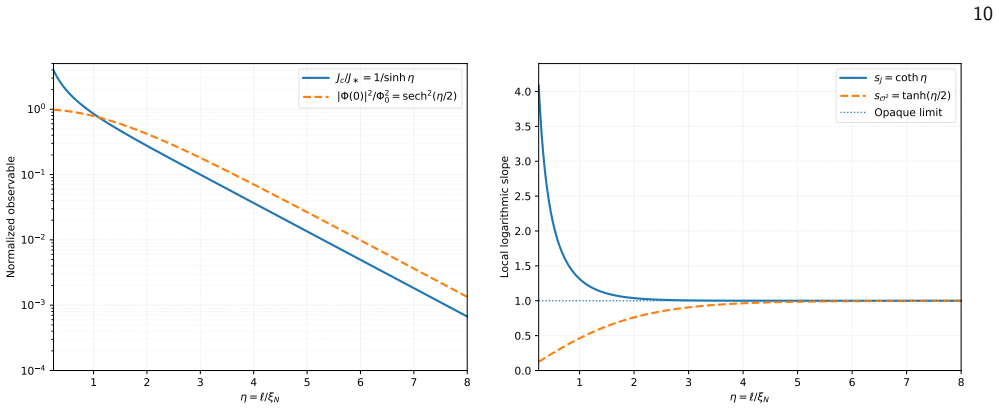
- In the SNS regime the critical current and midpoint condensate probe the same proximity scale.
- Higher harmonics in the current-phase relation diagnose enhanced transparency or departure from the opaque weak-link limit.
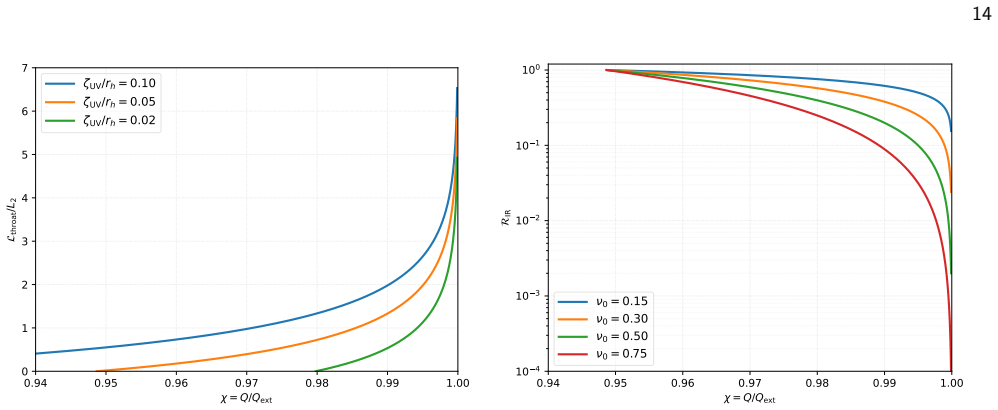
- After subtracting junction-width suppression the residual critical current scales with the infrared dimension of the charged scalar.
- The phase stiffness exhibits the same near-extremal scaling.
Where Pith is reading between the lines
- The same throat mechanism could be tested in other near-extremal geometries to check whether AdS2 control appears in different dimensions or matter content.
- Solving the model equations numerically would yield quantitative predictions for the scaling exponents that could be compared directly with the infrared dimension.
- The separation into proximity, density, and throat contributions might clarify which features of Josephson transport survive in strongly correlated charged matter beyond holography.
Load-bearing premise
The emergent AdS2 region radially modifies the Josephson coupling before it reaches the ultraviolet boundary in a manner that produces observable scaling in boundary observables.
What would settle it
A numerical computation of the critical current versus extremality parameter that fails to reproduce the scaling set by the infrared dimension of the charged scalar would falsify the throat-control claim.
Figures
read the original abstract
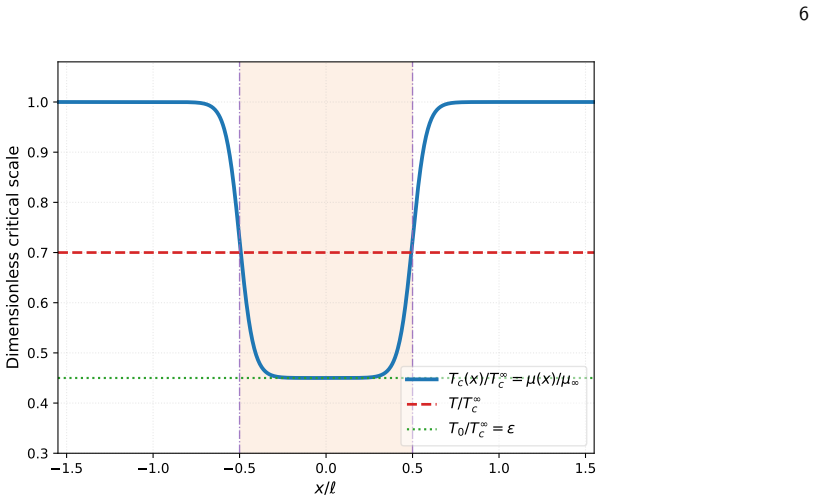
We formulate a holographic weak-link construction in which Josephson transport is controlled by the charge sector of a Reissner--Nordstrom-AdS black brane. The model is an Einstein-Maxwell-charged-scalar theory in asymptotically AdS$_4$, with a spatially inhomogeneous boundary chemical potential that creates two superconducting banks separated by a normal or weakly superconducting barrier. The Josephson phase difference is defined from gauge-invariant boundary observable of the charged condensate, rather than from the black hole charge itself, allowing a controlled extension of the standard holographic SNS junction to charged AdS backgrounds. We identify the current-phase relation, critical current, coherence length, and small-phase stiffness as the main observables. In the SNS regime, the critical current and midpoint condensate probe the same proximity scale, while higher harmonics in the current-phase relation diagnose enhanced transparency or departure from the opaque weak-link limit. The new mechanism is the near-extremal RN-AdS throat: as extremality is approached, the emergent AdS$_2\times\mathbb{R}^2$ region can radially modify the Josephson coupling before it reaches the ultraviolet boundary. After removing the ordinary spatial suppression due to the junction width, the residual critical current and phase stiffness are expected to exhibit scaling governed by the infrared dimension of the charged scalar in AdS$_2$. This separates ordinary proximity suppression, smooth finite-density corrections, and genuinely near-extremal throat control, providing a framework for phase-sensitive transport in charged holographic matter.
Editorial analysis
A structured set of objections, weighed in public.
Referee Report
Summary. The manuscript formulates a holographic weak-link construction in Einstein-Maxwell-charged-scalar theory in asymptotically AdS4, using a spatially inhomogeneous boundary chemical potential to create two superconducting banks separated by a normal or weakly superconducting barrier. It defines the Josephson phase difference from a gauge-invariant boundary observable of the charged condensate and identifies the current-phase relation, critical current, coherence length, and small-phase stiffness as observables. The central new claim is that the near-extremal RN-AdS throat (emergent AdS2×R2 region) radially modifies the Josephson coupling before it reaches the UV boundary; after subtracting ordinary junction-width suppression, the residual critical current and phase stiffness are expected to scale with the infrared dimension of the charged scalar in AdS2, separating proximity effects, finite-density corrections, and genuine near-extremal control.
Significance. If the proposed AdS2 scaling is explicitly derived and confirmed, the work supplies a controlled framework for phase-sensitive transport in charged holographic matter that isolates an infrared throat mechanism from standard proximity and density effects. This could be useful for extending holographic SNS junctions to finite-density settings and for testing IR-controlled observables in AdS/CFT applications to condensed-matter systems.
major comments (2)
- [Abstract / new mechanism] Abstract (new mechanism paragraph): the claim that the emergent AdS₂×R² region 'can radially modify the Josephson coupling before it reaches the ultraviolet boundary' and that the residual critical current 'is expected to exhibit scaling governed by the infrared dimension' is stated as an expectation rather than derived from an explicit near-extremal background solution, linearized fluctuation analysis around the throat, or UV-IR matching calculation. This is load-bearing for the central claim of throat control.
- [Observables / SNS regime] Section describing observables and the SNS regime: the assertion that 'after removing the ordinary spatial suppression due to the junction width, the residual critical current and phase stiffness' cleanly separate throat effects from proximity and finite-density corrections requires an explicit subtraction procedure and scaling relation; without the near-extremal derivation this separation remains unverified.
minor comments (2)
- [Model definition] Clarify how the gauge-invariant boundary observable for the phase difference is constructed from the charged condensate and why it is preferred over the black-hole charge.
- [Current-phase relation] The abstract refers to 'higher harmonics in the current-phase relation' diagnosing transparency; a brief statement of the expected functional form or diagnostic criterion would improve readability.
Simulated Author's Rebuttal
We thank the referee for the careful reading and for identifying the load-bearing aspects of the central claim. The comments correctly note that the near-extremal scaling is presented as an expectation rather than a fully derived result. We address each point below and indicate the changes we will make to the manuscript.
read point-by-point responses
-
Referee: [Abstract / new mechanism] Abstract (new mechanism paragraph): the claim that the emergent AdS₂×R² region 'can radially modify the Josephson coupling before it reaches the ultraviolet boundary' and that the residual critical current 'is expected to exhibit scaling governed by the infrared dimension' is stated as an expectation rather than derived from an explicit near-extremal background solution, linearized fluctuation analysis around the throat, or UV-IR matching calculation. This is load-bearing for the central claim of throat control.
Authors: We agree that the abstract states the AdS₂ scaling as an expectation based on the known infrared dimension of the charged scalar. The manuscript introduces the SNS construction in a charged background and identifies the observables, but does not perform the explicit throat fluctuation analysis or UV-IR matching. In the revised version we will rephrase the abstract to present the scaling as a conjectured mechanism motivated by AdS₂ dimensional analysis, and we will add a short paragraph in the main text sketching the expected Green's function scaling without claiming a completed derivation. This addresses the load-bearing concern by clarifying the status of the claim. revision: partial
-
Referee: [Observables / SNS regime] Section describing observables and the SNS regime: the assertion that 'after removing the ordinary spatial suppression due to the junction width, the residual critical current and phase stiffness' cleanly separate throat effects from proximity and finite-density corrections requires an explicit subtraction procedure and scaling relation; without the near-extremal derivation this separation remains unverified.
Authors: The separation is currently conceptual, distinguishing spatial (junction-width) suppression from additional radial throat effects. We accept that an explicit procedure is needed for verification. In revision we will define the residual quantities by explicit comparison to the non-extremal RN-AdS case at fixed width and density, and we will state the expected power-law dependence on the extremality parameter arising from the AdS₂ dimension. This makes the proposed separation more precise while acknowledging that full numerical confirmation lies beyond the present scope. revision: yes
Circularity Check
No significant circularity; scaling stated as expectation without load-bearing derivation
full rationale
The provided abstract and context present the AdS₂ scaling of residual critical current and phase stiffness as an expectation arising from the proposed near-extremal throat mechanism, without any explicit equations, matching calculations, or derivations that could reduce to fitted inputs, self-citations, or self-definitional steps. No load-bearing claims invoke prior author results as uniqueness theorems, rename known patterns, or smuggle ansatze via citation. The separation of proximity suppression, finite-density corrections, and throat control is framed as a new framework rather than a computed result, rendering the content self-contained with no circular reduction evident from the given material.
Axiom & Free-Parameter Ledger
axioms (2)
- domain assumption Einstein-Maxwell-charged-scalar theory in asymptotically AdS4 governs the bulk dynamics
- domain assumption Gauge-invariant boundary observable of the charged condensate correctly defines the Josephson phase difference
Reference graph
Works this paper leans on
-
[1]
1 +O ζT ζUV # .(69) Using Eq. (57), this may equivalently be written as a low-temperature power law at fixed ultraviolet matching scale, RIR(χ, T) = eCIR(χ) T ΛIR 2ν0
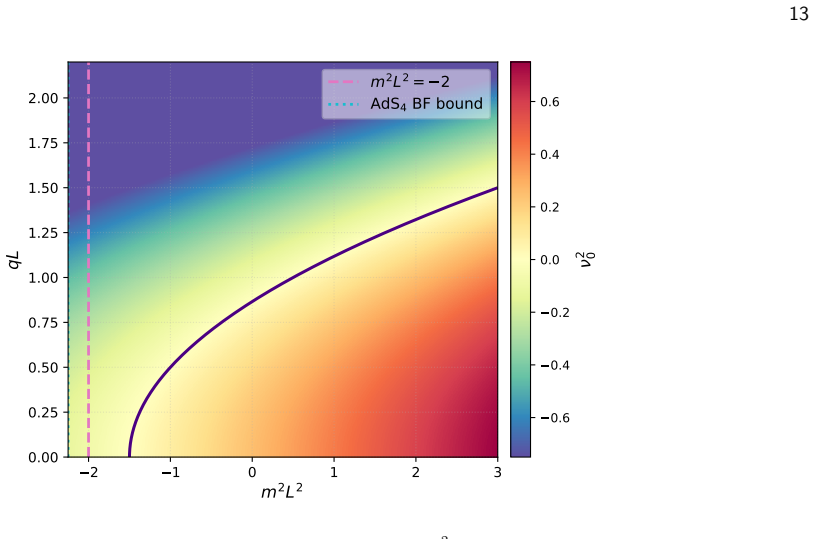
This throat is the geometric origin of the low-energy scaling effects that will later be connected to Josephson transport [34]. The charged scalar instability can be seen already at the linearized level. LetΨ = ψ(r)be real, static, and infinitesimal. Then Eq. (3) reduces to 1 r2 ∂r r2f ∂ rψ − m2 − q2A2 t f ! ψ= 0.(12) This equation shows that the gauge po...
-
[2]
J. M. Maldacena, The Large N limit of superconformal field theories and supergravity, Adv. Theor. Math. Phys.2, 231 (1998), arXiv:hep-th/9711200
Pith/arXiv arXiv 1998
-
[3]
S. S. Gubser, I. R. Klebanov, and A. M. Polyakov, Gauge theory correlators from noncritical string theory, Phys. Lett. B428, 105 (1998), arXiv:hep-th/9802109
Pith/arXiv arXiv 1998
-
[4]
Witten, Anti de Sitter space and holography, Adv
E. Witten, Anti de Sitter space and holography, Adv. Theor. Math. Phys.2, 253 (1998), arXiv:hep-th/9802150
Pith/arXiv arXiv 1998
-
[5]
S. A. Hartnoll, Lectures on holographic methods for condensed matter physics, Class. Quant. Grav.26, 224002 (2009), arXiv:0903.3246 [hep-th]
Pith/arXiv arXiv 2009
-
[6]
S. S. Gubser, Breaking an Abelian gauge symmetry near a black hole horizon, Phys. Rev. D78, 065034 (2008), arXiv:0801.2977 [hep-th]
Pith/arXiv arXiv 2008
-
[7]
S. A. Hartnoll, C. P. Herzog, and G. T. Horowitz, Building a Holographic Superconductor, Phys. Rev. Lett.101, 031601 (2008), arXiv:0803.3295 [hep-th]
Pith/arXiv arXiv 2008
-
[8]
S. A. Hartnoll, C. P. Herzog, and G. T. Horowitz, Holographic Superconductors, JHEP12, 015, arXiv:0810.1563 [hep-th]
-
[9]
J.-P. Wu, Y. Cao, X.-M. Kuang, and W.-J. Li, The 3+1 holographic superconductor with Weyl corrections, Phys. Lett. B697, 153 (2011), arXiv:1010.1929 [hep-th]
Pith/arXiv arXiv 2011
-
[10]
X.-M. Kuang, W.-J. Li, and Y. Ling, Holographic Superconductors in Quasi-topological Gravity, JHEP12, 069, arXiv:1008.4066 [hep-th]
-
[11]
X.-M. Kuang and E. Papantonopoulos, Building a Holographic Superconductor with a Scalar Field Coupled Kinematically to Einstein Tensor, JHEP08, 161, arXiv:1607.04928 [hep-th]
-
[12]
X.-M. Kuang, E. Papantonopoulos, G. Siopsis, and B. Wang, Building a Holographic Superconductor with Higher-derivative Couplings, Phys. Rev. D88, 086008 (2013), arXiv:1303.2575 [hep-th]
Pith/arXiv arXiv 2013
-
[13]
X.-M. Kuang, W.-J. Li, and Y. Ling, Holographic p-wave Superconductors in Quasi-topological Gravity, Class. Quant. Grav.29, 085015 (2012), arXiv:1106.0784 [hep-th]
Pith/arXiv arXiv 2012
-
[14]
D. Momeni, M. Raza, and R. Myrzakulov, Holographic superconductors with Weyl corrections, Int. J. Geom. Meth. Mod. Phys. 13, 1550131 (2016), arXiv:1410.8379 [hep-th]
Pith/arXiv arXiv 2016
-
[15]
J. Barrientos, N. C´ aceres, F. Diaz, and U. Hernandez-Vera, ModMax electrodynamics and holographic magnetotransport, Phys. Rev. D112, 086018 (2025), arXiv:2506.02884 [hep-th]
arXiv 2025
-
[16]
S. Gangopadhyay and D. Roychowdhury, Analytic study of properties of holographic superconductors in Born-Infeld electrodynamics, JHEP05, 002, arXiv:1201.6520 [hep-th]
-
[17]
S. Gangopadhyay and D. Roychowdhury, Analytic study of Gauss-Bonnet holographic superconductors in Born-Infeld electrody- namics, JHEP05, 156, arXiv:1204.0673 [hep-th]
-
[18]
A. Sheykhi, H. R. Salahi, and A. Montakhab, Analytical and Numerical Study of Gauss-Bonnet Holographic Superconductors with Power-Maxwell Field, JHEP04, 058, arXiv:1603.00075 [gr-qc]
-
[19]
A. Sheykhi, A. Ghazanfari, and A. Dehyadegari, Holographic conductivity of holographic superconductors with higher order corrections, Eur. Phys. J. C78, 159 (2018), arXiv:1712.04331 [hep-th]
Pith/arXiv arXiv 2018
-
[20]
S. I. Kruglov, Holographic Superconductors with Nonlinear Arcsin-Electrodynamics, Annalen Phys.530, 1800070 (2018), arXiv:1801.06905 [hep-th]
Pith/arXiv arXiv 2018
-
[21]
C. P. Herzog, An Analytic Holographic Superconductor, Phys. Rev. D81, 126009 (2010), arXiv:1003.3278 [hep-th]
Pith/arXiv arXiv 2010
-
[22]
C. P. Herzog and A. Yarom, Sound modes in holographic superfluids, Phys. Rev. D80, 106002 (2009), arXiv:0906.4810 [hep-th]. 17
Pith/arXiv arXiv 2009
-
[23]
C. P. Herzog, N. Lisker, P. Surowka, and A. Yarom, Transport in holographic superfluids, JHEP08, 052, arXiv:1101.3330 [hep-th]
-
[24]
C. P. Herzog and J. Ren, The Spin of Holographic Electrons at Nonzero Density and Temperature, JHEP06, 078, arXiv:1204.0518 [hep-th]
-
[25]
R. Emparan and C. P. Herzog, Large D limit of Einstein’s equations, Rev. Mod. Phys.92, 045005 (2020), arXiv:2003.11394 [hep-th]
arXiv 2020
-
[26]
C. P. Herzog, M. Spillane, and A. Yarom, The holographic dual of a Riemann problem in a large number of dimensions, JHEP08, 120, arXiv:1605.01404 [hep-th]
-
[27]
D. Momeni, H. Gholizade, M. Raza, and R. Myrzakulov, Holographic entanglement entropy in 2D holographic superconductor via AdS3/CF T2, Phys. Lett. B747, 417 (2015), arXiv:1503.02896 [hep-th]
Pith/arXiv arXiv 2015
-
[28]
S. Paul, G. Guin, and S. Gangopadhyay, Holographic entanglement entropy and complexity for the cosmological braneworld model, JHEP08, 164, arXiv:2505.11553 [hep-th]
-
[29]
D. Momeni, M. R. Setare, and N. Majd, Holographic superconductors in a model of non-relativistic gravity, JHEP05, 118, arXiv:1003.0376 [hep-th]
-
[30]
B. D. Josephson, Possible new effects in superconductive tunnelling, Phys. Lett.1, 251 (1962)
1962
-
[31]
K. K. Likharev, Superconducting weak links, Rev. Mod. Phys.51, 101 (1979)
1979
-
[32]
Barone and G
A. Barone and G. Patern` o,Physics and Applications of the Josephson Effect(Wiley, 1982)
1982
-
[33]
G. T. Horowitz, J. E. Santos, and B. Way, A Holographic Josephson Junction, Phys. Rev. Lett.106, 221601 (2011), arXiv:1101.3326 [hep-th]
Pith/arXiv arXiv 2011
-
[34]
Takeuchi, Holographic Superconducting Quantum Interference Device, Int
S. Takeuchi, Holographic Superconducting Quantum Interference Device, Int. J. Mod. Phys. A30, 1550040 (2015), arXiv:1309.5641 [hep-th]
arXiv 2015
-
[35]
T. Faulkner, H. Liu, J. McGreevy, and D. Vegh, Emergent quantum criticality, Fermi surfaces, and AdS(2), Phys. Rev. D83, 125002 (2011), arXiv:0907.2694 [hep-th]
Pith/arXiv arXiv 2011
-
[36]
Breitenlohner and D
P. Breitenlohner and D. Z. Freedman, Positive Energy in anti-De Sitter Backgrounds and Gauged Extended Supergravity, Phys. Lett. B115, 197 (1982)
1982
-
[37]
I. R. Klebanov and E. Witten, AdS / CFT correspondence and symmetry breaking, Nucl. Phys. B556, 89 (1999), arXiv:hep- th/9905104
arXiv 1999
discussion (0)
Sign in with ORCID, Apple, or X to comment. Anyone can read and Pith papers without signing in.