REVIEW 4 major objections 5 minor 44 references
A 2 mm thick pixelated silicon detector, run at room temperature with commercial electronics, is shown to be linear and stable enough to serve as the main electron spectrometer for a high-precision neutron beta-decay measurement.
Reviewed by Pith at T0; open to challenge. T0 means a machine referee read the full paper against a public rubric. the ladder, T0–T4 →
T0 review · deepseek-v4-flash
2026-08-02 03:55 UTC pith:324TB5JJ
load-bearing objection Solid, honest detector characterisation, but the photon linearity claim is stretched when applied to electrons without a proper electron-scale systematic budget. the 4 major comments →
Characterisation of a Thick Pixelated Silicon Detector for Electron Spectroscopy of Neutron Beta Decay
The pith
A machine-rendered reading of the paper's core claim, the machinery that carries it, and where it could break.
Core claim
Using six photon lines from 133Ba and 137Cs between 80 and 661 keV, the authors perform a simultaneous fit assuming a linear channel-energy relation; a second-order term contributes at the 10^-6 level and per-line fits show no systematic tension, so the detector is declared highly linear. Extending to electrons, the 975.651 keV conversion line of 207Bi is measured at 970.1(1) keV after a simulation-corrected air loss of about 4.3 keV, which the authors call reasonable agreement with the expected ~971.4 keV. The full-depletion voltage is found to be 50–60 V instead of the nominal 300 V, consistent with the doping inferred from capacitance measurements. The characterisation also quantifies cha
What carries the argument
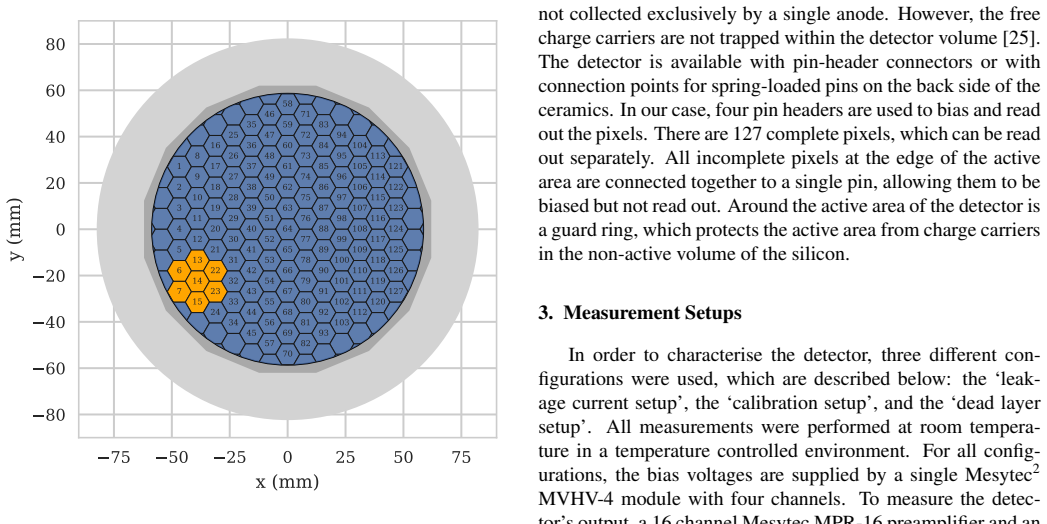
The central object is a 2 mm thick, 117 mm diameter pixelated silicon PIN detector whose entrance side is a continuous boron-doped layer (no insensitive dead region) and whose back side is divided into 127 hexagonal pixels with 100 µm gaps. The argument is carried by a simultaneous linear calibration fit to six photon lines, extended by one 975 keV electron point, together with a noise decomposition of the trapezoidal-filter resolution into parallel, series, and 1/f contributions and a two-/three-pixel coincidence analysis that maps charge sharing and cross-talk. The linear calibration model is the load-bearing identity: everything else—resolution, drift, dead layer, charge sharing—is assess
Load-bearing premise
That a linear energy calibration anchored on photon lines up to 661 keV plus one 975 keV electron point represents the full 0–782 keV electron response at the 10^-4 level; the authors could not cover the full range with an adequate source, and the 970.1(1) keV electron peak sits ~1.2 keV from the simulated expectation, a residual large compared with the goal.
What would settle it
Place an open, thin-foil 207Bi source in vacuum and measure the 975.651 keV K-line together with additional conversion lines down to about 480 keV; if each line's position deviates from a single linear calibration by more than the quoted systematic uncertainty, or if the K-line residual to the simulation-corrected prediction does not reproduce the ~1.2 keV offset, the linearity and calibration-uncertainty claims fail.
If this is right
- The detector can replace the planned plastic scintillator as the main electron detector, gaining about an order of magnitude in energy resolution (3.1 keV photons, 4 keV electrons) and far better linearity.
- Drift below 0.15 eV/h over 300 h means a single calibration can stay valid for long running campaigns.
- Fractional systematic calibration uncertainty of 2–8×10^-4 keeps the induced uncertainty on the beta-asymmetry parameter below 10^-4, and meets the O(10^-4) gain precision needed for a Fierz-term precision of 10^-3.
- The observed ~31% charge-sharing fraction and cross-talk shifts of 6.8 keV / 14.8 keV are significant for precision beta spectroscopy and require further investigation; this is the main caveat to using the current readout for the Fierz goal.
- The 123(6) nm dead layer shifts a 50 keV electron by only about 30 eV, so dead-layer effects are negligible for the electron measurement.
Where Pith is reading between the lines
- A natural next test is to calibrate with open, thin-foil conversion-electron sources under vacuum across 0–1 MeV; that would directly decide whether the linearity inferred from photon lines survives in the electron channel.
- If the cross-talk shift is indeed caused by femtofarad-level parasitic capacitance, reducing pin-header length or adding shielding between readout channels should shrink the 6.8/14.8 keV shifts and lower the charge-sharing loss fraction.
- Event-by-event reconstruction that sums energies of time-correlated neighbouring pixels could convert the charge-sharing 'loss' into a corrected full-energy peak; the paper does not demonstrate this, but the data it presents make the test straightforward.
- The factor-of-ten discrepancy between nominal and measured doping suggests production spread; a capacitance-voltage check on each detector unit would be a cheap quality-control gate before deploying a batch.
Editorial analysis
A structured set of objections, weighed in public.
Referee Report
Summary. The manuscript characterises a commercially available 2 mm thick pixelated silicon PIN detector (MSPX128) for use in electron spectroscopy of neutron beta decay in the PERC experiment. Measurements at room temperature cover leakage current, long-term stability, electronic noise, photon-energy calibration using 133Ba and 137Cs lines, signal rise time, electron response using 207Bi conversion electrons, charge sharing between pixels, and dead-layer thickness. The authors report good energy resolution (about 3.1 keV for photons, 4 keV for electrons), low drift, linear calibration with fractional systematic uncertainty 2–8e-4, and a dead layer of 123(6) nm. They conclude the detector is a viable upgrade for PERC but note that charge sharing/cross-talk at the percent level requires further study.
Significance. If the characterisation is trustworthy, this is a useful contribution to the development of precision beta-spectroscopy detectors. The measurements are careful and internally consistent: leakage currents are below 20 nA, drift is below 0.15 eV/h, and the simultaneous photon calibration with reduced chi-square 1.1–1.3 is well executed. The paper also provides an openly described analysis and cites external benchmark energies, so the calibration is not circular. The main significance is the quantitative assessment of whether a room-temperature, commercial silicon pixel detector can meet the 1e-4-level energy response required for the PERC Fierz-term goal. However, the current evidence is incomplete: the electron validation is limited to one conversion-electron point, the photon calibration range stops at 661 keV, and the charge-sharing effect is percent-level. Thus the paper supports the detector's potential but does not yet establish the full suitability claim.
major comments (4)
- [§4.4 and §5] The Summary states 'calibration uncertainty below 100 eV,' but §4.4 quotes a conservative fractional systematic uncertainty of 2...8×10^-4. At 782 keV, 8×10^-4 corresponds to about 0.6 keV, and at 1 MeV about 0.8 keV—far above 100 eV. Please reconcile the two statements and specify the energy at which the sub-100 eV claim applies.
- [§4.6] The only electron validation point is the 207Bi K conversion line: measured at 970.1(1) keV against a simulation-corrected expectation of ~971.4 keV (975.651 keV minus 4.3 keV air loss). The ~1.3 keV residual is roughly 1.3×10^-3 relative, more than an order of magnitude above the 1e-4 goal. The text calls this 'reasonable agreement' without assigning an uncertainty to the 4.3 keV air-loss correction or the response model. This residual and its uncertainty must be propagated into the quoted systematic error budget before the 1e-4-level electron response can be claimed.
- [§4.4, §4.6] The calibration function is assumed linear and anchored on photon lines up to 661 keV plus a single 975 keV electron point. The text explicitly states the full range up to 1 MeV could not be covered. A nonlinearity between 661 keV and 782 keV, or a difference between photon and electron response, would directly affect the beta-spectrum calibration. The authors should either provide an upper bound on such nonlinearity from the electron residual or restrict the claim of 'highly linear' to the calibrated photon range.
- [§4.7] Charge-sharing/cross-talk is found to affect about 31% of 975 keV electron events, with measured energy shifts of 6.8 keV and 14.8 keV for two- and three-pixel shared events. These effects are percent-level, far larger than the 1e-4 goal, and are not included in the electron calibration or the systematic uncertainty. The paper itself concludes 'requires further studies.' For the PERC Fierz-term projection, this is a load-bearing gap: the energy scale for electrons that experience charge sharing is not yet calibrated at the required level.
minor comments (5)
- [Abstract] The element should be written V_ud (subscript) for clarity.
- [§4.4] Typo: 'another another line at 53.1622 keV'—remove the duplicated word.
- [Figures 6, 7, 10] These figures are credited to [34], an unpublished thesis. The paper should be self-contained; at minimum, describe the key fitting features in the text or include the relevant plots in the main paper.
- [§4.6] The 4.3 keV air-loss correction is quoted without uncertainty. Please estimate and report its uncertainty, since it directly affects the electron validation residual.
- [§4.3] The optimal rise time is stated as ~4 µs from the fit, but 3 µs was chosen because it gave the narrowest width across pixels. Please clarify the discrepancy and the reason for the choice.
Circularity Check
No significant circularity: calibration is externally anchored; only a minor non-load-bearing self-citation ([34]) is noted.
full rationale
No circular reduction is present in the derivation chain. The energy calibration is anchored to externally tabulated photon energies (BIPM/DDEP [35,36]; Nuclear Data Sheets [17]), and the linearity claim is tested by a second-order term and by independent per-line fits, so it is not an assumption forced by definition. The electron validation compares the photon-calibrated 207Bi K-line to a PENELOPE air-loss simulation; the quoted 'reasonable agreement' with a residual is an acknowledged limitation (section 4.6), not a fitted-input prediction. The charge-sharing simulation in section 4.7 shares the 60 keV threshold with the analysis cut, but this is a selection criterion, not a parameter fit to the measured 31% fraction, so the 28% estimate is not equivalent to its input. The rise-time simulation in section 4.5 uses the manufacturer's C-V doping value as an external input, not as a fit to the measured rise times. The only self-citation affecting support is the first author's unpublished thesis [34] (figures, ADC integral nonlinearity); it is minor and not load-bearing, because the central calibration and resolution results are reported and testable in this paper. Score 2 reflects that non-load-bearing self-citation, not derivation circularity.
Axiom & Free-Parameter Ledger
free parameters (4)
- Charge-sharing analysis threshold E_cs =
60 keV
- Backscatter-peak shift correction =
34.7 eV
- Calibration gain and offset =
Delta g/g <= 7e-5; Delta t/t <= 4.5e-4
- Common electronic width sigma_electronic =
about 3.1 keV
axioms (8)
- domain assumption Reference photon and conversion-electron energies from evaluated nuclear data tables are correct (133Ba, 137Cs, 241Am, 207Bi).
- domain assumption Silicon detector response is linear in deposited energy over 0-1 MeV.
- domain assumption Fano factor F = 0.12 and pair-creation energy epsilon = 3.64 eV for silicon.
- domain assumption Step-function charge collection model for the dead layer.
- domain assumption PENELOPE electron/photon transport is correct for the air-loss (4.3 keV) and charge-sharing geometry calculations.
- domain assumption Atomic scattering and recombination contributions to pulse-height defect are angle-independent.
- domain assumption Parallel-plate signal formation with a uniform electric field models the rise time.
- ad hoc to paper Random coincidences are negligible in the charge-sharing selection.
Cite this review
Pith. "Pith review of Characterisation of a Thick Pixelated Silicon Detector for Electron Spectroscopy of Neutron Beta Decay." pith.science (2026). https://pith.science/paper/324TB5JJ
@misc{pith2026260713726,
  author       = {Pith},
  title        = {Pith review of: Characterisation of a Thick Pixelated Silicon Detector for Electron Spectroscopy of Neutron Beta Decay},
  year         = {2026},
  howpublished = {\url{https://pith.science/paper/324TB5JJ}},
  note         = {Machine review of arXiv:2607.13726}
}
read the original abstract
Silicon detectors are commonly used for spectroscopy of low-energy particles. For electrons in the 1 MeV range, a rather large thickness of 2mm is required to entirely stop the electrons and commercial options are scarce. With the instrument PERC at the FRM II, we aim to measure beta spectra from polarised and unpolarised neutrons in order to determine the axial-vector coupling constant, the element $V_\textrm{ud}$ of the Cabibbo-Kobayashi-Maskawa quark-mixing matrix, and to search for hypothetical scalar and tensor contributions. We present the characterisation of a commercially available, pixelated detector to assess its suitability to measure the entire electron energy spectrum of free neutron beta decay.
Figures


Reference graph
Works this paper leans on
-
[1]
D. Dubbers et al., A clean, bright, and versatile source of neutron decay products, Nuclear Instruments and Methods in Physics Research Section A: Accelerators, Spectrometers, Detectors and Associated Equipment 596 (2008) 238–247. doi:10.1016/j.nima.2008.07.157
-
[2]
Heinz Maier-Leibnitz Zentrum et al., MEPHISTO: Fa- cility for particle physics with cold neutrons, Journal of large-scale research facilities 1 (2015) A21. doi:10. 17815/jlsrf-1-48
2015
-
[3]
J. D. Jackson, S. B. Treiman, H. W. Wyld, Possible tests of time reversal invariance in beta decay, Physical Review 106 (1957) 517–521. doi:10.1103/PhysRev.106.517
-
[4]
B. Märkisch et al., Measurement of the weak axial- vector coupling constant in the decay of free neutrons us- ing a pulsed cold neutron beam, Physical Review Letters 122 (2019) 242501. doi:10.1103/PhysRevLett.122. 242501
-
[5]
C.-Y . Seng, M. Gorchtein, H. H. Patel, M. J. Ramsey- Musolf, Reduced hadronic uncertainty in the determina- tion ofV ud, Physical Review Letters 121 (2018) 241804. doi:10.1103/PhysRevLett.121.241804
-
[6]
Grossman, E
Y . Grossman, E. Passemar, S. Schacht, On the statis- tical treatment of the Cabibbo angle anomaly, Journal of High Energy Physics 2020 (2020) 68. doi:10.1007/ JHEP07(2020)068
2020
-
[7]
H. Saul et al., Limit on the Fierz interference term bfrom a measurement of the beta asymmetry in neu- tron decay, Physical Review Letters 125 (2020) 112501. doi:10.1103/PhysRevLett.125.112501
-
[8]
M. Beck et al., Reanalysis of theβ− νe angular corre- lation measurement from the aSPECT experiment with new constraints on Fierz interference, Physical Review Letters 132 (2024) 102501. doi:10.1103/PhysRevLett. 132.102501
-
[9]
X. Wang et al. (PERC collaboration), Design of the mag- net system of the neutron decay facility PERC, EPJ Web Conf. 219 (2019) 04007. doi:10.1051/epjconf/ 201921904007
doi:10.1051/epjconf/ 2019
-
[10]
C. R. Ziener, Das Spektrometer PERC zur Unter- suchung des Neutron-Beta-Zerfalls, Dissertation, Uni- versität Heidelberg, Heidelberg, 2014. doi:10.11588/ heidok.00017949
2014
-
[11]
K. L.-M. Bernert, Beta Spectroscopy in Neutron De- cay, Ph.D. thesis, Technische Universität München, 2025. URL:https://mediatum.ub.tum.de/1775529
arXiv 2025
-
[12]
Roick, D
C. Roick, D. Dubbers, B. Märkisch, H. Saul, U. Schmidt, Electron time-of-flight: A new tool inβ-decay spec- troscopy, Physical Review C 97 (2018). doi:10.1103/ PhysRevC.97.035502
2018
-
[13]
H. R. Zulliger, L. M. Middleman, D. W. Aitken, Linear- ity and resolution of semiconductor radiation detectors, IEEE Transactions on Nuclear Science 16 (1969) 47–61. doi:10.1109/TNS.1969.4325080
arXiv 1969
-
[14]
J. B. Birks, Scintillations from organic crystals: Specific fluorescence and relative response to different radiations, Proceedings of the Physical Society. Section A 64 (1951)
1951
-
[15]
H. Abele et al., A measurement of the beta asymmetryA in the decay of free neutrons, Physics Letters B 407 (1997) 212–218. doi:10.1016/S0370-2693(97)00739-9
-
[16]
B. Märkisch et al., The new neutron decay spectrom- eter PerkeoIII, Nuclear Instruments and Methods in Physics Research Section A: Accelerators, Spectrome- ters, Detectors and Associated Equipment 611 (2009) 216–218. doi:10.1016/j.nima.2009.07.066, Particle Physics with Slow Neutrons. 10
-
[17]
F. G. Kondev, S. Lalkovski, Nuclear data sheets forA= 207, Nuclear Data Sheets 112 (2011) 707–853. doi:10. 1016/j.nds.2011.02.002
2011
-
[18]
S. Seltzer, Stopping-powers and range tables for elec- trons, protons, and helium ions, NIST standard reference database 124, 1993. doi:10.18434/T4NC7P
doi:10.18434/t4nc7p 1993
-
[19]
doi:10.1787/ 32da5043-en
NEA, PENELOPE 2018: A code system for Monte Carlo simulation of electron and photon transport, in: Work- shop Proceedings, Barcelona, Spain, 28 January - 1 Febru- ary 2019, OECD Publishing, Paris, 2019. doi:10.1787/ 32da5043-en
2018
-
[20]
Baeßler et al., Study of neutron beta decay with the Nab experiment, EPJ Web Conf
S. Baeßler et al., Study of neutron beta decay with the Nab experiment, EPJ Web Conf. 303 (2024) 05001. doi:10. 1051/epjconf/202430305001
arXiv 2024
-
[21]
S. Baeßler et al. (pNAB collaboration), The pNAB exper- iment and the quest for ever better neutron beam polariza- tion, PoS PSTP2024 (2025) 066. doi:10.22323/1.472. 0066
-
[22]
L. J. Broussard et al., Detection system for neutronβde- cay correlations in the UCNB and Nab experiments, Nu- clear Instruments and Methods in Physics Research Sec- tion A: Accelerators, Spectrometers, Detectors and As- sociated Equipment 849 (2017) 83–93. doi:10.1016/j. nima.2016.12.030
doi:10.1016/j 2017
-
[23]
W. Wilburn et al., Measurement of neutron decay parame- ters - the abBA experiment, Journal of Research of the Na- tional Institute of Standards and Technology 110 (2005) 389–393. doi:10.6028/jres.110.058
-
[24]
A. Salas-Bacci et al., Characterization of large area, thick, and segmented silicon detectors for neutronβ-decay ex- periments, Nuclear Instruments and Methods in Physics Research Section A: Accelerators, Spectrometers, De- tectors and Associated Equipment 735 (2014) 408–415. doi:10.1016/j.nima.2013.09.059
-
[25]
L. Hayen et al., Precision pulse shape simulation for pro- ton detection at the Nab experiment, Physical Review C 107 (2023). doi:10.1103/PhysRevC.107.065503
-
[26]
R. J. Taylor et al., Characterization of low-energy ioniza- tion signals in silicon detectors for the Nab experiment, 2025.arXiv:2511.15912
Pith/arXiv arXiv 2025
-
[27]
H. Spieler, Semiconductor detector systems, volume 12 ofOxford science publications, repr ed., Oxford Univ. Press, Oxford, 2012. doi:10.1093/acprof:oso/ 9780198527848.001.0001
-
[28]
J. T. Routti, S. G. Prussin, Photopeak method for the com- puter analysis of gamma-ray spectra from semiconductor detectors, Nuclear Instruments and Methods 72 (1969) 125–142. doi:10.1016/0029-554X(69)90148-7
-
[29]
G. W. Phillips, K. W. Marlow, Automatic analysis of gamma-ray spectra from germanium detectors, Nuclear Instruments and Methods 137 (1976) 525–536. doi:10. 1016/0029-554X(76)90472-9
1976
-
[30]
J. L. Campbell, B. M. Millman, J. A. Maxwell, A. Pe- rujo, W. J. Teesdale, Analytic fitting of monoenergetic peaks from Si(Li) X-ray spectrometers, Nuclear Instru- ments and Methods in Physics Research Section B: Beam Interactions with Materials and Atoms 9 (1985) 71–79. doi:10.1016/0168-583X(85)90780-3
-
[31]
G. F. Knoll, Radiation detection and measurement, 4th ed., Wiley, Hoboken, NJ, 2010
2010
-
[32]
M. Lamparth, M. Bestehorn, B. Märkisch, Gaussian pro- cesses and Bayesian optimization for high precision ex- periments, 2022.arXiv:2205.07625
Pith/arXiv arXiv 2022
-
[33]
E. Gatti, P. Manfredi, M. Sampietro, V . Speziali, Sub- optimal filtering of 1/ƒ-noise in detector charge measure- ments, Nuclear Instruments and Methods in Physics Research Section A: Accelerators, Spectrometers, De- tectors and Associated Equipment 297 (1990) 467–478. doi:10.1016/0168-9002(90)91331-5
-
[34]
Lebert, A Silicon Detector for Free Neutronβ- Decay Spectroscopy, Ph.D
M. Lebert, A Silicon Detector for Free Neutronβ- Decay Spectroscopy, Ph.D. thesis, Technische Universität München, 2026. Unpublished
2026
-
[35]
Bé et al., Table of radionuclides (V ol
M.-M. Bé et al., Table of radionuclides (V ol. 8 - A= 41 to 198), volume 8 ofTable of radionuclides, Bureau International des Poids et Mesures, 2016. URL:https: //cea.hal.science/cea-02476462
2016
-
[36]
X. Mougeot et al., Evaluations of the decay data of 137mBa, 137Cs, 151Sm and 225Ac from the Decay Data Evaluation Project (DDEP)—2023, Metrologia 62 (2025) 029002. doi:10.1088/1681-7575/adb9de
-
[37]
F. M. Gonzalez et al. (Nab Collaboration), First full Dalitz plot measurement in neutronβdecay using the Nab spec- trometer and implications for new physics, Physical Re- view C 113 (2026) 035501. doi:10.1103/ksmp-zxsl
-
[38]
M. J. Berger, S. M. Seltzer, S. E. Chappell, J. C. Humphreys, J. W. Motz, Response of silicon detectors to monoenergetic electrons with energies between 0.15 and 5.0 MeV, Nuclear Instruments and Methods 69 (1969) 181–193. doi:10.1016/0029-554X(69)90411-X
-
[39]
E. Steinbauer et al., Energy resolution of silicon detec- tors: approaching the physical limit, Nuclear Instruments and Methods in Physics Research Section B: Beam In- teractions with Materials and Atoms 85 (1994) 642–649. doi:10.1016/0168-583X(94)95898-X
-
[40]
Bé et al., Table of Radionuclides (V ol
M.-M. Bé et al., Table of Radionuclides (V ol. 5 – A=22 to 244), volume 5 ofTable of radionuclides, Bureau In- ternational des Poids et Mesures, Pavillon de Breteuil, F- 92310 Sèvres, France, 2010. URL:https://cea.hal. science/cea-02476352. 11
2010
-
[41]
Pullia, D
A. Pullia, D. Weisshaar, F. Zocca, D. Bazzacco, Cross- talk limits of highly segmented semiconductor detectors, IEEE Transactions on Nuclear Science 58 (2011) 1201–
2011
-
[42]
M. Gugiatti et al., Characterisation of a silicon drift detector for high-resolution electron spectroscopy, Nu- clear Instruments and Methods in Physics Research Sec- tion A: Accelerators, Spectrometers, Detectors and As- sociated Equipment 979 (2020) 164474. doi:10.1016/j. nima.2020.164474. 12
arXiv 2020
-
[874]
doi:10.1088/0370-1298/64/10/303
-
[1205]
doi:10.1109/TNS.2011.2129530
arXiv 2011
discussion (0)
Sign in with ORCID, Apple, or X to comment. Anyone can read and Pith papers without signing in.