REVIEW 6 major objections 4 minor 44 references
Assessing the Capabilities and Limitations of FinGPT Model in Financial NLP Applications
T0 review · 6 major / 4 minor · reviewed 2026-08-06 · deepseek-v4-flash
Pith's one-line read FinGPT is strong at financial classification tasks but weak at reasoning and generation tasks, according to a six-task evaluation against GPT-4 and domain baselines.
desk verdict A genuinely new directional-bias analysis buried inside a benchmark whose comparative numbers don't hold up under inspection. read the letter →
The pith
A machine-rendered reading of the paper's core claim, the machinery that carries it, and where it could break.
The reading
What carries the argument
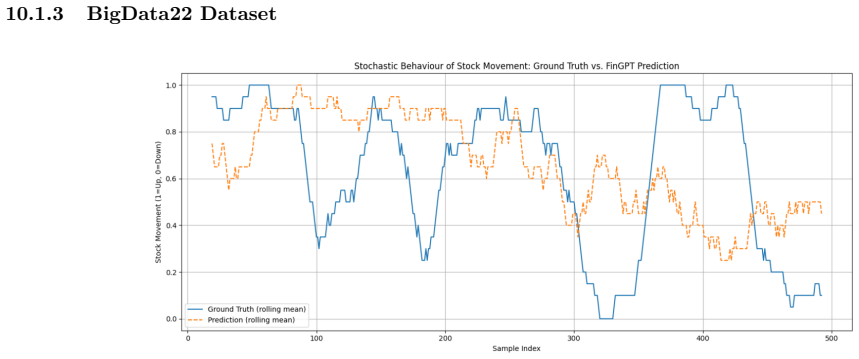
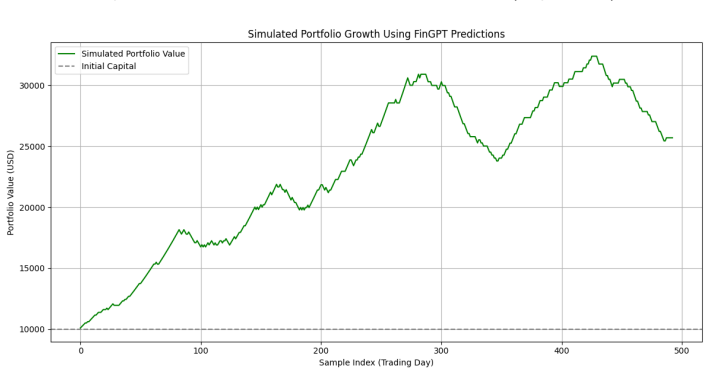
The evaluation is carried through FinGPT's four-layer framework of data source, data engineering, LLM, and applications, with LLaMA2 as the base model and finance-specific LoRA adapters supplying domain adaptation. The central diagnostic contrast is between structured classification tasks and reasoning or generation tasks, and the paper identifies the decoder-only causal attention mechanism as the limiting object for summarization and complex QA because it can only attend to past tokens. For stock movement, the key machinery is a newly introduced directional sensitivity analysis that compares FinGPT's alignment with bullish versus bearish trends and simulates long-only versus short-only trading portfolios.
What would settle it
A replication that runs GPT-4, FinMA 7B, and FinGPT through identical prompts, decoding parameters, test samples, and scoring code on FLARE-FPB and ConvFinQA would settle whether FinGPT's classification parity and QA deficit are genuine: if the QA gap shrinks dramatically or the classification parity disappears, the paper's central comparative claim fails.
Extended reading notes
Core claim
FinGPT reaches F1 scores of 87.62% on FLARE-FPB sentiment analysis and 95.50% on financial headline classification, slightly above the reported GPT-4 scores of 86% on both tasks. On the financial question answering datasets ConvFinQA and FLARE-FinQA, however, its exact match scores are 28.4% and 3.8%, versus GPT-4's 76% and 69% and human scores of 89% and 91%. The paper asserts that this gap is architectural: FinGPT is a decoder-only LLaMA2 model fine-tuned with LoRA adapters, and its causal attention cannot build the full-context representation that abstractive summarization and multi-step numerical reasoning require. It also reports a consistent bullish bias in stock movement prediction and proposes a directional sensitivity analysis that measures how well the model tracks upward versus downward market phases.
Load-bearing premise
The comparison assumes that the imported GPT-4, FinMA 7B, and human scores were produced under conditions equivalent to FinGPT's runs; if prompts, samples, preprocessing, or scoring differed, the relative strengths and gaps could change or vanish.
Editorial extensions
If this is right
- Financial sentiment analysis and headline classification pipelines can use FinGPT at accuracy levels comparable to GPT-4 while retaining the benefits of an open, lower-cost model.
- Multi-step numerical financial question answering should not be delegated to FinGPT, since exact match scores of 3.8% to 28.4% are far below GPT-4 and human performance.
- Text summarization of financial documents requires an encoder-decoder or retrieval-augmented architecture, because FinGPT's decoder-only attention does not capture the full document context needed for condensation.
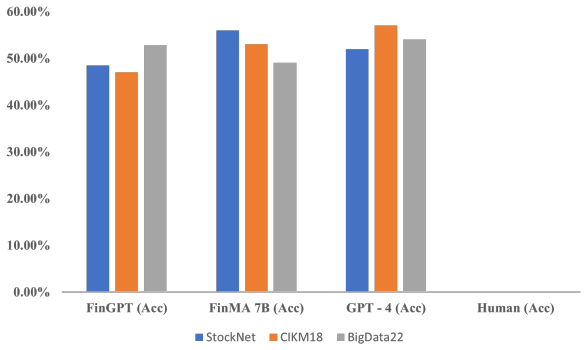
- Stock movement predictions from FinGPT carry a systematic bullish bias, so simulated long-only trading strategies outperform short-only strategies in the reported experiments.
- The six-task score table provides a reference benchmark that future financial large language model work can compare against directly.
Reading between the lines
- Because the GPT-4, FinMA 7B, and human numbers are imported from prior work rather than produced under the paper's exact prompts and decoding conditions, the comparative strengths and gaps should be treated as approximate until a same-condition rerun is done.
- The reported reasoning gap suggests a testable extension the paper does not try: adding chain-of-thought prompting or an external calculator to FinGPT may recover part of the ConvFinQA deficit without changing the architecture.
- The bullish bias in stock movement could come from the training distribution or label balance rather than from the model itself, so rebalancing fine-tuning data and checking calibration on bearish periods would separate those causes.
- A practical consequence the paper leaves implicit is model routing: financial systems could use FinGPT for high-volume classification tasks and reserve a stronger general model for reasoning-heavy queries.
Editorial analysis
A structured set of objections, weighed in public.
Referee Report
Summary. This paper evaluates FinGPT across six financial NLP tasks (sentiment analysis, text classification, named entity recognition, financial question answering, stock movement prediction, and summarization) using public finance datasets. The authors report that FinGPT achieves strong classification performance, sometimes comparable to GPT-4, but lags on reasoning-heavy QA and summarization. The evaluation uses FinGPT LoRA adapters with LLaMA-2 base models, compares against numbers imported from prior work for GPT-4, FinMA 7B, and human performance, and draws conclusions about architectural limitations of decoder-only models.
Significance. If the reported findings were methodologically sound, the paper would provide a useful multi-task benchmark for a widely used open-source financial LLM. The authors make a reasonable attempt to cover diverse tasks and real-world datasets, and they identify a plausible directional limitation of FinGPT in numerical reasoning and abstractive summarization. However, the current evidence is compromised by evaluation-protocol problems, unverified baseline comparability, and possible data circularity, so the paper does not yet establish its central comparative claims. The effort to include a directional sensitivity analysis for stock prediction is a positive feature, though it is not enough to offset the methodological issues.
major comments (6)
- [Table 2 and Section 6] The same FinGPT score on FLARE-FPB appears as 87.62 (F1) in Table 2 and 87.62% (Acc) in Table 3, while the GPT-4 comparison number is an imported F1 from prior work. Accuracy and F1 are not interchangeable, especially on class-imbalanced sentiment data, and no same-condition, same-metric runs of GPT-4 or FinMA 7B are reported. The abstract's claim that FinGPT 'often achieves results comparable to GPT-4' is therefore not supported by the evidence as presented.
- [Section 4.4.4] The NER max_new_tokens parameter was reduced from 64 to 34 because this improved macro F1 from 38% to approximately 69%, but no validation split is described. This constitutes tuning on the test set and inflates the NER result reported in Tables 2 and 5; the authors must either use a validation split or report the test-score selection bias explicitly.
- [Sections 4.3.2, 4.3.5, and 4.5.2] The evaluation excludes ambiguous outputs ('maybe'), 'unknown' outputs, and any example where either the prediction or the ground truth is not a valid number. The number and proportion of excluded samples are not reported. These post-hoc exclusions inflate the sentiment and QA scores and prevent unbiased interpretation of the F1 and EM results.
- [Sections 4.3.1, 4.4.1, and 4.5.1] The FinGPT Headline, FinGPT-NER, and ConvFinQA evaluation datasets are hosted by the FinGPT project, and the adapters used are from the same FinGPT project. The paper does not disclose whether the fine-tuning data of these adapters includes the evaluation splits. Without a demonstration of non-overlap, the strong classification and NER scores could reflect memorization rather than generalization; this is a load-bearing concern for the paper's conclusions.
- [Section 4.7 and Table 2] The summarization evaluation is entirely qualitative: Table 2 lists a dash for FinGPT, and Section 4.7 reports only that FinGPT 'failed to generate coherent or informative summaries.' No quantitative metric (e.g., ROUGE or BERTScore) or error-analysis statistics are provided, so the paper's claim that FinGPT is significantly limited in summarization is not supported by the quantitative evidence.
- [Section 4.5.1 and Table 6] The QA evaluation uses only the first 200 ConvFinQA and first 50 FLARE-FinQA test examples, with no confidence intervals or statistical comparison. A 3.8% EM on 50 examples corresponds to roughly two correct answers, making the reported gap to GPT-4's 69% EM fragile and not robust to sampling choice.
minor comments (4)
- [Tables 2 and 7] The FinGPT scores for the same stock movement datasets differ between Table 2 (e.g., CIKM18 45.00 F1) and Table 7 (47.03 Acc) without explanation; the relationship between these metrics should be clarified.
- [References] Reference [7] is labeled 'Cikm18 stock dataset' but points to the flare-sm-acl URL, which is described elsewhere as StockNet; the dataset citations need to be reconciled.
- [Section 2.1] The statement that 'accuracy and F1 often fall short in assessing financial task performance' is presented without support or follow-up; either cite relevant work or remove the claim.
- [Throughout] Some table and figure captions are minimal (e.g., Figure 8 and Figure 9 lack descriptive detail), and the paper would benefit from reporting the exact number of excluded samples in each filtering step.
Circularity Check
Partial circularity: NER macro F1 and FLARE-FinQA EM are partly constructed by test-set hyperparameter tuning and ground-truth-based answer selection; the headline 'comparable to GPT-4' claim is otherwise a comparability/evidence issue, not a circular one.
-
fitted input called prediction
[Section 4.4.4, Inference Procedure (NER)]
"Max New Tokens: Reduced from 64 to 34, which improved macro F1 from 38% to approximately 69%, minimizing hallucination."
The reported NER result (Table 5: 69.76 Entity F1) is obtained after choosing max_new_tokens by observing its effect on macro F1 on the same test set (98 examples used as-is per Section 4.4.1). The generation parameter is fitted to the test metric, so the final score is the maximum of the tuned values rather than an independent evaluation. Because the same test examples are used both to select the hyperparameter and to report the score, the improvement from 38% to 69% is by construction the result of test-set optimization, not a prediction of generalization.
-
fitted input called prediction
[Section 4.5.4, Inference Strategy (Financial QA)]
"For FLARE-FinQA, if multiple numbers were present, the one with the smallest absolute difference from the true value was used as the final prediction."
The reported EM score for FLARE-FinQA (3.8%) is computed after choosing, among several candidate numbers in the model output, the candidate closest to the ground-truth value. This selection uses the true answer to define the prediction, so the resulting exact-match score is partially constructed from the target it is meant to predict. Combined with Section 4.5.2's retention of only examples where both prediction and ground truth are valid numbers, the QA evaluation reduces to a best-case selection rather than a fixed decoding rule.
full rationale
The reported NER score is not an independent prediction: max_new_tokens was selected by watching macro F1 on the 98 test examples, so the jump from 38% to 69% is a test-set optimization artifact. The FLARE-FinQA EM is likewise partially built from ground truth, since the model's multiple numeric candidates are resolved by choosing the value closest to the true answer and then only valid-number pairs are scored. These are concrete reductions of reported results to their own targets, meeting the bar for partial circularity. The classification-strength claim (sentiment, headline) is not itself circular, since those numbers come from the paper's own runs and are not derived from GPT-4, but the comparison with GPT-4 and FinMA is unsupported because Table 2 and Table 3 mix Accuracy with F1 and import baseline scores from unknown conditions; that is a correctness and comparability problem rather than a definitional circle. No self-citation chain or dataset-overlap evidence is established, so the score is 6 rather than higher.
Assumptions & free parameters
free parameters (4)
- max_new_tokens (NER) =
34
- ConvFinQA sample size =
first 200 test examples
- FLARE-FinQA sample size =
first 50 test examples
- QA numeric filtering rule =
retain only numeric pairs
assumptions (4)
- domain assumption The numbers reported for GPT-4, FinMA 7B, and human performance are directly comparable to the FinGPT runs in this paper.
- domain assumption The LoRA adapters used (e.g., fingpt-mt_llama2-7b_lora) were not fine-tuned on the test datasets used in this evaluation.
- domain assumption Excluding 'unknown' and 'maybe' outputs does not bias the classification results.
- domain assumption The selected datasets are representative of the six financial NLP tasks.
Cite this review
Pith. "Pith review of Assessing the Capabilities and Limitations of FinGPT Model in Financial NLP Applications." pith.science (2026). https://pith.science/paper/32DIRQGG
@misc{pith2026250708015,
  author       = {Pith},
  title        = {Pith review of: Assessing the Capabilities and Limitations of FinGPT Model in Financial NLP Applications},
  year         = {2026},
  howpublished = {\url{https://pith.science/paper/32DIRQGG}},
  note         = {Machine review of arXiv:2507.08015}
}
read the original abstract
This work evaluates FinGPT, a financial domain-specific language model, across six key natural language processing (NLP) tasks: Sentiment Analysis, Text Classification, Named Entity Recognition, Financial Question Answering, Text Summarization, and Stock Movement Prediction. The evaluation uses finance-specific datasets to assess FinGPT's capabilities and limitations in real-world financial applications. The results show that FinGPT performs strongly in classification tasks such as sentiment analysis and headline categorization, often achieving results comparable to GPT-4. However, its performance is significantly lower in tasks that involve reasoning and generation, such as financial question answering and summarization. Comparisons with GPT-4 and human benchmarks highlight notable performance gaps, particularly in numerical accuracy and complex reasoning. Overall, the findings indicate that while FinGPT is effective for certain structured financial tasks, it is not yet a comprehensive solution. This research provides a useful benchmark for future research and underscores the need for architectural improvements and domain-specific optimization in financial language models.
Figures


Figures from the paper (14 more)







Reference graph
Works this paper leans on
-
[1]
Haisal Dauda Abubakar, Mahmood Umar, and Muhammad Abdullahi Bakale. Sentiment classification: Review of text vectorization methods: Bag of words, tf-idf, word2vec and doc2vec. SLU Journal of Science and Technology, 4(1):27–33, 2022
work page 2022
-
[2]
Ai in financial services: Fraud detection, algorithmic trading, and risk assessment
Moses Alabi. Ai in financial services: Fraud detection, algorithmic trading, and risk assessment. 2022
work page 2022
-
[3]
Ai competencies for internal auditors in the public sector.Edpacs, 69(1):3–21, 2024
Ceray Aldemİr and Tuğba Uçma Uysal. Ai competencies for internal auditors in the public sector.Edpacs, 69(1):3–21, 2024
work page 2024
-
[4]
Finbert: Financial sentiment analysis with pre-trained language models
Dogu Araci. Finbert: Financial sentiment analysis with pre-trained language models. arxiv 2019.arXiv preprint arXiv:1908.10063, 2019
arXiv 2019
-
[5]
Language models are few-shot learners
Tom Brown, Benjamin Mann, Nick Ryder, Melanie Subbiah, Jared D Kaplan, Prafulla Dhariwal, Arvind Neelakantan, Pranav Shyam, Girish Sastry, Amanda Askell, et al. Language models are few-shot learners. Advances in neural information processing systems, 33:1877–1901, 2020
1901
-
[6]
ChanceFocus. Flare-fiqa-sa: Financial sentiment dataset.https://huggingface.co/datasets/ChanceFocus/ flare-fiqasa, 2023. Accessed: 2025-06-10
work page 2023
-
[7]
ChanceFocus. Cikm18 stock dataset. https://huggingface.co/datasets/ChanceFocus/flare-sm-acl,
-
[8]
Flare-ectsum: Financial summarization dataset
ChanceFocus. Flare-ectsum: Financial summarization dataset. https://huggingface.co/datasets/ ChanceFocus/flare-ectsum, 2024. Accessed: 2025-06-10
work page 2024
Show all 44 references
-
[9]
Flare-finqa: Financial qa dataset
ChanceFocus. Flare-finqa: Financial qa dataset. https://huggingface.co/datasets/ChanceFocus/ flare-finqa, 2024. Accessed: 2025-06-10
2024
-
[10]
Stocknet dataset
ChanceFocus. Stocknet dataset. https://huggingface.co/datasets/ChanceFocus/flare-sm-stocknet,
-
[11]
How artificial intelligence is reshaping the financial services industry, 2024
Dr Kostis Chlouverakis. How artificial intelligence is reshaping the financial services industry, 2024
2024
-
[12]
Accessed: 2025-06-10
2025
-
[13]
Bert: Pre-training of deep bidirectional transformers for language understanding
Jacob Devlin, Ming-Wei Chang, Kenton Lee, and Kristina Toutanova. Bert: Pre-training of deep bidirectional transformers for language understanding. InProceedings of the 2019 conference of the North American chapter of the association for computational linguistics: human langua...
2019
-
[14]
An investigation of artificial intelligence application in auditing
Tamanna Abdul Rahman Dalwai, Araby Madbouly, and Syeeda Shafiya Mohammadi. An investigation of artificial intelligence application in auditing. InArtificial intelligence and COVID effect on accounting, pages 101–114. Springer, 2022
2022
-
[15]
Convfinqa dataset
FinGPT. Convfinqa dataset. https://huggingface.co/datasets/FinGPT/fingpt-convfinqa, 2024. Ac- cessed: 2025-06-10
2024
-
[16]
Enhancing financial risk management with federated ai
Vineet Dhanawat, Varun Shinde, Vishal Karande, and Kartik Singhal. Enhancing financial risk management with federated ai. In2024 8th SLAAI International Conference on Artificial Intelligence (SLAAI-ICAI), pages 1–6. IEEE, 2024
2024
-
[17]
Fingpt-ner dataset
FinGPT. Fingpt-ner dataset. https://huggingface.co/datasets/FinGPT/fingpt-ner, 2024. Accessed: 2025-06-10
2024
-
[18]
Fingpt-headline dataset
FinGPT. Fingpt-headline dataset. https://huggingface.co/datasets/FinGPT/fingpt-headline, 2024. Accessed: 2025-06-10
2024
-
[19]
Is chatgpt a financial expert? evaluating language models on financial natural language processing
Yue Guo, Zian Xu, and Yi Yang. Is chatgpt a financial expert? evaluating language models on financial natural language processing. arXiv preprint arXiv:2310.12664, 2023
2023 arXiv
-
[20]
MIT press Cambridge, 2016
Ian Goodfellow, Yoshua Bengio, Aaron Courville, and Yoshua Bengio.Deep learning, volume 1. MIT press Cambridge, 2016
2016
-
[21]
Analyzing the role of artificial intelligence in it audit: current practices and future prospects
U Iwuanyanwu, AJ Apeh, OR Adaramodu, EC Okeleke, and OG Fakeyede. Analyzing the role of artificial intelligence in it audit: current practices and future prospects. Computer Science & IT Research Journal, 4(2):54–68, 2023
2023
-
[22]
Finbert: A large language model for extracting information from financial text
Allen H Huang, Hui Wang, and Yi Yang. Finbert: A large language model for extracting information from financial text. Contemporary Accounting Research, 40(2):806–841, 2023. 20
2023
-
[23]
A survey of large language models in finance (finllms)
Jean Lee, Nicholas Stevens, Soyeon Caren Han, and Minseok Song. A survey of large language models in finance (finllms). arXiv preprint arXiv:2402.02315, 2024
2024 arXiv
-
[24]
A comprehensive review of generative ai in finance
David Kuo Chuen Lee, Chong Guan, Yinghui Yu, and Qinxu Ding. A comprehensive review of generative ai in finance. FinTech, 3(3):460–478, 2024
2024
-
[25]
Are chatgpt and gpt-4 general-purpose solvers for financial text analytics? a study on several typical tasks.arXiv preprint arXiv:2305.05862, 2023
Xianzhi Li, Samuel Chan, Xiaodan Zhu, Yulong Pei, Zhiqiang Ma, Xiaomo Liu, and Sameena Shah. Are chatgpt and gpt-4 general-purpose solvers for financial text analytics? a study on several typical tasks.arXiv preprint arXiv:2305.05862, 2023
2023 arXiv
-
[26]
Retrieval-augmented generation for knowledge- intensive nlp tasks.Advances in neural information processing systems, 33:9459–9474, 2020
Patrick Lewis, Ethan Perez, Aleksandra Piktus, Fabio Petroni, Vladimir Karpukhin, Naman Goyal, Heinrich Küttler, Mike Lewis, Wen-tau Yih, Tim Rocktäschel, et al. Retrieval-augmented generation for knowledge- intensive nlp tasks.Advances in neural information processing systems...
2020
-
[27]
A proposal for the dartmouth summer research project on artificial intelligence.WIRED, 2012
John McCarthy, Marvin Minsky, Nathaniel Rochester, and Claude Shannon. A proposal for the dartmouth summer research project on artificial intelligence.WIRED, 2012. Accessed: 2025-04-16
2012
-
[28]
Fingpt: Democratizing internet-scale data for financial large language models.arXiv preprint arXiv:2307.10485, 2023
Xiao-Yang Liu, Guoxuan Wang, Hongyang Yang, and Daochen Zha. Fingpt: Democratizing internet-scale data for financial large language models.arXiv preprint arXiv:2307.10485, 2023
2023 arXiv
-
[29]
Fino1: On the transferability of reasoning enhanced llms to finance.arXiv preprint arXiv:2502.08127, 2025
Lingfei Qian, Weipeng Zhou, Yan Wang, Xueqing Peng, Han Yi, Jimin Huang, Qianqian Xie, and Jianyun Nie. Fino1: On the transferability of reasoning enhanced llms to finance.arXiv preprint arXiv:2502.08127, 2025
2025 arXiv
-
[30]
Deep learning for financial applica- tions: A survey.Applied soft computing, 93:106384, 2020
Ahmet Murat Ozbayoglu, Mehmet Ugur Gudelek, and Omer Berat Sezer. Deep learning for financial applica- tions: A survey.Applied soft computing, 93:106384, 2020
2020
-
[31]
Generative adversarial networks applied to synthetic financial scenarios generation.Physica A: Statistical Mechanics and its Applications, 623:128899, 2023
Matteo Rizzato, Julien Wallart, Christophe Geissler, Nicolas Morizet, and Noureddine Boumlaik. Generative adversarial networks applied to synthetic financial scenarios generation.Physica A: Statistical Mechanics and its Applications, 623:128899, 2023
2023
-
[32]
Artificial intelligence and the evolution of finance: opportunities, challenges and ethical considerations.EdTech Journal, 3(1):20–23, 2023
Marko Ranković, Elena Gurgu, Oliva Martins, and Milan Vukasović. Artificial intelligence and the evolution of finance: opportunities, challenges and ethical considerations.EdTech Journal, 3(1):20–23, 2023
2023
-
[33]
Roformer: Enhanced transformer with rotary position embedding.Neurocomputing, 568:127063, 2024
Jianlin Su, Murtadha Ahmed, Yu Lu, Shengfeng Pan, Wen Bo, and Yunfeng Liu. Roformer: Enhanced transformer with rotary position embedding.Neurocomputing, 568:127063, 2024
2024
-
[34]
International Monetary Fund, 2023
Mr Ghiath Shabsigh and El Bachir Boukherouaa.Generative artificial intelligence in finance: Risk considera- tions. International Monetary Fund, 2023
2023
-
[35]
Flare-fpb: Financial phrase bank dataset
TheFinAI. Flare-fpb: Financial phrase bank dataset. https://huggingface.co/datasets/TheFinAI/ flare-fpb, 2023. Accessed: 2025-06-10
2023
-
[36]
Bigdata22 dataset.https://huggingface.co/datasets/TheFinAI/flare-sm-bigdata, 2023
TheFinAI. Bigdata22 dataset.https://huggingface.co/datasets/TheFinAI/flare-sm-bigdata, 2023. Ac- cessed: 2025-06-10
2023
-
[37]
Llama: Open and efficient foundation language models
Hugo Touvron, Thibaut Lavril, Gautier Izacard, Xavier Martinet, Marie-Anne Lachaux, Timothée Lacroix, Baptiste Rozière, Naman Goyal, Eric Hambro, Faisal Azhar, et al. Llama: Open and efficient foundation language models. arXiv preprint arXiv:2302.13971, 2023
2023 arXiv
-
[38]
Flare-fpb: Financial language analysis for real-world events - financial phrasebank
TheFinAI. Flare-fpb: Financial language analysis for real-world events - financial phrasebank. https:// huggingface.co/datasets/TheFinAI/flare-fpb, 2024. Accessed: 2025-05-18
2024
-
[39]
Bloomberggpt: A large language model for finance.arXiv preprint arXiv:2303.17564, 2023
Shijie Wu, Ozan Irsoy, Steven Lu, Vadim Dabravolski, Mark Dredze, Sebastian Gehrmann, Prabhanjan Kam- badur, David Rosenberg, and Gideon Mann. Bloomberggpt: A large language model for finance.arXiv preprint arXiv:2303.17564, 2023
2023 arXiv
-
[40]
Attention is all you need.Advances in neural information processing systems, 30, 2017
Ashish Vaswani, Noam Shazeer, Niki Parmar, Jakob Uszkoreit, Llion Jones, Aidan N Gomez, Łukasz Kaiser, and Illia Polosukhin. Attention is all you need.Advances in neural information processing systems, 30, 2017
2017
-
[41]
Fingpt: Open-source financial large language models
Hongyang Yang, Xiao-Yang Liu, and Christina Dan Wang. Fingpt: Open-source financial large language models. arXiv preprint arXiv:2306.06031, 2023
2023
-
[42]
Pixiu: A large language model, instruction data and evaluation benchmark for finance
Qianqian Xie, Weiguang Han, Xiao Zhang, Yanzhao Lai, Min Peng, Alejandro Lopez-Lira, and Jimin Huang. Pixiu: A large language model, instruction data and evaluation benchmark for finance. arXiv preprint arXiv:2306.05443, 2023. 21
2023 arXiv
-
[43]
Gpt (generative pre-trained transformer)–a comprehensive review on enabling technologies, potential applications, emerging challenges, and future directions.IEEE Access, 2024
Gokul Yenduri, M Ramalingam, G Chemmalar Selvi, Y Supriya, Gautam Srivastava, Praveen Kumar Reddy Maddikunta, G Deepti Raj, Rutvij H Jhaveri, B Prabadevi, Weizheng Wang, et al. Gpt (generative pre-trained transformer)–a comprehensive review on enabling technologies, potential ...
2024
-
[44]
Investlm: A large language model for investment using financial domain instruction tuning.arXiv preprint arXiv:2309.13064, 2023
Yi Yang, Yixuan Tang, and Kar Yan Tam. Investlm: A large language model for investment using financial domain instruction tuning.arXiv preprint arXiv:2309.13064, 2023
2023 arXiv
Reviewed August 6, 2026 · model on record in the stance chip above.
Discussion (0). Sign in to comment.