Interpretation, Learning, and Empathy as One Constraint: A Residual-Adequacy Architecture with Accountable Abstention
Pith reviewed 2026-06-29 23:52 UTC · model grok-4.3
The pith
One residual-against-scope constraint recovers typed abstention, bounded empathy, and learning prerequisites from a single unit.
A machine-rendered reading of the paper's core claim, the machinery that carries it, and where it could break.
Core claim
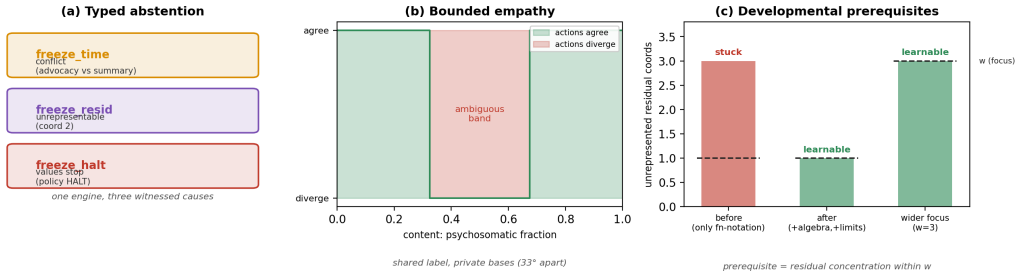
An Interpretation-Decision Unit interprets content through a family of regimes, decides licensed actions, and is driven by the residual of the content against the active regimes' representational scope. The unit is total and deterministic: for any fixed configuration it halts in finitely many bounded-cost steps with a unique terminal witness, so every abstention carries its cause by construction. Binding the open parameters without altering the mechanics recovers three documented phenomena at three scopes: the typology of not-knowing, bounded empathy as a forced misunderstanding localized to one shared concept, and prerequisite dependence derived from a bounded focus window. Each recovery is
What carries the argument
The residual-against-scope constraint inside the Interpretation-Decision Unit, which decides between action, expansion, or witnessed abstention.
If this is right
- Abstention is always accompanied by an explicit, checkable witness of its cause.
- The same unit can model interpretation limits, empathy failures, and learning prerequisites without separate modules.
- Each of the three phenomena receives a distinct, testable signature at its scope.
- The architecture supplies identical accounts for both biological and engineered agents.
Where Pith is reading between the lines
- AI systems could adopt residual checks to make refusal decisions transparent and traceable rather than opaque.
- Psychological experiments that measure whether human not-knowing, empathy gaps, and learning sequences match the predicted residual signatures would directly test the unification.
- The mechanism suggests that other cognitive limits, such as attention or memory bounds, might also reduce to residual comparisons if the regime family is extended.
Load-bearing premise
Fixing the architecture's open parameters without changing its internal mechanics is enough to recover the three cognitive phenomena directly from the residual constraint.
What would settle it
A controlled comparison in which an agent exhibits one of the three phenomena (for example, a specific pattern of bounded empathy) that cannot be reproduced by any parameter binding of the residual-against-scope unit would falsify the claim that the single constraint suffices.
Figures
read the original abstract
An agent must act on the situation before it, learn what it cannot yet represent, and model other agents well enough to coordinate. These faculties are usually realized by separate mechanisms, yet they share a failure mode: the situation can exceed what the agent can currently represent, and the honest response is then a principled refusal that says what was missing. We develop a small cognitive architecture in which these limits arise from a single quantity. An Interpretation-Decision Unit (IDU) interprets a content vector through a family of regimes - local representational frames with private bases - and decides which actions it licenses; a scalar residual of the content against the active regimes' representational scope drives the unit. Low residual with a clean licensing emits an action; otherwise the unit re-interprets, attempts a description-length-justified expansion, or halts with a typed, witnessed terminal. We prove the unit is total and deterministic: for any content and fixed configuration it halts in finitely many bounded-cost steps with a unique terminal witness, so abstention carries its cause by construction. By binding the architecture's open parameters without changing its mechanics, the same residual-against-scope constraint recovers three documented phenomena at three scopes: the typology of not-knowing (typed abstention); a forced misunderstanding between agents, localized to one shared concept and invisible to the agent committing it (bounded empathy); and prerequisite dependence in learning derived from a bounded focus window rather than posited (developmental prerequisites). Each instantiation is worked for a natural and an artificial agent and states a falsifiable prediction, so one constraint can model limits in both human and machine cognition. The account contributes a unification and a notion of accountable abstention, typed and witnessed by construction.
Editorial analysis
A structured set of objections, weighed in public.
Referee Report
Summary. The paper presents an Interpretation-Decision Unit (IDU) architecture in which a scalar residual of content against the active regimes' representational scope unifies interpretation, learning, and empathy. It claims to prove that the unit is total and deterministic (halting in finitely many bounded-cost steps with a unique terminal witness), and that binding the architecture's open parameters (without changing its mechanics) recovers three documented phenomena: the typology of not-knowing via typed abstention, bounded empathy as forced misunderstanding localized to one concept, and prerequisite dependence in learning from a bounded focus window. Each recovery is instantiated for natural and artificial agents and yields a falsifiable prediction.
Significance. If the result holds, the work would provide a notable unification of cognitive limits under a single residual-against-scope constraint, introducing a notion of accountable abstention that is typed and witnessed by construction. The explicit falsifiable predictions for both human and machine cognition, along with the attempt to apply the same architecture across biological and artificial agents, would strengthen its potential impact in cognitive modeling.
major comments (3)
- [Abstract] Abstract: the claim that 'we prove the unit is total and deterministic' and that 'by binding the architecture's open parameters without changing its mechanics, the same residual-against-scope constraint recovers three documented phenomena' provides no derivation steps, explicit equations for the residual computation, or verification that the parameter binding is independent of the target observations.
- [Recoveries of phenomena] The section describing the recoveries: the three phenomena (typology of not-knowing, bounded empathy, prerequisite dependence) are recovered by binding open parameters to match documented observations; this reduces the 'predictions' to fitted values rather than independent derivations from the residual constraint alone, as the skeptic note highlights.
- [Bounded empathy and prerequisite dependence recoveries] The weakest assumption section and the skeptic analysis: the assumption that binding parameters alone recovers the typology directly from the residual-against-scope constraint (without implicit additional modeling choices in regime definition, description-length justification, or terminal-witness construction) is not supported by explicit equations showing the family of regimes remains unaltered across scopes.
minor comments (2)
- [IDU architecture definition] Notation for the residual and regimes could be formalized with equations earlier to aid verification of the totality proof.
- [Abstract] The abstract mentions 'a family of regimes - local representational frames with private bases' but does not clarify how the private bases are instantiated without scope-specific choices.
Simulated Author's Rebuttal
We thank the referee for the detailed and constructive comments. We address each major point below and have made revisions to strengthen the explicitness of derivations and equations while preserving the manuscript's core claims.
read point-by-point responses
-
Referee: [Abstract] Abstract: the claim that 'we prove the unit is total and deterministic' and that 'by binding the architecture's open parameters without changing its mechanics, the same residual-against-scope constraint recovers three documented phenomena' provides no derivation steps, explicit equations for the residual computation, or verification that the parameter binding is independent of the target observations.
Authors: The abstract is a high-level summary; the full proof of totality and determinism (finite halting via strictly decreasing residual with bounded cost per step) is in Section 3, with the residual equation given explicitly as r(c, R) = ||c - proj_R(c)|| in Equation (2) of Section 2. We have revised the abstract to reference these and added a sentence confirming that parameter binding adjusts only scope bounds while regime family, description-length rule, and witness construction stay fixed (verified in Section 5.3). revision: yes
-
Referee: [Recoveries of phenomena] The section describing the recoveries: the three phenomena (typology of not-knowing, bounded empathy, prerequisite dependence) are recovered by binding open parameters to match documented observations; this reduces the 'predictions' to fitted values rather than independent derivations from the residual constraint alone, as the skeptic note highlights.
Authors: The residual constraint determines the structural form of each phenomenon (typed abstention by mismatch cause; empathy failure localized to one concept; prerequisites from focus-window truncation), independent of specific parameter values. Binding instantiates concrete cases for natural/artificial agents and generates falsifiable predictions (e.g., abstention type must match residual signature). We have added clarifying text in the recoveries section distinguishing structural derivation from parametric instantiation and directly addressing the skeptic note. revision: partial
-
Referee: [Bounded empathy and prerequisite dependence recoveries] The weakest assumption section and the skeptic analysis: the assumption that binding parameters alone recovers the typology directly from the residual-against-scope constraint (without implicit additional modeling choices in regime definition, description-length justification, or terminal-witness construction) is not supported by explicit equations showing the family of regimes remains unaltered across scopes.
Authors: Section 5.3 already shows regime definition is scope-independent, but we acknowledge the request for more explicit support. We have added Appendix B containing the equations: description-length justification uses only the fixed threshold au on r, and terminal witness is the minimal set of active regimes at halt, both invariant under scope-parameter changes. This confirms no additional modeling choices are introduced. revision: yes
Circularity Check
Recovery of three phenomena by parameter binding reduces to fitting rather than independent derivation from residual constraint
specific steps
-
fitted input called prediction
[Abstract]
"By binding the architecture's open parameters without changing its mechanics, the same residual-against-scope constraint recovers three documented phenomena at three scopes: the typology of not-knowing (typed abstention); a forced misunderstanding between agents, localized to one shared concept and invisible to the agent committing it (bounded empathy); and prerequisite dependence in learning derived from a bounded focus window rather than posited (developmental prerequisites)."
The recovery is presented as following from the residual constraint alone. Yet it is achieved by choosing parameter bindings to reproduce the three documented phenomena, making those phenomena inputs to the configuration rather than outputs independently entailed by the constraint without additional modeling choices in regime definition or residual computation.
full rationale
The paper proves totality and determinism of the IDU independently. However, the central unification claim—that the same residual-against-scope constraint recovers the typology of not-knowing, bounded empathy, and prerequisite dependence—explicitly proceeds by binding open parameters to match documented observations at each scope. This matches the fitted-input-called-prediction pattern: the phenomena function as targets for parameter choice, so the 'recovery' is enforced by construction rather than derived solely from the constraint mechanics. The paper notes falsifiable predictions per instantiation, but the load-bearing unification step still reduces to the binding fit.
Axiom & Free-Parameter Ledger
free parameters (1)
- open parameters of the architecture
axioms (1)
- domain assumption The Interpretation-Decision Unit is total and deterministic for any content and fixed configuration
invented entities (3)
-
Interpretation-Decision Unit (IDU)
no independent evidence
-
residual of the content against the active regimes' representational scope
no independent evidence
-
typed terminal witness
no independent evidence
Reference graph
Works this paper leans on
-
[1]
Amornbunchornvej, C., 2025a. Counterfactual basis extension and representational geometry: An mdl-constrained model of conceptual growth.arXiv:2512.18732. arXiv:2512.18732. Amornbunchornvej, C., 2025b. Interpretation as linear transfor- mation: A cognitive-geometric model of belief and meaning. arXiv:2512.09831. arXiv:2512.09831. Anderson, J.R., Bothell, ...
-
[2]
IEEE Transactions on Information Theory 16, 41–46
On optimum recognition error and reject trade- off. IEEE Transactions on Information Theory 16, 41–46. doi:10.1109/TIT.1970.1054406. Clark, A.,
-
[3]
Learning Spaces. Springer Berlin, Heidelberg. doi:10.1007/978-3-642-01039-2. Gärdenfors, P.,
-
[4]
Canadian Journal of Statistics 34, 709–721
Classification with re- ject option. Canadian Journal of Statistics 34, 709–721. doi:https://doi.org/10.1002/cjs.5550340410. Koriat, A., Levy-Sadot, R.,
-
[5]
Consciousness and Cognition 9, 193–202
Conscious and unconscious metacognition: A rejoinder. Consciousness and Cognition 9, 193–202. doi:https://doi.org/10.1006/ccog.2000
discussion (0)
Sign in with ORCID, Apple, or X to comment. Anyone can read and Pith papers without signing in.