REVIEW 4 major objections 5 minor 1 cited by
HyFedRAG proposes that a federated edge-cloud RAG pipeline, where clients keep raw patient data local and send only de-identified summaries, can outperform centralized RAG on heterogeneous, privacy-sensitive medical data while cutting infer
Reviewed by Pith at T0; open to challenge. T0 means a machine referee read the full paper against a public rubric. the ladder, T0–T4 →
HyFedRAG is a federated RAG framework over heterogeneous data with local anonymization and three-tier caching, but the experiments do not support its headline performance and privacy claims.
T0 review reviewed 2026-08-04 challenge →
load-bearing objection HyFedRAG builds a plausible federated RAG architecture and shows strong text-only retrieval numbers, but the headline claim about the full framework is not supported by any end-to-end experiment. the 4 major comments →
HyFedRAG: A Federated Retrieval-Augmented Generation Framework for Heterogeneous and Privacy-Sensitive Data
The pith
A machine-rendered reading of the paper's core claim, the machinery that carries it, and where it could break.
The reading
Core claim
On its own terms, the paper's central claim is that privacy and performance do not have to trade off in federated RAG: if each participating client converts its raw, format-specific data into standardized, de-identified summaries with a local LLM, a cloud-side LLM can fuse those summaries and produce answers at least as good as centralized systems that see the raw data. The evidence offered is a set of experiments on PMC-Patients: HyFedRAG's text pipeline reaches 39.63 MRR, 7.48 P@10, and 41.33 nDCG@10, against a best baseline of 27.76 MRR, 6.96 P@10, and 24.12 nDCG@10; the SQL and knowledge-graph variants degrade substantially (23.01 and 9.79 MRR respectively), which the paper attributes to
What carries the argument
The load-bearing mechanism is an edge-cloud collaboration in which each client runs format-specific retrieval (a sparse-dense hybrid with reranking for text, entity matching plus graph traversal for knowledge graphs, and full-text search plus deep reranking for SQL) and then a local LLM produces a privacy-preserving summary of the retrieved records. Three anonymization layers are offered—named-entity masking for coarse de-identification, attribution-aware erasure that removes spans not needed for the query, and homomorphic encryption for feature-level protection—so that only sanitized summaries leave the client. A server-side LLM fuses these summaries into the final answer. The efficiency co
Load-bearing premise
The load-bearing premise is that locally produced de-identified summaries preserve enough clinical meaning for the server-side LLM to fuse them into correct global answers; the paper never directly measures the information lost between raw records and those summaries.
What would settle it
Compare end-to-end retrieval and generation accuracy on PMC-Patients queries when the server receives HyFedRAG's anonymized summaries versus when it receives raw (or minimally redacted) records; if the accuracy gap is large, the federated privacy design cannot deliver the claimed performance, and if the gap is negligible, the assumption holds.
If this is right
- Cross-institution clinical question answering can proceed without moving raw records: only de-identified summaries cross the network, which is a precondition for GDPR/HIPAA-style settings.
- Hybrid retrieval with a tunable fusion weight improves over pure lexical or pure semantic retrieval; the paper finds the optimum near alpha=0.8.
- Structured data formats (SQL, knowledge graphs) lose retrieval quality compared with free text, so federated RAG over structured sources needs additional semantic augmentation to be clinically useful.
- Three-tier caching with neighborhood prefetching can reduce latency by roughly 80% in simulated federated workloads, making edge-cloud RAG practical on modest hardware.
- The same architecture can be assembled from off-the-shelf components: local embedding models, rerankers, local LLMs, and a federated orchestration layer.
Where Pith is reading between the lines
- The strongest unmeasured quantity is information loss: the paper does not directly compare raw records against their de-identified summaries for downstream answer quality, so a natural next experiment is to measure retrieval and generation accuracy as a function of summary compression.
- The three-tier caching design is not specific to medicine; it should transfer to any federated RAG deployment, and a benchmark on legal or financial heterogeneous data would test whether the 80% latency reduction generalizes.
- The privacy evaluation relies on an LLM judge scoring redaction output; a stricter test would attempt re-identification attacks against the summaries or measure residual private information in the fused answer itself.
- Because structured formats perform worst, a plausible extension is format-aware summary generation—learning what to preserve from SQL schemas or graph neighborhoods rather than applying the same text-oriented anonymization pipeline to all modalities.
Editorial analysis
A structured set of objections, weighed in public.
Referee Report
Summary. HyFedRAG proposes a federated retrieval-augmented generation framework for heterogeneous, privacy-sensitive medical data. The architecture combines edge-side local retrievers over text, SQL, and knowledge-graph sources; privacy-preserving summarization via Presidio, Eraser4RAG, and TenSEAL; server-side LLM fusion of de-identified summaries; and a three-tier cache. The paper reports retrieval results on PMC-Patients for a text-only retriever (Table 1), per-modality retrieval (Table 2), GEval privacy scores for redacted outputs, and a cache simulation that is claimed to reduce inference latency by up to 80%. The central claim is that HyFedRAG outperforms centralized baselines and existing methods in retrieval quality, generation consistency, and system efficiency.
Significance. The architecture addresses a real and timely problem: enabling RAG across heterogeneous, privacy-protected medical data without centralizing raw records. The edge-cloud design, the combination of multiple privacy tools, and the multi-tier cache are sensible components. If supported by a rigorous end-to-end evaluation, the framework could be a useful contribution. As it stands, however, the experiments exercise only individual components—a text retriever, per-modality retrievers, a privacy scorer, and a cache simulation—rather than the proposed federated pipeline. Moreover, the reported retrieval gains rely partly on test-set parameter selection. The paper includes no code or reproducibility package. The demonstrated significance is therefore substantially lower than the claims in the abstract and conclusion.
major comments (4)
- [Section 3.1, Section 4 Experiments, Tables 1-2] The central claim that HyFedRAG outperforms centralized baselines in generation consistency and system efficiency is not tested end-to-end. Section 3.1 describes a full pipeline with multiple clients, local anonymized summarization, and server-side fusion, but no experiment instantiates this configuration. Table 1 reports only text retrieval against text retrievers; Table 2 reports per-modality retrieval for Text, SQL, and KG separately. There is no multi-client setup, no server-side fusion step, no generation output, and no comparison to a centralized RAG system over the same heterogeneous data. Consequently the abstract's claims about 'generation consistency' and outperforming centralized baselines are unsupported by the presented evidence.
- [Section 4.3, Figure 7, Eq. (1)] The fusion weight alpha in Eq. (1) is selected from the evaluation set. Section 4.3 states that 'performance peaks at alpha=0.8' on MRR and nDCG@10, and Figure 7 displays the retrieval metrics as a function of alpha. The Table 1 'HyFedRAG(text)' results appear to use this peak value. No validation split or model-selection procedure is described, and the baselines are not given the same test-set tuning. This makes the reported relative gains a test-set-fitted quantity and overstates the generalizable improvement.
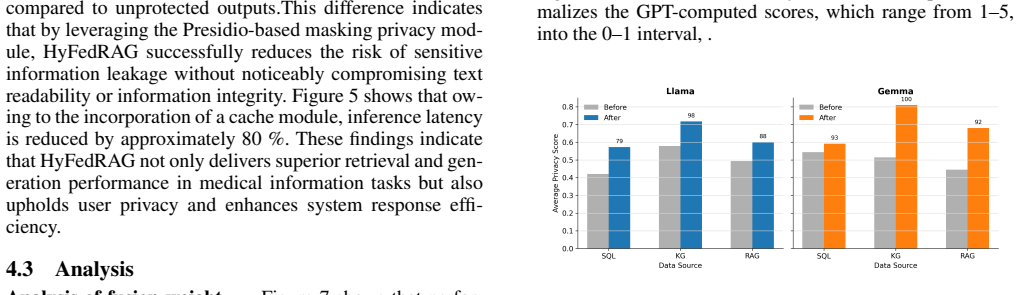
- [Section 3.4, Figure 4, Table 2] The privacy-utility tradeoff is not measured for the downstream generation task. Section 3.4 asserts that local LLMs produce 'de-identified, semantically rich representations suitable for global reasoning,' but Figure 4 only reports GEval privacy scores of redacted outputs. The paper does not measure whether anonymized summaries preserve enough information for the server-side LLM to answer queries correctly, nor does it compare generation quality with and without anonymization. Table 2 already shows large retrieval degradation for SQL and KG formats, indicating that format transformations can lose semantics; the additional effect of de-identification on answer quality is left unquantified, so the privacy-preservation claim does not establish utility.
- [Section 4.3, Figures 5-6] The 80% latency reduction claim is based on a simulation, not on measurements of the deployed HyFedRAG system. Section 4.3 says query sequences were 'generated via a random-walk process' and that a hierarchical cache was 'employed' to record hit/miss rates. Figure 6 reports cache hit rates, and Figure 5 is presented as 'inference latency comparison,' but no actual end-to-end latency measurement over the edge-cloud architecture is reported. The cache simulation parameters (100 warm-up, 500 test requests, LRU policies, prefetch depths) are also not validated against real workloads. The 'system efficiency' contribution is therefore not empirically established.
minor comments (5)
- [Table 1, Section 4.2] The row labeled 'Relative gain' gives +11.87, +0.52, +17.21, but these are absolute percentage-point differences (e.g., 39.63 - 27.76 = 11.87), not relative gains. The text in Section 4.2 also says '1.87 %' where Table 1 shows 11.87. Please correct the labeling and the numbers.
- [Section 4.3] The text says that 'MRR falls to 0.54 and nDCG@10 to 0.63' when alpha=1.0, but Table 1 reports MRR and nDCG@10 on a percentage scale (39.63% and 41.33%). The units are inconsistent and should be unified.
- [Section 3.4, Section 4.2] The paper lists Eraser4RAG and TenSEAL as supported privacy tools and counts them as a contribution, but the experiments only evaluate Presidio ('Anonymization is performed using the Presidio privacy protection toolkit'). No results are reported for the other two tools, so their effectiveness is unverified.
- [Figures 4-6] Figures 4 and 5 are referenced without numerical values, error bars, or axis definitions. The claimed improvements would be easier to assess if the underlying numbers and evaluation protocol were reported.
- [Section 4.3] The cache simulation uses ad-hoc parameters (100 warm-up and 500 test requests, random-walk restart, dwell, and session-memory mechanisms). No sensitivity analysis or justification is given for these choices, and it is unclear how well they approximate real clinical query workloads.
Circularity Check
Retrieval superiority is partially an in-sample fit: the reported HyFedRAG(text) metrics use α=0.8, the value selected by peaking the same evaluation metrics.
specific steps
-
fitted input called prediction
[Section 3.3 Eq. (1); Section 4.3 'Analysis of fusion weight α'; Table 1]
"Score(q, d) = α cos_tfidf(q, d) + (1−α) s_reranker(q, d) (1) ... Figure 7 shows that performance peaks at α = 0.8: increasing α from 0.0 to 0.8 improves both MRR and nDCG@10, while further raising it to 1.0 degrades them."
Table 1 reports HyFedRAG(text) as achieving 39.63% MRR, 7.48% P@10, and 41.33% nDCG@10. These are the values obtained at α=0.8, the interpolation weight that Section 4.3 selects by maximizing exactly those retrieval metrics on the evaluation set. Eq. (1) defines the retriever score as a convex combination of a lexical score and a semantic score with free parameter α, and the paper does not describe any held-out validation procedure for choosing α. Consequently, the reported 'prediction' that HyFedRAG outperforms baselines is not an out-of-sample result of a fixed pipeline; it is the in-sample optimum of a fitted interpolation weight. The headline retrieval gains are therefore partly selected rather than independently predicted.
full rationale
The paper's main retrieval claim reduces, in part, to an in-sample hyperparameter fit: Eq. (1) introduces α and Section 4.3 chooses α=0.8 because it maximizes the same MRR and nDCG@10 values that Table 1 reports as HyFedRAG's performance. Since no validation split is stated, the 'prediction' of superiority is not independent of the data used to pick α. The other components—GEval privacy scores, cache hit-rate simulations, and per-modality retrieval tables—are measurements or simulations rather than definitional reductions, though the absence of an end-to-end federated generation experiment and the conflation of simulated cache hits with measured latency are serious evidence gaps. Self-citations to Eraser4RAG and related prior work are present but not load-bearing for the reported experiments, which use Presidio for anonymization, and no uniqueness theorem is invoked. Overall, the partial circularity from fitting α on the evaluation benchmark warrants a score of 6, while the broader unsupported central claims are better classified as correctness risks than as circularity.
Axiom & Free-Parameter Ledger
free parameters (4)
- alpha (fusion weight, Eq. 1 and Eq. 2) =
0.8 (best on eval set, Figure 7)
- lambda_1..lambda_4 (SQL fusion weights, Eq. 3) =
not disclosed (manually tuned)
- tau (KG semantic matching threshold) =
0.9 (example)
- Query sequence parameters for cache simulation =
100 warm-up + 500 test requests, random-walk with restart/dwell/session-memory
axioms (4)
- domain assumption Flower provides correct and secure aggregation of client-side representations
- domain assumption Local LLMs and rerankers preserve retrieval utility after Presidio anonymization
- domain assumption The PMC-Patients subset and LLM-constructed KG are representative and correct
- domain assumption GPT-4o via GEval yields valid privacy and consistency judgments
Cite this review
Pith. "Pith review of HyFedRAG: A Federated Retrieval-Augmented Generation Framework for Heterogeneous and Privacy-Sensitive Data." pith.science (2026). https://pith.science/paper/33772UN7
@misc{pith2026250906444,
  author       = {Pith},
  title        = {Pith review of: HyFedRAG: A Federated Retrieval-Augmented Generation Framework for Heterogeneous and Privacy-Sensitive Data},
  year         = {2026},
  howpublished = {\url{https://pith.science/paper/33772UN7}},
  note         = {Machine review of arXiv:2509.06444}
}
read the original abstract
Centralized RAG pipelines struggle with heterogeneous and privacy-sensitive data, especially in distributed healthcare settings where patient data spans SQL, knowledge graphs, and clinical notes. Clinicians face difficulties retrieving rare disease cases due to privacy constraints and the limitations of traditional cloud-based RAG systems in handling diverse formats and edge devices. To address this, we introduce HyFedRAG, a unified and efficient Federated RAG framework tailored for Hybrid data modalities. By leveraging an edge-cloud collaborative mechanism, HyFedRAG enables RAG to operate across diverse data sources while preserving data privacy. Our key contributions are: (1) We design an edge-cloud collaborative RAG framework built on Flower, which supports querying structured SQL data, semi-structured knowledge graphs, and unstructured documents. The edge-side LLMs convert diverse data into standardized privacy-preserving representations, and the server-side LLMs integrates them for global reasoning and generation. (2) We integrate lightweight local retrievers with privacy-aware LLMs and provide three anonymization tools that enable each client to produce semantically rich, de-identified summaries for global inference across devices. (3) To optimize response latency and reduce redundant computation, we design a three-tier caching strategy consisting of local cache, intermediate representation cache, and cloud inference cache. Experimental results on PMC-Patients demonstrate that HyFedRAG outperforms existing baselines in terms of retrieval quality, generation consistency, and system efficiency. Our framework offers a scalable and privacy-compliant solution for RAG over structural-heterogeneous data, unlocking the potential of LLMs in sensitive and diverse data environments.
Figures




Forward citations
Cited by 1 Pith paper
-
As We May Search
Proposes local-first IR framework with experiments showing dense retrieval maintains over 91% nDCG@10 up to 100K documents on consumer hardware and 7B local models reach within 4 points of cloud baselines.
Reference graph
Works this paper leans on
-
[1]
L.; Almeida, D.; Altenschmidt, J.; Altman, S.; Anadkat, S.; et al
Achiam, J.; Adler, S.; Agarwal, S.; Ahmad, L.; Akkaya, I.; Aleman, F. L.; Almeida, D.; Altenschmidt, J.; Altman, S.; Anadkat, S.; et al. 2023. Gpt-4 technical report. arXiv preprint arXiv:2303.08774
Pith/arXiv arXiv 2023
-
[2]
Balasubramanian, A.; Kumar, A.; Liu, Y.; Cao, H.; Venkataraman, S.; and Akella, A. 2021. Accelerating deep learning inference via learned caches. arXiv preprint arXiv:2101.07344
work page internal anchor Pith review Pith/arXiv arXiv 2021
-
[3]
BehnamGhader, P.; Adlakha, V.; Mosbach, M.; Bahdanau, D.; Chapados, N.; and Reddy, S. 2024. Llm2vec: Large language models are secretly powerful text encoders. arXiv preprint arXiv:2404.05961
Pith/arXiv arXiv 2024
-
[4]
Benaissa, A.; Retiat, B.; Cebere, B.; and Belfedhal, A. E. 2021. Tenseal: A library for encrypted tensor operations using homomorphic encryption. arXiv preprint arXiv:2104.03152
Pith/arXiv arXiv 2021
-
[5]
J.; Topal, T.; Mathur, A.; Qiu, X.; Fernandez-Marques, J.; Gao, Y.; Sani, L.; Li, K
Beutel, D. J.; Topal, T.; Mathur, A.; Qiu, X.; Fernandez-Marques, J.; Gao, Y.; Sani, L.; Li, K. H.; Parcollet, T.; De Gusm \ a o, P. P. B.; et al. 2020. Flower: A friendly federated learning research framework. arXiv preprint arXiv:2007.14390
Pith/arXiv arXiv 2020
-
[6]
Christmann, P.; and Weikum, G. 2024. Rag-based question answering over heterogeneous data and text. arXiv preprint arXiv:2412.07420
Pith/arXiv arXiv 2024
-
[7]
Dubey, A.; Jauhri, A.; Pandey, A.; Kadian, A.; Al-Dahle, A.; Letman, A.; Mathur, A.; Schelten, A.; Yang, A.; Fan, A.; et al. 2024. The llama 3 herd of models. arXiv e-prints, arXiv--2407
2024
-
[8]
Herzig, J.; Mueller, T.; Krichene, S.; and Eisenschlos, J. 2021. Open Domain Question Answering over Tables via Dense Retrieval. In Proceedings of the 2021 Conference of the North American Chapter of the Association for Computational Linguistics: Human Language Technologies, 512--519
work page 2021
-
[9]
Huang, X.; Cheng, S.; Shu, Y.; Bao, Y.; and Qu, Y. 2023. Question decomposition tree for answering complex questions over knowledge bases. In Proceedings of the AAAI Conference on Artificial Intelligence, volume 37, 12924--12932
work page 2023
-
[10]
Huang, X.; Zhang, J.; Li, D.; and Li, P. 2019. Knowledge graph embedding based question answering. In Proceedings of the twelfth ACM international conference on web search and data mining, 105--113
work page 2019
-
[11]
Jin, Q.; Kim, W.; Chen, Q.; Comeau, D. C.; Yeganova, L.; Wilbur, W. J.; and Lu, Z. 2023. Medcpt: Contrastive pre-trained transformers with large-scale pubmed search logs for zero-shot biomedical information retrieval. Bioinformatics, 39(11): btad651
work page 2023
-
[12]
Kong, K.; Zhang, J.; Shen, Z.; Srinivasan, B.; Lei, C.; Faloutsos, C.; Rangwala, H.; and Karypis, G. 2024. Opentab: Advancing large language models as open-domain table reasoners. arXiv preprint arXiv:2402.14361
Pith/arXiv arXiv 2024
-
[13]
Kosti \'c , B.; Risch, J.; and M \"o ller, T. 2021. Multi-modal Retrieval of Tables and Texts Using Tri-encoder Models. In Proceedings of the 3rd Workshop on Machine Reading for Question Answering, 82--91
work page 2021
-
[14]
H.; Ng, P.; Xu, P.; Zhu, H.; Wang, Z.; and Xiang, B
Li, A. H.; Ng, P.; Xu, P.; Zhu, H.; Wang, Z.; and Xiang, B. 2021. Dual Reader-Parser on Hybrid Textual and Tabular Evidence for Open Domain Question Answering. In Proceedings of the 59th Annual Meeting of the Association for Computational Linguistics and the 11th International Joint Conference on Natural Language Processing (Volume 1: Long Papers), 4078--4088
work page 2021
-
[15]
Li, C.; Liu, Z.; Xiao, S.; and Shao, Y. 2023. Making large language models a better foundation for dense retrieval. arXiv preprint arXiv:2312.15503
arXiv 2023
-
[16]
Lin, W.; Blloshmi, R.; Byrne, B.; de Gispert, A.; and Iglesias, G. 2023. An inner table retriever for robust table question answering. In Proceedings of the 61st Annual Meeting of the Association for Computational Linguistics (Volume 1: Long Papers), 9909--9926
work page 2023
-
[17]
Liu, Y.; Iter, D.; Xu, Y.; Wang, S.; Xu, R.; and Zhu, C. 2023. G-Eval: NLG Evaluation using Gpt-4 with Better Human Alignment. In Proceedings of the 2023 Conference on Empirical Methods in Natural Language Processing, 2511--2522
work page 2023
-
[18]
Ma, K.; Cheng, H.; Liu, X.; Nyberg, E.; and Gao, J. 2022. Open Domain Question Answering with A Unified Knowledge Interface. In Proceedings of the 60th Annual Meeting of the Association for Computational Linguistics (Volume 1: Long Papers), 1605--1620
work page 2022
-
[19]
Microsoft. 2021. Presidio : A Privacy-Preserving PII Detection and Anonymization Toolkit. https://github.com/microsoft/presidio. Accessed: 2025-08-01
work page 2021
-
[20]
Min, D.; Xu, Z.; Qi, G.; Huang, L.; and You, C. 2025. UniHGKR: Unified Instruction-aware Heterogeneous Knowledge Retrievers. In Proceedings of the 2025 Conference of the Nations of the Americas Chapter of the Association for Computational Linguistics: Human Language Technologies (Volume 1: Long Papers), 4577--4594
work page 2025
-
[21]
Schick, T.; Dwivedi-Yu, J.; Dess \` , R.; Raileanu, R.; Lomeli, M.; Hambro, E.; Zettlemoyer, L.; Cancedda, N.; and Scialom, T. 2023. Toolformer: Language models can teach themselves to use tools. Advances in Neural Information Processing Systems, 36: 68539--68551
2023
-
[22]
Seo, M. 2024. REPLUG: Retrieval-Augmented Black-Box Language Models. In NAACL 2024. Association for Computational Linguistics (ACL)
work page 2024
-
[23]
G.; Hardin, C.; Bhupatiraju, S.; Hussenot, L.; Mesnard, T.; Shahriari, B.; Ram \'e , A.; et al
Team, G.; Riviere, M.; Pathak, S.; Sessa, P. G.; Hardin, C.; Bhupatiraju, S.; Hussenot, L.; Mesnard, T.; Shahriari, B.; Ram \'e , A.; et al. 2024. Gemma 2: Improving open language models at a practical size. arXiv preprint arXiv:2408.00118
Pith/arXiv arXiv 2024
-
[24]
Wang, Y.; Zhang, H.; Pang, L.; Guo, B.; Zheng, H.; and Zheng, Z. 2025 a . MaFeRw: Query rewriting with multi-aspect feedbacks for retrieval-augmented large language models. In Proceedings of the AAAI Conference on Artificial Intelligence, volume 39, 25434--25442
work page 2025
-
[25]
Wang, Y.; Zhang, H.; Pang, L.; Tong, Y.; Guo, B.; Zheng, H.; and Zheng, Z. 2025 b . Learning to Erase Private Knowledge from Multi-Documents for Retrieval-Augmented Large Language Models. arXiv preprint arXiv:2504.09910
work page internal anchor Pith review Pith/arXiv arXiv 2025
-
[26]
Wu, Z.; Sun, S.; Wang, Y.; Liu, M.; Xu, K.; Wang, W.; Jiang, X.; Gao, B.; and Lu, J. 2024. Fedcache: A knowledge cache-driven federated learning architecture for personalized edge intelligence. IEEE Transactions on Mobile Computing, 23(10): 9368--9382
work page 2024
-
[27]
Xiao, S.; Liu, Z.; Zhang, P.; Muennighoff, N.; Lian, D.; and Nie, J.-Y. 2024. C-pack: Packed resources for general chinese embeddings. In Proceedings of the 47th international ACM SIGIR conference on research and development in information retrieval, 641--649
work page 2024
-
[28]
Zhang, Q.; Zhang, H.; Pang, L.; Zheng, H.; and Zheng, Z. 2024. Adacomp: Extractive context compression with adaptive predictor for retrieval-augmented large language models. arXiv preprint arXiv:2409.01579
work page internal anchor Pith review Pith/arXiv arXiv 2024
-
[29]
Zhang, Y.; Cheng, H.; Shen, Z.; Liu, X.; Wang, Y.-Y.; and Gao, J. 2023. Pre-training Multi-task Contrastive Learning Models for Scientific Literature Understanding. In Findings of the Association for Computational Linguistics: EMNLP 2023, 12259--12275
work page 2023
-
[30]
X.; Liu, J.; Ren, R.; and Wen, J.-R
Zhao, W. X.; Liu, J.; Ren, R.; and Wen, J.-R. 2024. Dense text retrieval based on pretrained language models: A survey. ACM Transactions on Information Systems, 42(4): 1--60
work page 2024
-
[31]
Zhao, Z.; Jin, Q.; Chen, F.; Peng, T.; and Yu, S. 2022. Pmc-patients: A large-scale dataset of patient summaries and relations for benchmarking retrieval-based clinical decision support systems. arXiv preprint arXiv:2202.13876
Pith/arXiv arXiv 2022
-
[32]
Zheng, J.-Y.; Zhang, H.; Wang, L.; Qiu, W.; Zheng, H.-W.; and Zheng, Z.-M. 2024. Safely Learning with Private Data: A Federated Learning Framework for Large Language Model. In Proceedings of the 2024 Conference on Empirical Methods in Natural Language Processing, 5293--5306
work page 2024
-
[33]
, " * write output.state after.block = add.period write newline
ENTRY address archivePrefix author booktitle chapter edition editor eid eprint howpublished institution isbn journal key month note number organization pages publisher school series title type volume year label extra.label sort.label short.list INTEGERS output.state before.all mid.sentence after.sentence after.block FUNCTION init.state.consts #0 'before.a...
-
[34]
write newline
" write newline "" before.all 'output.state := FUNCTION n.dashify 't := "" t empty not t #1 #1 substring "-" = t #1 #2 substring "--" = not "--" * t #2 global.max substring 't := t #1 #1 substring "-" = "-" * t #2 global.max substring 't := while if t #1 #1 substring * t #2 global.max substring 't := if while FUNCTION word.in bbl.in capitalize " " * FUNCT...
This paper was first reviewed by deepseek-v4-flash on August 4, 2026.
discussion (0)
Sign in with ORCID, Apple, or X to comment. Anyone can read and Pith papers without signing in.