REVIEW 5 major objections 7 minor 27 references
Accelerating HEC-RAS: A Recurrent Neural Operator for Rapid River Forecasting
T0 review · 5 major / 7 minor · reviewed 2026-08-06 · deepseek-v4-flash
Pith's one-line read A deep-learning surrogate trained on HEC-RAS output forecasts a year of river stage across 67 reaches with a median error of 0.31 feet and runs 3.45 times faster than the physics solver.
desk verdict Honest applied surrogate paper with a genuine hold-out evaluation; the data-volume ablation is internally contradictory and must be fixed, but the headline error metric is probably not contaminated. read the letter →
The pith
A machine-rendered reading of the paper's core claim, the machinery that carries it, and where it could break.
The reading
What carries the argument
The carrying mechanism is the eight-channel input vector together with the autoregressive GRU-GeoFNO loop. The vector bundles dynamic state (stage H and discharge Q), static geometry and roughness (thalweg zbed, bank elevation zbank, Manning's coefficient nman, and normalized coordinate xcoord), and boundary forcings (upstream discharge Qup and downstream stage Hdn) broadcast across all cross-sections. A single-layer GRU compresses a 12-hour history per cross-section, a one-dimensional Geo-FNO applies global spectral convolutions over the cross-section dimension to capture long-range spatial dependencies, and a linear decoder emits next-hour stage and discharge that are fed back into the loop. The static and boundary channels are re-supplied at every step, so the model is anchored to the physical controls while learning the reach's internal dynamics from data alone.
What would settle it
Run the trained surrogates on the 2011 holdout while applying realistic perturbations to the upstream discharge and downstream stage at each autoregressive step, and measure how the resulting stage error and oscillation grow over the year; if the rollout is stable under boundary-condition noise comparable to operational forecast errors, the central claim is supported, and if it drifts, the claim fails for real-time use.
Extended reading notes
Core claim
On the paper's own terms, the discovery is that a deliberately minimal but physically complete feature vector lets a purely data-driven autoregressive network internalize the implicit physics of the solver: the surrogates produce stable year-long rollouts on the unseen 2011 flood with a median absolute stage error of 0.31 feet, and the ablation studies tie that stability directly to the static geometry and roughness channels and to training on complete hydrologic diversity.
Load-bearing premise
The autoregressive rollout re-uses the true upstream discharge and downstream stage at every hour, so the model never has to forecast with its own errors at the boundaries; if those boundary values are themselves predictions with uncertainty, the year-long stability may not transfer to real operations.
Editorial extensions
If this is right
- A full 67-reach, one-year ensemble forecast that takes 139 minutes with the solver can be produced in 40 minutes on the same hardware, making on-the-fly ensemble flood guidance practical.
- On well-defined main-stem channels, the surrogate tracks multiple flood crests over the entire unseen 2011 year, indicating that the learned implicit physics transfers across flood magnitudes within the training regime.
- The method is scoped to reaches with consistent unidirectional flow; low-flow and backwater-affected reaches can develop high-frequency oscillations, so operational deployment would need to either exclude those reaches or extend the training data.
- Feature and data ablation show that removing roughness and bank-height channels triples RMSE, and that withholding part of the training years causes catastrophic peak underprediction; the practical corollary is that training-corpus curation is a primary determinant of extreme-event reliability.
Reading between the lines
- A natural stress test the paper does not run is to feed the autoregressive loop boundary hydrographs with realistic forecast uncertainty; if boundary errors propagate like the ablated-feature errors, the 0.31-foot median would not survive real-time operation.
- Because one model is trained per reach, the surrogate cannot yet represent confluence and backwater interactions between reaches; a graph-based operator over the network would be the direct extension needed for basin-scale forecasts.
- The wall-clock comparison covers inference only; including per-reach training cost would change the operational break-even, especially if geometry updates require retraining.
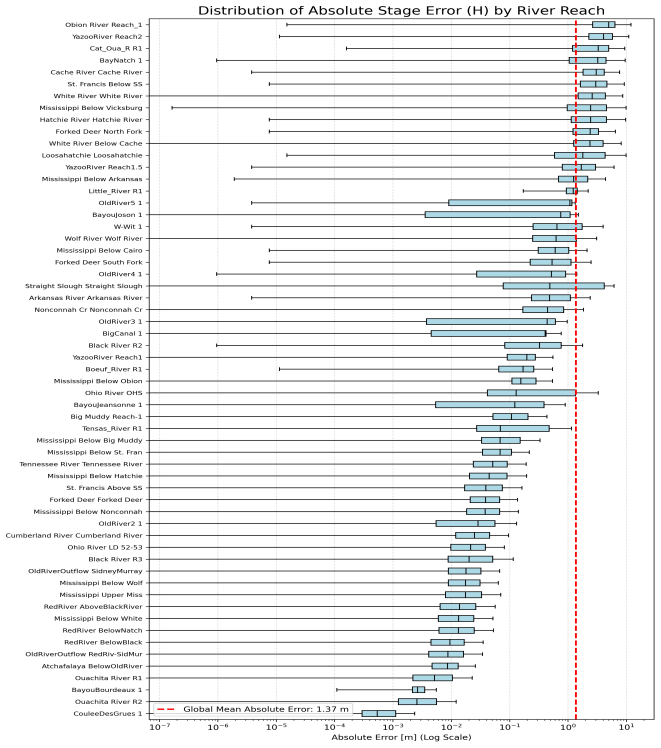
- The large gap between median (0.31 ft) and mean (1.81 ft) absolute error suggests the ensemble-level risk is concentrated in a few complex reaches; targeting those reaches with additional low-flow and backwater training samples could improve the tail more than adding data to already-accurate main channels.
Editorial analysis
A structured set of objections, weighed in public.
Referee Report
Summary. The paper proposes an autoregressive surrogate for HEC-RAS river simulations, combining a GRU for temporal dynamics with a one-dimensional Geo-FNO for spatial dependencies along a river reach. The model is trained per reach on 67 reaches of the Mississippi River Basin using an eight-channel feature vector of dynamic state, static geometry, roughness, and boundary forcings extracted from native HEC-RAS files. The authors report a median absolute stage error of 0.31 feet on a year-long 2011 hold-out simulation and a wall-clock speedup of 3.45x for a full 67-reach ensemble forecast. The paper includes feature-ablation and data-volume-ablation studies plus a computational benchmark.
Significance. If substantiated, this is a useful applied contribution: it demonstrates a large-scale, realistic case study of surrogate modeling for operational river forecasting, uses native HEC-RAS files as the data source, evaluates over full-year autoregressive rollouts across many reaches, and includes a physical-feature ablation that shows the value of static geometry and roughness channels. The same-hardware timing comparison is a strength. However, the evidence is weakened by an internal contradiction in the data-volume ablation that threatens the clean hold-out status of the 2011 evaluation, and by the absence of uncertainty quantification, boundary-error sensitivity analysis, and baseline model comparisons.
major comments (5)
- [§VII.C.2 / Fig. 7(b)] The data-volume ablation is internally contradictory. The text first says the second model is trained on the full 100% of 2002–2008 data, but Figure 7(b) is captioned '100% train on 2002+2008 and Q1 2011 for validation' and the following paragraph says the model was retrained 'augmenting the training set by including the first quarter of the 2011 simulation.' If the successful Below Vicksburg model used Q1 2011 data, the 2011 rollout for that reach is not a clean hold-out, and because Below Vicksburg is one of the 67 reaches, the reported median absolute error of 0.31 feet is potentially contaminated. The manuscript must state unequivocally which training set produced Figure 7(b), and if Q1 2011 was used, recompute the 67-reach ensemble statistics with a clean split.
- [§V.C.3 / §VII.A] The autoregressive rollout uses the true upstream discharge Qup and downstream stage Hdn at every step. In an operational forecast these boundary values are themselves uncertain predictions, yet the paper provides no sensitivity analysis or perturbation test for boundary-condition errors. The claimed year-long stability is therefore conditional on perfect boundary forcings; please add an explicit experiment degrading Qup and Hdn by realistic error magnitudes, or clearly scope the claim to solver replacement with oracle boundaries.
- [§VII.A] All quantitative claims are reported as point estimates: median 0.31 ft, mean 1.81 ft, and the 3.45x speedup have no error bars, confidence intervals, or seed variability. The per-reach box plots in Figure 4 show spread, but there is no quantification of the uncertainty in the median itself or of run-to-run variability from random initialization. Please report bootstrap intervals or multiple-seed statistics for the headline metrics.
- [§IV.B / §VII] The paper motivates the GRU–GeoFNO architecture as a key contribution, but the experiments do not include an architecture ablation or baseline comparisons. Without a GRU-only, FNO-only, LSTM, or persistence baseline on the same reaches and hold-out year, it is unclear which component contributes the reported accuracy; the feature ablation alone does not validate the hybrid design.
- [§VII.C.2 / §VIII.B] The discussion in Section VIII.B interprets the 80%-versus-100% comparison as showing that 'holding out a validation set from the training data can degrade the model’s robustness.' This conflates training-set size with the validation-splitting practice: the 80% model has 20% fewer observations, so the comparison isolates data volume, not the act of validation. The interpretation should be rephrased to avoid this logical error.
minor comments (7)
- [§IV.A / §IV.B.1] xcoord is listed as one of the eight feature channels, but the positional encoder concatenates xcoord again; the linear layer input is therefore 9-dimensional, not 8-channel. Clarify the counting and whether xcoord is a feature, a positional encoding, or both.
- [§II.D / §VII.A] Stage is defined in metres in Section II.D, but results throughout Section VII report absolute error in feet; state the conversion explicitly to avoid ambiguity.
- [§VII.E] Section VII.E duplicates the text of Section VII.C almost verbatim; the two sections should be merged into a single ablation presentation.
- [References] References [6] and [24] cite the same work twice; consolidate into a single citation.
- [General formatting] Several words appear with spurious spaces ('V olume', 'F orked Deer', 'F ourier', 'N AVD 88'); the manuscript needs a careful proofreading pass.
- [§VII.A] The statement that 'the precise median absolute stage error for all 67 reaches is catalogued in the box-plot figure' is not accurate, as a box plot summarizes distributions but does not catalogue precise values.
- [Table I] Table I lists 2-D mesh files (*.c##) although the study is limited to 1-D reaches; clarify whether such files are used in the pipeline.
Circularity Check
Hold-out claim for 2011 is undermined by the §VII.C.2 ablation text: the successful Below Vicksburg model was retrained on Q1 2011, so the 'unseen' prediction is partly fitted input; no other circularity found.
-
fitted input called prediction
[Section V.B (training/hold-out protocol) vs. Section VII.C.2 and Fig. 7(b) (data-volume ablation)]
"Hold-out Test Set: The entire 2011 simulation is held out as a completely unseen test set for the final evaluation of the trained model. [...] We then retrained the model, augmenting the training set by including the first quarter of the 2011 simulation (an increase of 8,737 hourly snapshots)."
Protocol V.B defines 2011 as completely unseen, but VII.C.2 states that the successful Below Vicksburg model was retrained with Q1 2011, and Fig. 7(b) is captioned '100% train on 2002+2008 and Q1 2011 for validation.' The 2011 rollout presented as the success case is therefore not an independent hold-out for that reach; the model was fitted on part of the same simulation it claims to predict. Since Below Vicksburg is one of the 67 reaches, the reported median absolute stage error of 0.31 ft is not established as a clean hold-out statistic. Section VIII.B contradicts VII.C.2 by describing Fig. 7b as trained on 'the entirety of the 2002 and 2008 data,' so the manuscript, as written, does not resolve whether the central unseen-2011 claim reduces to fitted input.
full rationale
Apart from the unresolved Q1-2011 contamination, the derivation chain is a standard supervised-learning surrogate: features and targets are extracted from HEC-RAS outputs, and the model is a fitted emulator rather than a first-principles derivation. There is no load-bearing self-citation: the authors' own PINN papers (refs [6], [24]) are cited only as related work and do not justify the architecture or the hold-out result. The use of true boundary forcings at every autoregressive step (V.C.3) makes the evaluation an oracle-conditioned emulator test rather than a fully operational forecast, but that is an assumption/limitation, not a circular step. The only identified reduction is the contradiction between the strict temporal split (V.B) and the Q1-2011-augmented retraining described in VII.C.2 and Fig. 7(b); if that text describes the actual successful model, the 2011 'prediction' for Below Vicksburg is partly a fit to 2011 inputs. Score 5 reflects one load-bearing prediction that may reduce to fitted input, while the remaining 66-reach evaluation is independently structured and the architecture choices are not circular.
Assumptions & free parameters
free parameters (6)
- hidden_size =
96
- fourier_modes =
up to 48
- learning_rate =
2e-4
- epochs =
60
- sequence_length =
12 hours
- normalization_stats =
computed from training set
assumptions (4)
- domain assumption HEC-RAS solves the 1-D Saint-Venant equations accurately and is a valid ground truth.
- domain assumption Static geometry and roughness features are time-invariant.
- domain assumption The 2002 and 2008 training years contain sufficiently diverse hydrology for the 2011 hold-out.
- standard math The 1-D Geo-FNO with up to 48 modes can represent the spatial coupling of a river reach.
Cite this review
Pith. "Pith review of Accelerating HEC-RAS: A Recurrent Neural Operator for Rapid River Forecasting." pith.science (2026). https://pith.science/paper/33VA5KLO
@misc{pith2026250715614,
  author       = {Pith},
  title        = {Pith review of: Accelerating HEC-RAS: A Recurrent Neural Operator for Rapid River Forecasting},
  year         = {2026},
  howpublished = {\url{https://pith.science/paper/33VA5KLO}},
  note         = {Machine review of arXiv:2507.15614}
}
read the original abstract
Physics-based solvers like HEC-RAS provide high-fidelity river forecasts but are too computationally intensive for on-the-fly decision-making during flood events. The central challenge is to accelerate these simulations without sacrificing accuracy. This paper introduces a deep learning surrogate that treats HEC-RAS not as a solver but as a data-generation engine. We propose a hybrid, auto-regressive architecture that combines a Gated Recurrent Unit (GRU) to capture short-term temporal dynamics with a Geometry-Aware Fourier Neural Operator (Geo-FNO) to model long-range spatial dependencies along a river reach. The model learns underlying physics implicitly from a minimal eight-channel feature vector encoding dynamic state, static geometry, and boundary forcings extracted directly from native HEC-RAS files. Trained on 67 reaches of the Mississippi River Basin, the surrogate was evaluated on a year-long, unseen hold-out simulation. Results show the model achieves a strong predictive accuracy, with a median absolute stage error of 0.31 feet. Critically, for a full 67-reach ensemble forecast, our surrogate reduces the required wall-clock time from 139 minutes to 40 minutes, a speedup of nearly 3.5 times over the traditional solver. The success of this data-driven approach demonstrates that robust feature engineering can produce a viable, high-speed replacement for conventional hydraulic models, improving the computational feasibility of large-scale ensemble flood forecasting.
Figures


Figures from the paper (5 more)


Reference graph
Works this paper leans on
-
[1]
Physics-informed neural networks: A deep learning framework for solving forward and inverse problems involving nonlinear partial differential equations,
M. Raissi, P. Perdikaris, and G. E. Karniadakis, “Physics-informed neural networks: A deep learning framework for solving forward and inverse problems involving nonlinear partial differential equations,” Journal of Computational Physics , vol. 378, pp. 686–707, 2019
2019
-
[2]
Fourier neural operator for parametric partial differential equations,
Z. Li, N. Kovachki, K. Azizzadenesheli, B. Liu, K. Bhattacharya, A. Stuart, and A. Anandkumar, “Fourier neural operator for parametric partial differential equations,” in Proc. ICLR, 2021
work page 2021
-
[3]
Fourier neural operator with learned deformations for PDEs on general geometries,
Z. Li, D. Z. Huang, B. Liu, and A. Anandkumar, “Fourier neural operator with learned deformations for PDEs on general geometries,” arXiv preprint arXiv:2207.05209 , 2022
arXiv 2022
-
[4]
On the spectral bias of neural networks,
N. Rahaman, A. Baratin, D. Arpit, F. Draxler, M. Lin, F. Hamprecht, Y . Bengio, and A. Courville, “On the spectral bias of neural networks,” in Proc. 36th Int. Conf. Machine Learning (ICML) , vol. 97, pp. 5301– 5310, 2019
work page 2019
-
[5]
Deep residual learning for image recognition,
K. He, X. Zhang, S. Ren, and J. Sun, “Deep residual learning for image recognition,” in Proc. IEEE Conf. Computer Vision and Pattern Recognition (CVPR) , 2015, pp. 770–778
work page 2015
-
[6]
Physics-Informed Neural Network Surrogate Models for River Stage Prediction
M. Zoch, E. Holmberg, P. Pokhrel, K. Pathak, S. Sloan, K. Niles, J. Ratcliff, M. Flanagin, E. Ioup, C. Guetl, and M. Abdelguerfi, “Physics- informed neural network surrogate models for river stage prediction,” arXiv preprint arXiv:2503.16850 , 2025
work page Pith review arXiv 2025
-
[7]
Chanson, Hydraulics of Open Channel Flow
H. Chanson, Hydraulics of Open Channel Flow . Butterworth- Heinemann, 2004
work page 2004
-
[8]
HEC-RAS river analysis system, hydraulic reference manual,
G. W. Brunner, “HEC-RAS river analysis system, hydraulic reference manual,” U.S. Army Corps of Engineers, Hydrologic Engineering Cen- ter, Davis, CA, Tech. Rep. CPD-69, 2021
work page 2021
Show all 27 references
-
[9]
A survey of projection-based model reduction methods for parametric dynamical systems,
P. Benner, S. Gugercin, and K. Willcox, “A survey of projection-based model reduction methods for parametric dynamical systems,” SIAM Review, vol. 57, no. 4, pp. 483–531, 2015
2015
-
[10]
Data-driven surrogate modeling in com- putational fluid dynamics: A review,
H. Bi, J. Lin, and X. Zhao, “Data-driven surrogate modeling in com- putational fluid dynamics: A review,” Computers and Fluids , vol. 258, p. 104764, 2023
2023
-
[11]
Challenges of using surrogate models for environmental simulations: A case study in hydrology,
Z. Takbiri-Borujeni, J. T. Smith, and M. D. White, “Challenges of using surrogate models for environmental simulations: A case study in hydrology,” Environmental Modelling and Software, vol. 134, p. 104882, 2020
2020
-
[12]
Hydraulic splines: A hybrid approach to modeling river channel geometries,
M. Flanagin, A. Grenotton, J. Ratcliff, K. B. Shaw, J. Sample, and M. Abdelguerfi, “Hydraulic splines: A hybrid approach to modeling river channel geometries,” Computing in Science and Engineering , vol. 9, no. 5, pp. 4–15, 2007
2007
-
[13]
PointNet: Deep learning on point sets for 3D classification and segmentation,
C. R. Qi, H. Su, K. Mo, and L. J. Guibas, “PointNet: Deep learning on point sets for 3D classification and segmentation,” in Proc. IEEE Conf. Computer Vision and Pattern Recognition (CVPR) , 2017, pp. 652–660
2017
-
[14]
Abdelguerfi, 3D Synthetic Environment Reconstruction
M. Abdelguerfi, 3D Synthetic Environment Reconstruction . Springer, 2012
2012
-
[15]
The geospatial information distribution system (GIDS),
M. Chung, R. Wilson, R. Ladner, T. Lovitt, M. Cobb, M. Abdelguerfi, and K. Shaw, “The geospatial information distribution system (GIDS),” in Succeeding with Object Databases . John Wiley & Sons, 2001, pp. 357–378
2001
-
[16]
Graph neural operator for PDEs,
Z. Li, N. Kovachki, K. Azizzadenesheli, B. Liu, K. Bhattacharya, A. Stuart, and A. Anandkumar, “Graph neural operator for PDEs,” arXiv preprint arXiv:2010.08895, 2020
2010 arXiv
-
[17]
Learning phrase representations using RNN Encoder–Decoder for statistical machine translation,
K. Cho, B. van Merriënboer, C. Gülçehre, D. Bahdanau, F. Bougares, H. Schwenk, and Y . Bengio, “Learning phrase representations using RNN Encoder–Decoder for statistical machine translation,” in Proc. Empirical Methods in Natural Language Processing (EMNLP) , Doha, Qatar, 2014...
2014
-
[18]
Message passing neural PDE solvers,
J. Brandstetter, D. E. Worrall, and M. Welling, “Message passing neural PDE solvers,” in Proc. Int. Conf. on Learning Representations (ICLR) ,
-
[19]
FourCastNet: A global data-driven high-resolution weather model using adaptive Fourier neural operators,
J. Pathak, S. Subramanian, P. Harrington, S. Raja, A. Chattopadhyay, M. Mardani, T. Kurth, D. Hall, Z. Li, K. Azizzadenesheli, P. Has- sanzadeh, K. Kashinath, and A. Anandkumar, “FourCastNet: A global data-driven high-resolution weather model using adaptive Fourier neural oper...
2022 arXiv
-
[20]
G. E. P. Box and G. M. Jenkins, Time Series Analysis: F orecasting and Control. San Francisco, CA: Holden–Day, 1970
1970
-
[21]
Scheduled sampling for sequence prediction with recurrent neural networks,
S. Bengio, O. Vinyals, N. Jaitly, and N. Shazeer, “Scheduled sampling for sequence prediction with recurrent neural networks,” in Advances in Neural Information Processing Systems (NeurIPS) , vol. 28, Montréal, Canada, 2015, pp. 1171–1179
2015
-
[22]
Toward improved predictions in ungauged basins: Exploiting the power of machine learning,
F. Kratzert, D. Klotz, J. Herrnegger, G. Hochreiter, and S. Nearing, “Toward improved predictions in ungauged basins: Exploiting the power of machine learning,” Water Resources Research , vol. 55, no. 12, pp. 11 344–11 364, 2019
2019
-
[23]
FloodFNO: Fourier neural operators for real-time inundation mapping,
A. Stenta, J. Smith, and L. Hennig, “FloodFNO: Fourier neural operators for real-time inundation mapping,” in Proc. IAHR World Congress, 2023
2023
-
[24]
Physics- informed neural network surrogate models for river stage prediction,
M. Zoch, E. Holmberg, P. Pokhrel, K. Pathak, S. Sloan, K. Niles, J. Ratcliff, M. Flanagin, E. Ioup, C. Guetl, and M. Abdelguerfi, “Physics- informed neural network surrogate models for river stage prediction,” in Proc. ALLDATA 2025 – 11th Int. Conf. on Big Data, Small Data, Li...
2025
-
[25]
Geographical data interchange using XML-enabled technology within the GIDB system,
R. Wilson, M. Cobb, F. McCreedy, R. Ladner, D. Olivier, T. Lovitt, K. Shaw, F. Petry, and M. Abdelguerfi, “Geographical data interchange using XML-enabled technology within the GIDB system,” in XML Data Management: Native XML and XML-Enabled Database Systems . Morgan Kaufmann,...
2003
-
[26]
Abdelguerfi (ed.), 3D Synthetic Environment Reconstruction
M. Abdelguerfi (ed.), 3D Synthetic Environment Reconstruction . Springer, 2001, vol. 611 of the NATO Science Series
2001
-
[2022]
Available: https://arxiv.org/abs/2202.03376
[Online]. Available: https://arxiv.org/abs/2202.03376
Reviewed August 6, 2026 · model on record in the stance chip above.
Discussion (0). Continue with ORCID to comment.