REVIEW 4 major objections 4 minor 1 cited by
This paper argues that GFlowNets, trained to sample graph colorings with probability proportional to a measurement-cost reward, find Hamiltonian groupings that reduce estimated measurement budgets relative to sorted-insertion heuristics on
Reviewed by Pith at T0; open to challenge. T0 means a machine referee read the full paper against a public rubric. the ladder, T0–T4 →
GFlowNet-based graph coloring finds Hamiltonian groupings with lower estimated measurement costs than sorted insertion on small molecules, subject to selection bias and a missing abstract claim.
T0 review reviewed 2026-08-04 challenge →
load-bearing objection A credible but overclaimed GFlowNet-for-measurement-grouping paper: the GNN architecture and exact-variance reward are real increments, yet the abstract advertises results the body does not contain and the main FC comparison leans on exact-FCI variances and best-of-N from a single seed. the 4 major comments →
Discrete Flow-Based Generative Models for Measurement Optimization in Quantum Computing
The pith
A machine-rendered reading of the paper's core claim, the machinery that carries it, and where it could break.
The reading
Core claim
On the paper's own terms, the discovery is that a GFlowNet trained with the trajectory-balance objective can sequentially color the complement of the Hamiltonian commutativity graph—each color naming one measurement group—and, over a few hundred to a few thousand samples, find colorings with lower estimated measurement cost ε²_M than sorted-insertion or recursive-largest-first heuristics. The reward used for training is inverse to the squared sum of fragment standard deviations, optionally regularized by the number of colors, which makes the sampler explore multi-objective trade-offs. In the reported tables, the best sampled FC groupings beat SI on estimated measurement cost for H2, H4, LiH,
What carries the argument
The load-bearing construction is the equivalence between partitioning a Hamiltonian into commuting fragments and coloring the complement of its commutativity graph: each color is a measurement circuit. GFlowNets provide a sequential policy that colors nodes one at a time under the constraint that adjacent nodes cannot share a color; the trajectory-balance objective assigns credit from the terminal reward to every coloring step. The reward R(x) = λ0/ε²_M(x) + λ1(NP − NG(x)) folds the measurement variance estimate and the number of groups into a single scalar, and a graph neural network (GINE/GINEw) parametrizes the forward and backward transition probabilities. In the experiments, variances a
Load-bearing premise
Every reported result is the single best of 500–5,000 samples from one fixed-seed run, and the reward is evaluated with exact FCI variances; the method assumes that one fixed seed is representative and that classically efficient wavefunctions reproduce those variances within the cited 9% error, neither of which is tested in the text.
What would settle it
Run the same seven-molecule pipeline under multiple random seeds and report the distribution (median and spread) of best-of-N measurement estimates. If the median best-of-N no longer beats sorted insertion on H4, LiH, BeH2, LiH*, and N2, the central claim fails. A complementary check is to recompute rewards with classically efficient wavefunction variances instead of exact FCI and see whether the best colorings—and the reported gains—survive the roughly 9% variance error.
If this is right
- If the best-sampled colorings are accepted as typical, GFlowNets provide a replacement for the initial non-overlapping grouping stage of measurement pipelines, without requiring a precomputed covariance dictionary.
- Composite rewards can improve both objectives at once: the paper reports BeH2 solutions with 16 groups and ε²_M = 0.550, beating the measurement-only solution (21 groups, 0.601).
- Because sampling returns a Pareto front of solutions, a user can trade a small measurement increase for substantially fewer circuits (e.g., H4: 11 groups at 0.805 vs 9 groups at 0.812).
- The reward function can be extended to hardware-aware terms such as circuit fidelity overhead, so the same sampler could be pointed at noise-aware objectives on near-term devices.
- Using these groupings to initialize overlapping methods such as iterative coefficient splitting yields an average 19% reduction in measurement cost for Jordan-Wigner FC Hamiltonians, per the abstract.
Where Pith is reading between the lines
- The reported best-of-N from a single fixed seed leaves open whether the advantage over sorted insertion is robust; a multi-seed study would settle whether GFlowNet's mode-covering behavior translates into reliably better groupings or just occasionally better ones.
- The QWC results, where valid-sample rates fall to 15–54%, suggest the coloring formulation itself—rather than the generative model—is the bottleneck for dense complement graphs; a clique-cover formulation on the sparse commutativity graph may scale better.
- The 19% initialization gain, if it reproduces, would imply that overlapping grouping methods inherit structural properties (fewer groups, lower two-qubit counts) from their starting partition—a design principle that could be tested with any non-overlapping grouping algorithm, not only GFlowNets.
- A natural testable extension is to add CNOT count or circuit fidelity directly into the reward and check whether the sampler trades a small shot increase for a large hardware saving.
Editorial analysis
A structured set of objections, weighed in public.
Referee Report
Summary. This paper proposes using Generative Flow Networks (GFlowNets) to generate non-overlapping groupings of Pauli terms for VQE measurement reduction. The authors formulate grouping as sequential coloring of the complement of the commutativity graph, with validity masks, and train GNN-based forward/backward policies via the trajectory-balance objective. The reward is a weighted combination of an inverse measurement-cost term (variance bound at ε = 1 mHa) and a group-count regularization. Experiments on H2, H4, LiH, BeH2, H2O, and N2 with FC and QWC groupings under JW/BK mappings compare against RLF and sorted-insertion baselines. The body claims that GFlowNets find groupings with lower estimated measurement budgets than SI for several FC cases; the abstract additionally claims a 19% further reduction from initializing overlapping methods and a two-qubit-count benefit, neither of which appears in the main text.
Significance. If the core claim were established, the paper would offer a useful generative alternative to greedy heuristics for Hamiltonian grouping, with the appealing ability to return diverse, multi-objective trade-offs. The use of GFlowNets with graph-isomorphism-style policies, the composite reward formulation, and the public code release are positive elements. However, the current evidence is partial: the central claim is contradicted by several reported results, the abstract advertises experiments that are absent from the body, and the evaluation relies on exact-FCI variances and a single fixed seed. With appropriate scoping and additional validation, the method could be a sound contribution; as submitted, the claims exceed the evidence.
major comments (4)
- [Abstract / Section 4] The abstract's two strongest quantitative claims — a 19% average further reduction by initializing overlapping methods, 'particularly iterative coefficient splitting,' and a preserved two-qubit-count benefit — do not appear in the body. No experiments with overlapping methods, coefficient splitting, or two-qubit counts are reported in Sections 3 or 4. The only two-qubit mention is an abstract phrase and a general 'fidelity overhead' remark. This means the most prominent advertised results are unsupported. They must either be added or removed/qualified before the manuscript can be considered.
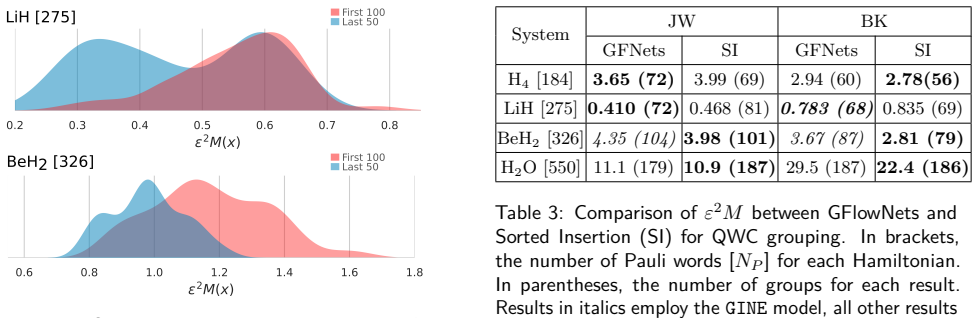
- [Section 3.1 (Table 1), Section 3.2 (Table 3), Section 4] The central claim that GFlowNets 'reduce estimated measurement budgets relative to standard sorted-insertion heuristics' is contradicted by the paper's own tables. In FC/JW, H2O is a loss (4.00 vs SI 2.78). In QWC (Table 3), GFlowNets lose for BeH2 (JW 4.35 vs 3.98; BK 3.67 vs 2.81) and H2O (JW 11.1 vs 10.9; BK 29.5 vs 22.4), and for H4-BK (2.94 vs 2.78). The claim should be scoped to FC grouping on most tested systems. Also, Table 1 reports the best result per molecule 'regardless of the model employed,' which is a selection over architectures; combined with fixed-seed runs this does not support a general superiority statement.
- [Section 2.3 (Eqs. 10-11), Section 3.1] The reward is computed from exact FCI variances. The text asserts that classically efficient wavefunctions introduce <9% error (citing [17]) without testing. This is load-bearing: the method's motivation is VQE, where FCI is unavailable, and several reported margins are small (e.g., BeH2 FC: 0.601 vs SI 0.614, a 2.1% gap; H2O is already a loss). A 9% perturbation of fragment variances can plausibly reorder such groupings. The reduction over SI is therefore not established under the approximate wavefunctions actually used in deployment. Please validate with at least one approximate wavefunction (e.g., HF or CCSD) or explicitly restrict the claims to FCI-evaluated costs.
- [Section 2.4 / Section 3] The stochastic optimization is evaluated with a single fixed seed ('sampling from a categorical distribution with a fixed seed for all simulations') and the reported numbers are best-of-N from 500–5,000 samples. No seed-to-seed variability is reported for the GNN models; the only multi-seed statement concerns the MLP baseline (Table SM6). Because GFlowNet training is stochastic and the performance differences are sometimes a few percent, the evidence that the method reliably outperforms SI is incomplete. Report mean and standard deviation over at least a few seeds for the key molecules, or characterize best-of-N as heuristic search rather than typical performance.
minor comments (4)
- [Section 4] Typo: 'GlowNets' should be 'GFlowNets'.
- [Sections 3.1 and 3.2] The word 'overstates' appears in three places ('This feature overstates one of the benefits', 'overstating the benefits of multiple terms', 'overstating the displacement') where 'illustrates/underscores' seems intended. This obscures the meaning and should be corrected.
- [Table 1 and Table 3 captions] Table 1's caption does not define the parenthetical values; Table 3 defines them as numbers of groups. Also, the LiH* entry in Table 1 does not appear in Tables SM1/SM2; the mapping and sample count for this system should be stated in the main text.
- [Section 3.1] The sentence 'The results shown contain the selection of the best-performing result for each molecule, regardless of the model employed' should be formalized as an explicit protocol and discussed as a limitation, since post-hoc selection over architectures can inflate apparent performance.
Circularity Check
No circular derivation: the reward is the objective, self-citations are historical baselines, and no fitted parameter is relabeled as a prediction.
full rationale
The central claim is that GFlowNet-generated groupings achieve lower epsilon^2 M(x) (Eq. 11) than SI/RLF. The reward (Eqs. 9-10) is defined directly as R_M = 1/(epsilon^2 M), so maximizing the reward and minimizing the reported metric are the same optimization task. This is objective alignment, not circularity: no parameter is fitted to the evaluation data and then 'predicted'; the baselines are independent heuristics evaluated under the same metric. The use of exact-FCI variances in both reward and evaluation is an oracle/validity limitation, not a reduction of the output to the input. The self-citations to Ref. [56] describe an earlier MLP implementation and a local-consistency training variant; they are historical comparisons and do not carry the main argument. The paper compares against external baselines (SI/RLF) and reports standard benchmark Hamiltonians, so the derivation chain is self-contained. Any concern that the margins are small or that approximate wavefunctions could change rankings belongs to correctness risk, not circularity.
Axiom & Free-Parameter Ledger
free parameters (3)
- Reward weights lambda_0, lambda_1 =
lambda_0=10^3, lambda_1=0 for measurement-only; lambda_0 scanned (0 to 10^3), lambda_1=1 for composite
- GNN architecture dimensions emb_d, hidden_d =
emb_d=2, hidden_d=64 for most molecules; hidden_d=8 for N2; alternatives in SM tables
- Total number of sampled colorings =
5,000 for H2/H4/LiH/BeH2, 1,000 for H2O, 500 for N2 and LiH*
axioms (5)
- standard math Minimum clique cover of the commutativity graph is equivalent to coloring its complement graph.
- domain assumption Trajectory balance training (Eq. 8) drives the GFlowNet to sample terminal states with probability proportional to reward R(sf).
- domain assumption Exact FCI variances are a valid proxy for the practical measurement allocation objective, and classically efficient wavefunctions approximate them with less than 9% error.
- ad hoc to paper A single fixed-seed run is representative of the method's performance.
- domain assumption RLF and SI are fair baselines even though they do not optimize the same exact-FCI variance reward.
Cite this review
Pith. "Pith review of Discrete Flow-Based Generative Models for Measurement Optimization in Quantum Computing." pith.science (2026). https://pith.science/paper/34LKKAZ2
@misc{pith2026250915486,
  author       = {Pith},
  title        = {Pith review of: Discrete Flow-Based Generative Models for Measurement Optimization in Quantum Computing},
  year         = {2026},
  howpublished = {\url{https://pith.science/paper/34LKKAZ2}},
  note         = {Machine review of arXiv:2509.15486}
}
read the original abstract
Achieving chemical accuracy in quantum simulations is often constrained by the measurement bottleneck: estimating operators requires a large number of shots, which remains costly even on fault-tolerant devices. Addressing this challenge involves a multi-objective optimization problem that balances the total shot count, the number of distinct measurement circuits, the total two-qubit gate count, and hardware-specific compilation constraints. Existing overlapping grouping methods, focused on reducing measurement counts, rely on an initial non-overlapping grouping of the Hamiltonian, generated through graph-coloring strategies or greedy heuristics to group commuting (FC) or qubit-wise-commuting Hamiltonian terms. We introduce an algorithm that adapts Generative Flow Networks (GFlowNets) to color graph representations of Hamiltonians, enabling the generation of reward-driven, non-overlapping groupings. Our approach samples colored graphs in proportion to a user-defined reward, allowing different objective terms to be incorporated into the reward, capturing multi-objective trade-offs. On benchmark molecular Hamiltonians, our method reduces measurement costs relative to sorted-insertion (SI) baselines and can reduce the two-qubit gate count for FC groupings. We show that the groupings generated with GFlowNets serve as better initializations for overlapping methods, particularly iterative coefficient splitting, further reducing measurement costs by 19\% on average for Jordan-Wigner-mapped Hamiltonians in FC groupings. Initializing overlapping methods with our groupings, which have lower two-qubit requirements, yields comparable reductions in measurement counts while preserving the two-qubit-count benefit. GFlowNets' generative policy framework not only reduces measurement and two-qubit gate costs but also provides flexibility for hardware-aware adaptations via its reward function.
Figures



Forward citations
Cited by 1 Pith paper
-
Reducing quantum measurements in qubit-based overlapping grouping methods for quantum energy estimation through better initializations
VarSI covariance-informed non-overlapping Pauli groupings reduce measurement counts ~38% over SI and improve ICS by mean 9–15% (max ~70%) across 130 molecular Hamiltonians.
Reference graph
Works this paper leans on
-
[1]
Love, Alán Aspuru-Guzik, and Jeremy L
Alberto Peruzzo, Jarrod McClean, Peter Shadbolt, Man-Hong Yung, Xiao-Qi Zhou, Peter J. Love, Alán Aspuru-Guzik, and Jeremy L. O’Brien. A variational eigen- value solver on a photonic quantum pro- cessor.Nature Communications, 5(1): 4213, Jul 2014. ISSN 2041-1723. DOI: 10.1038/ncomms5213. URLhttps://doi. org/10.1038/ncomms5213
-
[2]
Jules Tilly, Hongxiang Chen, Shuxiang Cao, Dario Picozzi, Kanav Setia, Ying Li, Edward Grant, Leonard Wossnig, Ivan Rungger, George H. Booth, and Jonathan Tennyson. The variational quantum eigensolver: A review of meth- ods and best practices.Physics Reports, 986:1–128, 2022. ISSN 0370-1573. DOI: https://doi.org/10.1016/j.physrep.2022.08.003. URLhttps://w...
-
[3]
Olson, Matthias Degroote, Peter D
Yudong Cao, Jonathan Romero, Jonathan P. Olson, Matthias Degroote, Peter D. John- son, Mária Kieferová, Ian D. Kivlichan, Tim Menke, Borja Peropadre, Nicolas P. D. Sawaya, Sukin Sim, Libor Veis, and Alán Aspuru-Guzik. Quantum chemistry in the age of quantum computing.Chem- ical Reviews, 119(19):10856–10915, 2019. DOI: 10.1021/acs.chemrev.8b00803. URL http...
-
[4]
Bela Bauer, Sergey Bravyi, Mario Motta, and Garnet Kin-Lic Chan. Quantum algorithms for quantum chemistry and quantum materials science.Chemi- cal Reviews, 120(22):12685–12717, 2020. DOI: 10.1021/acs.chemrev.9b00829. URL https://doi.org/10.1021/acs.chemrev. 9b00829. PMID: 33090772
-
[5]
Sam McArdle, Suguru Endo, Alán Aspuru- Guzik, Simon C. Benjamin, and Xiao Yuan. Quantum computational chemistry.Rev. Mod. Phys., 92:015003, Mar 2020. DOI: 10.1103/RevModPhys.92.015003. URL https://link.aps.org/doi/10.1103/ RevModPhys.92.015003
-
[6]
Kottmann, Tim Menke, Wai-Keong Mok, Sukin Sim, Leong-Chuan Kwek, and Alán Aspuru- Guzik
Kishor Bharti, Alba Cervera-Lierta, Thi Ha Kyaw, Tobias Haug, Sumner Alperin-Lea, Abhinav Anand, Matthias Degroote, Her- manni Heimonen, Jakob S. Kottmann, Tim Menke, Wai-Keong Mok, Sukin Sim, Leong-Chuan Kwek, and Alán Aspuru- Guzik. Noisy intermediate-scale quantum algorithms.Rev. Mod. Phys., 94:015004, Feb
-
[7]
Smik Patel, Praveen Jayakumar, Tzu- Ching Yen, and Artur F. Izmaylov. Quantum measurement for quantum chemistry on a quantum computer.Chem- ical Reviews, 125(16):7490–7524, 2025. DOI: 10.1021/acs.chemrev.5c00055. URL https://doi.org/10.1021/acs.chemrev. 5c00055. PMID: 40690271
-
[8]
William J Huggins, Jarrod R McClean, Nicholas C Rubin, Zhang Jiang, Nathan Wiebe, K Birgitta Whaley, and Ryan Babbush. Efficient and noise resilient measurements for quantum chemistry on near-term quantum computers.npj Quantum Information, 7(1):23, 2021. DOI: https://doi.org/10.1038/s41534-020-00341- 7
-
[9]
Oumarou Oumarou, Maximilian Scheurer, Robert M. Parrish, Edward G. Hohenstein, and Christian Gogolin. Accelerating Quan- tum Computations of Chemistry Through Regularized Compressed Double Factoriza- tion.Quantum, 8:1371, June 2024. ISSN 2521-327X. DOI: 10.22331/q-2024-06-13-
-
[10]
Izmaylov, Tzu-Ching Yen, Robert A
Artur F. Izmaylov, Tzu-Ching Yen, Robert A. Lang, and Vladyslav Vertelet- skyi. Unitary partitioning approach to the measurement problem in the vari- ational quantum eigensolver method. Journal of Chemical Theory and Com- putation, 16(1):190–195, 2020. DOI: 10.1021/acs.jctc.9b00791. URLhttps: //doi.org/10.1021/acs.jctc.9b00791. PMID: 31747266
-
[11]
Tzu-Ching Yen, Aadithya Ganeshram, and Artur F. Izmaylov. Deterministic improve- 13 ments of quantum measurements with group- ing of compatible operators, non-local trans- formations, and covariance estimates.npj Quantum Information, 9(1):14, Feb 2023. ISSN 2056-6387. DOI: 10.1038/s41534-023- 00683-y. URLhttps://doi.org/10.1038/ s41534-023-00683-y
-
[12]
Tzu-Ching Yen, Vladyslav Verteletskyi, and Artur F. Izmaylov. Measuring all com- patible operators in one series of single- qubit measurements using unitary transfor- mations.Journal of Chemical Theory and Computation, 16(4):2400–2409, 2020. DOI: 10.1021/acs.jctc.0c00008. URLhttps:// doi.org/10.1021/acs.jctc.0c00008
-
[13]
Vladyslav Verteletskyi, Tzu-Ching Yen, and Artur F. Izmaylov. Measurement opti- mization in the variational quantum eigen- solver using a minimum clique cover. The Journal of Chemical Physics, 152 (12), 03 2020. ISSN 0021-9606. DOI: 10.1063/1.5141458. URLhttps://doi.org/ 10.1063/1.5141458. 124114
-
[14]
Tzu-Ching Yen and Artur F. Izmaylov. Cartan subalgebra approach to efficient measurements of quantum observables. PRX Quantum, 2:040320, Oct 2021. DOI: 10.1103/PRXQuantum.2.040320. URL https://link.aps.org/doi/10.1103/ PRXQuantum.2.040320
-
[15]
IgnacioLoaizaandArturF.Izmaylov. Block- invariant symmetry shift: Preprocessing technique for second-quantized hamiltonians to improve their decompositions to linear combination of unitaries.Journal of Chem- ical Theory and Computation, 19(22):8201– 8209, Nov 2023. ISSN 1549-9618. DOI: 10.1021/acs.jctc.3c00912. URLhttps:// doi.org/10.1021/acs.jctc.3c00912
-
[16]
Ignacio Loaiza, Alireza Marefat Khah, Nathan Wiebe, and Artur F Izmaylov. Re- ducing molecular electronic hamiltonian sim- ulation cost for linear combination of uni- taries approaches.Quantum Science and Technology, 8(3):035019, may 2023. DOI: 10.1088/2058-9565/acd577. URLhttps:// dx.doi.org/10.1088/2058-9565/acd577
-
[17]
Seonghoon Choi, Ignacio Loaiza, and Ar- tur F. Izmaylov. Fluid fermionic fragments for optimizing quantum measurements of electronic Hamiltonians in the variational quantum eigensolver.Quantum, 7:889, January 2023. ISSN 2521-327X. DOI: 10.22331/q-2023-01-03-889. URLhttps:// doi.org/10.22331/q-2023-01-03-889
-
[18]
Mario Krenn, Robert Pollice, Si Yue Guo, Matteo Aldeghi, Alba Cervera-Lierta, Pas- cal Friederich, Gabriel dos Passos Gomes, Florian Häse, Adrian Jinich, AkshatKu- mar Nigam, Zhenpeng Yao, and Alán Aspuru-Guzik. On scientific understand- ing with artificial intelligence.Nature Re- views Physics, 4(12):761–769, Dec 2022. ISSN 2522-5820. DOI: 10.1038/s42254...
-
[19]
Entangling indepen- dent particles by path identity.Phys
Kai Wang, Zhaohua Hou, Kaiyi Qian, Leizhen Chen, Mario Krenn, Shining Zhu, and Xiao-Song Ma. Entangling indepen- dent particles by path identity.Phys. Rev. Lett., 133:233601, Dec 2024. DOI: 10.1103/PhysRevLett.133.233601. URL https://link.aps.org/doi/10.1103/ PhysRevLett.133.233601
-
[20]
Let the flows tell: Solving graph combinatorial problems with gflownets
Dinghuai Zhang, Hanjun Dai, Nikolay Malkin, Aaron C Courville, Yoshua Ben- gio, and Ling Pan. Let the flows tell: Solving graph combinatorial problems with gflownets. 36:11952–11969, 2023
2023
-
[21]
Rl4co: An extensive reinforcement learning for combinatorial optimization benchmark
Federico Berto, Chuanbo Hua, Juny- oung Park, Laurin Luttmann, Yining Ma, Fanchen Bu, Jiarui Wang, Haoran Ye, Minsu Kim, Sanghyeok Choi, Nayeli Gast Zepeda, André Hottung, Jianan Zhou, Jieyi Bi, Yu Hu, Fei Liu, Hyeonah Kim, Jiwoo Son, Haeyeon Kim, Davide Angioni, Wouter Kool, Zhiguang Cao, Qingfu Zhang, Joungho Kim, Jie Zhang, Kijung Shin, Cathy Wu, Sungs...
arXiv 2025
-
[22]
Learning combina- 14 torial optimization algorithms over graphs
Elias Khalil, Hanjun Dai, Yuyu Zhang, Bis- tra Dilkina, and Le Song. Learning combina- 14 torial optimization algorithms over graphs. In I. Guyon, U. Von Luxburg, S. Bengio, H. Wallach, R. Fergus, S. Vishwanathan, and R. Garnett, editors,Advances in Neural Information Processing Systems, volume 30. Curran Associates, Inc., 2017. URLhttps://proceedings.neu...
2017
-
[23]
Zi-Song Shen, Feng Pan, Yao Wang, Yi- Ding Men, Wen-Biao Xu, Man-Hong Yung, and Pan Zhang. Free-energy machine for combinatorial optimization.Nature Com- putational Science, 5(4):322–332, Apr 2025. ISSN 2662-8457. DOI: 10.1038/s43588-025- 00782-0. URLhttps://doi.org/10.1038/ s43588-025-00782-0
-
[24]
Multimodal learning with graphs.Na- ture Machine Intelligence, 5(4):340–350, Apr
Yasha Ektefaie, George Dasoulas, Ayush Noori, Maha Farhat, and Marinka Zitnik. Multimodal learning with graphs.Na- ture Machine Intelligence, 5(4):340–350, Apr
-
[25]
Kottmann, Nora Tischler, and Alán Aspuru-Guzik
Mario Krenn, Jakob S. Kottmann, Nora Tischler, and Alán Aspuru-Guzik. Con- ceptual understanding through efficient automated design of quantum optical exper- iments.Phys. Rev. X, 11:031044, Aug 2021. DOI: 10.1103/PhysRevX.11.031044. URL https://link.aps.org/doi/10.1103/ PhysRevX.11.031044
-
[26]
Vargas–Hernández, Kjell Jorner, Robert Pollice, and Alán Aspuru–Guzik
Rodrigo A. Vargas–Hernández, Kjell Jorner, Robert Pollice, and Alán Aspuru–Guzik. In- verse molecular design and parameter op- timization with hückel theory using auto- matic differentiation.The Journal of Chem- ical Physics, 158(10):104801, 03 2023. ISSN 0021-9606. DOI: 10.1063/5.0137103. URL https://doi.org/10.1063/5.0137103
-
[27]
Vargas-Hernández, John Sous, Mona Berciu, and Roman V
Rodrigo A. Vargas-Hernández, John Sous, Mona Berciu, and Roman V. Krems. Ex- trapolating quantum observables with machine learning: Inferring multiple phase transitions from properties of a single phase. Phys. Rev. Lett., 121:255702, Dec 2018. DOI: 10.1103/PhysRevLett.121.255702. URLhttps://link.aps.org/doi/10. 1103/PhysRevLett.121.255702
-
[28]
R. A. Vargas-Hernández and R. V. Krems. Physical Extrapolation of Quantum Observ- ables by Generalization with Gaussian Pro- cesses, pages171–194. SpringerInternational Publishing, Cham, 2020. DOI: 10.1007/978- 3-030-40245-7_9. URLhttps://doi.org/ 10.1007/978-3-030-40245-7_9
doi:10.1007/978- 2020
-
[29]
Nicoli, Paolo Stornati, Rouven Koch, Miriam Büttner, Robert Okuła, Gorka Muñoz-Gil, Ro- drigo A
Anna Dawid, Julian Arnold, Borja Re- quena, Alexander Gresch, Marcin Płodzień, Kaelan Donatella, Kim A. Nicoli, Paolo Stornati, Rouven Koch, Miriam Büttner, Robert Okuła, Gorka Muñoz-Gil, Ro- drigo A. Vargas-Hernández, Alba Cervera- Lierta, Juan Carrasquilla, Vedran Dunjko, Marylou Gabrié, Patrick Huembeli, Evert van Nieuwenburg, Filippo Vicentini, Lei Wa...
arXiv 2025
-
[30]
Martin J. A. Schuetz, J. Kyle Brubaker, Zhihuai Zhu, and Helmut G. Katz- graber. Graph coloring with physics- inspired graph neural networks.Phys. Rev. Res., 4:043131, Nov 2022. DOI: 10.1103/PhysRevResearch.4.043131. URL https://link.aps.org/doi/10.1103/ PhysRevResearch.4.043131
-
[31]
Digital Discov- ery of 100 diverse Quantum Experiments with PyTheus.Quantum, 7:1204, December
Carlos Ruiz-Gonzalez, Sören Arlt, Jan Pe- termann, Sharareh Sayyad, Tareq Jaouni, Ebrahim Karimi, Nora Tischler, Xuemei Gu, and Mario Krenn. Digital Discov- ery of 100 diverse Quantum Experiments with PyTheus.Quantum, 7:1204, December
-
[32]
Entan- glement by path identity.Phys
Mario Krenn, Armin Hochrainer, Mayukh Lahiri, and Anton Zeilinger. Entan- glement by path identity.Phys. Rev. Lett., 118:080401, Feb 2017. DOI: 10.1103/PhysRevLett.118.080401. URL https://link.aps.org/doi/10.1103/ PhysRevLett.118.080401
-
[33]
Combinatorial opti- mization and reasoning with graph neural networks, 2023
Quentin Cappart, Didier Chételat, Elias Khalil, Andrea Lodi, Christopher Morris, and Petar Veličković. Combinatorial opti- mization and reasoning with graph neural networks, 2023. URLhttp://jmlr.org/ 15 papers/v24/21-0449.html
2023
-
[34]
Yoshua Bengio, Andrea Lodi, and An- toine Prouvost. Machine learning for combinatorial optimization: A method- ological tour d’horizon.European Jour- nal of Operational Research, 290(2): 405–421, 2021. ISSN 0377-2217. DOI: https://doi.org/10.1016/j.ejor.2020.07.063. URLhttps://www.sciencedirect. com/science/article/pii/ S0377221720306895
-
[35]
DOI: 10.22331/q- 2023-12-12-1204
ISSN 2521-327X. DOI: 10.22331/q- 2023-12-12-1204. URLhttps://doi.org/ 10.22331/q-2023-12-12-1204
doi:10.22331/q- 2023
-
[36]
Unsupervised learning for the ele- mentary shortest path problem, 2025
Jingyi Chen, Xinyuan Zhang, and Xinwu Qian. Unsupervised learning for the ele- mentary shortest path problem, 2025. URL https://arxiv.org/abs/2508.01557
Pith/arXiv arXiv 2025
-
[37]
Artificial- intelligence-driven shot reduction in quan- tum measurement.Chemical Physics Re- views, 5(4):041403, 10 2024
Senwei Liang, Linghua Zhu, Xiaolin Liu, Chao Yang, and Xiaosong Li. Artificial- intelligence-driven shot reduction in quan- tum measurement.Chemical Physics Re- views, 5(4):041403, 10 2024. ISSN 2688-
2024
-
[38]
Kouhei Nakaji, Lasse Bjørn Kristensen, Jorge A. Campos-Gonzalez-Angulo, Moham- mad Ghazi Vakili, Haozhe Huang, Mohsen Bagherimehrab, Christoph Gorgulla, FuTe Wong, Alex McCaskey, Jin-Sung Kim, Thien Nguyen, PoojaRao, andAlanAspuru-Guzik. The generative quantum eigensolver (GQE) and its application for ground state search,
-
[39]
Xinyi Yang, Ziyi Wang, Hengxi Zhang, Nan Ma, Ning Yang, Hualin Liu, Haifeng Zhang, and Lei Yang. A review: Machine learn- ing for combinatorial optimization problems in energy areas.Algorithms, 15(6), 2022. ISSN 1999-4893. DOI: 10.3390/a15060205. URLhttps://www.mdpi.com/1999-4893/ 15/6/205
-
[40]
Moksh Jain, Emmanuel Bengio, Alex Hernandez-Garcia, Jarrid Rector-Brooks, Bonaventure F. P. Dossou, Chanakya Ajit Ekbote, Jie Fu, Tianyu Zhang, Michael Kil- gour, Dinghuai Zhang, Lena Simine, Payel Das, and Yoshua Bengio. Biological se- quence design with GFlowNets. In Kama- lika Chaudhuri, Stefanie Jegelka, Le Song, Csaba Szepesvari, Gang Niu, and Sivan ...
2022
-
[41]
Flow network based generative models for non-iterative diverse candidate generation
EmmanuelBengio, MokshJain, MaksymKo- rablyov, Doina Precup, and Yoshua Bengio. Flow network based generative models for non-iterative diverse candidate generation. Advances in Neural Information Processing Systems, 34:27381–27394, 2021
2021
-
[42]
Sam Bond-Taylor, Adam Leach, Yang Long, and Chris G. Willcocks. Deep genera- tive modelling: A comparative review of vaes, gans, normalizing flows, energy-based and autoregressive models.IEEE Trans- actions on Pattern Analysis and Machine Intelligence, 44(11):7327–7347, 2022. DOI: 10.1109/TPAMI.2021.3116668
arXiv 2022
-
[43]
GFlowNet Foundations
Yoshua Bengio, Salem Lahlou, Tristan Deleu, Edward J Hu, Mo Tiwari, and Em- manuel Bengio. GFlowNet Foundations. Journal of Machine Learning Research, 24 (210):1–55, 2023. URLhttp://jmlr.org/ papers/v24/22-0364.html
2023
-
[44]
A framework for adaptive MCMC targeting multimodal distributions
Emilia Pompe, Chris Holmes, and Krzysztof Łatuszyński. A framework for adaptive MCMC targeting multimodal distributions. The Annals of Statistics, 48(5):2930 – 2952,
-
[45]
Generativeflow- based warm start of the variational quan- tum eigensolver, 2025
Hang Zou, Martin Rahm, Anton Frisk Kockum, andSimonOlsson. Generativeflow- based warm start of the variational quan- tum eigensolver, 2025. URLhttps://arxiv. org/abs/2507.01726
arXiv 2025
-
[46]
GFlowNets for AI-driven scientific discovery.Dig- ital Discovery, 2:557–577, 2023
Moksh Jain, Tristan Deleu, Jason Hart- ford, Cheng-Hao Liu, Alex Hernandez- Garcia, and Yoshua Bengio. GFlowNets for AI-driven scientific discovery.Dig- ital Discovery, 2:557–577, 2023. DOI: 10.1039/D3DD00002H. URLhttp://dx. doi.org/10.1039/D3DD00002H
-
[47]
Discovery of novel reticular materials for carbon dioxide capture using GFlowNets
Flaviu Cipcigan, Jonathan Booth, Ro- drigo Neumann Barros Ferreira, Carine Ribeiro dos Santos, and Mathias Steiner. Discovery of novel reticular materials for carbon dioxide capture using GFlowNets. 16 Digital Discovery, 3:449–455, 2024. DOI: 10.1039/D4DD00020J. URLhttp://dx. doi.org/10.1039/D4DD00020J
-
[48]
Path-filtering in path-integral simulations of open quantum systems using GFlowNets
Jeremy Lackman-Mincoff, Moksh Jain, Niko- layMalkin, YoshuaBengio, andLenaSimine. Path-filtering in path-integral simulations of open quantum systems using GFlowNets. The Journal of Chemical Physics, 161(14): 144106, 10 2024. ISSN 0021-9606. DOI: 10.1063/5.0226408. URLhttps://doi.org/ 10.1063/5.0226408
-
[49]
Pascual Jordan and Eugene P. Wigner. About the Pauli exclusion principle. Z. Phys., 47:631–651, 1928. DOI: 10.1007/BF01331938
-
[50]
Sergey B. Bravyi and Alexei Yu. Ki- taev. Fermionic quantum computa- tion.Annals of Physics, 298(1):210– 226, 2002. ISSN 0003-4916. DOI: https://doi.org/10.1006/aphy.2002.6254. URLhttps://www.sciencedirect. com/science/article/pii/ S0003491602962548
arXiv 2002
-
[51]
URLhttps: //arxiv.org/abs/2312.11840
Ben DalFavero, Rahul Sarkar, Daan Camps, Nicolas Sawaya, and Ryan LaRose.k- commutativity and measurement reduction for expectation values, 2024. URLhttps: //arxiv.org/abs/2312.11840
arXiv 2024
-
[52]
Geometric-informed GFlowNets for structure-based drug design, 2024
Grayson Lee, Tony Shen, and Martin Es- ter. Geometric-informed GFlowNets for structure-based drug design, 2024. URL https://arxiv.org/abs/2406.10867
Pith/arXiv arXiv 2024
-
[53]
Encyclopedia of Mathematics and its Applications
Thore Husfeldt.Graph colouring al- gorithms, page 277–303. Encyclopedia of Mathematics and its Applications. Cambridge University Press, 2015. DOI: https://doi.org/10.1017/CBO9781139519793.016
-
[54]
Ophelia Crawford, Barnaby van Straaten, Daochen Wang, Thomas Parks, Earl Camp- bell, and Stephen Brierley. Efficient quan- tum measurement of Pauli operators in the presence of finite sampling error.Quantum, 5:385, January 2021. ISSN 2521-327X. DOI: 10.22331/q-2021-01-20-385. URLhttps:// doi.org/10.22331/q-2021-01-20-385
-
[55]
Seonghoon Choi, Tzu-Ching Yen, and Ar- tur F. Izmaylov. Improving quantum measurements by introducing “ghost” pauli products.Journal of Chemical The- ory and Computation, 18(12):7394–7402, Dec 2022. ISSN 1549-9618. DOI: 10.1021/acs.jctc.2c00837. URLhttps:// doi.org/10.1021/acs.jctc.2c00837
-
[56]
Huidobro-Meezs, Jun Dai, Guil- laume Rabusseau, and Rodrigo A
Isaac L. Huidobro-Meezs, Jun Dai, Guil- laume Rabusseau, and Rodrigo A. Vargas- Hernández. GFlowNets for hamiltonian de- composition in groups of compatible opera- tors, 2024. URLhttps://arxiv.org/abs/ 2410.16041
Pith/arXiv arXiv 2024
-
[57]
Tra- jectory balance: Improved credit assignment in gflownets.Advances in Neural Informa- tion Processing Systems, 35:5955–5967, 2022
Nikolay Malkin, Moksh Jain, Emmanuel Bengio, Chen Sun, and Yoshua Bengio. Tra- jectory balance: Improved credit assignment in gflownets.Advances in Neural Informa- tion Processing Systems, 35:5955–5967, 2022
2022
-
[58]
Hagberg, Daniel A
Aric A. Hagberg, Daniel A. Schult, and Pieter J. Swart. Exploring network struc- ture, dynamics, and function using networkx. In Gaël Varoquaux, Travis Vaught, and Jar- rod Millman, editors,Proceedings of the 7th Python in Science Conference, pages 11 – 15, Pasadena, CA USA, 2008
2008
-
[59]
Matthew X Burns, Chenxu Liu, Samuel Stein, Bo Peng, Karol Kowalski, and Ang Li. Galic: hybrid multi-qubitwise pauli grouping for quantum computing measure- ment.Quantum Science and Technology, 10 (1):015054, dec 2024. DOI: 10.1088/2058- 9565/ad9d74. URLhttps://dx.doi.org/ 10.1088/2058-9565/ad9d74
doi:10.1088/2058- 2024
-
[60]
How powerful are graph neural networks? InInternational Con- ference on Learning Representations, 2019
Keyulu Xu, Weihua Hu, Jure Leskovec, and Stefanie Jegelka. How powerful are graph neural networks? InInternational Con- ference on Learning Representations, 2019. URLhttps://openreview.net/forum?id= ryGs6iA5Km
2019
-
[61]
Strategies for pre- training graph neural networks
Weihua Hu, Bowen Liu, Joseph Gomes, Marinka Zitnik, Percy Liang, Vijay Pande, and Jure Leskovec. Strategies for pre- training graph neural networks. InInter- national Conference on Learning Represen- tations, 2020. URLhttps://openreview. net/forum?id=HJlWWJSFDH
2020
-
[62]
Jakob S Kottmann, Sumner Alperin-Lea, Teresa Tamayo-Mendoza, Alba Cervera- Lierta, Cyrille Lavigne, Tzu-Ching Yen, Vla- dyslav Verteletskyi, Philipp Schleich, Ab- hinav Anand, Matthias Degroote, Sky- 17 lar Chaney, Maha Kesibi, Naomi Grace Curnow, Brandon Solo, Georgios Tsilimigk- ounakis, Claudia Zendejas-Morales, Artur F Izmaylov, and Alán Aspuru-Guzik....
doi:10.1088/2058-956 2021
-
[63]
Qiming Sun, Timothy C. Berkelbach, Nick S. Blunt, George H. Booth, Sheng Guo, Zhendong Li, Junzi Liu, James D. McClain, Elvira R. Sayfutyarova, Sandeep Sharma, Sebastian Wouters, and Garnet Kin-Lic Chan. Pyscf: the python-based simulations of chemistry framework.WIREs Computa- tional Molecular Science, 8(1):e1340, 2018. DOI: https://doi.org/10.1002/wcms.1...
-
[64]
Blunt, Nikolay A
Qiming Sun, Xing Zhang, Samragni Baner- jee, Peng Bao, Marc Barbry, Nick S. Blunt, Nikolay A. Bogdanov, George H. Booth, Jia Chen, Zhi-Hao Cui, Janus J. Erik- sen, Yang Gao, Sheng Guo, Jan Hermann, Matthew R. Hermes, Kevin Koh, Peter Koval, Susi Lehtola, Zhendong Li, Junzi Liu, Narbe Mardirossian, James D. McClain, Mario Motta, Bastien Mussard, Hung Q. Ph...
2020
-
[65]
W. J. Hehre, R. F. Stewart, and J. A. Pople. Self-Consistent Molecular-Orbital Methods. I.UseofGaussianExpansionsofSlater-Type Atomic Orbitals.The Journal of Chemical Physics, 51(6):2657–2664, 09 1969. ISSN 0021-9606. DOI: 10.1063/1.1672392. URL https://doi.org/10.1063/1.1672392
-
[66]
Zachary Pierce Bansingh, Tzu-Ching Yen, Peter D. Johnson, and Artur F. Iz- maylov. Fidelity overhead for nonlocal measurements in variational quantum algorithms.The Journal of Physical Chem- istry A, 126(39):7007–7012, 2022. DOI: 10.1021/acs.jpca.2c04726. URLhttps: //doi.org/10.1021/acs.jpca.2c04726. PMID: 36150139
-
[67]
Hamilton, Rex Ying, and Jure Leskovec
William L. Hamilton, Rex Ying, and Jure Leskovec. Inductive representation learning on large graphs. InProceedings of the 31st International Conference on Neural Infor- mation Processing Systems, NIPS’17, page 1025–1035, Red Hook, NY, USA, 2017. Cur- ran Associates Inc. ISBN 9781510860964
2017
-
[68]
node2vec: Scalable feature learning for networks
Aditya Grover and Jure Leskovec. node2vec: Scalable feature learning for networks. In Proceedings of the 22nd ACM SIGKDD International Conference on Knowledge Discovery and Data Mining, KDD ’16, page 855–864, New York, NY, USA,
-
[69]
Scott.Multivariate Density Estima- tion: Theory, Practice, and Visualization
D.W. Scott.Multivariate Density Estima- tion: Theory, Practice, and Visualization. A Wiley-interscience publication. Wiley, 1992. ISBN 9780471547709. URLhttps://books. google.ca/books?id=7crCUS_F2ocC
1992
-
[70]
Haste makes waste: A simple approach for scaling graph neural networks
Rui Xue, Tong Zhao, Neil Shah, and Xiaorui Liu. Haste makes waste: A simple approach for scaling graph neural networks. InForty- second International Conference on Machine Learning, 2025. URLhttps://openreview. net/forum?id=RcJCuma3mo
2025
-
[71]
GraphFM: Improving large-scale GNN train- ing via feature momentum
Haiyang Yu, Limei Wang, Bokun Wang, Meng Liu, Tianbao Yang, and Shuiwang Ji. GraphFM: Improving large-scale GNN train- ing via feature momentum. In Kamalika Chaudhuri, Stefanie Jegelka, Le Song, Csaba Szepesvari, Gang Niu, and Sivan Sabato, ed- itors,Proceedings of the 39th International Conference on Machine Learning, volume 162 ofProceedings of Machine ...
2022
-
[72]
A compre- hensive study on large-scale graph training: Benchmarking and rethinking
Keyu Duan, Zirui Liu, Peihao Wang, Wen- qing Zheng, Kaixiong Zhou, Tianlong Chen, 18 Xia Hu, and Zhangyang Wang. A compre- hensive study on large-scale graph training: Benchmarking and rethinking. InThirty- sixth Conference on Neural Information Pro- cessing Systems Datasets and Benchmarks Track, 2022. URLhttps://openreview. net/forum?id=2QrFr_U782Z
2022
-
[73]
Diederik P. Kingma and Jimmy Ba. Adam: A method for stochastic optimization. In YoshuaBengioandYannLeCun, editors,3rd International Conference on Learning Rep- resentations, ICLR 2015, San Diego, CA, USA, May 7-9, 2015, Conference Track Pro- ceedings, 2015. URLhttp://arxiv.org/ abs/1412.6980
Pith/arXiv arXiv 2015
-
[74]
Order- preserving GFlownets
Yihang Chen and Lukas Mauch. Order- preserving GFlownets. InThe Twelfth Inter- national Conference on Learning Represen- tations, 2024. URLhttps://openreview. net/forum?id=VXDPXuq4oG
2024
-
[75]
Pre-training and fine- tuning generative flow networks
Ling Pan, Moksh Jain, Kanika Madan, and Yoshua Bengio. Pre-training and fine- tuning generative flow networks. InThe Twelfth International Conference on Learn- ing Representations, 2024. URLhttps:// openreview.net/forum?id=ylhiMfpqkm
2024
-
[76]
Pretraining generative flow net- works with inexpensive rewards for molec- ular graph generation
Mohit Pandey, Gopeshh Subbaraj, Artem Cherkasov, Martin Ester, and Emmanuel Bengio. Pretraining generative flow net- works with inexpensive rewards for molec- ular graph generation. InForty-second In- ternational Conference on Machine Learn- ing, 2025. URLhttps://openreview.net/ forum?id=zy15E0X3Dq
2025
-
[77]
GFlowNet fine-tuning for diverse correct solutions in mathematical reasoning tasks, 2024
Ryoichi Takase, Masaya Tsunokake, Yuta Tsuchiya, and Shota Inuzuka. GFlowNet fine-tuning for diverse correct solutions in mathematical reasoning tasks, 2024. URL https://arxiv.org/abs/2410.20147
Pith/arXiv arXiv 2024
-
[78]
Gen- erative augmented flow networks
Ling Pan, Dinghuai Zhang, Aaron Courville, Longbo Huang, and Yoshua Bengio. Gen- erative augmented flow networks. InInter- national Conference on Learning Represen- tations, 2023. URLhttps://openreview. net/forum?id=urF_CBK5XC0
2023
-
[79]
Efficient diversity-preserving diffusion alignment via gradient-informed GFlowNets
ZhenLiu, TimZ.Xiao, WeiyangLiu, Yoshua Bengio, and Dinghuai Zhang. Efficient diversity-preserving diffusion alignment via gradient-informed GFlowNets. InThe Thir- teenth International Conference on Learn- ing Representations, ICLR 2025, Singapore, April 24-28, 2025. OpenReview.net, 2025. URLhttps://openreview.net/forum?id= Aye5wL6TCn. 19 Supplementary Mat...
2025
-
[81]
Attention is all you need
Ashish Vaswani, Noam Shazeer, Niki Parmar, Jakob Uszkoreit, Llion Jones, Aidan N Gomez, Ł ukasz Kaiser, and Illia Polosukhin. Attention is all you need. In I. Guyon, U. Von Luxburg, S. Bengio, H. Wallach, R. Fergus, S. Vishwanathan, and R. Garnett, editors,Advances in Neural Information Processing Systems, volume 30. Curran Associates, Inc., 2017. URLhttp...
2017
This paper was first reviewed by deepseek-v4-flash on August 4, 2026.
discussion (0)
Sign in with ORCID, Apple, or X to comment. Anyone can read and Pith papers without signing in.