Motion-driven quantum dissipation in an open electronic system with nonlocal interaction
Pith reviewed 2026-05-23 21:29 UTC · model grok-4.3
The pith
Relative motion between parallel plates modeled as Dirac fields induces on-shell excitations and quantum dissipation analogous to the Schwinger effect.
A machine-rendered reading of the paper's core claim, the machinery that carries it, and where it could break.
Core claim
The relative motion induces energy transfer between the plates, leading to on-shell excitations in a manner analogous to the dissipative process of the Schwinger effect. The vacuum occupation number in momentum space is isotropic for v = 0 and anisotropic for nonzero v. Both the imaginary part of the quantum action due to the boost and the resulting dissipative force display a threshold dependence on v and increase with v.
What carries the argument
The effective action obtained after the Galilean boost, from which the momentum-space vacuum occupation number and the dissipative force are extracted perturbatively.
If this is right
- Vacuum occupation number becomes anisotropic once motion speed is nonzero.
- Energy transfer between plates produces on-shell excitations.
- Imaginary part of the action and dissipative force both turn on above a velocity threshold.
- Dissipative force increases with motion speed above the threshold.
Where Pith is reading between the lines
- The same boost construction could be used to examine how dissipation scales with plate separation or potential range.
- Anisotropy in occupation number supplies a directional signature that could be sought in transport measurements on moving 2D layers.
- The threshold velocity may mark the onset of real pair production, offering a condensed-matter analog whose critical speed depends on the chosen nonlocal potential.
Load-bearing premise
The electrons in both plates can be modeled using the 1+2 dimensional Dirac field together with a chosen nonlocal potential for the inter-plate interaction.
What would settle it
A calculation or measurement showing that the vacuum occupation number remains isotropic for any nonzero boost speed, or that the dissipative force lacks a threshold as a function of velocity.
Figures


read the original abstract
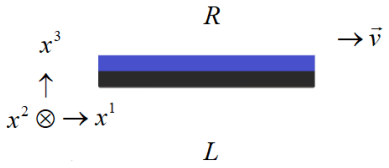
In this paper, we study excitations and dissipation in two infinite parallel metallic plates undergoing relative motion. The degrees of freedom of the electrons in both plates are modeled using the 1+2 dimensional Dirac field, and a nonlocal potential is selected to describe the interaction between the two plates. The internal relative motion is introduced via a Galilean boost, with one plate assumed to slide relative to the other. We then calculate the effective action of the system and derive the vacuum occupation number in momentum space using a perturbative method. Numerical plots reveal that the vacuum occupation number, as a function of momentum, is isotropic for a motion speed $v = 0$ and anisotropic for nonzero $v$. The relative motion induces energy transfer between the plates, leading to on-shell excitations in a manner analogous to the dissipative process of the Schwinger effect. Consequently, we study the motion-induced dissipation effects and the dissipative forces through the quantum action. Numerical results demonstrate that both the imaginary part of the quantum action due to the motion boost and the dissipative force exhibit a threshold as functions of $v$, and both are positively correlated with $v$.
Editorial analysis
A structured set of objections, weighed in public.
Referee Report
Summary. The manuscript studies excitations and dissipation in two infinite parallel metallic plates modeled by 1+2 dimensional Dirac fields with a chosen nonlocal inter-plate interaction. Relative motion is introduced via a Galilean boost applied to one plate. The effective action is computed perturbatively to obtain the vacuum occupation number in momentum space; numerical results show isotropy at v=0 and anisotropy for v>0. The relative motion is claimed to induce energy transfer leading to on-shell excitations analogous to the Schwinger effect, with dissipative forces extracted from the imaginary part of the action exhibiting a velocity threshold and positive correlation with v.
Significance. If the perturbative framework reliably captures the claimed dissipative mechanism, the work would provide a concrete link between Galilean-boosted Dirac fields and motion-induced quantum dissipation in electronic systems, offering testable predictions for anisotropy in occupation numbers and velocity-dependent forces. The numerical demonstration of threshold behavior supplies falsifiable outputs that could be compared with experiments in suitably engineered 2D materials.
major comments (2)
- [Abstract and perturbative effective-action calculation] The central claim that relative motion produces on-shell excitations 'in a manner analogous to the dissipative process of the Schwinger effect' (abstract) rests on a perturbative expansion of the effective action after the Galilean boost. Schwinger pair production is intrinsically non-perturbative (exponentially suppressed in 1/E), and no argument or convergence check is supplied showing that the perturbative result captures the leading dissipative contribution rather than a correction to an existing vacuum.
- [Numerical results for vacuum occupation number] The vacuum occupation number is obtained from the perturbative expansion and plotted as a function of momentum; however, no error estimates, convergence tests with respect to the expansion order, or comparison against a non-boosted baseline are reported, making it impossible to assess whether the reported anisotropy for nonzero v is physically meaningful or an artifact of truncation.
minor comments (2)
- [Model definition] The specific form chosen for the nonlocal inter-plate potential should be stated explicitly (including its Fourier transform) so that the perturbative kernel can be reproduced.
- [Galilean boost implementation] Notation for the boosted Dirac fields and the resulting mode functions should be defined with an equation number to clarify how the Galilean transformation enters the interaction term.
Simulated Author's Rebuttal
We thank the referee for the detailed review and valuable feedback on our manuscript. We address each of the major comments below, providing clarifications and indicating revisions where appropriate.
read point-by-point responses
-
Referee: [Abstract and perturbative effective-action calculation] The central claim that relative motion produces on-shell excitations 'in a manner analogous to the dissipative process of the Schwinger effect' (abstract) rests on a perturbative expansion of the effective action after the Galilean boost. Schwinger pair production is intrinsically non-perturbative (exponentially suppressed in 1/E), and no argument or convergence check is supplied showing that the perturbative result captures the leading dissipative contribution rather than a correction to an existing vacuum.
Authors: We appreciate the referee pointing out the distinction with the Schwinger effect. Our use of 'analogous' refers specifically to the dissipative outcome involving energy transfer and on-shell excitations induced by the relative motion, not to the non-perturbative pair-production mechanism in strong electric fields. In our model, the Galilean boost leads to a time-dependent phase in the interaction, allowing a perturbative computation of the effective action that yields the leading dissipative contribution at this order. We will revise the manuscript to explicitly state the perturbative nature and add a brief discussion justifying why this captures the motion-induced dissipation in the weak-coupling regime of our setup. revision: yes
-
Referee: [Numerical results for vacuum occupation number] The vacuum occupation number is obtained from the perturbative expansion and plotted as a function of momentum; however, no error estimates, convergence tests with respect to the expansion order, or comparison against a non-boosted baseline are reported, making it impossible to assess whether the reported anisotropy for nonzero v is physically meaningful or an artifact of truncation.
Authors: We agree that additional checks would enhance the reliability of the numerical results. In the revised version, we will include a plot or discussion comparing the occupation number at v=0 (isotropic, as expected for the static case) with the boosted cases to highlight the anisotropy. We will also provide an estimate of the truncation error by considering the scaling with the interaction strength and note the order of perturbation used. This should demonstrate that the anisotropy is a physical effect of the motion rather than a numerical artifact. revision: yes
Circularity Check
No significant circularity; derivation self-contained given modeling assumptions
full rationale
The paper selects a 1+2D Dirac field model plus nonlocal inter-plate potential, applies a Galilean boost for relative motion, then computes the effective action and vacuum occupation number via perturbative expansion. All reported quantities (anisotropy of occupation number, threshold behavior in imaginary action and force vs. v) are direct outputs of that expansion. No quoted step reduces a claimed prediction to a fitted input by construction, no self-citation is invoked as a uniqueness theorem, and the Schwinger analogy is presented as an interpretive remark on the computed on-shell excitations rather than an input that forces the result. The chain is therefore independent of its own outputs.
Axiom & Free-Parameter Ledger
axioms (2)
- domain assumption Electrons in the metallic plates are adequately described by the 1+2 dimensional Dirac field.
- domain assumption A nonlocal potential suffices to capture the interaction between the two plates.
Lean theorems connected to this paper
-
IndisputableMonolith/Cost/FunctionalEquation.leanwashburn_uniqueness_aczel unclear?
unclearRelation between the paper passage and the cited Recognition theorem.
We then calculate the effective action of the system and derive the vacuum occupation number in momentum space using a perturbative method... analogous to the dissipative process of the Schwinger effect.
-
IndisputableMonolith/Foundation/AlexanderDuality.leanalexander_duality_circle_linking contradicts?
contradictsCONTRADICTS: the theorem conflicts with this paper passage, or marks a claim that would need revision before publication.
1+2 dimensional Dirac field... infinite parallel metallic plates
What do these tags mean?
- matches
- The paper's claim is directly supported by a theorem in the formal canon.
- supports
- The theorem supports part of the paper's argument, but the paper may add assumptions or extra steps.
- extends
- The paper goes beyond the formal theorem; the theorem is a base layer rather than the whole result.
- uses
- The paper appears to rely on the theorem as machinery.
- contradicts
- The paper's claim conflicts with a theorem or certificate in the canon.
- unclear
- Pith found a possible connection, but the passage is too broad, indirect, or ambiguous to say the theorem truly supports the claim.
Reference graph
Works this paper leans on
-
[1]
Xu, R. & Yan, Y . Theory of open quantum systems.The J. Chem. Phys. 116, 9196–9206, DOI: 10.1063/1.1474579 (2002)
-
[2]
Joichi, I., Matsumoto, S. & Yoshimura, M. Quantum Dissipation in Open Harmonic Systems: —Operator Solution and Application to Decay Process—. Prog. Theor. Phys. 98, 9–28, DOI: 10.1143/PTP.98.9 (1997)
-
[3]
The theory of a general quantum system interacting with a linear dissipative system. Annals Phys. 281, 547–607, DOI: https://doi.org/10.1006/aphy.2000.6017 (2000)
-
[4]
Zhang, L. & Wang, C. Quantum markov semigroup for open quantum system interacting with quantum bernoulli noises. Rev. Math. Phys. 35, 2350015, DOI: 10.1142/S0129055X23500150 (2023). 13
-
[5]
Xu, R.-X. & Yan, Y . Dynamics of quantum dissipation systems interacting with bosonic canonical bath: Hierarchical equations of motion approach. Phys. Rev. E 75, 031107, DOI: 10.1103/PhysRevE.75.031107 (2007)
-
[6]
Jin, J. et al. Dynamics of quantum dissipation systems interacting with fermion and boson grand canonical bath ensembles: Hierarchical equations of motion approach. The J. Chem. Phys. 126, 134113, DOI: 10.1063/1.2713104 (2007)
-
[7]
Degrande, C. et al. Effective field theory: A modern approach to anomalous couplings. Annals Phys. 335, 21–32, DOI: https://doi.org/10.1016/j.aop.2013.04.016 (2013)
-
[8]
Wen, X.-G. Quantum Field Theory of Many-Body Systems: From the Origin of Sound to an Origin of Light and Electrons (Oxford University Press, 2007)
work page 2007
-
[9]
Vasiliev, A. N. Functional methods in quantum field theory and statistical physics (CRC Press, 1998)
work page 1998
-
[10]
Berera, A., Gleiser, M. & Ramos, R. O. Strong dissipative behavior in quantum field theory. Phys. Rev. D 58, 123508, DOI: 10.1103/PhysRevD.58.123508 (1998)
-
[11]
Peskin, M. E., Schroeder, D. V . & Martinec, E. An Introduction to Quantum Field Theory.Phys. Today 49, 69–72, DOI: 10.1063/1.2807734 (1996)
-
[12]
Jentschura, U. D. Friction effects in atom-surface interactions. In APS Division of Atomic, Molecular and Optical Physics Meeting Abstracts, vol. 2016, B5–010 (2016)
work page 2016
-
[13]
Wang, Y . & Jia, Y . Quantum dissipation and friction attributed to plasmons.Mod. Phys. Lett. B 36, 2150589, DOI: 10.1142/S0217984921505898 (2022)
-
[14]
Dodonov, A. V . Dynamical casimir effect via four- and five-photon transitions using a strongly detuned atom.Phys. Rev. A 100, 032510, DOI: 10.1103/PhysRevA.100.032510 (2019)
-
[15]
Fosco, C. D., Lombardo, F. C. & Mazzitelli, F. D. Quantum dissipative effects in moving imperfect mirrors: Sidewise and normal motions. Phys. Rev. D 84, 025011, DOI: 10.1103/PhysRevD.84.025011 (2011)
-
[16]
The Phonon Dissipation Mode in Nanofriction, vol. V olume 10: Micro- and Nano-Systems Engineering and Packag- ing of ASME International Mechanical Engineering Congress and Exposition. DOI: 10.1115/IMECE2016-66402
-
[17]
Magiera, M. P., Wolf, D. E., Brendel, L. & Nowak, U. Magnetic friction and the role of temperature. IEEE Transactions on Magn. 45, 3938–3941, DOI: 10.1109/TMAG.2009.2023623 (2009)
-
[18]
Electronic friction on a superconductor surface
Persson, B. Electronic friction on a superconductor surface. Solid State Commun. 115, 145–148, DOI: https: //doi.org/10.1016/S0038-1098(00)00151-4 (2000)
-
[19]
Dou, W. & Subotnik, J. E. Electronic friction near metal surfaces: A case where molecule-metal couplings depend on nuclear coordinates. The J. Chem. Phys. 146, 092304, DOI: 10.1063/1.4965823 (2016)
-
[20]
Fosco, C. D., Lombardo, F. C. & Mazzitelli, F. D. Quantum dissipative effects in moving mirrors: A functional approach. Phys. Rev. D 76, 085007, DOI: 10.1103/PhysRevD.76.085007 (2007)
-
[21]
Viotti, L., Belén Farías, M., Villar, P. I. & Lombardo, F. C. Thermal corrections to quantum friction and decoherence: A closed-time-path approach to atom-surface interaction. Phys. Rev. D 99, 105005, DOI: 10.1103/PhysRevD.99. 105005 (2019)
-
[22]
Farias, M. B., Fosco, C. D., Lombardo, F. C. & Mazzitelli, F. D. Quantum friction between graphene sheets. Phys. Rev. D 95, 065012, DOI: 10.1103/PhysRevD.95.065012 (2017)
-
[23]
Farías, M. B. & Lombardo, F. C. Dissipation and decoherence effects on a moving particle in front of a dielectric plate. Phys. Rev. D 93, 065035, DOI: 10.1103/PhysRevD.93.065035 (2016)
- [24]
-
[25]
Topological insulator materials.J
Ando, Y . Topological insulator materials.J. Phys. Soc. Jpn. 82, 102001, DOI: 10.7566/JPSJ.82.102001 (2013)
-
[26]
Zhang, D. et al. Superconducting proximity effect and possible evidence for pearl vortices in a candidate topological insulator. Phys. Rev. B 84, 165120, DOI: 10.1103/PhysRevB.84.165120 (2011). 14
-
[27]
Golkar, S., Roberts, M. & Dam, S. Effective field theory of relativistic quantum hall systems. J. High Energy Phys. 2014, 138, DOI: 10.1007/JHEP12%282014%29138 (2014)
-
[28]
Dou, W., Miao, G. & Subotnik, J. E. Born-oppenheimer dynamics, electronic friction, and the inclusion of electron-electron interactions. Phys. Rev. Lett. 119, 046001, DOI: 10.1103/PhysRevLett.119.046001 (2017)
-
[29]
Weinberg, S. & Greenberg, O. W. The Quantum Theory of Fields, V ol. 1: Foundations.Phys. Today 48, 78–78, DOI: 10.1063/1.2808256 (1995)
-
[30]
Quantum Field Theory and the Standard Model
Hollik, W. Quantum Field Theory and the Standard Model. Phys. Today 67, 57–58, DOI: 10.1063/PT.3.2624 (2014)
-
[31]
Kim, S. P. & Page, D. N. Schwinger pair production in electric and magnetic fields. Phys. Rev. D 73, 065020, DOI: 10.1103/PhysRevD.73.065020 (2006)
-
[32]
On vacuum instability in quantum field theory
Olesen, P. On vacuum instability in quantum field theory. Phys. Lett. B 73, 327–329, DOI: https://doi.org/10.1016/ 0370-2693(78)90526-9 (1978). 15
work page 1978
discussion (0)
Sign in with ORCID, Apple, or X to comment. Anyone can read and Pith papers without signing in.