REVIEW 3 major objections 4 minor 56 references
Single superflares from M dwarf hosts can drive order-of-magnitude chemical swings in brown dwarf companion atmospheres, but the changes fade within a day and are only observable soon after the event at high spectral resolution.
Reviewed by Pith at T0; open to challenge. T0 means a machine referee read the full paper against a public rubric. the ladder, T0–T4 →
Superflares from M dwarf hosts drive order-of-magnitude atmospheric chemistry changes in brown dwarf companions, but fast chemical relaxation (under a day) leaves high-resolution emission spectroscopy within hours of a flare as the only plausible, still very challenging, detection route.
T0 review reviewed 2026-08-04 challenge →
load-bearing objection First careful flare-chemistry model for hot high-gravity brown dwarfs; the qualitative picture is solid and limits are honestly disclosed, but the quantitative observability forecast rests on an untested synthetic flare SED. the 3 major comments →
Simulations of Flare Chemistry in Brown Dwarf Companions to Active M Dwarfs
The pith
A machine-rendered reading of the paper's core claim, the machinery that carries it, and where it could break.
The reading
Core claim
For a representative T_eff=2000 K, log g=5 cloudless brown dwarf orbiting an M1.5V star at 0.05 au, a single 10^33 to 10^35 erg superflare transiently reprograms the photochemistry of the upper atmosphere (pressures below roughly 1 mbar): mixing ratios of CH4, NH3, H2O, TiO, SO2 and other species swing by orders of magnitude within minutes. Because high temperatures and densities shorten chemical timescales, most abundances return toward the quiescent state within about a day, and the thermal response is only a few to a few tens of Kelvin, driven chiefly by photochemically altered opacities rather than direct flare heating. Translating the chemistry into emission spectra, the authors find th
What carries the argument
The modeling chain: VULCAN (1-D chemical kinetics with an HCNO+TiV reaction network) iteratively coupled to HELIOS (1-D radiative-convective transfer with on-the-fly opacities), driven by time-dependent Fiducial Flare spectra (a 9000 K blackbody plus UV emission lines with a boxcar-plus-exponential light curve). A 10-second sequential coupling step lets photochemistry and temperature respond to the flare's rise and decay; the resulting opacity feedback is what localizes the temperature change to the photochemically active layer around 10^-5 to 10^-4 bar.
Load-bearing premise
The flare input is a synthetic 9000 K blackbody plus UV lines with a boxcar-and-decay light curve; the authors themselves note that flares with significantly different spectral energy distributions (for example, predominantly X-ray) could produce different results, and the magnitude, duration, and even identity of the predicted chemical changes all depend on this assumed UV output.
What would settle it
Triggered high-resolution (R ~ 10^5) near-infrared emission spectroscopy of a known short-period brown dwarf companion, such as TOI-2119b, observed within hours of a detected superflare: look for the predicted percent-level H2O photolysis contrast and a several-hundred-ppm emission decrease at 4.2 microns persisting about a day. Absence of both signatures, or a simultaneous measurement showing the host flare's UV output to be far weaker than the Fiducial Flare assumption, would contradict the model's core SED and chemical-network predictions.
If this is right
- Even the most energetic single flare (10^35 erg) produces only tens of Kelvin of heating and mostly sub-day chemical perturbations, so repeated flaring is unlikely to build a quasi-steady altered state in hot, high-gravity brown dwarf atmospheres.
- Self-consistent temperature-chemistry coupling is unnecessary when the goal is predicting observability of flare impacts from radiative heating alone; VULCAN-only runs reproduce coupled runs to better than 1% in mixing ratios during the first two hours.
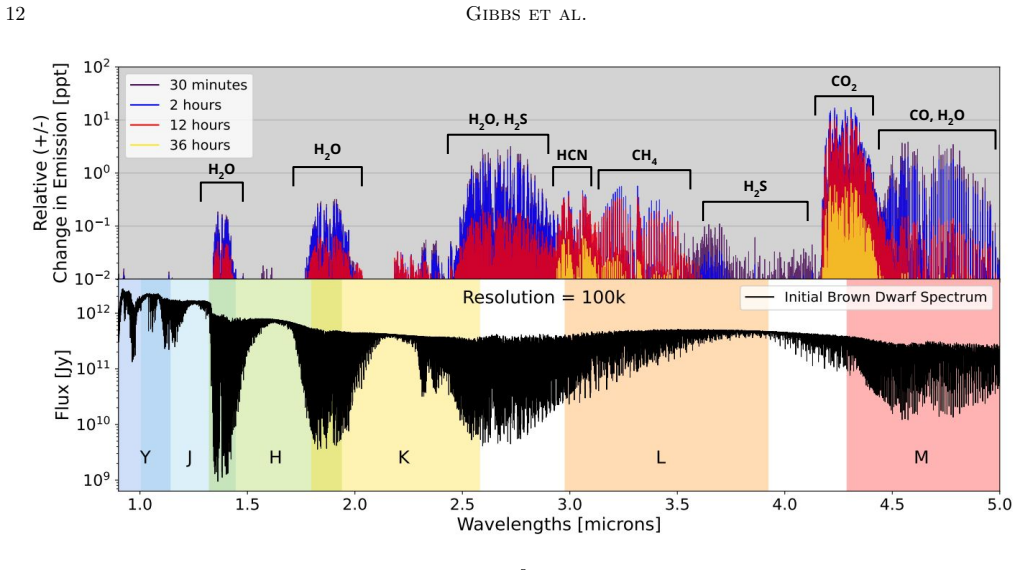
- At R ~ 10^5, immediate post-flare emission changes can reach about a percent (dominated by H2O photolysis), but drop below roughly 10 ppm within 36 hours; the longest-lived signature is a CO2-driven emission decrease near 4.2 microns.
- At R ~ 1000 the spectral changes peak at about 10 ppm, so high-resolution spectroscopy is the only plausible detection route.
- Catching a flare impact requires observing the brown dwarf within hours of a superflare with high-resolution emission spectroscopy while contending with stellar contamination, making single-flare detection very challenging but still worth attempting to validate the models.
Where Pith is reading between the lines
- The authors stop at single flares; extending the framework to repeated flaring with realistic flare statistics is a natural next test, and their own relaxation-time estimates suggest that for most species the quiescent state should dominate, with cumulative effects likely confined to slow-recovering species like SO2.
- If real M dwarf superflares are more X-ray-dominated than the Fiducial Flare assumption, the early-time UV photolysis signals (H2O, CH4) could weaken while ion-driven chemistry, which the neutral-only network cannot capture, might produce new long-lived species; the 4.2 micron CO2 response is the prediction most worth betting on.
- The paper's approach of computing high-resolution emission spectra from time-dependent chemistry could be applied to other transiting brown dwarf systems with known flare rates to rank which targets most deserve rapid-response high-resolution follow-up.
- Because the thermal effect is small and chemistry relaxes fast, the strongest test may not require chasing a live flare: monitoring the 4.2 micron region through multiple flare events and stacking post-flare epochs could recover the predicted CO2 enhancement even if single-epoch detection is marginal.
Editorial analysis
A structured set of objections, weighed in public.
Referee Report
Summary. The paper simulates the atmospheric response of a hot (Teff=2000 K), high-gravity (log g=5) cloudless brown dwarf in a short-period orbit around an active M dwarf to single superflares (10^33–10^35 erg). The authors couple the 1D chemical kinetics code VULCAN with the 1D radiative-convective code HELIOS, using the Fiducial Flare package for synthetic flare spectra and a MUSCLES spectrum for the quiescent host. They find that flares drive order-of-magnitude mixing-ratio changes for many species in the upper atmosphere (p ≲ 1 mbar), but that these changes relax within roughly a day. The thermal response is modest (up to ~20 K) and arises mainly through photochemically altered opacities. Using petitRADTRANS, they argue that the most observable signatures are H2O photolysis and CO2 enhancement near 4.2 μm, producing part-per-thousands changes in high-resolution (R=10^5) emission spectra within a few hours of the flare, though stellar contamination makes detection very challenging.
Significance. If the quantitative results are robust, this is the first self-consistent temperature–chemistry simulation of flare photochemistry in a brown dwarf companion. The paper extends prior hot-Jupiter work to a higher-temperature, higher-gravity regime and identifies a concrete observational target (CO2 at 4.2 μm and early H2O photolysis) with a clear warning that the effect is transient and requires high-resolution emission spectroscopy. The implementation is careful in several respects: the quiescent state is converged via 15 leapfrog iterations, a no-flare control run is included, the quiescent state is tested for drift after perturbation, and a timestep-convergence check is described. There is no parameter fitting or tuned constants, so the study is a genuinely forward model. The main weakness, acknowledged by the authors in Sec. 2.1.3, is that the synthetic flare SED is assumed rather than varied, and the entire photochemical response hinges on the sub-240 nm UV output, which real M-dwarf flares show large scatter in. Because the paper's headline numbers—order-of-magnitude abundance changes, part-per-thousands spectral contrasts, and the CO2/H2O ranking—scale directly with that UV f
major comments (3)
- [Sec. 2.1.3 / Fig. 1] The Fiducial Flare SED is the load-bearing driver of all photochemistry: VULCAN is sensitive only to wavelengths shorter than ~240 nm (Sec. 2.1.1), so the result is set by the UV tail of a 9000 K blackbody plus line prescriptions. The authors explicitly concede that 'flares with significantly different spectral energy distributions (e.g. predominately X-ray) could produce different results,' yet no sensitivity test is presented. Because real M-dwarf superflares exhibit large scatter in FUV/optical and X-ray/FUV ratios (e.g., Brasseur et al. 2023; Namekata et al. 2017), a factor-of-few change in the 100–240 nm fluence at fixed bolometric energy would directly affect the claimed 'orders-of-magnitude' abundance changes, the part-per-thousands spectral contrasts, and the recovery timescales. I recommend either running at least one alternative SED (e.g., enhanced Ly-alpha, an X-ray-dominated
- [Sec. 3.3 / Fig. 5] The 36-hour simulations, which underpin all long-term recovery claims and the spectra in Sec. 4.2, are run with VULCAN only—no temperature–chemistry coupling. The authors justify this by noting that in the first two hours the coupled and uncoupled runs differ by <1% in mixing ratios, and say this likely holds across the full 36 hours. However, Sec. 3.2 shows that the flare-induced temperature perturbation persists beyond the two-hour window, lasting 'as long as the underlying chemical changes that drive it.' If temperature changes persist beyond 2 hours, the chemical relaxation at later times could be affected in a way that is not captured by the short coupled run. The <1% claim is also not documented in a figure or table; the reader is asked to take it on faith from an unspecified comparison. To make the long-term results load-bearing, the authors should either run a longer coupled test
- [Sec. 4.2 / Fig. 6] The spectral-change calculations use petitRADTRANS with the chemistry-only (uncoupled) mixing ratios and explicitly neglect temperature changes, because temperature fields are 'not available beyond two hours.' The authors argue the effect is small, but the claimed long-lived CO2 signal at 36 hours is several hundred ppm. A few Kelvin of temperature change in the line-forming region could produce comparable brightness fluctuations in a 2000 K brown dwarf, especially at high spectral resolution. Since CO2 at 4.2 μm is the paper's main observability recommendation, this omission should be quantified. One concrete test: take the coupled temperature profile at 2 hours, apply it to the 2-hour chemistry, and compare the resulting spectrum with the chemistry-only spectrum at the same time to see how much the CO2 signal changes. This would bound the magnitude of the effect without needing a long
minor comments (4)
- [Figure 3 caption] The caption reads 'T emperature change' (apparent typo for 'Temperature').
- [Sec. 4.1] 'introconversion between C2H2 and CH3' should likely be 'interconversion.'
- [Sec. 2.2.2] The sentence 'Both codes are also capable of simulating flare impacts independently from each other' is slightly ambiguous; clarify that each code can be run without updates from the other.
- [Sec. 3.2] The statement that H2O's small relative change is due to its high initial abundance is clear, but the reader may wonder whether the absolute change in H2O column density is the relevant quantity for the spectral effect; consider making this explicit.
Circularity Check
No significant circularity: forward-modeling study using external open-source codes, with no fitted parameters or self-citation chain.
full rationale
This is a forward-modeling study. The authors couple VULCAN (Tsai et al. 2017, 2021) and HELIOS (Malik et al. 2017, 2019), drive the chemistry with the external Fiducial Flare package (Loyd et al. 2018), and post-process with petitRADTRANS (Mollière et al. 2019). None of the central quantitative claims — orders-of-magnitude mixing-ratio changes, sub-day recovery timescales, or the H2O-photolysis/CO2-enhancement observability ranking — are fitted to a target result or defined in terms of the outputs. The quiescent atmosphere is iterated to a stability criterion (temperature change <1 K, abundances <~1%) rather than imposed to match the flare response. The decision to drop temperature-chemistry coupling in the 36-hour runs is justified by an observed <1% difference in the first two hours, not by construction. The paper contains no self-citations by the present authors, and the load-bearing codes are external, benchmarked, and open source. The main sensitivity concern, the assumed Fiducial Flare SED (9000 K blackbody plus UV lines), is a stated modeling input, and the authors explicitly concede that 'flares with significantly different spectral energy distributions (e.g. predominately X-ray) could produce different results.' That is an acknowledged limitation and a possible robustness gap, but it is not circular: the flare input is not derived from the simulated abundances or spectra. Likewise, the stated omissions of X-ray photochemistry, charged-species chemistry, non-LTE effects, and particle radiation are limitations, not hidden circular dependencies. The paper's results are internally derived from the stated physical/chemical assumptions and external rate/opacity data, so no prediction reduces by definition to its inputs.
Axiom & Free-Parameter Ledger
free parameters (8)
- Effective temperature of the model brown dwarf =
2000 K
- Surface gravity =
log g = 5.0 (cgs)
- Radius and mass of the brown dwarf =
1.08 R_Jup, about 47 M_Jup
- Orbital separation =
0.05 au
- Flare bolometric energies =
10^33, 10^34, 10^35 erg
- Elemental abundances =
Solar
- Vertical eddy diffusion coefficient Kzz =
not stated in the paper
- Quiescent host-star spectrum =
MUSCLES GJ 832 (M1.5V)
axioms (7)
- domain assumption VULCAN's HCNOSTiV neutral chemical network, tabulated at 500 to 2500 K, stays accurate above 2500 K because equilibrium chemistry dominates in the deep atmosphere and matches FastChem.
- domain assumption The Fiducial Flare synthetic spectrum (9000 K blackbody plus UV lines, boxcar-plus-exponential light curve) represents real M dwarf flare output for photochemistry.
- domain assumption Radiation shortward of 246.6 nm is irrelevant to the modeled thermal structure, so roughly half the flare energy cannot heat the atmosphere.
- domain assumption Charged-species chemistry and X-ray photochemistry can be neglected without changing the main conclusions.
- domain assumption Local thermodynamic equilibrium holds throughout the irradiated atmosphere in HELIOS.
- domain assumption No atmospheric escape; zero mass flux at top and bottom boundaries of the model atmosphere.
- domain assumption Photodissociation energy deposits no heat; reactions carry no enthalpies in VULCAN.
Cite this review
Pith. "Pith review of Simulations of Flare Chemistry in Brown Dwarf Companions to Active M Dwarfs." pith.science (2026). https://pith.science/paper/354UTHAT
@misc{pith2026250907063,
  author       = {Pith},
  title        = {Pith review of: Simulations of Flare Chemistry in Brown Dwarf Companions to Active M Dwarfs},
  year         = {2026},
  howpublished = {\url{https://pith.science/paper/354UTHAT}},
  note         = {Machine review of arXiv:2509.07063}
}
abstract
Brown dwarfs that are short period ($<10\,$day) companions to actively flaring M dwarfs may provide a context to directly observe flare-driven photochemistry and structural changes in an extrasolar planet-like atmosphere. To assess the viability of directly observing flare impacts in the atmosphere of a brown dwarf, we perform self-consistent temperature-chemistry modeling of the atmospheric response to individual energetic superflares. We modified the existing open-source \texttt{VULCAN} chemical-kinetics and \texttt{HELIOS} radiative-transfer codes for this purpose. Similar to previous studies of flare impacts on hydrogen dominated atmospheres, we find flares are capable of orders-of-magnitude changes in the mixing abundances of many chemical species, including important opacity sources like CH$_4$ and CO$_2$. However, due to fast chemical timescales resulting from high temperatures and densities in brown dwarf atmospheres, these changes last for a short-period of time, generally less than a day, and are only plausibly observable via high resolution emission spectroscopy. We find that the most observable, short-term spectral changes in hot (T$_{\text{eff}}\sim2000\,$K), high-gravity ($\log{\text{g}}\sim5$), cloudless brown dwarfs are the photolysis of H$_2$O and enhancement of CO$_2$, which can result in part-per-thousands spectral changes in the hours after a flare.
Figures


Reference graph
Works this paper leans on
-
[1]
2016, Nature Geoscience, 9, 452, doi: 10.1038/ngeo2719
Danchi, W. 2016, Nature Geoscience, 9, 452, doi: 10.1038/ngeo2719
doi:10.1038/ngeo2719 2016
-
[2]
Argiroffi, C., Reale, F., Drake, J. J., et al. 2019, Nature Astronomy, 3, 742, doi: 10.1038/s41550-019-0781-4
-
[3]
2022, MNRAS, 512, 4877, doi: 10.1093/mnras/stac809
Baeyens, R., Konings, T., Venot, O., Carone, L., & Decin, L. 2022, MNRAS, 512, 4877, doi: 10.1093/mnras/stac809
-
[4]
2020, A&A, 643, A106, doi: 10.1051/0004-6361/202038881
Bashi, D., Zucker, S., Adibekyan, V., et al. 2020, A&A, 643, A106, doi: 10.1051/0004-6361/202038881
-
[5]
Biller, B. A., Vos, J. M., Zhou, Y., et al. 2024, MNRAS, 532, 2207, doi: 10.1093/mnras/stae1602
-
[6]
Brasseur, C. E., Osten, R. A., Tristan, I. I., & Kowalski, A. F. 2023, ApJ, 944, 5, doi: 10.3847/1538-4357/acab59
-
[7]
Carmichael, T. W., Irwin, J. M., Murgas, F., et al. 2022, MNRAS, 514, 4944, doi: 10.1093/mnras/stac1666
-
[8]
Cliver, E. W., & Dietrich, W. F. 2013, Journal of Space Weather and Space Climate, 3, A31, doi: 10.1051/swsc/2013053
arXiv 2013
-
[9]
2024, ApJ, 962, 157, doi: 10.3847/1538-4357/ad206a
Cohen, O., Glocer, A., Garraffo, C., et al. 2024, ApJ, 962, 157, doi: 10.3847/1538-4357/ad206a
-
[10]
France, K., Loyd, R. O. P., Youngblood, A., et al. 2016, ApJ, 820, 89, doi: 10.3847/0004-637X/820/2/89
-
[11]
Gan, T., Wang, S. X., Wang, S., et al. 2022, arXiv e-prints, arXiv:2210.08313, doi: 10.48550/arXiv.2210.08313
-
[12]
Gilbert, E. A., Barclay, T., Quintana, E. V., et al. 2022, The Astronomical Journal, 163, 147, doi: 10.3847/1538-3881/ac23ca
-
[13]
Gillen, E., Hillenbrand, L. A., David, T. J., et al. 2017, ApJ, 849, 11, doi: 10.3847/1538-4357/aa84b3
-
[14]
A., Carolan, S., Villarreal D’Angelo, C., & Manchester, W
Hazra, G., Vidotto, A. A., Carolan, S., Villarreal D’Angelo, C., & Manchester, W. 2021, Monthly Notices of the Royal Astronomical Society, 509, 5858, doi: 10.1093/mnras/stab3271
-
[15]
B., Shorttle, O., & Madhusudhan, N
Hobbs, R., Rimmer, P. B., Shorttle, O., & Madhusudhan, N. 2021, MNRAS, 506, 3186, doi: 10.1093/mnras/stab1839
-
[16]
M., Charbonneau, D., Esquerdo, G
Irwin, J. M., Charbonneau, D., Esquerdo, G. A., et al. 2018, AJ, 156, 140, doi: 10.3847/1538-3881/aad9a3
-
[17]
Jackman, J. A. G., Wheatley, P. J., Bayliss, D., et al. 2019, MNRAS, 489, 5146, doi: 10.1093/mnras/stz2496
-
[18]
Kaltenegger, L., & Traub, W. A. 2009, The Astrophysical Journal, 698, 519, doi: 10.1088/0004-637X/698/1/519
-
[19]
2019, A&A, 631, A125, doi: 10.1051/0004-6361/201935113
Kiefer, F., H´ ebrard, G., Sahlmann, J., et al. 2019, A&A, 631, A125, doi: 10.1051/0004-6361/201935113
-
[20]
Kiman, R., Faherty, J. K., Cruz, K. L., et al. 2021, AJ, 161, 277, doi: 10.3847/1538-3881/abf561
-
[21]
2018,, Astrophysics Source Code Library, record ascl:1804.025
Kitzmann, D., & Stock, J. 2018,, Astrophysics Source Code Library, record ascl:1804.025
work page 2018
-
[22]
2022, A&A, 667, A15, doi: 10.1051/0004-6361/202243436
Konings, T., Baeyens, R., & Decin, L. 2022, A&A, 667, A15, doi: 10.1051/0004-6361/202243436
-
[23]
Kotorashvili, K., & Blackman, E. G. 2024, arXiv e-prints, arXiv:2411.17916, doi: 10.48550/arXiv.2411.17916
-
[24]
2019, The Astrophysical Journal, 883, 143, doi: 10.3847/1538-4357/ab3f35
Lingam, M., & Loeb, A. 2019, The Astrophysical Journal, 883, 143, doi: 10.3847/1538-4357/ab3f35
-
[25]
2022, The Planetary Science Journal, 3, 1, doi: 10.3847/PSJ/ac3f3c
Locci, D., Petralia, A., Micela, G., et al. 2022, The Planetary Science Journal, 3, 1, doi: 10.3847/PSJ/ac3f3c
-
[26]
J., Miguel, Y., Tsai, S.-M., et al
Louca, A. J., Miguel, Y., Tsai, S.-M., et al. 2023, MNRAS, 521, 3333, doi: 10.1093/mnras/stac1220
-
[27]
Loyd, R. O. P., France, K., Youngblood, A., et al. 2018, ApJ, 867, 71, doi: 10.3847/1538-4357/aae2bd
-
[28]
Malik, M., Kitzmann, D., Mendon¸ ca, J. M., et al. 2019, AJ, 157, 170, doi: 10.3847/1538-3881/ab1084
-
[29]
Malik, M., Grosheintz, L., Mendon¸ ca, J. M., et al. 2017, AJ, 153, 56, doi: 10.3847/1538-3881/153/2/56
-
[30]
2021,, Sonora Bobcat Zenodo, doi: 10.5281/zenodo.5063476
Marley, M., Saumon, D., Morley, C., et al. 2021,, Sonora Bobcat Zenodo, doi: 10.5281/zenodo.5063476
-
[31]
McCarthy, A. M., Vos, J. M., Muirhead, P. S., et al. 2025, The Astrophysical Journal Letters, 981, L22, doi: 10.3847/2041-8213/ad9eaf
-
[32]
2023, arXiv e-prints, arXiv:2302.04242, doi: 10.48550/arXiv.2302.04242 Molli` ere, P., Wardenier, J
Ment, K., & Charbonneau, D. 2023, arXiv e-prints, arXiv:2302.04242, doi: 10.48550/arXiv.2302.04242 Molli` ere, P., Wardenier, J. P., van Boekel, R., et al. 2019, A&A, 627, A67, doi: 10.1051/0004-6361/201935470
-
[33]
Moses, J. I. 2014, Philosophical Transactions of the Royal Society of London Series A, 372, 20130073, doi: 10.1098/rsta.2013.0073
arXiv 2014
-
[34]
Mulders, G. D., Pascucci, I., & Apai, D. 2015, ApJ, 798, 112, doi: 10.1088/0004-637X/798/2/112
-
[35]
2017, ApJ, 851, 91, doi: 10.3847/1538-4357/aa9b34
Namekata, K., Sakaue, T., Watanabe, K., et al. 2017, ApJ, 851, 91, doi: 10.3847/1538-4357/aa9b34
-
[36]
2023, Monthly Notices of the Royal Astronomical Society, 523, 5681, doi: 10.1093/mnras/stad1734
Evans, E. 2023, Monthly Notices of the Royal Astronomical Society, 523, 5681, doi: 10.1093/mnras/stad1734
-
[37]
Statistical Analysis of Stellar Flares from the First Three Years of TESS Observations
Pietras, M., Falewicz, R., Siarkowski, M., Bicz, K., & Pre´ s, P. 2022, arXiv e-prints, arXiv:2207.11039, doi: 10.48550/arXiv.2207.11039
work page internal anchor Pith review Pith/arXiv arXiv doi:10.48550/arxiv.2207.11039 2022
-
[38]
2022, arXiv e-prints, arXiv:2203.04648, doi: 10.48550/arXiv.2203.04648
Pinamonti, M., Sozzetti, A., Maldonado, J., et al. 2022, arXiv e-prints, arXiv:2203.04648, doi: 10.48550/arXiv.2203.04648
-
[39]
Price-Whelan, A. M., Sip˝ ocz, B. M., G¨ unther, H. M., et al. 2018, AJ, 156, 123, doi: 10.3847/1538-3881/aabc4f
-
[40]
Rackham, B. V., Apai, D., & Giampapa, M. S. 2018, The Astrophysical Journal, 853, 122, doi: 10.3847/1538-4357/aaa08c 16Gibbs et al
-
[41]
Ridgway, R. J., Zamyatina, M., Mayne, N. J., et al. 2022, Monthly Notices of the Royal Astronomical Society, 518, 2472, doi: 10.1093/mnras/stac3105
-
[42]
2021, A&A, 653, A114, doi: 10.1051/0004-6361/202140968
Sabotta, S., Schlecker, M., Chaturvedi, P., et al. 2021, A&A, 653, A114, doi: 10.1051/0004-6361/202140968
-
[43]
Sagan, C., & Salpeter, E. E. 1976, ApJS, 32, 737, doi: 10.1086/190414
-
[44]
2010, Astrobiology, 10, 751, doi: 10.1089/ast.2009.0376
Hawley, S. 2010, Astrobiology, 10, 751, doi: 10.1089/ast.2009.0376
arXiv 2010
-
[45]
Stock, J. W., Kitzmann, D., & Patzer, A. B. C. 2022, MNRAS, 517, 4070, doi: 10.1093/mnras/stac2623
-
[46]
2019, Astrobiology, 19, 64, doi: 10.1089/ast.2017.1794
Davenport, J. 2019, Astrobiology, 19, 64, doi: 10.1089/ast.2017.1794
arXiv 2019
-
[47]
Triaud, A. H. M. J. 2021, in ExoFrontiers; Big Questions in Exoplanetary Science, ed. N. Madhusudhan, 6–1, doi: 10.1088/2514-3433/abfa8fch6
-
[48]
Tsai, S.-M., Lyons, J. R., Grosheintz, L., et al. 2017, ApJS, 228, 20, doi: 10.3847/1538-4365/228/2/20
-
[49]
2021, ApJ, 923, 264, doi: 10.3847/1538-4357/ac29bc
Tsai, S.-M., Malik, M., Kitzmann, D., et al. 2021, ApJ, 923, 264, doi: 10.3847/1538-4357/ac29bc
-
[50]
Tsai, S.-M., Lee, E. K. H., Powell, D., et al. 2023, Nature, 617, 483, doi: 10.1038/s41586-023-05902-2 van der Walt, S., Colbert, S. C., & Varoquaux, G. 2011, Computing in Science Engineering, 13, 22, doi: 10.1109/MCSE.2011.37
-
[51]
2019, A&A, 623, A49, doi: 10.1051/0004-6361/201834264
Vida, K., Leitzinger, M., Kriskovics, L., et al. 2019, A&A, 623, A49, doi: 10.1051/0004-6361/201834264
-
[52]
Virtanen, P., Gommers, R., Oliphant, T. E., et al. 2019, arXiv e-prints, arXiv:1907.10121. https://arxiv.org/abs/1907.10121
Pith/arXiv arXiv 2019
-
[53]
Vowell, N., Rodriguez, J. E., Latham, D. W., et al. 2025, arXiv e-prints, arXiv:2501.09795, doi: 10.48550/arXiv.2501.09795
-
[54]
E., M¨ uller, H.-R., Redfield, S., et al
Wood, B. E., M¨ uller, H.-R., Redfield, S., et al. 2021, ApJ, 915, 37, doi: 10.3847/1538-4357/abfda5
-
[55]
W., Wang, J., Ruffio, J.-B., et al
Xuan, J. W., Wang, J., Ruffio, J.-B., et al. 2022, ApJ, 937, 54, doi: 10.3847/1538-4357/ac8673
-
[56]
Yates, J. S., Palmer, P. I., Biller, B., & Cockell, C. S. 2017, The Astrophysical Journal, 836, 184, doi: 10.3847/1538-4357/836/2/184
This paper was first reviewed by deepseek-v4-flash on August 4, 2026.
discussion (0)
Sign in with ORCID, Apple, or X to comment. Anyone can read and Pith papers without signing in.