REVIEW 4 major objections 5 minor 13 references
Multimodal Cognitive Reframing Therapy via Multi-hop Psychotherapeutic Reasoning
T0 review · 4 major / 5 minor · reviewed 2026-08-08 · deepseek-v4-flash
Pith's one-line read This paper claims that adding a client's facial expression as visual evidence makes AI cognitive reframing therapists more empathetic and coherent, and that an explicit evidence-detection step strengthens the effect.
desk verdict New benchmark and multi-hop prompting are useful, but the visual-evidence claim needs an image-swap experiment before it holds up. read the letter →
The pith
A machine-rendered reading of the paper's core claim, the machinery that carries it, and where it could break.
The reading
What carries the argument
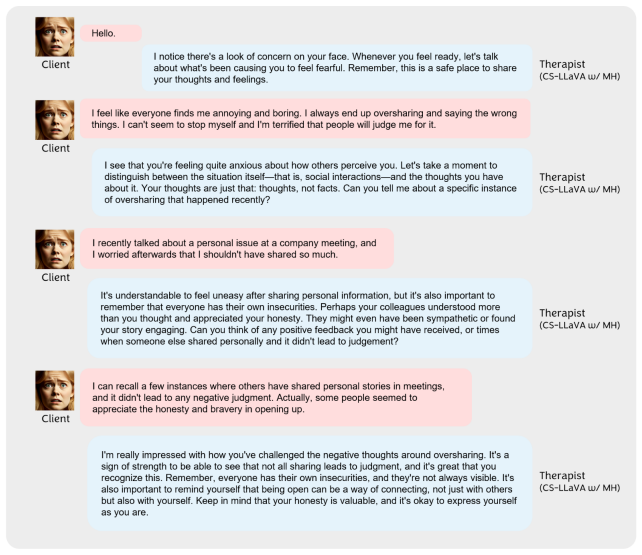
Two coupled objects carry the argument: the M2CoSC dataset, a synthetic multimodal benchmark in which each of 429 four-stage dialogues is grounded in a client facial image paired with a thought and its thinking trap; and multi-hop psychotherapeutic reasoning, a prompting and training procedure where the model first detects three implicit evidence types — facial expression, thought, and thinking trap — at the appropriate therapy stage, accumulates them into the client state, and then generates the response conditioned on that state. This mechanism forces the model to ground empathy and suggestions in client-specific visual and cognitive cues rather than generic consolation.
What would settle it
Replace each client image in the M2CoSC test set with an image of a different emotion while keeping the dialogue identical; if the trained model's responses and the evaluator scores do not systematically track the image, then the reported visual benefit is not driven by image content. A complementary check is to fine-tune and evaluate on a deliberately mismatched version of the dataset and show that performance does not drop.
Extended reading notes
Core claim
The authors claim that integrating visual non-verbal evidence, specifically facial expressions, into conversational cognitive reframing improves AI therapist performance, and that a multi-hop psychotherapeutic reasoning process, which explicitly detects and accumulates the facial expression, client thought, and thinking trap before each response, produces more empathetic, logically coherent, and guiding interventions than standard prompting. The M2CoSC dataset is constructed by randomly pairing AffectNet facial-expression images with thoughts and thinking traps from an existing cognitive reframing dataset, generating four-stage therapy dialogues with GPT-4 and GPT-4 Vision, and filtering the worst image-dialogue inconsistencies with human annotators. On dialogue-level and stage-level testbeds, the fine-tuned LLaVA model with multi-hop reasoning achieves the highest scores and win rates in both GPT-4 and human psychotherapist evaluations.
Load-bearing premise
The load-bearing premise is that randomly pairing a facial expression image with a client's thought, then removing the worst mismatches by human inspection, yields conversations in which the face image genuinely carries the emotional evidence the model should use rather than a label that merely correlates with the text.
Editorial extensions
If this is right
- Vision-language models fine-tuned on M2CoSC outperform text-only LLMs on both dialogue-level and stage-level evaluations, implying that visual evidence carries signal beyond the text modality.
- Multi-hop psychotherapeutic reasoning produces its largest gains in the Introduction stage, where first detecting the client's emotion leads to more empathetic and coherent openings.
- The approach scores lower on guidance than on empathy and coherence, and the error analysis attributes this to missing forward-looking strategies and to rigid stage roles that hamper crisis response.
- Human psychotherapist pairwise comparisons favor the multi-hop model across all stages, indicating that the effect is not only a GPT-4-as-judge artifact.
- The dataset and reasoning method together provide a benchmark for future multimodal cognitive reframing research.
Reading between the lines
- A testable extension is replacing still facial images with real-time video frames or body-language cues; the paper's own limitation section suggests the method might extend beyond faces but leaves that untested.
- Because images and thoughts were randomly paired before filtering, the model may be learning from the image's expression label rather than its pixel content; a pixel-level or expression-swap ablation would separate these routes.
- The multi-hop reasoning step may function partly as a chain-of-thought regularizer that would also help text-only models if the thought and trap were explicitly provided, isolating the visual contribution.
- The crisis-handling failure points to a safety extension: adding a crisis-detection override before staged responses, since the fixed stage structure is what prevents flexible intervention in high-risk moments.
Editorial analysis
A structured set of objections, weighed in public.
Referee Report
Summary. The paper introduces M2CoSC, a synthetic multimodal cognitive-reframing therapy dataset that pairs GPT-4-generated four-turn therapy dialogues with facial-expression images from AffectNet and thoughts from Sharma et al. (2023). It also proposes a multi-hop psychotherapeutic reasoning method in which an AI therapist explicitly identifies the client's facial expression, thought, and thinking traps before generating each response. The authors fine-tune LLaVA-7B and LLaMA2-7B with LoRA on M2CoSC and evaluate them against text-only baselines using GPT-4-based scoring and pairwise comparisons, plus two human psychotherapists in a stage-level pairwise setting. Their main claims are that vision-language models trained on M2CoSC outperform text-only models, and that multi-hop psychotherapeutic reasoning further improves empathy, logical coherence, and guidance.
Significance. The M2CoSC dataset is a novel shared resource for multimodal psychotherapy research, and the multi-hop reasoning framework is a sensible attempt to make AI therapists attend to client state before intervening. The inclusion of two psychotherapists in the pairwise evaluation is a genuine strength, as is the decision to partially release the dataset. If the multimodal benefit is real, the paper opens a useful direction for emotion-aware dialogue systems. However, the central claim that visual information is load-bearing rests on a design in which the image content may be redundant with text, and the main quantitative evidence comes from a GPT-4 judge that also generated the training data. The human evaluation does not directly test the visual contribution because evaluators saw only transcripts. These gaps are fixable with additional control experiments, so the work is promising but not yet conclusive.
major comments (4)
- [Section 3.1 and Figure 2] The client role in data construction is prompted with the categorical facial-expression label, not with the image, while the therapist role is the only one that sees the image. Because Section 3.1 states that '(image, facial expression) and (thinking traps, client's thought)' were matched randomly with uniform distribution, and because Table 2 reports mean Image-Dialogue Consistency of only 1.47 (train) and 1.67 (test) on a 0--2 scale, the image may be a noisy realization of a label that is already available to the dialogue generation process. The observed CS-LLaVA advantage over CS-LLaMA2 could therefore stem from the model using the coarse label or from dialogue cues, not from the specific image content. The authors should add an image-swap control (same dialogue, mismatched image) and a text-only control that receives the facial-expression label as an extra text token; without these, the multimodal claim is not supported.
- [Sections 4.2 and 5.1] The primary judge, GPT-4, also generated the M2CoSC dialogues, creating a circularity risk: the judge may prefer responses that match its own stylistic conventions. The human pairwise evaluation (Figure 7, Table 6) mitigates this concern for the multi-hop reasoning comparison, but the human evaluators were shown only dialogue history and responses, not the client images. Consequently, the human evaluation validates that CS-LLaVA with multi-hop reasoning produces more preferred text, but it cannot validate that the visual modality contributes anything, because the images are not part of what the human evaluators assess. The paper should either include images in the human evaluation interface or explicitly restrict the human-based conclusions to textual improvements.
- [Section 5.1, Table 4] The comparison between LLaVA and LLaMA2 is not an ablation of input modality; the two models differ in architecture, base pretraining, and the ability to consume images. The statement that 'LLaMA2 shows minimal improvement ... primarily due to the absence of visual information' is an interpretation, not a demonstrated causal effect. A clean test would compare CS-LLaVA against CS-LLaVA with the image masked or replaced by a neutral placeholder, or against a text-only model given the same dialogues augmented with the facial-expression label. Without such a control, the reported gains cannot be attributed to visual information as opposed to model capacity or fine-tuning dynamics.
- [Section 3.2, Table 2] The text says that Table 2 'indicates a considerable correlation between the client's facial expressions and their verbal responses,' but a mean Image-Dialogue Consistency of 1.47/1.67 on a 0--2 scale means the average pair is only 'acceptable,' not 'strongly consistent.' Since the cleansing only removed pairs with a score of 0, a large fraction of the dataset may have weak or incidental image--dialogue correspondence. The authors should report the full distribution of consistency scores (e.g., percentage of 0, 1, 2) and discuss whether the threshold should be raised if the dataset is intended to train models to rely on visual evidence.
minor comments (5)
- [Throughout] The model name is inconsistently typeset as 'LLaV A' (e.g., in Tables 4--6 and Figures 4--7) instead of 'LLaVA'; please standardize.
- [Table 4 and Table 5] Stars denote p < 0.05 from a paired t-test, but no actual p-values or effect sizes are reported; please provide them, ideally with a correction for multiple comparisons.
- [Algorithm 1] The overall score function returns 0 whenever empathy or coherence is at most 1, even if guidance is high; this design choice should be justified in the text, as it may unfairly penalize models that excel in guidance but have moderate empathy.
- [Section 3.3 and Appendix C] The 'Human' row in Table 3 is based on a single psychotherapist; the paper should explicitly state that this is a small-sample validation and avoid implying broad consensus from one evaluator.
- [Appendix F.2] The error analysis describes a case where the model failed to respond to suicidal ideation with crisis resources; this important safety limitation should be mentioned in the main text, not only in an appendix.
Circularity Check
No derivation-level circularity: the benchmark and fine-tuning results are empirical, with human psychotherapist checks, so no claim reduces to its own input by construction.
full rationale
The paper's central claims are empirical claims about a constructed benchmark, not mathematical derivations, and I find no step where a predicted quantity is defined in terms of the evidence used to produce it. M2CoSC is built by role-play between GPT-4 and GPT-4 Vision using random image/expression-to-thought pairing (Section 3.1), manual consistency filtering (Section 3.2), and held-out fine-tuning of LLaMA2/LLaVA; the main results are scores on the held-out test split by GPT-4 and by two human psychotherapists (Sections 4.2, 5.1, 5.2). The use of GPT-4 both as generator and judge is a legitimate self-preference/evaluation-validity risk, and the random pairing plus label-based client prompt (Figure 2) raises a label-shortcut concern for external validity; however, neither risk makes the observed CS-LLaVA w/ MH improvements follow by construction, since the fine-tuned models could plausibly have failed on the held-out split. The paper's own Limitations section explicitly concedes the controlled, image-only, consistency-filtered setting, so the generalization caveat is stated rather than hidden. No load-bearing self-citation chain or imported uniqueness theorem appears; Sharma et al. and Xiao et al. are external data/evaluation sources. Accordingly, there is no circularity in the pith-analyzer sense, and the score is 0.
Assumptions & free parameters
free parameters (3)
- Overall score composition thresholds =
e<=1 or c<=1 => overall 0; e,c>=2 and g<=1 => 1; g==2 => 2; g==3 => 3
- Fixed four-turn dialogue structure =
4 turns (Introduction, Exploration, Brainstorming, Suggestion)
- Excluded facial expression category =
happy excluded from 8 AffectNet expressions
assumptions (4)
- domain assumption AffectNet facial expression images randomly paired with cognitive reframing thoughts represent realistic client non-verbal behavior after manual cleansing.
- domain assumption GPT-4-generated role-play dialogues are adequate proxies for real psychotherapy sessions for training and evaluating AI therapists.
- domain assumption Facial expressions are a reliable, culturally generalizable signal of a client's internal emotional state.
- domain assumption GPT-4 scores correlate with human judgments on empathy, coherence, and guidance in this domain.
Cite this review
Pith. "Pith review of Multimodal Cognitive Reframing Therapy via Multi-hop Psychotherapeutic Reasoning." pith.science (2026). https://pith.science/paper/35LBQN5U
@misc{pith2026250206873,
  author       = {Pith},
  title        = {Pith review of: Multimodal Cognitive Reframing Therapy via Multi-hop Psychotherapeutic Reasoning},
  year         = {2026},
  howpublished = {\url{https://pith.science/paper/35LBQN5U}},
  note         = {Machine review of arXiv:2502.06873}
}
read the original abstract
Previous research has revealed the potential of large language models (LLMs) to support cognitive reframing therapy; however, their focus was primarily on text-based methods, often overlooking the importance of non-verbal evidence crucial in real-life therapy. To alleviate this gap, we extend the textual cognitive reframing to multimodality, incorporating visual clues. Specifically, we present a new dataset called Multi Modal-Cognitive Support Conversation (M2CoSC), which pairs each GPT-4-generated dialogue with an image that reflects the virtual client's facial expressions. To better mirror real psychotherapy, where facial expressions lead to interpreting implicit emotional evidence, we propose a multi-hop psychotherapeutic reasoning approach that explicitly identifies and incorporates subtle evidence. Our comprehensive experiments with both LLMs and vision-language models (VLMs) demonstrate that the VLMs' performance as psychotherapists is significantly improved with the M2CoSC dataset. Furthermore, the multi-hop psychotherapeutic reasoning method enables VLMs to provide more thoughtful and empathetic suggestions, outperforming standard prompting methods.
Figures


Figures from the paper (11 more)




Reference graph
Works this paper leans on
-
[3]
Robert A DiTomasso, Donna M Martin, and Karel D Kovnat
What are the five stages of counseling? Accessed: 2024-10-08. Robert A DiTomasso, Donna M Martin, and Karel D Kovnat
work page 2024
-
[4]
GPT-4 as an effective zero-shot evaluator for sci- entific figure captions. In Findings of the Associa- tion for Computational Linguistics: EMNLP 2023 , pages 5464–5474, Singapore. Association for Com- putational Linguistics. Edward J Hu, yelong shen, Phillip Wallis, Zeyuan Allen- Zhu, Yuanzhi Li, Shean Wang, Lu Wang, and Weizhu Chen
work page 2023
-
[5]
GPTAraEval: A comprehensive eval- uation of ChatGPT on Arabic NLP. In Proceedings of the 2023 Conference on Empirical Methods in Natural Language Processing, pages 220–247, Sin- gapore. Association for Computational Linguistics. Sunil Krishnan
work page 2023
-
[7]
G-eval: NLG evaluation using gpt-4 with better human align- ment. In Proceedings of the 2023 Conference on Empirical Methods in Natural Language Processing , pages 2511–2522, Singapore. Association for Com- putational Linguistics. Mounica Maddela, Megan Ung, Jing Xu, Andrea Madotto, Heather Foran, and Y-Lan Boureau
work page 2023
-
[8]
Five stages of the counseling process. Accessed: 2024-10-08. Renyi Qu, Lyle Ungar, and João Sedoc
work page 2024
-
[9]
In The 2023 Conference on Empirical Methods in Natural Language Processing
Condi- tioning on dialog acts improves empathy style trans- fer. In The 2023 Conference on Empirical Methods in Natural Language Processing. Laura N Rice and Robert Elliott
work page 2023
-
[10]
Evaluation metrics in the era of GPT-4: Reli- ably evaluating large language models on sequence to sequence tasks. In Proceedings of the 2023 Con- ference on Empirical Methods in Natural Language Processing, pages 8776–8788, Singapore. Associa- tion for Computational Linguistics. Hugo Touvron, Louis Martin, Kevin Stone, Peter Al- bert, Amjad Almahairi, Ya...
work page 2023
-
[11]
arXiv preprint arXiv:2307.09288
Llama 2: Open founda- tion and fine-tuned chat models. arXiv preprint arXiv:2307.09288. Susan R Walen, Raymond DiGiuseppe, and Windy Dry- den
Show all 13 references
-
[12]
In Proceedings of the 2023 Con- ference on Empirical Methods in Natural Language Processing, pages 6056–6077
To- wards interpretable mental health analysis with large language models. In Proceedings of the 2023 Con- ference on Empirical Methods in Natural Language Processing, pages 6056–6077. Kailai Yang, Tianlin Zhang, Ziyan Kuang, Qianqian Xie, Jimin Huang, and Sophia Ananiadou
2023
-
[13]
In Proceedings of the ACM on Web Conference 2024 , WWW ’24, page 4489–4500, New York, NY , USA
Mental- lama: Interpretable mental health analysis on social media with large language models. In Proceedings of the ACM on Web Conference 2024 , WWW ’24, page 4489–4500, New York, NY , USA. Association for Computing Machinery. Lianmin Zheng, Wei-Lin Chiang, Ying Sheng, Siyuan...
2024
-
[2015]
Technical report, Slideshare
The counselling process: Stages of the counselling process. Technical report, Slideshare. Retrieved: 2016-07-09. Michael J Lambert and Dean E Barley
2016
-
[2023]
arXiv preprint arXiv:2303.08774
Gpt-4 technical report. arXiv preprint arXiv:2303.08774. Aaron T. Beck
-
[2024]
arXiv preprint arXiv:2401.00820
A computational framework for behavioral assessment of llm therapists. arXiv preprint arXiv:2401.00820. Claibourne Counseling
Reviewed August 8, 2026 · model on record in the stance chip above.
Discussion (0). Continue with ORCID to comment.