Channel Location Constrains the Auditability of Subliminal Learning
Pith reviewed 2026-06-26 11:50 UTC · model grok-4.3
The pith
Channel location determines whether audits can soundly detect subliminal trait transfer.
A machine-rendered reading of the paper's core claim, the machinery that carries it, and where it could break.
Core claim
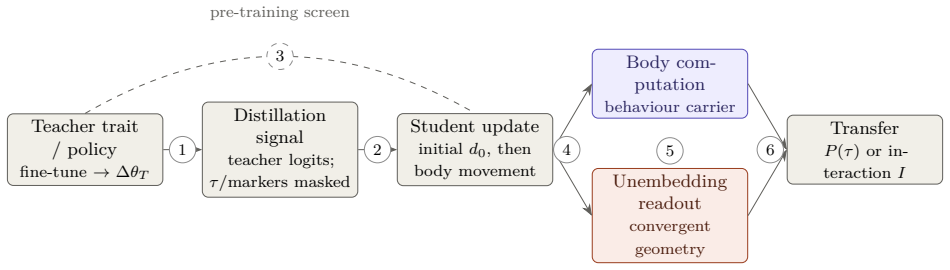
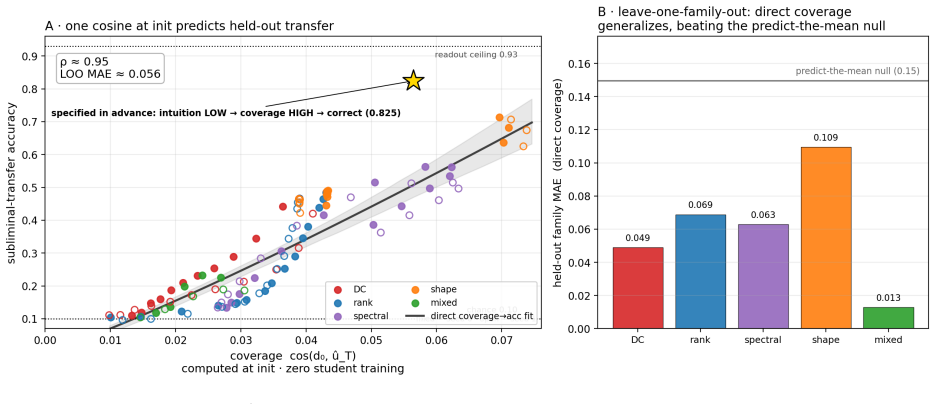
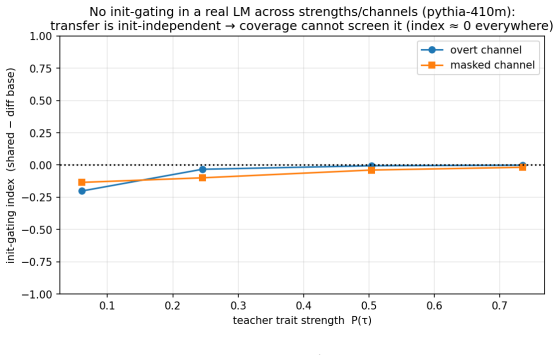
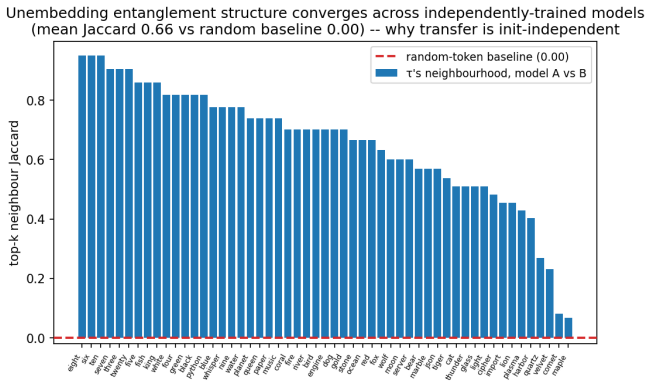
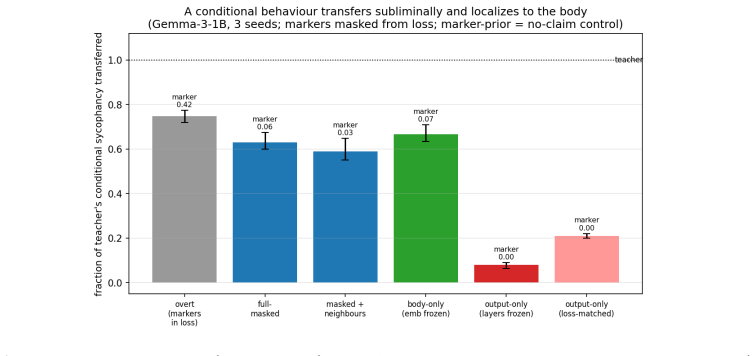
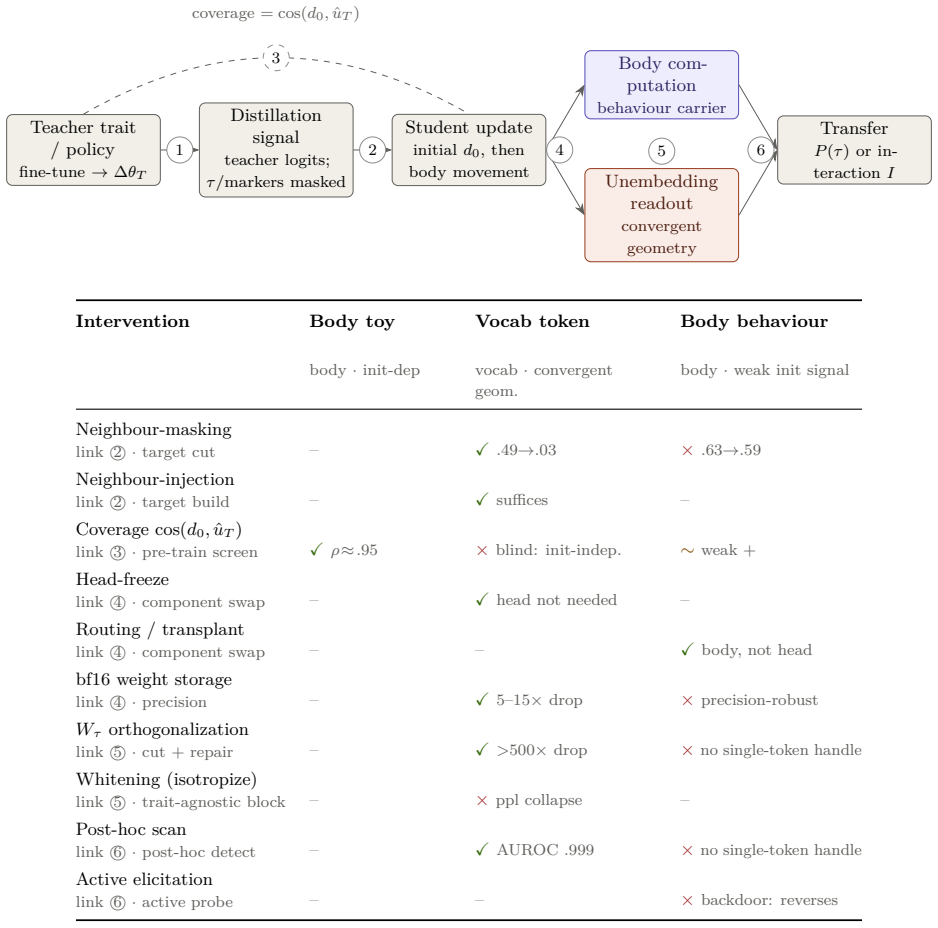
Channel location constrains the auditability of subliminal learning. Three regimes are identified. In a controlled initialization-dependent body channel, coverage predicts held-out transfer (Spearman ρ ≈ 0.95; AUROC 0.997). In pretrained language models, masked single-token traits ride convergent vocabulary geometry; this channel is initialization-independent, so initialization-alignment screens fail, and held-out probability for a removed entity still rises to 0.40 on average. Conditional behaviors such as sycophancy route through the network body, transferring at about 0.63 of the teacher's effect while evading four audits. Channel location is therefore necessary for choosing sound audits.
What carries the argument
Channel location: the specific carrier through which the hidden trait reaches the student.
If this is right
- Coverage predicts held-out transfer with Spearman ρ ≈ 0.95 and AUROC 0.997 inside initialization-dependent body channels.
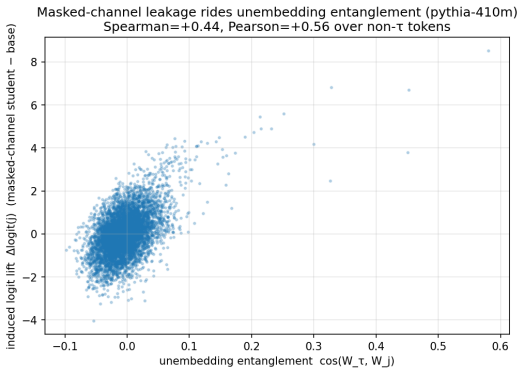
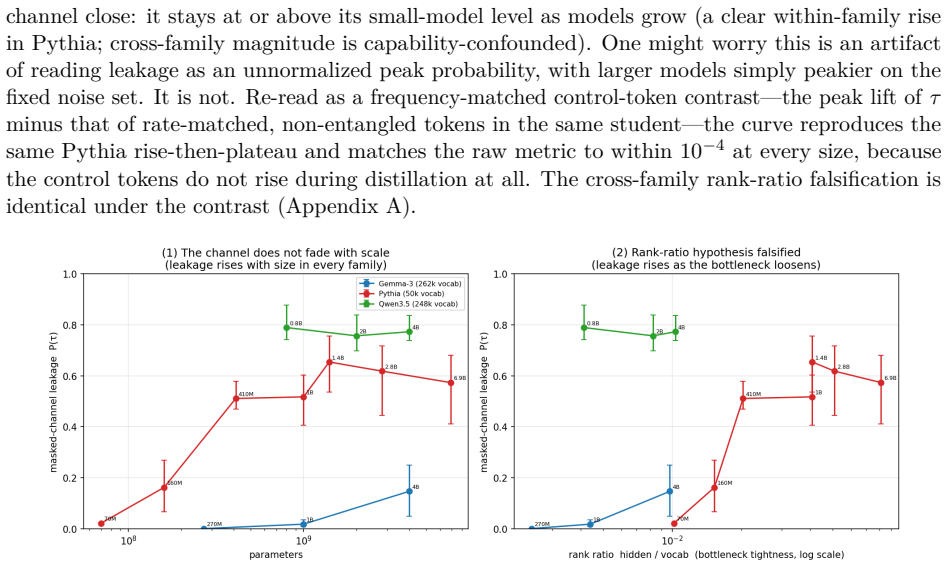
- In vocabulary geometry, a single-token entity's held-out probability rises to 0.40 on average even after removal from the loss, and related semantic classes transfer.
- Sycophancy transfers at roughly 0.63 of the teacher's effect when agreement and correction markers are masked from the loss.
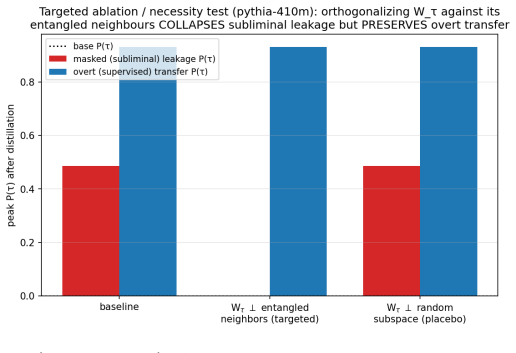
- Orthogonalizing the trait's output row against entangled neighbors collapses leakage in untied-head models, while equal-size random-subspace edits do not.
Where Pith is reading between the lines
- Safety checks on distilled models must first map the probable transfer channel before selecting an audit.
- Removing target strings from distillation labels is insufficient to block preference transfer carried by neighboring tokens.
- Architecture choices such as tied versus untied heads can shift which channel dominates and therefore which audits apply.
Load-bearing premise
The three regimes and the specific experimental setups on language models with single-token entities and sycophancy represent subliminal learning more generally.
What would settle it
An experiment demonstrating that one audit detects transfer with comparable reliability across all three regimes, or a new transfer mechanism that evades detection irrespective of channel location.
Figures
read the original abstract
Subliminal learning lets a student inherit a teacher's hidden trait from distillation data that never names it. We ask when such transfer can be audited before training. The answer is not model identity or scale alone, but channel location: the carrier through which the trait reaches the student. We find three regimes. In a controlled initialization-dependent body channel, a pre-training screen works. Coverage, the cosine between the student's initial distillation update and the teacher's fine-tuning displacement, predicts held-out transfer (Spearman $\rho \approx 0.95$; AUROC 0.997). In pretrained language models, masked single-token traits instead ride convergent vocabulary geometry. This channel is initialization-independent, so initialization-alignment screens, including coverage, are not mechanistic; the useful handles are post-hoc detection and targeted mitigation. Even when a single-token named entity is removed from the loss, the student's held-out probability for that entity rises to 0.40 on average ($\sim 2500\times$), and a related semantic class transfers. In an untied-head model, orthogonalizing the trait's output row against entangled neighbours collapses leakage, while equal-size random-subspace edits do not. Thus removing a target string from distillation labels does not remove the corresponding preference: neighbouring tokens can carry it. Finally, conditional behaviours can route through the network body. For sycophancy, with agreement and correction markers masked from the loss, transfer reaches about 0.63 of the teacher's effect, localizes to body computation, and evades four audits across two model families. We scope this as masked transfer of a condition-present policy. Channel location is necessary for deciding which audits can be sound. It is not a deployment-ready screen: an audit used outside its carrier regime can give false assurance.
Editorial analysis
A structured set of objections, weighed in public.
Referee Report
Summary. The paper claims that auditability of subliminal learning (student models inheriting hidden traits from distillation data that never names the trait) is constrained by 'channel location'—the carrier mechanism—rather than model identity or scale alone. It identifies three regimes: (1) initialization-dependent body channel, where a coverage metric (cosine between student's initial update and teacher's displacement) predicts held-out transfer (Spearman ρ ≈ 0.95, AUROC 0.997); (2) vocabulary geometry in pretrained LMs, where masked single-token traits still transfer (held-out probability rises to 0.40, ~2500×, with semantic class transfer) and orthogonalization mitigates leakage while random edits do not; (3) conditional body routing, where masked sycophancy transfers at ~0.63 of teacher's effect, localizes to body, and evades four audits. Conclusion: channel location is necessary to choose sound audits, but not a deployment-ready screen.
Significance. If the three regimes prove representative, the result would meaningfully constrain audit design in AI safety by showing that masking from loss is insufficient for vocabulary-geometry or conditional-body channels and that initialization-based screens fail outside their regime. The work supplies concrete, falsifiable experimental measurements (coverage correlations, probability shifts, transfer fractions) and a targeted mitigation (orthogonalization in untied heads). These are strengths. However, the absence of full methods, datasets, error bars, and controls in the reported results limits immediate impact; the necessity claim rests on the representativeness of the tested traits and setups.
major comments (3)
- [Abstract] Abstract: The reported metrics (Spearman ρ ≈ 0.95, AUROC 0.997; held-out probability 0.40; sycophancy transfer ~0.63) are presented without error bars, number of runs, statistical tests, or controls for confounding factors. These numbers are load-bearing for the claim that coverage predicts transfer in the first regime and that transfer occurs despite masking in the second and third.
- [Abstract] Abstract (regimes description): The necessity claim ('channel location is necessary for deciding which audits can be sound') requires that the three identified regimes capture the dominant carriers. The manuscript provides no argument or additional experiments showing that other channels (e.g., multi-token or non-semantic) are not prevalent, which directly affects whether an audit can be confidently classified as sound or unsound outside the tested cases.
- [Abstract] Abstract (vocabulary geometry regime): The statement that 'removing a target string from distillation labels does not remove the corresponding preference' is supported by the 0.40 held-out probability and orthogonalization result, but the manuscript does not report the magnitude of the effect relative to unmasked baselines or the fraction of leakage attributable to neighbouring tokens versus other mechanisms.
minor comments (2)
- [Abstract] Abstract: The term 'coverage' is used before any definition or equation is given; a brief parenthetical or forward reference would improve readability.
- [Abstract] Abstract: 'Four audits across two model families' is stated without naming the audits or families, reducing the ability to assess the evasion claim.
Simulated Author's Rebuttal
We thank the referee for the thoughtful review. We agree that the abstract requires additional statistical details and will revise accordingly. For the necessity claim, we will clarify its scope without overclaiming representativeness. We address each major comment below.
read point-by-point responses
-
Referee: [Abstract] Abstract: The reported metrics (Spearman ρ ≈ 0.95, AUROC 0.997; held-out probability 0.40; sycophancy transfer ~0.63) are presented without error bars, number of runs, statistical tests, or controls for confounding factors. These numbers are load-bearing for the claim that coverage predicts transfer in the first regime and that transfer occurs despite masking in the second and third.
Authors: We agree these metrics require supporting statistics. In revision we will report means, standard deviations across runs (typically n=5–10), and appropriate tests (e.g., Spearman p-values, AUROC confidence intervals). Confounding controls already present in the full experiments will be summarized in the abstract and methods. revision: yes
-
Referee: [Abstract] Abstract (regimes description): The necessity claim ('channel location is necessary for deciding which audits can be sound') requires that the three identified regimes capture the dominant carriers. The manuscript provides no argument or additional experiments showing that other channels (e.g., multi-token or non-semantic) are not prevalent, which directly affects whether an audit can be confidently classified as sound or unsound outside the tested cases.
Authors: The necessity claim is that audits must be matched to carrier mechanism rather than applied uniformly; the three regimes serve as existence proofs that different carriers produce qualitatively different audit outcomes. We do not claim exhaustiveness. We will revise the abstract and discussion to explicitly scope the claim as demonstrating the relevance of channel location, not its completeness across all possible carriers. revision: partial
-
Referee: [Abstract] Abstract (vocabulary geometry regime): The statement that 'removing a target string from distillation labels does not remove the corresponding preference' is supported by the 0.40 held-out probability and orthogonalization result, but the manuscript does not report the magnitude of the effect relative to unmasked baselines or the fraction of leakage attributable to neighbouring tokens versus other mechanisms.
Authors: We will add the requested comparisons: effect size versus fully unmasked distillation and an ablation quantifying leakage attributable to neighbours (via the orthogonalization contrast). These analyses exist in our experimental logs and will be included in the revision. revision: yes
Circularity Check
No circularity: empirical measurements of transfer effects
full rationale
The paper reports direct experimental results across controlled setups (initialization-dependent body channel, vocabulary geometry in pretrained LMs, conditional body routing for sycophancy). Key quantities such as coverage (cosine between initial update and teacher displacement), held-out probability (0.40), transfer fraction (~0.63), and AUROC (0.997) are measured outcomes, not quantities derived from or fitted to themselves. No equations, predictions, or uniqueness claims reduce to inputs by construction, and no self-citation chains bear the central claim. The work is self-contained against its own benchmarks.
Axiom & Free-Parameter Ledger
axioms (1)
- domain assumption Cosine similarity between initial distillation update and teacher fine-tuning displacement predicts held-out transfer in the body channel regime
invented entities (1)
-
channel location
no independent evidence
Reference graph
Works this paper leans on
- [1]
-
[2]
J. Betley et al. Emergent Misalignment: Narrow Finetuning Can Produce Broadly Misaligned LLMs. ICML 2025; arXiv:2502.17424
arXiv 2025
-
[3]
S. Schrodi, E. Kempf, F. Barez, T. Brox. Towards Understanding Subliminal Learning: When and How Hidden Biases Transfer. ICLR 2026; arXiv:2509.23886
arXiv 2026
-
[4]
A. Arditi, O. Obeso, A. Syed, D. Paleka, N. Panickssery, W. Gurnee, N. Nanda. Refusal in Language Models Is Mediated by a Single Direction. NeurIPS 2024; arXiv:2406.11717
Pith/arXiv arXiv 2024
-
[5]
A. M. Turner, L. Thiergart, G. Leech, D. Udell, J. J. Vazquez, U. Mini, M. MacDiarmid. Activation Addition: Steering Language Models Without Optimization. arXiv:2308.10248, 2023
Pith/arXiv arXiv 2023
-
[6]
A. Zou, L. Phan, S. Chen, J. Campbell, P. Guo, et al. Representation Engineering: A Top-Down Approach to AI Transparency. arXiv:2310.01405, 2023
Pith/arXiv arXiv 2023
-
[7]
K. Ethayarajh. How Contextual are Contextualized Word Representations? Comparing the Geometry of BERT, ELMo, and GPT-2 Embeddings. EMNLP 2019; arXiv:1909.00512
arXiv 2019
-
[8]
Zur et al
A. Zur et al. Token Entanglement in Subliminal Learning. NeurIPS 2025 Mechanistic Interpretability Workshop
2025
-
[9]
B. Dong, J. Hou, Y. Lu, Z. Zhang. Distillation≈Early Stopping? arXiv:1910.01255, 2019
arXiv 1910
-
[10]
G. Hinton, O. Vinyals, J. Dean. Distilling the Knowledge in a Neural Network. arXiv:1503.02531, 2015
Pith/arXiv arXiv 2015
-
[11]
G. Ji, Z. Zhu. Knowledge Distillation in Wide Neural Networks. NeurIPS 2020; arXiv:2010.10090
arXiv 2020
-
[12]
P. Micaelli, A. Storkey. Zero-Shot Knowledge Transfer via Adversarial Belief Matching. NeurIPS 2019; arXiv:1905.09768
arXiv 2019
- [13]
-
[14]
S. Stanton et al. Does Knowledge Distillation Really Work? NeurIPS 2021; arXiv:2106.05945
arXiv 2021
- [15]
- [16]
-
[17]
B. Woodworth et al. Kernel and Rich Regimes in Overparametrized Models. COLT 2020; arXiv:2002.09277. 38
arXiv 2020
-
[18]
S. Amari. Natural Gradient Works Efficiently in Learning. Neural Computation 10(2), 1998
1998
-
[19]
J. Martens. New Insights and Perspectives on the Natural Gradient Method. JMLR 21(146), 2020
2020
-
[20]
J. Hron, Y. Bahri, J. Sohl-Dickstein, R. Novak. Infinite Attention: NNGP and NTK for Deep Attention Networks. ICML 2020; arXiv:2006.10540
arXiv 2020
-
[21]
G. Yang, E. J. Hu. Tensor Programs IV: Feature Learning in Infinite-Width Neural Networks. ICML 2021; arXiv:2011.14522
arXiv 2021
-
[22]
N. Lee, T. Ajanthan, P. Torr. SNIP: Single-Shot Network Pruning. ICLR 2019; arXiv:1810.02340
Pith/arXiv arXiv 2019
- [23]
-
[24]
M. Abdelfattah, A. Mehrotra, Ł. Dudziak, N. Lane. Zero-Cost Proxies for Lightweight NAS. ICLR 2021; arXiv:2101.08134
arXiv 2021
-
[25]
J. Frankle, G. K. Dziugaite, D. M. Roy, M. Carbin. Pruning Neural Networks at Initialization: Why Are We Missing the Mark? ICLR 2021; arXiv:2009.08576
arXiv 2021
-
[26]
Cristianini, J
N. Cristianini, J. Shawe-Taylor, A. Elisseeff, J. Kandola. On Kernel-Target Alignment. NIPS 2001
2001
-
[27]
S. Fort, P. K. Nowak, S. Jastrzębski, S. Narayanan. Stiffness: A New Perspective on Generalization. arXiv:1901.09491, 2019
arXiv 1901
-
[28]
G. Ilharco et al. Editing Models with Task Arithmetic. ICLR 2023; arXiv:2212.04089
Pith/arXiv arXiv 2023
-
[29]
Z. Yang, Z. Dai, R. Salakhutdinov, W. W. Cohen. Breaking the Softmax Bottleneck. ICLR 2018; arXiv:1711.03953
Pith/arXiv arXiv 2018
-
[30]
Chang, A
H.-S. Chang, A. McCallum. Softmax Bottleneck Makes Language Models Unable to Represent Multi- mode Word Distributions. ACL 2022
2022
-
[31]
M. Finlayson, X. Ren, S. Swayamdipta. Logits of API-Protected LLMs Leak Proprietary Information. COLM 2024; arXiv:2403.09539
arXiv 2024
-
[32]
N. Carlini et al. Stealing Part of a Production Language Model. ICML 2024; arXiv:2403.06634
arXiv 2024
-
[33]
I. Aden-Ali, N. Golowich, A. Liu, A. Shetty, A. Moitra, N. Haghtalab. Subliminal Effects in Your Data: A General Mechanism via Log-Linearity. arXiv:2602.04863, 2026
arXiv 2026
-
[34]
V. C. Brockers, R. D. Ventzke, V. Neuhaus, B. Hidalgo-Ogalde, V. Priesemann. Learning Through Noise: Why Subliminal Learning Works and When It Fails. arXiv:2605.23645, 2026
Pith/arXiv arXiv 2026
-
[35]
A. S. Okatan, M. İ. Akbaş, L. Niure Kandel, B. Peköz. Seed-Induced Uniqueness in Transformer Models: Subspace Alignment Governs Subliminal Transfer. IEEE Cyber Awareness and Research Symposium (CARS) 2025; arXiv:2511.01023
arXiv 2025
-
[36]
Kitkana, S
C. Kitkana, S. Arora. Sustained Gradient Alignment Mediates Subliminal Learning in a Multi-Step Setting: Evidence from MNIST Auxiliary Logit Distillation. Sci4DL Workshop, ICLR 2026.https: //openreview.net/forum?id=UJM4H9oLJN
2026
-
[37]
C. Blank, A. Bhatia, S. Rajamanoharan, A. Conmy, N. Nanda. Subliminal Learning Is Steering Vector Distillation. arXiv:2606.00995, 2026
Pith/arXiv arXiv 2026
- [38]
-
[39]
S. Wang, L. Yu, J. Li. LoRA-GA: Low-Rank Adaptation with Gradient Approximation. NeurIPS 2024; arXiv:2407.05000
arXiv 2024
- [40]
-
[41]
Bricken, R
T. Bricken, R. Wang, S. Bowman, E. Ong, J. Treutlein, J. Wu, E. Hubinger, S. Marks. Building and Evaluating Alignment Auditing Agents. Anthropic Alignment Science, 2025.https://alignment. anthropic.com/2025/automated-auditing/
2025
-
[42]
M. Sharma, M. Tong, T. Korbak, D. Duvenaud, A. Askell, S. R. Bowman, et al. Towards Understanding Sycophancy in Language Models. ICLR 2024; arXiv:2310.13548
Pith/arXiv arXiv 2024
-
[43]
E. Perez et al. Discovering Language Model Behaviors with Model-Written Evaluations. arXiv:2212.09251, 2022
Pith/arXiv arXiv 2022
-
[44]
M. Huh, B. Cheung, T. Wang, P. Isola. The Platonic Representation Hypothesis. ICML 2024; arXiv:2405.07987
Pith/arXiv arXiv 2024
- [45]
-
[46]
A. Atanasov, B. Bordelon, C. Pehlevan. Neural Networks as Kernel Learners: The Silent Alignment Effect. ICLR 2022; arXiv:2111.00034
arXiv 2022
-
[47]
J. Vig, S. Gehrmann, Y. Belinkov, S. Qian, D. Nevo, Y. Singer, S. Shieber. Investigating Gender Bias in Language Models Using Causal Mediation Analysis. NeurIPS 2020; arXiv:2004.12265
arXiv 2020
-
[48]
K. Meng, D. Bau, A. Andonian, Y. Belinkov. Locating and Editing Factual Associations in GPT. NeurIPS 2022; arXiv:2202.05262
Pith/arXiv arXiv 2022
-
[49]
M. Wang, T. Dupré la Tour, O. Watkins, A. Makelov, R. A. Chi, et al. Persona Features Control Emergent Misalignment. arXiv:2506.19823, 2025
arXiv 2025
-
[50]
F. Behrens, L. Zdeborová. Dataset Distillation for Memorized Data: Soft Labels Can Leak Held-Out Teacher Knowledge. ICLR 2026; arXiv:2506.14457
arXiv 2026
-
[51]
A. Draganov, T. H. Dur, A. Bhongade, M. Phuong. Phantom Transfer: Data Poisoning can Survive Data-Level Defences. arXiv:2602.04899, 2026
Pith/arXiv arXiv 2026
- [52]
- [53]
-
[54]
J. Gao, D. He, X. Tan, T. Qin, L. Wang, T.-Y. Liu. Representation Degeneration Problem in Training Natural Language Generation Models. ICLR 2019; arXiv:1907.12009
arXiv 2019
-
[55]
E. Hubinger et al. Sleeper Agents: Training Deceptive LLMs that Persist Through Safety Training. arXiv:2401.05566, 2024
Pith/arXiv arXiv 2024
- [56]
-
[57]
capability, not bottleneck tightness
B. Wang, Y. Yao, S. Shan, H. Li, B. Viswanath, H. Zheng, B. Y. Zhao. Neural Cleanse: Identifying and Mitigating Backdoor Attacks in Neural Networks. IEEE S&P 2019. 40 A Additional results Identity check (Section 2).The stage-1 scalar( d0·ˆuT )/(∥∆θT∥ˆu⊤ TFˆuT )is0 .99,1 .00,0 .99for teachers trained1,5,10epochs (20paired models each), while the full-vecto...
2019
discussion (0)
Sign in with ORCID, Apple, or X to comment. Anyone can read and Pith papers without signing in.