REVIEW 4 major objections 4 minor 48 references
Pure memorizers can mimic abstraction-first learning, so trajectory order is not proof of abstraction.
Reviewed by Pith at T0; open to challenge. T0 means a machine referee read the full paper against a public rubric. the ladder, T0–T4 →
T0 review · deepseek-v4-flash
2026-08-05 00:12 UTC pith:36DZKSZI
load-bearing objection A sound and useful simulation study showing that the abstraction-first versus exemplar-first onset ordering is not diagnostic; it deserves peer review, with one overstatement and an uncalibrated threshold issue to fix. the 4 major comments →
Exemplars in Disguise: Pure Exemplar Models Mimic Abstraction-First Learning
The pith
A machine-rendered reading of the paper's core claim, the machinery that carries it, and where it could break.
Core claim
The paper's central claim is that the temporal ordering of two onset measures—between-class onset (ob), a relative rank test, and within-class onset (ow), an absolute threshold on within-class divergence—reflects the learner's sensitivity to individual observations rather than whether it forms abstract class representations. A Dirichlet-Multinomial pure memorizer with add-k smoothing produces the abstraction-first ordering (ob < ow) at high k, because the prior's pseudo-counts suppress idiosyncratic early-token noise until class-based separation accumulates; at low k, the same memorizer produces the exemplar-first ordering (ow < ob) because individual observations immediately drive within-cl
What carries the argument
The carrying mechanism is the asymmetry between the two onset criteria. Between-class onset is a relative rank test: it fires when at least 10% of verbs have within-class Jensen-Shannon distances significantly smaller (one-tailed Mann-Whitney, p < 0.001) than their distances to out-of-class verbs, regardless of absolute magnitude. Within-class onset is an absolute threshold: it fires only when mean within-class DJS exceeds 0.01 for three consecutive steps. The second ingredient is the Dirichlet-Multinomial posterior mean, P_v(t) = (count(t|v) + k) / (nobs + kV), which defines the Variable-Sensitivity Learner; the smoothing parameter k controls how much a single observation moves the estimate
Load-bearing premise
The simulations assume their formalized onset criteria—within-class DJS above 0.01 for three consecutive steps, at least 10% of verbs passing a p<0.001 between-class test, and a near-uniform starting state—are faithful to the original GPT-2 study's unformalized visual onset judgments; the original study's intermediate checkpoints are not public, so a direct calibration check is impossible, and the near-uniform starting state is verified on a different model (OPT-125M on BabyL
What would settle it
Obtain the original GPT-2 training checkpoints and re-run the onset analysis with the formal thresholds used here. If GPT-2's own within-class DJS crosses 0.01 before the between-class Mann-Whitney test passes in a majority of verbs, while a high-k Dirichlet-Multinomial memorizer trained on the same corpus still shows ob < ow, the central claim would be falsified. Alternatively, fitting an effective k to GPT-2's checkpoints and finding k low (below the transition) while ob < ow also would falsify the sensitivity-based explanation.
If this is right
- The ordering of between-class and within-class onset tracks observation sensitivity, not abstraction: a pure memorizer with no class-level representations produces the abstraction-first ordering at low sensitivity.
- The existing GPT-2 evidence does not establish abstraction-first learning; the same pattern is produced by high-k exemplar memorization.
- Any methodology that infers learning strategy from onset ordering must control for learner sensitivity and the distributional structure of the input.
- For distributed representations, between-class and within-class divergence need not correspond to separable learning events; class-level properties may be embedded in item-specific distributions.
- Answering whether transformers are abstraction-first learners will require methods that go beyond the ordering of onset criteria.
Where Pith is reading between the lines
- The relative-versus-absolute asymmetry in the two onset criteria is a general confound: the critique likely extends to any 'which comes first' trajectory analysis using a rank-based between-class test alongside a magnitude-based within-class threshold.
- A testable extension is to estimate an effective k for a real transformer by fitting its next-token distributions to the Dirichlet-Multinomial update rule on controlled verb classes; if a transformer's effective k is high, its abstraction-first ordering would be exactly what a pure memorizer predicts.
- The same logic may apply to developmental data: children's apparent item-first versus abstraction-first ordering in corpus trajectories could also be explained purely by sensitivity to individual observations, so behavioral ordering alone underdetermines the representational claim.
- The indistinguishability argument shifts the burden of proof: showing that class-level representations exist and are not merely a re-description of the geometry of distributed representations requires positive evidence, not onset-order patterns.
Editorial analysis
A structured set of objections, weighed in public.
Referee Report
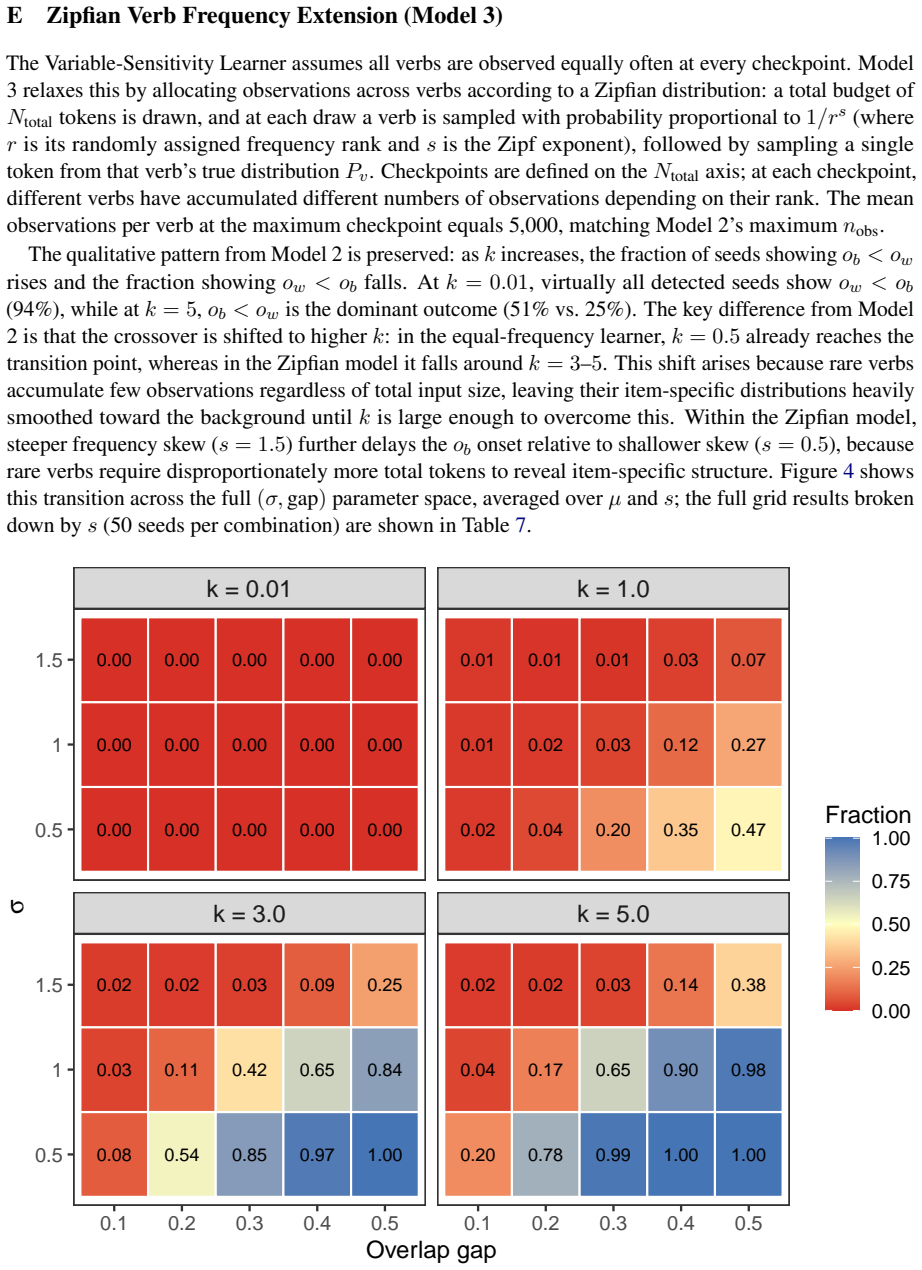
Summary. This paper challenges the abstraction-first learning conclusion of Jian and Manning (2026), who found that GPT-2's between-class onsets (ob) precede within-class onsets (ow). The authors construct two pure memorizer models with no cross-verb information flow: the Zero-Sensitivity Learner (ZSL), a deterministic interpolation toward each verb's true distribution, and the Variable-Sensitivity Learner (VSL), a Dirichlet-Multinomial learner with smoothing parameter k. Using the same verb classes, vocabulary structure, and a formalized version of J&M's onset criteria, they find that ZSL produces ob < ow in 85% of seeds overall (Section 2.2.2), while VSL produces ow < ob at low k and transitions to ob < ow at high k (Table 1). They argue that the onset ordering is governed by observation sensitivity rather than by abstraction, and further argue that the exemplar/abstraction distinction may be ill-defined for distributed representations. The appendix includes a Zipfian frequency extension, a derivation of ZSL as the k→∞ limit of VSL, and a threshold robustness analysis.
Significance. If the central claim holds, this is a significant methodological intervention: it would show that a specific recent empirical argument for abstraction-first learning in GPT-2 does not establish its conclusion, because a pure memorizer with no abstract representations can reproduce the same onset ordering under the same criteria. The paper is methodologically strong in its internal simulation: 5,400 ZSL runs and 27,000 VSL runs over a broad structural parameter grid; a transparent mechanism (the asymmetry between a relative rank-based between-class test and an absolute within-class threshold, Section 2.1.3); an analytic derivation of the ZSL/VSL correspondence (Appendix D); a Zipfian frequency extension (Appendix E); and publicly available code. The paper is also honest about its assumptions and limitations. The main weakness is that the transfer to J&M's actual GPT-2 analysis rests on an uncalibrated reconstruction of J&M's onset detection procedure, as Appendix G explicitly concedes.
major comments (4)
- [§2.1.3 and Appendix G] The paper's comparability claim is that the onset criteria 'match Jian and Manning (2026)'s Experiments 1 and 2' (§2.1.3). Appendix G concedes that CLASS_FRAC=0.10, DJS_THRESH=0.01, and SUSTAIN=3 are not taken from J&M's Experiment 1, that J&M identified onsets visually, and that direct calibration is impossible because J&M's intermediate GPT-2 checkpoints are not public. This is load-bearing: the VSL's ~70% ob<ow at k=1.0 (Table 1) and the ZSL's 85% ob<ow (Section 2.2.2) are computed under these exact thresholds. If J&M's within-class onset fires earlier (e.g., a lower DJS magnitude or no consecutive-step requirement) or their between-class test is configured differently (e.g., a group-level rather than individual-verb Mann-Whitney pass-rate criterion), the simulated crossover may not transfer. Appendix G sweeps only two parameter settings and a threshold grid around the authors' recons
- [Appendix A / Section 2] Both learners assume a near-uniform starting state (α≈0 for ZSL, nobs≈0 for VSL). The only direct empirical support is for OPT-125M trained on BabyLM (Table 2), not for GPT-2 on OpenWebText as in J&M. The paper asserts that the near-uniform start is 'a general property of randomly initialized transformers,' but the evidence is from a different architecture and corpus. Since the simulation's starting condition shapes the entire trajectory, the transfer of the counterexample to J&M's GPT-2 analysis depends on this premise. The authors should verify the early-checkpoint near-uniformity on a GPT-2-family model trained on WebText-like data, or provide a stronger formal/empirical argument that the BabyLM result carries over. At minimum, this limitation should appear in the main text, not only in an appendix.
- [Section 4, Limitations] The paper models two verb classes, while J&M analyzed four. The Limitations section concedes that a multi-class scenario 'remains to be verified.' This is not a purely cosmetic gap: with four classes, the set of out-of-class verbs used in the Mann-Whitney between-class test changes, and the within-class mean is computed over more pairs; both could affect relative onset times. The paper's argument that the asymmetry between a relative rank test and an absolute threshold is the sole driver is plausible but unverified. Since the conclusion targets J&M's four-class evidence, a multi-class simulation (or a formal argument with a worked example) is needed to close this scope gap.
- [Section 3] The statement 'The ordering of onsets is therefore diagnostic of observation sensitivity, not of abstraction' is too strong. The simulations show that a pure memorizer can produce either ordering depending on k; they do not show that onset ordering is uninformative about abstraction under every possible analysis. The supported conclusion is that the particular J&M ordering test is not decisive, because a pure memorizer can reproduce its output under the formalized criteria. The authors should soften the claim to 'not diagnostic of abstraction under these criteria' or provide a further argument that no possible ordering can distinguish the two accounts.
minor comments (4)
- [Equation 3] The within-class DJS formula uses equal weighting of the two class means (outer factor 1/2) rather than a pooled average over all within-class pairs. Clarify whether this weighting is intended, since class sizes differ (35 vs. 36) and a pooled average could change onset timing slightly.
- [References] Kapatsinski (2026), 'Transformers perform adaptive partial pooling,' is cited as a preprint with no venue, URL, or arXiv number. Please add a full citation or link so readers can verify the claim.
- [Figure 1 / Figure 3] The captions state that the complement of the displayed fraction is split between the other ordering and 'neither.' Since the displayed fraction is averaged over μ, consider adding per-μ tables or referencing Appendix C/F more directly in the caption for reproducibility.
- [General] There are a few minor typos and stylistic inconsistencies (e.g., 'Verbs' capitalization in Table 2, the use of 'J&M' as an abbreviation). A careful proofread would improve readability.
Circularity Check
No significant circularity: the simulations are forward computations over parameter grids; no parameter is fitted to J&M's onsets, and the one self-citation (Kapatsinski 2026) is speculative support, not load-bearing. Appendix G's threshold-concession is an external-validity limitation, not a circular reduction.
full rationale
The central claim is a possibility demonstration, not a fitted prediction. The Zero-Sensitivity Learner (Eq. 4) and Variable-Sensitivity Learner (Eq. 6) are forward models: each verb's distribution is estimated from its own observations with no information flow between verbs and no class-level representation. The onset ordering (ob vs. ow) is computed by applying the asymmetric criteria of Section 2.1.3 to the resulting DJS trajectories. The ordering is an output of the simulation, not an input or an assumed conclusion. No parameter is fitted to reproduce Jian and Manning (2026)'s observed onsets; the paper sweeps a grid and reports the fraction of seeds producing each ordering. The mechanism the authors identify—the asymmetry between a relative rank test (ob) and an absolute threshold test (ow)—is explicitly stated and tested, which is transparency rather than circularity. The conclusion that ordering tracks observation sensitivity follows from varying k in the Dirichlet-Multinomial learner, but that is a legitimate mathematical/dynamical result, not a definitional equivalence. There is a self-citation to Kapatsinski (2026) suggesting transformers may behave like high-k learners, but this is speculative supporting context; the main argument that J&M's evidence is insufficient rests on the simulation results alone, so the self-citation is not load-bearing. Appendix G honestly concedes that CLASS_FRAC=0.10, DJS_THRESH=0.01, and SUSTAIN=3 were not directly taken from J&M's Experiment 1 and that a direct calibration check is impossible because J&M's intermediate checkpoints are unavailable. That is a limitation on external validity/transfer to GPT-2, not a circular reduction of the paper's own derivation. The near-uniform starting-state assumption is verified on OPT-125M/BabyLM rather than GPT-2/OpenWebText, again an external-validity caveat, and the paper flags it. Overall, no load-bearing step reduces by construction to its own inputs; the minor self-citation and uncalibrated thresholds keep the score at the low end.
Axiom & Free-Parameter Ledger
free parameters (6)
- k (Dirichlet concentration / smoothing) =
swept 0.001 to 1.0 (equal-frequency VSL), 0.001 to 10 (Zipfian model)
- DJS_THRESH (within-class onset threshold) =
0.01
- CLASS_FRAC (fraction of verbs passing Mann-Whitney) =
0.10
- Structural grid parameters: mu, sigma, item_overlap, class_overlap =
mu in {10,30,60,100}, sigma in {0.5,1.0,1.5}, item_overlap in {0.5,0.6,0.7}, class_overlap in {0.2,0.3,0.4}
- SUSTAIN = 3 consecutive steps; Mann-Whitney p < 0.001 =
3; 0.001
- npref = 50 preferred tokens per verb =
50
axioms (6)
- standard math Dirichlet-Multinomial conjugacy and the posterior-mean estimator (Eqs. 5-6): P_v(t) = (count + k) / (nobs + k*V).
- standard math Jensen-Shannon divergence is a valid dissimilarity and the Mann-Whitney U-test reliably detects between-class rank separation at the stated sample sizes (35 and 36 verbs per class).
- domain assumption Transformers start from a near-uniform verb-conditional distribution, assumed for GPT-2/OpenWebText but verified only on OPT-125M/BabyLM checkpoint 1.
- domain assumption The synthetic overlap structure (cross tokens shared by all verbs, within-class tokens, idiosyncratic tokens, with class_overlap < item_overlap) captures the class-versus-item structure of real verb-argument distributions.
- domain assumption Two verb classes suffice to reproduce findings from J&M's four-class design.
- domain assumption Vocabulary size V = 1000 does not change the qualitative results.
Cite this review
Pith. "Pith review of Exemplars in Disguise: Pure Exemplar Models Mimic Abstraction-First Learning." pith.science (2026). https://pith.science/paper/36DZKSZI
@misc{pith2026260800821,
  author       = {Pith},
  title        = {Pith review of: Exemplars in Disguise: Pure Exemplar Models Mimic Abstraction-First Learning},
  year         = {2026},
  howpublished = {\url{https://pith.science/paper/36DZKSZI}},
  note         = {Machine review of arXiv:2608.00821}
}
read the original abstract
Whether idiosyncratic, item-specific knowledge is learned before abstract class-level generalizations, or vice versa, is a central question in language learning, with exemplar and abstraction-based theories making opposite predictions. Recent methods have claimed to show that, at least for large language models, abstract knowledge is learned first. We show that these methods fall short: pure memorizer models with no abstract representations can appear, by the same criteria, to learn either item-specific or class-level knowledge first, depending on their sensitivity to individual observations, with the transition point governed by the distributional properties of the input. We further argue that the distinction between item-specific and abstract knowledge may be ill-defined for distributed representations, as a word's class-level properties may not be separable from its item-specific properties.
Figures


Reference graph
Works this paper leans on
-
[1]
The Child's Learning of English Morphology , author =. 1958 , month =. doi:10.1080/00437956.1958.11659661 , url =
-
[2]
analogy in English past tenses: A computational/experimental study , author =
Rules vs. analogy in English past tenses: A computational/experimental study , author =. Cognition , pages =. 2003 , date =
work page 2003
-
[3]
Constructing a language: A usage-based theory of language acquisition , author =. 2005 , publisher =
work page 2005
-
[4]
Abstract knowledge versus direct experience in processing of binomial expressions , author =. Cognition , pages =. 2016 , date =. doi:10.1016/j.cognition.2016.09.011 , url =
-
[5]
Trends in Cognitive Sciences , pages =
Constructions: A new theoretical approach to language , author =. Trends in Cognitive Sciences , pages =. 2003 , date =
work page 2003
-
[6]
Psychology of Learning and Motivation , pages =
Investigations of an exemplar-based connectionist model of category learning , author =. Psychology of Learning and Motivation , pages =. 1992 , date =
work page 1992
-
[7]
Attention, similarity, and the identification-categorization relationship , author =. 1986 , journal =
work page 1986
-
[8]
Against stored abstractions: A radical exemplar model of language acquisition , author =. First Language , pages =. 2020 , date =
work page 2020
-
[9]
Abstractions made of exemplars or
Ambridge, Ben , year =. Abstractions made of exemplars or. First Language , pages =
-
[10]
On learning the past tenses of English verbs , author =. 1986 , booktitle =
work page 1986
-
[11]
Productive knowledge and item-specific knowledge trade off as a function of frequency in multiword expression processing , author =. Language , pages =. 2024 , date =
work page 2024
-
[12]
Multi-Word Representations in Minds and Models: Investigating the Storage of Multi-Word Phrases in Humans and Large Language Models , author =. 2025 , school =
work page 2025
-
[13]
The role of abstract representations and observed preferences in the ordering of binomials in large language models , author =. 2025 , booktitle =
work page 2025
-
[14]
Changing minds changing tools: From learning theory to language acquisition to language change , author =. 2018 , date =
work page 2018
-
[15]
Oxford Research Encyclopedia of Linguistics , editor =
Words Versus Rules (Storage Versus Online Production/Processing) in Morphology , author =. Oxford Research Encyclopedia of Linguistics , editor =. 2018 , date =
work page 2018
- [16]
-
[17]
Mechanistic Interpretability of ASR models using Sparse Autoencoders , author =. 2026 , doi =
work page 2026
-
[18]
Frequency and the lexical storage of regularly inflected forms , author =. 1986 , journal =
work page 1986
-
[19]
Are inflected forms stored in the lexicon? , author =. 2004 , booktitle =
work page 2004
-
[20]
Introduction to frequency and the emergence of linguistic structure , author =. 2001 , booktitle =
work page 2001
- [21]
- [22]
- [23]
-
[24]
Frequency and the emergence of prefabs: Evidence from monitoring , author =. 2009 , booktitle =
work page 2009
-
[25]
Hierarchical Inference in Sound Change: Words, Sounds, and Frequency of Use , author =. 2021 , journal =
work page 2021
- [26]
- [27]
-
[28]
Language Variation and Change , pages =
Word frequency and context of use in the lexical diffusion of phonetically conditioned sound change , author =. Language Variation and Change , pages =. 2002 , date =
work page 2002
-
[29]
Mechanisms of Change in Grammaticization: The Role of Frequency , author =. 2003 , booktitle =
work page 2003
-
[30]
The effect of usage on degrees of constituency: the reduction of don't in English , author =. 1999 , journal =
work page 1999
-
[31]
Gradient effects of within-category phonetic variation on lexical access , author =. 2002 , journal =
work page 2002
-
[32]
Pierrehumbert, Janet B. , booktitle =. Exemplar dynamics:. 2001 , publisher =
work page 2001
-
[33]
Laboratory Phonology 7 , editor =
Word-specific phonetics , author =. Laboratory Phonology 7 , editor =. 2002 , publisher =
work page 2002
- [34]
-
[35]
Morphological convergence as on-
R. Morphological convergence as on-. 2020 , journal =
work page 2020
-
[36]
Type and token frequency jointly drive learning of morphology , author =. 2025 , journal =
work page 2025
-
[37]
Advancement of phonetics in the 21st century:
Goldrick, Matthew and Cole, Jennifer , year =. Advancement of phonetics in the 21st century:. Journal of Phonetics , volume =
-
[38]
A learning perspective on the emergence of abstractions: the curious case of phone(me)s , author =. 2023 , journal =
work page 2023
-
[39]
The Handbook of Usage-Based Linguistics , editor =
The Future of Exemplar Theory , author =. The Handbook of Usage-Based Linguistics , editor =. 2023 , publisher =
work page 2023
-
[40]
Frequency-dependent preference extremity arises from a noisy-channel processing model , author =. 2024 , booktitle =
work page 2024
-
[41]
Cognitive Psychology , pages =
Putting old tools to novel uses: The role of form accessibility in semantic extension , author =. Cognitive Psychology , pages =. 2017 , date =. doi:10.1016/j.cogpsych.2017.08.002 , url =
-
[42]
The Holistic Storage of Verb+Up Phrases in Text-based and Audio-based Language Models , author=. 2026 , eprint=
work page 2026
-
[43]
Does Predictability Drive the Holistic Storage of Compound Nouns? , author =. 2023 , booktitle =
work page 2023
-
[44]
Modeling idiosyncratic preferences: How generative knowledge and expression frequency jointly determine language structure , author =. 2015 , booktitle =
work page 2015
-
[45]
What is grammar like? A usage-based constructionist perspective , author =. 2014 , journal =
work page 2014
-
[46]
What statistics do learners track? Rules, constraints or schemas in (artificial) grammar learning , author =. 2012 , booktitle =
work page 2012
-
[47]
Frequency-dependent regularization in iterated learning , author =. 2016 , booktitle =
work page 2016
-
[48]
Frequency-dependent Regularization in Constituent Ordering Preferences , author =. 2020 , booktitle =
work page 2020
discussion (0)
Sign in with ORCID, Apple, or X to comment. Anyone can read and Pith papers without signing in.