REVIEW 2 major objections 6 minor 38 references
Commercial edge neural processors can run a complete wireless baseband transceiver without any dedicated baseband chips.
Reviewed by Pith at T0; open to challenge. T0 means a machine referee read the full paper against a public rubric. the ladder, T0–T4 →
T0 review · grok-4.5
2026-07-11 20:49 UTC pith:36L7EU5K
load-bearing objection First complete OFDM transceiver on a commercial edge NPU with real OTA validation and open artifacts; feasibility claim holds, latency and portability are acknowledged limits. the 2 major comments →
AI-RAN on NPUs: Baseband Processing Without Baseband Chips
The pith
A machine-rendered reading of the paper's core claim, the machinery that carries it, and where it could break.
Core claim
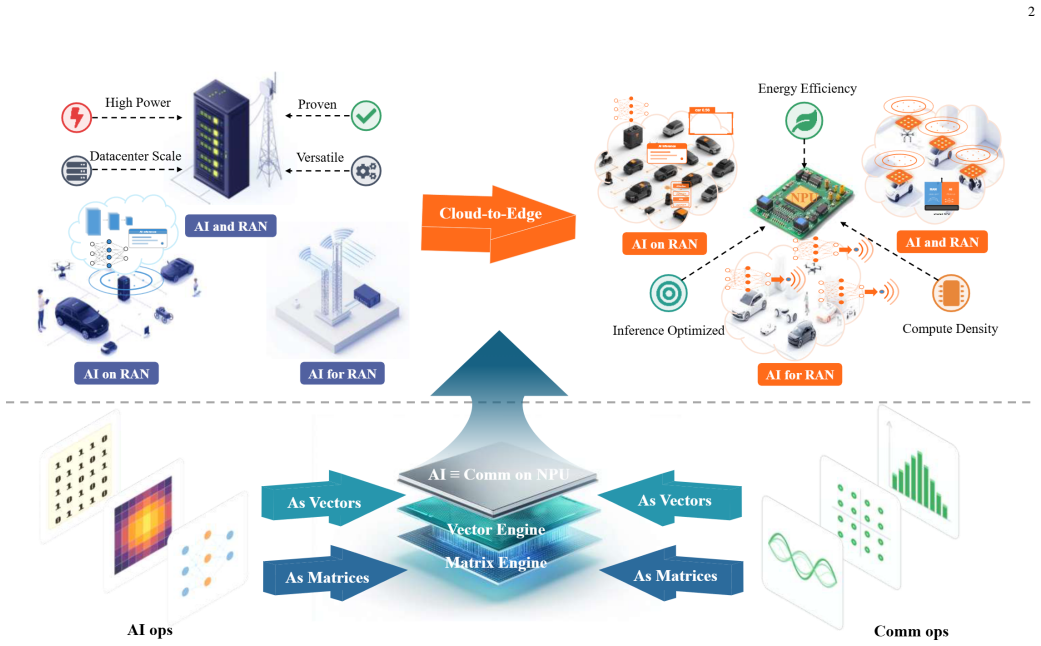
Edge NPUs can support complete wireless baseband processing. A full OFDM transceiver executes entirely on an Ascend 310B1 with no dedicated baseband silicon and achieves end-to-end over-the-air transmission at 3.0 GHz, with mean post-LDPC bit error rate 7.4×10⁻⁴ across 200 frames. The enabling fact is a computational isomorphism: the matrix and vector engines NPUs dedicate to inference already cover physical-layer operations once communication algorithms are reconstructed to maximize engine utilization rather than minimize arithmetic count.
What carries the argument
Computational isomorphism between baseband and AI inference, realized by two mapping strategies: reshape linear operators into dense matrix multiplication on the Cube engine and recast nonlinear operators as pure batch arithmetic on the Vector engine; and on-chip pipeline fusion that keeps intermediate tensors in local memory instead of round-tripping through off-chip DDR.
Load-bearing premise
That rewriting classical baseband algorithms as dense matrix multiplies and batch arithmetic, then fusing them on-chip, works as a general solution for NPU-class chips rather than only for one Ascend edge device, its programming model, and a particular 256-point OFDM setup.
What would settle it
Port the identical full OFDM chain (same algorithms, matrix sizes, and parameters) to a different vendor’s edge NPU that exposes only matrix and vector engines, then check whether over-the-air post-LDPC BER stays near 10⁻³ and performance-per-watt still beats a matched edge GPU; if utilization collapses or latency balloons without Ascend-specific fusion, the central claim fails.
If this is right
- AI-RAN can move from centralized GPU servers onto distributed low-power edge NPUs.
- Traditional and learned physical-layer blocks can share the same Cube/Vector engines, so individual operators can be replaced by neural implementations without a new substrate.
- The same NPU can host edge AI services delivered through the RAN while it runs baseband.
- Higher-throughput members of the same NPU family can inherit the operator code and shrink absolute latency toward real-time budgets without a full rewrite.
- Programmer-managed on-chip memory and core allocation enable joint scheduling of baseband and AI workloads under shared latency constraints.
Where Pith is reading between the lines
- If the reshape-and-fuse pattern ports cleanly to other matrix-vector NPU families, dedicated baseband silicon becomes optional at the edge rather than a permanent hardware partition.
- The measured 6.8× performance-per-watt edge over a GPU at matched algorithms points to power-constrained small cells and private 5G as the first practical niches, even while absolute latency still needs work.
- Scalar-heavy upper-layer processing will likely force hybrid NPU-CPU partitions, so a pure-NPU PHY does not automatically yield a full software stack.
- Without richer fused primitives or higher tensor throughput on future chips, the approach remains a feasibility demonstration rather than a drop-in replacement for 5G NR timing budgets.
Editorial analysis
A structured set of objections, weighed in public.
Referee Report
Summary. The paper argues that commercial edge NPUs can host complete wireless baseband processing without dedicated baseband silicon. It identifies a computational isomorphism between AI inference and PHY operations on shared matrix/vector engines, then resolves the mismatch between classical arithmetic-minimizing baseband algorithms and NPU utilization-maximizing engines by remapping operators (dense DFT/Toeplitz/generator matmuls on Cube; pure batch arithmetic on Vector) and fusing adjacent kernels on-chip. The claim is validated by a full OFDM transceiver on an Ascend 310B1 (8 W), with end-to-end over-the-air SISO transmission via USRP X300 at 3.0 GHz (mean post-LDPC BER 7.4e-4 over 200 frames; sync success 199/200), plus matched-algorithm latency and performance-per-watt comparisons against an edge GPU, desktop CPU, and on-SoC ARM cores.
Significance. If the result holds, it extends AI-RAN beyond GPU-centric servers to distributed edge NPUs and supplies a concrete systems existence proof rather than a simulation or block-level study. Strengths include: a complete TX/RX OFDM chain (not selected operators); real OTA measurements with open IQ captures, ground-truth bits, and BER statistics (Zenodo); public AscendC operator and host code; and a clear methodological distinction from GPU AI-RAN, custom AI-PHY ASICs, and neural-receiver work. The dual mapping strategies (reshape-to-matrix/arithmetic and on-chip fusion) and Table I give a reusable template for other matrix–vector AI accelerators. Absolute RX latency remains far above 5G NR budgets, which the authors correctly treat as future work on higher-end platforms rather than a contradiction of the feasibility claim as stated.
major comments (2)
- Abstract and Introduction frame the result as an affirmative answer for NPUs as a class (matrix/vector engines shared by Da Vinci, Hexagon, TPU, Neural Engine, etc.), but all measurements, kernel interfaces (AscendC), alignment constraints, and fusion details are specific to the Ascend 310B1. The central feasibility claim for this platform is solid; the class-level claim needs a short, explicit scope paragraph stating which assumptions transfer (dense matmul + vector arithmetic + programmer-managed on-chip memory) versus which are AscendC/310B1 artifacts (tile sizes, int8 LDPC lift, host NEON bit packing). Without that, the plural “NPUs” claim is stronger than the evidence.
- Results / Discussion: end-to-end RX latency is 46.2 ms (4.1 frames/s/W TX). The paper correctly notes this is well above 5G NR sub-ms budgets and points to higher-end family members. The “viable third operating point for edge AI-RAN” claim in Results would be stronger with a brief, quantitative target (e.g., frames/s or symbols/s needed for a stated edge use case under the 8 W envelope) so readers can judge how large the remaining gap is. This is not a contradiction of the OTA feasibility result, but it is load-bearing for the deployment interpretation of Fig. 3b.
minor comments (6)
- Fig. 3 caption: state explicitly that GPU/CPU baselines also use DFT matmul (not butterfly FFT) so the algorithmic-equivalence claim is visible without hunting the main text.
- Methods, nonlinear ops: the host-side ARM NEON path for bit packing / index extraction is pragmatic but should be listed in the operator table or a short “host/NPU partition” note so the pure-NPU claim for the chain is not overstated.
- Table I: “Vec + Scl” for QAM demod is clear; add a one-line note that scalar bit extract is on the host, consistent with the Methods text.
- Introduction: “nCUDA” as a coined umbrella term is useful; define it once at first use and avoid implying a single standard interface across vendors.
- Results OTA: report SNR or approximate path loss / distance for the horn-antenna link so the BER of 7.4e-4 can be interpreted against channel quality.
- Typos / polish: “acomputational isomorphism” (missing space) in Introduction; ensure consistent capitalization of Cube/Vector engines throughout.
Circularity Check
No circularity: empirical systems demonstration with measured OTA/BER/latency outcomes, not a derivation that reduces to its inputs.
full rationale
The paper’s central claim is a feasibility result: a complete OFDM transceiver can run entirely on a commercial edge NPU (Ascend 310B1) without dedicated baseband silicon and achieve real over-the-air transmission (mean post-LDPC BER 7.4×10⁻⁴ over 200 frames). That claim is supported by external measurements (USRP X300, antennas, cross-platform latency/power benchmarks) and open code/data, not by fitting a parameter and renaming it a prediction, nor by a self-citation uniqueness theorem. The “computational isomorphism” and remapping of baseband operators onto Cube/Vector engines are engineering design choices (restore dense matmul / pure batch arithmetic; fuse kernels on-chip), validated experimentally rather than derived as forced mathematical consequences of prior author-defined quantities. No step reduces Eq. X to Eq. Y by construction, and no load-bearing premise is justified only by overlapping-author citation. Scope limits (portability beyond AscendC/256-point OFDM; 46.2 ms RX latency vs 5G NR budgets) are acknowledged as future work, not circularly papered over. Score 0 is the correct honest finding for this class of systems paper.
Axiom & Free-Parameter Ledger
free parameters (2)
- OFDM system parameters (FFT size 256, CP 16, 220 data / 16 pilot subcarriers, 64-QAM, rate-1/2 LDPC(512,256), RRC β=0.35
- Frame batching / matrix alignment padding
axioms (4)
- standard math Core baseband linear operators (DFT, FIR/RRC, LDPC generator, LS estimation) are mathematically matrix multiplications and can be restored to dense matmul form executable on NPU Cube engines.
- domain assumption NPU performance is dominated by utilization of matrix (Cube) and vector engines rather than arithmetic operation count; under-utilized dense engines can make O(N²) matmul faster than optimized O(N log N) butterflies.
- domain assumption Ascend 310B1 Cube and Vector engines plus AscendC nCUDA-class interface provide sufficient kernel-level access to implement the full transceiver chain.
- domain assumption USRP X300 acts purely as RF front-end with no baseband processing; all reported baseband latency and BER are attributable to the NPU chain.
invented entities (2)
-
Computational isomorphism (AI inference ↔ baseband primitives on shared matrix/vector engines)
independent evidence
-
NPU-native mapping strategies (reshape-to-matrix/arithmetic + on-chip pipeline fusion)
independent evidence
read the original abstract
AI-RAN aims to unify artificial intelligence and radio access network workloads on a shared compute substrate. While this paradigm has so far been demonstrated primarily on Graphics Processing Units (GPUs), it remains unclear whether Neural Processing Units (NPUs), which are AI accelerators optimized for inference, can also support wireless baseband processing. Here, we provide the first affirmative answer by resolving the fundamental mismatch between baseband workloads and NPU architecture. A computational isomorphism exists: matrix and vector engines NPUs dedicate to inference inherently cover physical-layer operations. Yet NPU architectures are natively shaped for dense-tensor AI inference, not baseband. This architectural mismatch surfaces as opposing optimization objectives: traditional baseband minimizes arithmetic operations, whereas NPU performance demands maximizing engine utilization. We close this gap by reconstructing communication algorithms onto AI compute primitives, prioritizing engine utilization over arithmetic count. We validate this with a complete OFDM transceiver on an Ascend 310B1 edge NPU, demonstrating end-to-end over-the-air transmission via USRP X300 at 3.0 GHz.
Figures


Reference graph
Works this paper leans on
-
[1]
Kundu, L., Lin, X., Gadiyar, R., Lacasse, J.-F. & Chowdhury, S. AI-RAN: transforming RAN with AI-driven computing infrastructure. arXiv:2501.09007(2025)
Pith/arXiv arXiv 2025
-
[2]
Kundu, L., Lin, X., Agostini, E., Ditya, V . & Yu, T. Hardware acceler- ation for open radio access networks: a contemporary overview.IEEE Commun. Mag.62, 160–167 (2023)
2023
-
[3]
& Melodia, T
Polese, M., Bonati, L., D’Oro, S., Basagni, S. & Melodia, T. Understand- ing O-RAN: architecture, interfaces, algorithms, security, and research challenges.IEEE Commun. Surveys Tut.25, 1376–1411 (2023)
2023
-
[4]
& Kim, D
Hong, Y . & Kim, D. Performance and efficiency gains of NPU-based servers over GPUs for AI model inference.Systems13, 797 (2025)
2025
-
[5]
& Zhou, X
Liao, H., Tu, J., Xia, J. & Zhou, X. DaVinci: a scalable architecture for neural network computing. InProc. IEEE Hot Chips 31 Symp. (HCS), 1–44 (2019)
2019
-
[6]
Jouppi, N. P.et al. In-datacenter performance analysis of a tensor processing unit. InProc. ACM/IEEE Int. Symp. Comput. Archit. (ISCA), 1–12 (2017)
2017
-
[7]
Bertuletti, M., Zhang, Y ., Shen, D., Vanelli-Coralli, A., G ¨urkaynak, F. K. & Benini, L. TensorPool: a 3D-stacked 8.4 TFLOPS/4.3 W many- core domain-specific processor for AI-native radio access networks. arXiv:2604.02291(2026)
arXiv 2026
-
[8]
Abdollahpour, M.et al. A compute and memory efficient model-driven neural 5G receiver for edge AI-assisted RAN.arXiv:2508.12892(2025)
arXiv 2025
-
[9]
A neural receiver for 5G NR multi-user MIMO
Cammerer, S.et al. A neural receiver for 5G NR multi-user MIMO. In Proc. IEEE Globecom Workshops, 329–334 (2023)
2023
-
[10]
Sionna: an open-source library for next-generation physical layer research.arXiv:2203.11854(2022)
Hoydis, J.et al. Sionna: an open-source library for next-generation physical layer research.arXiv:2203.11854(2022)
Pith/arXiv arXiv 2022
-
[11]
& Keller, A
Wiesmayr, R., Cammerer, S., A ¨ıt Aoudia, F., Hoydis, J., Zakrzewski, J. & Keller, A. Design of a standard-compliant real-time neural receiver for 5G NR. InProc. IEEE Int. Conf. Mach. Learn. Commun. Netw. (ICMLCN), 1–6 (2025)
2025
-
[12]
Pennanen, H., H ¨anninen, T., Tervo, O., T ¨olli, A. & Latva-aho, M. 6G: the intelligent network of everything — a comprehensive vision, survey, and tutorial.arXiv:2407.09398(2024)
Pith/arXiv arXiv 2024
-
[13]
Debunking seven myths about 5G New Radio.arXiv:1908.06152 (2019)
Lin, X. Debunking seven myths about 5G New Radio.arXiv:1908.06152 (2019)
Pith/arXiv arXiv 1908
-
[14]
Rathakrishnan, M., Gayan, S., Singh, R., Kaur, A., Inaltekin, H., Edirisinghe, S. & Poor, H. V . Towards AI-driven RANs for 6G and be- yond: architectural advancements and future horizons.arXiv:2506.16070 (2025)
Pith/arXiv arXiv 2025
-
[15]
Beyond connectivity: an open architecture for AI-RAN convergence in 6G.IEEE Commun
Polese, M., Mohamadi, N., D’Oro, S.et al. Beyond connectivity: an open architecture for AI-RAN convergence in 6G.IEEE Commun. Mag. (2026)
2026
-
[16]
Shah, S. D. A., Hafeez, M., Salama, A. & Zaidi, S. A. R. Proactive AI-and-RAN workload orchestration in O-RAN architectures for 6G networks.IEEE Open J. Commun. Soc.(2025)
2025
-
[17]
X5G: an open, programmable, multi-vendor, end-to-end, private 5G O-RAN testbed with NVIDIA ARC and OpenAirInterface.IEEE Trans
Villa, D., Khan, I., Kaltenberger, F.et al. X5G: an open, programmable, multi-vendor, end-to-end, private 5G O-RAN testbed with NVIDIA ARC and OpenAirInterface.IEEE Trans. Mobile Comput.(2025)
2025
-
[18]
S., Upadhyaya, P
Abdalla, A. S., Upadhyaya, P. S., Shah, V . K.et al. Toward next generation open radio access networks: what O-RAN can and cannot do!IEEE Netw.36, 206–213 (2022)
2022
-
[19]
A., Obeed, M., Saif, M., Chaaban, A
Hasabelnaby, M. A., Obeed, M., Saif, M., Chaaban, A. & Hossain, M. J. From centralized RAN to open RAN: a survey on the evolution of distributed antenna systems.arXiv:2411.12166(2024)
Pith/arXiv arXiv 2024
-
[20]
& Skadron, K
Nickolls, J., Buck, I., Garland, M. & Skadron, K. Scalable parallel programming with CUDA.ACM Queue6, 40–53 (2008)
2008
-
[21]
B., Shi, Y ., Lu, J
Letaief, K. B., Shi, Y ., Lu, J. & Lu, J. Edge artificial intelligence for 6G: vision, enabling technologies, and applications.IEEE J. Sel. Areas Commun.40, 5–36 (2022)
2022
-
[22]
& Tang, T
Chen, Y ., Xie, Y ., Song, L., Chen, F. & Tang, T. A survey of accelerator architectures for deep neural networks.Engineering6, 264–274 (2020)
2020
-
[23]
W., Laure, E., Peng, I
Markidis, S., Der Chien, S. W., Laure, E., Peng, I. B. & Vetter, J. S. NVIDIA tensor core programmability, performance & precision. InProc. IEEE Int. Parallel Distrib. Process. Symp. Workshops (IPDPSW), 522– 531 (2018)
2018
-
[24]
Hexagon DSP: an architecture optimized for mobile multimedia and communications.IEEE Micro34, 34–43 (2014)
Codrescu, L.et al. Hexagon DSP: an architecture optimized for mobile multimedia and communications.IEEE Micro34, 34–43 (2014)
2014
-
[25]
AI and ML accelerator survey and trends
Reuther, A.et al. AI and ML accelerator survey and trends. InProc. IEEE High Performance Extreme Computing Conf. (HPEC), 1–10 (2022)
2022
-
[26]
A survey on deep learning hardware accelerators for heterogeneous HPC platforms.ACM Comput
Silvano, C., Ielmini, D., Ferrandi, F.et al. A survey on deep learning hardware accelerators for heterogeneous HPC platforms.ACM Comput. Surv.57, 1–39 (2025)
2025
-
[27]
Xu, B., Banerjee, A. & Gupta, S. Hardware acceleration for neural networks: a comprehensive survey.arXiv:2512.23914(2025)
arXiv 2025
-
[28]
& Prasanna, V
Jayanth, R., Gupta, N. & Prasanna, V . Benchmarking edge AI platforms for high-performance ML inference. InProc. IEEE High Performance Extreme Computing Conf. (HPEC), 1–7 (2024)
2024
-
[29]
Wafer-scale deep learning
Lie, S. Wafer-scale deep learning. InProc. IEEE Hot Chips 31 Symp. (HCS), 1–31 (2019)
2019
-
[30]
& Kawala-Sterniuk, A
Kasperek, D., Podpora, M. & Kawala-Sterniuk, A. Comparison of the usability of Apple M1 processors for various machine learning tasks. Sensors22, 8005 (2022)
2022
-
[31]
& Bonavitacola, F
Bishop, J., Chareau, J.-M. & Bonavitacola, F. Implementing 5G NR features in FPGA. InProc. European Conf. Netw. Commun. (EuCNC), 373–379 (2018)
2018
-
[32]
& Berg, H
Anjum, O., Ahonen, T., Garzia, F., Nurmi, J., Brunelli, C. & Berg, H. State of the art baseband DSP platforms for software defined radio: a survey.EURASIP J. Wirel. Commun. Netw.2011, 5 (2011)
2011
-
[33]
C., Keyela, P., Rostamian, F., Tashman, D
Kirana, M. C., Keyela, P., Rostamian, F., Tashman, D. H. & Cherkaoui, S. ML-enabled open RAN: a comprehensive survey of architectures, challenges, and opportunities.IEEE Commun. Surveys Tut.(2026)
2026
-
[34]
& Cavallaro, J
Tarver, C., Tonnemacher, M., Chen, H., Zhang, J. & Cavallaro, J. R. GPU-based LDPC decoding for 5G and beyond.IEEE Open J. Circuits Syst.2, 278–290 (2021)
2021
-
[35]
& Benini, L
Bertuletti, M., Zhang, Y ., Vanelli-Coralli, A. & Benini, L. Efficient paral- lelization of 5G-PUSCH on a scalable RISC-V many-core processor. In Proc. Design, Automation & Test in Europe Conf. (DATE), 1–6 (2023)
2023
-
[36]
& Hoydis, J
O’Shea, T. & Hoydis, J. An introduction to deep learning for the physical layer.IEEE Trans. Cogn. Commun. Netw.3, 563–575 (2017)
2017
-
[37]
5G New Radio: unveiling the essentials of the next generation wireless access technology.IEEE Commun
Lin, X., Li, J., Baldemair, R.et al. 5G New Radio: unveiling the essentials of the next generation wireless access technology.IEEE Commun. Stand. Mag.3, 30–37 (2019)
2019
-
[38]
& Pizzi, S
Rinaldi, F., Raschell `a, A. & Pizzi, S. 5G NR system design: a concise survey of key features and capabilities.Wireless Netw.27, 5173–5188 (2021)
2021
discussion (0)
Sign in with ORCID, Apple, or X to comment. Anyone can read and Pith papers without signing in.