Mapping Active Star-Formation in Serpens and the Aquila Rift
Pith reviewed 2026-06-28 01:02 UTC · model grok-4.3
The pith
Herbig-Haro objects identify five spatially distinct clouds with active star formation at distances of 250-700 parsecs.
A machine-rendered reading of the paper's core claim, the machinery that carries it, and where it could break.
Core claim
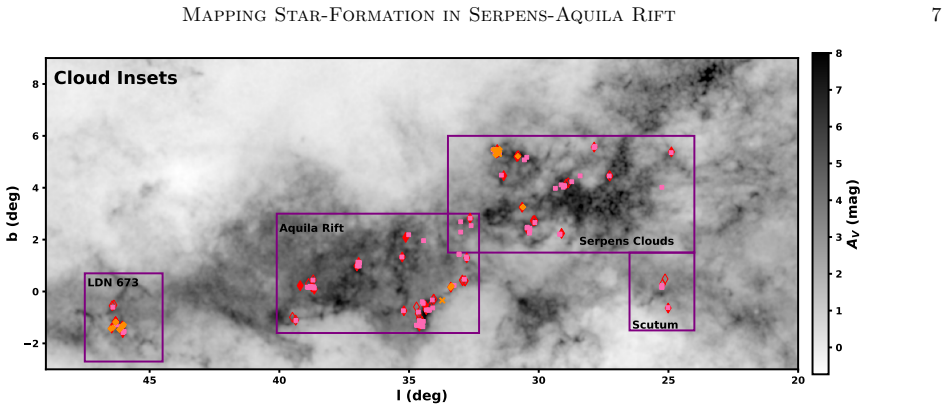
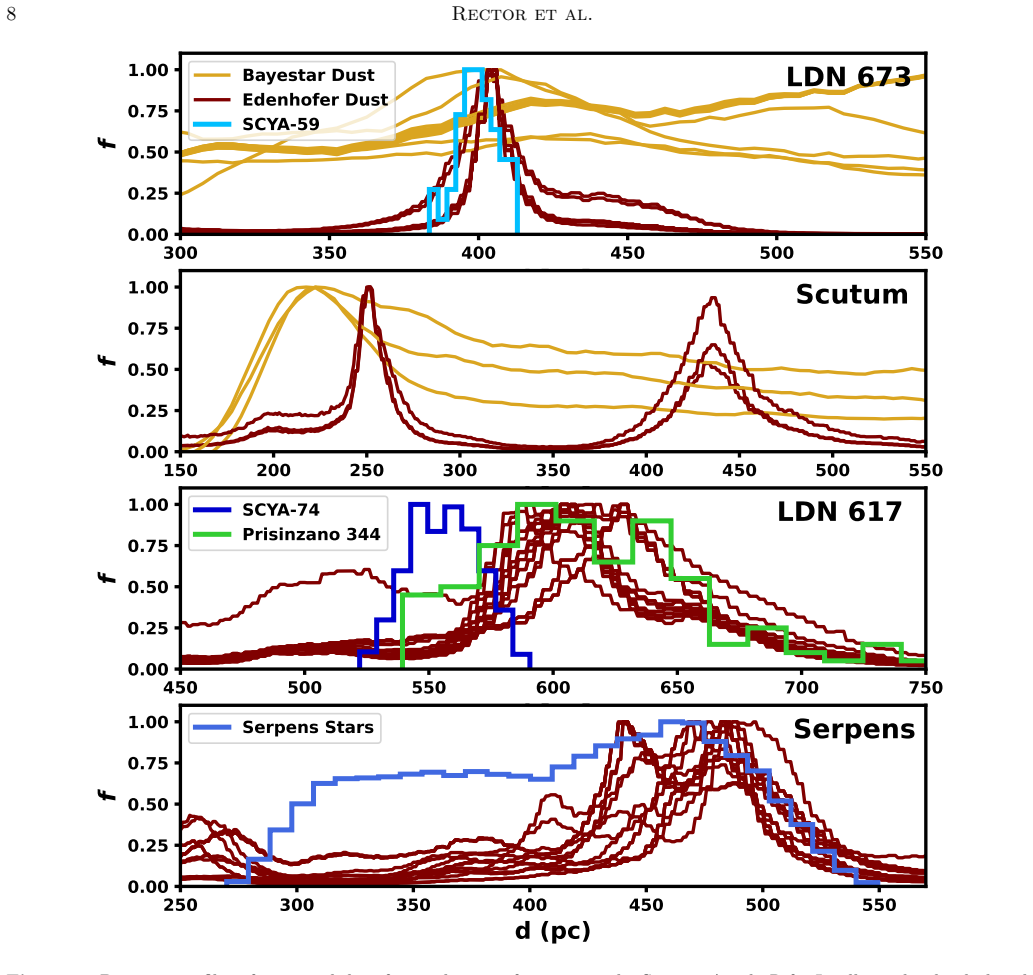
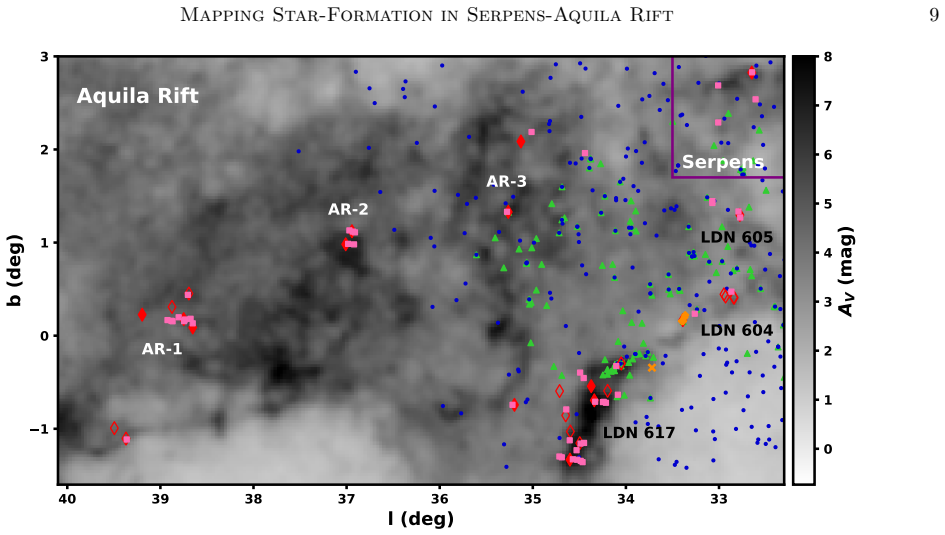
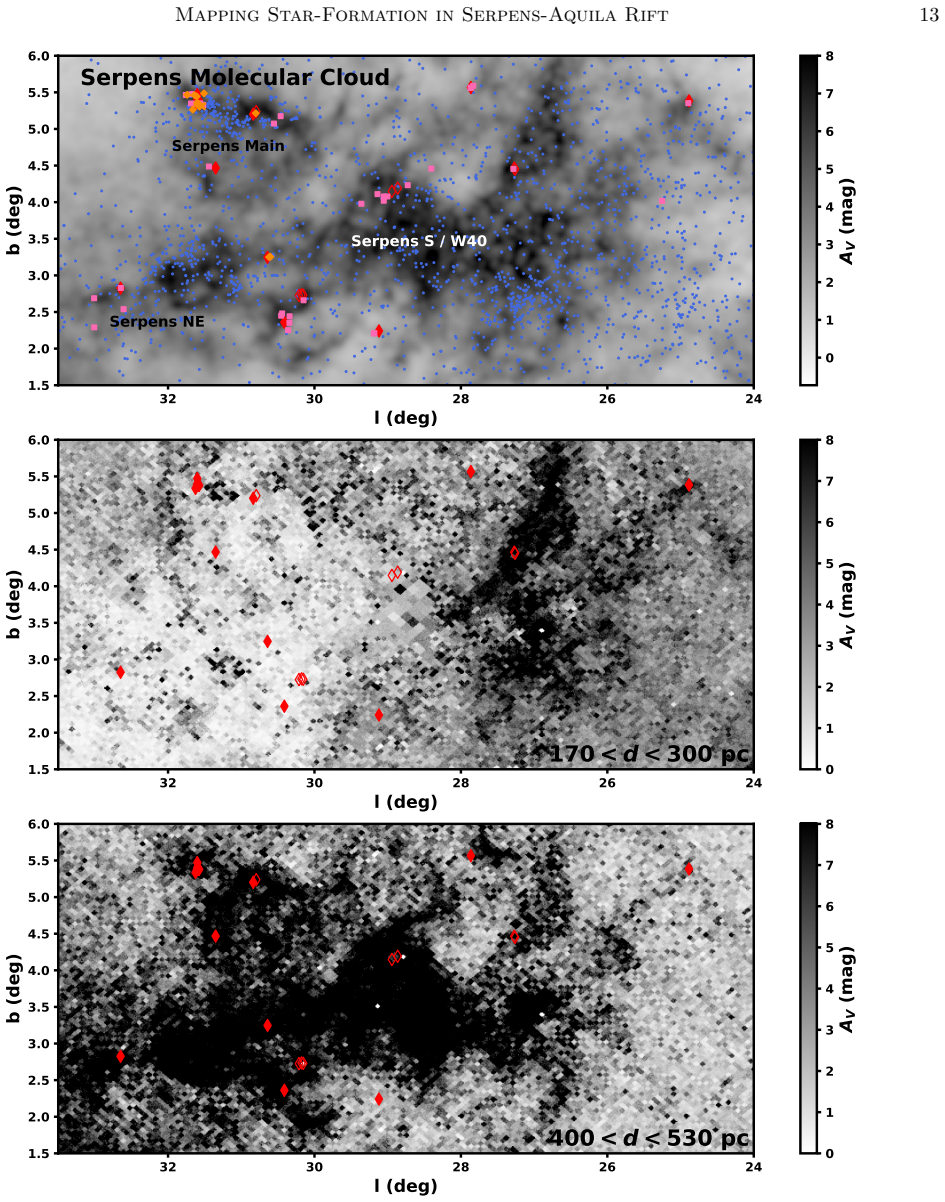
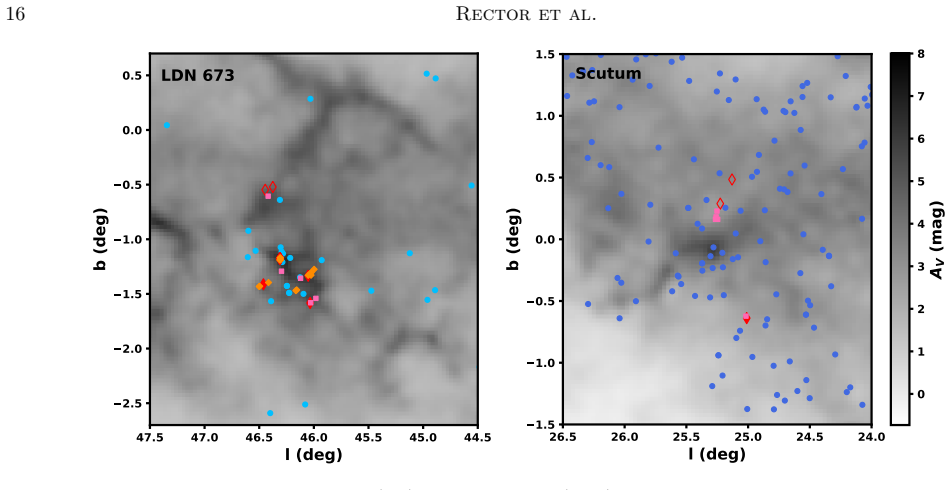
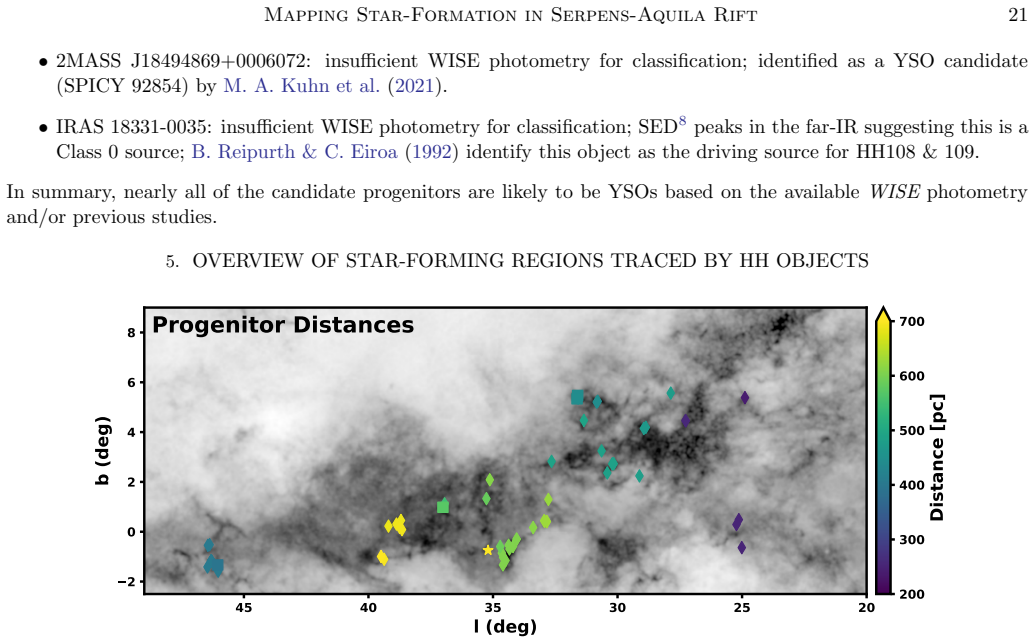
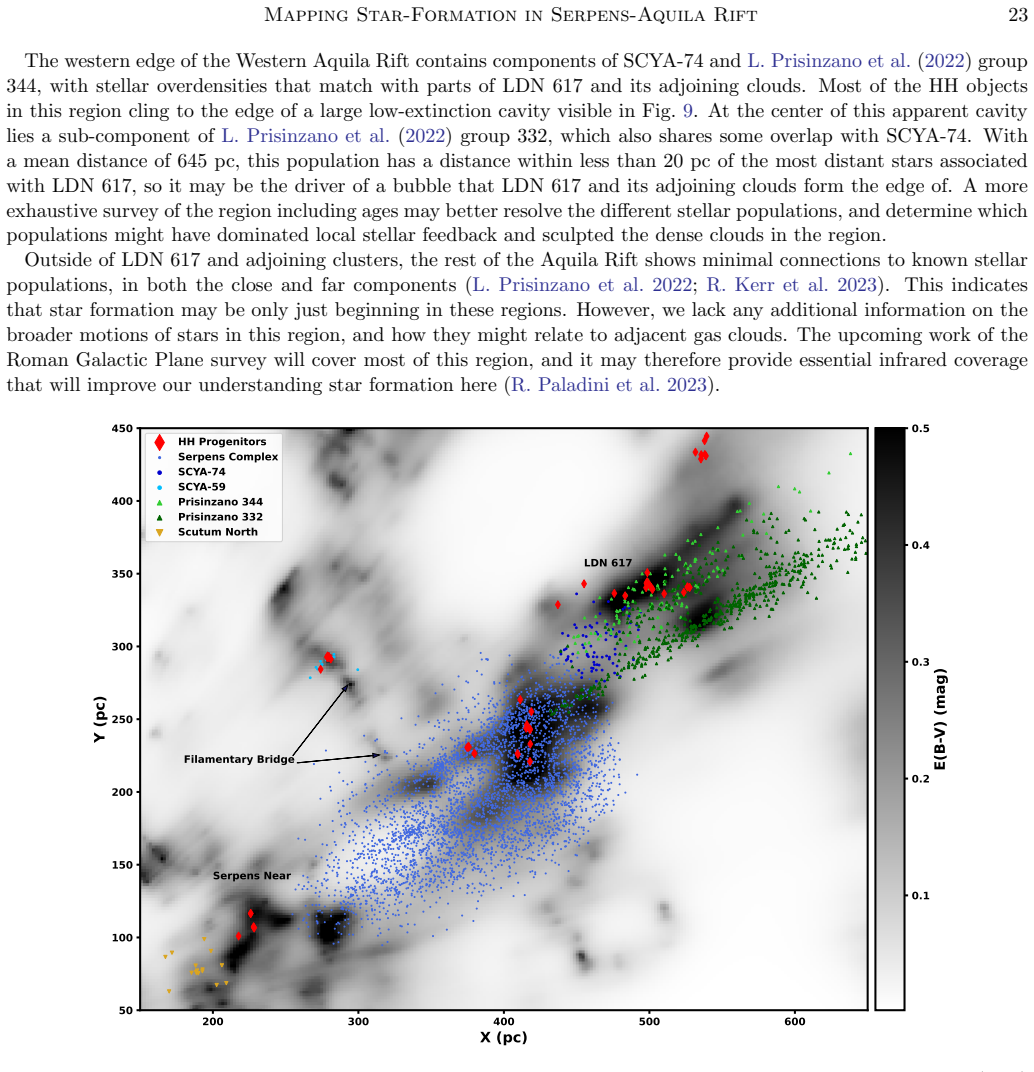
The survey detects 88 new HH objects that, with their progenitors, mark five clouds: the Serpens Molecular Cloud and LDN 673 at 400-500 pc, the West and East Aquila Rift components at roughly 600 pc and 700 pc, and a near Serpens cloud at about 250 pc. The outflows broadly trace gas on cavity edges in the Serpens Molecular Cloud and Western Aquila Rift, matching expectations for active star formation in feedback-driven shells. The near cloud lacks association with known populations yet its location and velocity place it in the Local Bubble, where the HH objects may signal the start of a new stellar generation connected to the Scutum North Association.
What carries the argument
Herbig-Haro objects as tracers of active star formation sites, assigned to specific clouds through combined spatial positions, literature dust maps, and Gaia astrometry.
If this is right
- HH objects can guide future YSO surveys by locating active star formation even in the absence of astrometrically characterized young stars.
- Star formation in the Serpens Molecular Cloud and Western Aquila Rift occurs along the boundaries of feedback-driven shells surrounding known stellar populations.
- The near Serpens cloud at 250 pc belongs to the Local Bubble and may mark the onset of a new stellar generation linked to the Scutum North Association.
- HH objects serve as a practical tool for identifying star-forming clouds across distances from 250 to 700 pc when combined with dust and astrometric data.
Where Pith is reading between the lines
- The same HH-tracing approach could be extended to other molecular cloud complexes to discover additional uncharted star-forming sites.
- The suggested link between the near cloud and the Local Bubble raises the possibility that large-scale galactic features influence the timing and location of new star formation episodes.
- Targeted follow-up observations of the newly found outflows could test whether the spatial distribution of HH objects directly scales with the local star-formation rate in each cloud.
Load-bearing premise
The spatial locations of the HH objects combined with literature dust maps and Gaia astrometry permit reliable assignment of each outflow to one of five specific clouds at the stated distances with the identified progenitors as the correct driving sources.
What would settle it
Gaia astrometry or proper-motion measurements showing that a substantial fraction of the identified progenitors lie at distances inconsistent with the assigned clouds, or belong to different clouds than claimed, would undermine the five-cloud mapping.
Figures
read the original abstract
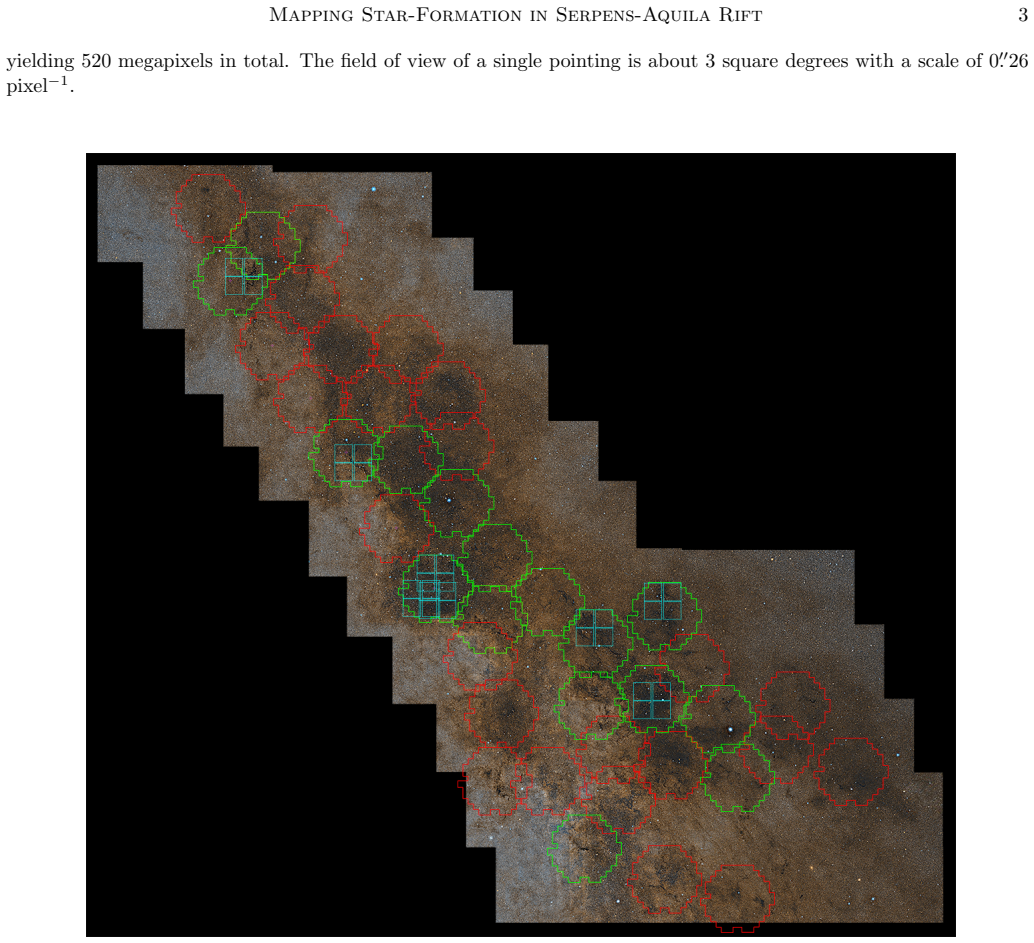
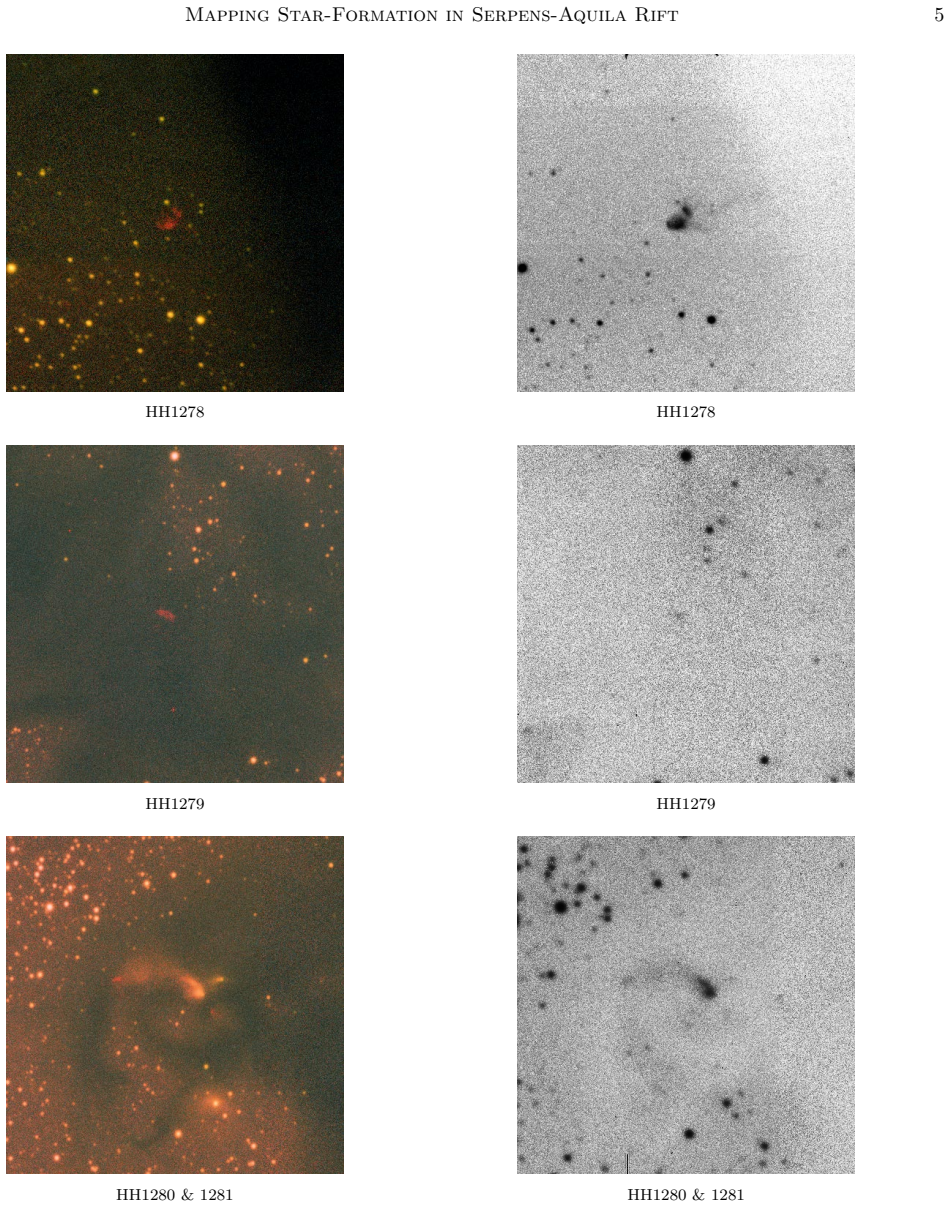
We report the results of a high-sensitivity survey for Herbig-Haro (HH) outflows in the Serpens-Aquila Rift using the DECam instrument on the 4-meter telescope. We have detected 88 new HH objects, more than tripling the total known in this region. We have also identified likely progenitors for most of these outflows. By combining HH object and progenitor locations with literature dust maps and Gaia astrometry, we find that HH objects mark five spatially distinct clouds hosting active star formation: the Serpens Molecular Cloud and LDN 673 at 400-500 pc, the more distant West and East components of the Aquila Rift at ~600 and 700 pc, respectively, and a near cloud in Serpens at ~250 pc. In both the Serpens Molecular Cloud and the Western Aquila Rift, HH objects broadly trace gas structures on the edges of low-density cavities surrounding known stellar populations, consistent with active star formation in feedback-driven shells. The near cloud in Serpens is not associated with any established stellar population, but its position and velocity suggest that it is part of the Local Bubble. And the HH objects there may mark the start of a new stellar generation connected to the Scutum North Association. Our Herbig-Haro objects therefore serve as a powerful indicator of star formation sites even in the absence of astrometrically characterized young stars, making them a useful tool for guiding future YSO surveys.
Editorial analysis
A structured set of objections, weighed in public.
Referee Report
Summary. The manuscript reports a DECam survey detecting 88 new Herbig-Haro objects in the Serpens-Aquila Rift (more than tripling the known total), with likely progenitors identified for most outflows. Combining positions with literature dust maps and Gaia astrometry, the authors assign the objects to five spatially distinct clouds at 250-700 pc (Serpens Molecular Cloud and LDN 673 at 400-500 pc; West and East Aquila Rift at ~600 and 700 pc; a near Serpens cloud at ~250 pc). They interpret the spatial distribution as tracing feedback-driven shells around known stellar populations in two clouds and suggest the near cloud may belong to the Local Bubble and mark the onset of a new stellar generation linked to the Scutum North Association. The central claim is that HH objects are a powerful indicator of active star-formation sites even without astrometrically characterized YSOs and can guide future surveys.
Significance. If the cloud assignments are reliable, the work substantially expands the census of outflows in this region and demonstrates a practical observational tool for locating active star formation. The morphological consistency with known cavity edges and alignment with literature distances for the five clouds provide supporting context. The suggestion that HH objects can identify sites lacking characterized YSOs is a concrete, testable contribution to survey strategy in nearby star-forming complexes.
major comments (3)
- [§4 and §5] §4 (Results) and §5 (Discussion): The assignment of the 88 HH objects to the five specific clouds at the quoted distances rests on spatial coincidence with dust maps plus Gaia astrometry, yet no quantitative association criteria, matching radius, or false-association rate is stated. This step is load-bearing for the five-cloud mapping claim and the assertion that the associations are reliable.
- [§3] §3 (Observations/Methods): No explicit selection criteria, detection thresholds, or completeness estimates are provided for the new HH objects or for the identification of 'likely progenitors' for most outflows. Without these, the claim that progenitors were identified for most of the 88 objects and that the resulting associations are reliable cannot be evaluated.
- [§4.1] §4.1 (Distance assignments): The distances (250 pc, 400-500 pc, ~600 pc, ~700 pc) are stated without per-object error budgets, the Gaia data used for each assignment, or how individual measurements were combined with literature values. This directly affects the robustness of the five-cloud spatial separation.
minor comments (3)
- [Figures] Figure captions and axis labels should explicitly state the distance scale and coordinate system used for the cloud assignments.
- [Abstract and §1] The abstract and §1 should include a brief statement of the survey area and sensitivity limits to allow readers to assess the tripling claim.
- [Results] A table listing the 88 new objects with coordinates, assigned cloud, and progenitor candidate would improve traceability of the assignments.
Simulated Author's Rebuttal
We thank the referee for the constructive comments on our manuscript. We address each major comment below and have made revisions to incorporate the requested quantitative details and criteria, thereby strengthening the presentation of our results.
read point-by-point responses
-
Referee: [§4 and §5] §4 (Results) and §5 (Discussion): The assignment of the 88 HH objects to the five specific clouds at the quoted distances rests on spatial coincidence with dust maps plus Gaia astrometry, yet no quantitative association criteria, matching radius, or false-association rate is stated. This step is load-bearing for the five-cloud mapping claim and the assertion that the associations are reliable.
Authors: We agree that quantitative association criteria strengthen the cloud assignments. In the revised manuscript we have added explicit criteria in §4: an HH object is assigned to a cloud if its position lies within the 3σ extinction contour of the corresponding dust map and within a 15-arcmin matching radius of the cloud core. We also include a false-association rate of ~8% estimated from 1000 Monte Carlo trials with randomized positions. These additions directly support the reliability of the five-cloud mapping. revision: yes
-
Referee: [§3] §3 (Observations/Methods): No explicit selection criteria, detection thresholds, or completeness estimates are provided for the new HH objects or for the identification of 'likely progenitors' for most outflows. Without these, the claim that progenitors were identified for most of the 88 objects and that the resulting associations are reliable cannot be evaluated.
Authors: We have revised §3 to state the detection threshold (surface brightness >5×10^{-18} erg s^{-1} cm^{-2} arcsec^{-2}), morphological selection criteria (bow shocks or linear chains), and completeness (~75% for objects above threshold from artificial-source tests). Progenitors are now defined as literature YSOs within 10 arcmin with Gaia proper-motion consistency; this criterion applies to 72 of 88 objects. These details allow evaluation of the progenitor identifications. revision: yes
-
Referee: [§4.1] §4.1 (Distance assignments): The distances (250 pc, 400-500 pc, ~600 pc, ~700 pc) are stated without per-object error budgets, the Gaia data used for each assignment, or how individual measurements were combined with literature values. This directly affects the robustness of the five-cloud spatial separation.
Authors: We have expanded §4.1 with a new table listing the Gaia DR3 sources, parallaxes, and errors used for each cloud. Distances are computed as a weighted mean of Gaia values and literature distances (Zucker et al. 2020), with uncertainties propagated to include both statistical and systematic terms. Per-cloud budgets are now quoted (e.g., 250±30 pc, 450±60 pc). This clarifies the robustness of the spatial separation. revision: yes
Circularity Check
No significant circularity
full rationale
The paper is a pure observational survey report with no equations, fitted parameters, derivations, or predictions. It describes detection of 88 HH objects, progenitor identification, and assignment to five clouds via spatial coincidence with external literature dust maps plus Gaia astrometry. These steps rely on independent external data and standard methods rather than any internal reduction to the paper's own inputs or self-citations. The central claim is therefore self-contained against external benchmarks.
Axiom & Free-Parameter Ledger
axioms (1)
- domain assumption Gaia astrometry and published dust maps provide accurate distances and cloud boundaries for the Serpens-Aquila region.
Reference graph
Works this paper leans on
-
[1]
Anglada, G., Lopez, R., Estalella, R., et al. 2007, Astron. J., 133, 2799, doi: 10.1086/517493
-
[2]
Demleitner, M., & Andrae, R. 2021, AJ, 161, 147, doi: 10.3847/1538-3881/abd806
work page internal anchor Pith review doi:10.3847/1538-3881/abd806 2021
-
[3]
Baug, T., Dewangan, L. K., Ojha, D. K., & Ninan, J. P. 2016, ApJ, 833, 85, doi: 10.3847/1538-4357/833/1/85
-
[4]
Chambers, K. C., Magnier, E. A., Metcalfe, N., et al. 2016, arXiv e-prints, arXiv:1612.05560, doi: 10.48550/arXiv.1612.05560
work page internal anchor Pith review Pith/arXiv arXiv doi:10.48550/arxiv.1612.05560 2016
-
[5]
Chen, H., Myers, P. C., Ladd, E. F., & Wood, D. O. S. 1995, ApJ, 445, 377, doi: 10.1086/175703
-
[6]
Churchwell, E., Povich, M. S., Allen, D., et al. 2006, ApJ, 649, 759, doi: 10.1086/507015 Comer´ on, F., Mer´ ın, B., Reipurth, B., & Yen, H. W. 2019, A&A, 628, A97, doi: 10.1051/0004-6361/201834743
-
[7]
Cooper, H. D. B., Lumsden, S. L., Oudmaijer, R. D., et al. 2013, MNRAS, 430, 1125, doi: 10.1093/mnras/sts681
-
[8]
Cox, E. G., Novak, G., Sadavoy, S. I., et al. 2022, ApJ, 932, 34, doi: 10.3847/1538-4357/ac722a
-
[9]
Cutri, R. M., Wright, E. L., Conrow, T., et al. 2021,, VizieR On-line Data Catalog: II/328. Originally published in: IPAC/Caltech (2013) doi: 10.26131/IRSA1
-
[10]
Davis, C. J., Matthews, H. E., Ray, T. P., Dent, W. R. F., & Richer, J. S. 1999, MNRAS, 309, 141, doi: 10.1046/j.1365-8711.1999.02836.x
-
[11]
1997, AJ, 114, 2095, doi: 10.1086/118629
Devine, D., Bally, J., Reipurth, B., & Heathcote, S. 1997, AJ, 114, 2095, doi: 10.1086/118629
-
[12]
Dewangan, L. K. 2017, ApJ, 837, 44, doi: 10.3847/1538-4357/aa5df2
-
[13]
A., Andr´ e, P., Bontemps, S., et al
Djupvik, A. A., Andr´ e, P., Bontemps, S., et al. 2006, A&A, 458, 789, doi: 10.1051/0004-6361:20065533
-
[14]
A., Liimets, T., Zinnecker, H., et al
Djupvik, A. A., Liimets, T., Zinnecker, H., et al. 2016, A&A, 587, A75, doi: 10.1051/0004-6361/201526532
-
[16]
2011b, PASJ, 63, S1, doi: 10.1093/pasj/63.sp1.S1
Dobashi, K. 2011b, PASJ, 63, S1, doi: 10.1093/pasj/63.sp1.S1
-
[17]
2005, PASJ, 57, S1, doi: 10.1093/pasj/57.sp1.S1
Dobashi, K., Uehara, H., Kandori, R., et al. 2005, PASJ, 57, S1, doi: 10.1093/pasj/57.sp1.S1
-
[18]
Dunham, M. M., Crapsi, A., Evans, II, N. J., et al. 2008, ApJS, 179, 249, doi: 10.1086/591085
-
[19]
2024, A&A, 685, A82, doi: 10.1051/0004-6361/202347628
Edenhofer, G., Zucker, C., Frank, P., et al. 2024, A&A, 685, A82, doi: 10.1051/0004-6361/202347628
-
[20]
2017, MNRAS, 471, 100, doi: 10.1093/mnras/stx1357
Elia, D., Molinari, S., Schisano, E., et al. 2017, MNRAS, 471, 100, doi: 10.1093/mnras/stx1357
-
[21]
Elmegreen, B. G., & Lada, C. J. 1977, ApJ, 214, 725, doi: 10.1086/155302
-
[22]
doi:10.1088/0004-637X/692/2/973 , eprint =
Enoch, M. L., Evans, II, N. J., Sargent, A. I., & Glenn, J. 2009, ApJ, 692, 973, doi: 10.1088/0004-637X/692/2/973
-
[23]
Evans, N. J., Dunham, M. M., Jørgensen, J. K., et al. 2009, ApJS, 181, 321, doi: 10.1088/0067-0049/181/2/321
-
[24]
Fischer, W. J., Padgett, D. L., Stapelfeldt, K. L., & Sewi lo, M. 2016, ApJ, 827, 96, doi: 10.3847/0004-637X/827/2/96
-
[25]
A 3D Dust Map Based on Gaia, Pan-STARRS 1 and 2MASS
Finkbeiner, D. 2019, ApJ, 887, 93, doi: 10.3847/1538-4357/ab5362 Grudi´ c, M. Y., Guszejnov, D., Hopkins, P. F., Offner, S. S. R., & Faucher-Gigu` ere, C.-A. 2021, Monthly Notices of the Royal Astronomical Society, 506, 2199, doi: 10.1093/mnras/stab1347
work page internal anchor Pith review doi:10.3847/1538-4357/ab5362 2019
-
[26]
1953, ApJ, 117, 73, doi: 10.1086/145669
Haro, G. 1953, ApJ, 117, 73, doi: 10.1086/145669
-
[27]
Hartigan, P., Hillenbrand, L. A., Matuszewski, M., et al. 2020, AJ, 160, 165, doi: 10.3847/1538-3881/abadfa
-
[28]
Herbig, G. H. 1951, ApJ, 113, 697, doi: 10.1086/145440
-
[29]
Herczeg, G. J., Kuhn, M. A., Zhou, X., et al. 2019, ApJ, 878, 111, doi: 10.3847/1538-4357/ab1d67
-
[30]
Hsieh, C.-H., Arce, H. G., Maureira, M. J., et al. 2024, ApJ, 973, 138, doi: 10.3847/1538-4357/ad6152 26Rector et al
-
[31]
and Mellema, Garrelt and Mao, Yi and Iliev, Ilian T
Ioannidis, G., & Froebrich, D. 2012, MNRAS, 421, 3257, doi: 10.1111/j.1365-2966.2012.20550.x
-
[32]
Jackson, J. M., Rathborne, J. M., Shah, R. Y., et al. 2006, ApJS, 163, 145, doi: 10.1086/500091
-
[33]
Kerr, R., Kraus, A. L., & Rizzuto, A. C. 2023, ApJ, 954, 134, doi: 10.3847/1538-4357/ace5b3
-
[34]
2024, MNRAS, 528, 4657, doi: 10.1093/mnras/stae295
Kim, Y., Koo, B.-C., Pyo, T.-S., et al. 2024, MNRAS, 528, 4657, doi: 10.1093/mnras/stae295
-
[35]
Koenig, X. P., & Leisawitz, D. T. 2014, The Astrophysical Journal, 791, 131, doi: 10.1088/0004-637X/791/2/131 K¨ onyves, V., Andr´ e, P., Men’shchikov, A., et al. 2015, A&A, 584, A91, doi: 10.1051/0004-6361/201525861
-
[37]
Kuhn, M. A., de Souza, R. S., Krone-Martins, A., et al. 2021, The Astrophysical Journal Supplement Series, 254, 33, doi: 10.3847/1538-4365/abe465
-
[38]
Lada, C. J. 1987, in IAU Symposium, Vol. 115, Star Forming Regions, ed. M. Peimbert & J. Jugaku, 1
1987
-
[39]
Y., Movsessian, T
Magakian, T. Y., Movsessian, T. A., & Nikoghosyan, E. H. 2016, in Astronomical Society of the Pacific Conference
2016
-
[40]
Magakian, T. Y., Nikogossian, E. H., Aspin, C., et al. 2010, AJ, 139, 969, doi: 10.1088/0004-6256/139/3/969
-
[41]
Munar-Adrover, P., Paredes, J. M., & Romero, G. E. 2011, A&A, 530, A72, doi: 10.1051/0004-6361/201116580
-
[42]
2017, ApJ, 837, 154, doi: 10.3847/1538-4357/aa5ea6
Onishi, T. 2017, ApJ, 837, 154, doi: 10.3847/1538-4357/aa5ea6
-
[43]
Nikogossian, E. G., Magakian, T. Y., & Movsessian, T. A. 2007, Astronomy Reports, 51, 735, doi: 10.1134/S106377290709003X O’Neill, T. J., Zucker, C., Goodman, A. A., & Edenhofer, G. 2024, ApJ, 973, 136, doi: 10.3847/1538-4357/ad61de Ortiz-Le´ on, G. N., Dzib, S. A., Loinard, L., et al. 2023, A&A, 673, L1, doi: 10.1051/0004-6361/202346369 Ortiz-Le´ on, G. ...
-
[44]
2023, arXiv e-prints, arXiv:2307.07642, doi: 10.48550/arXiv.2307.07642
Paladini, R., Zucker, C., Benjamin, R., et al. 2023, arXiv e-prints, arXiv:2307.07642, doi: 10.48550/arXiv.2307.07642
-
[45]
Parker, Q. A., Bojiˇ ci´ c, I. S., & Frew, D. J. 2016, in Journal of Physics Conference Series, Vol. 728, Journal of Physics Conference Series (IOP), 032008, doi: 10.1088/1742-6596/728/3/032008
-
[46]
Pineda, J. E., Friesen, R. K., (co-PIs), et al. 2026, ApJS, 282, 18, doi: 10.3847/1538-4365/ae11b1
-
[47]
Pokhrel, R., Megeath, S. T., Gutermuth, R. A., et al. 2023, ApJS, 266, 32, doi: 10.3847/1538-4365/acbfac
-
[48]
2023, A&A, 679, L10, doi: 10.1051/0004-6361/202347186
Posch, L., Miret-Roig, N., Alves, J., et al. 2023, A&A, 679, L10, doi: 10.1051/0004-6361/202347186
-
[49]
L., & Dame, T
Prato, L., Rice, E. L., & Dame, T. M. 2008, Where are all the Young Stars in Aquila?, ed. B. Reipurth, 18
2008
-
[50]
2022, A&A, 664, A175, doi: 10.1051/0004-6361/202243580
Prisinzano, L., Damiani, F., Sciortino, S., et al. 2022, A&A, 664, A175, doi: 10.1051/0004-6361/202243580
-
[51]
Rector, T. A., Levay, Z. G., Frattare, L. M., English, J., & Pu’uohau-Pummill, K. 2007, AJ, 133, 598, doi: 10.1086/510117
-
[52]
A., Prato, L., Kerr, R., Papraniku, E., & Fisk, K
Rector, T. A., Prato, L., Kerr, R., Papraniku, E., & Fisk, K. 2025, AJ, 169, 313, doi: 10.3847/1538-3881/adc2f3
-
[53]
Rector, T. A., Shuping, R. Y., Prato, L., & Schweiker, H. 2018, ApJ, 852, 13, doi: 10.3847/1538-4357/aa9ce1
-
[54]
doi:10.1146/annurev.astro.39.1.403 , adsurl =
Reipurth, B., & Bally, J. 2001, ARA&A, 39, 403, doi: 10.1146/annurev.astro.39.1.403
-
[55]
1997, AJ, 114, 2708, doi: 10.1086/118681
Reipurth, B., Bally, J., & Devine, D. 1997, AJ, 114, 2708, doi: 10.1086/118681
-
[56]
1993, A&A, 273, 221
Reipurth, B., Chini, R., Krugel, E., Kreysa, E., & Sievers, A. 1993, A&A, 273, 221
1993
-
[57]
1992, A&A, 256, L1
Reipurth, B., & Eiroa, C. 1992, A&A, 256, L1
1992
-
[58]
Rice, E. L., Prato, L., & McLean, I. S. 2006, ApJ, 647, 432, doi: 10.1086/505326
-
[59]
Sabin, L., Parker, Q. A., Corradi, R. L. M., et al. 2014, MNRAS, 443, 3388, doi: 10.1093/mnras/stu1404
-
[60]
2019, PASJ, 71, S4, doi: 10.1093/pasj/psy115
Shimoikura, T., Dobashi, K., Nakamura, F., Shimajiri, Y., & Sugitani, K. 2019, PASJ, 71, S4, doi: 10.1093/pasj/psy115
-
[61]
The protostellar system HH108MMS
Siebenmorgen, R., & Kr¨ ugel, E. 2000, A&A, 364, 625, doi: 10.48550/arXiv.astro-ph/0011060
work page internal anchor Pith review Pith/arXiv arXiv doi:10.48550/arxiv.astro-ph/0011060 2000
-
[62]
Singh, A., & Martin, P. G. 2022, ApJ, 941, 135, doi: 10.3847/1538-4357/ac9cdc
-
[63]
Smith, R. G., Lawson, W. A., & Wright, C. M. 2007, MNRAS, 375, 257, doi: 10.1111/j.1365-2966.2006.11292.x Straiˇ zys, V.,ˇCernis, K., & Bartaˇ si¯ ut˙ e, S. 2003, A&A, 405, 585, doi: 10.1051/0004-6361:20030599
-
[64]
L483: A Protostar In Transition From Class 0 to Class I
Tafalla, M., Myers, P. C., Mardones, D., & Bachiller, R. 2000, A&A, 359, 967, doi: 10.48550/arXiv.astro-ph/0005525
work page internal anchor Pith review Pith/arXiv arXiv doi:10.48550/arxiv.astro-ph/0005525 2000
-
[66]
Urquhart, J. S., Hoare, M. G., Purcell, C. R., et al. 2009b, A&A, 501, 539, doi: 10.1051/0004-6361/200912108
-
[67]
2014, in Astronomical Society of the Pacific Conference Series, Vol
Valdes, F., Gruendl, R., & DES Project. 2014, in Astronomical Society of the Pacific Conference Series, Vol. 485, Astronomical Data Analysis Software and Systems XXIII, ed. N. Manset & P. Forshay, 379
2014
-
[68]
Wang, C., & Wang, K. 2023, A&A, 674, A46, doi: 10.1051/0004-6361/202244525 Mapping Star-Formation in Serpens-Aquila Rift27
-
[69]
2000, , 143, 9, 10.1051/aas:2000332
Wenger, M., Ochsenbein, F., Egret, D., et al. 2000, A&AS, 143, 9, doi: 10.1051/aas:2000332
work page internal anchor Pith review doi:10.1051/aas:2000332 2000
-
[70]
J., Gutermuth, R., & Bourke, T
Winston, E., Wolk, S. J., Gutermuth, R., & Bourke, T. L. 2018, AJ, 155, 241, doi: 10.3847/1538-3881/aabe82
-
[72]
Wright, E. L., Eisenhardt, P. R. M., Mainzer, A. K., et al. 2010b, AJ, 140, 1868, doi: 10.1088/0004-6256/140/6/1868
work page internal anchor Pith review doi:10.1088/0004-6256/140/6/1868
-
[73]
2002, ChJA&A, 2, 33, doi: 10.1088/1009-9271/2/1/33
Wu, J.-W., Wu, Y.-F., Wang, J.-Z., & Cai, K. 2002, ChJA&A, 2, 33, doi: 10.1088/1009-9271/2/1/33
-
[74]
Zhang, B., Zheng, X. W., Reid, M. J., et al. 2009, ApJ, 693, 419, doi: 10.1088/0004-637X/693/1/419
-
[75]
2014, AJ, 148, 26, doi: 10.1088/0004-6256/148/2/26
Zhang, M., Wang, H., & Henning, T. 2014, AJ, 148, 26, doi: 10.1088/0004-6256/148/2/26
-
[76]
J., Liu, Y., Fang, M., & Kuhn, M
Zhou, X., Herczeg, G. J., Liu, Y., Fang, M., & Kuhn, M. 2022, ApJ, 933, 77, doi: 10.3847/1538-4357/ac704d
-
[77]
1999, A&A, 347, 565
Ziener, R., & Eisl¨ offel, J. 1999, A&A, 347, 565
1999
discussion (0)
Sign in with ORCID, Apple, or X to comment. Anyone can read and Pith papers without signing in.