Curvature-guided topology and self-assembly in chiral nematics and liquid-crystal colloids
Pith reviewed 2026-06-27 14:50 UTC · model grok-4.3
The pith
Curvature selects topological defects and guides self-assembly in liquid-crystal colloids through a framework of genus, Euler characteristic, anchoring, and chirality.
A machine-rendered reading of the paper's core claim, the machinery that carries it, and where it could break.
Core claim
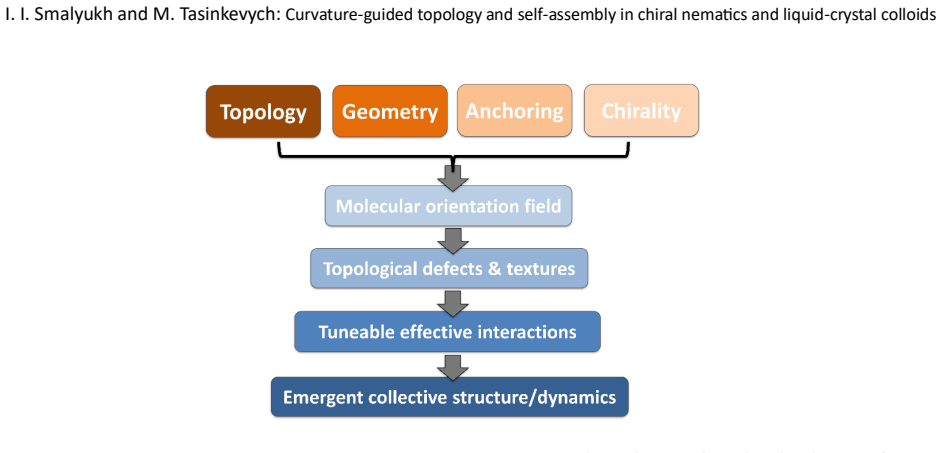
We introduce a unifying framework based on genus, Euler characteristic, anchoring, and chirality, and use it to discuss spherical, handlebody, and boundary-bearing colloids, together with droplets and polymer-dispersed nematics of nontrivial topology, highlighting the interplay of geometry and topology in determining defect structures and how chirality and confinement stabilize three-dimensional topological states.
What carries the argument
The unifying framework based on genus, Euler characteristic, anchoring, and chirality that organizes defect selection and self-assembly across curved geometries.
If this is right
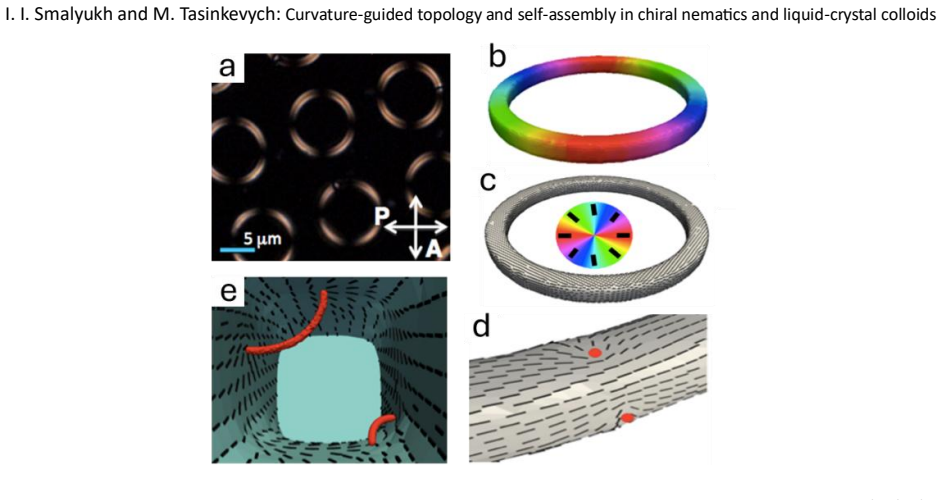
- Defect structures such as boojums, disclination loops, hedgehog charges, and linked or knotted configurations are selected by the topology parameters of the boundaries.
- Chirality combined with confinement stabilizes localized three-dimensional textures including skyrmions, torons, and hopfions.
- These defect-mediated interactions provide design principles for controlled self-assembly, templating, and functional composite materials.
Where Pith is reading between the lines
- The framework could be extended to predict defect behavior in active or driven liquid-crystal systems where additional energy inputs compete with elastic and anchoring energies.
- Testing the framework in new multiply connected geometries not covered by existing experiments would reveal whether additional parameters become necessary.
- The same topological classification may apply to defect structures in other soft-matter systems such as membranes or emulsions with comparable curvature and anchoring.
Load-bearing premise
The four parameters of genus, Euler characteristic, anchoring, and chirality are adequate to capture the essential physics across the reviewed systems without additional system-specific adjustments.
What would settle it
An experimental curved colloid or confined nematic system in which observed defects or assembly patterns cannot be classified or predicted using only genus, Euler characteristic, anchoring, and chirality.
Figures
read the original abstract
In soft condensed matter, curvature does more than simply distort an ordered medium: it helps select defect structures, redistribute elastic stress, bias chirality, and guide self-assembly. This review examines how curved, multiply connected, and knotted boundaries in liquid-crystal colloids and confined nematics generate topological defects and localized solitonic textures, and how these structures mediate interactions between mesoscale building blocks. We introduce a unifying framework based on genus, Euler characteristic, anchoring, and chirality, and use it to discuss spherical, handlebody, and boundary-bearing colloids, together with droplets and polymer-dispersed nematics of nontrivial topology. Particular emphasis is placed on the interplay of geometry and topology in determining boojums, disclination loops, hedgehog charges, and linked and knotted defect structures. We then turn to chiral systems hosting skyrmions, torons, hopfions, and related localized textures, highlighting how chirality and confinement stabilize three-dimensional topological states. Finally, we discuss how these concepts translate into design principles for controlled self-assembly, templating, and functional composite materials. More broadly, we argue that liquid-crystal colloids and confined nematics provide experimentally accessible model systems in which curvature, topology, and chirality can be harnessed as programmable tools for designing organized soft matter.
Editorial analysis
A structured set of objections, weighed in public.
Referee Report
Summary. The manuscript is a review article that introduces a unifying framework based on genus, Euler characteristic, anchoring, and chirality to organize and discuss how curvature selects defect structures (boojums, disclination loops, hedgehogs, skyrmions, torons, hopfions) and guides self-assembly in liquid-crystal colloids and confined nematics. It covers spherical, handlebody, and boundary-bearing colloids, droplets, polymer-dispersed systems of nontrivial topology, and chiral textures, emphasizing geometry-topology interplay and design principles for functional materials.
Significance. As a review, the paper synthesizes existing literature on topological defects in curved soft-matter geometries under four organizing parameters. This organizational synthesis can aid researchers by highlighting connections across systems and suggesting design rules for self-assembly and templating. The explicit framing of liquid-crystal colloids as experimentally accessible model systems for curvature, topology, and chirality is a constructive contribution. No new derivations, data, or quantitative predictions are presented, which is consistent with the review format and does not detract from its utility as a reference.
Simulated Author's Rebuttal
We thank the referee for their careful reading and positive assessment of the manuscript. Their summary accurately reflects the scope and intent of the review, and we are pleased that they recommend acceptance.
Circularity Check
No circularity: review organizes literature without derivations or predictions
full rationale
This is a review article that synthesizes existing experimental and theoretical studies on topological defects in curved liquid-crystal geometries. It introduces an organizational framework based on genus, Euler characteristic, anchoring, and chirality to discuss known systems, but advances no new equations, quantitative predictions, fitted parameters, or first-principles derivations. No load-bearing steps reduce to self-definition, self-citation chains, or renamed inputs; the central claim is an organizational synthesis of prior literature rather than a testable derivation whose validity hinges on internal consistency.
Axiom & Free-Parameter Ledger
Reference graph
Works this paper leans on
-
[1]
Review: knots and other new topological effects in liquid crystals and colloids,
I. I. Smalyukh, “Review: knots and other new topological effects in liquid crystals and colloids,” Rep. Prog. Phys. 83, 106601 (2020)
2020
-
[2]
Liquid crystal colloids,
I. I. Smalyukh, “Liquid crystal colloids,” Annu. Rev. Condens. Matter Phys. 9, 207–226 (2018). I. I. Smalyukh and M. Tasinkevych: Curvature-guided topology and self-assembly in chiral nematics and liquid-crystal colloids 41
2018
-
[3]
Three-dimensional structure and multistable optical switching of triple-twisted particle-like excitations in anisotropic fluids,
I. I. Smalyukh, Y . Lansac, N. Clark, and R. Trivedi, “Three-dimensional structure and multistable optical switching of triple-twisted particle-like excitations in anisotropic fluids,” Nat. Mater. 9, 139–145 (2010)
2010
-
[4]
Static three-dimensional topological solitons in fluid chiral ferromagnets and colloids,
P . J. Ackerman and I. I. Smalyukh, “Static three-dimensional topological solitons in fluid chiral ferromagnets and colloids,” Nat. Mater. 16, 426–432 (2017)
2017
-
[5]
Topological colloids,
B. Senyuk, Q. Liu, S. He, R. D. Kamien, R. Kusner, T. C. Lubensky, and I. I. Smalyukh, “Topological colloids,” Nature 493, 200–205 (2013)
2013
-
[6]
Nematic liquid crystal boojums with handles on colloidal handlebodies,
Q. Liu, B. Senyuk, M. Tasinkevych, and I. I. Smalyukh, “Nematic liquid crystal boojums with handles on colloidal handlebodies,” Proc. Natl. Acad. Sci. USA 110, 9231–9236 (2013)
2013
-
[7]
Colloidal surfaces with boundaries, apex boojums, and nested elastic self-assembly of nematic colloids,
S. Park, Q. Liu, and I. I. Smalyukh, “Colloidal surfaces with boundaries, apex boojums, and nested elastic self-assembly of nematic colloids,” Phys. Rev. Lett. 117, 277801 (2016)
2016
-
[8]
Topological polymer dispersed liquid crystals with bulk nematic defect lines pinned to handlebody surfaces,
M. Campbell, M. Tasinkevych, and I. I. Smalyukh, “Topological polymer dispersed liquid crystals with bulk nematic defect lines pinned to handlebody surfaces,” Phys. Rev. Lett. 112, 197801 (2014)
2014
-
[9]
Splitting, linking, knotting, and solitonic escape of topological defects in homeotropic nematic drops with handles,
M. Tasinkevych, M. Campbell, and I. I. Smalyukh, “Splitting, linking, knotting, and solitonic escape of topological defects in homeotropic nematic drops with handles,” Proc. Natl. Acad. Sci. USA 111, 16268– 16273 (2014)
2014
-
[10]
Towards template-assisted assembly of nematic colloids,
N. M. Silvestre, Q. Liu, B. Senyuk, I. I. Smalyukh, and M. Tasinkevych, “Towards template-assisted assembly of nematic colloids,” Phys. Rev. Lett. 112, 225501 (2014)
2014
-
[11]
P . G. de Gennes and J. Prost, The Physics of Liquid Crystals, 2nd ed. (Clarendon Press, Oxford, 1993)
1993
-
[12]
Kleman and O
M. Kleman and O. D. Lavrentovich, Soft Matter Physics: An Introduction (Springer, New York, 2003)
2003
-
[13]
The topological theory of defects in ordered media,
N. D. Mermin, “The topological theory of defects in ordered media,” Rev. Mod. Phys. 51, 591–648 (1979)
1979
-
[14]
The geometry of soft materials: a primer,
R. D. Kamien, “The geometry of soft materials: a primer,” Rev. Mod. Phys. 74, 953–971 (2002)
2002
-
[15]
J. V . Selinger, Introduction to Topological Defects and Solitons: In Liquid Crystals, Magnets, and Related Materials, 1st ed., Lecture Notes in Physics 1032 (Springer, Cham, 2024)
2024
-
[16]
Stable nematic droplets with handles,
E. Pairam, J. Vallamkondu, V . Koning, B. C. van Zuiden, P . W. Ellis, M. A. Bates, V . Vitelli, and A. Fernandez-Nieves, “Stable nematic droplets with handles,” Proc. Natl. Acad. Sci. USA 110, 9295–9300 (2013)
2013
-
[17]
Shape-controlled colloidal interactions in nematic liquid crystals,
C. P . Lapointe, T. G. Mason, and I. I. Smalyukh, “Shape-controlled colloidal interactions in nematic liquid crystals,” Science 326, 1083–1086 (2009)
2009
-
[18]
Knots and nonorientable surfaces in chiral nematics,
T. Machon and G. P . Alexander, “Knots and nonorientable surfaces in chiral nematics,” Proc. Natl. Acad. Sci. USA 110, 14174–14179 (2013)
2013
-
[19]
Reconfigurable knots and links in chiral nematic colloids,
U. Tkalec, M. Ravnik, S. Čopar, S. Žumer, and I. Muševič, “Reconfigurable knots and links in chiral nematic colloids,” Science 333, 62–65 (2011)
2011
-
[20]
Colloidal entanglement in highly twisted chiral nematic colloids: Twisted loops, Hopf links, and trefoil knots,
V . S. R. Jampani, M. Škarabot, M. Ravnik, S. Čopar, S. Žumer, and I. Muševič, “Colloidal entanglement in highly twisted chiral nematic colloids: Twisted loops, Hopf links, and trefoil knots,” Phys. Rev. E 84, 031703 (2011). I. I. Smalyukh and M. Tasinkevych: Curvature-guided topology and self-assembly in chiral nematics and liquid-crystal colloids 42
2011
-
[21]
Knotted defects in nematic liquid crystals,
T. Machon and G. P . Alexander, “Knotted defects in nematic liquid crystals,” Phys. Rev. Lett. 113, 027801 (2014)
2014
-
[22]
Mutually tangled colloidal knots and induced defect loops in nematic fields,
A. Martinez, M. Ravnik, B. Lucero, R. Visvanathan, S. Žumer, and I. I. Smalyukh, “Mutually tangled colloidal knots and induced defect loops in nematic fields,” Nat. Mater . 13, 258–263 (2014)
2014
-
[23]
Linked topological colloids in a nematic host,
A. Martinez, L. Hermosillo, M. Tasinkevych, and I. I. Smalyukh, “Linked topological colloids in a nematic host,” Proc. Natl. Acad. Sci. USA 112, 4546–4551 (2015)
2015
-
[24]
Topological solitons, cholesteric fingers and singular defect lines in Janus liquid crystal shells,
G. Durey, H. R. O. Sohn, P . J. Ackerman, É. Brasselet, I. I. Smalyukh, and T. Lopez-Leon, “Topological solitons, cholesteric fingers and singular defect lines in Janus liquid crystal shells,” Soft Matter 16, 2669–2682 (2020)
2020
-
[25]
Geometric transformation and three-dimensional hopping of Hopf solitons,
J.-S. B. Tai, J.-S. Wu, and I. I. Smalyukh, “Geometric transformation and three-dimensional hopping of Hopf solitons,” Nat. Commun. 13, 2986 (2022)
2022
-
[26]
Surface anchoring as a control parameter for stabilizing torons, skyrmions, twisted walls, fingers and their hybrids in chiral nematics,
J.-S. B. Tai and I. I. Smalyukh, “Surface anchoring as a control parameter for stabilizing torons, skyrmions, twisted walls, fingers and their hybrids in chiral nematics,” Phys. Rev. E 101, 042702 (2020)
2020
-
[27]
Surface stabilized topological solitons in nematic liquid crystals,
I. Nys, B. Berteloot, and G. Poy, “Surface stabilized topological solitons in nematic liquid crystals,” Crystals 10, 840 (2020)
2020
-
[28]
Experimental observation of vortex rings in a bulk magnet,
C. Donnelly, K. L. Metlov, V . Scagnoli, M. Guizar-Sicairos, M. Holler, N. S. Bingham, J. Raabe, L. J. Heyderman, N. R. Cooper, and S. Gliga, “Experimental observation of vortex rings in a bulk magnet,” Nat. Phys. 17, 316–321 (2021)
2021
-
[29]
Static Hopf solitons and knotted emergent fields in solid-state noncentrosymmetric magnetic nanostructures,
J.-S. B. Tai and I. I. Smalyukh, “Static Hopf solitons and knotted emergent fields in solid-state noncentrosymmetric magnetic nanostructures,” Phys. Rev. Lett. 121, 187201 (2018)
2018
-
[30]
Photonic torons with 3D topology transitions and tunable spin monopoles,
H. Wu, N. Mata-Cervera, H. Wang, Z. Zhu, C. Qiu, and Y . Shen, “Photonic torons with 3D topology transitions and tunable spin monopoles,” Phys. Rev. Lett. 135, 063802 (2025)
2025
-
[31]
Three-dimensional crystals of adaptive knots,
J.-S. Tai and I. I. Smalyukh, “Three-dimensional crystals of adaptive knots,” Science 365, 1449–1453 (2019)
2019
-
[32]
Fusion and fission of particle-like chiral nematic vortex knots,
D. Hall, J.-S. B. Tai, L. H. Kauffman, and I. I. Smalyukh, “Fusion and fission of particle-like chiral nematic vortex knots,” Nat. Phys. 22, 103–111 (2026)
2026
-
[33]
Hopf solitons in helical and conical backgrounds of chiral magnetic solids,
R. V oinescu, J.-S. B. Tai, and I. I. Smalyukh, “Hopf solitons in helical and conical backgrounds of chiral magnetic solids,” Phys. Rev. Lett. 125, 057201 (2020)
2020
-
[34]
Electrically writing a magnetic heliknoton in a chiral magnet,
L. Li, D. Song, W. Wang, L. Kong, S. Zhang, N. Wang, S. Zhang, M. Tian, J. Zang, Y . Liu, and H. Du, “Electrically writing a magnetic heliknoton in a chiral magnet,” Nat. Mater. 25, 950–955 (2026)
2026
-
[35]
Two-dimensional skyrmions and other solitonic structures in confinement-frustrated chiral nematics,
P . J. Ackerman, R. P . Trivedi, B. Senyuk, J. van de Lagemaat, and I. I. Smalyukh, “Two-dimensional skyrmions and other solitonic structures in confinement-frustrated chiral nematics,” Phys. Rev. E 90, 012505 (2014)
2014
-
[36]
Two-dimensional skyrmion bags in liquid crystals and ferromagnets,
D. Foster, C. Kind, P . J. Ackerman, J.-S. B. Tai, M. R. Dennis, and I. I. Smalyukh, “Two-dimensional skyrmion bags in liquid crystals and ferromagnets,” Nat. Phys. 15, 655–659 (2019)
2019
-
[37]
Dynamics of topological solitons, knotted streamlines, and transport of cargo in liquid crystals,
H. R. O. Sohn, P . J. Ackerman, T. J. Boyle, G. H. Sheetah, B. Fornberg, and I. I. Smalyukh, “Dynamics of topological solitons, knotted streamlines, and transport of cargo in liquid crystals,” Phys. Rev. E 97, 052701 (2018). I. I. Smalyukh and M. Tasinkevych: Curvature-guided topology and self-assembly in chiral nematics and liquid-crystal colloids 43
2018
-
[38]
Self-assembly and electrostriction of arrays and chains of hopfion particles in chiral liquid crystals,
P . J. Ackerman, J. van de Lagemaat, and I. I. Smalyukh, “Self-assembly and electrostriction of arrays and chains of hopfion particles in chiral liquid crystals,” Nat. Commun. 6, 6012 (2015)
2015
-
[39]
Diversity of knot solitons in liquid crystals manifested by linking of preimages in torons and hopfions,
P . J. Ackerman and I. I. Smalyukh, “Diversity of knot solitons in liquid crystals manifested by linking of preimages in torons and hopfions,” Phys. Rev. X 7, 011006 (2017)
2017
-
[40]
Schools of skyrmions with electrically tunable elastic interactions,
H. R. O. Sohn, C. D. Liu, and I. I. Smalyukh, “Schools of skyrmions with electrically tunable elastic interactions,” Nat. Commun. 10, 4744 (2019)
2019
-
[41]
Electrically powered motions of toron crystallites in chiral liquid crystals,
H. R. O. Sohn and I. I. Smalyukh, “Electrically powered motions of toron crystallites in chiral liquid crystals,” Proc. Natl. Acad. Sci. U.S.A. 117, 6437–6445 (2020)
2020
-
[42]
Geometry-guided colloidal interactions and self-tiling of elastic dipoles formed by truncated pyramid particles in liquid crystals,
B. Senyuk, Q. Liu, E. Bililign, P . D. Nystrom, and I. I. Smalyukh, “Geometry-guided colloidal interactions and self-tiling of elastic dipoles formed by truncated pyramid particles in liquid crystals,” Phys. Rev. E 91, 040501(R) (2015)
2015
-
[43]
Key-lock colloids in a nematic liquid crystal,
N. M. Silvestre, M. Tasinkevych, and M. M. Telo da Gama, “Key-lock colloids in a nematic liquid crystal,” Phys. Rev. E 95, 012606 (2017)
2017
-
[44]
Triclinic nematic colloidal crystals from competing elastic and electrostatic interactions,
H. Mundoor, B. Senyuk, and I. I. Smalyukh, “Triclinic nematic colloidal crystals from competing elastic and electrostatic interactions,” Science 352, 69–73 (2016)
2016
-
[45]
Moiré effect enables versatile design of topological defects in nematic liquid crystals,
X. Wang, J. Jiang, J. Chen, Z. Asilehan, W. Tang, C. Peng, and R. Zhang, “Moiré effect enables versatile design of topological defects in nematic liquid crystals,” Nat. Commun. 15, 1655 (2024)
2024
-
[46]
Symmetry Breaking of Self-Propelled Topological Defects in Thin- Film Active Chiral Nematics,
W. Wang, H. Ren, and R. Zhang, “Symmetry Breaking of Self-Propelled Topological Defects in Thin- Film Active Chiral Nematics,” Phys. Rev. Lett. 132, 038301 (2024)
2024
-
[47]
Lock-key microfluidics: simulating nematic colloid advection along wavy-walled channels,
K. Wamsler, L. C. Head, and T. N. Shendruk, “Lock-key microfluidics: simulating nematic colloid advection along wavy-walled channels,” Soft Matter 20, 3954–3970 (2024)
2024
-
[48]
Nanoparticle-laden droplets of liquid crystals: Interactive morphogenesis and dynamic assembly,
Y . Li, N. Khuu, E. Prince, M. Alizadehgiashi, E. Galati, O. D. Lavrentovich, and E. Kumacheva, “Nanoparticle-laden droplets of liquid crystals: Interactive morphogenesis and dynamic assembly,” Sci. Adv. 5, eaav1035 (2019)
2019
-
[49]
Machine learning methods for liquid crystal research: phases, textures, defects and physical properties,
A. Piven, D. Darmoroz, E. Skorb, and T. Orlova, “Machine learning methods for liquid crystal research: phases, textures, defects and physical properties,” Soft Matter 20, 1380–1391 (2024)
2024
-
[50]
Machine eye for defects: Machine learning-based solution to identify and characterize topological defects in textured images of nematic materials,
H. Ren, W. Wang, W. Tang, and R. Zhang, “Machine eye for defects: Machine learning-based solution to identify and characterize topological defects in textured images of nematic materials,” Phys. Rev. Res. 6, 013259 (2024)
2024
-
[51]
Convolutional neural network analysis of optical texture patterns in liquid-crystal skyrmions,
J. Terroa, M. Tasinkevych, and C. S. Dias, “Convolutional neural network analysis of optical texture patterns in liquid-crystal skyrmions,” Sci. Rep. 15, 10921 (2025)
2025
discussion (0)
Sign in with ORCID, Apple, or X to comment. Anyone can read and Pith papers without signing in.