REVIEW 4 major objections 5 minor 74 references
Hardware-software co-exploration with racetrack memory based in-memory computing for CNN inference in embedded systems
T0 review · 4 major / 5 minor · reviewed 2026-08-06 · deepseek-v4-flash
Pith's one-line read A racetrack-memory CNN accelerator claims up to 83.5x lower energy and 1.68x higher performance for 8-bit inference by replacing magnetic writes with cheap shift operations and co-optimizing model and memory.
desk verdict Solid circuit-level ideas in a simulation-only RM accelerator; headline energy gains hinge on an unvalidated 20x write/shift ratio. read the letter →
The pith
A machine-rendered reading of the paper's core claim, the machinery that carries it, and where it could break.
The reading
What carries the argument
The carrying mechanism is the write-shift transformation: each input magnetic tunnel junction in an adder is paired with a three-bit racetrack preloaded with magnetization patterns for '1' and '0', so changing the required input bit is done by shifting the track until the right pattern sits under the junction, consuming 0.051 pJ of shift energy instead of a 1 pJ write, and nothing when the bit is unchanged. The second mechanism is the shift-based multiplier, which reuses the same shift-enable/disable idea: a CMOS decrementing counter per weight controls which tracks shift in each cycle, so logarithmically quantized activations align themselves during access and are accumulated by a bit-serial full adder without ever writing partial products. The macro unit, a layout interleaving four racetrack strips and access transistors, carries the data-reuse strategy: all four tracks shift together and share one weight, giving four parallel multiplications per access.
What would settle it
Measure the energy of toggling a single input to an MTJ-based full adder through the three-bit shift track over many cycles; if the average toggle energy is materially above 0.051 pJ per bit, the reported 94.4% adder energy reduction and the 83.5x system-level gain would not survive.
Extended reading notes
Core claim
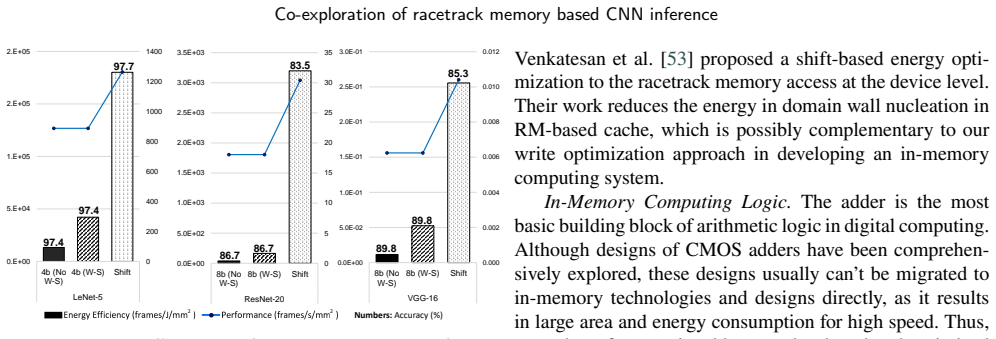
On the paper's own terms, the discovery is that racetrack memory's natural shift operation can be turned into an arithmetic enabler rather than an access overhead. The proposed circuits are magnetic-tunnel-junction half and full adders with fewer junction writes than prior magnetic adders, a Booth multiplier for ordinary fixed-point models, and a shift-based multiplier that aligns power-of-two products by selectively enabling and disabling each track's shift circuitry under a decrementing counter. The write-shift transformation equips each computation junction with a tiny three-bit track so an input bit is delivered by shifting the needed '0' or '1' into place, and consecutive identical bits cost no energy. In system-level simulation, this lowers arithmetic energy by up to 94.4% per adder, and combined with logarithmically quantized weights and a memory layout that reuses weights across the four tracks of a macro unit, the accelerator reports 83.5x energy-efficiency gain and 1.68x speedup on 8-bit ResNet-20 inference with a 3.2% accuracy loss.
Load-bearing premise
The headline savings assume that writing a racetrack bit costs roughly 20 times more energy than shifting it (1 pJ versus 0.051 pJ), and that the three-bit shift tracks feeding each adder junction can be operated reliably at that energy.
Editorial extensions
If this is right
- If the write-shift transformation works at the modeled energies, arithmetic energy in racetrack-memory adders drops by about 94%, and system-level energy becomes dominated by memory access rather than by computation.
- Logarithmically quantized models with shift distance ±7 can be executed with over 70% lower energy on LeNet-5 and over 90% lower energy on ResNet-20 than their Booth-based fixed-point counterparts, with accuracy loss below 10%.
- For embedded-scale models that fit in a single bank (LeNet-5 and ResNet-20), the accelerator can run the whole inference on-chip, avoiding the off-chip transfers that dominate conventional CNN accelerators.
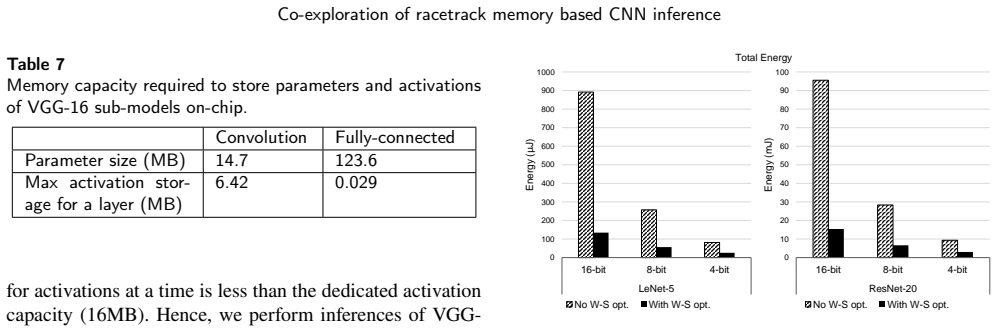
- On ResNet-20, combining the write-shift optimization with shift-based multiplication gives the headline 83.5x energy-efficiency and 1.68x performance improvements relative to unoptimized 8-bit fixed-point execution.
- For large models such as VGG-16, batching inputs to size 8 or more reduces DRAM transfers by over 70%, but on-chip write energy remains the dominant cost, so the largest savings appear on models that fit on-chip.
Reading between the lines
- If the real device write-to-shift energy ratio is closer to 5x than to the modeled 20x, the 94.4% adder savings and the headline 83.5x would shrink in roughly proportional fashion; a sensitivity sweep across this ratio would be a cheap way to test how robust the conclusion is.
- Because the paper notes that skyrmion racetracks share the same shift-and-access interface, the same write-shift transformation could plausibly be ported to skyrmion devices, though skyrmion readability is not yet solved.
- Because the shift control is a small CMOS counter, the shift distance could in principle be exposed as a runtime software knob, letting a deployed device trade accuracy for energy on a per-inference basis; the paper does not explore this dynamic control.
- The reported 83.5x gain comes from a model that fits in one bank, so applying the same comparison to a large model with significant DRAM traffic would almost certainly yield a smaller multiple, a direction the paper's own VGG-16 results already suggest.
Signed reviews
Editorial analysis
A structured set of objections, weighed in public.
Referee Report
Summary. The paper presents an in-memory CNN accelerator built on racetrack memory (RM), comprising RM-based half/full adders, a Booth multiplier, a shift-based multiplier, and a 'write-shift transformation' that replaces energy-expensive MTJ writes with cheaper shift operations. The authors integrate these arithmetic units into a multi-bank RM memory system with a specific data mapping for CNN layers, and they co-explore model quantization (linear and logarithmic) and system configurations across LeNet-5, ResNet-20, and VGG-16. Using SPICE circuit simulations, NVSim memory modeling, and a custom system-level simulator, they report up to 83.5x improved energy efficiency and 1.68x better performance for 8-bit CNN models relative to their unoptimized 8-bit fixed-point implementation.
Significance. If the results are robust, the paper makes a meaningful contribution to in-memory computing with emerging racetrack memory: it shows how the intrinsic shift operation of RM can be exploited both for shift-based neural network models and for replacing write operations in arithmetic circuits. The methodology is largely transparent: component energies come from SPICE and NVSim, operation counts are derived from the dataflow description, and the authors explicitly state that the write-shift transformation is mainly an energy optimization. A notable strength is that the headline claims are not obtained by fitting parameters to the target results; they follow from a transparent combination of measured component energies and operation counts. However, the central quantitative claims depend critically on the modeled write/shift energy ratio in Table 2, which is not validated and receives no sensitivity analysis, making the reported savings a single-point estimate. The paper also builds on the authors' own prior adder and Booth multiplier designs without clearly delineating the new contributions in this manuscript.
major comments (4)
- [§3.4, Table 2, §5.1.1, Fig. 35] The write-shift energy optimization and the resulting 94.4% adder-energy reduction (Section 5.1.1) and the system-level 83.5x efficiency improvement (Fig. 35) are all directly inherited from the assumption that a racetrack write costs approximately 20x more energy than a shift (1 pJ vs 0.051 pJ in Table 2). The paper provides no sensitivity analysis over this ratio, nor over the absolute shift energy, and the shift-energy value is taken from modeling works for a 64-domain racetrack [62,65] and applied without validation to the proposed 3-bit auxiliary track with overhead regions. If the real write/shift energy ratio is materially smaller or the 3-bit track cannot be shifted reliably at the modeled energy, the central efficiency advantage collapses proportionally. Please add a sensitivity analysis over the write/shift energy (and latency) ratio and the actual energy of shifting the short auxiliary track, and discuss the impact on the 83.5x and 94.4% claims.
- [§3.1 and §3.2] The adder circuits and Booth multiplier are presented as part of this work's contribution, but the text opens Section 3.1 with 'we illustrate energy-efficient MTJ-based half adder and full adder circuits [33,34]', and prior self-citations [33,34,31] cover the Booth multiplier and adder. The abstract states 'we design a series of fundamental arithmetic circuits,' which overstates the novelty if those circuits were already published. The manuscript must clearly separate prior contributions of the authors from the new contributions of this paper (e.g., the shift-based multiplier, the write-shift transformation, and the system-level integration), so that the novelty claim is evaluable.
- [§5.2.4, Fig. 35] The headline '83.5x better energy efficiency and 1.68x higher performance' for ResNet-20 is reported as a ratio without giving the absolute energy and latency values for the three compared configurations (8b No W-S, 8b W-S, Shift). The axes of Fig. 35 are not readable in the text, and the exact definition of the efficiency metric (presumably frames/J, possibly normalized by area) is not stated. Please provide a table with the absolute energy, latency, throughput, and area-normalized efficiency numbers for all three configurations, along with the explicit formula used to compute the 83.5x and 1.68x ratios.
- [§5.2] The system-level simulator is described only as 'we developed a simulator to assess the total energy and latency of an inference pass' and the results are given without the aggregation equations or assumptions for interleaving, position-reset phases, duplicate activations, and bank-level adder-tree communication. To make the system-level results reproducible and auditable, please specify the equations and dataflow parameters used to combine SPICE and NVSim numbers into the reported totals, including how the position-reset cycles and the duplicate-activation overhead are included.
minor comments (5)
- [Throughout] The manuscript contains numerous typographical and grammatical errors, including 'a obstacle' in the Introduction, 'With characteristicsof' in Section 3.3, and 'the enable logicto besimple' in the same section. A thorough proofreading pass is needed.
- [Section 3.4] The sentence 'the full adder is synchronous and depends on pulses of the system clock, which remains bound by write operations in MU storage' is confusing; clarify that the write-shift transformation reduces energy but does not reduce the critical-path latency because the system clock must still accommodate write operations in the storage array.
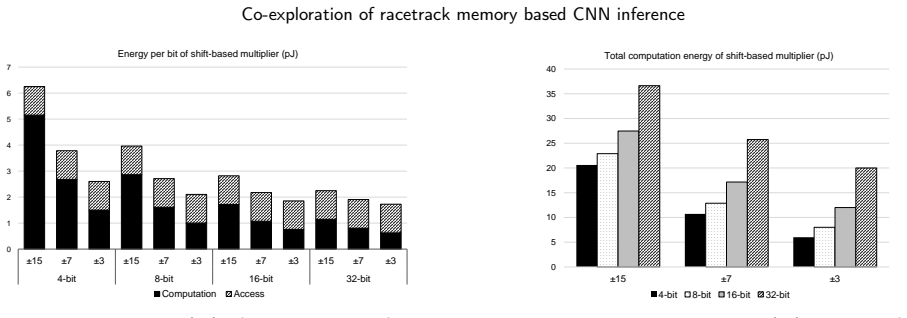
- [Section 5.1.2] In Fig. 23, the Booth multiplier energy is reported as 'energy per bit' but the text is not explicit about whether the write-shift overhead (shift-control circuitry energy) is included in the optimized curve; please clarify the energy breakdown.
- [Section 6] The comparison with prior skyrmion/racetrack logic works [29,3] claims that 'our bit-serial 8-bit full adder outperforms those reported in [29] (latency, energy, area)' but no quantitative comparison table is provided. Adding a table with the specific numbers would strengthen the related-work discussion.
- [Table 2] Since the write energy of 1 pJ and shift energy of 0.051 pJ are the linchpin of the claimed savings, the sources and modeling assumptions for these parameters should be stated more prominently, and the applicability of these values to the specific 3-bit auxiliary track should be discussed.
Circularity Check
No circular derivation: the reported energy/latency savings are computed from stated device parameters and simulated operation counts; the only self-citations (prior adder/Booth designs, racetrack model) are not load-bearing.
full rationale
The derivation chain is: device parameters in Table 2 (write=1 pJ, shift=0.051 pJ) produce SPICE-level adder/multiplier energies (Section 5.1), then NVSim memory-array energies (Section 4.1), then a system simulator that counts MAC operations per CNN layer (Section 5.2), leading to the headline 83.5x energy efficiency and 1.68x performance (Fig. 35). No step fits a parameter to the claim being predicted. The 94.4% adder-energy reduction is the arithmetic consequence of replacing 7 MTJ writes by 7 shifts in the full adder (7.019 pJ to 0.392 pJ, i.e., 7*(1-0.051) pJ plus logic energy); the 83.5x for ResNet-20 similarly follows from the simulator's energy model and per-layer operation counts. The write/shift energy ratio is an external device assumption from [62]/[65], not a fitted output, so the absence of sensitivity analysis is a robustness and validity concern, not circularity. Self-citations do exist: Sections 3.1-3.2 build on the authors' prior adder and Booth designs [33,34], and the racetrack model [62] has co-author overlap (Wei Zhang). These are not load-bearing: the circuits are re-specified with schematics and re-evaluated via SPICE in Section 5.1, and the racetrack model is an independent parameterized modeling paper whose assumptions do not include the present efficiency result. No uniqueness theorem is imported and no known result is merely renamed. The central claim therefore stands on the paper's own simulation chain; the score of 2 reflects only the minor self-citation, not any circular reduction.
Assumptions & free parameters
free parameters (4)
- Linear quantization scale x_max =
Chosen from powers of two 1 to 32 per model and bit-width to maximize validation accuracy
- Model activation bit-width for reported configurations =
LeNet-5: 4-bit; ResNet-20: 8-bit; VGG-16: 8-bit
- Logarithmic shift distance d_s =
+-7 for all recommended models
- VGG-16 batch size =
8
assumptions (5)
- domain assumption Racetrack memory write energy is 1 pJ and shift energy is 0.051 pJ, as given in Table 2.
- domain assumption NVSim accurately models racetrack memory banks configured with MU parameters.
- domain assumption The prior adder and Booth multiplier circuits [33,34] are correct and form the basis of the claimed arithmetic units.
- domain assumption LogQuant [27] post-training quantization provides realistic CNN accuracy for linear and logarithmic weight quantization.
- domain assumption The custom simulator includes all relevant dynamic energy, including computation, read, write, shift, and DRAM energy.
Cite this review
Pith. "Pith review of Hardware-software co-exploration with racetrack memory based in-memory computing for CNN inference in embedded systems." pith.science (2026). https://pith.science/paper/37JZXBSC
@misc{pith2026250701429,
  author       = {Pith},
  title        = {Pith review of: Hardware-software co-exploration with racetrack memory based in-memory computing for CNN inference in embedded systems},
  year         = {2026},
  howpublished = {\url{https://pith.science/paper/37JZXBSC}},
  note         = {Machine review of arXiv:2507.01429}
}
read the original abstract
Deep neural networks generate and process large volumes of data, posing challenges for low-resource embedded systems. In-memory computing has been demonstrated as an efficient computing infrastructure and shows promise for embedded AI applications. Among newly-researched memory technologies, racetrack memory is a non-volatile technology that allows high data density fabrication, making it a good fit for in-memory computing. However, integrating in-memory arithmetic circuits with memory cells affects both the memory density and power efficiency. It remains challenging to build efficient in-memory arithmetic circuits on racetrack memory within area and energy constraints. To this end, we present an efficient in-memory convolutional neural network (CNN) accelerator optimized for use with racetrack memory. We design a series of fundamental arithmetic circuits as in-memory computing cells suited for multiply-and-accumulate operations. Moreover, we explore the design space of racetrack memory based systems and CNN model architectures, employing co-design to improve the efficiency and performance of performing CNN inference in racetrack memory while maintaining model accuracy. Our designed circuits and model-system co-optimization strategies achieve a small memory bank area with significant improvements in energy and performance for racetrack memory based embedded systems.
Figures


Figures from the paper (25 more)





Reference graph
Works this paper leans on
-
[1]
Aimar, A., Mostafa, H., Calabrese, E., Rios-Navarro, A., Tapiador- Morales,R.,Lungu,I.A.,Milde,M.B.,Corradi,F.,Linares-Barranco, A., Liu, S.C., et al., 2018. Nullhop: A flexible convolutional neural network accelerator based on sparse representations of feature maps. IEEE transactions on neural networks and learning systems 30, 644– 656
work page 2018
-
[2]
A signed binary multiplication technique
Booth, A.D., 1951. A signed binary multiplication technique. The Quarterly Journal of Mechanics and Applied Mathematics 4, 236–
work page 1951
-
[3]
Skyrmion logic system for large- scale reversible computation
Chauwin, M., Hu, X., Garcia-Sanchez, F., Betrabet, N., Paler, A., Moutafis, C., Friedman, J.S., 2019. Skyrmion logic system for large- scale reversible computation. Physical Review Applied 12, 064053
work page 2019
-
[4]
Chen, C., Li, K., Ouyang, A., Li, K., 2018a. Flinkcl: An opencl- based in-memory computing architecture on heterogeneous cpu-gpu clusters for big data. IEEE Transactions on Computers 67, 1765– 1779
-
[5]
IEEE Transactions on Systems, Man, and Cybernetics: Systems 47, 2740–2753
Chen,C.,Li,K.,Ouyang,A.,Tang,Z.,Li,K.,2017a.Gpu-accelerated parallel hierarchical extreme learning machine on flink for big data. IEEE Transactions on Systems, Man, and Cybernetics: Systems 47, 2740–2753
-
[6]
Gflink: An in- memory computing architecture on heterogeneous cpu-gpu clusters Choong et
Chen, C., Li, K., Ouyang, A., Zeng, Z., Li, K., 2018b. Gflink: An in- memory computing architecture on heterogeneous cpu-gpu clusters Choong et. al.: Preprint submitted to Elsevier Page 23 of 25 Co-exploration of racetrack memory based CNN inference for big data. IEEE Transactions on Parallel and Distributed Systems 29, 1275–1288
-
[7]
Eyeriss: An energy-efficient reconfigurable accelerator for deep convolutional neural networks
Chen, Y.H., Krishna, T., Emer, J.S., Sze, V., 2017b. Eyeriss: An energy-efficient reconfigurable accelerator for deep convolutional neural networks. IEEE Journal of Solid-State Circuits 52, 127–138. doi:10.1109/JSSC.2016.2616357
arXiv 2016
-
[8]
Dwmacc: Accelerating shift-based cnns with domain wall memories
Chen, Z., Deng, Q., Xiao, N., Pruhs, K., Zhang, Y., 2019. Dwmacc: Accelerating shift-based cnns with domain wall memories. ACM Trans. Embed. Comput. Syst. 18. URL:https://doi-org.libproxy1. nus.edu.sg/10.1145/3358199, doi:10.1145/3358199
Show all 74 references
-
[9]
The mnist database of handwritten digit images for machine learning research
Deng, L., 2012. The mnist database of handwritten digit images for machine learning research. IEEE Signal Processing Magazine 29, 141–142
2012
-
[10]
Quantized deep neural networks for energy efficient hardware-based inference, in:201823rdAsiaandSouthPacificDesignAutomationConference (ASP-DAC), pp
Ding, R., Liu, Z., Blanton, R.D.S., Marculescu, D., 2018. Quantized deep neural networks for energy efficient hardware-based inference, in:201823rdAsiaandSouthPacificDesignAutomationConference (ASP-DAC), pp. 1–8. doi:10.1109/ASPDAC.2018.8297274
2018
-
[11]
Nvsim: A circuit- level performance, energy, and area model for emerging nonvolatile memory.IEEETransactionsonComputer-AidedDesignofIntegrated Circuits and Systems 31, 994–1007
Dong, X., Xu, C., Xie, Y., Jouppi, N.P., 2012. Nvsim: A circuit- level performance, energy, and area model for emerging nonvolatile memory.IEEETransactionsonComputer-AidedDesignofIntegrated Circuits and Systems 31, 994–1007. doi:10.1109/TCAD.2012.2185930
2012
-
[12]
Neural cache: Bit-serial in-cache acceleration of deep neural networks, in: 2018 ACM/IEEE 45th Annual International Symposium on Computer Architecture (ISCA), pp
Eckert,C.,Wang,X.,Wang,J.,Subramaniyan,A.,Iyer,R.,Sylvester, D., Blaaauw, D., Das, R., 2018. Neural cache: Bit-serial in-cache acceleration of deep neural networks, in: 2018 ACM/IEEE 45th Annual International Symposium on Computer Architecture (ISCA), pp. 383–396. doi:10.1109/...
2018
-
[13]
Deepcompression:Compressing deepneuralnetworkswithpruning,trainedquantizationandhuffman coding
Han,S.,Mao,H.,Dally,W.J.,2016. Deepcompression:Compressing deepneuralnetworkswithpruning,trainedquantizationandhuffman coding. arXiv:1510.00149
2016 arXiv
-
[14]
Deep residual learning for image recognition, in: 2016 IEEE Conference on Computer Vision and Pattern Recognition (CVPR), pp
He, K., Zhang, X., Ren, S., Sun, J., 2016. Deep residual learning for image recognition, in: 2016 IEEE Conference on Computer Vision and Pattern Recognition (CVPR), pp. 770–778. doi:10.1109/CVPR. 2016.90
2016 doi
-
[15]
Hegde, K., Yu, J., Agrawal, R., Yan, M., Pellauer, M., Fletcher, C.,
-
[16]
Mobilenets: Effi- cient convolutional neural networks for mobile vision applications
Howard, A.G., Zhu, M., Chen, B., Kalenichenko, D., Wang, W., Weyand, T., Andreetto, M., Adam, H., 2017. Mobilenets: Effi- cient convolutional neural networks for mobile vision applications. CoRR abs/1704.04861. URL: http://arxiv.org/abs/1704.04861, arXiv:1704.04861
2017 arXiv
-
[17]
Essa: An energy-aware bit-serial streaming deep convolutional neu- ral network accelerator
Hsu, L.C., Chiu, C.T., Lin, K.T., Chou, H.H., Pu, Y.Y., 2020. Essa: An energy-aware bit-serial streaming deep convolutional neu- ral network accelerator. Journal of Systems Architecture 111, 101831. URL: https://www.sciencedirect.com/science/article/ pii/S1383762120301235, doi...
2020 doi
-
[18]
Exploring main memory designbasedonracetrackmemorytechnology,in:2016International Great Lakes Symposium on VLSI (GLSVLSI), pp
Hu, Q., Sun, G., Shu, J., Zhang, C., 2016. Exploring main memory designbasedonracetrackmemorytechnology,in:2016International Great Lakes Symposium on VLSI (GLSVLSI), pp. 397–402. doi:10. 1145/2902961.2902967
2016
-
[19]
Batch normalization: Accelerat- ing deep network training by reducing internal covariate shift
Ioffe, S., Szegedy, C., 2015. Batch normalization: Accelerat- ing deep network training by reducing internal covariate shift. CoRR abs/1502.03167. URL: http://arxiv.org/abs/1502.03167, arXiv:1502.03167
2015 arXiv
-
[20]
Quantizationandtrainingofneu- ral networks for efficient integer-arithmetic-only inference, in: 2018 IEEE/CVFConferenceonComputerVisionandPatternRecognition, pp
Jacob, B., Kligys, S., Chen, B., Zhu, M., Tang, M., Howard, A., Adam,H.,Kalenichenko,D.,2018. Quantizationandtrainingofneu- ral networks for efficient integer-arithmetic-only inference, in: 2018 IEEE/CVFConferenceonComputerVisionandPatternRecognition, pp. 2704–2713. doi:10.110...
2018
-
[21]
Accelerator-awarepruningforconvolutionalneural networks
Kang,H.J.,2020. Accelerator-awarepruningforconvolutionalneural networks. IEEE Transactions on Circuits and Systems for Video Technology 30, 2093–2103. doi:10.1109/TCSVT.2019.2911674
2020
-
[22]
skyrmion, in: 2018 IEEE 7th Non-Volatile Memory Systems and Applications Symposium (NVMSA), IEEE
Kang,W.,Chen,X.,Zhu,D.,Zhang,X.,Zhou,Y.,Qiu,K.,Zhang,Y., Zhao,W.,2018.Acomparativestudyonracetrackmemories:Domain wall vs. skyrmion, in: 2018 IEEE 7th Non-Volatile Memory Systems and Applications Symposium (NVMSA), IEEE. pp. 7–12
2018
-
[23]
Compact modeling and evaluation of magnetic skyrmion- basedracetrackmemory
Kang, W., Zheng, C., Huang, Y., Zhang, X., Lv, W., Zhou, Y., Zhao, W., 2017. Compact modeling and evaluation of magnetic skyrmion- basedracetrackmemory. IEEETransactionsonElectronDevices64, 1060–1068
2017
-
[24]
Exploiting retraining-basedmixed-precisionquantizationforlow-costdnnaccel- erator design
Kim, N., Shin, D., Choi, W., Kim, G., Park, J., 2020. Exploiting retraining-basedmixed-precisionquantizationforlow-costdnnaccel- erator design. IEEE Transactions on Neural Networks and Learning Systems 32, 2925–2938
2020
-
[25]
Heterogeneous dataflow accelerators for multi-dnn work- loads,in:2021IEEEInternationalSymposiumonHigh-Performance Computer Architecture (HPCA), IEEE
Kwon, H., Lai, L., Pellauer, M., Krishna, T., Chen, Y.H., Chandra, V., 2021. Heterogeneous dataflow accelerators for multi-dnn work- loads,in:2021IEEEInternationalSymposiumonHigh-Performance Computer Architecture (HPCA), IEEE. pp. 71–83
2021
-
[26]
Gradient-based learning applied to document recognition
Lecun, Y., Bottou, L., Bengio, Y., Haffner, P., 1998. Gradient-based learning applied to document recognition. Proceedings of the IEEE 86, 2278–2324. doi:10.1109/5.726791
1998 doi
-
[27]
Lognet:Energy-efficientneuralnetworksusinglogarithmiccomputa- tion, in: 2017 IEEE International Conference on Acoustics, Speech and Signal Processing (ICASSP), pp
Lee, E.H., Miyashita, D., Chai, E., Murmann, B., Wong, S.S., 2017. Lognet:Energy-efficientneuralnetworksusinglogarithmiccomputa- tion, in: 2017 IEEE International Conference on Acoustics, Speech and Signal Processing (ICASSP), pp. 5900–5904. doi: 10.1109/ ICASSP.2017.7953288
2017
-
[28]
45nm low power cmos logic compatible embedded stt mram utilizing a reverse-connection 1t/1mtj cell, in: 2009 IEEE International Electron Devices Meeting (IEDM), pp
Lin, C., Kang, S., Wang, Y., Lee, K., Zhu, X., Chen, W., Li, X., Hsu, W., Kao, Y., Liu, M., Chen, W., Lin, Y., Nowak, M., Yu, N., Tran, L., 2009. 45nm low power cmos logic compatible embedded stt mram utilizing a reverse-connection 1t/1mtj cell, in: 2009 IEEE International Ele...
2009
-
[29]
Liu, B., Gu, S., Chen, M., Kang, W., Hu, J., Zhuge, Q., Sha, E.H.M.,
-
[30]
Skyrmion devices for memory and logic applications
Luo, S., You, L., 2021. Skyrmion devices for memory and logic applications. APL Materials 9, 050901
2021
-
[31]
A novel two- stage modular multiplier based on racetrack memory for asymmet- ric cryptography, in: 2017 IEEE/ACM International Conference on Computer-Aided Design (ICCAD), IEEE
Luo, T., He, B., Zhang, W., Maskell, D.L., 2017. A novel two- stage modular multiplier based on racetrack memory for asymmet- ric cryptography, in: 2017 IEEE/ACM International Conference on Computer-Aided Design (ICCAD), IEEE. pp. 276–282
2017
-
[32]
An fpga-based hardware emulator for neuromorphic chip with rram
Luo,T.,Wang,X.,Qu,C.,Lee,M.K.F.,Tang,W.T.,Wong,W.F.,Goh, R.S.M., 2018. An fpga-based hardware emulator for neuromorphic chip with rram. IEEE Transactions on Computer-Aided Design of Integrated Circuits and Systems 39, 438–450
2018
-
[33]
Energy efficient in-memory integer multiplication based on racetrack mem- ory, in: 2020 IEEE 40th International Conference on Distributed Computing Systems (ICDCS), IEEE
Luo, T., Zhang, W., He, B., Liu, C., Maskell, D., 2020. Energy efficient in-memory integer multiplication based on racetrack mem- ory, in: 2020 IEEE 40th International Conference on Distributed Computing Systems (ICDCS), IEEE. pp. 1409–1414
2020
-
[34]
A racetrack memory based in-memory booth multiplier for cryptography application, in: 2016 21st Asia and South Pacific Design Automation Conference (ASP-DAC), IEEE
Luo, T., Zhang, W., He, B., Maskell, D., 2016. A racetrack memory based in-memory booth multiplier for cryptography application, in: 2016 21st Asia and South Pacific Design Automation Conference (ASP-DAC), IEEE. pp. 286–291
2016
-
[35]
Towards energy-proportional datacenter memory with mobile dram, in: 2012 39th Annual International Sym- posium on Computer Architecture (ISCA), pp
Malladi,K.T.,Nothaft,F.A.,Periyathambi,K.,Lee,B.C.,Kozyrakis, C., Horowitz, M., 2012. Towards energy-proportional datacenter memory with mobile dram, in: 2012 39th Annual International Sym- posium on Computer Architecture (ISCA), pp. 37–48. doi:10.1109/ ISCA.2012.6237004
2012
-
[36]
Exploration of gpgpu register file architecture using domain-wall-shift-write based racetrack memory, in: Design Automation Conference (DAC), 2014 51st ACM/EDAC/IEEE, pp
Mao, M., Wen, W., Zhang, Y., Chen, Y., Li, H., 2014. Exploration of gpgpu register file architecture using domain-wall-shift-write based racetrack memory, in: Design Automation Conference (DAC), 2014 51st ACM/EDAC/IEEE, pp. 1–6
2014
-
[37]
An energy- efficient gpgpu register file architecture using racetrack memory
Mao, M., Wen, W., Zhang, Y., Chen, Y., Li, H., 2017. An energy- efficient gpgpu register file architecture using racetrack memory. IEEE Transactions on Computers 66, 1478–1490
2017
-
[38]
Applied Physics Express 1, 091301
Matsunaga, S., Hayakawa, J., Ikeda, S., Miura, K., Hasegawa, H., Endoh,T.,Ohno,H.,Hanyu,T.,2008.Fabricationofanonvolatilefull adder based on logic-in-memory architecture using magnetic tunnel junctions. Applied Physics Express 1, 091301. Choong et. al.: Preprint submitted to E...
2008
-
[39]
Zigzag: Enlarging joint architecture-mapping design space explo- ration for dnn accelerators
Mei, L., Houshmand, P., Jain, V., Giraldo, S., Verhelst, M., 2021. Zigzag: Enlarging joint architecture-mapping design space explo- ration for dnn accelerators. IEEE Transactions on Computers 70, 1160–1174
2021
-
[40]
A spintronics full adder for magnetic cpu
Meng, H., Wang, J., Wang, J.P., 2005. A spintronics full adder for magnetic cpu. Electron Device Letters, IEEE 26, 360–362
2005
-
[41]
Anenergy-efficientprecision-scalable convnetprocessorin40-nmcmos.IEEEJournalofsolid-stateCircuits 52, 903–914
Moons,B.,Verhelst,M.,2016. Anenergy-efficientprecision-scalable convnetprocessorin40-nmcmos.IEEEJournalofsolid-stateCircuits 52, 903–914
2016
-
[42]
Magneticdomain-wall racetrack memory
Parkin,S.S.P.,Hayashi,M.,Thomas,L.,2008. Magneticdomain-wall racetrack memory. Science 320, 190–194. URL:https://science. sciencemag.org/content/320/5873/190, doi:10.1126/science.1145799
2008 doi
-
[43]
Pytorch: An imper- ative style, high-performance deep learning library, in: Advances in Neural Information Processing Systems 32
Paszke, A., Gross, S., Massa, F., Lerer, A., Bradbury, J., Chanan, G., Killeen,T.,Lin,Z.,Gimelshein,N.,Antiga,L.,Desmaison,A.,Kopf, A., Yang, E., DeVito, Z., Raison, M., Tejani, A., Chilamkurthy, S., Steiner, B., Fang, L., Bai, J., Chintala, S., 2019. Pytorch: An imper- ative ...
2019
-
[44]
Parallelcom- putation in the racetrack memory
Riente,F.,Turvani,G.,Vacca,M.,Graziano,M.,2021. Parallelcom- putation in the racetrack memory. IEEE Transactions on Emerging Topics in Computing
2021
-
[45]
ImageNet Large Scale Visual Recognition Challenge
Russakovsky, O., Deng, J., Su, H., Krause, J., Satheesh, S., Ma, S., Huang, Z., Karpathy, A., Khosla, A., Bernstein, M., Berg, A.C., Fei- Fei, L., 2015. ImageNet Large Scale Visual Recognition Challenge. International Journal of Computer Vision (IJCV) 115, 211–252. doi:10.1007...
2015 doi
-
[46]
Sharma, H., Park, J., Suda, N., Lai, L., Chau, B., Chandra, V., Esmaeilzadeh, H., 2018. Bit fusion: Bit-level dynamically com- posable architecture for accelerating deep neural network, in: 2018 ACM/IEEE 45th Annual International Symposium on Computer Ar- chitecture (ISCA), IE...
2018
-
[47]
45nm freepdk library URL: https://si2.org/open-cell-library/
Silicon Integration Initiative, I., 2016. 45nm freepdk library URL: https://si2.org/open-cell-library/
2016
-
[48]
Very deep convolutional net- works for large-scale image recognition, in: Bengio, Y., LeCun, Y
Simonyan, K., Zisserman, A., 2015. Very deep convolutional net- works for large-scale image recognition, in: Bengio, Y., LeCun, Y. (Eds.), 3rd International Conference on Learning Representations, ICLR 2015, San Diego, CA, USA, May 7-9, 2015, Conference Track Proceedings. URL:...
2015 arXiv
-
[49]
Stt-ram buffer design for precision-tunable general-purpose neural network accelerator
Song, L., Wang, Y., Han, Y., Li, H., Cheng, Y., Li, X., 2017. Stt-ram buffer design for precision-tunable general-purpose neural network accelerator. IEEE Transactions on Very Large Scale Integration (VLSI) Systems 25, 1285–1296
2017
-
[50]
Cross-layer racetrack memory design for ultra high density and low power consumption, in: Design AutomationConference(DAC),201350thACM/EDAC/IEEE,pp.1– 6
Sun, Z., Wu, W., Li, H., 2013. Cross-layer racetrack memory design for ultra high density and low power consumption, in: Design AutomationConference(DAC),201350thACM/EDAC/IEEE,pp.1– 6
2013
-
[51]
Magnetic adder based on racetrack memory
Trinh, H.P., Zhao, W., Klein, J.O., Zhang, Y., Ravelsona, D., Chap- pert, C., 2013. Magnetic adder based on racetrack memory. IEEE Transactions on Circuits and Systems I: Regular Papers 60, 1469–
2013
-
[52]
Stag: Spintronic-tape architecture for gpgpu cache hierarchies, in: Computer Architecture (ISCA), 2014 ACM/IEEE 41st International Symposium on, pp
Venkatesan, R., Ramasubramanian, S.G., Venkataramani, S., Roy, K., Raghunathan, A., 2014. Stag: Spintronic-tape architecture for gpgpu cache hierarchies, in: Computer Architecture (ISCA), 2014 ACM/IEEE 41st International Symposium on, pp. 253–264
2014
-
[53]
Dwm- tapestri-an energy efficient all-spin cache using domain wall shift based writes, in: Proceedings of the Conference on Design, Automa- tion and Test in Europe, EDA Consortium
Venkatesan, R., Sharad, M., Roy, K., Raghunathan, A., 2013. Dwm- tapestri-an energy efficient all-spin cache using domain wall shift based writes, in: Proceedings of the Conference on Design, Automa- tion and Test in Europe, EDA Consortium. pp. 1825–1830
2013
-
[54]
Ultra-dense ring-shaped racetrack memory cache design
Wang, G., Zhang, Y., Zhang, B., Wu, B., Nan, J., Zhang, X., Zhang, Z., Klein, J.O., Ravelosona, D., Wang, Z., et al., 2018. Ultra-dense ring-shaped racetrack memory cache design. IEEE Transactions on Circuits and Systems I: Regular Papers , 1–11
2018
-
[55]
An automatic- addressingarchitecturewithfullyserializedaccessinracetrackmem- ory for energy-efficient cnns
Wang, J., Liu, J., Wang, D., An, J., Fan, X., 2020. An automatic- addressingarchitecturewithfullyserializedaccessinracetrackmem- ory for energy-efficient cnns. IEEE Transactions on Computers
2020
-
[56]
Dw-aes: A domain- wall nanowire-based aes for high throughput and energy-efficient data encryption in non-volatile memory
Wang, Y., Ni, L., Chang, C.H., Yu, H., 2016. Dw-aes: A domain- wall nanowire-based aes for high throughput and energy-efficient data encryption in non-volatile memory. IEEE Transactions on Information Forensics and Security 11, 2426–2440
2016
-
[57]
Energy efficient in- memory aes encryption based on nonvolatile domain-wall nanowire, in:Design,AutomationandTestinEuropeConferenceandExhibition (DATE), 2014, IEEE
Wang, Y., Yu, H., Sylvester, D., Kong, P., 2014. Energy efficient in- memory aes encryption based on nonvolatile domain-wall nanowire, in:Design,AutomationandTestinEuropeConferenceandExhibition (DATE), 2014, IEEE. pp. 1–4
2014
-
[58]
Multilane racetrack caches: Improving efficiency through compression and independent shifting, in: Design Automation Conference (ASP-DAC), 2015 20th Asia and South Pacific, IEEE
Xu, H., Li, Y., Melhem, R., Jones, A.K., 2015. Multilane racetrack caches: Improving efficiency through compression and independent shifting, in: Design Automation Conference (ASP-DAC), 2015 20th Asia and South Pacific, IEEE. pp. 417–422
2015
-
[59]
Designing energy-efficient convolutional neural networks using energy-aware pruning, in: 2017 IEEE Conference on Computer Vision and Pattern Recognition (CVPR), pp
Yang, T.J., Chen, Y.H., Sze, V., 2017. Designing energy-efficient convolutional neural networks using energy-aware pruning, in: 2017 IEEE Conference on Computer Vision and Pattern Recognition (CVPR), pp. 6071–6079. doi:10.1109/CVPR.2017.643
2017 doi
-
[60]
Yu, H., Wang, Y., Chen, S., Fei, W., Weng, C., Zhao, J., Wei, Z.,
-
[61]
Energy-efficient nonvolatile reconfigurable logic using spin hall effect-based lookup tables
Zand, R., Roohi, A., Fan, D., DeMara, R.F., 2017. Energy-efficient nonvolatile reconfigurable logic using spin hall effect-based lookup tables. IEEE Transactions on Nanotechnology 16, 32–43
2017
-
[62]
Quantitative modeling of racetrack memory, a tradeoff among area, performance, and power, in: The 20th Asia and South Pacific Design Automation Conference, pp
Zhang, C., Sun, G., Zhang, W., Mi, F., Li, H., Zhao, W., 2015a. Quantitative modeling of racetrack memory, a tradeoff among area, performance, and power, in: The 20th Asia and South Pacific Design Automation Conference, pp. 100–105. doi: 10.1109/ASPDAC.2015. 7058988
-
[63]
In-memory computation of a machine-learning classifier in a standard 6t sram array
Zhang, J., Wang, Z., Verma, N., 2017. In-memory computation of a machine-learning classifier in a standard 6t sram array. IEEE Journal of Solid-State Circuits 52, 915–924. doi:10.1109/JSSC.2016.2642198
2017
-
[64]
Magnetic skyrmion logic gates: conversion, duplication and merging of skyrmions
Zhang, X., Ezawa, M., Zhou, Y., 2015b. Magnetic skyrmion logic gates: conversion, duplication and merging of skyrmions. Scientific reports 5, 1–8
-
[65]
Perpendicular-magnetic-anisotropy cofeb racetrack mem- ory
Zhang, Y., Zhao, W., Ravelosona, D., Klein, J.O., Kim, J., Chappert, C., 2012. Perpendicular-magnetic-anisotropy cofeb racetrack mem- ory. Journal of Applied Physics 111, 093925
2012
-
[66]
Zhao, W., Romdhane, N.B., Zhang, Y., Klein, J.O., Ravelosona, D.,
-
[67]
Incremen- tal network quantization: Towards lossless cnns with low-precision weights
Zhou, A., Yao, A., Guo, Y., Xu, L., Chen, Y., 2017. Incremen- tal network quantization: Towards lossless cnns with low-precision weights. CoRR abs/1702.03044. URL: http://arxiv.org/abs/1702. 03044, arXiv:1702.03044
2017 arXiv
-
[68]
An efficient hardware accelerator for structured sparse convolutional neural networks on fpgas
Zhu, C., Huang, K., Yang, S., Zhu, Z., Zhang, H., Shen, H., 2020. An efficient hardware accelerator for structured sparse convolutional neural networks on fpgas. IEEE Transactions on Very Large Scale Integration (VLSI) Systems 28, 1953–1965. Choong et. al.: Preprint submitted ...
2020
-
[240]
URL: https://doi.org/10.1093/qjmam/4.2.236, doi:10.1093/ qjmam/4.2.236
-
[1477]
doi:10.1109/TCSI.2012.2220507
2012
-
[2013]
Racetrack memory based reconfigurable computing, in: Faible Tension Faible Consommation (FTFC), 2013 IEEE, IEEE. pp. 1–4
2013
-
[2014]
Energyefficientin-memorymachinelearningfordataintensive image-processingbynon-volatiledomain-wallmemory,in:201419th Asia and South Pacific Design Automation Conference (ASP-DAC), pp. 191–196. doi:10.1109/ASPDAC.2014.6742888
2014
-
[2017]
An efficient racetrack memory-based processing-in-memory architecture for convolutional neural networks, in: 2017 IEEE In- ternational Symposium on Parallel and Distributed Processing with Applicationsand2017IEEEInternationalConferenceonUbiquitous ComputingandCommunications(IS...
2017
-
[2018]
Ucnn:Exploitingcomputationalreuseindeepneuralnetworks viaweightrepetition,in:2018ACM/IEEE45thAnnualInternational SymposiumonComputerArchitecture(ISCA),pp.674–687. doi: 10. 1109/ISCA.2018.00062
2018
Reviewed August 6, 2026 · model on record in the stance chip above.
Discussion (0). Continue with ORCID to comment.