REVIEW 4 major objections 6 minor 50 references
Goal Recognition using Actor-Critic Optimization
T0 review · 4 major / 6 minor · reviewed 2026-08-10 · deepseek-v4-flash
Pith's one-line read The paper claims that goal recognition can be done by learning one policy network per candidate goal in a simulator and scoring an observed trajectory by its distance to each policy, removing hand-built domain models and discretization.
desk verdict A genuinely new way to do goal recognition with per-goal learned policies, but the 'first' and 'state-of-the-art' claims outrun the evidence; worth reviewing seriously with revision. read the letter →
The pith
A machine-rendered reading of the paper's core claim, the machinery that carries it, and where it could break.
The reading
What carries the argument
The load-bearing object is the set of goal-conditioned actor networks $\pi_g$, one neural network policy per candidate goal, trained offline with an actor-critic reinforcement learning algorithm. The actor network outputs an action distribution in the same space as the observations, so the comparison between an observed action and the policy can be done directly, without symbolic domain theory or discretization. At inference, DRACO aggregates the per-step distance into $\Delta(O,\pi_g)$, turns it into $P(O|g)$ by softmin, and normalizes to $P(g|O)$. The critic network is used only during training; the actor's output carries the recognition signal.
What would settle it
Create a two-goal continuous domain where the trained policies yield the same action distribution at every state the observed agent visits; if DRACO's posterior over the true goal stays at chance while a separated-policy control succeeds, the distinguishing-policy assumption is the point of failure.
Extended reading notes
Core claim
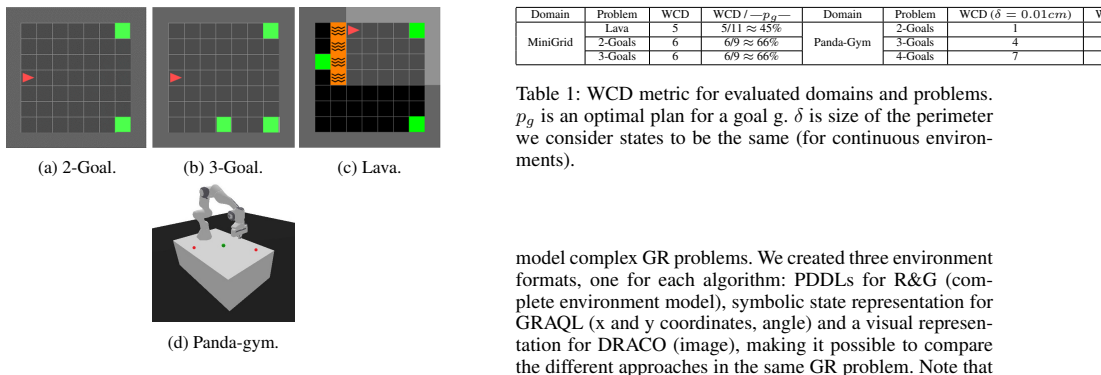
The paper's central claim is that goal recognition can be solved end-to-end from raw state-action observations by learning a policy $\pi_g$ for each candidate goal and measuring how well an observed trajectory fits each policy. The likelihood $P(O|g)$ is computed from an aggregate distance $\Delta(O,\pi_g)$ between observed actions and the actions the policy would take, and $P(g|O)$ comes from softmin normalization over goals. Two distance metrics are introduced: a Wasserstein-based distance that compares each observed action to a single action sampled from the policy, and a Z-score-based distance that compares the observed action to the mean of the policy's Gaussian action distribution divided by its standard deviation. The paper reports that in discrete grid-navigation problems DRACO reaches or exceeds the accuracy of the planner-based and tabular baselines while providing far higher confidence, and in a continuous robot-arm environment it outperforms the discretized tabular baseline, with memory measured in a few megabytes versus gigabytes and training times of about thirteen minutes versus hundreds of minutes.
Load-bearing premise
The method assumes the policy learned for each goal is more similar to an observed agent's behavior toward that goal than toward any other goal, and that a simulator or environment model is available to train those policies.
Editorial extensions
If this is right
- Continuous state and action spaces no longer need to be discretized for recognition, because the policy networks operate directly on the raw observation format.
- Memory and inference cost stop depending on the size of the state-action space: what is stored is a set of neural networks, not a table or a planning domain.
- Adding a new candidate goal can reuse existing policies through goal-conditioned RL or transfer learning, rather than requiring a new hand-built domain theory.
- The two inference metrics give practitioners a choice: Wasserstein distance holds up better under missing and noisy observations, while the Z-score metric becomes more accurate as the learned policies approach optimality.
Reading between the lines
- The paper leaves implicit that the per-goal policy-distance mechanism could apply to human intent prediction if policy training used demonstrations rather than simulator rewards, removing the environment-model requirement at deployment.
- A testable extension is to train one goal-conditioned policy that takes the candidate goal as input and ask whether the Wasserstein and Z-score distances still separate hypotheses; success would cut training cost from one network per goal to a single network.
- The distinguishability requirement yields a practical diagnostic: before deployment, compute pairwise distances between learned policies on the states the observed agent is expected to visit and flag goal pairs that overlap, since no distance-based recognizer can separate them.
Signed reviews
Editorial analysis
A structured set of objections, weighed in public.
Referee Report
Summary. The paper proposes DRACO, a goal recognition algorithm that learns one actor-critic policy per candidate goal via deep RL and then infers the observed agent's goal by comparing its trajectory with these policies using two proposed distance metrics: a so-called Wasserstein distance and a z-score. The approach is evaluated in MiniGrid (discrete) and Panda-gym (continuous) against Ramirez and Geffner's plan-recognition baseline and GRAQL, a tabular RL method, reporting accuracy, precision, recall, F-score, confidence, and resource usage.
Significance. If the technical issues are corrected, the idea of using learned policy networks for goal recognition is a promising step toward scaling GR to continuous and unstructured domains, and the Panda-gym testbed is a useful addition. The authors explicitly train with one RL algorithm (PPO) and test on trajectories from another (A2C), which is a good generalization check. However, the current empirical evidence does not justify the 'state-of-the-art' claim, as the only comparisons are against a tabular method and a symbolic planner, omitting the deep-learning GR baselines cited in the paper itself.
major comments (4)
- [Section 3.2, Eqs. (2)-(3)] The term P(O|g) is defined as a softmin over distances to all goals in G, so the value for one goal inherently depends on the other hypotheses and the vector sums to 1. Applying Bayes' rule in Eq. (3) then merely renormalizes this already-normalized vector, making the Bayesian step redundant with a uniform prior. Consequently P(O|g) is not a likelihood in the usual sense; the posterior is a softmin score, not the result of a generative model. Please reframe the inference as score-based ranking or define a per-goal likelihood that factorizes over observations.
- [Section 3.3, Eqs. (5)-(7)] The method labeled 'Wasserstein distance' is not a Wasserstein distance. Eq. (6) is the L1 norm between a single observed action and a single random sample from the policy, and Eq. (7) averages these per-step deviations; this is a Monte Carlo estimator of the mean absolute deviation, not the Wasserstein distance defined in Eq. (5). The stochastic sampling also introduces avoidable variance. Please either compute a true Wasserstein distance or rename the metric and justify the approximation.
- [Section 4-5, Table 2] Several R&G rows in Table 2 are internally inconsistent under standard definitions. For instance, in the 10% Lava row, accuracy is 1.0 ± 0.0 while precision is 0.77 ± 0.46 and recall is 1.0 ± 0.0; with accuracy = (TP+TN)/(TP+TN+FP+FN), recall = 1.0 and accuracy = 1.0 force FP = 0, which contradicts precision = 0.77. The 2-Goals and 3-Goals rows (accuracy 1.0 with precision 0.5) are similarly impossible. Please clarify the exact computation of these metrics for multi-goal problems and correct the table, as these numbers undermine the comparative claims.
- [Section 5 and Section 6] The 'state-of-the-art' claim is not supported by the experimental comparison. The evaluation includes only GRAQL (tabular RL) and R&G (symbolic planning), while the related work itself identifies deep-learning GR methods: Chiari et al. 2022 (GRNet), Maynard et al. 2019, and Fang et al. 2023, the last of which applies deep RL to continuous-domain goal recognition. None of these appears in the experiments. Please add at least one direct deep-RL baseline or provide a clear justification for their omission, and temper the abstract's 'state-of-the-art' wording accordingly. The priority claim of being 'first' to learn a set of policy networks also requires a detailed prior-art discussion relative to Fang et al. 2023.
minor comments (6)
- [Section 3.2, Eq. (2)] The softmin expression does not specify a temperature parameter; if the temperature is a free parameter, its value and sensitivity should be reported, and if it is fixed, the value should be stated.
- [Section 3.3, Eq. (8)] The z-score metric for continuous multi-dimensional actions is ambiguous: it should specify whether μ and σ are computed per action dimension and how the absolute value is computed for vector-valued actions.
- [Section 3.1, Eq. (1)] The notation a(s) in the reward function is not defined; it appears to denote the successor state after applying action a in state s, and should be clarified.
- [Section 4, Hyperparameters] The sentence 'In Panda-Gym, GRAQL's learning rate (γ) was 0.01' uses γ, which elsewhere in the paper denotes the discount factor; rename one of these variables to avoid confusion.
- [Section 5, Scalability] The phrase 'GRAQL and DRACO load their policies before inference' should specify that GRAQL loads Q-tables rather than policies; the term 'policy' is used loosely throughout.
- [Throughout] There are several typos and formatting issues, including 'differnece' and 'precieved' in Section 3.2, and garbled equation formatting in Eqs. (4) and (5) (e.g., '1P' and 'kX'). A careful proofread is needed.
Circularity Check
No circular derivation: DRACO's per-goal policy training and distance-based inference are self-contained; the SOTA claim is an external-validity concern, not a circular reduction.
full rationale
DRACO's derivation chain is self-contained rather than circular. For each candidate goal g it trains an independent policy π_g from environment interaction using a goal-specific reward (Eq. 1), and at inference it compares the observed state-action sequence O to each π_g through the proposed Wasserstein (Eqs. 5-7) and Z-score (Eqs. 8-9) distances. The observed trajectories come from a different agent (A2C), not from the trained PPO policies, so the comparison is not fitted to the test observations. The posterior computation (Eqs. 2-3) follows the Bayesian formulation of Ramírez and Geffner, an external source, and although Eq. 2's softmin already normalizes over goals and Eq. 3 re-normalizes, that is a double-normalization and statistical-modeling oddity rather than a circular reduction: the posterior is effectively a monotone function of the proposed distance scores, but those scores are independently computed from learned policies and observations. The paper's self-citations (GRAQL/Amado et al. 2022 as a baseline, plus prior GR surveys and transfer-learning references) are not load-bearing for the correctness of the derivation. Section 7 honestly lists the distinguishability assumption and simulator access as limitations, which further supports that the method's central assumptions are stated rather than smuggled in. The unsupported 'state-of-the-art' claim, arising from comparisons only with GRAQL and Ramírez & Geffner while related work cites but does not benchmark Fang et al. 2023, Chiari et al. 2022, and Maynard et al. 2019, is an external-validity and evidence-strength concern, not circularity.
Assumptions & free parameters
free parameters (2)
- Goal-reaching reward function =
R_g(s,a) = -||a(s)-g||_1
- PPO hyperparameters =
learning rate 0.001 (MiniGrid), 0.0006 (Panda-gym); 100K episodes
assumptions (4)
- domain assumption The environment behaves as an MDP (Definition 2).
- domain assumption Access to a simulator or sampling model of the environment is available.
- domain assumption The goal set G is exhaustive and mutually exclusive, and the observed agent pursues exactly one goal.
- domain assumption The learned goal policies must be distinguishable for the observed agent's behavior: policy for goal i is closer to that agent's behavior under goal i than under other goals.
Cite this review
Pith. "Pith review of Goal Recognition using Actor-Critic Optimization." pith.science (2026). https://pith.science/paper/3BC3LWEP
@misc{pith2026250101463,
  author       = {Pith},
  title        = {Pith review of: Goal Recognition using Actor-Critic Optimization},
  year         = {2026},
  howpublished = {\url{https://pith.science/paper/3BC3LWEP}},
  note         = {Machine review of arXiv:2501.01463}
}
read the original abstract
Goal Recognition aims to infer an agent's goal from a sequence of observations. Existing approaches often rely on manually engineered domains and discrete representations. Deep Recognition using Actor-Critic Optimization (DRACO) is a novel approach based on deep reinforcement learning that overcomes these limitations by providing two key contributions. First, it is the first goal recognition algorithm that learns a set of policy networks from unstructured data and uses them for inference. Second, DRACO introduces new metrics for assessing goal hypotheses through continuous policy representations. DRACO achieves state-of-the-art performance for goal recognition in discrete settings while not using the structured inputs used by existing approaches. Moreover, it outperforms these approaches in more challenging, continuous settings at substantially reduced costs in both computing and memory. Together, these results showcase the robustness of the new algorithm, bridging traditional goal recognition and deep reinforcement learning.
Figures


Figures from the paper (1 more)

Reference graph
Works this paper leans on
-
[1]
, " * write output.state after.block = add.period write newline
ENTRY address archivePrefix author booktitle chapter edition editor eid eprint howpublished institution isbn journal key month note number organization pages publisher school series title type volume year label extra.label sort.label short.list INTEGERS output.state before.all mid.sentence after.sentence after.block FUNCTION init.state.consts #0 'before.a...
-
[2]
write newline
" write newline "" before.all 'output.state := FUNCTION n.dashify 't := "" t empty not t #1 #1 substring "-" = t #1 #2 substring "--" = not "--" * t #2 global.max substring 't := t #1 #1 substring "-" = "-" * t #2 global.max substring 't := while if t #1 #1 substring * t #2 global.max substring 't := if while FUNCTION word.in bbl.in capitalize " " * FUNCT...
-
[3]
Amado, L.; Mirsky, R.; and Meneguzzi, F. 2022. Goal recognition as reinforcement learning. In Proceedings of the AAAI Conference on Artificial Intelligence, volume 36, 9644--9651
work page 2022
-
[4]
Andrychowicz, M.; Wolski, F.; Ray, A.; Schneider, J.; Fong, R.; Welinder, P.; McGrew, B.; Tobin, J.; Pieter Abbeel, O.; and Zaremba, W. 2017. Hindsight experience replay. Advances in neural information processing systems, 30
work page 2017
-
[5]
Avrahami-Zilberbrand, D.; and Kaminka, G. A. 2005. Fast and Complete Symbolic Plan Recognition. In IJCAI, 653--658
work page 2005
-
[6]
Brockman, G.; Cheung, V.; Pettersson, L.; Schneider, J.; Schulman, J.; Tang, J.; and Zaremba, W. 2016. Openai gym. arXiv preprint arXiv:1606.01540
arXiv 2016
-
[7]
Chevalier-Boisvert, M.; Dai, B.; Towers, M.; de Lazcano, R.; Willems, L.; Lahlou, S.; Pal, S.; Castro, P. S.; and Terry, J. 2023. Minigrid & Miniworld: Modular & Customizable Reinforcement Learning Environments for Goal-Oriented Tasks. CoRR, abs/2306.13831
arXiv 2023
-
[8]
Goal Recognition as a Deep Learning Task: the GRNet Approach
Chiari, M.; Gerevini, A. E.; Putelli, L.; Percassi, F.; and Serina, I. 2022. Goal Recognition as a Deep Learning Task: the GRNet Approach. arXiv preprint arXiv:2210.02377
work page Pith review arXiv 2022
Show all 50 references
-
[9]
Durugkar, I.; Tec, M.; Niekum, S.; and Stone, P. 2021. Adversarial intrinsic motivation for reinforcement learning. Advances in Neural Information Processing Systems, 34: 8622--8636
2021
-
[10]
D.; and Smith, D
E-Mart \' n, Y.; R-Moreno, M. D.; and Smith, D. E. 2015. A fast goal recognition technique based on interaction estimates. In Proceedings of the 24th International Conference on Artificial Intelligence, 761--768
2015
-
[11]
Fang, Z.; Chen, D.; Zeng, Y.; Wang, T.; and Xu, K. 2023. Real-Time Online Goal Recognition in Continuous Domains via Deep Reinforcement Learning. Entropy, 25(10): 1415
2023
-
[12]
Gallou \'e dec, Q.; Cazin, N.; Dellandr \'e a, E.; and Chen, L. 2021. panda-gym: Open-Source Goal-Conditioned Environments for Robotic Learning . 4th Robot Learning Workshop: Self-Supervised and Lifelong Learning at NeurIPS
2021
-
[13]
S.; and Hadad, M
Gedraite, E. S.; and Hadad, M. 2011. Investigation on the effect of a Gaussian Blur in image filtering and segmentation. In Proceedings ELMAR-2011, 393--396. IEEE
2011
-
[14]
W.; and Goldman, R
Geib, C. W.; and Goldman, R. P. 2009. A probabilistic plan recognition algorithm based on plan tree grammars. Artificial Intelligence, 173(11): 1101--1132
2009
-
[15]
Granada, R.; Monteiro, J.; Gavenski, N.; and Meneguzzi, F. 2020. Object-based goal recognition using real-world data. In Mexican International Conference on Artificial Intelligence, 325--337. Springer
2020
-
[16]
M.; Elyan, E.; and Jayne, C
Hussein, A.; Gaber, M. M.; Elyan, E.; and Jayne, C. 2017. Imitation Learning: A Survey of Learning Methods. ACM Computing Surveys, 50(2): 21:1--21:35
2017
-
[17]
Kaelbling, L. P. 1993. Learning to achieve goals. In IJCAI, volume 2, 1094--8. Citeseer
1993
-
[18]
Kaminka, G.; Vered, M.; and Agmon, N. 2018. Plan recognition in continuous domains. In Proceedings of the AAAI Conference on Artificial Intelligence, volume 32
2018
-
[19]
A.; Allen, J
Kautz, H. A.; Allen, J. F.; et al. 1986. Generalized plan recognition. In AAAI, volume 86, 5. Philadelphia, PA
1986
-
[20]
Keren, S.; Gal, A.; and Karpas, E. 2014. Goal recognition design. In Twenty-Fourth International Conference on Automated Planning and Scheduling
2014
-
[21]
M.; Montali, M.; Peñaloza, R.; and Pereira, R
Ko, J.; Maggi, F. M.; Montali, M.; Peñaloza, R.; and Pereira, R. F. 2023. Plan Recognition as Probabilistic Trace Alignment. In 5th International Conference on Process Mining (ICPM)
2023
-
[22]
Masters, P.; and Sardina, S. 2019. Cost-based goal recognition in navigational domains. Journal of Artificial Intelligence Research, 64: 197--242
2019
-
[23]
Maynard, M.; Duhamel, T.; and Kabanza, F. 2019. Cost-based goal recognition meets deep learning. arXiv preprint arXiv:1911.10074
2019 arXiv
-
[24]
Meneguzzi, F.; and Pereira, R. F. 2021. A survey on goal recognition as planning. In Proceedings of the 30th International Joint Conference on Artificial Intelligence (IJCAI), 2021, Canada
2021
-
[25]
Min, W.; Ha, E.; Rowe, J.; Mott, B.; and Lester, J. 2014. Deep learning-based goal recognition in open-ended digital games. In Proceedings of the AAAI Conference on Artificial Intelligence and Interactive Digital Entertainment, volume 10, 37--43
2014
-
[26]
Mirsky, R.; Keren, S.; and Geib, C. 2021. Introduction to symbolic plan and goal recognition. Synthesis Lectures on Artificial Intelligence and Machine Learning, 16: 1--190
2021
-
[27]
P.; Mirza, M.; Graves, A.; Lillicrap, T.; Harley, T.; Silver, D.; and Kavukcuoglu, K
Mnih, V.; Badia, A. P.; Mirza, M.; Graves, A.; Lillicrap, T.; Harley, T.; Silver, D.; and Kavukcuoglu, K. 2016. Asynchronous methods for deep reinforcement learning. In International conference on machine learning, 1928--1937. PMLR
2016
-
[28]
Y.; Russell, S
Ng, A. Y.; Russell, S. J.; et al. 2000. Algorithms for inverse reinforcement learning. In Icml, volume 1, 2
2000
-
[29]
F.; Oren, N.; and Meneguzzi, F
Pereira, R. F.; Oren, N.; and Meneguzzi, F. 2020. Landmark-based approaches for goal recognition as planning. Artificial Intelligence, 279: 103217
2020
-
[30]
Polyvyanyy, A.; Su, Z.; Lipovetzky, N.; and Sardina, S. 2020. Goal Recognition Using Off-The-Shelf Process Mining Techniques. In AAMAS, 1072--1080
2020
-
[31]
Qin, X.; and Lee, W. 2004. Attack plan recognition and prediction using causal networks. In 20th Annual Computer Security Applications Conference, 370--379. IEEE
2004
-
[32]
Raffin, A.; Hill, A.; Gleave, A.; Kanervisto, A.; Ernestus, M.; and Dormann, N. 2021. Stable-baselines3: Reliable reinforcement learning implementations. The Journal of Machine Learning Research, 22(1): 12348--12355
2021
-
[33]
Ram \' rez, M.; and Geffner, H. 2009. Plan recognition as planning. In Twenty-First international joint conference on artificial intelligence
2009
-
[34]
Ramirez, M.; and Geffner, H. 2011. Goal recognition over POMDPs: Inferring the intention of a POMDP agent. In Twenty-second international joint conference on artificial intelligence
2011
-
[35]
Ramírez, M.; and Geffner, H. 2010. Probabilistic Plan Recognition Using Off-the-Shelf Classical Planners. In AAAI Conference on Artificial Intelligence
2010
-
[36]
Schaul, T.; Horgan, D.; Gregor, K.; and Silver, D. 2015. Universal value function approximators. In International conference on machine learning, 1312--1320. PMLR
2015
-
[37]
Schulman, J.; Wolski, F.; Dhariwal, P.; Radford, A.; and Klimov, O. 2017. Proximal policy optimization algorithms. arXiv preprint arXiv:1707.06347
2017 arXiv
-
[38]
Seipp, J.; Torralba, \'A .; and Hoffmann, J. 2022. PDDL Generators. https://doi.org/10.5281/zenodo.6382173
2022 doi
-
[39]
E.; and Mirsky, R
Shamir, M.; Elhadad, O.; Taylor, M. E.; and Mirsky, R. 2024. ODGR: Online Dynamic Goal Recognition. In Finding the Frame: An RLC Workshop for Examining Conceptual Frameworks
2024
-
[40]
N.; and McIlraith, S
Shvo, M.; Hari, R.; O'Reilly, Z.; Abolore, S.; Wang, S.-Y. N.; and McIlraith, S. A. 2022. Proactive Robotic Assistance via Theory of Mind. In 2022 IEEE/RSJ International Conference on Intelligent Robots and Systems (IROS), 9148--9155. IEEE
2022
-
[41]
Sukthankar, G.; Geib, C.; Bui, H.; Pynadath, D.; and Goldman, R. P. 2014. Plan, activity, and intent recognition: Theory and practice. Newnes
2014
-
[42]
S.; and Barto, A
Sutton, R. S.; and Barto, A. G. 2018. Reinforcement learning: An introduction. MIT press
2018
-
[43]
E.; and Stone, P
Taylor, M. E.; and Stone, P. 2009. Transfer learning for reinforcement learning domains: A survey. Journal of Machine Learning Research, 10(7)
2009
-
[44]
Vallender, S. 1974. Calculation of the Wasserstein distance between probability distributions on the line. Theory of Probability & Its Applications, 18(4): 784--786
1974
-
[45]
A.; and Peer, A
Van-Horenbeke, F. A.; and Peer, A. 2021. Activity, plan, and goal recognition: A review. Frontiers in Robotics and AI, 8: 643010
2021
-
[46]
Vered, M.; and Kaminka, G. A. 2017. Online recognition of navigation goals through goal mirroring. In Proceedings of the 16th Conference on Autonomous Agents and Multiagent Systems, 1748--1750
2017
-
[47]
Zeng, Y.; Xu, K.; Yin, Q.; Qin, L.; Zha, Y.; and Yeoh, W. 2018. Inverse Reinforcement Learning Based Human Behavior Modeling for Goal Recognition in Dynamic Local Network Interdiction. In The Workshops of the The Thirty-Second AAAI Conference on Artificial Intelligence , 646--653
2018
-
[48]
Zhu, Z.; Lin, K.; Dai, B.; and Zhou, J. 2020. Off-policy imitation learning from observations. Advances in Neural Information Processing Systems, 33: 12402--12413
2020
-
[49]
H.; Zha, Y.; Kambhampati, S.; and Tian, X
Zhuo, H. H.; Zha, Y.; Kambhampati, S.; and Tian, X. 2020. Discovering Underlying Plans Based on Shallow Models. ACM Transactions on Intelligent Systems and Technology, 11(2)
2020
-
[50]
write newline
" write newline "" before.all 'output.state := FUNCTION fin.entry add.period write newline FUNCTION new.block output.state before.all = 'skip after.block 'output.state := if FUNCTION new.sentence output.state after.block = 'skip output.state before.all = 'skip after.sentence '...
Reviewed August 10, 2026 · model on record in the stance chip above.
Discussion (0). Continue with ORCID to comment.