On the gauge-invariant dynamical charges and densities of the 1-instanton solution
Pith reviewed 2026-06-27 04:28 UTC · model grok-4.3
The pith
The 1-instanton solution carries non-zero observable gauge-invariant magnetic and electric fluxes at its center.
A machine-rendered reading of the paper's core claim, the machinery that carries it, and where it could break.
Core claim
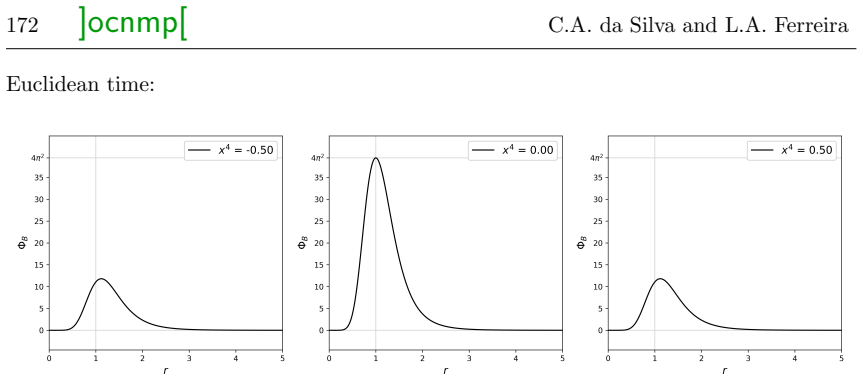
The magnetic and electric fluxes of the 1-instanton and anti-instanton, evaluated via the integral non-Abelian Gauss law on spherical surfaces centered at the origin, are non-zero and gauge-invariant at r=1 and x^4=0, where r is the scaled radial coordinate; these fluxes therefore define observable gauge-invariant charge densities that describe the internal structure of the instanton.
What carries the argument
Integral non-Abelian Gauss law applied to spherical surfaces centered on the instanton, which converts the conserved charges into gauge-invariant magnetic and electric fluxes.
If this is right
- The magnetic and electric fluxes remain non-zero and observable for both instanton and anti-instanton at the stated surface.
- Charge densities obtained from the flux through infinitesimal shells are reparameterization-invariant.
- The internal structure of the instanton is characterized by a non-trivial distribution of these gauge-invariant charges.
- The same construction may constrain the role of instantons in the Yang-Mills theta vacuum.
Where Pith is reading between the lines
- Observable fluxes could serve as a diagnostic for single-instanton configurations in lattice calculations.
- Non-vanishing central fluxes suggest that instanton-induced tunneling carries an intrinsic charge signature that might modify vacuum-to-vacuum amplitudes.
- The method could be applied to multi-instanton configurations to extract interaction-induced charge redistributions.
Load-bearing premise
The gauge-invariant charges built from loop-space integral equations remain dynamically conserved when inserted into the explicit 1-instanton field configuration.
What would settle it
Numerical evaluation of the integral non-Abelian Gauss law on the standard BPST 1-instanton solution that returns exactly zero flux at scaled radius r=1 and x^4=0.
Figures



read the original abstract
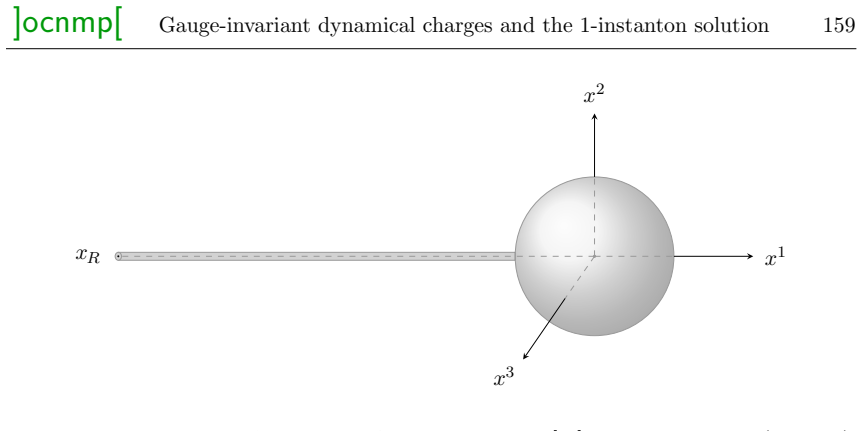
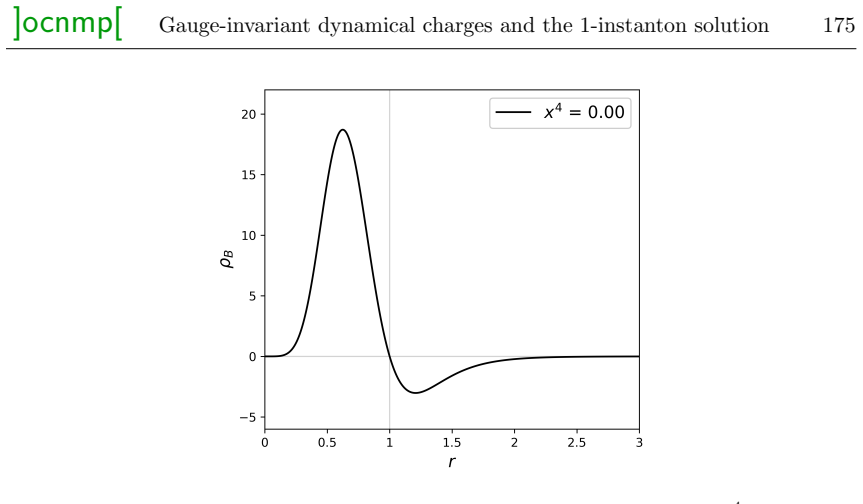
We study the gauge-invariant dynamically conserved charges, and their corresponding densities, for instanton solutions of Yang-Mills theories in four dimensional Euclidean space, for the gauge group $SU(2)$. Those charges were constructed in [1,2] through the integral equations of Yang-Mills theory, using techniques on generalized loop spaces. We use the integral non-Abelian Gauss law to evaluate the gauge-invariant flux of the magnetic and electric non-Abelian fields through spherical surfaces centered at the origin of the instanton solution. From such a flux, we define gauge-invariant charge densities by considering the charge within an infinitesimal spherical shell of radius $r\equiv\sqrt{x_i \, x^i}/\lambda$, with $\lambda$ being the parameter of the instanton solution, defining its size, and $x_i \, x^i = (x^1)^2 + (x^{2})^2 + (x^{3})^2$. We discuss the issue of the reparameterization invariance of the charges and densities, and show that the magnetic and electric fluxes for the instanton and anti-instanton, at $r=1$ and $x^4 = 0$, $x^4$ being the Euclidean time, are non-zero and observable. Our results give an interesting picture of the internal structure of the instanton, and may be important for the properties of the Yang-Mills $\theta$-vacuum.
Editorial analysis
A structured set of objections, weighed in public.
Referee Report
Summary. The paper applies gauge-invariant dynamical charges and densities, previously constructed via integral equations on generalized loop spaces in references [1,2], to the explicit BPST 1-instanton (and anti-instanton) solution of SU(2) Yang-Mills theory in four-dimensional Euclidean space. It uses the integral non-Abelian Gauss law to compute the magnetic and electric fluxes through spherical surfaces centered at the instanton origin, defines corresponding charge densities within infinitesimal spherical shells of radius r = √(x_i x^i)/λ at x^4=0, discusses reparameterization invariance, and reports that the fluxes at r=1 are non-zero and thus observable, yielding an internal structure for the instanton with possible implications for the Yang-Mills θ-vacuum.
Significance. If the central applicability claim holds, the work provides an explicit gauge-invariant assignment of dynamical charges to the 1-instanton that is independent of the usual topological winding number, which could be relevant for non-perturbative aspects of the θ-vacuum. The explicit evaluation on the BPST solution and the reparameterization-invariance discussion are concrete strengths that go beyond the abstract constructions in [1,2].
major comments (1)
- [Application to the 1-instanton solution and results on fluxes] The constructions of the integral equations and conserved charges in references [1,2] are formulated for real-time (Minkowski) Yang-Mills theory. The manuscript applies these directly to the Euclidean 1-instanton without deriving or verifying that the integral equations and dynamical conservation survive the Wick rotation or remain valid under the self-duality condition F=*F. This verification is load-bearing for the claim that the computed fluxes at r=1, x^4=0 are dynamically conserved and observable (see the paragraph beginning 'We use the integral non-Abelian Gauss law...' and the results paragraph on non-zero fluxes).
minor comments (2)
- [Definition of charge densities] The definition of the radial coordinate r ≡ √(x_i x^i)/λ is introduced without an explicit statement of how the scaling with the instanton size λ affects the normalization of the reported fluxes; a brief clarification would improve readability.
- [Results paragraph] The abstract and results paragraph state that the fluxes 'are non-zero and observable' but do not include a short table or explicit numerical values for the instanton versus anti-instanton cases; adding these would make the central claim easier to assess.
Simulated Author's Rebuttal
We thank the referee for the careful reading and the positive evaluation of the significance of our results. We address the single major comment below.
read point-by-point responses
-
Referee: [Application to the 1-instanton solution and results on fluxes] The constructions of the integral equations and conserved charges in references [1,2] are formulated for real-time (Minkowski) Yang-Mills theory. The manuscript applies these directly to the Euclidean 1-instanton without deriving or verifying that the integral equations and dynamical conservation survive the Wick rotation or remain valid under the self-duality condition F=*F. This verification is load-bearing for the claim that the computed fluxes at r=1, x^4=0 are dynamically conserved and observable (see the paragraph beginning 'We use the integral non-Abelian Gauss law...' and the results paragraph on non-zero fluxes).
Authors: We agree that an explicit verification is required to support the dynamical conservation claims. The integral non-Abelian Gauss law follows directly from the Yang-Mills equations of motion, which retain the same differential form after Wick rotation to Euclidean signature. Self-dual (and anti-self-dual) configurations satisfy these equations, so the integral form and the associated conservation should carry over. To address the referee's concern rigorously, the revised manuscript will include a new subsection that (i) performs the Wick rotation on the integral equations of [1,2], (ii) confirms that the resulting Euclidean integral Gauss law holds for any solution of the Euclidean Yang-Mills equations, and (iii) notes that self-duality is sufficient but not necessary for the conservation statement. This addition will make the applicability to the BPST solution fully explicit. revision: yes
Circularity Check
Central gauge-invariant charges and conservation laws imported from authors' prior works [1,2] without independent Euclidean verification
specific steps
-
self citation load bearing
[Abstract]
"Those charges were constructed in [1,2] through the integral equations of Yang-Mills theory, using techniques on generalized loop spaces. We use the integral non-Abelian Gauss law to evaluate the gauge-invariant flux of the magnetic and electric non-Abelian fields through spherical surfaces centered at the origin of the instanton solution. ... show that the magnetic and electric fluxes for the instanton and anti-instanton, at r=1 and x^4 = 0 ... are non-zero and observable."
The dynamical conservation property that allows the Gauss law to define observable fluxes is justified solely by citation to [1,2] (prior works with author overlap). The manuscript applies the construction directly to the Euclidean 1-instanton without deriving or confirming survival under Wick rotation/self-duality, so the non-zero flux result reduces to the imported premise rather than an independent check.
full rationale
The paper's core construction of dynamically conserved charges and the use of the integral non-Abelian Gauss law to obtain observable fluxes on the 1-instanton rests entirely on the applicability of the integral equations and conservation properties defined in references [1,2]. These are cited as the source of the charges, with no derivation or explicit check in the present manuscript that the Minkowski-derived equations survive the Wick rotation or self-duality condition F=*F when evaluated on the BPST solution. This matches self_citation_load_bearing: the dynamical status and observability of the reported non-zero magnetic/electric fluxes at r=1, x^4=0 are not independently established here but inherit from the self-cited framework. The reparameterization-invariance discussion does not substitute for that verification. No other circular patterns (self-definition, fitted predictions, etc.) are exhibited by the quoted text.
Axiom & Free-Parameter Ledger
axioms (1)
- domain assumption The integral non-Abelian Gauss law can be used to evaluate gauge-invariant fluxes for the 1-instanton solution
Reference graph
Works this paper leans on
-
[1]
The integral equations of Yang-Mills and its gauge invariant conserved charges
L. A. Ferreira and G. Luchini, “Integral form of Yang-Mills equations and its gauge invariant conserved charges,”Phys. Rev. D86(2012) 085039,arXiv:1205.2088 [hep-th]
work page internal anchor Pith review Pith/arXiv arXiv 2012
-
[2]
Gauge and Integrable Theories in Loop Spaces
L. A. Ferreira and G. Luchini, “Gauge and Integrable Theories in Loop Spaces,”Nucl. Phys. B858(2012) 336–365,arXiv:1109.2606 [hep-th]
work page internal anchor Pith review Pith/arXiv arXiv 2012
-
[3]
Integrals of Nonlinear Equations of Evolution and Solitary Waves,
P. D. Lax, “Integrals of Nonlinear Equations of Evolution and Solitary Waves,”Com- mun. Pure Appl. Math.21(1968) 467–490
1968
-
[4]
Exact Theory of Two-Dimensional Self-Focusing and One-Dimensional Self-Modulation of Waves in Nonlinear Media (english transl. Soviet Phys. JETP, 34 (1972) 62-69),
V. Zakharov and A. Shabat, “Exact Theory of Two-Dimensional Self-Focusing and One-Dimensional Self-Modulation of Waves in Nonlinear Media (english transl. Soviet Phys. JETP, 34 (1972) 62-69),”Zh. Exp. Teor. Fiz.61(1971) 118–134. 182]ocnmp[C.A. da Silva and L.A. Ferreira
1972
-
[5]
L. D. Faddeev and L. A. Takhtajan,Hamiltonian Methods in the Theory of Solitons. Springer Series in Soviet Mathematics. Springer, 1987
1987
-
[6]
The hidden symmetries of Yang-Mills theory in (3 + 1)-dimensions,
L. A. Ferreira and H. Malavazzi, “The hidden symmetries of Yang-Mills theory in (3 + 1)-dimensions,”JHEP11(2025) 102,arXiv:2506.15832 [hep-th]
-
[7]
Integrable models in (1+1)-dimensional quantum field theory,
L. D. Faddeev, “Integrable models in (1+1)-dimensional quantum field theory,” in Les Houches Summer School in Theoretical Physics: Recent Advances in Field Theory and Statistical Mechanics, pp. 294–341. 8, 1982
1982
-
[8]
Introduction to classical and quantum integrability,
A. L. Retore, “Introduction to classical and quantum integrability,”J. Phys. A55 no. 17, (2022) 173001,arXiv:2109.14280 [hep-th]
-
[9]
L. D. Faddeev and A. A. Slavnov,Gauge Fields: Introduction to Quantum Theory. Benjamin/Cummings Publ. Co., Inc., 1980
1980
-
[10]
Higher symmetry and gapped phases of gauge theories
A. Kapustin and R. Thorngren, “Higher Symmetry and Gapped Phases of Gauge Theories,”Prog. Math.324(2017) 177–202,arXiv:1309.4721 [hep-th]
work page internal anchor Pith review Pith/arXiv arXiv 2017
-
[11]
D. Gaiotto, A. Kapustin, N. Seiberg, and B. Willett, “Generalized Global Symme- tries,”JHEP02(2015) 172,arXiv:1412.5148 [hep-th]
work page internal anchor Pith review Pith/arXiv arXiv 2015
-
[12]
Notes on generalized global symmetries in QFT
E. Sharpe, “Notes on generalized global symmetries in QFT,”Fortsch. Phys.63 (2015) 659–682,arXiv:1508.04770 [hep-th]
work page internal anchor Pith review Pith/arXiv arXiv 2015
-
[13]
Snowmass White Paper: Generalized Symmetries in Quantum Field Theory and Beyond,
C. Cordova, T. T. Dumitrescu, K. Intriligator, and S.-H. Shao, “Snowmass White Paper: Generalized Symmetries in Quantum Field Theory and Beyond,” inSnowmass
-
[14]
5, 2022.arXiv:2205.09545 [hep-th]
work page internal anchor Pith review Pith/arXiv arXiv 2022
-
[15]
A direct test of the integral Yang-Mills equations through SU(2) monopoles
C. P. Constantinidis, L. A. Ferreira, and G. Luchini, “Direct test of the integral Yang- Mills equations through SU(2) monopoles,”Phys. Rev. D96no. 10, (2017) 105024, arXiv:1710.03359 [hep-th]
work page internal anchor Pith review Pith/arXiv arXiv 2017
-
[16]
A New Approach to Integrable Theories in any Dimension
O. Alvarez, L. A. Ferreira, and J. Sanchez Guillen, “A New approach to integrable the- ories in any dimension,”Nucl. Phys. B529(1998) 689–736,arXiv:hep-th/9710147
work page internal anchor Pith review Pith/arXiv arXiv 1998
-
[17]
Integrable theories and loop spaces: fundamentals, applications and new developments
O. Alvarez, L. A. Ferreira, and J. Sanchez Guillen, “Integrable theories and loop spaces: Fundamentals, applications and new developments,”Int. J. Mod. Phys. A24 (2009) 1825–1888,arXiv:0901.1654 [hep-th]
work page internal anchor Pith review Pith/arXiv arXiv 2009
-
[18]
The Hidden Symmetries of Yang-Mills Theory in (2 + 1)-dimensions,
L. A. Ferreira and H. Malavazzi, “The Hidden Symmetries of Yang-Mills Theory in (2 + 1)-dimensions,” (to appear)
-
[19]
The Hidden Symmetries of Yang-Mills Theory in (1+1)-dimensions
L. A. Ferreira, G. Luchini, and H. Malavazzi, “The Hidden Symmetries of Yang-Mills Theory in (1+1)-dimensions,”arXiv:2604.12873 [hep-th]
work page internal anchor Pith review Pith/arXiv arXiv
-
[20]
Conservation of Isotopic Spin and Isotopic Gauge In- variance,
C.-N. Yang and R. L. Mills, “Conservation of Isotopic Spin and Isotopic Gauge In- variance,”Phys. Rev.96(1954) 191–195
1954
-
[21]
Pseudoparticle Solutions of the Yang-Mills Equations,
A. A. Belavin, A. M. Polyakov, A. S. Schwartz, and Y. S. Tyupkin, “Pseudoparticle Solutions of the Yang-Mills Equations,”Phys. Lett. B59(1975) 85–87. ]ocnmp[Gauge-invariant dynamical charges and the 1-instanton solution 183
1975
-
[22]
N. S. Manton and P. Sutcliffe,Topological solitons. Cambridge Monographs on Math- ematical Physics. Cambridge University Press, 2004
2004
-
[23]
Y. M. Shnir,Topological and Non-Topological Solitons in Scalar Field Theories. Cam- bridge University Press, 7, 2018
2018
discussion (0)
Sign in with ORCID, Apple, or X to comment. Anyone can read and Pith papers without signing in.