REVIEW 3 major objections 6 minor 40 references
Evaluating LLMs Across Multi-Cognitive Levels: From Medical Knowledge Mastery to Scenario-Based Problem Solving
T0 review · 3 major / 6 minor · reviewed 2026-08-07 · deepseek-v4-flash
Pith's one-line read Current LLMs can recall medical facts, but their ability to plan and reason through a real diagnostic workup drops sharply, with the best model reaching only 19.4% full-path diagnosis accuracy.
desk verdict Useful three-level medical benchmark with a solid L1→L2 drop; the L3 headline number is hostage to a questionable gold standard. read the letter →
The pith
A machine-rendered reading of the paper's core claim, the machinery that carries it, and where it could break.
The reading
What carries the argument
The central object is MultiCogEval, a three-level evaluation framework that keeps medical knowledge coverage roughly constant across levels while varying cognitive demand, and normalizes accuracy by random-guessing baselines so the levels are comparable. At L3 it uses a full-path diagnosis metric that multiplies final-diagnosis correctness by examination recall, where the ground-truth examinations are the ones actually recorded in each MIMIC-IV admission note. This machinery is what turns the abstract claim 'higher cognition is harder for LLMs' into a measurable performance gap.
What would settle it
Have a panel of experienced clinicians independently order tests for the same patient histories used in the high-level task and compare their orders with the recorded MIMIC-IV orders; if clinicians frequently omit or add different tests, or if model accuracy scored against clinician-approved orders rises far above 19.4%, the paper's central conclusion about scenario-based problem solving would be called into question.
Extended reading notes
Core claim
The paper claims that current LLMs are strong at recalling medical knowledge but weak at applying it in realistic clinical workflows. Using its MultiCogEval framework, it shows that state-of-the-art models score above 60% normalized accuracy on L1 MCQ tasks, drop roughly 20 points on L2 reformulated application tasks, and fall to about 19.4% on L3 full-path diagnosis, where the model must choose which examinations to order, interpret their results, and produce a final diagnosis. It further reports that larger model size matters more at higher cognitive levels, that medical-domain fine-tuning improves L1 and L2 but not L3, and that inference-time scaling helps across levels, especially on L2. The central discovery is a quantitative, level-by-level map of where LLM medical competence breaks down.
Load-bearing premise
The load-bearing assumption is that the examinations actually recorded in each historical MIMIC-IV admission are the correct set a model should order, so the exam-recall part of the full-path metric treats deviations from those records as errors; if real notes contain unnecessary, redundant, or missing tests, then the 19.4% figure is not a clean measure of clinical problem-solving.
Editorial extensions
If this is right
- Medical exam-style benchmarks overstate readiness: a model can ace knowledge questions while lacking the planning and information-seeking behavior needed for diagnosis.
- Model selection should be task-appropriate: roughly 10B-parameter models may suffice for knowledge QA, while complex clinical tasks require larger models.
- Medical-domain fine-tuning should shift its objective from memorized knowledge to high-level abilities such as clinical planning and proactive test ordering.
- Inference-time scaling is a promising lever for improving application-level medical reasoning, though it does not by itself close the high-level gap.
- Benchmark design for medical AI should include interactive scenario tasks with sequential decisions, not only static QA.
Reading between the lines
- Editorial extension: the reported 19.4% depends on treating the tests recorded in historical MIMIC-IV notes as the correct test set; if those notes reflect over-testing or missing tests, the exam-recall term may penalize clinically reasonable strategies and the true problem-solving gap could differ.
- Editorial extension: the same three-level design could be applied to other professional domains, such as legal reasoning or engineering troubleshooting, where factual recall and on-the-job planning are similarly separable.
- Editorial extension: a direct test of the framework's metric would compare clinician-ordered test sets against the recorded orders; if clinicians themselves disagree substantially with the recorded orders, the high-level metric should be re-anchored.
- Editorial extension: the framework measures whether models request the same tests as physicians, not whether they request better, cheaper, or safer tests; a cost- or safety-weighted variant could change the ranking of models at L3.
Editorial analysis
A structured set of objections, weighed in public.
Referee Report
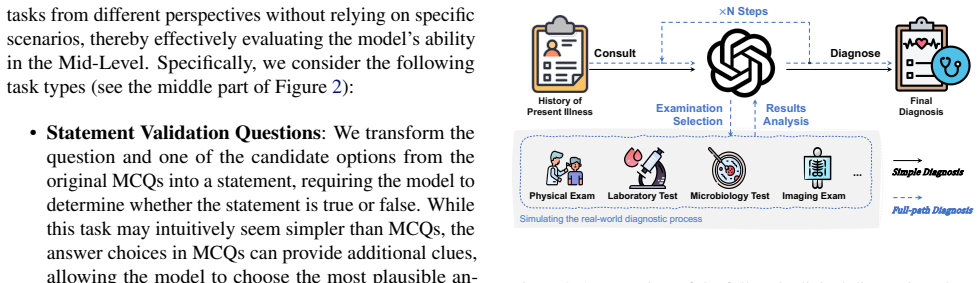
Summary. The paper proposes MultiCogEval, a three-level evaluation framework for medical LLMs inspired by Bloom's Taxonomy. Level 1 (Preliminary Knowledge Grasp) uses multiple-choice questions from MedQA and MedMCQA; Level 2 (Comprehensive Knowledge Application) reformulates those MCQs into statement validation, multi-step rectification, and answer-existence judgment tasks; Level 3 (Scenario-based Problem Solving) uses a full-path clinical diagnosis task built from MIMIC-IV admission records. The authors evaluate 32 general and 8 medical LLMs from six families and report that normalized accuracy declines monotonically from Level 1 to Level 3, with DeepSeek-V3 achieving 19.4% full-path diagnosis accuracy at the highest level. They also analyze the effects of model size, medical-domain fine-tuning, and inference-time scaling.
Significance. If the measurements are valid, the paper makes a useful contribution. It is the first to compare LLMs across multiple cognitive levels in the medical domain, it releases code and data, and the monotonic decline is observed across all six LLM families, which gives the result a systematic robustness. The knowledge-consistency design between levels is thoughtful, and the fine-grained analyses (per-disease long tail, medical fine-tuning effects, inference-time scaling) are valuable. However, the validity of the High-Level metric is the linchpin of the headline claim, and the current evidence for that metric is weaker than the strength of the claim requires.
major comments (3)
- [Section 3.3, Eq. (3)] The examination recall in Eq. (3) uses the full set of exam items recorded in each MIMIC-IV admission as the denominator, i.e., it treats every recorded test as mandatory for an ideal diagnostic workup. MIMIC-IV records reflect real clinical practice, which includes routine, redundant, or defensive tests, and may omit tests that a competent clinician would order. A model that reaches the correct diagnosis through a more selective or different workup is therefore penalized. This is not a minor scaling issue: Table 5 reports an end-point diagnosis accuracy of 53.6% for DeepSeek-V3, which is well above the Mid-Level score reported in Table 3, so the Level-2-to-Level-3 decline in the headline result is entirely produced by the multiplicative recall term. The authors should recompute the High-Level metric with a necessity-filtered denominator (e.g., a clinician-validated subset of essential tests per case) or provide a sensitivity analysis that shows how the results change when the denominator is restricted or reweighted.
- [Section 4.4 / Section F] The clinician validation does not validate the full-path High-Level task as actually administered to the models. According to Section F, clinicians were given only the history of present illness and asked to provide a diagnosis, with the list of allowed test types described but not interactively executed; the model evaluation, by contrast, requires sequential exam ordering, result integration, and a final diagnosis after multiple turns. Moreover, the validation uses only 100 samples (20 per task). This small and simplified validation cannot independently establish that the exam-recall gold standard in Eq. (3) is objective, nor does it speak to the procedural-correctness component that drives the Level-3 scores. The paper should either run the interactive task with clinicians or explicitly state this as a limitation and avoid claims that the validation demonstrates the validity of the proposed benchmark.
- [Table 2 footnote / Section D] The evaluation of GPT-4o, GPT-4o-mini, DeepSeek-V3, and DeepSeek-R1 was performed on approximately 10% of the original dataset, but the paper does not specify how this subset was chosen: whether it is a random sample, whether it is stratified by disease, or whether the same subset is used for all four models. Since the headline 19.4% figure for DeepSeek-V3 is computed on this subset, the authors should document the subset construction, state the exact number of samples, and verify that the reported cross-model comparisons are not skewed by subset composition.
minor comments (6)
- [Section 4.2 / Figure 5] The text states that model size plays a more critical role at higher cognitive levels, but Figure 5 and the accompanying discussion indicate that the performance gap between 7B and 70B models narrows again at the High-Level. The wording should be adjusted to be consistent with the data, e.g., 'the gap widens from Low to Mid but narrows again at High.'
- [Section B / Eq. (4)] For the High-Level task, the random accuracy is set to zero. Since the diagnosis is open-ended but the task is constructed from a limited disease pool of 42 diseases, the assumption of zero random accuracy should be justified or relaxed in a sensitivity analysis.
- [Section A.2] The manual verification of GPT-4o-generated statements and distractors is reported as an error rate of less than 5%, but the text does not state whether the verified batch of 100 was used to filter the final dataset or only as a quality check. Please clarify whether any generated items were removed or corrected after verification.
- [Section A.3] The prompt says 'You will get all the lab tests results at once' but the later interaction requires the model to list specific tests before receiving results. Please clarify the precise protocol so that readers understand whether the model receives results only for requested items or for an entire category.
- [Section 3.1] There is a typo in the heading: 'Priciples' should be 'Principles.'
- [Section 3.3 / Eq. (2)] The main text says the full-path accuracy is computed as a macro-average across examination types and diseases, but the formula in Eq. (2) does not show this averaging. Please make the metric definition self-contained in the main text.
Circularity Check
No significant circularity: the cognitive-level ordering is an empirical result with external clinician validation, and the self-citations are not load-bearing.
full rationale
The paper's central claim is an empirical evaluation result, not a derivation that reduces to its own inputs. The three cognitive levels are defined by an external taxonomy (Bloom's Taxonomy) and by the human clinician training process, not by model performance. Mid-Level tasks are reformulations of the same Low-Level MCQs, and High-Level tasks are built from MIMIC-IV admissions filtered to diseases appearing in the MCQ-derived disease pool. This design deliberately controls knowledge coverage, but it does not logically force the observed accuracy ordering; statement validation or multi-step rectification could in principle be easier for some models than the original MCQ format, and the reported decline is an empirical finding rather than a tautology. The full-path accuracy metric in Equations (2)-(3) uses the recorded MIMIC-IV examination items as an external gold standard; it is not fitted to model outputs, so any concern that the denominator over-counts unnecessary tests is a validity or correctness issue, not circularity. The clinician validation (Section 4.4) provides independent evidence that the task ordering corresponds to genuine difficulty, with clinician accuracy falling from 68.8% to 23.5% and subjective difficulty rising, which further anchors the levels outside the model evaluations. Normalization in Equation (4) is transparent and adjusts for random-guess baselines without encoding the conclusion. The self-citations, such as Yan et al. (2025) and Qiu et al. (2024), appear in related-work and motivation contexts and are not load-bearing for the central evaluation chain. No fitted parameter is renamed as a prediction, no uniqueness theorem is imported from the authors' prior work, and no ansatz is smuggled in via self-citation. The manuscript is self-contained against external benchmarks and human validation for its main claims.
Assumptions & free parameters
free parameters (4)
- alpha (weight for correct-answer questions in Multi-Step Rectification) =
1/N_c
- Fuzzy matching similarity threshold for exam-item parsing =
0.9
- Disease inclusion cutoff and per-disease sampling cap =
>10 records; cap at 100 records per disease
- High-Level random accuracy in normalization =
0
assumptions (5)
- domain assumption The three task formats (MCQ, reformulated application tasks, full-path diagnosis) correspond to ordered cognitive levels aligned with Bloom's Taxonomy and the clinician training trajectory.
- domain assumption The disease-pool matching procedure (MedCAT, ICD-10-CM filtering) ensures knowledge coverage is consistent across cognitive levels.
- domain assumption The set of examinations recorded in each MIMIC-IV admission record is the gold standard for correct examination ordering.
- domain assumption GPT-4o-generated statements and distractors for Mid-Level tasks are correct, based on manual verification of 100 samples with claimed error <5%.
- standard math The normalized accuracy formula (Equation 4) with theoretical random baselines makes performance comparable across levels.
Cite this review
Pith. "Pith review of Evaluating LLMs Across Multi-Cognitive Levels: From Medical Knowledge Mastery to Scenario-Based Problem Solving." pith.science (2026). https://pith.science/paper/3BS3J6M6
@misc{pith2026250608349,
  author       = {Pith},
  title        = {Pith review of: Evaluating LLMs Across Multi-Cognitive Levels: From Medical Knowledge Mastery to Scenario-Based Problem Solving},
  year         = {2026},
  howpublished = {\url{https://pith.science/paper/3BS3J6M6}},
  note         = {Machine review of arXiv:2506.08349}
}
read the original abstract
Large language models (LLMs) have demonstrated remarkable performance on various medical benchmarks, but their capabilities across different cognitive levels remain underexplored. Inspired by Bloom's Taxonomy, we propose a multi-cognitive-level evaluation framework for assessing LLMs in the medical domain in this study. The framework integrates existing medical datasets and introduces tasks targeting three cognitive levels: preliminary knowledge grasp, comprehensive knowledge application, and scenario-based problem solving. Using this framework, we systematically evaluate state-of-the-art general and medical LLMs from six prominent families: Llama, Qwen, Gemma, Phi, GPT, and DeepSeek. Our findings reveal a significant performance decline as cognitive complexity increases across evaluated models, with model size playing a more critical role in performance at higher cognitive levels. Our study highlights the need to enhance LLMs' medical capabilities at higher cognitive levels and provides insights for developing LLMs suited to real-world medical applications.
Figures


Figures from the paper (7 more)


Reference graph
Works this paper leans on
-
[1]
J., Javaheripi, M., Kauffmann, P., et al
Abdin, M., Aneja, J., Behl, H., Bubeck, S., Eldan, R., Gunasekar, S., Harrison, M., Hewett, R. J., Javaheripi, M., Kauffmann, P., et al. Phi-4 technical report. ArXiv preprint, abs/2412.08905, 2024 a . URL https://arxiv.org/abs/2412.08905
arXiv 2024
-
[2]
Abdin, M., Jacobs, S. A., Awan, A. A., Aneja, J., Awadallah, A., Awadalla, H., Bach, N., Bahree, A., Bakhtiari, A., Behl, H., et al. Phi-3 technical report: A highly capable language model locally on your phone. ArXiv preprint, abs/2404.14219, 2024 b . URL https://arxiv.org/abs/2404.14219
arXiv 2024
-
[3]
L., Almeida, D., Altenschmidt, J., Altman, S., Anadkat, S., et al
Achiam, J., Adler, S., Agarwal, S., Ahmad, L., Akkaya, I., Aleman, F. L., Almeida, D., Altenschmidt, J., Altman, S., Anadkat, S., et al. Gpt-4 technical report. ArXiv preprint, abs/2303.08774, 2023. URL https://arxiv.org/abs/2303.08774
arXiv 2023
-
[4]
Anderson, L. W. and Krathwohl, D. R. A taxonomy for learning, teaching, and assessing: A revision of Bloom's taxonomy of educational objectives: complete edition. Addison Wesley Longman, Inc., 2001
work page 2001
-
[5]
Anil, R., Borgeaud, S., Wu, Y., Alayrac, J.-B., Yu, J., Soricut, R., Schalkwyk, J., Dai, A. M., Hauth, A., et al. Gemini: a family of highly capable multimodal models. ArXiv preprint, abs/2312.11805, 2023. URL https://arxiv.org/abs/2312.11805
arXiv 2023
-
[6]
Bai, J., Bai, S., Chu, Y., Cui, Z., Dang, K., Deng, X., Fan, Y., Ge, W., Han, Y., Huang, F., et al. Qwen technical report. ArXiv preprint, abs/2309.16609, 2023. URL https://arxiv.org/abs/2309.16609
arXiv 2023
-
[7]
Overview of the medical question answering task at trec 2017 liveqa
Ben Abacha , A., Agichtein, E., Pinter, Y., and Demner - Fushman, D. Overview of the medical question answering task at trec 2017 liveqa. In TREC 2017, 2017
work page 2017
-
[8]
Bloom, B. S., Englehart, M. D., Furst, E. J., Hill, W. H., Krathwohl, D. R., et al. Taxonomy of educational objectives, handbook i: the cognitive domain. new york: David mckay co, 1956
work page 1956
Show all 40 references
-
[9]
The unified medical language system (umls): integrating biomedical terminology
Bodenreider, O. The unified medical language system (umls): integrating biomedical terminology. Nucleic acids research, 32 0 (suppl\_1): 0 D267--D270, 2004
2004
-
[10]
Brown, T. B., Mann, B., Ryder, N., Subbiah, M., Kaplan, J., Dhariwal, P., Neelakantan, A., Shyam, P., Sastry, G., Askell, A., Agarwal, S., Herbert - Voss, A., Krueger, G., Henighan, T., Child, R., Ramesh, A., Ziegler, D. M., Wu, J., Winter, C., Hesse, C., Chen, M., Sigler, E.,...
2020
-
[11]
Medbench: A large-scale chinese benchmark for evaluating medical large language models
Cai, Y., Wang, L., Wang, Y., de Melo, G., Zhang, Y., Wang, Y., and He, L. Medbench: A large-scale chinese benchmark for evaluating medical large language models. In Wooldridge, M. J., Dy, J. G., and Natarajan, S. (eds.), Thirty-Eighth AAAI Conference on Artificial Intelligence...
2024
-
[12]
H., Romanou, A., Bonnet, A., Matoba, K., Salvi, F., Pagliardini, M., Fan, S., K \"o pf, A., Mohtashami, A., et al
Chen, Z., Cano, A. H., Romanou, A., Bonnet, A., Matoba, K., Salvi, F., Pagliardini, M., Fan, S., K \"o pf, A., Mohtashami, A., et al. Meditron-70b: Scaling medical pretraining for large language models. ArXiv preprint, abs/2311.16079, 2023. URL https://arxiv.org/abs/2311.16079
2023 arXiv
-
[13]
U., Pimentel, M
Christophe, C., Kanithi, P., Munjal, P., Raha, T., Hayat, N., Rajan, R., Al Mahrooqi, A., Gupta, A., Salman, M. U., Pimentel, M. A., et al. Med42-evaluating fine-tuning strategies for medical llms: Full-parameter vs. parameter-efficient approaches. In AAAI 2024 Spring Symposiu...
2024
-
[14]
K., Raha, T., Khan, S., and Pimentel, M
Christophe, C., Kanithi, P. K., Raha, T., Khan, S., and Pimentel, M. A. Med42-v2: A suite of clinical llms, 2024 b . URL https://arxiv.org/abs/2408.06142
2024 arXiv
-
[15]
The llama 3 herd of models
Dubey, A., Jauhri, A., Pandey, A., Kadian, A., Al-Dahle, A., Letman, A., Mathur, A., Schelten, A., Yang, A., Fan, A., et al. The llama 3 herd of models. ArXiv preprint, abs/2407.21783, 2024. URL https://arxiv.org/abs/2407.21783
2024 arXiv
-
[16]
Evaluation and mitigation of the limitations of large language models in clinical decision-making
Hager, P., Jungmann, F., Holland, R., Bhagat, K., Hubrecht, I., Knauer, M., Vielhauer, J., Makowski, M., Braren, R., Kaissis, G., et al. Evaluation and mitigation of the limitations of large language models in clinical decision-making. Nature medicine, 30 0 (9): 0 2613--2622, 2024
2024
-
[17]
Hui, B., Yang, J., Cui, Z., Yang, J., Liu, D., Zhang, L., Liu, T., Zhang, J., Yu, B., Dang, K., et al. Qwen2. 5-coder technical report. ArXiv preprint, abs/2409.12186, 2024. URL https://arxiv.org/abs/2409.12186
2024 arXiv
-
[18]
What disease does this patient have? a large-scale open domain question answering dataset from medical exams
Jin, D., Pan, E., Oufattole, N., Weng, W.-H., Fang, H., and Szolovits, P. What disease does this patient have? a large-scale open domain question answering dataset from medical exams. Applied Sciences, 11 0 (14): 0 6421, 2021
2021
-
[19]
P ub M ed QA : A dataset for biomedical research question answering
Jin, Q., Dhingra, B., Liu, Z., Cohen, W., and Lu, X. P ub M ed QA : A dataset for biomedical research question answering. In Inui, K., Jiang, J., Ng, V., and Wan, X. (eds.), Proceedings of the 2019 Conference on Empirical Methods in Natural Language Processing and the 9th Inte...
2019 doi
-
[20]
E., Bulgarelli, L., Shen, L., Gayles, A., Shammout, A., Horng, S., Pollard, T
Johnson, A. E., Bulgarelli, L., Shen, L., Gayles, A., Shammout, A., Horng, S., Pollard, T. J., Hao, S., Moody, B., Gow, B., et al. Mimic-iv, a freely accessible electronic health record dataset. Scientific data, 10 0 (1): 0 1, 2023
2023
-
[21]
A., Roberts, A., et al
Kraljevic, Z., Searle, T., Shek, A., Roguski, L., Noor, K., Bean, D., Mascio, A., Zhu, L., Folarin, A. A., Roberts, A., et al. Multi-domain clinical natural language processing with medcat: the medical concept annotation toolkit. Artificial intelligence in medicine, 117: 0 102...
2021
-
[22]
Deepseek-v3 technical report
Liu, A., Feng, B., Xue, B., Wang, B., Wu, B., Lu, C., Zhao, C., Deng, C., Zhang, C., Ruan, C., et al. Deepseek-v3 technical report. arXiv preprint arXiv:2412.19437, 2024
2024 arXiv
-
[23]
S., Love, J., et al
Mesnard, T., Hardin, C., Dadashi, R., Bhupatiraju, S., Pathak, S., Sifre, L., Rivi \`e re, M., Kale, M. S., Love, J., et al. Gemma: Open models based on gemini research and technology. ArXiv preprint, abs/2403.08295, 2024. URL https://arxiv.org/abs/2403.08295
2024 arXiv
-
[24]
M., Carignan, D., and Horvitz, E
Nori, H., King, N., McKinney, S. M., Carignan, D., and Horvitz, E. Capabilities of gpt-4 on medical challenge problems. ArXiv preprint, abs/2303.13375, 2023 a . URL https://arxiv.org/abs/2303.13375
2023 arXiv
-
[25]
T., Zhang, S., Carignan, D., Edgar, R., Fusi, N., King, N., Larson, J., Li, Y., Liu, W., et al
Nori, H., Lee, Y. T., Zhang, S., Carignan, D., Edgar, R., Fusi, N., King, N., Larson, J., Li, Y., Liu, W., et al. Can generalist foundation models outcompete special-purpose tuning? case study in medicine. ArXiv preprint, abs/2311.16452, 2023 b . URL https://arxiv.org/abs/2311.16452
2023 arXiv
-
[26]
Gpt-4o mini: advancing cost-efficient intelligence, 2024
OpenAI. Gpt-4o mini: advancing cost-efficient intelligence, 2024. URL https://openai.com/index/hello-gpt-4o
2024
-
[27]
L., Mishkin, P., Zhang, C., Agarwal, S., Slama, K., Ray, A., Schulman, J., Hilton, J., Kelton, F., Miller, L., Simens, M., Askell, A., Welinder, P., Christiano, P
Ouyang, L., Wu, J., Jiang, X., Almeida, D., Wainwright, C. L., Mishkin, P., Zhang, C., Agarwal, S., Slama, K., Ray, A., Schulman, J., Hilton, J., Kelton, F., Miller, L., Simens, M., Askell, A., Welinder, P., Christiano, P. F., Leike, J., and Lowe, R. Training language models t...
2022
-
[28]
Climedbench: A large-scale chinese benchmark for evaluating medical large language models in clinical scenarios
Ouyang, Z., Qiu, Y., Wang, L., De Melo, G., Zhang, Y., Wang, Y., and He, L. Climedbench: A large-scale chinese benchmark for evaluating medical large language models in clinical scenarios. In Proceedings of the 2024 Conference on Empirical Methods in Natural Language Processin...
2024
-
[29]
K., and Sankarasubbu, M
Pal, A., Umapathi, L. K., and Sankarasubbu, M. Medmcqa: A large-scale multi-subject multi-choice dataset for medical domain question answering. In Flores, G., Chen, G. H., Pollard, T., Ho, J. C., and Naumann, T. (eds.), Proceedings of the Conference on Health, Inference, and L...
2022
-
[30]
Towards building multilingual language model for medicine
Qiu, P., Wu, C., Zhang, X., Lin, W., Wang, H., Zhang, Y., Wang, Y., and Xie, W. Towards building multilingual language model for medicine. Nature Communications, 15 0 (1): 0 8384, 2024
2024
-
[31]
S., Wei, J., Chung, H
Singhal, K., Azizi, S., Tu, T., Mahdavi, S. S., Wei, J., Chung, H. W., Scales, N., Tanwani, A., Cole-Lewis, H., Pfohl, S., et al. Large language models encode clinical knowledge. Nature, 620 0 (7972): 0 172--180, 2023 a
2023
-
[32]
Towards expert-level medical question answering with large language models
Singhal, K., Tu, T., Gottweis, J., Sayres, R., Wulczyn, E., Hou, L., Clark, K., Pfohl, S., Cole-Lewis, H., Neal, D., et al. Towards expert-level medical question answering with large language models. ArXiv preprint, abs/2305.09617, 2023 b . URL https://arxiv.org/abs/2305.09617
2023 arXiv
-
[33]
G., Hardin, C., Bhupatiraju, S., Hussenot, L., Mesnard, T., Shahriari, B., Ram \'e , A., et al
Team, G., Riviere, M., Pathak, S., Sessa, P. G., Hardin, C., Bhupatiraju, S., Hussenot, L., Mesnard, T., Shahriari, B., Ram \'e , A., et al. Gemma 2: Improving open language models at a practical size. ArXiv preprint, abs/2408.00118, 2024. URL https://arxiv.org/abs/2408.00118
2024 arXiv
-
[34]
R., Ba, J., Krishnan, R
Toma, A., Lawler, P. R., Ba, J., Krishnan, R. G., Rubin, B. B., and Wang, B. Clinical camel: An open expert-level medical language model with dialogue-based knowledge encoding. ArXiv preprint, abs/2305.12031, 2023. URL https://arxiv.org/abs/2305.12031
2023 arXiv
-
[35]
Llama: Open and efficient foundation language models
Touvron, H., Lavril, T., Izacard, G., Martinet, X., Lachaux, M.-A., Lacroix, T., Rozi \`e re, B., Goyal, N., Hambro, E., Azhar, F., et al. Llama: Open and efficient foundation language models. ArXiv preprint, abs/2302.13971, 2023 a . URL https://arxiv.org/abs/2302.13971
2023 arXiv
-
[36]
Llama 2: Open foundation and fine-tuned chat models
Touvron, H., Martin, L., Stone, K., Albert, P., Almahairi, A., Babaei, Y., Bashlykov, N., Batra, S., Bhargava, P., Bhosale, S., et al. Llama 2: Open foundation and fine-tuned chat models. ArXiv preprint, abs/2307.09288, 2023 b . URL https://arxiv.org/abs/2307.09288
2023 arXiv
-
[37]
CMB : A comprehensive medical benchmark in C hinese
Wang, X., Chen, G., Dingjie, S., Zhiyi, Z., Chen, Z., Xiao, Q., Chen, J., Jiang, F., Li, J., Wan, X., Wang, B., and Li, H. CMB : A comprehensive medical benchmark in C hinese. In Duh, K., Gomez, H., and Bethard, S. (eds.), Proceedings of the 2024 Conference of the North Americ...
2024
-
[38]
C., Wu, J., and Liu, X
Yan, C., Fu, X., Xiong, Y., Wang, T., Hui, S. C., Wu, J., and Liu, X. Llm sensitivity evaluation framework for clinical diagnosis. In Proceedings of the 31st International Conference on Computational Linguistics, pp.\ 3083--3094, 2025
2025
-
[39]
Qwen2 technical report
Yang, A., Yang, B., Hui, B., Zheng, B., Yu, B., Zhou, C., Li, C., Li, C., Liu, D., Huang, F., et al. Qwen2 technical report. ArXiv preprint, abs/2407.10671, 2024. URL https://arxiv.org/abs/2407.10671
2024 arXiv
-
[40]
write newline
" write newline "" before.all 'output.state := FUNCTION n.dashify 't := "" t empty not t #1 #1 substring "-" = t #1 #2 substring "--" = not "--" * t #2 global.max substring 't := t #1 #1 substring "-" = "-" * t #2 global.max substring 't := while if t #1 #1 substring * t #2 gl...
Reviewed August 7, 2026 · model on record in the stance chip above.
Discussion (0). Sign in to comment.