REVIEW 3 major objections 5 minor 33 references
A Lightweight Framework for Trigger-Guided LoRA-Based Self-Adaptation in LLMs
T0 review · 3 major / 5 minor · reviewed 2026-08-15 · deepseek-v4-flash
Pith's one-line read SAGE lets LLMs detect and fix their own reasoning failures at inference time.
desk verdict A clearly-described LoRA self-adaptation pipeline whose central test-time claim is undercut by the trigger's need for gold answers and an evaluation that trains and tests on the same data. read the letter →
The pith
A machine-rendered reading of the paper's core claim, the machinery that carries it, and where it could break.
The reading
What carries the argument
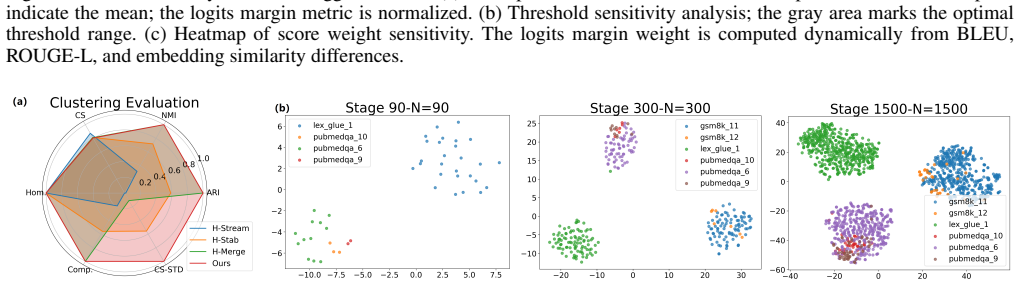
The central object is SAGE's three-module loop: trigger, buffer, store. The Trigger turns each reasoning step into a supervised signal by comparing the model's output with the retained gold answer (masked at input, unmasked for comparison), producing a normalized anomaly score. The Trigger Buffer aggregates flagged samples into stable clusters via HDBSCAN plus stability metrics (Adjusted Rand Index and average cosine similarity) and merges clusters whose centroids are close. The LoRA Store runs Cluster-Aware LoRA Optimization (CLO), which samples LoRA ranks and learning rates, trains candidate adapters, sorts them by accuracy then cross-entropy loss, and retains the Top-3 adapters for future inference.
What would settle it
Run SAGE on a held-out stream where gold answers are withheld or provided only for a small fraction of samples, and show that the Trigger fires on almost nothing and the reported EM gain disappears; a positive control would use the same stream with gold answers available, confirming that the gain comes from the label-dependent trigger.
Extended reading notes
Core claim
On its own terms, SAGE establishes that a static LLM can become a self-adapting system during inference by chaining three components: a Trigger that flags reasoning failures by comparing the model's prediction with a masked gold answer using logits margin, BLEU, ROUGE-L, and embedding similarity; a Trigger Buffer that clusters the flagged samples with streaming HDBSCAN, stability checks, and similarity-based merging; and a LoRA Store that searches over hyperparameters, trains candidate adapters, ranks them by accuracy and loss, and keeps the best three for reuse. The paper's central experimental claim is that on the GSM8K level-1 atomic subtask, SAGE's best adapters reach 99.80% exact match, with a mean of 97.16% ± 4.65% over random seeds and a statistically significant improvement over static baselines.
Load-bearing premise
The whole pipeline assumes that the correct answer is available for every test-time sample, because the Trigger detects failures by comparing the generated answer with a masked gold answer; if a real inference stream lacks these labels, no anomalies can be flagged and the self-adaptation loop never starts.
Editorial extensions
If this is right
- Deployed LLMs could update themselves during test-time interaction, incorporating new knowledge without full retraining and without modifying the base weights.
- Decomposing a task into atomic subtasks makes LoRA fine-tuning effective on sparse, streaming data; the paper reports more than 50% improvement over multitask fine-tuning on atomic tasks.
- Failure-triggered, event-driven learning converts static LoRA updates into a continual process that only fires when the model detects an anomaly.
- Top-3 adapters retained in the LoRA Store provide reusable, task-specific modules that can be selected for future reasoning calls.
Reading between the lines
- The label-availability premise is the key boundary: the Trigger needs the gold answer at inference time to compute its anomaly score, so in a fully unsupervised stream the pipeline would never fire; a version that replaces this with self-supervised signals (e.g., consistency across decoding attempts, or verification of arithmetic steps) would be a natural testable extension.
- If the reported 97% EM holds on broader OOD datasets, the framework suggests a modular alternative to RL-based post-training: instead of one global policy update, a library of small adapters could be grown incrementally, each specialized to a cluster of failures.
- The clustering step implicitly assumes that similar failures share a cause; one could test this by measuring whether adapter performance transfers across clusters that are similar by embedding but differ in underlying error type.
Signed reviews
Editorial analysis
A structured set of objections, weighed in public.
Referee Report
Summary. The paper proposes SAGE, a three-module framework for test-time self-adaptation of LLMs: a Trigger module that detects reasoning failures from multiple evaluation metrics, a Trigger Buffer that clusters anomalous samples, and a LoRA Store that fine-tunes and retains adapters. The manuscript claims that SAGE enables dynamic knowledge updating during inference, reporting 97.16% ± 4.65% EM accuracy on GSM8K Level-1, and includes module-wise evaluations and ablations.
Significance. If the central claim were valid, SAGE would be a practical advance in continual and test-time adaptation, since a deployed LLM could detect its own failures and improve with lightweight LoRA updates. The paper provides a detailed system description and several ablation comparisons. However, the key claim is not established by the current evidence: the failure signal used by the Trigger is the gold answer, and the end-to-end evaluation is conducted on the same samples used to train the adapters. The reported results therefore demonstrate supervised online fine-tuning with oracle failure detection, not autonomous test-time self-adaptation.
major comments (3)
- [Design of SAGE, Trigger] Equation (5) defines the anomaly score AS as a weighted sum of one minus normalized similarity terms, where BLEU, ROUGE-L, and embedding similarity are computed against the ground-truth answer. The text also states that the LLM 'first receives a masked version of the gold answer, which is retained as the ground truth.' Consequently, the Trigger cannot operate in a deployment stream without gold answers, contradicting the abstract's claim of 'real-time' detection and the Preliminaries' requirement that adaptation run 'without external supervision.' The end-to-end experiment therefore demonstrates supervised online fine-tuning with oracle failure detection, not autonomous test-time self-adaptation.
- [End-to-End Evaluation of SAGE] The final EM accuracy is reported on the same GSM8K Level-1 samples whose anomalies were clustered and used to train the LoRA adapters (Tables 2 and 3). This is not a held-out evaluation: the adapters are selected by validation accuracy on clusters derived from the test set, and the best of Top-3 adapters is reported for each seed. The headline '97.16% ± 4.65%' is the mean over 9 adapters from three seeds, with the best adapter per seed retained, which inflates the estimate. A held-out split is needed before any claim of generalization can be made.
- [End-to-End Evaluation of SAGE] The Wilcoxon signed-rank test (W=0, p=0.0039) compares SAGE against baselines on the same non-held-out data, so it does not establish statistical significance of a generalization improvement. The test also appears to use the post-hoc selected adapter; the selection procedure is not accounted for in the p-value, making the significance claim uninterpretable.
minor comments (5)
- [Appendix B.2] The text refers to 'Appendix B.2' for random-seed stability, but the referenced results appear in Appendix Table 4; the in-text citation is ambiguous.
- [Appendix B.1] There is an unresolved LaTeX reference in the text: 'Figure reffig:tri-sj' in Appendix B.1.
- [Table 1] The symbol '*' in Table 1 is explained only in the caption, not in the main text, and the notation 'LStore500', 'LStore499', and 'SAGE315' is not defined anywhere in the paper.
- [Throughout] The paper alternates between 'Lora Store' and 'LoRA Store' (e.g., section headers and the Table 2 caption), and there are typographical errors such as 'unclusterd' and 'Lora Store' in the LoRA Store section.
- [Tables 1-3] Many numeric values appear with formatting issues (e.g., '107', '4811.8×10 6', '291851.5×10 10'), which makes the tables difficult to interpret.
Circularity Check
Trigger's 'real-time failure detection' is defined as disagreement with gold answers, and the headline EM is produced by adapters trained on and selected by the same labeled GSM8K samples; the claimed unsupervised self-adaptation is label-retrospective supervised fine-tuning.
-
self definitional
[Design of SAGE, Trigger; Eq. (5); Preliminaries, 'Adaptation autonomy']
"given a test set, the LLM first receives a masked version of the gold answer, which is retained as the ground truth. It then generates an answer based on the question, producing the predicted answer. The Trigger module compares the ground truth with the predicted answer at the token level to determine whether a reasoning failure has occurred."
The anomaly score AS in Eq. (5) is a weighted sum of (1 - BLEU/ROUGE/embedding similarity) between the prediction and the ground-truth answer. 'Reasoning failure' is therefore defined, by construction, as a drop in similarity to the gold label. The claimed 'detect reasoning failures in real time without additional supervision' and 'Adaptation autonomy ... without external supervision' is a relabeling of a supervised comparison: the failure signal is not detected or predicted but is supplied by the label. In a genuine inference stream no gold answer is available, so the Trigger cannot fire, the Trigger Buffer receives no samples, and no LoRA adapter can be trained.
-
fitted input called prediction
[LoRA Store (CLO), Algorithm 2; End-to-End Evaluation of SAGE; Table 2]
"Finally, CLO algorithm merges the preliminary result set R 0 with the refined set R 1 into the total result set R all , sorts it again by accuracy and cross-entropy loss, and selects the final Top-3 configurations ... During evaluation, the Top-3 adapters were retained and the effectiveness of this approach was verified. While all reached 100% training accuracy, only Adapter 3 Adp3 generalized well, achieving the best test EM, MSE, MAE, and digit extraction rate."
The reported 'test EM' is not an independent estimate of a fixed model: CLO ranks LoRA configurations by accuracy on the triggered, gold-labeled cluster data, and the final Top-3 adapters are then filtered by test performance ('only Adapter 3 ... generalized well, achieving the best test EM'). The headline numbers, including the seed-averaged 97.16% ± 4.65%, are the product of fitting adapters to the same GSM8K Level-1 evaluation set and selecting the best-performing adapter on that set. This is test-set selection presented as system accuracy, i.e., the 'prediction' is the fit.
full rationale
The central derivation is not self-contained in the way claimed. The Trigger module's 'failure signal' is defined as a weighted sum of dissimilarities to the gold answer (Eq. 5), so the claimed 'real-time detection without additional supervision' reduces by construction to comparing against a label; with no gold answer at inference time, the SAGE loop cannot start. The evaluation compounds the issue: adapters are trained on clusters of gold-labeled triggered samples, ranked by accuracy on that data, and the final reported EM is taken from Top-3 adapters selected by test performance on the same GSM8K Level-1 dataset. Thus the headline 97.16% ± 4.65% is a fit-and-select product rather than an independent measure of inference-time self-adaptation. There are no load-bearing self-citations; the references are external, and the clustering and LoRA-search components have independent algorithmic content. The partial circularity is concentrated in the label-dependent trigger and the test-set-selected adapter reporting, warranting a score of 6 rather than a higher score.
Assumptions & free parameters
free parameters (5)
- Anomaly threshold τ =
0.5
- Indicator weights w_i =
equal, 0.25 each
- Margin normalization bound LM_m =
5.0
- Clustering thresholds T, η_ARI, η_cos, merge δ =
not reported
- LoRA search space and selection counts (n, k, Top-3) =
not fully reported
assumptions (5)
- ad hoc to paper Gold answer (ground truth) is available for each test question at inference time.
- domain assumption Fine-tuning LoRA adapters on a cluster of samples from the evaluation set improves accuracy on the same evaluation set.
- domain assumption HDBSCAN with stability checks produces clusters that are semantically coherent and useful for LoRA training in small streaming settings.
- domain assumption Selecting the GSM8K level-1 subset (1-2 computation steps) captures 'atomic reasoning subtasks' that are representative of complex reasoning.
- domain assumption BLEU, ROUGE-L, embedding similarity, and logits margin are valid indicators of reasoning failure.
Cite this review
Pith. "Pith review of A Lightweight Framework for Trigger-Guided LoRA-Based Self-Adaptation in LLMs." pith.science (2026). https://pith.science/paper/3BSHL3TQ
@misc{pith2026250905385,
  author       = {Pith},
  title        = {Pith review of: A Lightweight Framework for Trigger-Guided LoRA-Based Self-Adaptation in LLMs},
  year         = {2026},
  howpublished = {\url{https://pith.science/paper/3BSHL3TQ}},
  note         = {Machine review of arXiv:2509.05385}
}
read the original abstract
Large language models are unable to continuously adapt and learn from new data during reasoning at inference time. To address this limitation, we propose that complex reasoning tasks be decomposed into atomic subtasks and introduce SAGE, a trigger-guided dynamic fine-tuning framework that enables adaptive updates during reasoning at inference time. SAGE consists of three key components: (1) a Trigger module that detects reasoning failures through multiple evaluation metrics in real time; (2) a Trigger Buffer module that clusters anomaly samples using a streaming clustering process with HDBSCAN, followed by stability checks and similarity-based merging; and (3) a Lora Store module that dynamically optimizes parameter updates with an adapter pool for knowledge retention. Evaluation results show that SAGE demonstrates excellent accuracy, robustness, and stability on the atomic reasoning subtask through dynamic knowledge updating during test time.
Figures


Figures from the paper (4 more)



Reference graph
Works this paper leans on
-
[1]
, " * write output.state after.block = add.period write newline
ENTRY address archivePrefix author booktitle chapter edition editor eid eprint howpublished institution isbn journal key month note number organization pages publisher school series title type volume year label extra.label sort.label short.list INTEGERS output.state before.all mid.sentence after.sentence after.block FUNCTION init.state.consts #0 'before.a...
-
[2]
write newline
" write newline "" before.all 'output.state := FUNCTION n.dashify 't := "" t empty not t #1 #1 substring "-" = t #1 #2 substring "--" = not "--" * t #2 global.max substring 't := t #1 #1 substring "-" = "-" * t #2 global.max substring 't := while if t #1 #1 substring * t #2 global.max substring 't := if while FUNCTION word.in bbl.in capitalize " " * FUNCT...
-
[3]
Berges, V.-P.; O g uz, B.; Haziza, D.; Yih, W.-t.; Zettlemoyer, L.; and Gosh, G. 2024. Memory Layers at Scale. arXiv e-prints, arXiv--2412
work page 2024
-
[4]
B.; Lespiau, J.-B.; Damoc, B.; Clark, A.; et al
Borgeaud, S.; Mensch, A.; Hoffmann, J.; Cai, T.; Rutherford, E.; Millican, K.; Van Den Driessche, G. B.; Lespiau, J.-B.; Damoc, B.; Clark, A.; et al. 2022. Improving language models by retrieving from trillions of tokens. In International conference on machine learning, 2206--2240. PMLR
2022
-
[5]
J.; Moulavi, D.; and Sander, J
Campello, R. J.; Moulavi, D.; and Sander, J. 2013. Density-based clustering based on hierarchical density estimates. In Pacific-Asia conference on knowledge discovery and data mining, 160--172. Springer
work page 2013
-
[6]
Dziri, N.; Lu, X.; Sclar, M.; Li, X. L.; Jiang, L.; Lin, B. Y.; Welleck, S.; West, P.; Bhagavatula, C.; Le Bras, R.; et al. 2023. Faith and fate: Limits of transformers on compositionality. Advances in Neural Information Processing Systems, 36: 70293--70332
work page 2023
-
[7]
Geva, M.; Schuster, R.; Berant, J.; and Levy, O. 2021. Transformer Feed-Forward Layers Are Key-Value Memories. In Proceedings of the 2021 Conference on Empirical Methods in Natural Language Processing. Association for Computational Linguistics
2021
-
[8]
He, J.; Zhou, C.; Ma, X.; Berg-Kirkpatrick, T.; and Neubig, G. 2021. Towards a Unified View of Parameter-Efficient Transfer Learning. arXiv e-prints, arXiv--2110
work page 2021
Show all 33 references
-
[9]
J.; Shen, Y.; Wallis, P.; Allen-Zhu, Z.; Li, Y.; Wang, S.; Wang, L.; Chen, W.; et al
Hu, E. J.; Shen, Y.; Wallis, P.; Allen-Zhu, Z.; Li, Y.; Wang, S.; Wang, L.; Chen, W.; et al. 2022. Lora: Low-rank adaptation of large language models. ICLR, 1(2): 3
2022
-
[10]
Jin, H.; Zhang, P.; Luo, M.; and Wang, H. 2025. Reasoning Can Hurt the Inductive Abilities of Large Language Models. arXiv preprint arXiv:2505.24225
2025 arXiv
-
[11]
Kil, J.; Mai, Z.; Lee, J.; Chowdhury, A.; Wang, Z.; Cheng, K.; Wang, L.; Liu, Y.; and Chao, W.-L. H. 2024. Mllm-compbench: A comparative reasoning benchmark for multimodal llms. Advances in Neural Information Processing Systems, 37: 28798--28827
2024
-
[12]
Kong, R.; Li, Q.; Fang, X.; Feng, Q.; He, Q.; Dong, Y.; Wang, W.; Li, Y.; Kong, L.; and Liu, Y. 2024. LoRA-Switch: Boosting the Efficiency of Dynamic LLM Adapters via System-Algorithm Co-design. CoRR
2024
-
[13]
u ttler, H.; Lewis, M.; Yih, W.-t.; Rockt \
Lewis, P.; Perez, E.; Piktus, A.; Petroni, F.; Karpukhin, V.; Goyal, N.; K \"u ttler, H.; Lewis, M.; Yih, W.-t.; Rockt \"a schel, T.; et al. 2020. Retrieval-augmented generation for knowledge-intensive nlp tasks. Advances in neural information processing systems, 33: 9459--9474
2020
-
[14]
Li, D.; Sun, Z.; Hu, X.; Hu, B.; and Zhang, M. 2025. Cmt: A memory compression method for continual knowledge learning of large language models. In Proceedings of the AAAI Conference on Artificial Intelligence, volume 39, 24413--24421
2025
-
[15]
Li, Y.; Han, S.; and Shihao, J. 2024. VB-LoRA: Extreme Parameter Efficient Fine-Tuning with Vector Banks. In The Thirty-eighth Annual Conference on Neural Information Processing Systems
2024
-
[16]
Liao, X.; Wang, C.; Zhou, S.; Hu, J.; Zheng, H.; and Gao, J. 2025. Dynamic Adaptation of LoRA Fine-Tuning for Efficient and Task-Specific Optimization of Large Language Models. arXiv preprint arXiv:2501.14859
2025 arXiv
-
[17]
Lin, C.-Y. 2004. Rouge: A package for automatic evaluation of summaries. In Text summarization branches out, 74--81
2004
-
[18]
N.; Yu, M.; Xiang, B.; Zhou, B.; and Bengio, Y
Lin, Z.; Feng, M.; dos Santos, C. N.; Yu, M.; Xiang, B.; Zhou, B.; and Bengio, Y. 2017. A STRUCTURED SELF-ATTENTIVE SENTENCE EMBEDDING. In International Conference on Learning Representations
2017
-
[19]
Liu, J.; Lin, J.; and Liu, Y. 2024. How much can rag help the reasoning of llm? arXiv preprint arXiv:2410.02338
2024 arXiv
-
[20]
Liu, W.; Wen, Y.; Yu, Z.; and Yang, M. 2016. Large-margin softmax loss for convolutional neural networks. In Proceedings of the 33rd International Conference on International Conference on Machine Learning-Volume 48, 507--516
2016
-
[21]
M.; Charlin, L.; Le Roux, N.; Caccia, L.; and Sordoni, A
Ostapenko, O.; Su, Z.; Ponti, E. M.; Charlin, L.; Le Roux, N.; Caccia, L.; and Sordoni, A. 2024. Towards modular LLMs by building and reusing a library of LoRAs. In Proceedings of the 41st International Conference on Machine Learning, 38885--38904
2024
-
[22]
Ouyang, L.; Wu, J.; Jiang, X.; Almeida, D.; Wainwright, C.; Mishkin, P.; Zhang, C.; Agarwal, S.; Slama, K.; Ray, A.; et al. 2022. Training language models to follow instructions with human feedback. Advances in neural information processing systems, 35: 27730--27744
2022
-
[23]
Papineni, K.; Roukos, S.; Ward, T.; and Zhu, W.-J. 2002. Bleu: a method for automatic evaluation of machine translation. In Proceedings of the 40th annual meeting of the Association for Computational Linguistics, 311--318
2002
-
[24]
Shazeer, N.; Mirhoseini, A.; Maziarz, K.; Davis, A.; Le, Q.; Hinton, G.; and Dean, J. 2017. Outrageously large neural networks: The sparsely-gated mixture-of-experts layer. arXiv preprint arXiv:1701.06538
2017 arXiv
-
[25]
Tie, G.; Zhao, Z.; Song, D.; Wei, F.; Zhou, R.; Dai, Y.; Yin, W.; Yang, Z.; Yan, J.; Su, Y.; et al. 2025. A survey on post-training of large language models. arXiv e-prints, arXiv--2503
2025
-
[26]
Valipour, M.; Rezagholizadeh, M.; Kobyzev, I.; and Ghodsi, A. 2022. DyLoRA: Parameter Efficient Tuning of Pre-trained Models using Dynamic Search-Free Low Rank Adaptation. NeurIPS
2022
-
[27]
Wang, W.; Dong, L.; Cheng, H.; Liu, X.; Yan, X.; Gao, J.; and Wei, F. 2023. Augmenting language models with long-term memory. Advances in Neural Information Processing Systems, 36: 74530--74543
2023
-
[28]
Wang, Y.; Gao, Y.; Chen, X.; Jiang, H.; Li, S.; Yang, J.; Yin, Q.; Li, Z.; Li, X.; and Yin, B. 2024. MEMORYLLM: Towards Self-Updatable Large Language Models. ICML
2024
-
[29]
N.; Hutchins, D.; and Szegedy, C
Wu, Y.; Rabe, M. N.; Hutchins, D.; and Szegedy, C. 2022. Memorizing Transformers. In International Conference on Learning Representations
2022
-
[30]
Xu, J.; Lai, J.; and Huang, Y. 2024. MeteoRA: Multiple-tasks Embedded LoRA for Large Language Models. arXiv e-prints, arXiv--2405
2024
-
[31]
Yang, H.; Lin, Z.; Wang, W.; Wu, H.; Li, Z.; Tang, B.; Wei, W.; Wang, J.; Tang, Z.; Song, S.; et al. 2024. Memory3: Language modeling with explicit memory. arXiv preprint arXiv:2407.01178
2024 arXiv
-
[32]
S.; Su, Z.; Kim, M.; Ostapenko, O.; Precup, D.; Caccia, L.; and Alessandro, S
Yeasar, A. S.; Su, Z.; Kim, M.; Ostapenko, O.; Precup, D.; Caccia, L.; and Alessandro, S. 2025. Exploring Sparse Adapters for Scalable Merging of Parameter Efficient Experts. In ICLR 2025 Workshop on Modularity for Collaborative, Decentralized, and Continual Deep Learning
2025
-
[33]
Zhong, Z.; Lei, T.; and Chen, D. 2022. Training Language Models with Memory Augmentation. In 2022 Conference on Empirical Methods in Natural Language Processing, EMNLP 2022
2022
Reviewed August 15, 2026 · model on record in the stance chip above.
Discussion (0). Continue with ORCID to comment.