REVIEW 5 minor 2 references
Qif resolves the correspondence problem and makes the quantum SWITCH definable for measurement-containing programs.
Reviewed by Pith at T0; open to challenge. T0 means a machine referee read the full paper against a public rubric. the ladder, T0–T4 →
T0 review · deepseek-v4-flash
2026-08-01 22:04 UTC pith:3BYINH3G
load-bearing objection A serious, well-crafted PL paper that makes a credible case for a linear-type design letting quantum SWITCH be defined for arbitrary measurement-containing programs; the main caveat is the load-bearing strong monoidal embedding, but it is explicit and defended, so I'd send it out.
Programming with Quantum-Controlled Quantum Channels
The pith
A machine-rendered reading of the paper's core claim, the machinery that carries it, and where it could break.
Core claim
On the paper's own terms, the discovery is that the semantic ill-definedness of quantum conditional branching over channels has a precise cause—the correspondence problem: the then- and else-branches of qif contain measurements whose outcomes must be paired, and there is no canonical pairing in general. The authors show that if both branches use each higher-order channel variable exactly once (linearity), a canonical pairing exists, because each hidden measurement in F has a twin in the other branch. Interpreting qif in the Hilbert-space layer while classical constructs live in the completely-positive layer, with a structure-preserving embedding between them, then makes the defining equation
What carries the argument
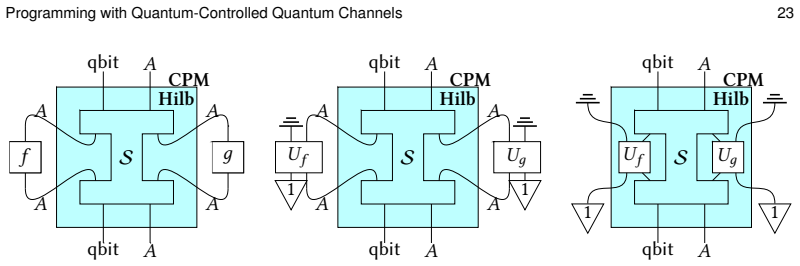
The central machinery is the two-layer categorical model: the quantum sublanguage lives in Hilb (finite-dimensional Hilbert spaces and linear maps), the classical sublanguage lives in CPM (completely positive maps), and an embedding functor ι from Hilb to CPM connects them, preserving the compact closed structure exactly. The qif construct is interpreted using the biproduct in Hilb, not in CPM, which is what lets a pure superposition of two programs lift to a genuine superposition of channel orders. Around this sits a linear type system: in Hilb terms every variable is used exactly once, so the two branches of qif are forced to contain matching uses of the same function variables. The operat
Load-bearing premise
The load-bearing premise is that the denotational model—two layers, Hilb for pure quantum programs and CPM for classical/measurement programs, connected by an embedding that preserves the compact closed structure exactly—is the correct semantics for quantum control; if that embedding preserved structure only in a weaker (lax) sense, the coercion that lets a higher-order quantum operation be applied to a measurement-based channel would not exist, and the definability of the SW
What would settle it
Take F=G=D, where D is the measure-then-flip channel D(ρ)=|1⟩⟨0|ρ|0⟩⟨1|+|0⟩⟨1|ρ|1⟩⟨0|. Compute the syntactic dilation of qif x then F(G(y)) else G(F(y)) with x=|+⟩ and compare the final state on the control and target qubits with the quantum SWITCH's output, which retains entanglement between them. If the compiled circuit ever yields |+⟩⊗D(D(y))—the output of the non-switched composition—then the claimed equality fails; conversely, direct state tomography of the compiled circuit on this example settles the claim.
If this is right
- The equation SWITCH(x,y,F,G) = qif x then F(G(y)) else G(F(y)) is valid for arbitrary quantum operations F and G, including programs that branch on measurement outcomes; this is the first such definability result.
- Because the denotational semantics is independent of the choice of operator-sum decompositions, programs have a unique observational meaning even when F and G are given as black-box channels.
- Every well-typed Qif program can be compiled to a quantum circuit by syntactic dilation; the compilation is white-box, so it does not contradict the impossibility of a black-box circuit for the quantum SWITCH with opaque holes.
- The language distinguishes SWITCH from the superficially similar qif x then F(G(y)) else F(G(y)); the latter is rejected by linearity or denotes a different operation, resolving the apparent paradox that SWITCH(F,F) beats the composition F∘F.
- Adding divergence yields a fully abstract semantics, so program equivalence in the language coincides with contextual equivalence at first-order types.
Where Pith is reading between the lines
- Our inference: the paper's linearity diagnosis suggests a general design principle for indefinite-causal-order languages—any construct that duplicates a channel inside the branches of quantum control is likely to reintroduce the correspondence ambiguity, so non-linear control of general channels may be intrinsically underdetermined.
- Our inference: since compilation is white-box and depends on the chosen dilations of F and G, the practical cost of running a Qif program is sensitive to how F and G are implemented; the language itself does not provide a black-box realization of the SWITCH.
- Our inference: the paper notes that one well-known indefinite-causal-order protocol is probably not expressible in Qif and that adding general recursion blocks a simple syntactic dilation. A testable extension is to apply the dilation dynamically, one loop iteration at a time, which the paper sketches but does not formalize.
Editorial analysis
A structured set of objections, weighed in public.
Referee Report
Summary. This paper presents Qif, a linear functional quantum programming language designed around the thesis that quantum-controlled operations and the quantum SWITCH are different mechanisms. The language has a quantum sublanguage (modelled in Hilb, with qif) and a classical sublanguage (modelled in CPM, with measurement and if), connected by a strong monoidal embedding ι:Hilb→CPM. The central claim is that the term SWITCH(x,y,F,G) = qif x then F(G(y)) else G(F(y)) defines the quantum SWITCH even when F,G are arbitrary quantum channels containing measurement, and that this is the first language with this property. The paper diagnoses the correspondence problem in earlier semantics and enforces a linear type discipline to solve it. It supplies a denotational semantics that is shown independent of Kraus decompositions, and an operational semantics obtained by syntactic dilation to a measurement-free language QifUnitary, which yields concrete white-box circuit synthesis. Theorems prove type safety, progress, termination, soundness, adequacy, and full abstraction with divergence.
Significance. Assuming the proofs are correct, this is a substantial contribution to quantum programming language semantics. It gives the first fully worked-out language in which the quantum SWITCH is definable for general quantum channels, with both a concise categorical model and an executable compilation strategy. The contrast with Dave et al.'s lax-monoidal model is illuminating and makes the source of the extra expressiveness precise. The paper's main theorems are formal, and the appendix contains detailed proofs; in particular, the semantic independence from Kraus decompositions is a strong correctness property. The white-box compilation theorem is a concrete algorithmic achievement. The main caveat is that the central claim is conditioned on the choice of a strong monoidal embedding; this is a design decision rather than a physical axiom, but it is supported by the operational 'no dummy values' analysis and is not an internal inconsistency. I found no error that would invalidate the central claim.
minor comments (5)
- [Section 3.1, Eq. (2)] The association of control states with the two causal orders is inconsistent with Eq. (1) and the qif semantics in Fig. 8. Eq. (1) gives |0⟩ -> G(F) and |1⟩ -> F(G) under Fig. 8, while Eq. (2) and the surrounding text say |0⟩ -> F(G) and |1⟩ -> G(F). The proof of Theorem 5.2 (Appendix C.12) computes |1⟩⊗F(G)+|0⟩⊗G(F), which matches Eq. (1), not Eq. (2). Since the two conventions differ by a NOT on the control qubit, this is a presentation bug, but it should be fixed for consistency, e.g. by swapping |0⟩ and |1⟩ in Eq. (2).
- [Section 4.1] The FO(A) restriction on qif/if results is justified only by a pointer to prior work (Hirata & Tsukada 2026). Please include a short explanation or a precise theorem statement, since this restriction also limits the expressiveness of the language and is not self-contained.
- [Appendix C.8] The 'abort' constant is described as causing divergence, but its syntactic dilation (κ≔α);() is a normal form in QifUnitary. The intended interpretation is that output test channels are projected onto ⟨0|, so the program has zero probability of producing an observable output. This should be stated explicitly to avoid confusion about the operational meaning of divergence.
- [Appendix C.9] In the full abstraction proof for the Hilb case, the construction of a unit-type context that distinguishes two terms differing by a global phase is only sketched. Please expand this step, e.g. by explaining how the qbit output is embedded into CPM and measured to produce a unit-type observation.
- [Section 5.1, Remark 5.1] The dependence of the central expressivity claim on the strong monoidal embedding is a design assumption. The paper should state this more prominently, e.g. in the introduction, so that the 'first language' claim is understood as relative to this semantic choice.
Circularity Check
No significant circularity; the SWITCH claim is derived from the model, with one minor non-load-bearing self-citation.
full rationale
The central derivation is self-contained rather than circular. The denotational semantics is defined compositionally in Hilb and CPM, and Theorem 5.2 is proved by computing the denotation of the SWITCH term from the qif rule and the strong monoidal embedding, then comparing the result with the external definition of the quantum SWITCH [Chiribella et al. 2013]. Proposition C.36 is a substitution lemma proved from the model, not an assumed instance of the target theorem. The operational semantics and its soundness/adequacy/full-abstraction results are proved relative to that denotational semantics. The only self-citation is the restriction forbidding function types as qif results, attributed to Hirata and Tsukada [2026]; that restriction is orthogonal to the first-order SWITCH example and does not carry the paper's central claim. The choice of a strong rather than lax embedding is an explicitly disclosed modeling assumption, not a circular one, and it is contrasted with Dave et al. 2025a. No prediction or theorem reduces by construction to its own input.
Axiom & Free-Parameter Ledger
axioms (5)
- domain assumption Quantum systems are finite-dimensional Hilbert spaces; states are density operators; operations are completely positive trace-preserving maps (quantum channels).
- standard math Hilb and CPM are compact closed categories with biproducts, and the embedding functor ι: Hilb → CPM preserves the compact closed structure on the nose.
- standard math Stinespring's dilation theorem: every quantum channel arises as a unitary on a dilated system followed by partial trace.
- domain assumption Measurements are modeled by the map m: (2) → (1,1) in CPM, and booleans are the biproduct (1,1); the semantics of if and qif uses the biproducts in CPM and Hilb respectively.
- ad hoc to paper Qif forbids function types in the results of qif and if (the FO(A) restriction), justified only by a technical reason in the authors' prior work (Hirata & Tsukada 2026).
invented entities (1)
-
Output test channels κ in QifUnitary-with-divergence
no independent evidence
read the original abstract
In contrast to a classical bit, which can only take the value $0$ or $1$, its quantum counterpart -- a qubit -- can exist in a superposition of $0$ and $1$. This is a superposition of data values, naturally raising the question of whether one can superpose not only data but also programs. For example, a particular superposition of programs, known as the quantum SWITCH, has attracted much attention, and its implementations and computational advantages have been studied extensively within the physics community. A naive way to control a program by a qubit is by means of a controlled operation. Given an operation $F$, this amounts to considering an operation that behaves as $F$ when the control qubit is $|1\rangle$, and as the identity operation when the control qubit is $|0\rangle$. This idea works well when $F$ is a unitary operation, but it is not well-defined for a general quantum channel. By contrast, the quantum SWITCH is free from the well-definedness issue. This contrast leads to the key insight of this paper: controlled operations and the quantum SWITCH should be regarded as different kinds of quantum control mechanisms. Building on this insight, we develop a novel quantum programming language with quantum control and measurement that can express the quantum SWITCH over quantum channels. Using a semantic analysis based on program transformations, we identify the source of the ill-behavedness of controlled operations as the \emph{correspondence problem}: a lack of coordination between the measurements performed in the then- and else-branches of quantum conditional branching. We address this problem with a linear type system that enforces alignment of the quantum operations used in the two branches, yielding a well-behaved language capable of expressing the quantum SWITCH.
Figures




Reference graph
Works this paper leans on
-
[2]
implements
has the type qbit⊗𝐴 ′ @(®𝛼®𝛽1,®𝜉®𝜉1) inQifUnitary. □ C.3 Proof of Semantic Preservation of Syntactic Dilation For the proof, we define another category𝑇(A) . We first define a compact closed categoryA, and obtain𝑇(A)usingfocussed orthogonalityby Hyland and Schalk [2003]. Definition C.14.The category A consists of the following: An object ofA is a sequence...
2003
-
[2024]
Exponential separation in quantum query complexity of the quantum switch with respect to simulations with standard quantum circuits. https://doi.org/10.48550/ARXIV.2409.18420 Hlér Kristjánsson, Giulio Chiribella, Sina Salek, Daniel Ebler, and Matthew Wilson. 2020. Resource theories of communication. New Journal of Physics22, 7 (jul 2020), 073014. https://...
discussion (0)
Sign in with ORCID, Apple, or X to comment. Anyone can read and Pith papers without signing in.