REVIEW 3 major objections 6 minor 1 cited by
T2SG: Traffic Topology Scene Graph for Topology Reasoning in Autonomous Driving
T0 review · 3 major / 6 minor · reviewed 2026-08-12 · deepseek-v4-flash
Pith's one-line read A unified traffic topology scene graph, generated by a geometry- and counterfactual-guided transformer, sets a new OpenLane-V2 state of the art at 46.3 OLS.
desk verdict A plausible lane-topology method with a real SOTA claim on OpenLane-V2, but the lane-to-signal 'topology' is a class-equality shortcut, so the headline TOPlt gain is not yet convincing. read the letter →
The pith
A machine-rendered reading of the paper's core claim, the machinery that carries it, and where it could break.
The reading
What carries the argument
The load-bearing object is the T2SG graph itself, together with two attention mechanisms inside TopoFormer. Lane Aggregation Layer (LAL) adds a spatial proximity matrix, whose entries are normalized inverse distances from the end point of one predicted centerline to the start point of another, directly into the softmax attention, so global lane features are aggregated according to geometric plausibility. Counterfactual Intervention Layer (CIL) forms a counterfactual attention map by zeroing the learned attention weights while keeping lane features and the spatial proximity matrix unchanged, then trains the edge predictor to be sensitive to the difference between factual and counterfactual structure (the total indirect effect); at inference the factual attention alone is used. These two layers are what carry the argument that geometry and road-structure priors, rather than more parameters, are what improve topology reasoning.
What would settle it
Use the ground-truth lane and traffic-element categories from OpenLane-V2 in Eq. (16) instead of the predicted classes, and re-measure TOPlt. If the score stays near 29.5, the lane-to-signal topology is genuinely structural; if it falls toward the classification baseline, the OLS gain of TopoFormer is an artifact of the class-equality rule rather than evidence of learned control relationships.
Extended reading notes
Core claim
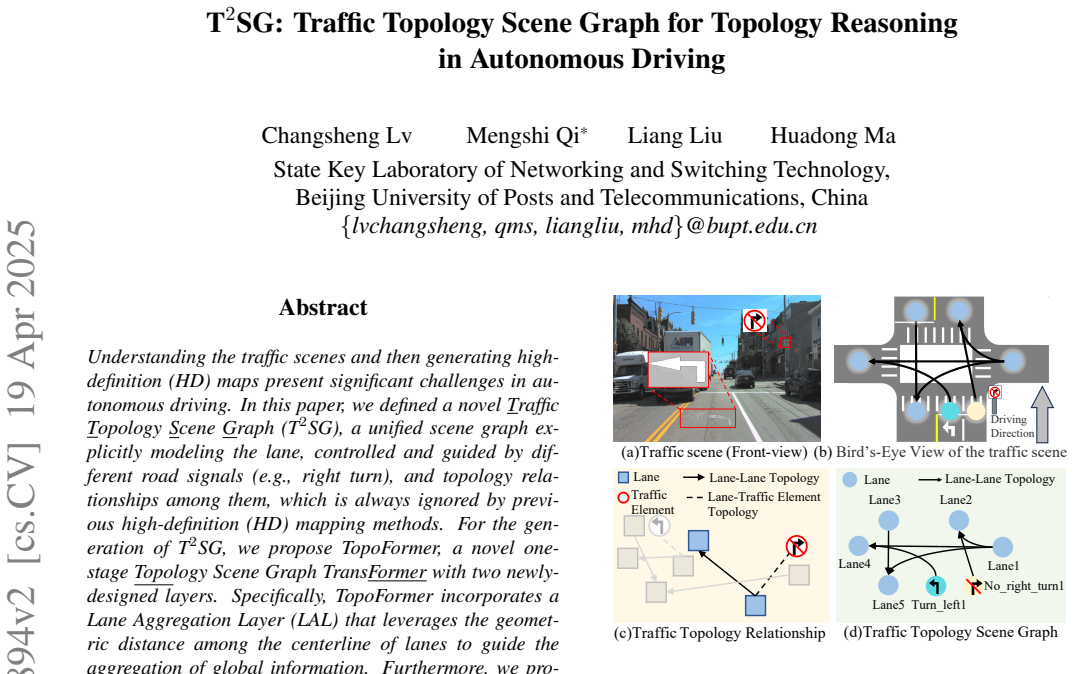
The central claim is that a single scene graph, T2SG, can carry the full topological structure of a traffic scene: each lane node carries a centerline and a category drawn from ten classes that include road-sign semantics (go straight, turn left, no right turn, and so on), and each directed edge is a binary connectivity indicator. The paper's TopoFormer learns this graph in one stage: it first detects lane centerlines with a DETR-style detector, then passes the lane queries through Lane Aggregation Layers whose self-attention is biased by a spatial-proximity matrix built from inverse distances between lane endpoints, and then through a Counterfactual Intervention Layer that trains the model to maximize the total indirect effect of learned attention on edge predictions while using the factual attention at inference. On OpenLane-V2 subsetA the method reaches 46.3 OLS, with lane-to-lane topology at 24.1 and lane-to-traffic-element topology at 29.5, and on subsetB it reaches 47.5 OLS, both above the prior published results.
Load-bearing premise
The load-bearing premise is that matching a lane's predicted category to a traffic element's predicted category is a trustworthy substitute for the true 'this signal controls this lane' relationship; if that premise fails, the topology gain mostly reflects classification accuracy.
Editorial extensions
If this is right
- Lane detection, road-sign understanding, and topology reasoning can be trained jointly as one scene-graph generation task instead of as separate detection-plus-matching pipelines.
- Geometry-guided global attention yields better lane centerline detection (DETl 34.7 on subsetA, up 4.8 over the prior best) as well as better connectivity, so spatial priors help perception itself, not just relation reasoning.
- Counterfactual training on road structure transfers to inference, because the model uses only factual attention at test time yet still improves TOPll and TOPlt over the no-intervention baselines.
- The same T2SG output can feed downstream tasks directly: a planner or predictor can query the graph for which signal controls a lane and which lane follows which, instead of recomputing topology from raw detections.
Reading between the lines
- Editorial inference: because Eq. (16) declares a lane-to-traffic-element connection whenever the predicted lane class equals the predicted traffic-element class, the reported TOPlt of 29.5 probably borrows much of its signal from classification accuracy; a variant that matches signals to lanes by geometric proximity or by a learned edge head would separate structural reasoning from class predictio
- Editorial inference: the counterfactual intervention could be acting largely as a regularizer that prevents attention from latching onto spurious feature correlations; an equal-parameter baseline with random attention masking or dropout would test whether the causal framing adds anything beyond regularization.
- Editorial inference: the T2SG node vocabulary could be extended to traffic lights, speed limits, and crosswalks, and the counterfactual layer could then model the effect of signal state (red/green) on lane availability, which would make the graph directly useful for motion planning rather than mapping only.
Editorial analysis
A structured set of objections, weighed in public.
Referee Report
Summary. The paper proposes a Traffic Topology Scene Graph (T2SG) representation for autonomous driving scenes, where nodes are lanes with maneuver categories and edges encode lane-to-lane connectivity. The authors introduce TopoFormer, a one-stage transformer with a Lane Aggregation Layer (LAL) using geometry-guided self-attention and a Counterfactual Intervention Layer (CIL) that encourages the learned attention to have a positive total indirect effect on edge prediction. They evaluate on OpenLane-V2 subsetA and subsetB, reporting 46.3 and 47.5 OLS respectively, outperforming prior work (TopoLogic 44.1 and 42.3). They also construct a T2SG generation task and report improvements over scene-graph baselines.
Significance. If the results hold, T2SG would be a useful unified representation for HD mapping and topology reasoning, and the geometric attention and counterfactual intervention are interesting architectural ideas. The paper introduces a new benchmark task and provides quantitative comparisons. However, the claimed advantage in traffic topology reasoning is weakened because the lane-to-traffic-element topology for road signs is not learned; Eq. (16) sets it by class equality. Consequently, the reported TOPlt and the OLS margin are not a valid demonstration of improved structural reasoning. The lane-lane topology component is genuinely learned, but it improves only modestly over the strongest baseline.
major comments (3)
- [3.6, Eq. (16)] The lane-to-traffic-element topology Elt(i,j) is defined as 1 whenever the predicted lane class v̂c_i equals the predicted traffic element class t̂c_j. This rule is hardcoded and independent of the learned TopoFormer model for road signs; the lane-light relations are handled separately with an MLP borrowed from [13]. As a result, the reported TOPlt of 29.5 on subsetA (Table 2) and the +3.6 gain over TopoLogic (25.4) can be explained by improved lane and traffic-element classification (DETl 34.7 vs 29.9, DETt 48.2 vs 47.2) rather than by any learned topology reasoning. The manuscript currently provides no oracle experiment using ground-truth classes in Eq. (16), no precision/recall breakdown, and no learned baseline for the sign-to-lane edges. Without these, the state-of-the-art OLS claim in the abstract is not supported as a claim about topology reasoning.
- [4.4, Table 3] The ablation study selects the best configuration ('w/ Add SPM' and 'CIL-Zero') by comparing OLS on the same subsetA benchmark that is later reported as the final result. This is a form of test-set model selection; the reported 46.3 OLS is therefore an optimistically biased estimate. The authors should either use a held-out validation set for choosing hyperparameters and variants, or report the mean and standard deviation over multiple seeds and a paired significance test for the comparison with TopoLogic. As written, the 2.2 OLS advantage over TopoLogic cannot be assessed for statistical reliability.
- [Abstract and Introduction] The paper states that T2SG 'explicitly model[s] the lane, controlled and guided by different road signals... and topology relationships among them' and that TopoFormer 'significantly enhances traffic topology reasoning.' However, in the actual system, the lane-to-sign edges are produced by the class-equality lookup of Eq. (16) and the lane-to-traffic-light edges by an independent MLP; the only edges learned by TopoFormer are lane-to-lane (Ell in Sec. 3.6). The claims should be scoped to lane-to-lane topology reasoning and the T2SG generation task, or the model should be extended to learn lane-to-sign relations. This is necessary to avoid misleading the reader about what is actually learned.
minor comments (6)
- [Related Work] The reference to 'TopoLogits [7]' should be 'TopoLogic' to match the name used in Table 2 and the published paper.
- [Eq. (12)] The notation uses A both as the learned attention matrix and as the counterfactual intervention value; this is confusing and should be clarified, for instance by writing the intervention as do(A = Ā) and using a distinct symbol for the counterfactual attention.
- [Table 1] The baseline 'Baseline' appears to be a detector without any scene graph model, yet GCN-based methods such as 3DSSG and EdgeGCN drop to 0.4 A@1.0 compared with 8.0 for the baseline; this large degradation is surprising and should be explained, for example by describing how the baselines are adapted and trained on the T2SG task.
- [4.1, Datasets] The construction of the T2SG dataset from OpenLane-V2 is described in a single sentence; the authors should specify how the lane maneuver categories and the lane-lane ground-truth edges are derived from the OpenLane-V2 annotations, and how the graph is used for the scene graph generation experiments.
- [3.6, Traffic topology reasoning] The sentence 'since our generated T2SG focuses solely on the road itself, the category Clc includes road signals' is confusing because Clc was defined in Sec. 3.1 as the set of lane categories; the authors should rephrase to distinguish between lane maneuver classes and traffic-element classes.
- [Abstract and Sec. 1] The promise of source code release at the given GitHub URL should be verified and a license should be stated at publication time; the current text says 'We will release' in the abstract but the footnote says 'available', which is inconsistent.
Circularity Check
Eq. (16) defines the lane-traffic-element topology as equality of predicted class labels, so the reported TOPlt and the OLS advantage are partly a renamed classification result.
-
fitted input called prediction
[Section 3.6, Eq. (16)]
"for Elt, traffic elements and lanes that share the same class indicate connectivity. This connectivity is expressed as follows: Elt(i, j) = 1, if vc_i = tc_j, 0, otherwise. (16) where vc_i and tc_j represent the categories of the lane v_i and traffic element t_j, respectively, as obtained from Eq. (1) and Eq. (15)."
The lane-traffic-element topology is not output by the learned edge head (Eq. 10), which is only applied to lane-lane pairs; instead, Elt is a deterministic equality test on the predicted class labels v_c and t_c, which are themselves fitted outputs of the lane and traffic-element classifiers trained by the classification losses in Eqs. (11)-(14). Therefore TOPlt, and through OLS the headline 46.3 score, partly measures classification accuracy rather than structural topology reasoning. The paper presents this as a topology-reasoning result without a learned baseline or precision/recall analysis for Eq. (16), so the TOPlt gain is, by construction, a renamed classification output.
full rationale
The paper contains one genuinely learned and independently grounded component: the lane-lane topology, which is predicted by the edge head (Eq. 10) on top of the Lane Aggregation Layer and Counterfactual Intervention Layer, and it is evaluated against external OpenLane-V2 ground truth. That branch is not circular. However, the claim of state-of-the-art traffic topology reasoning rests on the OpenLane-V2 score, which includes TOPlt. The paper's Eq. (16) defines TOPlt's lane-traffic-element edges as the equality of two independently predicted semantic class labels. This is not a learned structural relation; it is a deterministic function of the outputs of the two detection classifiers. If the classifiers are accurate, TOPlt will be high even if the model has learned no control/guide relationships. The paper provides no oracle study, no precision/recall decomposition, and no learned comparison for Eq. (16), so the reader cannot separate topology reasoning from classification accuracy. This makes the core 'topology reasoning SOTA' claim partially circular, while the lane-lane reasoning contribution retains independent content. No load-bearing self-citation circularity was found; the self-cited SGformer is used as a baseline, not as a justification for the central claim. Score 6 reflects that a major reported prediction component reduces by construction, while the remaining contributions are independent.
Assumptions & free parameters
free parameters (3)
- Loss coefficients λcls and λreg =
not reported
- Number of LAL and CIL layers =
2 LAL, 1 CIL (Figure 2)
- epsilon in SPM (Eq. 2) =
unspecified small constant
assumptions (4)
- domain assumption The 10 lane categories in the constructed T2SG dataset are annotated consistently and match the road-sign control semantics claimed.
- ad hoc to paper Class equality in Eq. (16) is a valid proxy for lane-to-traffic-element control relationships.
- ad hoc to paper Zero-attention counterfactual isolates the causal contribution of learned road structure.
- domain assumption Published comparison scores from prior methods were produced under the same evaluation protocol.
Cite this review
Pith. "Pith review of T2SG: Traffic Topology Scene Graph for Topology Reasoning in Autonomous Driving." pith.science (2026). https://pith.science/paper/3C55BFBP
@misc{pith2026241118894,
  author       = {Pith},
  title        = {Pith review of: T2SG: Traffic Topology Scene Graph for Topology Reasoning in Autonomous Driving},
  year         = {2026},
  howpublished = {\url{https://pith.science/paper/3C55BFBP}},
  note         = {Machine review of arXiv:2411.18894}
}
read the original abstract
Understanding the traffic scenes and then generating high-definition (HD) maps present significant challenges in autonomous driving. In this paper, we defined a novel Traffic Topology Scene Graph, a unified scene graph explicitly modeling the lane, controlled and guided by different road signals (e.g., right turn), and topology relationships among them, which is always ignored by previous high-definition (HD) mapping methods. For the generation of T2SG, we propose TopoFormer, a novel one-stage Topology Scene Graph TransFormer with two newly designed layers. Specifically, TopoFormer incorporates a Lane Aggregation Layer (LAL) that leverages the geometric distance among the centerline of lanes to guide the aggregation of global information. Furthermore, we proposed a Counterfactual Intervention Layer (CIL) to model the reasonable road structure ( e.g., intersection, straight) among lanes under counterfactual intervention. Then the generated T2SG can provide a more accurate and explainable description of the topological structure in traffic scenes. Experimental results demonstrate that TopoFormer outperforms existing methods on the T2SG generation task, and the generated T2SG significantly enhances traffic topology reasoning in downstream tasks, achieving a state-of-the-art performance of 46.3 OLS on the OpenLane-V2 benchmark. We will release our source code and model.
Figures


Forward citations
Cited by 1 Pith paper
-
TopoPoint: Enhance Topology Reasoning via Endpoint Detection in Autonomous Driving
TopoPoint detects lane endpoints explicitly and uses geometry matching to refine them, achieving 48.8 OLS on OpenLane-V2.
Reference graph
Works this paper leans on
-
[13]
Graph-based topology reasoning for driving scenes
Tianyu Li, Li Chen, Huijie Wang et al. Graph-based topology reasoning for driving scenes. arXiv preprint arXiv:2304.05277, 2023. 1, 4, 6, 7, 8
arXiv 2023
-
[1]
nuscenes: A multimodal dataset for autonomous driving
Holger Caesar, Varun Bankiti, Alex H Lang et al. nuscenes: A multimodal dataset for autonomous driving. In Proceed- ings of the IEEE/CVF conference on computer vision and pattern recognition, pages 11621–11631, 2020. 6
work page 2020
-
[2]
Structured bird’s-eye-view traffic scene understanding from onboard images
Yigit Baran Can, Alexander Liniger, Danda Pani Paudel et al. Structured bird’s-eye-view traffic scene understanding from onboard images. In Proceedings of the IEEE/CVF Interna- tional Conference on Computer Vision, pages 15661–15670,
-
[3]
Topology preserving local road network estimation from sin- gle onboard camera image
Yigit Baran Can, Alexander Liniger, Danda Pani Paudel et al. Topology preserving local road network estimation from sin- gle onboard camera image. In Proceedings of the IEEE/CVF Conference on Computer Vision and Pattern Recognition , pages 17263–17272, 2022. 2
work page 2022
-
[4]
End-to-end object detection with transformers
Nicolas Carion, Francisco Massa, Gabriel Synnaeve et al. End-to-end object detection with transformers. In European conference on computer vision , pages 213–229. Springer,
-
[5]
Mp3: A unified model to map, perceive, predict and plan
Sergio Casas, Abbas Sadat and Raquel Urtasun. Mp3: A unified model to map, perceive, predict and plan. In Pro- ceedings of the IEEE/CVF Conference on Computer Vision and Pattern Recognition, pages 14403–14412, 2021. 1
work page 2021
-
[6]
Yuren Cong, Michael Ying Yang and Bodo Rosenhahn. Reltr: Relation transformer for scene graph generation.IEEE Transactions on Pattern Analysis and Machine Intelligence, 45(9):11169–11183, 2023. 2
work page 2023
-
[7]
Topologic: An interpretable pipeline for lane topology reasoning on driving scenes
Yanping Fu, Wenbin Liao, Xinyuan Liu et al. Topologic: An interpretable pipeline for lane topology reasoning on driving scenes. Advances in Neural Information Processing Systems, 37:61658–61676, 2024. 2, 4, 7
work page 2024
Show all 46 references
-
[8]
Deep residual learning for image recognition
Kaiming He, Xiangyu Zhang, Shaoqing Ren et al. Deep residual learning for image recognition. In Proceedings of the IEEE conference on computer vision and pattern recog- nition, pages 770–778, 2016. 4, 5, 6
2016
-
[9]
Causalpc: Improving the robustness of point cloud classification by causal effect identification
Yuanmin Huang, Mi Zhang, Daizong Ding et al. Causalpc: Improving the robustness of point cloud classification by causal effect identification. In Proceedings of the IEEE/CVF Conference on Computer Vision and Pattern Recognition , pages 19779–19789, 2024. 3
2024
-
[10]
Egtr: Ex- tracting graph from transformer for scene graph generation
Jinbae Im, JeongYeon Nam, Nokyung Park et al. Egtr: Ex- tracting graph from transformer for scene graph generation. In Proceedings of the IEEE/CVF Conference on Computer Vision and Pattern Recognition, pages 24229–24238, 2024. 2, 6, 7
2024
-
[11]
Image retrieval using scene graphs
Justin Johnson, Ranjay Krishna, Michael Stark et al. Image retrieval using scene graphs. InProceedings of the IEEE con- ference on computer vision and pattern recognition , pages 3668–3678, 2015. 2
2015
-
[12]
Visual genome: Connecting language and vision using crowd- sourced dense image annotations
Ranjay Krishna, Yuke Zhu, Oliver Groth et al. Visual genome: Connecting language and vision using crowd- sourced dense image annotations. International journal of computer vision, 123(1):32–73, 2017. 2
2017
-
[14]
Bevformer: Learning bird’s-eye-view representation from multi-camera images via spatiotemporal transformers
Zhiqi Li, Wenhai Wang, Hongyang Li et al. Bevformer: Learning bird’s-eye-view representation from multi-camera images via spatiotemporal transformers. In European con- ference on computer vision, pages 1–18. Springer, 2022. 4
2022
-
[15]
Maptr: Structured modeling and learning for online vectorized hd map construction
Bencheng Liao, Shaoyu Chen, Xinggang Wang et al. Maptr: Structured modeling and learning for online vectorized hd map construction. arXiv preprint arXiv:2208.14437, 2022. 1, 2, 7
2022 arXiv
-
[16]
Lane graph as path: Continuity-preserving path-wise modeling for online lane graph construction
Bencheng Liao, Shaoyu Chen, Bo Jiang et al. Lane graph as path: Continuity-preserving path-wise modeling for online lane graph construction. In European Conference on Com- puter Vision, pages 334–351. Springer, 2025. 2
2025
-
[17]
Feature pyra- mid networks for object detection
Tsung-Yi Lin, Piotr Doll ´ar, Ross Girshick et al. Feature pyra- mid networks for object detection. In Proceedings of the IEEE conference on computer vision and pattern recogni- tion, pages 2117–2125, 2017. 4, 5, 6
2017
-
[18]
Focal loss for dense object detection
Tsung-Yi Lin, Priya Goyal, Ross Girshick et al. Focal loss for dense object detection. In Proceedings of the IEEE inter- national conference on computer vision , pages 2980–2988,
-
[19]
Vectormap- net: End-to-end vectorized hd map learning
Yicheng Liu, Tianyuan Yuan, Yue Wang et al. Vectormap- net: End-to-end vectorized hd map learning. In Inter- national Conference on Machine Learning , pages 22352– 22369. PMLR, 2023. 1, 2, 7
2023
-
[20]
Sgdr: Stochas- tic gradient descent with warm restarts
Ilya Loshchilov and Frank Hutter. Sgdr: Stochas- tic gradient descent with warm restarts. arXiv preprint arXiv:1608.03983, 2016. 6
2016 arXiv
-
[21]
Sgformer: Seman- tic graph transformer for point cloud-based 3d scene graph generation
Changsheng Lv, Mengshi Qi, Xia Li et al. Sgformer: Seman- tic graph transformer for point cloud-based 3d scene graph generation. In Proceedings of the AAAI Conference on Arti- ficial Intelligence, pages 4035–4043, 2024. 2, 7
2024
-
[22]
Disentan- gled counterfactual learning for physical audiovisual com- monsense reasoning
Changsheng Lv, Shuai Zhang, Yapeng Tian et al. Disentan- gled counterfactual learning for physical audiovisual com- monsense reasoning. Advances in Neural Information Pro- cessing Systems, 36, 2024. 3
2024
-
[23]
Attentive relational networks for mapping images to scene graphs
Mengshi Qi, Weijian Li, Zhengyuan Yang et al. Attentive relational networks for mapping images to scene graphs. In Proceedings of the IEEE/CVF Conference on Computer Vi- sion and Pattern Recognition, pages 3957–3966, 2019. 2
2019
-
[24]
Stagnet: An at- tentive semantic rnn for group activity and individual action recognition
Mengshi Qi, Yunhong Wang, Jie Qin et al. Stagnet: An at- tentive semantic rnn for group activity and individual action recognition. IEEE Transactions on Circuits and Systems for Video Technology, 30(2):549–565, 2019. 1
2019
-
[25]
Stc-gan: Spatio-temporally coupled generative adversarial networks for predictive scene parsing
Mengshi Qi, Yunhong Wang, Annan Li et al. Stc-gan: Spatio-temporally coupled generative adversarial networks for predictive scene parsing. IEEE Transactions on Image Processing, 29:5420–5430, 2020. 2
2020
-
[26]
Semantics-aware spatial- temporal binaries for cross-modal video retrieval
Mengshi Qi, Jie Qin, Yi Yang et al. Semantics-aware spatial- temporal binaries for cross-modal video retrieval. IEEE Transactions on Image Processing, 30:2989–3004, 2021. 2
2021
-
[27]
End-to-end vec- torized hd-map construction with piecewise bezier curve
Limeng Qiao, Wenjie Ding, Xi Qiu et al. End-to-end vec- torized hd-map construction with piecewise bezier curve. In Proceedings of the IEEE/CVF Conference on Computer Vi- sion and Pattern Recognition, pages 13218–13228, 2023. 2
2023
-
[28]
Counterfac- tual attention learning for fine-grained visual categorization and re-identification
Yongming Rao, Guangyi Chen, Jiwen Lu et al. Counterfac- tual attention learning for fine-grained visual categorization and re-identification. In Proceedings of the IEEE/CVF inter- national conference on computer vision , pages 1025–1034,
-
[29]
Sgaligner: 3d scene alignment with scene graphs
Sayan Deb Sarkar, Ondrej Miksik, Marc Pollefeys et al. Sgaligner: 3d scene alignment with scene graphs. In Proceedings of the IEEE/CVF International Conference on Computer Vision, pages 21927–21937, 2023. 2
2023
-
[30]
Keep your eyes on the lane: Real-time attention-guided lane detection
Lucas Tabelini, Rodrigo Berriel, Thiago M Paixao et al. Keep your eyes on the lane: Real-time attention-guided lane detection. In Proceedings of the IEEE/CVF conference on computer vision and pattern recognition , pages 294–302,
-
[31]
Rio: 3d object instance re-localization in changing indoor envi- ronments
Johanna Wald, Armen Avetisyan, Nassir Navab et al. Rio: 3d object instance re-localization in changing indoor envi- ronments. In Proceedings of the IEEE/CVF International Conference on Computer Vision, pages 7658–7667, 2019. 6, 7
2019
-
[32]
Learning 3d semantic scene graphs from 3d indoor reconstructions
Johanna Wald, Helisa Dhamo, Nassir Navab et al. Learning 3d semantic scene graphs from 3d indoor reconstructions. In Proceedings of the IEEE/CVF Conference on Computer Vision and Pattern Recognition, pages 3961–3970, 2020. 2
2020
-
[33]
Openlane-v2: A topology reasoning benchmark for unified 3d hd mapping
Huijie Wang, Tianyu Li, Yang Li et al. Openlane-v2: A topology reasoning benchmark for unified 3d hd mapping. In NeurIPS, 2023. 1, 2, 3, 5, 6, 7, 8
2023
-
[34]
Vqa- gnn: Reasoning with multimodal knowledge via graph neu- ral networks for visual question answering
Yanan Wang, Michihiro Yasunaga, Hongyu Ren et al. Vqa- gnn: Reasoning with multimodal knowledge via graph neu- ral networks for visual question answering. In Proceedings of the IEEE/CVF International Conference on Computer Vi- sion, pages 21582–21592, 2023. 2
2023
-
[35]
Drones help drones: A collaborative framework for multi-drone ob- ject trajectory prediction and beyond
Zhechao Wang, Peirui Cheng, Minxing Chen et al. Drones help drones: A collaborative framework for multi-drone ob- ject trajectory prediction and beyond. Advances in Neural Information Processing Systems, 37:64604–64628, 2024. 1
2024
-
[36]
Argo- verse 2: Next generation datasets for self-driving perception and forecasting
Benjamin Wilson, William Qi, Tanmay Agarwal et al. Argo- verse 2: Next generation datasets for self-driving perception and forecasting. In Advances in Neural Information Process- ing Systems, 2023. 6
2023
-
[37]
Topomlp: A simple yet strong pipeline for driving topology reasoning
Dongming Wu, Jiahao Chang, Fan Jia et al. Topomlp: A simple yet strong pipeline for driving topology reasoning. In The Twelfth International Conference on Learning Represen- tations, 2024. 2, 4, 6, 7
2024
-
[38]
Scene graph generation by iterative message passing
Danfei Xu, Yuke Zhu, Christopher B Choy et al. Scene graph generation by iterative message passing. In Proceed- ings of the IEEE Conference on Computer Vision and Pattern Recognition, pages 5410–5419, 2017. 2
2017
-
[39]
Exploring diverse in-context configurations for image captioning
Xu Yang, Yongliang Wu, Mingzhuo Yang et al. Exploring diverse in-context configurations for image captioning. Ad- vances in Neural Information Processing Systems, 36, 2024. 2
2024
-
[40]
Topo2seq: En- hanced topology reasoning via topology sequence learning
Yiming Yang, Yueru Luo, Bingkun He et al. Topo2seq: En- hanced topology reasoning via topology sequence learning. arXiv preprint arXiv:2502.08974, 2025. 2
2025 arXiv
-
[41]
Commonscenes: Generating commonsense 3d indoor scenes with scene graphs
Guangyao Zhai, Evin Pınar ¨Ornek, Shun-Cheng Wu et al. Commonscenes: Generating commonsense 3d indoor scenes with scene graphs. Advances in Neural Information Process- ing Systems, 36, 2024. 2
2024
-
[42]
Exploiting edge- oriented reasoning for 3d point-based scene graph analysis
Chaoyi Zhang, Jianhui Yu, Yang Song et al. Exploiting edge- oriented reasoning for 3d point-based scene graph analysis. In Proceedings of the IEEE/CVF Conference on Computer Vision and Pattern Recognition, pages 9705–9715, 2021. 6, 7
2021
-
[43]
On- line vectorized hd map construction using geometry
Zhixin Zhang, Yiyuan Zhang, Xiaohan Ding et al. On- line vectorized hd map construction using geometry. In European Conference on Computer Vision , pages 73–90. Springer, 2024. 2
2024
-
[44]
3dvg- transformer: Relation modeling for visual grounding on point clouds
Lichen Zhao, Daigang Cai, Lu Sheng et al. 3dvg- transformer: Relation modeling for visual grounding on point clouds. In Proceedings of the IEEE/CVF International Conference on Computer Vision, pages 2928–2937, 2021. 4
2021
-
[45]
Unsupervised self-driving attention prediction via uncertainty mining and knowledge embedding
Pengfei Zhu, Mengshi Qi, Xia Li et al. Unsupervised self-driving attention prediction via uncertainty mining and knowledge embedding. In Proceedings of the IEEE/CVF International Conference on Computer Vision, pages 8558– 8568, 2023. 1
2023
-
[46]
Deformable detr: Deformable transformers for end-to-end object detection
Xizhou Zhu, Weijie Su, Lewei Lu et al. Deformable detr: Deformable transformers for end-to-end object detection. In International Conference on Learning Representations ,
Reviewed August 12, 2026 · model on record in the stance chip above.
Discussion (0). Continue with ORCID to comment.