REVIEW 4 major objections 6 minor 14 references
Tale of tails using rule augmented sequence labeling for event extraction
T0 review · 4 major / 6 minor · reviewed 2026-08-14 · deepseek-v4-flash
Pith's one-line read Rule augmentation lifts rare event labels in low-resource event extraction.
desk verdict The dataset is the real contribution; the rule-augmentation gains are plausible but statistically unproven, and the paper overclaims at larger training sizes. read the letter →
The pith
A machine-rendered reading of the paper's core claim, the machinery that carries it, and where it could break.
The reading
What carries the argument
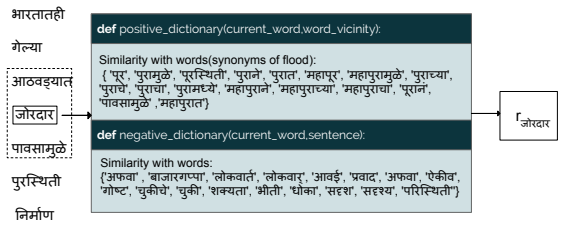
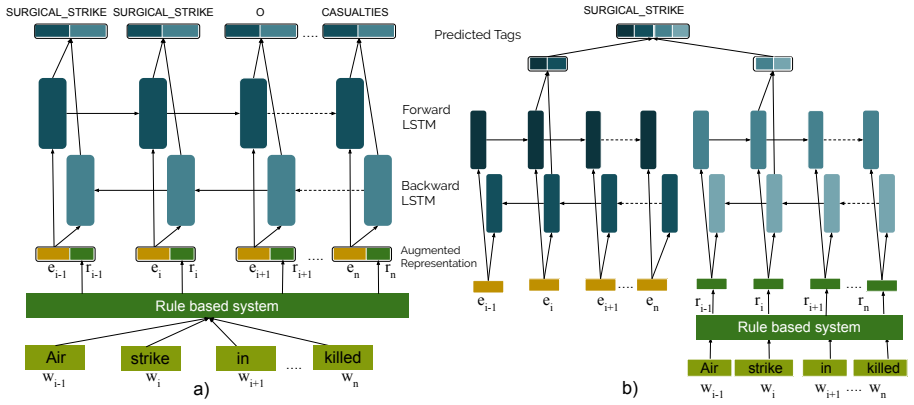
The carrying object is the rule vector: for each word, Algorithm 1 sets bits for every label whose synonym dictionary has a match inside a window of size 2l around the word, and sets 'other' when the word is in a negative dictionary or nothing matches. It is multi-hot because labels overlap, so an attack can be both a normal bombing and a terrorist attack. The paper feeds this vector into the Bi-LSTM in three ways: concatenated with fastText embeddings, passed through a parallel Bi-LSTM whose hidden states are concatenated, or distilled into the network by biasing the prediction distribution as q*(T|w_i) proportional to p_theta(T|w_i) exp(-C(1-r_i)). The rule vector does the work of transferring rare-label knowledge without needing many training examples.
What would settle it
A direct test is to compute dictionary coverage on the gold tail-label triggers in the test split: run Algorithm 1 with the released dictionaries and check what fraction of gold trigger tokens have a dictionary match in their window. If coverage on tail labels is low (say, under 80%) while the reported tail F1 gains are large, the gains cannot be coming from the rules, and the 'tail labels can be easily incorporated' claim is falsified.
Extended reading notes
Core claim
The central discovery is that tail labels in event extraction are handled more reliably when the model receives a rule-derived vector alongside learned word representations. The paper states that tail labels can be easily incorporated by creating new rules without large annotated data. In its experiments, rule-augmented methods outperform plain deep learning on lesser annotated data and low-resource languages; for example, many tail labels improve at 20% and 40% training sizes. The authors' own framing is that the value of rules is greatest exactly where deep learning is weakest.
Load-bearing premise
The method stands on the assumption that a hand-built synonym dictionary covers the trigger words that actually occur in test text, because any word outside the dictionaries is silently labeled 'other' and contributes no rule signal.
Editorial extensions
If this is right
- At 20% and 40% training data, rule-augmented variants improve micro- and macro-F1 over the Bi-LSTM baseline for several low-resource languages, with the gains concentrated among tail labels.
- A new tail label can be added by writing a synonym dictionary and a rule, which the paper argues requires no large annotated corpus.
- Even though plain Bi-LSTM catches up when all training data is available, the rule signal determines performance at the small-data sizes typical of low-resource settings.
- Dropping CRF is justified in this regime: transition probabilities learned from skewed label distributions hurt rare tags, and rule vectors supply the missing signal.
Reading between the lines
- The practical claim 'without large annotated data' hides the cost of dictionary construction; a careful reader would measure dictionary building time per label to assess the true trade-off.
- Because the method's tail gain depends on lexical coverage, a natural improvement is to let the rule layer learn morphological variants from unlabeled text, reducing the need for exact dictionary entries.
- The same rule-vector recipe likely transfers to other sequence labeling problems where labels have recognizable trigger lexicons, such as argument role labeling, slot filling, or intent detection.
- If dictionary coverage correlates with tail F1 gain, the method becomes a diagnostic: labels with low coverage are exactly the ones that need more annotation, turning rule augmentation into a data-collection guide.
Signed reviews
Editorial analysis
A structured set of objections, weighed in public.
Referee Report
Summary. The paper introduces InDEE-2019, a disaster-domain event extraction dataset in five Indic languages (Marathi, Hindi, English, Tamil, Bengali) with 43–48 labels per language, and proposes three rule-augmented Bi-LSTM variants for sequence labeling. The rule layer is a multi-hot vector per token built from hand-made positive and negative synonym dictionaries; it is incorporated either by concatenation with word embeddings, by a parallel Bi-LSTM whose hidden states are concatenated, or by distillation with a teacher distribution biased by the rule vector. Experiments train on 20%–100% splits and report micro/macro F1, with special attention to tail labels. The empirical claim is that rule-augmented methods outperform plain Bi-LSTM at small training sizes and that tail labels can be incorporated by creating new rules without large annotated data.
Significance. If substantiated, the paper would provide a useful resource (the InDEE-2019 dataset) and a practical recipe for low-resource event extraction: a simple, interpretable rule layer that compensates for scarce training data and handles rare labels. The framing as sequence labeling, the coverage of five languages, and the release of a new dataset are concrete strengths. However, the central comparative claim rests entirely on single-run point estimates without variance or significance testing, and the cost of constructing the rule dictionaries is not quantified. As written, the evidence is not strong enough to establish that rule augmentation reliably beats the Bi-LSTM baseline on lesser annotated data; the direction of the effect is plausible but the effect size is often within run-to-run noise.
major comments (4)
- [§5.2, Tables 3–6] Every F1 score in Tables 3–6 is a point estimate with no confidence intervals, standard deviations, number of random seeds, or significance tests. This matters directly because the headline claim (rule-augmented methods outperform deep learning on lesser annotated data) is supported by margins that are often small. For example, in Table 6 at 20% training, Bengali B/C/D are all below baseline A (63.90/63.16/63.28 vs 64.26), Tamil D is below A (66.25 vs 67.44), and Hindi B is below A (48.44 vs 48.56). At 40%, Tamil D is below A (50.93 vs 55.94 in Table 5; 70.03 vs 70.99 in Table 6). Without repeated runs and a paired significance test (e.g., bootstrap or approximate randomization over test sentences), the claimed advantage could be run-to-run noise. I recommend reporting mean±std over at least 5 seeds and a significance test for the key 20%/40% comparisons.
- [Table 6, Tamil rows] The Tamil block in Table 6 shows exactly identical micro/macro F1 values for 80% and 100% training for all four models (e.g., A: 73.62/69.77; B: 74.3/69.1; C: 73.7/69.33; D: 73.69/69.2). It is implausible that training on 80% versus 100% of the data yields identical scores for every model unless the rows were copied or the experimental setup is misdescribed. This must be corrected or explained, since it undermines the trustworthiness of the reported table.
- [§5.2, tail-label definition and Table 5] The definition of a tail label is ambiguous: 'We chose those tails labels whose sum forms 5% of total training set instances.' This could mean a cumulative-frequency threshold, a per-label count threshold, or something else, and it should be stated precisely (e.g., labels whose total number of training mentions is below a fixed cutoff). In addition, Table 5 is introduced with the phrase 'significant improvement,' but no significance testing is reported anywhere; several cells show tiny margins (e.g., Hindi 20% D: 29.87 vs A: 29.57; Tamil 20% B: 44.95 vs A: 44.88). Please clarify the tail-label criterion and qualify the word 'significant' accordingly.
- [§4.2, §4.3, Algorithm 1] The claim that 'tail labels can be easily incorporated by creating new rules without the requirement of large annotated data' depends on the cost and coverage of the hand-built synonym and negative dictionaries, but the paper provides no dictionary sizes, per-label counts, or coverage rates. Algorithm 1 defaults an unmatched token to 'other' (ri[other]=1), so incomplete dictionary coverage could directly suppress rare-event recall. The manuscript should report how many dictionary entries were created per language and per label, evaluate rule-vector coverage on the test set, and discuss the manual effort involved; otherwise the 'without large annotated data' claim is not yet supported.
minor comments (6)
- [§4.2.1] The sentence 'Once we create robust dictionary for one language is easy to extend it to other languages' should be rephrased for grammar and, more importantly, should be supported by evidence or hedged as a hypothesis, since cross-lingual dictionary transfer is a nontrivial claim.
- [Algorithm 1] The pseudocode is ambiguous at line 3: it checks whether the whole word sequence {w1,...,wn} is in {neg}, while the surrounding text says 'If any word wi in the sentence found in negative dictionary.' Please align the pseudocode with the intended per-word check and clarify the variable 'flag' initialization and scope.
- [§4.4.3, Eq. (1)] Equation (1) applies exp(-C(1-ri)) where ri is a multi-hot vector; the reader needs an explicit statement that the exponent is taken elementwise over tags, and a definition of C is needed at the point of the equation (it is introduced later as 'C = 1'). Similarly, the imitation parameter pi is introduced in text but should be defined immediately before Eq. (2).
- [Tables 3 and 4] The counts of 'labels improved' should state explicitly whether equal-score labels are excluded and what the denominator is (the total number of labels per language, 43–48). This will prevent misinterpretation of the improvement counts.
- [Figure 1] Figure 1 contains garbled Marathi text and an untranslated explanation line; the figure should be cleaned and the example dictionary entries presented in a readable transliteration or with a translation, since the reader cannot verify the dictionary construction from the current image.
- [§5.1] The dataset release is a contribution, but no URL or accessibility statement is given beyond the name 'InDEE-2019' in a footnote. Please add a data availability link or repository reference.
Circularity Check
No significant circularity: the rule-augmentation pipeline is an explicit feature-engineering method, not a hidden reduction of predictions to inputs.
full rationale
The paper's central claim is that hand-built synonym and negative dictionaries can be turned into rule vectors (Algorithm 1) and combined with a Bi-LSTM (Sections 4.4.1-4.4.3) to improve tail-label extraction at small training sizes. This is a declared feature-construction method, not a derivation in which an output is defined in terms of itself. The rule vector is a multi-hot indicator built from external lexical resources; the Bi-LSTM still must learn to map the augmented representation to tags, and the final predictions in methods B and C are produced by the network, not by the rule vector alone. Method D's distillation (Eq. 1) reweights the student distribution using the rule vector, but the student distribution is learned from data and the rule vector is not fitted to the test labels, so the held-out tail-label F1 scores in Table 5 are not equal to the rule construction by definition. There are no load-bearing self-citations, no imported uniqueness theorems, and no fitted parameter renamed as a prediction. The absence of error bars and significance tests is a statistical-validity concern, not circularity.
Assumptions & free parameters
free parameters (3)
- Rule window size l =
not reported; multiple values tested
- Distillation constant C =
1
- Imitation parameter pi =
0.4
assumptions (4)
- domain assumption A robust synonym dictionary in one language is easy to extend to other languages
- domain assumption Bi-LSTM without CRF is appropriate for skewed tag distributions
- domain assumption Merging Begin and Inside IOB labels into a single TO tag does not lose event boundary information
- domain assumption fastText embeddings with roughly 50% coverage are sufficient after fine-tuning
Cite this review
Pith. "Pith review of Tale of tails using rule augmented sequence labeling for event extraction." pith.science (2026). https://pith.science/paper/3DULKQGZ
@misc{pith2026190807018,
  author       = {Pith},
  title        = {Pith review of: Tale of tails using rule augmented sequence labeling for event extraction},
  year         = {2026},
  howpublished = {\url{https://pith.science/paper/3DULKQGZ}},
  note         = {Machine review of arXiv:1908.07018}
}
read the original abstract
The problem of event extraction is a relatively difficult task for low resource languages due to the non-availability of sufficient annotated data. Moreover, the task becomes complex for tail (rarely occurring) labels wherein extremely less data is available. In this paper, we present a new dataset (InDEE-2019) in the disaster domain for multiple Indic languages, collected from news websites. Using this dataset, we evaluate several rule-based mechanisms to augment deep learning based models. We formulate our problem of event extraction as a sequence labeling task and perform extensive experiments to study and understand the effectiveness of different approaches. We further show that tail labels can be easily incorporated by creating new rules without the requirement of large annotated data.
Figures

Figures from the paper (1 more)

Reference graph
Works this paper leans on
-
[1]
URL: " 'urlintro :=
ENTRY address author booktitle chapter edition editor howpublished institution journal key month note number organization pages publisher school series title type volume year eprint doi pubmed url lastchecked label extra.label sort.label short.list INTEGERS output.state before.all mid.sentence after.sentence after.block STRINGS urlintro eprinturl eprintpr...
-
[2]
write newline
" write newline "" before.all 'output.state := FUNCTION n.dashify 't := "" t empty not t #1 #1 substring "-" = t #1 #2 substring "--" = not "--" * t #2 global.max substring 't := t #1 #1 substring "-" = "-" * t #2 global.max substring 't := while if t #1 #1 substring * t #2 global.max substring 't := if while FUNCTION word.in bbl.in capitalize " " * FUNCT...
-
[3]
Piotr Bojanowski, Edouard Grave, Armand Joulin, and Tomas Mikolov. 2017. Enriching word vectors with subword information. Transactions of the Association for Computational Linguistics, 5:135--146
2017
-
[4]
Sepp Hochreiter and J \"u rgen Schmidhuber. 1997. Long short-term memory. Neural Computation, 9:1735--1780
1997
-
[5]
Zhiting Hu, Xuezhe Ma, Zhengzhong Liu, Eduard H. Hovy, and Eric P. Xing. 2016. Harnessing deep neural networks with logic rules. CoRR, abs/1603.06318
arXiv 2016
-
[6]
Zhiheng Huang, Wei Xu, and Kai Yu. 2015. Bidirectional lstm-crf models for sequence tagging. CoRR, abs/1508.01991
arXiv 2015
-
[7]
Guillaume Lample, Miguel Ballesteros, Sandeep Subramanian, Kazuya Kawakami, and Chris Dyer. 2016. Neural architectures for named entity recognition. In HLT-NAACL
work page 2016
-
[8]
Thien Huu Nguyen, Kyunghyun Cho, and Ralph Grishman. 2016. Joint event extraction via recurrent neural networks. In HLT-NAACL
work page 2016
Show all 14 references
-
[9]
Lance A Ramshaw and Mitchell P Marcus. 1999. Text chunking using transformation-based learning. In Natural language processing using very large corpora, pages 157--176. Springer
1999
-
[10]
Bach, Henry R
Alexander Ratner, Stephen H. Bach, Henry R. Ehrenberg, Jason Alan Fries, Sen Wu, and Christopher R \'e . 2017. Snorkel: Rapid training data creation with weak supervision. Proceedings of the VLDB Endowment. International Conference on Very Large Data Bases, 11 3:269--282
2017
-
[11]
Manning, and Daniel Jurafsky
Kevin Reschke, Martin Jankowiak, Mihai Surdeanu, Christopher D. Manning, and Daniel Jurafsky. 2014. Event extraction using distant supervision. In LREC
2014
-
[12]
Hinton, Alex Krizhevsky, Ilya Sutskever, and Ruslan R
Nitish Srivastava, Geoffrey E. Hinton, Alex Krizhevsky, Ilya Sutskever, and Ruslan R. Salakhutdinov. 2014. Dropout: a simple way to prevent neural networks from overfitting. Journal of Machine Learning Research, 15:1929--1958
2014
-
[13]
Chen Sun, Abhinav Shrivastava, Saurabh Singh, and Abhinav Gupta. 2017. Revisiting unreasonable effectiveness of data in deep learning era. 2017 IEEE International Conference on Computer Vision (ICCV), pages 843--852
2017
-
[14]
Marco A Valenzuela-Esc \'a rcega, Gus Hahn-Powell, Mihai Surdeanu, and Thomas Hicks. 2015. A domain-independent rule-based framework for event extraction. Proceedings of ACL-IJCNLP 2015 System Demonstrations, pages 127--132
2015
Reviewed August 14, 2026 · model on record in the stance chip above.
Discussion (0). Continue with ORCID to comment.