REVIEW 1 minor 4 references
Differential privacy mechanisms for Fréchet mean and variance on Riemannian manifolds support consistent inference with explicit privacy budgets.
Reviewed by Pith at T0; open to challenge. T0 means a machine referee read the full paper against a public rubric. the ladder, T0–T4 →
T0 review · grok-4.3
2026-06-30 20:17 UTC pith:3EYR77FR
load-bearing objection This paper supplies geometry-calibrated DP mechanisms for Fréchet mean and variance on manifolds plus the matching consistency and CLTs.
Differentially private inference framework for Riemannian manifold data
The pith
A machine-rendered reading of the paper's core claim, the machinery that carries it, and where it could break.
Core claim
Two types of differentially private mechanisms are designed for the Fréchet mean and variance of i.i.d. Riemannian manifold-valued data, tailored to different geometric structures and accompanied by analytic privacy budgets calibrated to the geometry of the underlying manifold; the proposed DP estimators are shown to be consistent and to satisfy central limit theorems, enabling a suite of statistical inference procedures under privacy constraints.
What carries the argument
Differentially private mechanisms for the Fréchet mean and variance whose noise scale and privacy budgets are derived directly from the Riemannian metric and curvature of the data manifold.
Load-bearing premise
The manifold geometry allows closed-form expressions for both the privacy loss of the added noise and the asymptotic variance needed for the central limit theorems.
What would settle it
Empirical coverage of confidence intervals constructed from the private estimators fails to approach the nominal level at the rate predicted by the central limit theorem when sample size grows on a manifold with known geometry such as the unit sphere.
If this is right
- The private estimators converge in probability to the true Fréchet mean and variance as sample size increases.
- Central limit theorems supply normal approximations that justify standard-error-based inference under the stated privacy level.
- Consistent estimators of the asymptotic variance can be computed while preserving differential privacy.
- The same construction yields explicit privacy budgets for any manifold whose exponential map and curvature admit analytic bounds.
Where Pith is reading between the lines
- The geometry-calibrated noise addition may extend to other intrinsic statistics such as geodesic regression coefficients on the same manifolds.
- Medical imaging pipelines that already represent shapes on spheres or Kendall shape spaces could incorporate these mechanisms without changing the downstream analysis code.
- Curvature bounds that are only approximate rather than exact would require numerical privacy accounting whose error must be tracked separately.
Editorial analysis
A structured set of objections, weighed in public.
Referee Report
Summary. The manuscript develops a differentially private inference framework for i.i.d. Riemannian manifold-valued data. It designs two types of DP mechanisms for the Fréchet mean and variance, supplies analytic privacy budgets calibrated to manifold geometry, establishes consistency and central limit theorems for the resulting DP estimators, and provides consistent DP estimators of the asymptotic variance to support downstream inference. The work includes implementation guidelines, numerical experiments, and applications to medical imaging and sociological datasets on representative manifolds.
Significance. If the consistency, CLT, and analytic-budget results hold as claimed, the contribution is significant: it supplies the first systematic geometry-aware DP framework for non-Euclidean data together with the asymptotic theory and variance estimators needed for practical private inference. The explicit calibration of privacy budgets to manifold structure and the provision of reproducible procedures are strengths that would be useful in shape analysis, directional statistics, and medical imaging applications.
minor comments (1)
- The abstract and introduction would benefit from a brief statement of the precise manifold assumptions (e.g., compactness, curvature bounds) required for the analytic sensitivity and CLT derivations.
Simulated Author's Rebuttal
We thank the referee for their positive assessment of the manuscript, recognition of its significance for geometry-aware private inference, and recommendation to accept.
Circularity Check
No significant circularity; derivation is self-contained
full rationale
The paper proposes new DP mechanisms for Fréchet mean/variance on manifolds with geometry-calibrated analytic privacy budgets, then proves consistency and CLTs for the resulting estimators, and supplies consistent DP estimators for the asymptotic variances. These are independent theoretical constructions and proofs; the abstract and description contain no self-definitional equations, no fitted parameters renamed as predictions, and no load-bearing self-citations that reduce the central claims to prior inputs by construction. The weakest assumption (i.i.d. samples on manifolds admitting analytic sensitivity bounds) is a standard prerequisite explicitly noted as necessary, not a hidden tautology.
Axiom & Free-Parameter Ledger
read the original abstract
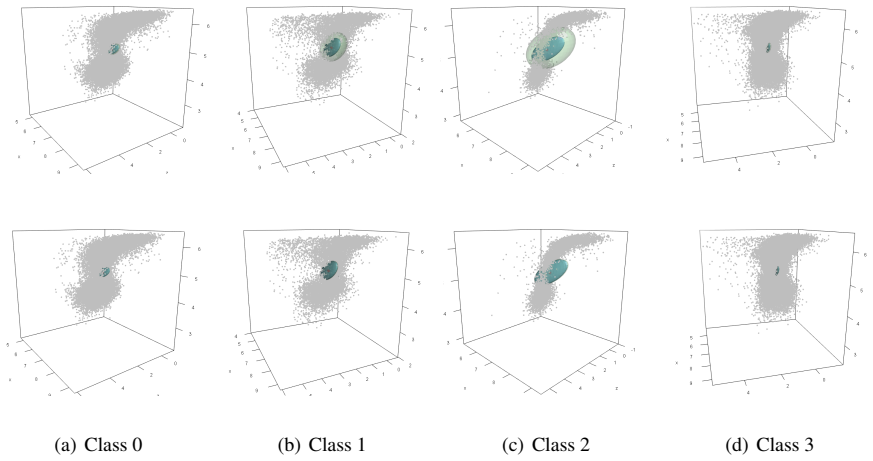
We propose a novel and systematic differentially private (DP) inference framework for non-Euclidean data. First, we design two types of DP mechanisms for the Fr\'echet mean and variance for i.i.d. Riemannian manifold-valued data, tailored to different geometric structures and accompanied by analytic privacy budgets calibrated to the geometry of the underlying manifold. Second, we establish the consistency and central limit theorems (CLTs) of the proposed DP estimators, enabling a suite of statistical inference procedures under privacy constraints. Furthermore, we provide comprehensive implementation guidelines and feasible procedures, including consistent DP estimators of the asymptotic variance in the CLTs. Extensive numerical experiments support the proposed methodologies. Finally, we demonstrate the effectiveness of our approach on real-world medical image and sociological datasets supported on two representative manifolds.
Figures



Reference graph
Works this paper leans on
-
[1]
S. Bhattacharjee, B. Li, and L. Xue. Nonlinear global fr ´echet regression for random objects via weak conditional expectation.arXiv:2310.07817,
- [2]
- [3]
-
[4]
C.-H. Yang and B. C. Vemuri. Shrinkage estimation of the fr´echet mean in lie groups. arXiv:2009.13020,
discussion (0)
Sign in with ORCID, Apple, or X to comment. Anyone can read and Pith papers without signing in.