REVIEW 3 major objections 5 minor 18 references
Computing and Learning Stationary Mean Field Equilibria with Scalar Interactions: Algorithms and Applications
T0 review · 3 major / 5 minor · reviewed 2026-08-09 · deepseek-v4-flash
Pith's one-line read This paper reduces MFE computation in scalar-interaction dynamic games to a one-dimensional root-finding problem and gives globally convergent model-based and model-free algorithms.
desk verdict Scalar bisection for MFE is a genuinely useful idea and the paper is largely defensible, but the ridesharing application violates Assumption 1 at the endpoint, so the global convergence claim is overstated as written. read the letter →
The pith
A machine-rendered reading of the paper's core claim, the machinery that carries it, and where it could break.
The reading
What carries the argument
The scalar interaction reduction is $f(m)=m-M(s_{m,g})$, where $M(s)$ is the scalar interaction function and $s_{m,g}$ is the unique invariant distribution of the Markov chain $L_{m,g}$ induced by the optimal policy $g$ at scalar value $m$. For each fixed $m$, the agent solves a standard discounted dynamic program; the optimal policy then defines a linear Markov chain whose invariant distribution is obtained by solving a linear system. Assumption 1 plus single-valuedness make $f$ continuous, so bracketing $f(a)\leq 0\leq f(b)$ and bisection converge to a root that certifies an MFE. In the learning version, Q-learning replaces the dynamic program and Monte Carlo simulation replaces the linear-system solve, preserving the outer bisection structure.
What would settle it
Take the paper's ridesharing model and run Algorithm 1 with bisection interval $[0,1]$; at scalar value $m=1$ every driver is available, so no driver receives a request, states containing a request are unreachable, and the induced Markov chain is not irreducible on the full state space, meaning Assumption 1 fails and the invariant distribution used to define $f$ does not exist. A single evaluation at $m=1$ therefore breaks the guarantee, so the theorem is falsified unless Assumption 1 is checked at the boundaries.
Extended reading notes
Core claim
The central claim is Theorem 1: under Assumption 1, meaning every induced Markov chain is irreducible and aperiodic, and under a single-valued optimal policy correspondence, the sequence $m_t$ produced by the bisection-driven Algorithm 1 converges to $m^*$ such that $f(m^*)=m^*-M(s_{m^*,g^*})=0$, and the policy $g^*(x,m^*)$ together with the invariant population state $s_{m^*,g^*}$ constitutes an MFE. The same root condition is reached asymptotically by Algorithm 2 when its inner Q-learning and Monte Carlo sampling are run with increasing accuracy. The paper further claims that because all interaction flows through the scalar $M(s)$, the equilibrium set is exactly the zero set of the continuous function $f$, so bisection replaces fixed-point iteration. A model-free version learns the MFE from simulated trajectories without knowing payoffs or transitions, and the same proof structure yields existence on Polish state spaces and monotone comparative statics of the equilibrium scalar under stochastic dominance.
Load-bearing premise
The proof needs the map from each candidate scalar $m$ to an optimal policy to be single-valued and the induced Markov chain to be irreducible and aperiodic; where payoffs or transitions make best responses tied or make some states transient, $f$ may discontinue or fail to exist.
Editorial extensions
If this is right
- In any scalar-interaction model satisfying the assumptions, MFE can be computed by value iteration followed by a linear-system solve, with the number of outer iterations logarithmic in the desired scalar tolerance.
- The same guarantee carries over to the data-driven setting: with enough Q-learning updates and enough simulated transitions, the learned policy and population state approach an MFE even though payoffs and transition probabilities were never estimated.
- Existence no longer requires a compact state space; a moment-boundedness condition on invariant distributions is enough.
- Comparative statics of the equilibrium scalar follow from stochastic dominance of policy-induced invariant distributions, so policy conclusions such as demand shifts raising equilibrium average capacity come with formal support.
Reading between the lines
- The root-finding viewpoint suggests a practical screening test before applying the algorithm: compute $f$ on a coarse grid and check continuity by comparing $f(m+\varepsilon)$ with $f(m)$; where jumps appear, either the policy has ties or the chain is near-non-ergodic, and the user knows the convergence guarantee does not apply.
- Multi-dimensional interactions are the natural next target; the paper's Broyden extension has no global guarantee, but if the Jacobian of $f$ is diagonally dominant in an application, a globally convergent quasi-Newton method might be restored.
- The platform-design reading of the inventory results is that a marketplace controlling both storage fees and commissions can substitute low storage fees for high commissions: even though the paper only sweeps a grid, the equilibrium mechanism of fewer stockouts and more transaction volume gives a testable prediction for platform pricing.
Signed reviews
Editorial analysis
A structured set of objections, weighed in public.
Referee Report
Summary. The paper studies stationary mean field equilibria in dynamic games in which payoffs and transitions depend on the population distribution only through a scalar M(s). It defines f(m)=m-M(s_{m,g}), where s_{m,g} is the invariant distribution induced by an optimal policy g at fixed scalar m, and observes that roots of f are MFEs. Algorithm 1 (Adaptive Value Function Iteration) evaluates f by dynamic programming plus an invariant-distribution computation and uses bisection; Theorem 1 asserts convergence to an MFE under Assumption 1 (ergodicity of L_{m,g}) and a single-valued optimal policy. Algorithm 2 replaces the dynamic-programming step with Q-learning and the invariant-distribution step with Monte Carlo sampling; Theorem 2 asserts asymptotic convergence. The paper also proves existence on non-compact Polish state spaces (Proposition 1), comparative statics (Proposition 2 and Theorem 3), and finite-time error bounds (Propositions 4 and 5), and reports simulations for inventory, capacity, ridesharing, social learning, and reputation models.
Significance. If the main theorem holds, the scalar-interaction formulation turns a nonconvex fixed-point problem into one-dimensional root-finding, and bisection gives global convergence without contraction or monotonicity assumptions. This is a genuinely useful and nontrivial contribution, especially the model-free Q-learning variant and the finite-time bounds. The existence result for non-compact state spaces and the comparative-statics results are also valuable. A further strength is that the convergence argument is not circular: the MFE is encoded as a root of f, and bisection does not presuppose the equilibrium. However, the paper's stated assumptions currently fail to cover at least one of its own applications (ridesharing at m=1), and parts of the comparative-statics theorem are not proved in the text. These issues are fixable but currently limit the manuscript's claims.
major comments (3)
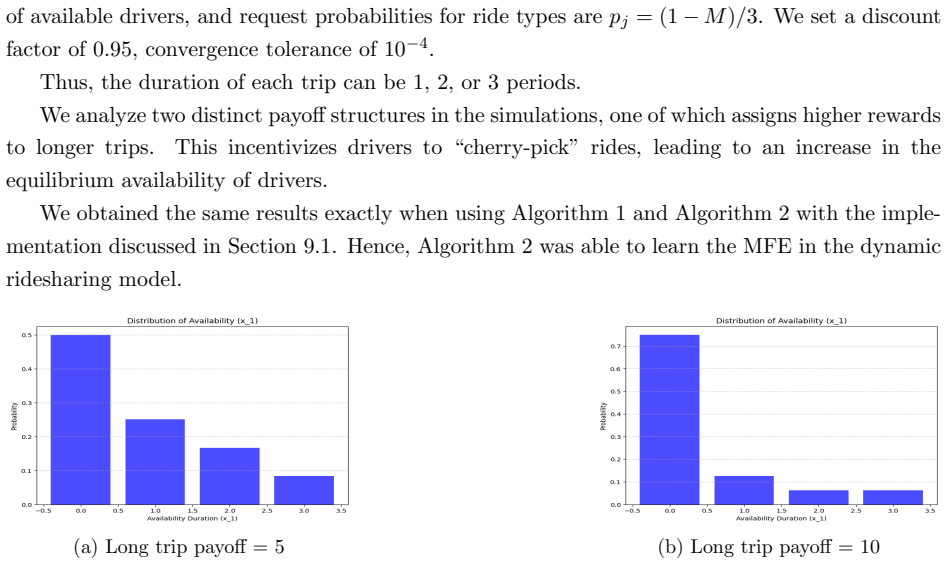
- [Section 7.1; Section 7 opening] The opening of Section 7 states that Assumption 1 "is satisfied in all of the applications below." This is contradicted by the ridesharing model of Section 7.1. There f(M)=M and p_j=(1-M)/3, so at m=1 no request arrives with probability one. Starting from the recurrent state (0,0), the next state is (0,0); states (0,j) with j>0 and (d,j) with d>0 are transient and have no incoming transitions from the recurrent class. Thus L_{1,g} is not irreducible, and Theorem 1 and Theorem 2, which assume Assumption 1 for every m in [a,b], do not apply at the endpoint m=1. Moreover M(s_{1,g})=1, so f(1)=0 and the endpoint is itself a root, so the endpoint cannot be discarded by an open-interval argument. The theorem is likely salvageable by weakening Assumption 1 to uniqueness of the invariant distribution (a single recurrent class) or by handling the endpoints separately, but as written the applications claim is false.
- [Section 10.3, Theorem 3] The proof of Theorem 3 parts (iii) and (iv) is incomplete. For part (iii), the text says "an argument similar to Theorem 3 in Light (2021) shows that the policy function g(x,m,z) is increasing in z," but no statement of the hypotheses of that result and no verification of those hypotheses in the present setting is provided. Part (iv) is dismissed with "follows from the same argument and therefore omitted." Since parts (iii)-(iv) are stated as theorems and support the paper's analytical comparative-statics contribution, the proof should be written out or reduced to a precise reference whose assumptions are explicitly checked.
- [Section 3.2, Section 10.1] The proof of Theorem 2 has two gaps relative to the stated result. First, the asynchronous Q-learning convergence proposition (Proposition 3) is quoted with only step-size conditions sum(gamma)=infinity and sum(gamma^2)<infinity; for asynchronous Q-learning one also needs a condition guaranteeing that every state-action pair is visited infinitely often. Algorithm 2's Step 2 does not specify the behavior policy (e.g., epsilon-greedy with a suitable schedule), so the theorem's hypotheses are incomplete. Second, the proof says "The proof of Proposition 1 shows that f is continuous," but Proposition 1 is proved under Assumption 2, whereas Theorem 2 assumes only Assumption 1. The continuity statement is true in the finite-state setting, but the argument should be supplied directly rather than by reference to a different assumption set.
minor comments (5)
- [Algorithm 1, Step 1] The update "Set m_t = a+b / 2" should read "Set m_t = (a+b)/2"; the initialization m_1=a, m_2=b and the subsequent use of m_t in Steps 2-4 also make the indexing of the sequence confusing.
- [Section 3.1] Theorem 1 is stated without a proof; the text says "Theorem 2 and its proof immediately lead to the proof of Theorem 1," but no direct proof or corollary is given. Add a short proof for the full-information case.
- [Proposition 5] The statement contains the duplicated phrase "with probability at least with probability"; it should read "with probability at least 1-(epsilon_H+epsilon_K)."
- [Assumption 4(iv)] The function b(delta) introduced in Assumption 4(iv) conflicts notationally with the interval endpoint b in [a,b]; using a different symbol (e.g., rho(delta)) would avoid confusion.
- [Section 7.1] The symbol f is used both for the no-request probability f(M) and for the root function f(m)=m-M(s_{m,g}); different letters (e.g., q(M) and F(m)) would improve clarity.
Circularity Check
No circularity found: the root-finding reduction is self-contained; only minor background self-citations appear.
full rationale
The paper's central claim is an algorithmic reduction, not a derivation from the target. Algorithm 1 defines f(m)=m-M(s_m,g), and by construction a root of f satisfies both the optimality and consistency conditions of an MFE; as the proof of Theorem 2 states, 'Because f(m*)=...=0, we have ... constitute a mean field equilibrium as required.' Bisection on the continuous function f does not presuppose the equilibrium: it only uses the sign of f and the bracketing f(a)<=0<=f(b) implied by M(s) in [a,b]. The convergence argument for Algorithm 2 is self-contained given standard Q-learning convergence (Proposition 3, citing Bertsekas and Tsitsiklis (1996) as well as Light (2024a)) and standard continuity arguments. The self-citations appearing in the paper, including Light (2024a, 2024b), Light (2021), and Light and Weintraub (2022), support background lemmas such as Q-learning convergence, dynamic-programming continuity, and comparative-statics arguments; they do not carry the root-finding equivalence or the convergence-to-MFE claim, so they are not load-bearing circularity. The finite-time bounds in Propositions 4 and 5 are conditional Lipschitz error bounds and do not smuggle the equilibrium in as an input. The only substantive concern is a correctness gap rather than circularity: Section 7 asserts that Assumption 1 holds in all applications, but in the ridesharing model at m=1 the probability of receiving a request is zero, so the induced Markov chain is not irreducible on the full state space; this affects whether Theorem 1's hypotheses cover that application, but it does not make the derivation circular.
Assumptions & free parameters
assumptions (8)
- standard math Standard dynamic programming results: the Bellman equation holds and an optimal stationary Markov policy exists for fixed scalar interaction.
- domain assumption Assumption 1: for every m in [a,b] and each optimal policy g(x,m), the Markov chain L_{m,g} is irreducible and aperiodic with a unique invariant distribution.
- domain assumption The optimal policy correspondence G is single-valued.
- standard math Asynchronous Q-learning converges to the optimal Q-function under standard step-size conditions.
- domain assumption Assumption 2: unique invariant distributions, endpoint bounds on M, and a uniform p-th moment bound in general state spaces.
- domain assumption Assumption 4: Lipschitz continuity of M, invariant distributions, and policies in m, plus a non-flatness condition near roots.
- standard math Monotone comparative statics tools from Topkis (2011) and Light (2021) for parameter monotonicity of optimal policies.
- domain assumption The scalar interaction function M is continuous with known bounds a and b, and is increasing with respect to stochastic dominance in the comparative statics section.
Cite this review
Pith. "Pith review of Computing and Learning Stationary Mean Field Equilibria with Scalar Interactions: Algorithms and Applications." pith.science (2026). https://pith.science/paper/3FZ45W75
@misc{pith2026250212024,
  author       = {Pith},
  title        = {Pith review of: Computing and Learning Stationary Mean Field Equilibria with Scalar Interactions: Algorithms and Applications},
  year         = {2026},
  howpublished = {\url{https://pith.science/paper/3FZ45W75}},
  note         = {Machine review of arXiv:2502.12024}
}
read the original abstract
Mean field equilibrium (MFE) has emerged as a computationally tractable solution concept for large dynamic games. However, computing MFE remains challenging due to nonlinearities and the absence of contraction properties, limiting its reliability for counterfactual analysis and comparative statics. This paper focuses on MFE in dynamic models where agents interact through a scalar function of the population distribution, referred to as the scalar interaction function. Such models naturally arise in a wide range of applications involving market dynamics and strategic competition. The main contribution of this paper is to introduce iterative algorithms that leverage the scalar interaction structure and are guaranteed to converge to the MFE under mild assumptions. Leveraging this structure, we also establish an MFE existence result for non-compact state spaces and analytical comparative statics. To the best of our knowledge, these are the first algorithms with global convergence guarantees in such settings. Unlike existing approaches, our algorithms do not rely on monotonicity or contraction properties, significantly broadening their applicability. Furthermore, we provide a model-free algorithm that learns the MFE via simulation and reinforcement learning techniques such as Q-learning and policy gradient methods without requiring prior knowledge of payoff or transition functions. We apply our algorithms to classic models of dynamic competition, such as capacity competition, and to competitive models motivated by online marketplaces, including ridesharing and inventory competition, as well as to social learning models. We show how key market parameters influence equilibrium outcomes through reliable comparative statics in these representative models, providing insights into the design of competitive systems.
Figures


Figures from the paper (5 more)



Reference graph
Works this paper leans on
-
[1]
Social Learning under Platform Influence: Consensus and Persistent Disagreement
Acemoglu, D. and M. K. Jensen(2015): “Robust Comparative Statics in Large Dynamic Economies,”Journal of Political Economy, 587–640. Acemoglu, D., A. Ozdaglar, and J. Siderius(2024): “A model of online misinformation,” Review of Economic Studies, 91, 3117–3150. 28 Adlakha, S. and R. Johari(2013): “Mean field equilibrium in dynamic games with strategic comp...
work page Pith review arXiv 2015
-
[2]
With a slight abuse of notation, we denoteV(σ) in this section as the expected discounted payoff defined in Equation (1) for a given policyσ, and we assume thatV(σ) is differentiable. The projected policy gradient update rule which is expressed as: σh+1 =P P(S×A) (σh +γ h∇σV(σ h)) (7) whereγ h denotes the learning rate at iterationh. The gradient∇ σV(σ h)...
work page 2024
-
[4]
Specifically, we assume thatM:P(X)→ M ⊂R n, whereMis a compact set
8.3 Adaptive Algorithms for MFE with Multi-Valued Interaction Function In this section, we discuss how we can extend our framework to the case where the interaction functionMis multi-valued, mapping the population state to a compact subset inR n. Specifically, we assume thatM:P(X)→ M ⊂R n, whereMis a compact set. This generalization captures systems where...
work page 1965
-
[5]
Fatou’s lemma for weakly converging measures under the uniform integrability condition,
Feinberg, E. A., P. O. Kasyanov, and Y. Liang(2020): “Fatou’s lemma for weakly converging measures under the uniform integrability condition,”Theory of Probability & Its Applications, 64, 615–630. Garg, N. and H. Nazerzadeh(2022): “Driver surge pricing,”Management Science, 68, 3219–
work page 2020
-
[7]
, H, yielding policy ˆgt(x, mt)
underm t forh= 0,1, . . . , H, yielding policy ˆgt(x, mt). 3.Sampling:SimulateKtransitions using ˆg t:x k+1 ∼L mt,ˆgt(xk,·),fork= 0,1, . . . , K.Com- pute the approximate invariant distribution: ˆsmt,ˆgt(y) = 1 K KX k=0 1{xk=y},∀y∈X. 4.Evaluate and update:Compute ˆf(m t) =m t −M(ˆsmt,ˆgt). Update: b=m t if ˆf(m t)> δ;a=m t if ˆf(m t)<−δ. 8.2 Unknown Payof...
work page 2019
-
[11]
The scalar interaction function is the mean field limit of this finite retailers case
25In the dynamic stockout-based substitution model (e.g., Olsen and Parker (2014)) withNretailers, the total demand for retaileriarising from stockouts of other retailers is computed (assuming equal redistribu- tion of unmet demand among all retailers) by summing over the actions of all retailers except retaileri, i.e.,P i̸=j(ζj −a j)+/(N−1),whereζ j repr...
work page 2014
-
[12]
The discount factor in this setting corresponds to the probability of remaining in the market. A similar regenerative framework for arrivals and departures is discussed in other MFE models (e.g., Iyer et al. (2014)). We now formally describe the dynamic reputation model. States.The state of selleriat timetis denoted byx i,t = (xi,t,1, xi,t,2)∈X 1 ×X 2 =X....
work page 2014
-
[13]
are presented to illustrate the steady-state behavior of the system under the computed MFE for different investment costs. (a) Investment cost = 0.1 (b) Investment cost = 0.25 (c) Investment cost = 0.4 (d) Investment cost = 0.55 Figure 8: Equilibrium ranking distributions under different investment costs. As investment costs increase, sellers invest less ...
work page 1996
Show all 18 references
-
[14]
Proof of Theorem 2.Lettbe some iteration of the algorithm
Proposition 3Suppose that ∞X h=0 γh(x, a) =∞and ∞X h=0 γ2 h(x, a)<∞ thenQ h derived from the Q-learning described in Equation (5) converges with probability1toQ ∗. Proof of Theorem 2.Lettbe some iteration of the algorithm. First note that whenHtends to ∞, then from Proposition...
2024
-
[15]
Hence, ∆V (0, a) = (1−δ)h′ 1(a)V(1, m) + (−h′ 1(a) +δh ′ 1(a))V(0, m) =h′ 1(a)(1−δ)∆V(0, m)
We haveE V (0, a) = (1−δ)h1(a)V(1, m) + (h2(a) +δh 1(a))V(0, m). Hence, ∆V (0, a) = (1−δ)h′ 1(a)V(1, m) + (−h′ 1(a) +δh ′ 1(a))V(0, m) =h′ 1(a)(1−δ)∆V(0, m). Thus, ∆V (1, a)−∆V (0, a) =h′ 1(a) [K(1, m)−(1−δ)∆V(0, m)] =h ′ 1(a) [(1−δ)V(2, m) + (2δ−1)V(1, m)−δV(0, m)−(1−δ)(V(1, ...
2011
-
[16]
Part (ii) shows thatgis increasing inx
To prove part (iii), an argument similar to Theorem 3 in Light (2021) shows that the policy functiong(x, m, z) is increasing in the parameterz. Part (ii) shows thatgis increasing inx. Hence, W(x, g(x, z), B) is increasing inxandzwhenBis an upper set. This implies that Km(θ2, z...
2021
-
[17]
This is typically satisfied in many practical settings, including cases whereM(s) represents the expected value operator
First, the scalar interaction functionM(s) is required to be Lipschitz continuous in the population states, as assumed in part (i). This is typically satisfied in many practical settings, including cases whereM(s) represents the expected value operator. Part (ii) relates to th...
2023
-
[18]
These bounds characterize the accuracy of the learned policy ˆgt and the population state ˆsmt,ˆgt relative to some MFE policyg(·, m∗) and invariant distributions m∗,g. In the case the algorithm terminates before iterationT, the errors depend on both the sampling errors (δH , ...
2003
-
[23]
Large population stochastic dynamic games: closed-loop McKean-Vlasov systems and the Nash certainty equivalence principle,
Huang, M., R. P. Malham ´e, and P. E. Caines(2006): “Large population stochastic dynamic games: closed-loop McKean-Vlasov systems and the Nash certainty equivalence principle,”Com- mun. Inf. Syst., 6, 221–252. Iyer, K., R. Johari, and M. Sundararajan(2014): “Mean Field Equilib...
2006 arXiv
-
[32]
A general framework for learning mean-field games,
——— (2023): “A general framework for learning mean-field games,”Mathematics of Operations Research, 48, 656–686. Hasselt, H.(2010): “Double Q-learning,”Advances in neural information processing systems,
2023
-
[1265]
Learning while playing in mean-field games: Convergence and optimality,
Xie, Q., Z. Yang, Z. W ang, and A. Minca(2021): “Learning while playing in mean-field games: Convergence and optimality,” inInternational Conference on Machine Learning, PMLR, 11436–11447. Yang, P., K. Iyer, and P. Frazier(2018): “Mean Field Equilibria for Resource Competition...
2021
-
[3235]
Your uber is arriving: Managing on-demand workers through surge pricing, forecast communication, and worker incentives,
Guda, H. and U. Subramanian(2019): “Your uber is arriving: Managing on-demand workers through surge pricing, forecast communication, and worker incentives,”Management Science, 65, 1995–2014. Guo, X., A. Hu, R. Xu, and J. Zhang(2019): “Learning mean-field games,”Advances in neu...
2019
-
[6715]
Markov perfect industry dynamics with many firms,
Weintraub, G. Y., C. L. Benkard, and B. V an Roy(2008): “Markov perfect industry dynamics with many firms,”Econometrica, 76, 1375–1411. ——— (2010): “Computational methods for oblivious equilibrium,”Operations research, 58, 1247–
2008
Reviewed August 9, 2026 · model on record in the stance chip above.
Discussion (0). Continue with ORCID to comment.