Steering a warp drive without exotic matter
Pith reviewed 2026-06-26 09:57 UTC · model grok-4.3
The pith
A positive-energy warp drive can accelerate by matching a photon rocket exterior to a flat interior via a timelike shell.
A machine-rendered reading of the paper's core claim, the machinery that carries it, and where it could break.
Core claim
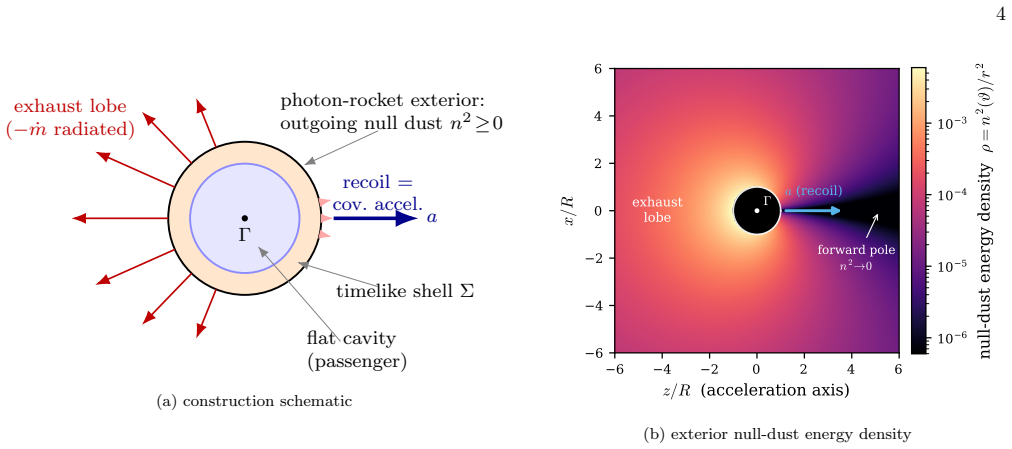
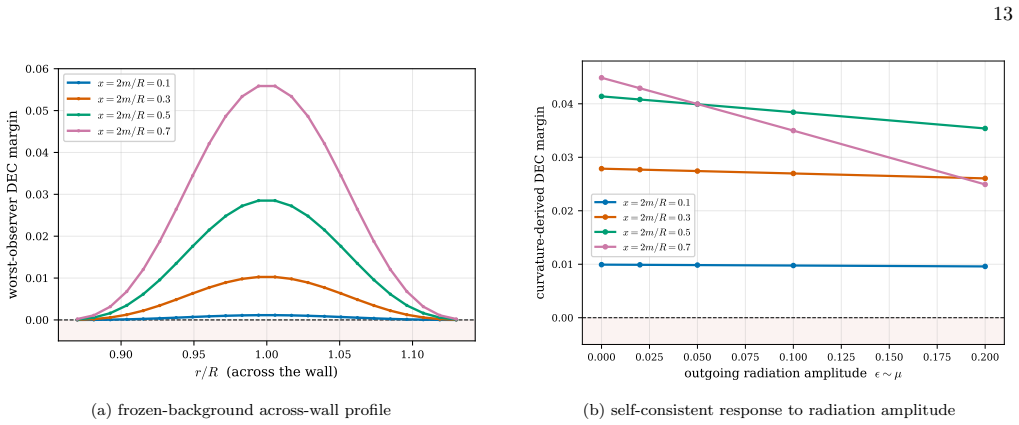
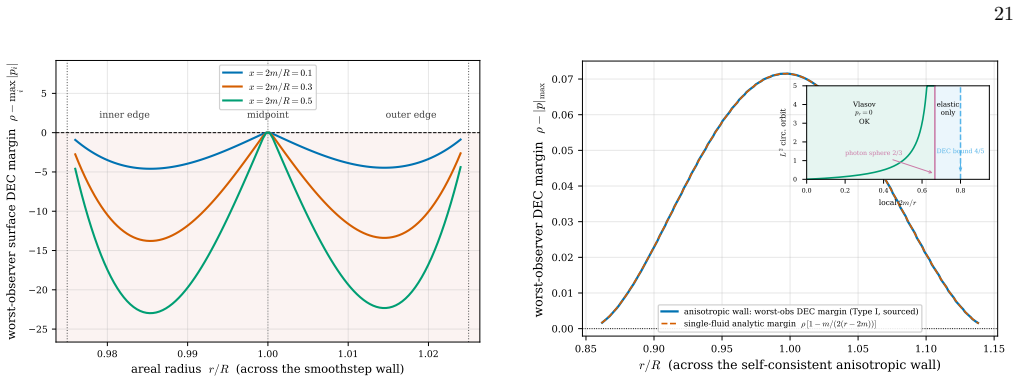
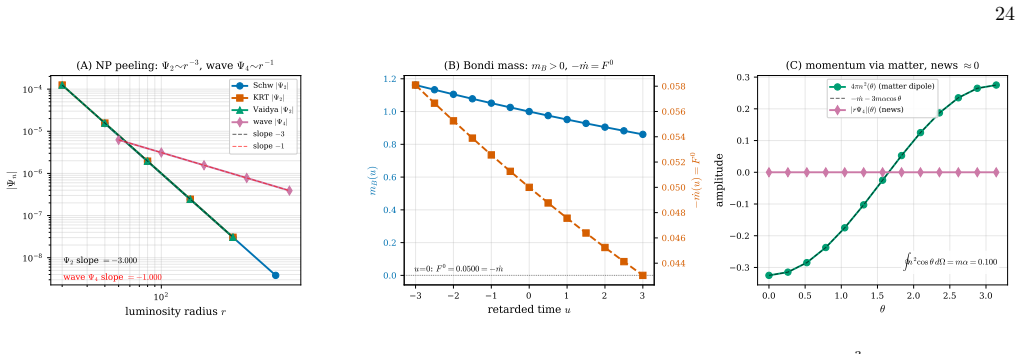
Prescribing the passenger worldtube, the exact Kinnersley photon rocket serves as exterior and the matching timelike shell is solved for; the exterior and steering law are exact while the shell is certified perturbatively and numerically. The mechanism is photon-rocket recoil on a tidally protected flat cavity. The exterior energy conditions reduce to n² ≥ 0, steering obeys -ṁ ≥ 3m|a| paid by Bondi mass loss, and the shell satisfies the surface dominant energy condition for 2m/R < 24/25 with a Buchdahl-type frontier a_max R ≤ g(2m/R).
What carries the argument
The Kinnersley photon rocket exterior matched across a timelike shell to an exactly flat interior cavity.
If this is right
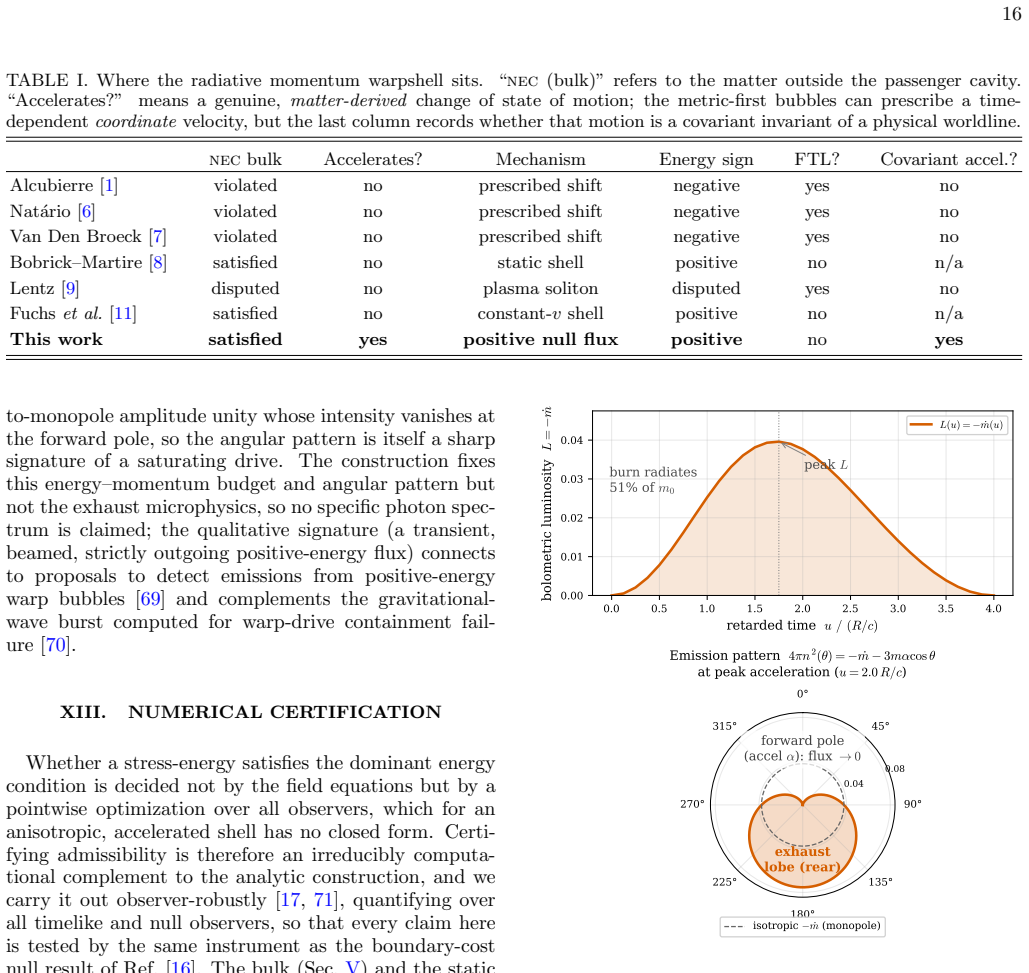
- Steering is paid for by Bondi mass loss satisfying -ṁ ≥ 3m|a|.
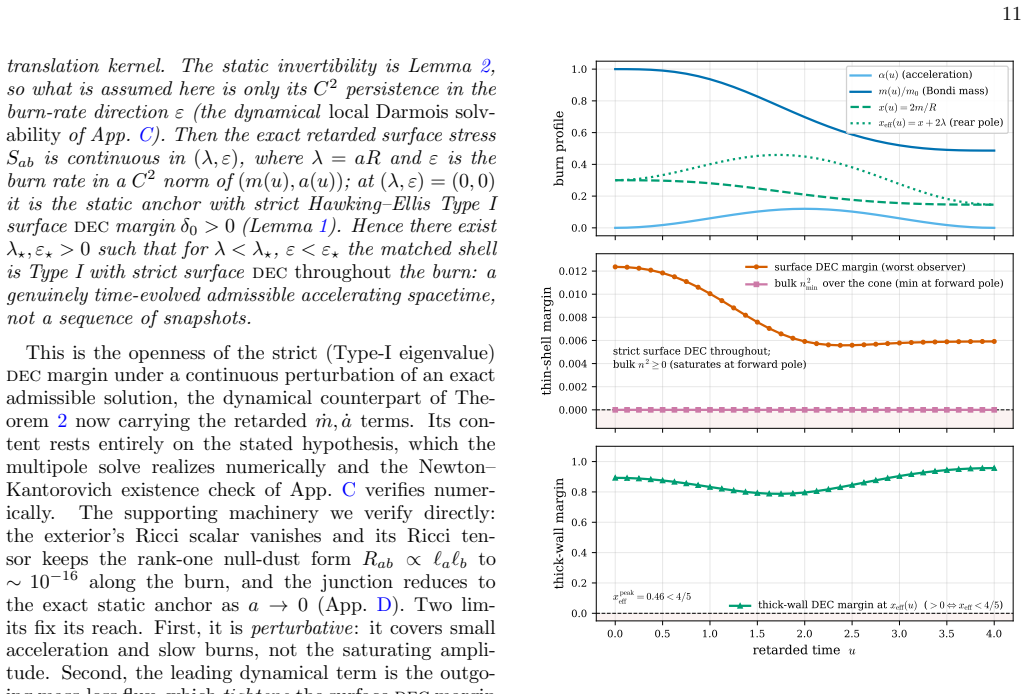
- Admissible accelerating shells exist near the Schwarzschild-Minkowski anchor and for slow burns as time-evolved spacetimes.
- Acceleration is capped between a numerical lower bound around 0.2 and the closed-form ceiling ½(1-2m/R).
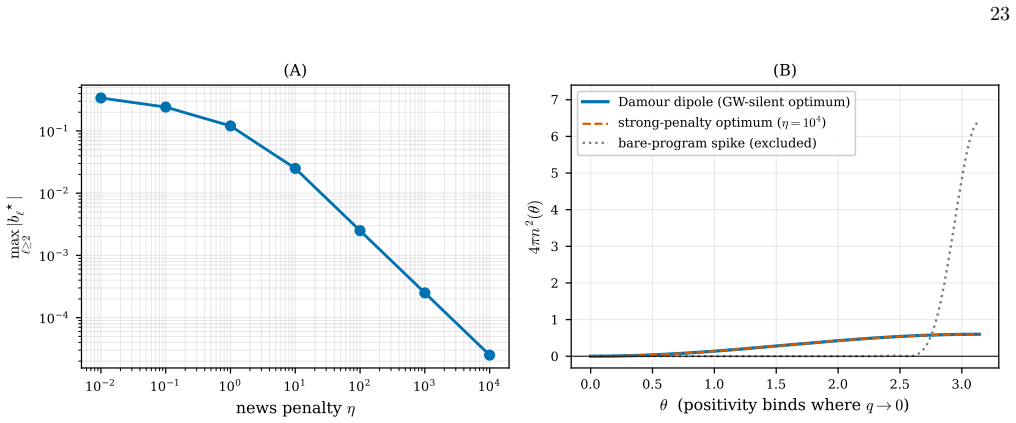
- On the gravitational-wave-silent class the optimal maneuver is the Damour dipole.
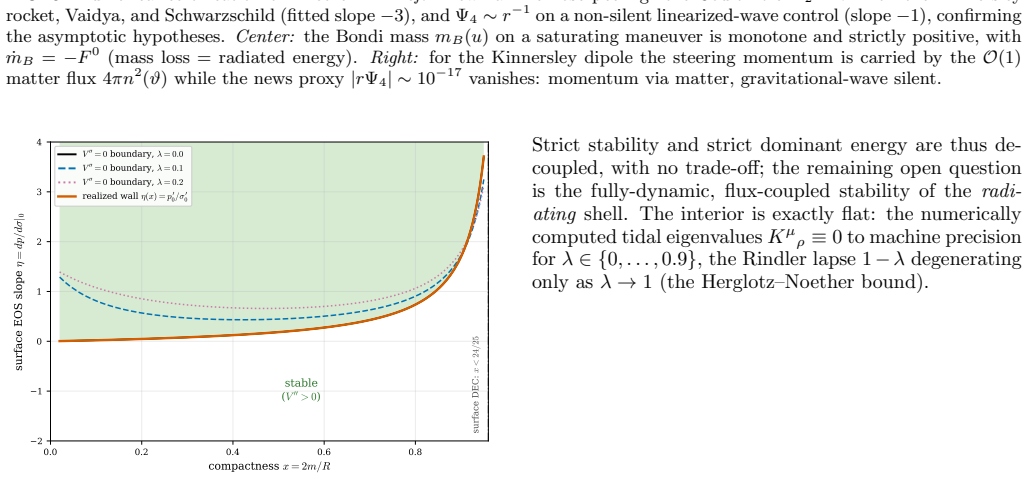
- The wall is marginally stable, with strict stability available at no energy-condition cost.
Where Pith is reading between the lines
- The flat interior decouples the passenger from external tidal forces, so the drive functions as a protected cavity rather than a warped metric.
- The energy-budget requirement implies that rapid velocity changes remain costly even when exotic matter is avoided.
- Matching techniques of this type could be tested in numerical relativity codes by evolving the shell under the derived steering law.
- Similar constructions might extend to other exterior solutions that carry different radiation patterns or multipole moments.
Load-bearing premise
A timelike shell exists that matches the Kinnersley exterior to the flat interior while satisfying the surface dominant energy condition for 2m/R below 24/25.
What would settle it
An exact closed-form shell metric or high-resolution numerical evolution that violates the surface dominant energy condition for any accelerating configuration with 2m/R < 24/25.
Figures
read the original abstract
A useful warp drive must change its velocity, yet known positive-energy constructions are static or constant-velocity, while accelerating ones require exotic matter; Bobrick and Martire noted that warp drives ``do not have any natural way of changing their velocities.'' First, a conservation law settles the principle: for any asymptotically flat drive with a confined dominant-energy source and standard peeling, the Bondi--Sachs four-momentum changes only through radiation to null infinity, so the drive cannot steer without radiating. Second, we construct a positive-energy spacetime that saturates this bound. Prescribing the passenger worldtube, we take the exact Kinnersley photon rocket as exterior and solve for the matching timelike shell; the exterior and steering law are exact, while the shell is certified perturbatively and numerically. The mechanism is photon-rocket recoil on a tidally protected, exactly flat cavity; the warp drive is the decoupled flat interior, not a warp field. The exterior energy conditions reduce to $n^2\ge0$, and steering obeys $-\dot m\ge 3m|a|$, paid for by Bondi mass loss. The shell satisfies the surface dominant energy condition for $2m/R<24/25$; admissible accelerating shells exist near the Schwarzschild--Minkowski anchor and, for slow burns, as time-evolved spacetimes. A Buchdahl-type frontier $a_{\max}R\le g(2m/R)$ caps the acceleration between a numerical lower bound $\sim\!0.2$ and a closed-form ceiling ${1\over2}(1-2m/R)$. On the gravitational-wave--silent class, the optimal maneuver is the Damour dipole. The wall is marginally stable, with strict stability available at no energy-condition cost; fully dynamical flux-coupled stability remains open. The drive is causal, subluminal, and energetically costly but positive-energy: steering is a problem of energy budget, not exotic matter.
Editorial analysis
A structured set of objections, weighed in public.
Referee Report
Summary. The paper claims that a warp drive can change velocity without exotic matter by saturating the Bondi-Sachs conservation bound: an exact Kinnersley photon-rocket exterior is matched to a flat interior across a timelike shell whose surface stress-energy satisfies the dominant energy condition for 2m/R < 24/25. The exterior solution and steering law (–ṁ ≥ 3m|a|) are exact and paid for by radiation; the shell is certified perturbatively and numerically, admissible accelerating shells exist near the Schwarzschild–Minkowski anchor, a Buchdahl-type bound a_max R ≤ g(2m/R) caps acceleration, and the construction is causal and subluminal.
Significance. If the shell construction and surface DEC hold, the work supplies the first explicit positive-energy mechanism for accelerating a warp drive, directly addressing Bobrick–Martire’s observation that known positive-energy drives lack a natural steering mechanism. Credit is due for the exact Kinnersley exterior, the parameter-free use of the standard Bondi–Sachs law, and the absence of invented entities or ad-hoc parameters.
major comments (2)
- [Abstract / shell-matching section] Abstract and the section describing the shell construction: the central claim that a timelike shell exists and obeys the surface dominant energy condition for 2m/R < 24/25 rests on perturbative and numerical certification rather than a closed-form derivation of the Israel junction conditions and the resulting surface stress-energy tensor; without the latter it is not shown that the DEC holds identically across the claimed range.
- [stability discussion] The paragraph stating that fully dynamical flux-coupled stability remains open: because the construction is intended as a physical steering mechanism, the absence of a stability proof for the shell under the coupled gravitational-wave and matter fluxes is load-bearing for the long-term viability of the positive-energy claim.
minor comments (1)
- The notation for the surface stress-energy tensor and the precise definition of the passenger worldtube should be introduced with an equation number at first use to improve readability.
Simulated Author's Rebuttal
We thank the referee for the careful reading and for identifying these two substantive issues. We respond to each major comment below, indicating the extent of any revisions.
read point-by-point responses
-
Referee: [Abstract / shell-matching section] Abstract and the section describing the shell construction: the central claim that a timelike shell exists and obeys the surface dominant energy condition for 2m/R < 24/25 rests on perturbative and numerical certification rather than a closed-form derivation of the Israel junction conditions and the resulting surface stress-energy tensor; without the latter it is not shown that the DEC holds identically across the claimed range.
Authors: The referee is correct that the surface stress-energy is obtained by solving the Israel junction conditions numerically (or via perturbative expansion about the Schwarzschild–Minkowski anchor) rather than in closed form. The Kinnersley exterior and the steering law −ṁ ≥ 3m|a| are exact; the shell quantities are determined by enforcing continuity of the induced metric and the jump in extrinsic curvature across the timelike hypersurface. In the revised manuscript we will add the explicit component expressions for the surface stress-energy tensor that follow directly from the junction conditions, together with the perturbative series used to certify the bound 2m/R < 24/25. These additions will make the certification fully transparent while preserving the statement that the DEC holds throughout the indicated range on the basis of the numerical and perturbative evidence already obtained. revision: partial
-
Referee: [stability discussion] The paragraph stating that fully dynamical flux-coupled stability remains open: because the construction is intended as a physical steering mechanism, the absence of a stability proof for the shell under the coupled gravitational-wave and matter fluxes is load-bearing for the long-term viability of the positive-energy claim.
Authors: We agree that long-term viability requires control of stability under the coupled fluxes. The manuscript already states explicitly that “fully dynamical flux-coupled stability remains open” while demonstrating marginal stability of the wall and the existence of a strictly stable configuration at no extra energy-condition cost on the gravitational-wave-silent sector. A complete analytic or numerical proof of stability in the presence of both gravitational-wave and matter fluxes lies outside the scope of the present work and would constitute a separate investigation. We will expand the relevant paragraph to underscore this limitation and to frame it as an important open question for subsequent study. revision: partial
- A rigorous proof of stability for the shell under simultaneous gravitational-wave and matter fluxes is not available and remains an open problem.
Circularity Check
No significant circularity; derivation relies on external known solutions and standard conservation laws
full rationale
The paper applies the standard Bondi-Sachs four-momentum conservation law (external) to an asymptotically flat spacetime with confined dominant-energy source, concluding that steering requires radiation. It then adopts the exact known Kinnersley photon rocket as the exterior metric (a pre-existing solution, not derived here) and solves for a matching timelike shell to a flat interior. The shell matching and surface DEC are certified only perturbatively and numerically, but this is presented as a limitation rather than a fitted prediction or self-definition. No self-citations appear as load-bearing steps, no parameters are fitted to subsets of data and renamed as predictions, and no ansatz or uniqueness theorem is smuggled via prior author work. The construction is therefore self-contained against external benchmarks, with the central positive-energy claim following from the external inputs rather than reducing to them by construction.
Axiom & Free-Parameter Ledger
axioms (2)
- domain assumption Asymptotically flat spacetime with standard peeling for the Bondi-Sachs four-momentum
- domain assumption Dominant energy condition on the timelike shell
Reference graph
Works this paper leans on
-
[1]
energy without momentum
streaming through it: a generalized-Vaidya interior m(u, r) = ¯m(u)χ(r) withχ(0) = 0, so the radia- tion fills the wall with no beam through the center and no matter→vacuum edge. For the idealized fixed- background split (31) at constantµ(withp r = 0), the radial Hawking–Ellis block has discriminant ∆ = (ρ+p r)(ρ+p r + 4µ) =ρ(ρ+ 4µ)>0,(32) so it stays Haw...
-
[2]
postulated single fluid
The lapse/tilt block is alge- braic with non-vanishing Jacobian forx <1 (the √1−x redshift factors, e.g.∂ R[√f] =m/(R 2√1−x)̸= 0). HenceDF 0 is a bounded isomorphism off theℓ= 1 trans- lation gauge, and the implicit function theorem makes Theorem 2unconditionalin a (rigorous, non-explicit) open neighborhood of the anchor. What this argument doesnotsupply ...
-
[3]
Two facts contain this
lasts∼2× longer, so even the high-xcorner is not certified safe with- out active stabilization. Two facts contain this. First, the realized mode isneutralatλ= 0 (zero growth rate): a static wall drifts only secularly, not exponentially. Sec- ond, a slightlystifferwall,η > η crit, sits in a strict poten- tial well and is linearly stable, and this costsnoth...
-
[4]
M. Alcubierre, Class. Quantum Grav.11, L73 (1994), arXiv:gr-qc/0009013
Pith/arXiv arXiv 1994
-
[5]
J. Santiago, S. Schuster, and M. Visser, Phys. Rev. D 105, 064038 (2022), arXiv:2105.03079
arXiv 2022
-
[6]
F. S. N. Lobo and M. Visser, Class. Quantum Grav.21, 5871 (2004), arXiv:gr-qc/0406083
Pith/arXiv arXiv 2004
-
[7]
M. J. Pfenning and L. H. Ford, Class. Quantum Grav. 14, 1743 (1997), arXiv:gr-qc/9702026
Pith/arXiv arXiv 1997
-
[8]
L. H. Ford and T. A. Roman, Phys. Rev. D51, 4277 (1995), arXiv:gr-qc/9410043
Pith/arXiv arXiv 1995
-
[9]
J. Nat´ ario, Class. Quantum Grav.19, 1157 (2002), arXiv:gr-qc/0110086
Pith/arXiv arXiv 2002
-
[10]
C. Van Den Broeck, Class. Quantum Grav.16, 3973 (1999), arXiv:gr-qc/9905084
Pith/arXiv arXiv 1999
-
[11]
A. Bobrick and G. Martire, Class. Quantum Grav.38, 105009 (2021), arXiv:2102.06824
arXiv 2021
-
[12]
E. W. Lentz, Class. Quantum Grav.38, 075015 (2021), arXiv:2006.07125
arXiv 2021
-
[13]
S. D. B. Fell and L. Heisenberg, Class. Quantum Grav. 38, 155020 (2021), arXiv:2104.06488
arXiv 2021
- [14]
- [15]
-
[16]
R. Garattini and K. Zatrimaylov, (2025), arXiv:2502.13153 [gr-qc]
Pith/arXiv arXiv 2025
- [17]
- [18]
-
[19]
A. T. Le, (2026), arXiv:2605.25417
Pith/arXiv arXiv 2026
-
[20]
A. T. Le, (2026), arXiv:2602.18023 [gr-qc]
Pith/arXiv arXiv 2026
-
[21]
S. W. Hawking and G. F. R. Ellis,The Large Scale Struc- ture of Space-Time(Cambridge University Press, 1973)
1973
-
[22]
Kinnersley, Phys
W. Kinnersley, Phys. Rev.186, 1335 (1969)
1969
-
[23]
Robinson and A
I. Robinson and A. Trautman, Proc. R. Soc. Lond. A 265, 463 (1962)
1962
-
[24]
W. B. Bonnor, Class. Quantum Grav.11, 2007 (1994)
2007
-
[25]
J. Podolsk´ y, Int. J. Mod. Phys. D20, 335 (2011), arXiv:1006.1583
Pith/arXiv arXiv 2011
-
[26]
S. Dain, O. M. Moreschi, and R. J. Gleiser, Class. Quan- tum Grav.13, 1155 (1996)
1996
-
[27]
Israel, Nuovo Cimento B44, 1 (1966)
W. Israel, Nuovo Cimento B44, 1 (1966)
1966
-
[28]
Poisson,A Relativist’s Toolkit: The Mathematics of Black-Hole Mechanics(Cambridge University Press, 2004)
E. Poisson,A Relativist’s Toolkit: The Mathematics of Black-Hole Mechanics(Cambridge University Press, 2004)
2004
-
[29]
Penrose, Proc
R. Penrose, Proc. R. Soc. Lond. A284, 159 (1965)
1965
-
[30]
Newman and R
E. Newman and R. Penrose, J. Math. Phys.3, 566 (1962)
1962
-
[31]
E. T. Newman and T. W. J. Unti, J. Math. Phys.3, 891 (1962)
1962
-
[32]
Dray and M
T. Dray and M. Streubel, Class. Quantum Grav.1, 15 (1984)
1984
-
[33]
Geroch and J
R. Geroch and J. Winicour, J. Math. Phys.22, 803 (1981)
1981
-
[34]
Geroch, inAsymptotic Structure of Space-Time, edited by F
R. Geroch, inAsymptotic Structure of Space-Time, edited by F. P. Esposito and L. Witten (Plenum Press, New York, 1977) pp. 1–105
1977
-
[35]
Bondi, M
H. Bondi, M. G. J. van der Burg, and A. W. K. Metzner, Proc. R. Soc. Lond. A269, 21 (1962)
1962
-
[36]
R. K. Sachs, Proc. R. Soc. Lond. A270, 103 (1962)
1962
-
[37]
Ashtekar and M
A. Ashtekar and M. Streubel, Proc. R. Soc. Lond. A376, 585 (1981)
1981
-
[38]
Schoen and S.-T
R. Schoen and S.-T. Yau, Comm. Math. Phys.79, 231 (1981)
1981
-
[39]
Witten, Comm
E. Witten, Comm. Math. Phys.80, 381 (1981)
1981
-
[40]
G. T. Horowitz and M. J. Perry, Phys. Rev. Lett.48, 371 (1982)
1982
-
[41]
Reula and K
O. Reula and K. P. Tod, J. Math. Phys.25, 1004 (1984)
1984
-
[42]
Ludvigsen and J
M. Ludvigsen and J. A. G. Vickers, J. Phys. A: Math. Gen.15, L67 (1982)
1982
-
[43]
Wisdom, Science299, 1865 (2003)
J. Wisdom, Science299, 1865 (2003)
2003
-
[44]
J. E. Avron and O. Kenneth, New J. Phys.8, 68 (2006), arXiv:math-ph/0602053
Pith/arXiv arXiv 2006
-
[45]
R. Andrade e Silva, G. E. A. Matsas, and D. A. T. Vanzella, Phys. Rev. D94, 121502 (2016), arXiv:1611.06183
Pith/arXiv arXiv 2016
-
[46]
W. B. Bonnor and M. A. Rotenberg, Proc. R. Soc. Lond. A265, 109 (1961)
1961
-
[47]
Peres, Phys
A. Peres, Phys. Rev.128, 2471 (1962)
1962
- [48]
-
[49]
P. C. Vaidya, Proc. Indian Acad. Sci. A33, 264 (1951)
1951
-
[50]
M. L. McClure, K. Anderson, and K. Bardahl, (2007), arXiv:0709.3288 [gr-qc]
Pith/arXiv arXiv 2007
-
[51]
H. Ge, M. Luo, Q. Su, D. Wang, and X. Zhang, Gen. Relativ. Gravit.43, 2729 (2011), arXiv:1105.3258
Pith/arXiv arXiv 2011
-
[52]
T. Damour, Class. Quantum Grav.12, 725 (1995), arXiv:gr-qc/9412063
Pith/arXiv arXiv 1995
-
[53]
H. Andr´ easson, Commun. Math. Phys.274, 399 (2007), arXiv:gr-qc/0605097
Pith/arXiv arXiv 2007
-
[54]
D. Horvat and S. Iliji´ c, Class. Quantum Grav.24, 5637 (2007), arXiv:0707.1636
Pith/arXiv arXiv 2007
- [55]
-
[56]
Barrab` es and W
C. Barrab` es and W. Israel, Phys. Rev. D43, 1129 (1991)
1991
- [57]
-
[58]
Han and J.-X
Q. Han and J.-X. Hong,Isometric Embedding of Rieman- nian Manifolds in Euclidean Spaces, Mathematical Sur- veys and Monographs, Vol. 130 (American Mathematical Society, Providence, RI, 2006)
2006
-
[59]
H. Andr´ easson, Living Rev. Relativ.14, 4 (2011), arXiv:1106.1367
Pith/arXiv arXiv 2011
-
[60]
M. Karlovini and L. Samuelsson, Class. Quantum Grav. 20, 3613 (2003), arXiv:gr-qc/0211026
Pith/arXiv arXiv 2003
-
[61]
U. von der G¨ onna and D. Kramer, Class. Quantum Grav. 15, 215 (1998), arXiv:gr-qc/9711001
Pith/arXiv arXiv 1998
-
[62]
F. H. J. Cornish, Class. Quantum Grav.17, 3945 (2000)
2000
-
[63]
L. S. Pontryagin, V. G. Boltyanskii, R. V. Gamkrelidze, and E. F. Mishchenko,The Mathematical Theory of Op- timal Processes(Interscience Publishers, 1962)
1962
-
[64]
Liberzon,Calculus of Variations and Optimal Control Theory: A Concise Introduction(Princeton University Press, 2012)
D. Liberzon,Calculus of Variations and Optimal Control Theory: A Concise Introduction(Princeton University Press, 2012)
2012
-
[65]
T. Buchert and A. Frackowiak, Universe12, 132 (2026), arXiv:2605.03653
Pith/arXiv arXiv 2026
-
[66]
S. V. Krasnikov, Phys. Rev. D57, 4760 (1998), arXiv:gr- qc/9511068
arXiv 1998
-
[67]
S. Schuster, J. Santiago, and M. Visser, Gen. Relativ. Gravit.55, 14 (2023), arXiv:2205.15950
arXiv 2023
-
[68]
E. Poisson and M. Visser, Phys. Rev. D52, 7318 (1995), arXiv:gr-qc/9506083
Pith/arXiv arXiv 1995
-
[69]
P. Mart´ ın-Moruno, N. Montelongo-Garc´ ıa, F. S. N. Lobo, and M. Visser, JCAP03, 034, arXiv:1112.5253
- [70]
-
[71]
Kinnersley and M
W. Kinnersley and M. Walker, Phys. Rev. D2, 1359 (1970)
1970
-
[72]
E. W. Lentz and R. C. Felton, (2024), arXiv:2405.19381
arXiv 2024
-
[73]
K. Clough, T. Dietrich, and S. Khan, Open J. Astro- phys.7, 10.33232/001c.121868 (2024), arXiv:2406.02466 [gr-qc]
-
[74]
C. Helmerich, J. Fuchs, A. Bobrick, L. Sellers, B. Melcher, and G. Martire, Class. Quantum Grav.41, 095009 (2024), arXiv:2404.03095
arXiv 2024
-
[75]
L. V. Kantorovich and G. P. Akilov,Functional Analysis, 2nd ed. (Pergamon Press, Oxford, 1982)
1982
-
[76]
Bradbury, R
J. Bradbury, R. Frostig, P. Hawkins, M. J. John- son, Y. Katariya, C. Leary, D. Maclaurin, G. Nec- ula, A. Paszke, J. VanderPlas, S. Wanderman-Milne, and Q. Zhang, JAX: composable transformations of Python+NumPy programs,https://github.com/ jax-ml/jax(2018)
2018
discussion (0)
Sign in with ORCID, Apple, or X to comment. Anyone can read and Pith papers without signing in.