REVIEW 4 major objections 4 minor 58 references
A way forward towards improvement of tensor force in \textit{pf}-shell
T0 review · 4 major / 4 minor · reviewed 2026-08-14 · deepseek-v4-flash
Pith's one-line read The paper shows that seven of ten T=1 tensor monopole matrix elements in GX pf-shell interactions carry signs opposite to the bare tensor force, and that replacing them with Yukawa-tensor values yields a data-compatible interaction, GX1R.
desk verdict An honest, incremental repair of known tensor-force irregularities in GX interactions; the revised interaction is as good as the original, and the paper never isolates whether the tensor sign correction actually matters. read the letter →
The pith
A machine-rendered reading of the paper's core claim, the machinery that carries it, and where it could break.
The reading
What carries the argument
The central object is the spin-tensor decomposition of an effective two-body interaction, $V = \sum_{k=0}^2 Q^k\cdot S^k$, which separates rank-0 central, rank-1 spin-orbit, and rank-2 tensor components; the tensor monopole matrix elements $\bar V^{T}_{jj'}(T) = (\sum_J (2J+1)\langle jj'|V|jj'\rangle_{JT})/(\sum_J (2J+1))$ are then extracted for each orbit pair. The repair mechanism is a Yukawa-type tensor force with a single strength parameter fitted to the tensor monopoles of USDB in the sd shell, whose matrix elements replace all ninety-four T=1 tensor TBMEs of GX1B1. The strength transfer from sd to pf shell is what lets the corrected interaction inherit the bare force sign pattern.
What would settle it
Take a tensor-sensitive observable in the pf shell, such as the Gamow-Teller strength or M1 transition probability of 48Ca or 54Ca, and compute it with GX1R and GX1B1 under identical truncations; if the predictions coincide within uncertainties, then the sign-repaired tensor part is not operationally detectable, weakening the paper's premise that the GX tensor signs were defective. A second check would be to find any established pf-shell interaction that keeps GX1B1-like tensor monopole signs and still fits the same data, which would show the bare-sign rule is not necessary.
Extended reading notes
Core claim
Working in the pf shell, the paper decomposes GX1B1 into central, spin-orbit, and tensor parts using spin-tensor decomposition ($V = Q^0\cdot S^0 + Q^1\cdot S^1 + Q^2\cdot S^2$), and compares the ten T=1 tensor monopole matrix elements $\bar V^{T=1}_{jj'}(T)$ against the known rule from the bare tensor force: attraction when one orbit is spin-up and the other spin-down, repulsion when both are of the same type. It finds seven violations: $\bar V_{f_7f_7}$, $\bar V_{f_5f_5}$, $\bar V_{f_7p_3}$, and $\bar V_{f_5p_1}$ are attractive when expected repulsive, and $\bar V_{f_7f_5}$, $\bar V_{f_7p_1}$, and $\bar V_{f_5p_3}$ are repulsive when expected attractive, with the same irregularity present in GXPF1 and GXPF1A. To fix this, all ninety-four T=1 tensor TBMEs are replaced by values from a Yukawa tensor force $V_T = V(r)\sqrt{24\pi/5}[Y^{(2)}\cdot(\sigma_1\otimes\sigma_2)^{(2)}](\tau_1\cdot\tau_2)$ with $V(r) = -V_0 e^{-r/a}/(r/a)$, where the strength $V_0$ is fitted to the sd-shell USDB tensor monopoles and $a=1.41$ fm is the pion Compton length. After also shifting the 1p3/2 single-particle energy by $-0.221$ MeV and adjusting two 0f-orbit TBMEs ($V(7777:61)$ by $-0.280$ MeV and $V(7575:61)$ by $+0.399$ MeV), the resulting interaction GX1R reproduces Ca-to-Ge data satisfactorily and its total TBMEs stay within 0.14 MeV rms of GX1B1.
Load-bearing premise
The whole correction rests on treating the bare tensor force's sign pattern as the standard that an effective interaction must satisfy, so any deviation is classified as an irregularity rather than as a legitimate renormalization effect.
Editorial extensions
If this is right
- GX1R supplies a pf-shell interaction with bare-like T=1 tensor monopoles; its TBMEs can be used wherever a tensor-corrected effective interaction is wanted.
- Because GX1R and GX1B1 yield nearly identical spectra despite different tensor parts, the tensor sign irregularity in GX1B1 cannot be the main driver of the tested Ca-to-Ge observables.
- The N=28, N=32, and N=34 shell gaps in Ca isotopes are reproduced, with the central force dominant for the 1f5/2-1p1/2 gap at N=34 and the spin-orbit force opposing it.
- The very soft 56Ni core, with a 67% closed-core component in the ground state versus 93% for 48Ca, is captured by GX1R.
- Total matrix elements of GX1R and GX1B1 agree to 0.14 MeV rms, so the correction preserves the overall phenomenology while changing the tensor part.
Reading between the lines
- Going beyond the paper, the same spin-tensor audit could be applied as a diagnostic to other effective interactions; any interaction whose tensor monopoles violate the bare-sign rule would be flagged.
- A testable extension would be to search for pf-shell observables that respond sharply to the tensor component, such as spin-flip transitions or isospin-dependent single-particle gaps, since the near-identical GX1R and GX1B1 spectra suggest such observables are rare.
- The authors do not isolate which of the two 0f-orbit adjustments, -0.280 MeV and +0.399 MeV, carries the phenomenological improvement; a follow-up varying them independently would clarify this.
- Since the Yukawa strength is fitted to sd-shell USDB monopoles, the approach implicitly assumes cross-shell transferability of the tensor pattern; fitting V0 directly in the pf shell would test that assumption.
Signed reviews
Editorial analysis
A structured set of objections, weighed in public.
Referee Report
Summary. The paper examines the tensor, central, and spin-orbit monopole matrix elements of the GX-family pf-shell interactions (GXPF1, GXPF1A, GX1B1) using spin-tensor decomposition. It reports that seven of the ten T=1 tensor monopole matrix elements of GX1B1 have signs opposite to the systematic trend of the bare Yukawa tensor force, while T=0 and the 1p-orbit T=1 matrix elements follow the systematics. To correct this, the authors replace all ninety-four T=1 tensor TBMEs with values calculated from a Yukawa-type tensor force whose strength V0 is fitted to USDB tensor monopoles. They then make three additional ad hoc modifications: a -0.221 MeV shift of the 1p3/2 single-particle energy and adjustments of -0.280 and +0.399 MeV to V(7777;JT=61) and V(7575;JT=61). The resulting interaction, GX1R, is tested on Ca, Ti, Cr, Fe, Ni, Zn, and Ge isotopes. The calculations are reported to be in satisfactory agreement with experiment, but GX1R and GX1B1 give nearly identical predictions, and the total TBMEs of the two interactions differ by only 0.14 MeV rms.
Significance. The paper is a transparent application of the standard spin-tensor decomposition and is honest in reporting that GX1R and GX1B1 produce almost identical results. If one accepts the premise that effective tensor monopoles must preserve the bare-tensor sign pattern, the paper provides a constructive recipe for building an interaction with that property while retaining acceptable predictive power, and the interaction has already been used in neutrinoless double-beta decay calculations. The central weakness is that the empirical data do not discriminate the tensor correction: the observable predictions are essentially unchanged, and the three ad hoc parameter shifts, not the tensor replacement, are responsible for the final agreement with experiment. The paper's own comparison undermines the claim that the 'irregular' tensor signs were a meaningful defect in GX1B1.
major comments (4)
- [Sec. II.C and Sec. III.C] The paper never isolates the effect of the tensor replacement from the three ad hoc modifications. The tensor replacement alone leaves Ca spectra 0.2–0.8 MeV below experiment (Sec. II.C), and the final agreement is obtained only after shifting the 1p3/2 SPE by -0.221 MeV and V(7777;61) and V(7575;61) by -0.280 and +0.399 MeV. Section III.C then reports that GX1R and GX1B1 have almost identical total TBMEs (0.14 MeV rms) and nearly identical predictions for the same observables. Therefore no evidence is presented that the restored sign pattern changes any prediction; a control calculation with GX1B1 plus the same SPE and TBME modifications, without the tensor replacement, is needed and is absent.
- [Sec. II.B] The classification of seven T=1 tensor monopole matrix elements as 'irregularities' presupposes that an effective shell-model interaction must reproduce the bare-tensor sign pattern in Vbar^{T=1}. The paper cites evidence that USDB retains the pattern and that microscopic renormalization barely changes it, but it does not test the alternative that GX1B1's off-pattern signs are legitimate medium and three-body renormalization effects. Since the replacement in Sec. II.C is constructed to restore exactly the bare pattern, the subsequent appearance of the correct signs is by construction, not a validation. A concrete, falsifiable test—such as comparing with ab initio or with interactions evolved in the presence of explicit three-nucleon forces—would be needed to support the central claim.
- [Sec. III, Figs. 4–7] The empirical validation is not supported by quantitative metrics. The text repeatedly characterizes agreement as 'good' or 'satisfactory' without reporting uncertainties, chi-square values, rms deviations, or any systematic comparison of GX1R and GX1B1 level-by-level. Since the two interactions give nearly identical predictions, the displayed agreement with experiment does not discriminate between them, and the 'improvement' referenced in the abstract cannot be assessed from the presented results.
- [Sec. II.C] The GX1R interaction is the central product of the paper, but its TBMEs are not provided; the text states that they 'can be obtained by contacting the authors.' A new interaction intended for community use should be supplied as supplementary material or in a public repository so that the results can be reproduced and the interaction can be employed independently by other groups.
minor comments (4)
- [Sec. II.A and II.C] There are several language and typographical errors: 'aprops tool' should be 'appropriate tool', 'theortical' should be 'theoretical', 'segr`e chart' should be 'Segrè chart', and 'Ostuka' should be 'Otsuka' in the Introduction.
- [Sec. III.3] The text uses '1p/2 orbit' where '1p1/2 orbit' is intended (p. 7, discussion of 57Ni states).
- [Eqs. (3)-(4) and Sec. II.B] Reference [31] is cited as 'P. Kumar, private communication' both for the 9j expansion in Eq. (4) and for the Yukawa-type central-force comparison. A core formula and a physics comparison should rely on published literature rather than a private communication.
- [Fig. 2] The caption states that solid diamond symbols denote the two affected 0f TBMEs, but in the printed figure these symbols are difficult to distinguish from the open-circle and half-filled-triangle markers; using larger or uniquely colored markers would improve readability.
Circularity Check
Partial circularity: the corrected tensor systematic is imposed by construction, and the Ca validation inherits three parameters tuned to the same Ca data.
-
self definitional
[Sec. II.C (Tensor force rectification), Eqs. (5)-(6)]
"In order to rectify the tensor force disparity, we have separately calculated ninety-four T = 1 two-body tensor force matrix elements using tensor force [19] ... and replaced them with those of GX1B1. ... The systematic properties of tensor force in pf -shell are found for all calculated matrix elements."
The 'irregularity' of the GX T=1 tensor monopoles is diagnosed by comparing them with the sign pattern of the bare-Yukawa tensor force. The remedy is then to overwrite all ninety-four T=1 tensor TBMEs with matrix elements of that same Yukawa-type tensor operator (Eqs. 5-6). Therefore the subsequent 'finding' that the calculated monopoles all show the expected systematic pattern is guaranteed by construction: the diagnostic standard and the intervention share the same input. This makes the central tensor-correction claim self-definitional rather than an independently tested prediction about whether the off-pattern GX1B1 signs actually matter physically.
-
fitted input called prediction
[Sec. II.C (parameter adjustments) and Sec. III.B.1 (Ca isotopes)]
"We have modified the single-particle energy of 1 p3/ 2 orbit by -0.221 MeV, and the V (7777 : 61) and V (7575 : 61) matrix elements by -0.280 MeV and 0.399 MeV, respectively. It was captivating to note that these small modifications had improved the level structure in overall. ... The level structure of pf-shell nuclei is very rich, and in the present case turns out as one mean to test the prediction power of GX1R interaction. ... Overall, comparison between theory and experiment is found to be good."
The three adjusted quantities (the 1p3/2 single-particle energy and two 0f TBMEs) were chosen specifically to remove the 0.2-0.8 MeV discrepancy left in the Ca spectra after the tensor replacement. The same Ca level data are then presented in Fig. 4 as a test of the 'prediction power' of GX1R and found to agree. Thus the favorable Ca comparison is partly an after-the-fit reproduction, not an independent prediction. No control calculation is shown in which GX1B1 is given the same SPE and 0f TBME shifts but without the tensor replacement, so the distinctive effect of the tensor sign correction is not isolated from the fitted parameters.
full rationale
The paper's core operation is construction, not derivation: a Yukawa-type tensor force is fitted to the external USDB interaction, and its T=1 tensor TBMEs replace those of GX1B1. Because the correction criterion is the same bare-Yukawa sign pattern that is inserted, the reported restoration of the systematic signs is guaranteed rather than empirically demonstrated. That alone would be a mild definitional point were it not for the validation strategy: the three additional parameters are tuned to Ca data that are then used as evidence of GX1R's predictive power. On the other hand, the paper is transparent that GX1R and GX1B1 produce nearly identical spectra, and most of the later comparisons (Ti, Cr, Fe, Ni, Zn, Ge) are not used to fit the Yukawa strength, which is anchored to USDB rather than to the pf-shell observables. There is no load-bearing self-citation chain. Overall, the circularity is partial: the central tensor correction is self-definitional, and the Ca validation is partly fitted input called prediction, but the interaction nevertheless has independent content in its external USDB anchor and in the out-of-sample isotope trends.
Assumptions & free parameters
free parameters (4)
- V0 (Yukawa tensor strength) =
Not given in the paper
- Delta epsilon(1p3/2) =
-0.221 MeV
- Delta V(7777; JT=61) =
-0.280 MeV
- Delta V(7575; JT=61) =
+0.399 MeV
assumptions (4)
- domain assumption The bare tensor force monopole matrix elements have systematic sign properties (attractive for j>j'<, repulsive for j>j'>), and effective interactions should preserve them.
- domain assumption The Yukawa radial form (Eq. 6) with a = 1.41 fm adequately represents the tensor force in the pf shell.
- standard math The spin-tensor decomposition expression in jj basis (Eq. 4) is correct; cited to Ref [31] which is a private communication.
- ad hoc to paper Leaving T=0 tensor matrix elements unchanged while replacing all 94 T=1 tensor TBMEs is a valid surgery on the interaction.
Cite this review
Pith. "Pith review of A way forward towards improvement of tensor force in \textit{pf}-shell." pith.science (2026). https://pith.science/paper/3GWOFVZ4
@misc{pith2026190807983,
  author       = {Pith},
  title        = {Pith review of: A way forward towards improvement of tensor force in \textitpf-shell},
  year         = {2026},
  howpublished = {\url{https://pith.science/paper/3GWOFVZ4}},
  note         = {Machine review of arXiv:1908.07983}
}
abstract
In many shell model interactions, the tensor force monopole matrix elements often retain systematic trends originating in the bare tensor force. In this work, however, we note for GX-interactions of \textit{pf}-shell that the seven out of ten T = 1 tensor force monopole matrix elements do not share these systematic. We ameliorate this disparity making use of Yukawa-type tensor force and spin-tensor decomposition. Furthermore, we modify the single-particle energy of $1p_{3/2}$ orbit and two TBMEs of $0f$-orbit,and test the revised interaction from Ca to Ge isotopes with various physics viewpoints. The results are found to be satisfactory with respect to the experimental data.
Figures


Figures from the paper (5 more)



Reference graph
Works this paper leans on
-
[1]
Overall, comparison between theory and exper- iment is found to be good
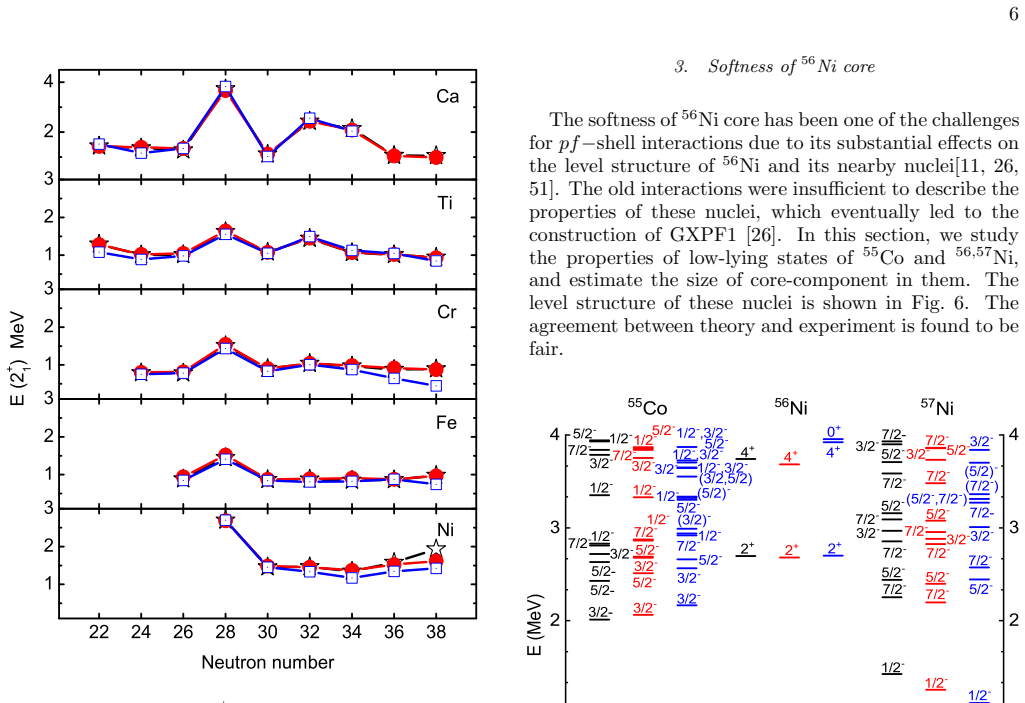
Ca isotopes In Fig 4, we show the level structure for 47−54Ca iso- topes. Overall, comparison between theory and exper- iment is found to be good. For instance, in 47Ca, 3 2 − 1 state measured at 2.01 MeV is predicted at 2.14 MeV. In 49, 51Ca, 1 2 − 1 state is found close to experimental data. This state is dominated by νp1 1/ 2 ⊗ νf 8 7/ 2 and νp1 1/ 2 ⊗...
-
[2]
Evolution of E (2+ 1 ) The salient closed-shell features can be studied through the systematic of E(2 + 1 ) of even-even nuclei. The evolu- 6 /s50 /s52 /s49 /s50 /s51 /s49 /s50 /s51 /s49 /s50 /s51 /s50/s50 /s50/s52 /s50/s54 /s50/s56 /s51/s48 /s51/s50 /s51/s52 /s51/s54 /s51/s56 /s49 /s50 /s51 /s32 /s67/s97 /s84/s105 /s32 /s69/s32/s40/s50 /s43 /s49 /s41/s32...
-
[3]
Softness of 56Ni core The softness of 56Ni core has been one of the challenges for pf −shell interactions due to its substantial effects on the level structure of 56Ni and its nearby nuclei[11, 26, 51]. The old interactions were insufficient to describe the properties of these nuclei, which eventually led to the construction of GXPF1 [26]. In this section, w...
-
[4]
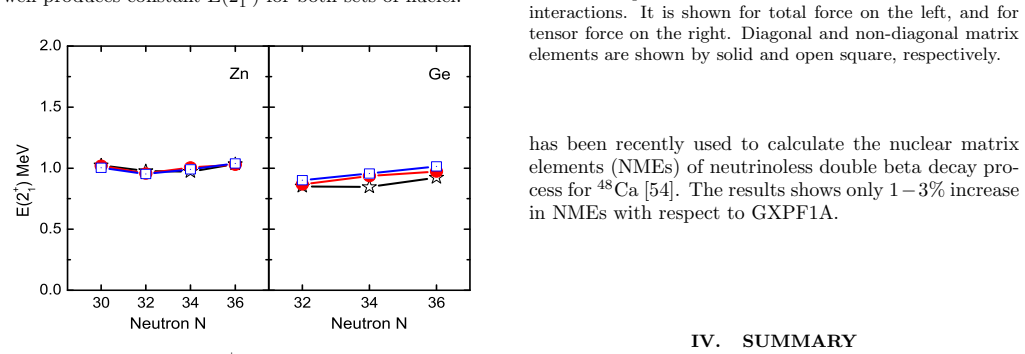
Z > 28 nuclei The Z >28 nuclei are usually studied in the reference of f5/ 2pg9/ 2−model space [52, 53] , however, the data of these nuclei is included for driving pf -shell interaction [26]. Therefore, their results also need to be investigated in pf -shell to account the righteousness of an interaction on a broader scale. In Fig. 8, we present the syste...
-
[5]
Caurier et al
E. Caurier et al. , Rev. Mod. Phys. 77, 427 (2005)
2005
- [6]
-
[7]
B. A. Brown et al. , Ann. Rev. Nucl. Part. Sci. 38, 29 (1988)
work page 1988
-
[8]
T. T. S. Kuo et al. , Nucl. Phys. 85, 40 (1966); Nucl. Phys. A 114, 241 (1968)
work page 1966
Show all 58 references
-
[9]
M. H. Jensen, et al. , Phys. Rep. 261, 125 (1995); Jour. Phys. G: Nucl. Part. Phys. 22, 321 (1996)
1995
-
[10]
D. J. Dean et al. , Prog. Part. Nucl. Phys. 53, 419 (2004)
2004
-
[11]
Chung, Ph.D
W. Chung, Ph.D. thesis, Michigan State University, 1976
1976
-
[12]
Poves et al
A. Poves et al. , Phys. Rep. 70, 235 (1981)
1981
-
[13]
A. P. Zuker, Nucl. Phys. A 576, 65 (1994)
1994
-
[14]
Dufour et al
M. Dufour et al. , Phys. Rev. C 54, 1641 (1996)
1996
-
[15]
Poves et al
A. Poves et al. , Nucl. Phys. A 694, 157 (2001)
2001
-
[16]
Honma et al., RIKEN Accel
M. Honma et al., RIKEN Accel. Prog. Rep. 41, 32 (2008)
2008
-
[17]
Steppenbeck et al
D. Steppenbeck et al. , Nature 502, 207 (2013)
2013
-
[18]
Umeya et al
A. Umeya et al. , Phys. Rev. C 69, 024306 (2004); Nucl. Phys. A 955, 194 (2016)
2004
-
[19]
N. A. Smirnova et al. , Phys. Lett. B 686, 109 (2010); Phys. Rev. C 86, 034314 (2012)
2010
-
[20]
Kumar et al
P. Kumar et al. , Phys. Rev. C 100, 024328 (2019); Nucl. Phys. A 983, 210 (2019)
2019
-
[21]
Otsuka et al
T. Otsuka et al. , Phys. Rev. Lett. 95, 232502 (2005); Phys. Rev. Lett. 97, 162501 (2006); Rew. Mod. Phys. 92, 015002 (2020); Phys. Scr. T 152, 014007 (2013)
2005
-
[22]
Utsuno et al
Y. Utsuno et al. , Phys. Rev. C 86, 051301(R) (2012); EPJ Web Conf. 66, 02106 (2014)
2012
-
[23]
Otsuka et al
T. Otsuka et al. , Phys. Rev. Lett. 104, 012501 (2010)
2010
-
[24]
Tsunoda et al
N. Tsunoda et al. , Phys. Rev. C 84, 044322 (2011); J. Phys. Conf. Ser. 267, 012020 (2011)
2011
-
[25]
M. W. Kirson, Phys. Lett. B. 47, 110 (1973)
1973
-
[26]
B. A. Brown et al. , J. Phys. G: Nucl. Phys. 11, 1191 (1985)
1985
-
[27]
B. A. Brown et al. , Phys. Rev. C 74, 034315 (2006)
2006
-
[28]
Wang et al
X.B. Wang et al. , J. Phys. G: Nucl. Part. Phys. 42, 125101 (2015)
2015
-
[29]
Honma et al
M. Honma et al. , Eur. Phys. J. A 25, 499 (2005)
2005
-
[30]
Honma et al
M. Honma et al. , Phys. Rev. C 65, 061301(R) (2002); Phys. Rev. C 69, 034335 (2004)
2002
-
[31]
Umeya et al
A. Umeya et al. , Phys. Rev. C 77, 034318 (2008)
2008
-
[32]
Klingenbeck et al
K. Klingenbeck et al. , Phys. Rev. C 15, 1483 (1977)
1977
-
[33]
Yoro, Nucl
K. Yoro, Nucl. Phys. A 333, 67 (1980)
1980
-
[34]
Elhott et al
J P. Elhott et al. , Nucl. Phys. A 121, 241 (1968)
1968
-
[35]
Kumar, private communication
P. Kumar, private communication
-
[36]
Utsuno et al
Y. Utsuno et al. , JPS Conf. Proc. 6, 010007 (2015)
2015
-
[37]
Yukawa, Proc
H. Yukawa, Proc. Phys. Math. Soc. Japan 17, 48 (1935)
1935
- [38]
-
[39]
J. D. Holt et al. , Phys. Rev. C 90, 024312 (2014)
2014
-
[40]
Utsuno et al
Y. Utsuno et al. , Phys. Rev. C 60, 054315 (1999)
1999
-
[41]
Otsuka et al
T. Otsuka et al. , Phys. Rev. Lett. 87, 082502 (2001)
2001
-
[42]
N. A. Smirnova et al. , Phys. Rev. C 69, 044306(2004)
2004
-
[43]
Gade et al
A. Gade et al. , Phys. Rev. C 74, 021302(R) (2006)
2006
-
[44]
Wienholtz et al
F. Wienholtz et al. , Nature 498, 346 (2013)
2013
-
[45]
Michimasa et al
S. Michimasa et al. , Phys. Rev. Lett. 121, 022506 (2018)
2018
-
[46]
Uozumi et al
Y. Uozumi et al. , Phys. Rev. C 50, 263 (1994)
1994
-
[47]
M. G. Mayer, Phys. Rev. 75, 1969 (1949)
1949
-
[48]
A. Bohr, B. R. Mottelson, Nuclear Structure, vol. 1, World Scientific, Singapore, 1988,
1988
-
[49]
B. A. Brown et al. , Nucl. Data Sheets 120, 115 (2014)
2014
-
[50]
http://www.nndc.bnl.gov/ensdf/
-
[51]
Rejmund et al
M. Rejmund et al. , Phys. Rev. C 76, 021304(R) (2007)
2007
-
[52]
Chen et al
S. Chen et al. , Phys. Rev. Lett. 123, 142501 (2019)
2019
-
[53]
Liu et al
H.N. Liu et al. , Phys. Rev. Lett. 122, 072502 (2019)
2019
-
[54]
S. M. Lenzi et al. , Phys. Rev. C 82, 054301 (2010)
2010
-
[55]
W. A. Richter et al. , Nucl. Phys. A 523, 325 (1991)
1991
-
[56]
Honma et al
M. Honma et al. , Phys. Rev. C 80, 064323 (2009)
2009
-
[57]
Brown and Lisetskiy, unpublished: official Ref. B. Cheal et al. , Phys. Rev. Lett. 104, 252502 (2010)
2010
-
[58]
Sarkar et al
S. Sarkar et al. , Phys. Rev. C 101, 014307 (2020)
2020
Reviewed August 14, 2026 · model on record in the stance chip above.
Discussion (0). Continue with ORCID to comment.