REVIEW 3 major objections 5 minor 58 references
Extrapolated low-Q² electron data give a larger Δ(1232) peak for the deuteron and neutron than real-photon measurements, matching the proton as isospin symmetry requires.
Reviewed by Pith at T0; open to challenge. T0 means a machine referee read the full paper against a public rubric. the ladder, T0–T4 →
T0 review · grok-4.5
2026-07-31 02:10 UTC pith:3HNJ2Y3U
load-bearing objection Useful new Q²→0 σ_TT spectra that restore approximate p–n Δ equality via electroextraction, but the headline rests on a linear extrapolation that is only lightly stress-tested. the 3 major comments →
Extraction of σ_(TT) for Proton, Neutron, Deuteron and ³He from Quasi-real Photon Scattering
The pith
A machine-rendered reading of the paper's core claim, the machinery that carries it, and where it could break.
Core claim
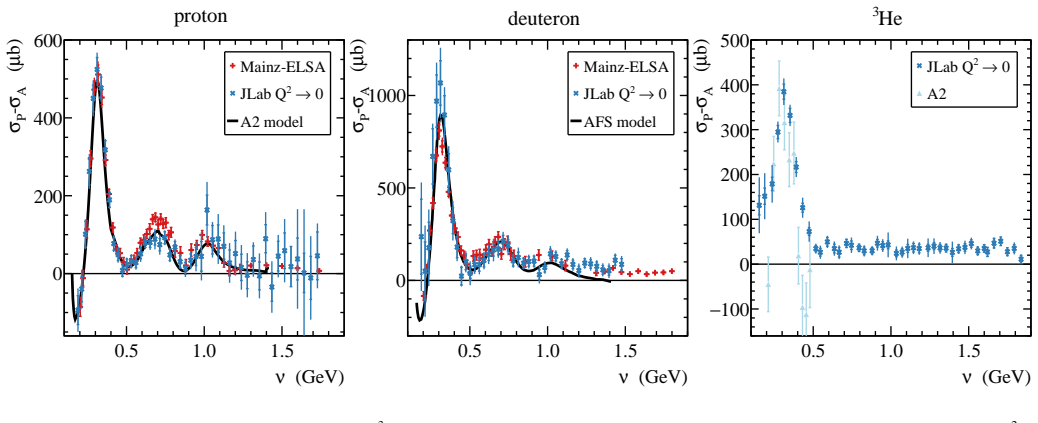
When Jefferson Lab electroproduction data on the proton, deuteron and ³He are extrapolated to Q² = 0, the resulting σ_TT for the proton matches real-photon measurements, while the deuteron and the neutron extracted via the weak-binding approximation display a markedly larger Δ(1232) peak. The neutron results from deuteron and from ³He agree with each other and with the proton magnitude, restoring the isospin expectation that had been in tension with earlier photoproduction extractions.
What carries the argument
Linear extrapolation of A₁F₁ (or of σ_TT itself) versus Q² in the window Q² < 0.2 GeV² to the real-photon point, followed by weak-binding-approximation unsmearing that subtracts the proton contribution and removes nuclear Fermi motion to recover free-neutron σ_TT.
Load-bearing premise
That a straight-line fit in virtuality below 0.2 GeV² is accurate enough to reach the true real-photon cross section, with no important curvature near Q² = 0.
What would settle it
A new exclusive real-photon measurement of deuteron σ_TT across the Δ(1232) that either reproduces the larger strength found by the extrapolation or reconfirms the smaller existing photoproduction values at the few-percent level.
If this is right
- Neutron σ_TT extracted from deuteron and from ³He electroproduction are mutually consistent and comparable in size to the proton at the Δ(1232).
- The weak-binding approximation can be used to obtain neutron spin structure from ³He data at real and quasi-real photon kinematics, a regime previously unexplored with that method.
- Low-Q² inclusive electroproduction plus extrapolation becomes a practical complement to exclusive real-photon experiments for photoproduction observables.
- The isovector combination σ_TT^(p−n) is near zero at the Δ peak in the extrapolated data, consistent with the small isovector GDH sum implied by the near-equality of proton and neutron anomalous moments.
Where Pith is reading between the lines
- If the larger extrapolated Δ strength is correct, existing real-photon deuteron analyses may have under-subtracted quasi-elastic or final-state-interaction backgrounds near threshold.
- Agreement between deuteron- and ³He-based neutron extractions at Q² = 0 suggests the same nuclear-smearing framework can be applied to the large body of existing low-Q² ³He spin data still awaiting neutron extraction.
- A controlled comparison of linear versus higher-order Q² extrapolations on the same data set would quantify the dominant systematic that currently limits the claim.
Editorial analysis
A structured set of objections, weighed in public.
Referee Report
Summary. The manuscript extracts the polarized photoproduction cross section σ_TT(ν) for the proton, deuteron, ³He and (via WBA) the neutron by linearly extrapolating low-Q² electroproduction data from JLab EG4 and E97-110 to the real-photon point. Proton results agree with Mainz-ELSA photoproduction in the Δ(1232) region; deuteron and neutron extractions yield a larger Δ strength than real-photon deuteron data and are closer to isospin equality with the proton. Resonance-region integrals (Tables 1–3) and isovector combinations quantify the comparisons, and WBA is applied to ³He at quasi-real kinematics for the first time.
Significance. If the extrapolated spectra and the restored isospin pattern hold, the work supplies an independent inclusive data set that complements exclusive real-photon measurements, tests the practical reach of Q²→0 extrapolation for photoproduction observables, and opens a path to neutron spin structure from existing ³He data outside DIS. The first application of WBA unsmearing to ³He at very low Q² and the tabulated resonance integrals are concrete, reusable results. The tension with photoproduction deuteron Δ strength is a falsifiable claim of interest to the GDH and nucleon-resonance communities.
major comments (3)
- [§2] §2: The central claim (larger deuteron/neutron Δ strength restoring isospin; Abstract, Tables 1–3, Figs. 1–3) rests on linear fits of A1F1 or σ_TT vs Q² for Q²<0.2 GeV². Reduced χ²~0.7–0.9 and leave-many-out/perturbation ensembles do not test curvature or resonance-dependent Q² shapes near the photon point (chiral loops, VMD, N→Δ multipole evolution). A systematic shift of the Q²=0 intercept would move the headline Δ integrals (Table 2: 80.6/71.5 vs 51.3) and the near-zero isovector at the Δ peak without being captured by the quoted errors. The paper should show quadratic (or theory-motivated) alternatives, quantify intercept shifts bin-by-bin especially under the Δ, and either enlarge the extrapolation uncertainty or justify why linear is adequate.
- [Table 1, §2] Table 1 and §2: Proton electro- vs photo-production disagree at 4σ in the second resonance region (21.8±2.2 vs 31.9±1.3) while agreeing in the Δ. The text notes the discrepancy but does not assess whether it signals residual Q² dependence, radiative-correction differences, or an under-estimated extrapolation uncertainty that could also affect the deuteron/neutron Δ comparison. A quantitative discussion of this control sample is needed before the isospin conclusion is drawn.
- [§3] §3: WBA is applied to ³He at Q²=0 for the first time and yields neutron Δ strength consistent with the deuteron electroproduction extraction. The paper states that wave-function and input-model variations are negligible, but does not show the size of those variations relative to the data errors, nor discuss known limitations of WBA for exclusive/resonant channels or final-state interactions at the photon point. A short quantitative appendix or figure demonstrating the stability of the unsmeared σ_n_TT under the stated variations would make the first-time ³He claim more robust.
minor comments (5)
- [Fig. 1] Fig. 1 caption and panels: axis labels use mixed fonts and truncated units (‘b) µ’); make σ_TT units and ν labels uniform across the three panels.
- [Eq. (3)] Eq. (3): K_γ is introduced without an explicit definition in the text; cite the convention used (e.g. Hand or Gilman) for reproducibility.
- [Table 2] Table 2 header and bold/italic convention: the caption says bold (italic) for >4σ (>3σ), but the body uses bold only for one entry and italic for others inconsistently with Table 1’s italic-only rule; unify the significance markup.
- [Appendix A] Appendix tables A.4–A.8: W and ν columns are useful; add a brief note on whether the listed syst already includes the extrapolation component or only the original experimental syst.
- [References] References: arXiv:2604.14385 is cited as Pedroni et al. (4 2026); confirm status and update if a journal version or final arXiv exists before publication.
Circularity Check
No significant circularity: empirical Q2-to-0 extrapolation compared to independent real-photon data and external models.
full rationale
The paper’s chain is an experimental extraction, not a derivation that closes on its inputs. EG4/E97-110 electroproduction points are fit linearly in Q2 < 0.2 GeV2 and extrapolated to Q2 = 0; neutron sigma_TT is then obtained via the weak-binding approximation using external nuclear wavefunctions and independent proton photoproduction (or electroproduction) inputs. The headline comparison is to Mainz-ELSA/A2 real-photon datasets and to external multipion/AFS/SAID models—none of which are defined by the extrapolated intercepts. Reduced chi2 and drop-half-points resampling quantify fit uncertainty; they do not force the Delta integrals or the near-zero isovector by construction. Self-citations are to the authors’ own source experiments (normal data provenance) and are not used as uniqueness theorems or as the sole justification of the isospin claim. Adequacy of the linear ansatz is a systematic/correctness question, not circularity. Score 0; steps empty.
Axiom & Free-Parameter Ledger
free parameters (2)
- Per-ν-bin linear coefficients for A1F1(Q²) or σ_TT(Q²) in Q²<0.2 GeV² =
Bin-dependent; not tabulated as slopes, only Q²=0 intercepts in Appendix tables
- Extrapolation uncertainty ensemble (drop up to half the points; perturb within errors)
axioms (5)
- domain assumption Virtual-photon electroproduction observables at Q²≲0.2 GeV² connect smoothly to real-photon σ_TT via a low-order (here linear) polynomial in Q².
- domain assumption Weak binding approximation: light-nucleus structure functions are convolutions of free nucleon structure functions with smearing functions from nuclear wavefunctions.
- domain assumption Born approximation relating measured lepton asymmetries/structure functions to virtual-photon σ_TT via Eqs. (2)–(3).
- domain assumption Isospin-symmetric N→Δ transition implies σ_TT^{p−n}≈0 near the Δ peak (modulo nonresonant background).
- standard math Standard arithmetic and χ² fitting for linear regression and integral comparisons.
read the original abstract
We report on an extraction of the polarized photoproduction cross-section for the proton, deuteron, neutron and $^3$He, obtained by extrapolating electron scattering data to the real photon point. The data are from the Jefferson Lab E97-110 ($^3$He) and CLAS EG4 (proton and deuteron) experiments. Information on the neutron is extracted from the deuteron or $^3$He data using the weak binding approximation. Comparing with data obtained with real photons, we find that while the proton results agree, our results on the deuteron and the neutron exhibit a larger strength in the $\Delta(1232)$ region, and are more consistent with isospin symmetry when compared with the proton results.
Figures


Reference graph
Works this paper leans on
-
[1]
J. Ashman, et al., A Measurement of the Spin Asymme- try and Determination of the Structure Function g(1) in Deep Inelastic Muon-Proton Scattering, Phys. Lett. B 206 (1988) 364.doi:10.1016/0370-2693(88)91523-7
-
[2]
M. Anselmino, A. Efremov, E. Leader, The theory and phenomenology of polarized deep inelastic scattering, Phys. Rept. 261 (1995) 1–124, [Erratum: Phys.Rept. 281, 399–400 (1997)].arXiv:hep-ph/9501369,doi:10. 1016/0370-1573(95)00011-5
Pith/arXiv arXiv 1995
-
[3]
A. Deur, S. J. Brodsky, G. F. De Téramond, The Spin Structure of the Nucleon, Rept. Prog. Phys. 82 (2019) 076201.arXiv:1807.05250,doi:10.1088/ 1361-6633/ab0b8f
arXiv 2019
-
[4]
X. Ji, F. Yuan, Y . Zhao, What we know and what we don’t know about the proton spin after 30 years, Nature Rev. Phys. 3 (1) (2021) 27–38.arXiv:2009.01291,doi:10. 1038/s42254-020-00248-4
Pith/arXiv arXiv 2021
-
[5]
S. B. Gerasimov, A sum rule for magnetic moments and the damping of the nucleon magnetic moment in nuclei, Yad. Fiz. 2 (1965) 598–602
1965
-
[6]
S. D. Drell, A. C. Hearn, Exact sum rule for nucleon magnetic moments, Phys. Rev. Lett. 16 (1966) 908–911. doi:10.1103/PhysRevLett.16.908
-
[7]
Altarelli, N
G. Altarelli, N. Cabibbo, L. Maiani, The Drell-Hearn sum rule and the lepton magnetic moment in the Wein- berg model of weak and electromagnetic interactions, Phys. Lett. B 40 (1972) 415–419.doi:10.1016/ 0370-2693(72)90833-7
1972
-
[8]
M. M. Dalton, A. Deur, C. D. Keith, S. Širca, J. Stevens, Measurement of the high-energy contribution to the Gerasimov-Drell-Hearn sum rule (8 2020).arXiv:2008. 11059
2020
-
[9]
J. Ahrens, et al., First measurement of the Gerasimov- Drell-Hearn integral for hydrogen from 200 to 800 MeV, Phys. Rev. Lett. 87 (2001) 022003.arXiv:hep-ex/ 0105089,doi:10.1103/PhysRevLett.87.022003
-
[10]
Dutz, et al., First measurement of the Gerasimov- Drell-Hearn sum rule for H-1 from 0.7-GeV to 1.8-GeV at ELSA, Phys
H. Dutz, et al., First measurement of the Gerasimov- Drell-Hearn sum rule for H-1 from 0.7-GeV to 1.8-GeV at ELSA, Phys. Rev. Lett. 91 (2003) 192001.doi:10. 1103/PhysRevLett.91.192001
2003
-
[11]
Dutz, et al., Experimental check of the Gerasimov- Drell-Hearn sum rule for H-1, Phys
H. Dutz, et al., Experimental check of the Gerasimov- Drell-Hearn sum rule for H-1, Phys. Rev. Lett. 93 (2004) 032003.doi:10.1103/PhysRevLett.93.032003
-
[12]
Ahrens, et al., Measurement of the Gerasimov-Drell- Hearn integrand for H-2 from 200-MeV to 800-MeV, Phys
J. Ahrens, et al., Measurement of the Gerasimov-Drell- Hearn integrand for H-2 from 200-MeV to 800-MeV, Phys. Rev. Lett. 97 (2006) 202303.doi:10.1103/ PhysRevLett.97.202303
2006
-
[13]
Ahrens, et al., Helicity dependence of the total inclusive cross section on the deuteron, Phys
J. Ahrens, et al., Helicity dependence of the total inclusive cross section on the deuteron, Phys. Lett. B 672 (2009) 328–332.doi:10.1016/j.physletb.2009.01.061
-
[14]
Helbing, The Gerasimov-Drell-Hearn sum rule, Prog
K. Helbing, The Gerasimov-Drell-Hearn sum rule, Prog. Part. Nucl. Phys. 57 (2006) 405–469.arXiv:nucl-ex/ 0603021,doi:10.1016/j.ppnp.2005.09.003
-
[15]
P. Aguar Bartolome, et al., First measurement of the he- licity dependence of 3He photoreactions in the∆(1232) resonance region, Phys. Lett. B 723 (2013) 71–77.doi: 10.1016/j.physletb.2013.04.057
-
[16]
P. Pedroni, et al., Measurement of the Gerasimov-Drell- Hearn integrand for proton and deuteron from 200 to 1400 MeV (4 2026).arXiv:2604.14385
Pith/arXiv arXiv 2026
-
[17]
H. Dutz, et al., Measurement of helicity-dependent pho- toabsorption cross sections on the neutron from 815-MeV to 1825-MeV, Phys. Rev. Lett. 94 (2005) 162001.doi: 10.1103/PhysRevLett.94.162001
-
[18]
G. Laskaris, et al., First Measurements of Spin-Dependent Double-Differential Cross Sections and the Gerasimov- Drell-Hearn Integrand from 3⃗He(⃗γ,n)ppat Incident Pho- ton Energies of 12.8 and 14.7 MeV, Phys. Rev. Lett. 110 (20) (2013) 202501.arXiv:1304.5442,doi:10. 1103/PhysRevLett.110.202501
Pith/arXiv arXiv 2013
-
[19]
G. Laskaris, et al., Measurement of the doubly-polarized ⃗3He(⃗γ,n)ppreaction at 16.5 MeV and its implications for the GDH sum rule, Phys. Lett. B 750 (2015) 547– 551.arXiv:1506.00332,doi:10.1016/j.physletb. 2015.09.065
Pith/arXiv arXiv 2015
-
[20]
G. Laskaris, et al., First measurement of the asymme- try and the Gerasimov-Drell-Hearn integrand from the 3He(γ,p)2H reaction at an incident photon energy of 29 MeV, Phys. Rev. C 103 (3) (2021) 034311.arXiv: 2010.14055,doi:10.1103/PhysRevC.103.034311
Pith/arXiv arXiv 2021
-
[21]
Anselmino, B
M. Anselmino, B. L. Ioffe, E. Leader, On possible resolu- tions of the spin crisis in the parton model, Sov. J. Nucl. Phys. 49 (1989) 136
1989
-
[22]
X.-D. Ji, J. Osborne, Generalized sum rules for spin de- pendent structure functions of the nucleon, J. Phys. G 27 (2001) 127.arXiv:hep-ph/9905410,doi:10.1088/ 0954-3899/27/1/308
Pith/arXiv arXiv 2001
-
[23]
D. Drechsel, S. S. Kamalov, L. Tiator, The GDH sum rule and related integrals, Phys. Rev. D 63 (2001) 114010.arXiv:hep-ph/0008306,doi:10.1103/ PhysRevD.63.114010
Pith/arXiv arXiv 2001
-
[24]
D. Drechsel, L. Tiator, The Gerasimov-Drell-Hearn sum rule and the spin structure of the nucleon, Ann. Rev. Nucl. Part. Sci. 54 (2004) 69–114.arXiv:nucl-th/0406059, doi:10.1146/annurev.nucl.54.070103.181159. 5
Pith/arXiv arXiv 2004
-
[25]
A. Airapetian, et al., TheQ 2 dependence of the gen- eralized Gerasimov-Drell-Hearn integral for the proton, Phys. Lett. B 494 (2000) 1–8.arXiv:hep-ex/0008037, doi:10.1016/S0370-2693(00)01111-4
Pith/arXiv arXiv 2000
-
[26]
A. Airapetian, et al., TheQ 2 dependence of the gener- alized Gerasimov-Drell-Hearn integral for the deuteron, proton and neutron, Eur. Phys. J. C 26 (2003) 527– 538.arXiv:hep-ex/0210047,doi:10.1140/epjc/ s2002-01118-x
Pith/arXiv arXiv 2003
-
[27]
K. Ackerstaff, et al., Determination of the deep inelas- tic contribution to the generalized Gerasimov-Drell-Hearn integral for the proton and neutron, Phys. Lett. B 444 (1998) 531–538.arXiv:hep-ex/9809015,doi:10. 1016/S0370-2693(98)01396-3
Pith/arXiv arXiv 1998
-
[28]
M. Amarian, et al., The Q**2 evolution of the general- ized Gerasimov-Drell-Hearn integral for the neutron using a He-3 target, Phys. Rev. Lett. 89 (2002) 242301.arXiv: nucl-ex/0205020,doi:10.1103/PhysRevLett.89. 242301
Pith/arXiv arXiv 2002
-
[29]
Prok, et al., Moments of the spin structure functions gp 1 and g d 1 for 0.05<Q 2 <3.0-GeV 2, Phys
Y . Prok, et al., Moments of the spin structure functions gp 1 and g d 1 for 0.05<Q 2 <3.0-GeV 2, Phys. Lett. B 672 (2009) 12–16.arXiv:0802.2232,doi:10.1016/j. physletb.2008.12.063
Pith/arXiv arXiv 2009
-
[30]
N. Guler, et al., Precise determination of the deuteron spin structure at low to moderateQ 2 with CLAS and ex- traction of the neutron contribution, Phys. Rev. C 92 (5) (2015) 055201.arXiv:1505.07877,doi:10.1103/ PhysRevC.92.055201
Pith/arXiv arXiv 2015
-
[31]
R. Fersch, et al., Determination of the proton spin struc- ture functions for 0.05<Q 2 <5 GeV 2 using CLAS, Phys. Rev. C 96 (6) (2017) 065208.arXiv:1706.10289, doi:10.1103/PhysRevC.96.065208
Pith/arXiv arXiv 2017
-
[32]
V . Sulkosky, et al., Measurement of the generalized spin polarizabilities of the neutron in the low-Q 2 region, Na- ture Phys. 17 (6) (2021) 687–692, [Erratum: Nature Phys. 18, (2022)].arXiv:2103.03333,doi:10.1038/ s41567-021-01245-9
Pith/arXiv arXiv 2021
-
[33]
V . Sulkosky, et al., Measurement of the 3He spin- structure functions and of neutron (3He) spin-dependent sum rules at 0.035≤Q2≤0.24 GeV2, Phys. Lett. B 805 (2020) 135428.arXiv:1908.05709,doi:10.1016/j. physletb.2020.135428
Pith/arXiv arXiv 2020
-
[34]
Zheng, et al., Measurement of the proton spin structure at long distances, Nature Phys
X. Zheng, et al., Measurement of the proton spin structure at long distances, Nature Phys. 17 (6) (2021) 736–741.arXiv:2102.02658,doi:10.1038/ s41567-021-01198-z
Pith/arXiv arXiv 2021
-
[35]
K. P. Adhikari, et al., Measurement of theQ 2 dependence of the deuteron spin structure functiong 1 and its mo- ments at lowQ 2 with CLAS, Phys. Rev. Lett. 120 (6) (2018) 062501.arXiv:1711.01974,doi:10.1103/ PhysRevLett.120.062501
Pith/arXiv arXiv 2018
-
[36]
Deur, et al., Measurement of the nucleon spin structure functions for 0.01<Q2<1GeV2 using CLAS, Phys
A. Deur, et al., Measurement of the nucleon spin structure functions for 0.01<Q2<1GeV2 using CLAS, Phys. Rev. C 111 (3) (2025) 035202.arXiv:2409.08365,doi:10. 1103/PhysRevC.111.035202
arXiv 2025
-
[37]
Deur, et al., Experimental study of the behavior of the Bjorken sum at very low Q2, Phys
A. Deur, et al., Experimental study of the behavior of the Bjorken sum at very low Q2, Phys. Lett. B 825 (2022) 136878.arXiv:2107.08133,doi:10.1016/j. physletb.2022.136878
Pith/arXiv arXiv 2022
-
[38]
V . Bernard, N. Kaiser, U.-G. Meissner, Chiral dynam- ics in nucleons and nuclei, Int. J. Mod. Phys. E 4 (1995) 193–346.arXiv:hep-ph/9501384,doi:10. 1142/S0218301395000092
Pith/arXiv arXiv 1995
-
[39]
Y . Kahn, W. Melnitchouk, S. A. Kulagin, New method for extracting neutron structure functions from nuclear data, Phys. Rev. C 79 (2009) 035205.arXiv:0809.4308, doi:10.1103/PhysRevC.79.035205
Pith/arXiv arXiv 2009
-
[40]
J. J. Ethier, W. Melnitchouk, Comparative study of nuclear effects in polarized electron scattering from 3He, Phys. Rev. C 88 (5) (2013) 054001.arXiv:1308.3723,doi: 10.1103/PhysRevC.88.054001
Pith/arXiv arXiv 2013
-
[41]
J. J. Ethier, N. Doshi, S. Malace, W. Mel- nitchouk, Quasielastic electron-deuteron scatter- ing in the weak binding approximation, Phys. Rev. C 89 (2014) 065203.arXiv:1402.3910, doi:10.1103/PhysRevC.89.065203
Pith/arXiv arXiv 2014
-
[42]
A. J. Tropiano, J. J. Ethier, W. Melnitchouk, N. Sato, Deep-inelastic and quasielastic electron scattering from A=3 nuclei, Phys. Rev. C 99 (3) (2019) 035201.arXiv: 1811.07668,doi:10.1103/PhysRevC.99.035201
Pith/arXiv arXiv 2019
-
[43]
B. A. Mecking, et al., The CEBAF Large Acceptance Spectrometer (CLAS), Nucl. Instrum. Meth. A 503 (2003) 513–553.doi:10.1016/S0168-9002(03)01001-5
-
[44]
Alcorn, et al., Basic Instrumentation for Hall A at Jef- ferson Lab, Nucl
J. Alcorn, et al., Basic Instrumentation for Hall A at Jef- ferson Lab, Nucl. Instrum. Meth. A 522 (2004) 294–346. doi:10.1016/j.nima.2003.11.415
-
[45]
I. Strakovsky, S. Širca, W. J. Briscoe, A. Deur, A. Schmidt, R. L. Workman, Single-pion contribution to the Gerasimov-Drell-Hearn sum rule and related in- tegrals, Phys. Rev. C 105 (4) (2022) 045202.arXiv: 2201.06495,doi:10.1103/PhysRevC.105.045202
Pith/arXiv arXiv 2022
-
[46]
A. Fix, H. Arenhoevel, Double pion photoproduction on nucleon and deuteron, Eur. Phys. J. A 25 (2005) 115– 135.arXiv:nucl-th/0503042,doi:10.1140/epja/ i2005-10067-5
Pith/arXiv arXiv 2005
-
[47]
L. Tiator, M. Gorchtein, V . L. Kashevarov, K. Nikonov, M. Ostrick, M. Hadžimehmedovi ´c, R. Omerovi ´c, H. Os- manovi´c, J. Stahov, A. Švarc, Eta and Etaprime Photo- production on the Nucleon with the Isobar Model Eta- MAID2018, Eur. Phys. J. A 54 (12) (2018) 210.arXiv: 1807.04525,doi:10.1140/epja/i2018-12643-x. 6
Pith/arXiv arXiv 2018
-
[48]
M. Matveev, A. V . Sarantsev, V . A. Nikonov, A. V . Aniso- vich, U. Thoma, E. Klempt, Hyperon I: Partial-wave amplitudes for K−p scattering, Eur. Phys. J. A 55 (10) (2019) 179.arXiv:1907.03645,doi:10.1140/epja/ i2019-12878-y
Pith/arXiv arXiv 2019
-
[49]
A. V . Sarantsev, M. Matveev, V . A. Nikonov, A. V . Anisovich, U. Thoma, E. Klempt, Hyperon II: Prop- erties of excited hyperons, Eur. Phys. J. A 55 (10) (2019) 180.arXiv:1907.13387,doi:10.1140/epja/ i2019-12880-5
Pith/arXiv arXiv 2019
-
[50]
H. Arenhovel, A. Fix, M. Schwamb, Spin asymmetry and Gerasimov-Drell-Hearn sum rule for the deuteron, Phys. Rev. Lett. 93 (2004) 202301.arXiv:nucl-th/0407058, doi:10.1103/PhysRevLett.93.202301
Pith/arXiv arXiv 2004
-
[51]
R. L. Workman, M. W. Paris, W. J. Briscoe, I. I. Strakovsky, Unified Chew-Mandelstam SAID analysis of pion photoproduction data, Phys. Rev. C 86 (2012) 015202.arXiv:1202.0845,doi:10.1103/PhysRevC. 86.015202
Pith/arXiv arXiv 2012
-
[52]
W. J. Briscoe, A. Schmidt, I. Strakovsky, R. L. Work- man, A. Svarc, Extended SAID partial-wave analy- sis of pion photoproduction, Phys. Rev. C 108 (6) (2023) 065205.arXiv:2309.06631,doi:10.1103/ PhysRevC.108.065205
Pith/arXiv arXiv 2023
-
[53]
V . D. Burkert, Comment on the generalized Gerasimov- Drell-Hearn sum rule in chiral perturbation theory, Phys. Rev. D 63 (2001) 097904.arXiv:nucl-th/0004001, doi:10.1103/PhysRevD.63.097904
Pith/arXiv arXiv 2001
-
[54]
Solvignon, et al., Moments of the neutrong 2 structure function at intermediateQ 2, Phys
P. Solvignon, et al., Moments of the neutrong 2 structure function at intermediateQ 2, Phys. Rev. C 92 (1) (2015) 015208.arXiv:1304.4497,doi:10.1103/PhysRevC. 92.015208
Pith/arXiv arXiv 2015
-
[55]
Flay, et al., Measurements ofd n 2 andA n 1: Prob- ing the neutron spin structure, Phys
D. Flay, et al., Measurements ofd n 2 andA n 1: Prob- ing the neutron spin structure, Phys. Rev. D 94 (5) (2016) 052003.arXiv:1603.03612,doi:10.1103/ PhysRevD.94.052003
Pith/arXiv arXiv 2016
-
[56]
J. D. Bjorken, Asymptotic sum rules at infinite momen- tum, Phys. Rev. 179 (1969) 1547–1553.doi:10.1103/ PhysRev.179.1547
1969
-
[57]
A. Deur, S. J. Brodsky, C. D. Roberts, QCD running cou- plings and effective charges, Prog. Part. Nucl. Phys. 134 (2024) 104081.arXiv:2303.00723,doi:10.1016/j. ppnp.2023.104081
Pith/arXiv arXiv 2024
-
[58]
S. J. Brodsky, R. Shrock, Maximum Wavelength of Confined Quarks and Gluons and Properties of Quan- tum Chromodynamics, Phys. Lett. B 666 (2008) 95–99. arXiv:0806.1535,doi:10.1016/j.physletb.2008. 06.054. Table A.4: Cross sections extrapolated toQ 2 =0 for 1H. W ν σT T stat syst GeV GeV µb µb µb 1.11 0.188 −93.8 37.0 41.9 1.13 0.212 −39.7 32.6 37.5 1.15 0....
Pith/arXiv arXiv 2008
discussion (0)
Sign in with ORCID, Apple, or X to comment. Anyone can read and Pith papers without signing in.