Damped Harmonic Oscillator Dark Energy and the Hubble Tension
Pith reviewed 2026-06-27 00:20 UTC · model grok-4.3
The pith
A dark energy equation of state obeying the damped harmonic oscillator differential equation yields H0 values of 70.9 or 72.0 km/s/Mpc with two supernova compilations, reducing tension with local measurements to 1.4 sigma while matching Lam
A machine-rendered reading of the paper's core claim, the machinery that carries it, and where it could break.
Core claim
We investigate a dark-energy equation of state governed by a damped harmonic oscillator equation, admitting underdamped, critically damped, and overdamped solutions. Confronting the model against Planck CMB, DESI BAO, BBN, Cosmic Chronometers, and three Type Ia supernova compilations, we find that the underdamped solution yields H0 = 70.9 ± 1.1 km/s/Mpc with DESY5 and H0 = 72.0+1.4−2.1 km/s/Mpc with Union3, reducing the tension with SH0ES to ∼1.4σ, while Pantheon+ strongly favors a near-critically damped solution with positive w0 and H0 = 66.23 ± 0.85 km/s/Mpc, revealing a significant systematic tension among supernova datasets. Bayesian evidence relative to ΛCDM is inconclusive for DES and
What carries the argument
Damped harmonic oscillator differential equation obeyed by the dark energy equation of state
If this is right
- The underdamped regime returns H0 near 71-72 km/s/Mpc and lowers the tension with SH0ES to 1.4 sigma for DESY5 and Union3 supernova samples.
- Pantheon+ data instead select a near-critically damped solution with H0 = 66.23 km/s/Mpc and positive present-day equation of state.
- Bayesian evidence remains inconclusive or comparable to Lambda CDM, showing tension reduction occurs without loss of fit quality.
- The three supernova compilations produce mutually inconsistent preferred damping regimes, indicating systematic differences among the datasets.
Where Pith is reading between the lines
- The result implies that apparent Hubble tension may partly reflect inconsistencies in how different supernova samples are calibrated rather than a universal failure of Lambda CDM.
- If the model holds, future high-precision supernova surveys could decide which damping regime, if any, actually describes the data.
- The functional form is introduced without a microphysical origin, so any confirmation would motivate searches for a fundamental mechanism that naturally produces such oscillatory late-time dynamics.
Load-bearing premise
The dark energy equation of state is assumed to obey exactly the damped harmonic oscillator differential equation without derivation from a more fundamental theory.
What would settle it
A measurement of the dark energy equation of state at multiple redshifts that lies outside the family of underdamped, critically damped, and overdamped trajectories would rule out the model.
Figures
read the original abstract
We investigate a dark-energy equation of state governed by a damped harmonic oscillator equation, admitting underdamped, critically damped, and overdamped solutions. Confronting the model against Planck CMB, DESI BAO, BBN, Cosmic Chronometers, and three Type~Ia supernova compilations, we find that the underdamped solution yields $H_0 = 70.9 \pm 1.1$ km/s/Mpc, with DESY5 and $H_0 = 72.0^{+1.4}_{-2.1}$ km/s/Mpc with Union3, reducing the tension with SH0ES to $\sim\!1.4\sigma$, while Pantheon+ strongly favors a near-critically damped solution with positive $w_0$ and $H_0 = 66.23 \pm 0.85$ km/s/Mpc, revealing a significant systematic tension among supernova datasets. Bayesian evidence relative to $\Lambda$CDM is inconclusive for DES and Union3 data, demonstrating that $H_0$ tension alleviation is achievable at no statistical cost relative to the standard model.
Editorial analysis
A structured set of objections, weighed in public.
Referee Report
Summary. The manuscript proposes a phenomenological dark energy model in which the equation-of-state parameter w(a) obeys the differential equation of a damped harmonic oscillator, admitting underdamped, critically damped, and overdamped solutions. The model (with three free parameters: oscillator frequency, damping coefficient, and initial conditions) is confronted with Planck CMB, DESI BAO, BBN, cosmic chronometers, and three Type Ia supernova compilations. The underdamped solution yields H0 = 70.9 ± 1.1 km/s/Mpc (DESY5) and H0 = 72.0+1.4−2.1 km/s/Mpc (Union3), reducing SH0ES tension to ~1.4σ, while Pantheon+ prefers a near-critically damped solution with positive w0 and H0 = 66.23 ± 0.85 km/s/Mpc; Bayesian evidence relative to ΛCDM is reported as inconclusive.
Significance. If the posteriors and evidence ratios hold under scrutiny, the work shows that a simple three-parameter late-time ansatz can produce H0 values consistent with local measurements for two supernova datasets without incurring a Bayesian penalty over ΛCDM. It also quantifies a systematic difference among supernova compilations and supplies an explicit, solvable functional form for w(a) that can be used in future forecasts.
major comments (2)
- [Results section] Results section (posterior tables and H0 marginals): the reported tension reductions are obtained by fitting the oscillator parameters directly to the same combined likelihoods used to quote the H0 values; the manuscript should demonstrate that the alleviation is not an artifact of the specific prior volume or of the way the three SN compilations are combined (e.g., by showing the shift in H0 when the oscillator parameters are fixed to their ΛCDM best-fit values).
- [Model definition] Model definition (ODE and regime classification): the boundaries between under-, critical-, and over-damped regimes depend on the relative size of the damping coefficient and frequency; the paper must state the exact prior ranges adopted for these parameters and report the posterior probability mass assigned to each regime for every dataset combination, as the central narrative hinges on which regime is preferred.
minor comments (4)
- [Abstract] Abstract: the asymmetric error on the Union3 H0 value is written with superscripts but the corresponding table or text should use a consistent notation (e.g., 72.0^{+1.4}_{-2.1}).
- The manuscript should add a summary table listing the best-fit oscillator parameters, H0, and ln-evidence ratios for all six dataset combinations (Planck+BAO+BBN+CC plus each SN sample).
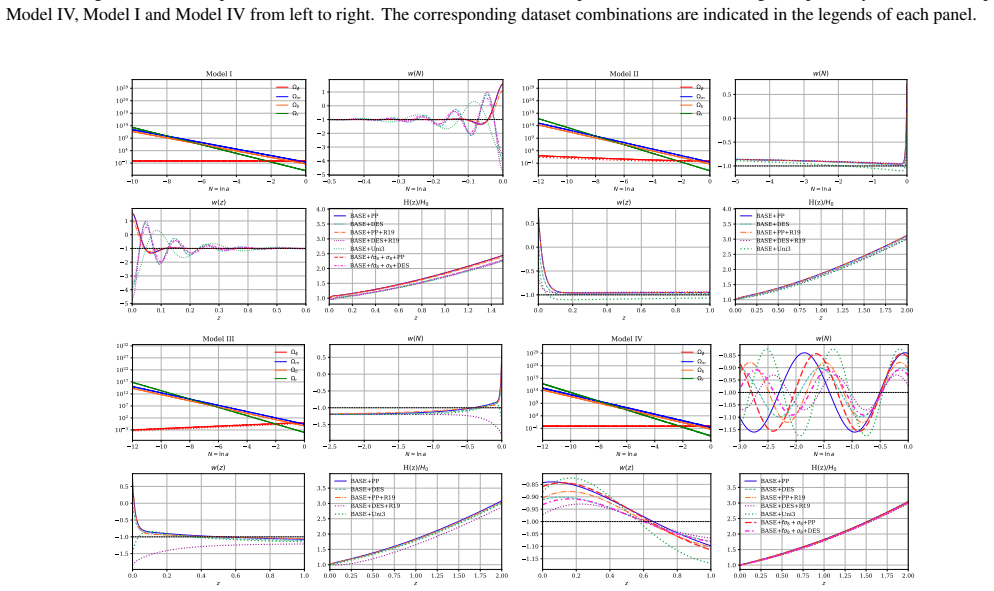
- Figure captions (phase-space or w(a) plots): explicitly label which curves correspond to underdamped, critically damped, and overdamped solutions and indicate the parameter values used.
- [Introduction] Introduction: add references to earlier phenomenological oscillating or damped dark-energy models to place the present ansatz in context.
Simulated Author's Rebuttal
We thank the referee for the careful reading of our manuscript and the constructive comments. We address each major comment below and will incorporate the requested additions in the revised version.
read point-by-point responses
-
Referee: [Results section] Results section (posterior tables and H0 marginals): the reported tension reductions are obtained by fitting the oscillator parameters directly to the same combined likelihoods used to quote the H0 values; the manuscript should demonstrate that the alleviation is not an artifact of the specific prior volume or of the way the three SN compilations are combined (e.g., by showing the shift in H0 when the oscillator parameters are fixed to their ΛCDM best-fit values).
Authors: We agree that an explicit check is useful to confirm the H0 shift arises from the model rather than prior volume. In the revised manuscript we will add a table in the Results section reporting the H0 posterior obtained when the oscillator parameters are fixed to their ΛCDM best-fit values (recovering w = −1) for each supernova compilation. This will quantify the shift attributable to the additional freedom. revision: yes
-
Referee: [Model definition] Model definition (ODE and regime classification): the boundaries between under-, critical-, and over-damped regimes depend on the relative size of the damping coefficient and frequency; the paper must state the exact prior ranges adopted for these parameters and report the posterior probability mass assigned to each regime for every dataset combination, as the central narrative hinges on which regime is preferred.
Authors: We will update the Model definition section to state the exact prior ranges adopted for the frequency, damping coefficient, and initial-condition parameters. We will also add a table that reports the posterior probability mass in the underdamped, critically damped, and overdamped regimes for every dataset combination, thereby clarifying the preferred regime in each case. revision: yes
Circularity Check
No significant circularity identified
full rationale
The paper introduces the damped harmonic oscillator equation for the dark energy equation of state explicitly as a phenomenological ansatz rather than deriving it from a more fundamental theory or prior result. The reported H0 values and tension reductions are obtained by fitting the three free parameters of this ansatz to the listed datasets (Planck, DESI, BBN, chronometers, and supernova compilations) and comparing the resulting posteriors to SH0ES; this is standard parameter estimation with no claim that any quantity is independently predicted beyond the fit itself. No equations, self-citations, or uniqueness theorems are invoked in the provided text that would reduce the central claim to a tautology or self-referential fit. The derivation chain is therefore self-contained as an empirical model comparison.
Axiom & Free-Parameter Ledger
free parameters (3)
- oscillator frequency
- damping coefficient
- initial conditions for w and w'
axioms (2)
- standard math Standard Friedmann-Lemaître-Robertson-Walker metric and background equations govern the expansion
- ad hoc to paper Dark energy is fully described by an effective equation-of-state function w(a) obeying the damped oscillator ODE
Reference graph
Works this paper leans on
-
[1]
S. Perlmutter, et al., Astrophys. J.517, 565 (1999). doi: 10.1086/307221
work page internal anchor Pith review doi:10.1086/307221 1999
-
[2]
A.G. Riess, et al., Astron. J.116, 1009 (1998). doi: 10.1086/300499
work page internal anchor Pith review doi:10.1086/300499 1998
-
[3]
S. Weinberg, Rev. Mod. Phys.61, 1 (1989). doi: 10.1103/RevModPhys.61.1
-
[4]
I. Zlatev, L.M. Wang, P.J. Steinhardt, Phys. Rev. Lett.82, 896 (1999). doi:10.1103/PhysRevLett.82.896
-
[5]
K. Lodha, et al., Phys. Rev. D111(2), 023532 (2025). doi: 10.1103/PhysRevD.111.023532
-
[6]
M. Abdul Karim, et al., Phys. Rev. D112(8), 083515 (2025). doi:10.1103/tr6y-kpc6
-
[7]
M. Chevallier, D. Polarski, Int. J. Mod. Phys. D10, 213 (2001). doi:10.1142/S0218271801000822
-
[8]
E.V. Linder, Phys. Rev. Lett.90, 091301 (2003). doi: 10.1103/PhysRevLett.90.091301
-
[9]
Zhao, et al., Nature Astron.1(9), 627 (2017)
G.B. Zhao, et al., Nature Astron.1(9), 627 (2017). doi: 10.1038/s41550-017-0216-z
-
[10]
A.N. Ormondroyd, W.J. Handley, M.P. Hobson, A.N. Lasenby, Mon. Not. Roy. Astron. Soc.541(4), 3388 (2025). doi: 10.1093/mnras/staf1144
-
[11]
L.A. Escamilla, J.A. Vazquez, Eur. Phys. J. C83(3), 251 (2023). doi:10.1140/epjc/s10052-023-11404-2
-
[12]
Kessler, L.A
D.A. Kessler, L.A. Escamilla, S. Pan, E. Di Valentino. One- parameter dynamical dark energy: Hints for oscillations (2025)
2025
-
[13]
S. Hussain, S. Arora, A. Wang, B. Rose, Mon. Not. Roy. Astron. Soc.545(2), staf1924 (2025). doi:10.1093/mnras/staf1924
-
[14]
C. Rubano, P. Scudellaro, E. Piedipalumbo, S. Capozziello, Phys. Rev. D68, 123501 (2003). doi: 10.1103/PhysRevD.68.123501
-
[15]
R. Lazkoz, G. Leon, I. Quiros, Phys. Lett. B649, 103 (2007). doi:10.1016/j.physletb.2007.03.060
-
[16]
A.R. Brown, Phys. Rev. Lett.121(25), 251601 (2018). doi: 10.1103/PhysRevLett.121.251601
-
[17]
E.V. Linder, Astropart. Phys.25, 167 (2006). doi: 10.1016/j.astropartphys.2005.12.003
-
[18]
A. Arvanitaki, S. Dimopoulos, S. Dubovsky, N. Kaloper, J. March-Russell, Phys. Rev. D81, 123530 (2010). doi: 10.1103/PhysRevD.81.123530
-
[19]
Ruchika, S.A. Adil, K. Dutta, A. Mukherjee, A.A. Sen, Phys. Dark Univ.40, 101199 (2023). doi:10.1016/j.dark.2023.101199
-
[20]
R.R. Caldwell, E.V. Linder, Phys. Rev. Lett.95, 141301 (2005). doi:10.1103/PhysRevLett.95.141301
-
[21]
F. Pace, C. Fedeli, L. Moscardini, M. Bartelmann, Mon. Not. Roy. Astron. Soc.422, 1186 (2012). doi:10.1111/j.1365- 2966.2012.20692.x
-
[22]
S. Pan, E.N. Saridakis, W. Yang, Phys. Rev. D98(6), 063510 (2018). doi:10.1103/PhysRevD.98.063510
-
[23]
H. Li, X. Zhang, Phys. Lett. B703, 119 (2011). doi: 10.1016/j.physletb.2011.07.069
-
[24]
M. Rezaei, Astrophys. J.967(1), 2 (2024). doi:10.3847/1538- 4357/ad3963
-
[25]
M. Moresco, et al., JCAP08, 006 (2012). doi:10.1088/1475- 7516/2012/08/006
-
[26]
M. Moresco, L. Pozzetti, A. Cimatti, R. Jimenez, C. Maraston, L. Verde, D. Thomas, A. Citro, R. Tojeiro, D. Wilkinson, JCAP 05, 014 (2016). doi:10.1088/1475-7516/2016/05/014 7 Data set: CC+PLA+DBAO+BBN+PP Model 𝐻0 Ωde 𝑁eff Ω𝑏 ℎ2 𝑤 0 𝑤 𝑎 𝑓 𝑏log𝑍 I,(𝑤 𝑚 =1.0) 66.23±0.85 0.6680±0.0063 3.26±0.13 0.02265 ±0.00015 1.58+0.42 −0.14 <2.32 59 +9 −7 >64.3−873.04 II,...
-
[27]
N. Arendse, et al., Astron. Astrophys.639, A57 (2020). doi: 10.1051/0004-6361/201936720
-
[28]
C. Pitrou, A. Coc, J.P. Uzan, E. Vangioni, Phys. Rept.754, 1 (2018). doi:10.1016/j.physrep.2018.04.005
-
[29]
A.G. Riess, S. Casertano, W. Yuan, L.M. Macri, D. Scolnic, Astrophys. J.876(1), 85 (2019). doi:10.3847/1538-4357/ab1422
work page internal anchor Pith review doi:10.3847/1538-4357/ab1422 2019
-
[30]
The Pantheon+ Analysis: Cosmological Constraints.Astrophys
D.B. et al., The Astrophysical Journal938(2), 110 (2022). doi: 10.3847/1538-4357/ac8e04
-
[31]
B. Popovic, et al., Mon. Not. Roy. Astron. Soc.548, stag632 (2026). doi:10.1093/mnras/stag632
-
[32]
Union through UNITY: Cosmology with 2000 SNe Using a Unified Bayesian Framework.Astrophys
D. Rubin, et al., Astrophys. J.986(2), 231 (2025). doi: 10.3847/1538-4357/adc0a5
-
[33]
S. Alam, et al., Mon. Not. Roy. Astron. Soc.470(3), 2617 (2017). doi:10.1093/mnras/stx721
-
[34]
S. Sahlu, ´A. de la Cruz-Dombriz, A. Abebe, Mon. Not. Roy. Astron. Soc.539(2), 690 (2025). doi:10.1093/mnras/staf439
-
[35]
J.S. Speagle, Mon. Not. Roy. Astron. Soc.493(3), 3132 (2020). doi:10.1093/mnras/staa278
-
[36]
R.E. Kass, A.E. Raftery, J. Am. Statist. Assoc.90(430), 773 (1995). doi:10.1080/01621459.1995.10476572
-
[37]
A. Sah, M. Rameez, S. Sarkar, (2026). doi: 10.1093/mnras/stag844
-
[38]
C. Chung, Y.W. Lee, J. Son, S. Park, H. Cho, Mon. Not. Roy. As- tron. Soc.544(1), 975 (2025). doi:10.3390/universe12010022
-
[39]
G. Leon, E.N. Saridakis, JCAP03, 025 (2013). doi: 10.1088/1475-7516/2013/03/025
-
[40]
S. Hussain, Q. Wu, T. Zhu, JCAP04, 067 (2026). doi: 10.1088/1475-7516/2026/04/067
discussion (0)
Sign in with ORCID, Apple, or X to comment. Anyone can read and Pith papers without signing in.