Governing Actions, Not Agents: Institutional Attestation as a Governance Model for Autonomous AI Systems
Pith reviewed 2026-06-26 01:39 UTC · model grok-4.3
The pith
AI agents retain full planning autonomy but require independent attestations for high-risk action execution.
A machine-rendered reading of the paper's core claim, the machinery that carries it, and where it could break.
Core claim
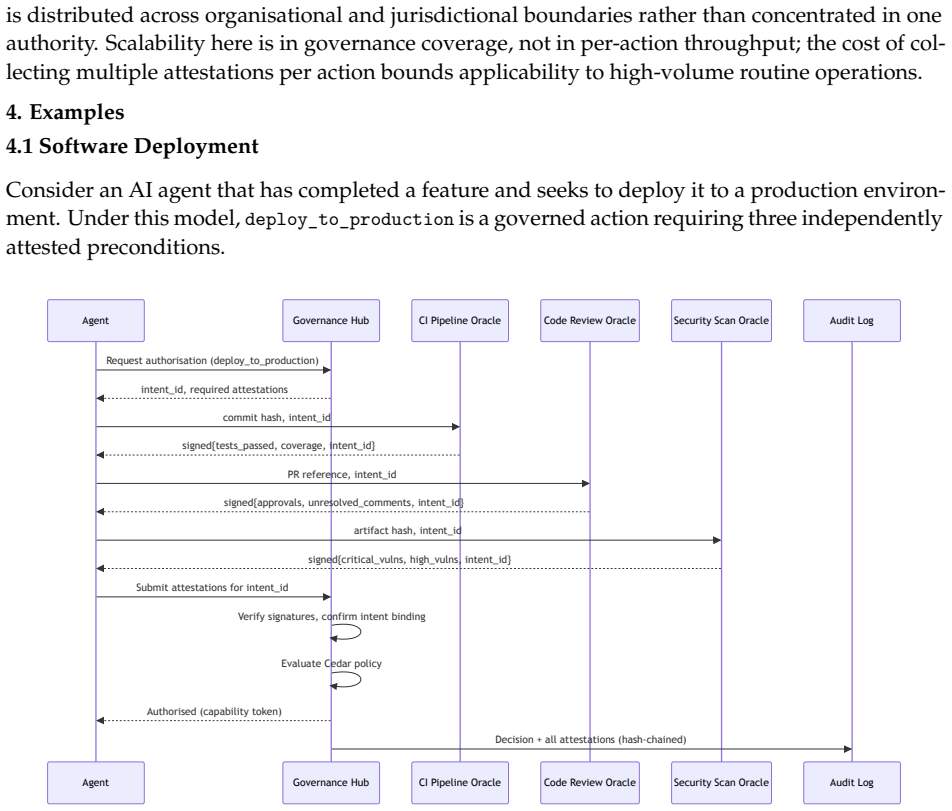
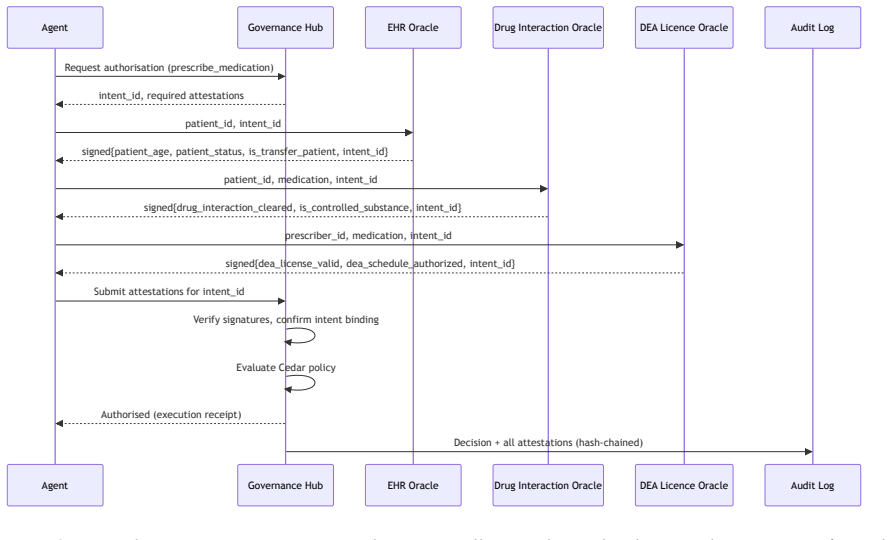
Under the proposed model, an agent retains full autonomy over planning and reasoning but holds no execution authority over designated high-risk actions. Execution is conditional on preconditions that are each independently attested by a separate authoritative source, cryptographically bound to a declared intent, and evaluated by a deterministic policy. Decisions are recorded in a tamper-evident log amenable to independent re-verification.
What carries the argument
Institutional attestation: independent authoritative sources each attest specific preconditions for high-risk actions, with cryptographic binding to declared intent and deterministic policy evaluation.
If this is right
- Agents keep unrestricted planning and reasoning while execution of high-risk actions is gated by external attestations.
- Multiple independent sources for attestations distribute control away from any single party.
- Tamper-evident logs make every execution decision subject to later independent audit.
- The model applies to concrete domains including software deployment and clinical prescribing.
- Execution authority is removed from the agent for designated actions but planning autonomy remains complete.
Where Pith is reading between the lines
- Existing institutions such as medical boards or software registries could supply the required attestations in their domains.
- The model could be tested by simulating attestation failures to measure whether execution is reliably blocked.
- New technical protocols for binding intents to attestations may be needed for practical deployment.
- This action-focused approach could combine with other safety methods that target agent internals.
Load-bearing premise
Reliable independent authoritative sources exist and can supply attestations without introducing single points of failure or forgery risks.
What would settle it
A test case in which a forged attestation from one source allows an unauthorized high-risk action to execute despite the policy check.
Figures
read the original abstract
Autonomous AI agents may begin to perform consequential, irreversible actions such as clinical prescribing and production software deployment. This paper observes that human institutions have governed powerful autonomous actors not by monitoring their reasoning but by requiring independently attested evidence at the point of consequential action. We formalise this institutional pattern as a computational governance model for AI agent systems. Under the proposed model, an agent retains full autonomy over planning and reasoning but holds no execution authority over designated high-risk actions. Execution is conditional on preconditions that are each independently attested by a separate authoritative source, cryptographically bound to a declared intent, and evaluated by a deterministic policy. Decisions are recorded in a tamper-evident log amenable to independent re-verification. We present a proof-of-concept implementation and illustrate the model with examples from software deployment and clinical prescribing.
Editorial analysis
A structured set of objections, weighed in public.
Referee Report
Summary. The paper claims that autonomous AI agents can be governed for consequential actions by requiring independently attested preconditions at execution time rather than controlling their planning or reasoning. Under the model, agents retain full autonomy over reasoning but execution of high-risk actions is conditional on attestations from separate authoritative sources that are cryptographically bound to declared intent and evaluated by a deterministic policy; decisions are recorded in a tamper-evident log. A proof-of-concept implementation is presented and illustrated with examples from software deployment and clinical prescribing.
Significance. If the security and integration properties can be established, the model would offer a constructive governance pattern that separates agent autonomy from execution authority by leveraging existing institutional attestation mechanisms. This could be significant for high-stakes AI deployment domains, providing a falsifiable alternative to internal monitoring approaches and drawing directly from observed human institutional practices.
major comments (2)
- [Abstract and model formalization] Abstract and model formalization: The central claim that execution authority is withheld because each precondition is attested by a separate authoritative source, cryptographically bound, and enforced by a deterministic policy the agent cannot bypass is load-bearing. However, the manuscript provides no analysis of how attestation sources are discovered, authenticated, or integrated without introducing single points of failure, centralization risks, collusion, or forgery vectors. This directly affects whether the claimed security properties hold.
- [Proof-of-concept implementation] Proof-of-concept implementation: The manuscript states that a proof-of-concept is presented but supplies no details on implementation correctness, how the cryptographic binding or policy evaluation is realized outside agent control, or any evaluation of security properties. Without this, the central claim that the model prevents bypass cannot be assessed.
minor comments (1)
- [Abstract] The abstract could more explicitly state the assumptions about the existence and reliability of authoritative sources.
Simulated Author's Rebuttal
We thank the referee for their constructive comments. We address each major point below and indicate planned revisions.
read point-by-point responses
-
Referee: [Abstract and model formalization] Abstract and model formalization: The central claim that execution authority is withheld because each precondition is attested by a separate authoritative source, cryptographically bound, and enforced by a deterministic policy the agent cannot bypass is load-bearing. However, the manuscript provides no analysis of how attestation sources are discovered, authenticated, or integrated without introducing single points of failure, centralization risks, collusion, or forgery vectors. This directly affects whether the claimed security properties hold.
Authors: We agree that the manuscript does not analyze attestation source discovery, authentication, or integration risks. The contribution centers on formalizing the governance model itself, treating reliable attestation sources as an institutional primitive analogous to existing human practices. To strengthen the paper we will add a new subsection on model assumptions and limitations that explicitly discusses these vectors and notes how the model can be composed with existing PKI and identity frameworks. revision: yes
-
Referee: [Proof-of-concept implementation] Proof-of-concept implementation: The manuscript states that a proof-of-concept is presented but supplies no details on implementation correctness, how the cryptographic binding or policy evaluation is realized outside agent control, or any evaluation of security properties. Without this, the central claim that the model prevents bypass cannot be assessed.
Authors: The proof-of-concept is intentionally high-level to demonstrate applicability rather than to serve as a security evaluation. We acknowledge the absence of low-level implementation details and security analysis. In revision we will expand the implementation section with additional description of the cryptographic binding mechanism and policy evaluation logic, clarifying how enforcement remains outside agent control, while stating that a full security audit lies beyond the scope of the present work. revision: yes
Circularity Check
No circularity: constructive formalization of observed institutional pattern
full rationale
The paper observes a human institutional pattern of requiring attested evidence at action points rather than monitoring reasoning, then formalizes this as a governance model for AI with preconditions, cryptographic binding, deterministic policy evaluation, and tamper-evident logs. It presents a POC implementation and domain examples. No equations, fitted parameters, self-citations, or uniqueness theorems appear in the provided text; the central claim is a constructive proposal, not a derivation that reduces to its inputs by construction. The model is self-contained against external benchmarks as an applied analogy rather than a closed mathematical system.
Axiom & Free-Parameter Ledger
Reference graph
Works this paper leans on
-
[1]
A Comparison of Commercial and Military Computer Security Policies,
D. D. Clark and D. R. Wilson, “A Comparison of Commercial and Military Computer Security Policies,” IEEE Symposium on Security and Privacy , 1987
1987
-
[2]
eXtensible Access Control Markup Language (XACML) V ersion 3.0,
OASIS, “eXtensible Access Control Markup Language (XACML) V ersion 3.0,” OASIS Stan- dard, 2013
2013
-
[3]
Cedar: A New Language for Expressive, Fast, Safe, and Analyzable Autho- rization,
J. Cutler et al., “Cedar: A New Language for Expressive, Fast, Safe, and Analyzable Autho- rization,” Proc. ACM on Programming Languages (OOPSLA), 2024. 9
2024
-
[4]
Rego Policy Language,
The Open Policy Agent Authors, “Rego Policy Language,” https://www.openpolicyagent.org/docs/latest/policy-language/
-
[5]
A Digital Signature Based on a Conventional Encryption Function,
R. C. Merkle, “A Digital Signature Based on a Conventional Encryption Function,” Advances in Cryptology (CRYPTO ’87), 1988
1988
-
[6]
Certificate Transparency ,
B. Laurie, A. Langley , and E. Kasper, “Certificate Transparency ,” RFC 6962, Internet Engineer- ing Task Force, 2013
2013
-
[7]
in-toto: Providing farm-to-table guarantees for bits and bytes,
S. Torres-Arias, H. Afzali, T. K. Kuppusamy , R. Curtmola, and J. Cappos, “in-toto: Providing farm-to-table guarantees for bits and bytes,” USENIX Security Symposium, 2019
2019
-
[8]
An Architecture for Trustworthy and Transparent Digital Sup- ply Chains,
IETF SCITT Working Group, “An Architecture for Trustworthy and Transparent Digital Sup- ply Chains,” Internet-Draft, 2024
2024
-
[9]
Zero Trust Architecture,
S. Rose, O. Borchert, S. Mitchell, and S. Connelly , “Zero Trust Architecture,” NIST Special Publication 800-207, 2020
2020
-
[10]
The Protection of Information in Computer Systems,
J. H. Saltzer and M. D. Schroeder, “The Protection of Information in Computer Systems,” Proceedings of the IEEE, vol. 63, no. 9, 1975
1975
-
[11]
Robust Composition: Towards a Unified Approach to Access Control and Con- currency Control,
M. S. Miller, “Robust Composition: Towards a Unified Approach to Access Control and Con- currency Control,” Ph.D. dissertation, Johns Hopkins University , 2006
2006
-
[12]
The Byzantine Generals Problem,
L. Lamport, R. Shostak, and M. Pease, “The Byzantine Generals Problem,” ACM Transactions on Programming Languages and Systems, vol. 4, no. 3, 1982
1982
-
[13]
Computer Security Technology Planning Study ,
J. P . Anderson, “Computer Security Technology Planning Study ,” Technical Report ESD-TR- 73-51, US Air Force Electronic Systems Division, 1972
1972
-
[14]
High-Speed High-Security Signatures,
D. J. Bernstein, N. Duif, T. Lange, P . Schwabe, and B.-Y . Yang, “High-Speed High-Security Signatures,” Journal of Cryptographic Engineering, vol. 2, 2012
2012
-
[15]
Dead Simple Signing Envelope,
E. Engelke and S. Torres-Arias, “Dead Simple Signing Envelope,” https://github.com/secure-systems-lab/dsse, 2021
2021
-
[16]
The Knowledge Complexity of Interactive Proof Systems,
S. Goldwasser, S. Micali, and C. Rackoff, “The Knowledge Complexity of Interactive Proof Systems,” SIAM Journal on Computing, vol. 18, no. 1, 1989
1989
-
[17]
Top 10 for Agentic Applications,
OWASP , “Top 10 for Agentic Applications,” OWASP GenAI Security Project, 2025. See ASI10: Rogue Agents
2025
-
[18]
Regulation (EU) 2024/1689 laying down harmonised rules on artificial intelligence (Artificial Intelligence Act),
European Parliament and Council, “Regulation (EU) 2024/1689 laying down harmonised rules on artificial intelligence (Artificial Intelligence Act),” Article 12: Record-keeping, 2024
2024
-
[19]
Before the Tool Call: Deterministic Pre-Action Authorization for Autonomous AI Agents,
U. Uchibeke, “Before the Tool Call: Deterministic Pre-Action Authorization for Autonomous AI Agents,” arXiv preprint arXiv:2603.20953, 2026
arXiv 2026
-
[20]
Sovereign Execution Broker: Enforcing Certificate-Bound Authority in Agentic Control Planes,
J. He and D. Yu, “Sovereign Execution Broker: Enforcing Certificate-Bound Authority in Agentic Control Planes,” arXiv preprint arXiv:2606.20520, 2026
Pith/arXiv arXiv 2026
-
[21]
A. Ruan, “From Logic Monopoly to Social Contract: Separation of Power and the Institutional Foundations for Autonomous Agent Economies,” arXiv preprint arXiv:2603.25100, 2026. 10
arXiv 2026
-
[22]
Securing LLM Agents Need Intent- to-Execution Integrity ,
W. Qu, M. Xu, P . Wang, S. Zhai, J. Zhang, and D. Song, “Securing LLM Agents Need Intent- to-Execution Integrity ,” arXiv preprint arXiv:2605.16976, 2026
Pith/arXiv arXiv 2026
-
[23]
Sovereign Assurance Boundary: Certificate-Bound Admission for Agentic Infrastructure,
J. He and D. Yu, “Sovereign Assurance Boundary: Certificate-Bound Admission for Agentic Infrastructure,” arXiv preprint arXiv:2606.11632, 2026. 11
Pith/arXiv arXiv 2026
discussion (0)
Sign in with ORCID, Apple, or X to comment. Anyone can read and Pith papers without signing in.