REVIEW 4 major objections 6 minor 1 cited by
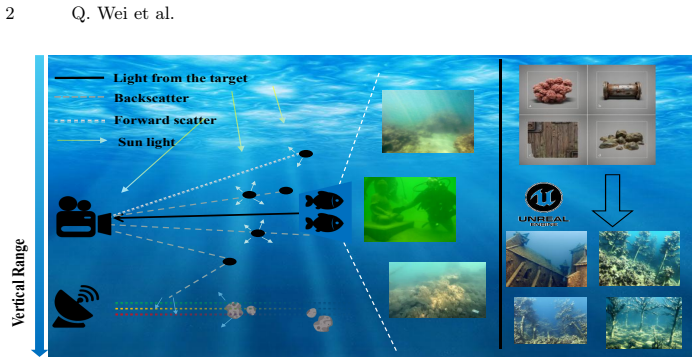
AquaStereo makes zero-shot underwater stereo matching work by rendering geometry-preserving underwater pairs from land stereo and teaching a student with a frozen clean-domain teacher plus perception frames.
Reviewed by Pith at T0; open to challenge. T0 means a machine referee read the full paper against a public rubric. the ladder, T0–T4 →
T0 review · grok-4.5
2026-07-11 20:13 UTC pith:3IOKK4DO
load-bearing objection Solid underwater stereo systems paper: diffusion-rendered stereo + geometry self-distillation + perception frames deliver large zero-shot gains; the soft spot is incomplete proof that generation preserves metric correspondence. the 4 major comments →
AquaStereo: Enabling Underwater Stereo Matching via Depth-Conditioned Diffusion and Geometry Self-Distillation
The pith
A machine-rendered reading of the paper's core claim, the machinery that carries it, and where it could break.
Core claim
AquaStereo establishes that depth-conditioned diffusion, constrained by a lightweight left-right consistency module, can synthesize large-scale underwater stereo pairs that preserve binocular geometry from terrestrial sources, and that cross-domain self-distillation plus learnable perception frames then produce stereo matchers that generalize zero-shot to challenging underwater scenes without target-domain fine-tuning, cutting error well below prior baselines on UWStereo, FLSea, Squid, and TartanAir.
What carries the argument
Depth-conditioned diffusion stereo generation with a left-right consistency module, plus geometry self-distillation (frozen clean teacher supervising a perturbed underwater student via shared pseudo disparities) and learnable perception frames fused with image-encoder semantics through a video backbone.
Load-bearing premise
The rendered underwater pairs look enough like real water for training to transfer, while still keeping the same true depth labels that came from the original clean land stereo pair.
What would settle it
Train only on the rendered set, then measure EPE and D1 on a held-out real underwater stereo set that has independent dense metric ground truth; if errors stay near pure terrestrial-trained baselines instead of the large drops reported on UWStereo and FLSea/Squid, the central claim fails.
If this is right
- Training on the diffusion-rendered UW-Dataset narrows the land-to-water gap more than SceneFlow, KITTI, or CG underwater sets of similar scale.
- Zero-shot underwater stereo becomes practical without dense in-situ capture or underwater ground-truth campaigns.
- Self-distillation with shared pseudo targets reduces scale drift and cleans up boundaries and low-texture regions under turbidity.
- More accurate disparities yield denser, cleaner underwater point clouds useful for navigation and inspection.
Where Pith is reading between the lines
- The same depth-conditioned stereo-generation pattern could help other domains where light transport breaks photometric matching, such as fog, rain, or night driving.
- Because supervision rides on terrestrial foundation-stereo pseudo labels, further gains may track progress in clean-domain stereo as much as underwater appearance modeling.
- If the patch-level left-right consistency module is the main geometry safeguard, similar attention over epipolar candidates could stabilize multi-view generation beyond stereo.
Editorial analysis
A structured set of objections, weighed in public.
Referee Report
Summary. AquaStereo targets underwater stereo matching under scarce in-domain data and degraded imagery. It proposes (i) a depth-conditioned Stable Diffusion + ControlNet pipeline that renders geometry-preserving underwater stereo pairs from terrestrial pairs, guided by a physics-inspired prompt pool and a lightweight left–right consistency module (Sec. 3.2, Eqs. 1–4); (ii) cross-domain self-distillation in which a frozen teacher on clean pairs supervises a student on rendered/perturbed underwater pairs via feature alignment and clean-branch L1 supervision with shared pseudo-disparities D_GT (Sec. 3.3, Eqs. 5–8); and (iii) a perception-enhanced matcher that concatenates two learnable perception frames with the stereo pair, encodes them with a video backbone, and fuses DINOv2 semantics (Sec. 3.4, Eqs. 9–10). Zero-shot evaluations on UWStereo, FLSea, Squid, and TartanAir, plus training-set and component ablations (Tables 1–6; Figs. 5–8), report large gains over strong baselines, including Total EPE/D1 of 0.590/2.616 on UWStereo.
Significance. Underwater stereo is practically important for AUVs, inspection, and marine reconstruction, and remains poorly served by terrestrial stereo models. The paper’s combination of controllable diffusion stereo generation, geometry-aligned self-distillation, and perception frames is a coherent systems contribution with clear empirical impact if the transfer claims hold. Strengths include multi-benchmark zero-shot evaluation, training-set controls (SceneFlow/KITTI vs UW-Dataset), component ablations (LR consistency, distillation variants, feature designs), qualitative disparity and point-cloud evidence, and a public code link. If the synthetic degradations and preserved D_GT supervision truly transfer to real in-situ water, the recipe is useful beyond this specific backbone.
major comments (4)
- Sec. 3.2–3.3 and Eqs. 1–4, 6–8: The central training assumption is that D_GT = F_FStereo(I_L, I_R) remains a valid shared metric target for diffusion-rendered pairs (I'_L, I'_R). Geometry preservation is supported mainly by a proxy Break-px drop (15→5) and generation-time cost in Table 4, plus downstream EPE. The manuscript does not report post-generation left–right warping error against D_GT, epipolar residual statistics, or scale consistency under view-dependent backscatter. Without such checks, L_sup and L_feat may supervise incorrect geometry; please add quantitative correspondence/scale diagnostics on held-out generated pairs and, if possible, a failure analysis when Break-px is high.
- Table 1 vs Tables 2–3: The headline UWStereo comparison attributes large margins (e.g., Total EPE 0.590 vs FoundationStereo 1.669) to AquaStereo, but “Ours” is trained on the rendered UW-Dataset while most baselines are SceneFlow- or mixed-data models. Tables 2–3 partially control for training data and show UW-Dataset helps IGEV++/PSMNet/StereoBase, yet Table 1 still confounds architecture, training corpus, distillation, and perception frames. Please restructure the main comparison so method gains are separated from data gains (e.g., same backbone + same UW-Dataset ± each module), and state clearly which baselines were re-trained versus used off-the-shelf.
- Abstract vs Sec. 3.3, Eq. 6: The abstract claims a “stage-weighted sequence loss” aligns the student’s disparities with the teacher’s geometry, but the written objective aligns multi-scale features (L_feat) and supervises student disparities only against shared D_GT (L_sup), not against teacher disparities. Please reconcile the abstract/method text with the equations, clarify whether any disparity-level distillation is used, and fix the indexing of the K-sum in Eq. 6 (the written form does not index the perturbed samples).
- Sec. 3.4 and Table 6: Treating a rectified stereo pair plus two learnable frames as a pseudo-temporal sequence for a video encoder is an ad-hoc modeling choice. Table 6 shows AquaStereo beats several alternative extractors, but there is little analysis of what I_P1/I_P2 learn, whether two frames are necessary, or sensitivity to frame initialization/placement. Given that perception frames are presented as a core contribution, please add ablations on frame count/position and a clearer statement of when the pseudo-temporal assumption fails (e.g., large baseline, severe view-dependent scatter).
minor comments (6)
- Fig. 2: The dataset comparison table is hard to read in text form (many “----” cells, mixed “Disparity/Type/Acquisition” rows). Consider a cleaner multi-column layout and consistent units for image counts.
- Eq. 4: λ and τ are free parameters of the LR consistency module but are not specified numerically in the experimental setup; please report chosen values and sensitivity.
- Sec. 4.1: Training resolution 384×736, λ_sup=0.2, and DDIM 50 steps are given, but prompt-pool size, sampling frequency of prompts, and Perturb strengths are underspecified for reproducibility despite the code link.
- Fig. 5 and Fig. 7 captions claim sharper boundaries and denser point clouds; adding quantitative boundary/outlier metrics (e.g., bad-2.0 near edges) would strengthen the qualitative claims.
- Related Work: Concurrent or closely related underwater stereo adaptation work (e.g., StereoAdapter, cited in Table 3) could be discussed more explicitly regarding differences from diffusion-based generation versus CG rendering.
- Minor wording: “stage-weighted sequence loss,” “binocular teacher,” and “perception frames” are used somewhat interchangeably with feature alignment and auxiliary tokens; unify terminology across abstract, Sec. 3.3, and Sec. 3.4.
Circularity Check
No circularity: empirical CV pipeline evaluated on external underwater GT; self-distillation and pseudo-labels are training machinery, not tautological predictions.
full rationale
AquaStereo is an engineering methods paper (diffusion data synthesis + teacher–student distillation + perception frames), not a first-principles derivation. The load-bearing claims are zero-shot EPE/D1 on external benchmarks (UWStereo, FLSea, Squid, TartanAir) that are not used to define the method or fit free parameters that are then re-reported as predictions. Pseudo-disparities D_GT = FoundationStereo(I_L, I_R) and the shared-target losses L_feat / L_sup (Eqs. 1, 6–8) are standard self-training supervision; they constrain the student during training but do not make the reported test metrics equal to the fit by construction. Depth-conditioned SD+ControlNet and the LR-consistency module (Eqs. 2–4, Table 4) are generative assumptions whose validity can be questioned, but that is an empirical transfer risk, not circular reduction of output to input. Self-citations to the authors’ prior underwater depth work (Atlantis, etc.) are background, not uniqueness theorems that force the central result. No self-definitional loop, no fitted-parameter-as-prediction, and no load-bearing self-citation chain. Score 0 is the honest finding.
Axiom & Free-Parameter Ledger
free parameters (5)
- lambda_sup (clean-branch supervised weight)
- lambda and tau in disparity-aware patch similarity (Eq. 4)
- number and role of learnable perception frames (I_P1, I_P2)
- diffusion sampling settings (DDIM 50 steps, SD v1.5, ControlNet depth)
- Perturb augmentation strength on underwater branch
axioms (5)
- domain assumption FoundationStereo pseudo-disparities D_GT on terrestrial pairs are accurate enough metric targets for both teacher training and shared student supervision.
- domain assumption Depth-conditioned diffusion with text prompts can change underwater appearance while preserving binocular geometry and epipolar structure when aided by the LR consistency module.
- ad hoc to paper A rectified stereo pair plus two learnable frames can be treated as a pseudo-temporal sequence so a video encoder supplies useful cross-view attention.
- domain assumption Frozen clean-domain teacher features provide stable geometric cues that remain meaningful under underwater photometric violations.
- standard math Standard stereo evaluation metrics EPE and D1 on the chosen underwater benchmarks measure the intended robustness.
invented entities (4)
-
Learnable perception frames (I_P1, I_P2)
no independent evidence
-
Coherence-enhanced left-right consistency module for diffusion stereo generation
no independent evidence
-
UW-Dataset (~40K diffusion-rendered underwater stereo pairs)
no independent evidence
-
Physics-inspired underwater prompt pool (CLIP + LLM curated)
no independent evidence
read the original abstract
Learning-based stereo matching models struggle in underwater environments due to scarce in-domain data and the difficulty of extracting discriminative correspondences from degraded imagery. In this work, we present $\textbf{AquaStereo}$, a perception-enhanced framework with a data simulation pipeline and a self-distillation strategy that jointly address data scarcity and feature degradation in underwater stereo matching. First, a depth-conditioned diffusion pipeline renders underwater stereo pairs while preserving binocular geometry, with a lightweight left-right consistency module ensuring geometric alignment. Training on this synthetic corpus effectively narrows the terrestrial-underwater gap and improves zero-shot robustness. Second, a frozen binocular teacher trained on clean terrestrial pairs guides a student exposed to rendered underwater pairs with perturbations. A stage-weighted sequence loss is performed to align the student's disparities with the teacher's geometry, while a clean-branch supervision with shared pseudo targets prevents scale drift. To further enhance feature stability under turbidity and low texture, we introduce learnable perception frames, a perception-enhanced feature formulation that constructs robust matching descriptors by fusing temporal cues from two auxiliary views encoded by a video backbone with semantic features extracted by a strong image encoder. Extensive experiments demonstrate that $\textbf{AquaStereo}$ substantially improves robustness and zero-shot generalization in challenging underwater scenarios. The code is available at https://github.com/qz-wei/AquaStereo.
Figures


Forward citations
Cited by 1 Pith paper
-
A Unified Stereo Geometry Estimation Framework for Disparity and Surface Normal
A joint stereo–normal framework where a diffusion normal estimator is conditioned on stereo disparity and, through backpropagation, improves zero-shot stereo disparity in ill-posed regions.
Reference graph
Works this paper leans on
-
[1]
In: Pro- ceedings of the IEEE conference on computer vision and pattern recognition
Akkaynak, D., Treibitz, T.: A revised underwater image formation model. In: Pro- ceedings of the IEEE conference on computer vision and pattern recognition. pp. 6723–6732 (2018)
2018
-
[2]
In: Proceedings of the IEEE/CVF conference on computer vision and pattern recognition
Akkaynak, D., Treibitz, T.: Sea-thru: A method for removing water from underwa- ter images. In: Proceedings of the IEEE/CVF conference on computer vision and pattern recognition. pp. 1682–1691 (2019)
2019
-
[3]
Quaternary Science Reviews27(23-24), 2153–2165 (2008)
Bailey, G.N., Flemming, N.C.: Archaeology of the continental shelf: marine re- sources, submerged landscapes and underwater archaeology. Quaternary Science Reviews27(23-24), 2153–2165 (2008)
2008
-
[4]
IEEE transactions on pattern analysis and machine intelligence43(8), 2822–2837 (2020)
Berman, D., Levy, D., Avidan, S., Treibitz, T.: Underwater single image color restoration using haze-lines and a new quantitative dataset. IEEE transactions on pattern analysis and machine intelligence43(8), 2822–2837 (2020)
2020
-
[5]
In: Proceedings of the IEEE conference on computer vision and pattern recognition
Chang, J.R., Chen, Y.S.: Pyramid stereo matching network. In: Proceedings of the IEEE conference on computer vision and pattern recognition. pp. 5410–5418 (2018)
2018
-
[6]
Chinese Journal of Electronics35(5), 1–21 (2026)
Chen, L., Fu, Y., Shangguan, J., Xu, J., Peng, Y.: A survey on degraded image segmentation. Chinese Journal of Electronics35(5), 1–21 (2026)
2026
-
[7]
In: Proceed- ings of the Computer Vision and Pattern Recognition Conference
Cheng, J., Liu, L., Xu, G., Wang, X., Zhang, Z., Deng, Y., Zang, J., Chen, Y., Cai, Z., Yang, X.: Monster: Marry monodepth to stereo unleashes power. In: Proceed- ings of the Computer Vision and Pattern Recognition Conference. pp. 6273–6282 (2025)
2025
-
[8]
In: OCEANS 2000 MTS/IEEE Conference and Exhibition
Coleman, D.F., Newman, J.B., Ballard, R.D.: Design and implementation of ad- vanced underwater imaging systems for deep sea marine archaeological surveys. In: OCEANS 2000 MTS/IEEE Conference and Exhibition. Conference Proceed- ings (Cat. No. 00CH37158). vol. 1, pp. 661–665. IEEE (2000)
2000
-
[9]
Advances in neural information processing systems34, 8780–8794 (2021)
Dhariwal, P., Nichol, A.: Diffusion models beat gans on image synthesis. Advances in neural information processing systems34, 8780–8794 (2021)
2021
-
[10]
Journal of Image and Graphics28(10), 3281–3294 (2023)
Fang, Z., Fu, Y., Liu, L.: A dual of transformer features-related map-intelligent generation method. Journal of Image and Graphics28(10), 3281–3294 (2023)
2023
-
[11]
In: 2012 IEEE conference on computer vision and pattern recognition
Geiger, A., Lenz, P., Urtasun, R.: Are we ready for autonomous driving? the kitti vision benchmark suite. In: 2012 IEEE conference on computer vision and pattern recognition. pp. 3354–3361. IEEE (2012)
2012
-
[12]
Communications of the ACM63(11), 139–144 (2020)
Goodfellow, I., Pouget-Abadie, J., Mirza, M., Xu, B., Warde-Farley, D., Ozair, S., Courville, A., Bengio, Y.: Generative adversarial networks. Communications of the ACM63(11), 139–144 (2020)
2020
-
[13]
In: Proceedings of the IEEE/CVF Conference on Computer Vision and Pattern Recognition
Guan, T., Wang, C., Liu, Y.H.: Neural markov random field for stereo matching. In: Proceedings of the IEEE/CVF Conference on Computer Vision and Pattern Recognition. pp. 5459–5469 (2024)
2024
-
[14]
arXiv preprint arXiv:2312.00343 (2023)
Guo, X., Zhang, C., Lu, J., Duan, Y., Wang, Y., Yang, T., Zhu, Z., Chen, L.: Openstereo: A comprehensive benchmark for stereo matching and strong baseline. arXiv preprint arXiv:2312.00343 (2023)
Pith/arXiv arXiv 2023
-
[15]
arXiv preprint arXiv:2411.14053 (2024)
Guo, X., Zhang, C., Zhang, Y., Wang, R., Nie, D., Zheng, W., Poggi, M., Zhao, H., Ye, M., Zou, Q., et al.: Stereo anything: Unifying zero-shot stereo matching with large-scale mixed data. arXiv preprint arXiv:2411.14053 (2024)
arXiv 2024
-
[16]
In: 2025 IEEE International Conference on Robotics and Automation (ICRA)
Guo, X., Zhang, C., Zhang, Y., Zheng, W., Nie, D., Poggi, M., Chen, L.: Light- stereo: Channel boost is all you need for efficient 2d cost aggregation. In: 2025 IEEE International Conference on Robotics and Automation (ICRA). pp. 8738–
2025
-
[17]
IEEE (2025) AquaStereo for Underwater Stereo Matching 17
2025
-
[18]
In: Proceedings of the IEEE/CVF conference on computer vision and pattern recognition
Guo, X., Yang, K., Yang, W., Wang, X., Li, H.: Group-wise correlation stereo network. In: Proceedings of the IEEE/CVF conference on computer vision and pattern recognition. pp. 3273–3282 (2019)
2019
-
[19]
IEEE Transactions on Instrumentation and Measurement70, 1–12 (2021)
Hambarde, P., Murala, S., Dhall, A.: Uw-gan: Single-image depth estimation and image enhancement for underwater images. IEEE Transactions on Instrumentation and Measurement70, 1–12 (2021)
2021
-
[20]
In: Proceedings of the IEEE/CVF Conference on Computer Vision and Pattern Recognition (CVPR)
He, K., Zhang, X., Ren, S., Sun, J.: Deep residual learning for image recognition. In: Proceedings of the IEEE/CVF Conference on Computer Vision and Pattern Recognition (CVPR). pp. 770–778 (2016)
2016
-
[21]
IEEE Transactions on pattern analysis and machine intelligence30(2), 328– 341 (2008)
Hirschmuller, H.: Stereo processing by semiglobal matching and mutual informa- tion. IEEE Transactions on pattern analysis and machine intelligence30(2), 328– 341 (2008)
2008
-
[22]
arXiv preprint arXiv:2207.12598 (2022)
Ho, J., Salimans, T.: Classifier-free diffusion guidance. arXiv preprint arXiv:2207.12598 (2022)
Pith/arXiv arXiv 2022
-
[23]
In: Proceedings of the IEEE/CVF conference on computer vision and pattern recog- nition
Ke, B., Obukhov, A., Huang, S., Metzger, N., Daudt, R.C., Schindler, K.: Re- purposing diffusion-based image generators for monocular depth estimation. In: Proceedings of the IEEE/CVF conference on computer vision and pattern recog- nition. pp. 9492–9502 (2024)
2024
-
[24]
In: Proceedings of the IEEE international conference on computer vision
Kendall, A., Martirosyan, H., Dasgupta, S., Henry, P., Kennedy, R., Bachrach, A., Bry, A.: End-to-end learning of geometry and context for deep stereo regression. In: Proceedings of the IEEE international conference on computer vision. pp. 66–75 (2017)
2017
-
[25]
Pattern recognition98, 107038 (2020)
Li, C., Anwar, S., Porikli, F.: Underwater scene prior inspired deep underwater image and video enhancement. Pattern recognition98, 107038 (2020)
2020
-
[26]
Computational Visual Media11(1), 195–211 (2025)
Li, H., Fu, Y.: Fcdfusion: A fast, low color deviation method for fusing visible and infrared image pairs. Computational Visual Media11(1), 195–211 (2025)
2025
-
[27]
Journal of Image and Graphics28(12), 3922–3934 (2023)
Li, M., Fu, Y.: Joint self-attention transformer for multispectral and hyperspectral image fusion. Journal of Image and Graphics28(12), 3922–3934 (2023)
2023
-
[28]
International Journal of Computer Vision133(5), 2868–2885 (2025)
Liang, Y., Fu, Y.: Relation-guided adversarial learning for data-free knowledge transfer. International Journal of Computer Vision133(5), 2868–2885 (2025)
2025
-
[29]
IEEE Transactions on Pattern Analysis and Machine Intelligence (2025)
Liang, Y., Fu, Y., Hu, Y., Shao, W., Liu, J., Zhang, D.: Flow-anything: Learn- ing real-world optical flow estimation from large-scale single-view images. IEEE Transactions on Pattern Analysis and Machine Intelligence (2025)
2025
-
[30]
Liang, Y., Hu, Y., Shao, W., Fu, Y.: Distilling monocular foundation model for fine-graineddepthcompletion.In:ProceedingsoftheComputerVisionandPattern Recognition Conference. pp. 22254–22265 (2025)
2025
-
[31]
In: 2021 International conference on 3D vision (3DV)
Lipson, L., Teed, Z., Deng, J.: Raft-stereo: Multilevel recurrent field transforms for stereo matching. In: 2021 International conference on 3D vision (3DV). pp. 218–227. IEEE (2021)
2021
-
[32]
arXiv preprint arXiv:2409.01782 (2024)
Lv, Q., Dong, J., Li, Y., Chen, S., Yu, H., Zhang, S., Wang, W.: Uwstereo: A large synthetic dataset for underwater stereo matching. arXiv preprint arXiv:2409.01782 (2024)
Pith/arXiv arXiv 2024
-
[33]
In: CVPR
Mayer, N., Ilg, E., Häusser, P., Fischer, P., Cremers, D., Dosovitskiy, A., Brox, T.: A large dataset to train convolutional networks for disparity, optical flow, and scene flow estimation. In: CVPR. pp. 4040–4048 (2016)
2016
-
[34]
In: CVPR
Menze, M., Geiger, A.: Object scene flow for autonomous vehicles. In: CVPR. pp. 3061–3070 (2015)
2015
-
[35]
arXiv preprint arXiv:2304.07193 (2023) 18 Q
Oquab, M., Darcet, T., Moutakanni, T.H., Vo, H.T., Szafraniec, M., Cata, R., Shi, D., Lenc, K., Haziza, D., Harchaoui, Z., Mairal, J., Yu, X., Bojanowski, P., Joulin, A., Lefaudeux, B., Caron, M.: Dinov2: Learning robust visual features without supervision. arXiv preprint arXiv:2304.07193 (2023) 18 Q. Wei et al
Pith/arXiv arXiv 2023
-
[36]
IEEE Journal of oceanic engineering39(1), 131–149 (2013)
Paull, L., Saeedi, S., Seto, M., Li, H.: Auv navigation and localization: A review. IEEE Journal of oceanic engineering39(1), 131–149 (2013)
2013
-
[37]
In: International conference on machine learning
Radford, A., Kim, J.W., Hallacy, C., Ramesh, A., Goh, G., Agarwal, S., Sastry, G., Askell, A., Mishkin, P., Clark, J., et al.: Learning transferable visual models from natural language supervision. In: International conference on machine learning. pp. 8748–8763. PmLR (2021)
2021
-
[38]
University of Haifa (Israel) (2023)
Randall, Y.: Flsea: Underwater visual-inertial and stereo-vision forward-looking datasets. University of Haifa (Israel) (2023)
2023
-
[39]
In: CVPR (2022)
Rombach, R., Blattmann, A., Lorenz, D., Esser, P., Ommer, B.: High-resolution image synthesis with latent diffusion models. In: CVPR (2022)
2022
-
[40]
Advances in neural information processing systems35, 36479–36494 (2022)
Saharia, C., Chan, W., Saxena, S., Li, L., Whang, J., Denton, E.L., Ghasemipour, K., Gontijo Lopes, R., Karagol Ayan, B., Salimans, T., et al.: Photorealistic text- to-image diffusion models with deep language understanding. Advances in neural information processing systems35, 36479–36494 (2022)
2022
-
[41]
Advances in Neural Information Processing Systems36, 39443–39469 (2023)
Saxena, S., Herrmann, C., Hur, J., Kar, A., Norouzi, M., Sun, D., Fleet, D.J.: The surprising effectiveness of diffusion models for optical flow and monocular depth estimation. Advances in Neural Information Processing Systems36, 39443–39469 (2023)
2023
-
[42]
International journal of computer vision47(1), 7–42 (2002)
Scharstein, D., Szeliski, R.: A taxonomy and evaluation of dense two-frame stereo correspondence algorithms. International journal of computer vision47(1), 7–42 (2002)
2002
-
[43]
In: Proceedings of the IEEE/CVF conference on computer vision and pattern recognition
Shen, Z., Dai, Y., Rao, Z.: Cfnet: Cascade and fused cost volume for robust stereo matching. In: Proceedings of the IEEE/CVF conference on computer vision and pattern recognition. pp. 13906–13915 (2021)
2021
-
[44]
Oceanography and marine biology pp
Shortis, M., Abdo, E.H.D.: A review of underwater stereo-image measurement for marine biology and ecology applications. Oceanography and marine biology pp. 269–304 (2016)
2016
-
[45]
In: International Conference on Learning Representations (ICLR) (2015), arXiv:1409.1556
Simonyan, K., Zisserman, A.: Very deep convolutional networks for large-scale im- age recognition. In: International Conference on Learning Representations (ICLR) (2015), arXiv:1409.1556
Pith/arXiv arXiv 2015
-
[46]
In: 2019 International Conference on Robotics and Automation (ICRA)
Skinner, K.A., Zhang, J., Olson, E.A., Johnson-Roberson, M.: Uwstereonet: Un- supervised learning for depth estimation and color correction of underwater stereo imagery. In: 2019 International Conference on Robotics and Automation (ICRA). pp. 7947–7954. IEEE (2019)
2019
-
[47]
In: ICLR (2021)
Song, J., Meng, C., Ermon, S.: Denoising diffusion implicit models. In: ICLR (2021)
2021
-
[48]
Advances in neural information processing systems30(2017)
Tarvainen, A., Valpola, H.: Mean teachers are better role models: Weight-averaged consistency targets improve semi-supervised deep learning results. Advances in neural information processing systems30(2017)
2017
-
[49]
In: European Conference on Computer Vision
Tosi, F., Ramirez, P.Z., Poggi, M.: Diffusion models for monocular depth estima- tion: Overcoming challenging conditions. In: European Conference on Computer Vision. pp. 236–257. Springer (2024)
2024
-
[50]
In: Proceedings of the IEEE/CVF Confer- ence on Computer Vision and Pattern Recognition (2025)
Wang, J., Chen, M., Karaev, N., Vedaldi, A., Rupprecht, C., Novotny, D.: Vggt: Visual geometry grounded transformer. In: Proceedings of the IEEE/CVF Confer- ence on Computer Vision and Pattern Recognition (2025)
2025
-
[51]
In: 2020 IEEE/RSJ International Conference on Intelligent Robots and Systems (IROS)
Wang, W., Zhu, D., Wang, X., Hu, Y., Qiu, Y., Wang, C., Hu, Y., Kapoor, A., Scherer, S.: Tartanair: A dataset to push the limits of visual slam. In: 2020 IEEE/RSJ International Conference on Intelligent Robots and Systems (IROS). pp. 4909–4916. IEEE (2020)
2020
-
[52]
arXiv preprint arXiv:2505.08607 (2025) AquaStereo for Underwater Stereo Matching 19
Wang, Y., Liang, Y., Fu, Y.: Boosting zero-shot stereo matching using large-scale mixed images sources in the real world. arXiv preprint arXiv:2505.08607 (2025) AquaStereo for Underwater Stereo Matching 19
Pith/arXiv arXiv 2025
-
[53]
In: Proceedings of the IEEE/CVF International Conference on Computer Vision
Wang, Y., Liang, Y., Hu, Y., Fu, Y.: Robustereo: Robust zero-shot stereo matching under adverse weather. In: Proceedings of the IEEE/CVF International Conference on Computer Vision. pp. 25134–25144 (2025)
2025
-
[54]
In: Proceedings of the IEEE/CVF conference on computer vision and pattern recognition
Wen, B., Trepte, M., Aribido, J., Kautz, J., Gallo, O., Birchfield, S.: Foundation- stereo: Zero-shot stereo matching. In: Proceedings of the IEEE/CVF conference on computer vision and pattern recognition. pp. 5249–5260 (2025)
2025
-
[55]
arXiv preprint arXiv:2509.16415 (2025)
Wu, Z., Wang, Y., Wen, Y., Zhang, Z., Wu, B., Tang, H.: Stereoadapter: Adapting stereo depth estimation to underwater scenes. arXiv preprint arXiv:2509.16415 (2025)
arXiv 2025
-
[56]
In: Proceedings of the IEEE/CVF conference on computer vision and pattern recognition
Xu, G., Wang, X., Ding, X., Yang, X.: Iterative geometry encoding volume for stereo matching. In: Proceedings of the IEEE/CVF conference on computer vision and pattern recognition. pp. 21919–21928 (2023)
2023
-
[57]
IEEE Transactions on Pattern Analysis and Machine Intelligence (2025)
Xu, G., Wang, X., Zhang, Z., Cheng, J., Liao, C., Yang, X.: Igev++: Iterative multi-range geometry encoding volumes for stereo matching. IEEE Transactions on Pattern Analysis and Machine Intelligence (2025)
2025
-
[58]
arXiv preprint arXiv:2406.09414 (2024)
Yang, L., Kang, B., Huang, Z., Zhao, Z., Xu, X., Feng, J., Zhao, H.: Depth anything v2. arXiv preprint arXiv:2406.09414 (2024)
Pith/arXiv arXiv 2024
-
[59]
Advanced robotics15(5), 609–639 (2001)
Yuh, J., West, M.: Underwater robotics. Advanced robotics15(5), 609–639 (2001)
2001
-
[60]
Journal of Machine Learning Research17(65), 1–32 (2016)
Žbontar,J., LeCun, Y.: Stereo matching by training aconvolutional neural network to compare image patches. Journal of Machine Learning Research17(65), 1–32 (2016)
2016
-
[61]
In: Proceedings of the IEEE/CVF conference on computer vision and pattern recognition
Zhang, F., You, S., Li, Y., Fu, Y.: Atlantis: Enabling underwater depth estimation with stable diffusion. In: Proceedings of the IEEE/CVF conference on computer vision and pattern recognition. pp. 11852–11861 (2024)
2024
-
[62]
IEEE Transactions on Pattern Analysis and Machine Intelligence 47(10), 9169–9186 (2025)
Zhang, F., You, S., Li, Y., Fu, Y.: Learning rain location prior for nighttime derain- ing and beyond. IEEE Transactions on Pattern Analysis and Machine Intelligence 47(10), 9169–9186 (2025)
2025
-
[63]
International Journal of Computer Vision 134(6), 260 (2026)
Zhang, F., You, S., Li, Y., Fu, Y.: Atlantis++: Enabling underwater depth estima- tion with stable diffusion and beyond. International Journal of Computer Vision 134(6), 260 (2026)
2026
-
[64]
In: Proceedings of the IEEE/CVF conference on computer vision and pattern recognition
Zhang, F., Prisacariu, V., Yang, R., Torr, P.H.: Ga-net: Guided aggregation net for end-to-end stereo matching. In: Proceedings of the IEEE/CVF conference on computer vision and pattern recognition. pp. 185–194 (2019)
2019
-
[65]
IEEE Transactions on Pattern Analysis and Machine Intelligence44(8), 4388–4403 (2021)
Zhang, L., Bao, C., Ma, K.: Self-distillation: Towards efficient and compact neural networks. IEEE Transactions on Pattern Analysis and Machine Intelligence44(8), 4388–4403 (2021)
2021
-
[66]
In: Proceedings of the IEEE/CVF international conference on computer vision
Zhang, L., Rao, A., Agrawala, M.: Adding conditional control to text-to-image diffusion models. In: Proceedings of the IEEE/CVF international conference on computer vision. pp. 3836–3847 (2023)
2023
-
[67]
Zhang, T., Wang, B., Fu, Y., Liu, S., Ye, J., Shan, P., Yan, C.: Deep learning-based spectral image super-resolution: A survey. J. Image Graph29(8), 2113–2136 (2024)
2024
-
[68]
In: Proceedings of the Computer Vision and Pattern Recognition Conference
Zhu, D., Huang, X., Huang, H., Zhou, H., Shao, Z.: Change3d: Revisiting change detection and captioning from a video modeling perspective. In: Proceedings of the Computer Vision and Pattern Recognition Conference. pp. 24011–24022 (2025)
2025
-
[69]
IEEE Transactions on Pattern Analysis and Machine Intelligence (2025)
Zou, Y., Fu, Y., Zhang, Y., Zhang, T., Yan, C., Timofte, R.: Calibration-free raw image denoising via fine-grained noise estimation. IEEE Transactions on Pattern Analysis and Machine Intelligence (2025)
2025
-
[70]
In: Proceedings of the IEEE/CVF international conference on com- puter vision
Zwilgmeyer, P.G.O., Yip, M., Teigen, A.L., Mester, R., Stahl, A.: The varos syn- thetic underwater data set: Towards realistic multi-sensor underwater data with ground truth. In: Proceedings of the IEEE/CVF international conference on com- puter vision. pp. 3722–3730 (2021)
2021
discussion (0)
Sign in with ORCID, Apple, or X to comment. Anyone can read and Pith papers without signing in.