REVIEW 3 major objections 6 minor 24 references
Reactive Multi-Stage Feature Fusion for Multimodal Dialogue Modeling
T0 review · 3 major / 6 minor · reviewed 2026-08-14 · deepseek-v4-flash
Pith's one-line read A multi-stage fusion encoder-decoder outperforms the released baseline on audio-visual scene-aware dialogue.
desk verdict A cleanly written AVSD paper with plausible but not rigorously supported results; the headline comparison is confounded by feature selection, but the ablation work is worth a referee's time. read the letter →
The pith
A machine-rendered reading of the paper's core claim, the machinery that carries it, and where it could break.
The reading
What carries the argument
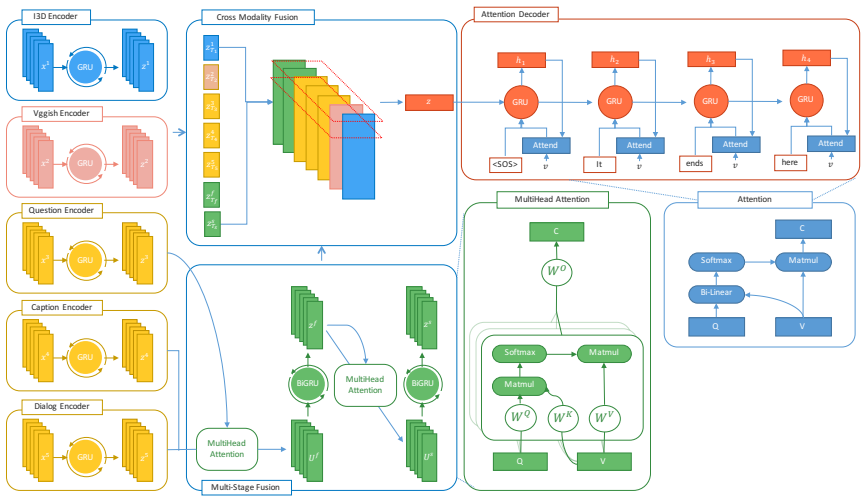
The load-bearing mechanism is the multi-stage fusion stack. First, multi-head attention (with a residual connection) lets the encoded question re-weight the concatenated caption and dialogue context; a bidirectional GRU reads the result. Second, self-attention over that fused context, followed by another bidirectional GRU, produces a representation that fuses all textual information. Finally, the last hidden states of all modalities are projected through a 1x1 convolution with multiple output channels and combined by a trainable weighted sum to form the decoder's initial state. This stack lets the question condition the context before decoding begins, and the 1x1 convolution lets feature channels interact before the weighted sum, which the paper contrasts with simple sum, product, and concatenation fusion.
What would settle it
Train the full fusion model with and without I3D features under identical hyperparameters and evaluate on the AVSD test set; if the I3D-augmented model does not show a CIDEr drop relative to the I3D-free model, the paper's feature-selection assumption is contradicted.
Extended reading notes
Core claim
The central claim is that reactive multi-stage feature fusion improves multimodal dialogue generation. The proposed encoder first encodes question, caption, dialogue, and VGGish audio features with GRUs, then fuses the question into the concatenated caption–dialogue context via multi-head attention, applies self-attention to that fused context, passes both through bidirectional GRUs, and combines the last hidden states of every modality through a 1x1 convolution followed by a trainable weighted sum. This fused state initializes a GRU decoder that uses multiplicative attention over all encoded features. The paper reports that this full model outperforms the released baseline on almost all metrics, with the largest gain in CIDEr, and that removing I3D features improves performance, which the authors interpret as evidence that I3D is too noisy and that VGGish plus text covers its useful content.
Load-bearing premise
The load-bearing premise is that the useful information in the I3D video features can be fully obtained by combining VGGish audio features with the caption and dialogue text; if that premise fails, the model's comparison against the released baseline is not apples-to-apples because the baseline uses I3D and the proposed model does not.
Editorial extensions
If this is right
- On the AVSD dev set, the full model (multi-stage fusion, 1x1 convolution, and attention decoder) raises CIDEr from 0.790 to 1.059 and improves METEOR and ROUGE-L over the released baseline.
- Adding I3D features back to the full model lowers CIDEr from 1.059 to 0.958, supporting the paper's claim that I3D is noisy rather than helpful in this setup.
- A text-only version of the full model (without VGGish) still beats the released baseline on BLEU scores, indicating that much of the answer content is carried by the dialogue text itself.
- The attention decoder and the top-down attention LSTM have complementary strengths: attention improves BLEU metrics while top-down attention improves ROUGE-L, so the paper adopts the attention decoder for the final model.
Reading between the lines
- If the feature-selection result generalizes, audio-visual dialogue systems could drop dedicated video encoders and rely on audio plus text fusion, substantially reducing compute and simplifying data pipelines.
- The multi-stage fusion recipe—query-into-context attention, self-attention, channel-wise projection, weighted sum—is task-agnostic and could be transferred to other multimodal problems such as embodied question answering or audio-visual navigation.
- The paper's finding that a naive copy baseline achieves high BLEU-1 and BLEU-2 points to a broader caution about using precision-style metrics to evaluate dialogue generation, where CIDEr and human evaluation may be more informative.
Signed reviews
Editorial analysis
A structured set of objections, weighed in public.
Referee Report
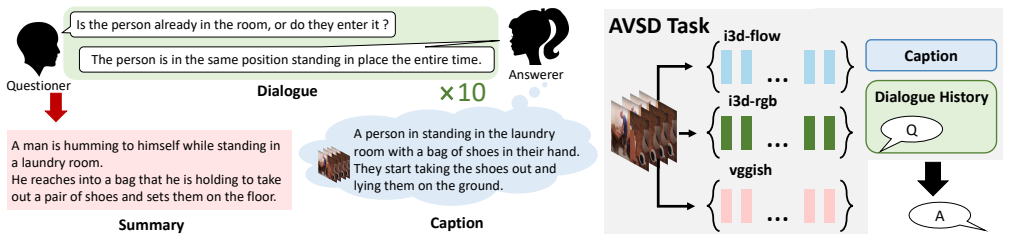
Summary. The paper addresses audio visual scene-aware dialogue (AVSD) and proposes an encoder-decoder model with two fusion mechanisms (multi-stage attention fusion and 1x1 convolution fusion) and two attention-based decoding variants (an attention decoder and a top-down attention LSTM). The authors perform feature selection, dropping I3D video features and the questioner summary, and they evaluate on the AVSD dev set as well as a submitted official test-set entry. They report that a full model combining multi-stage fusion, 1x1 convolution fusion, and the attention decoder outperforms the released baseline on most metrics, and they provide ablation studies and qualitative examples.
Significance. If the empirical claims held, the paper would offer a simple, parameter-light fusion recipe for multimodal dialogue: weighted-sum fusion after 1x1 convolution, multi-stage question-conditioned attention, and a multiplicative attention decoder, with controlled ablations on feature sets and fusion operators. The authors are also transparent about their feature-selection rationale and provide qualitative examples. However, the central comparison is confounded by the simultaneous change of input features, and no variance or significance information is reported, so the current evidence does not establish that the proposed fusion modules themselves drive the reported gains. The work is a plausible systems paper whose main claim needs a cleaner experimental demonstration.
major comments (3)
- [Feature Selection and Table 2 vs. Table 5] The headline comparison in Table 2 is confounded: the released baseline uses I3D features while all proposed models do not, and Table 5 shows that in the simple model adding I3D improves every metric (e.g., CIDEr from 0.994 to 1.002 and BLEU-1 from 0.232 to 0.239). The assumption in the Feature Selection section that 'the useful information contained in i3d can be obtained by combining vggish and texts' is therefore not supported by the paper's own ablation, and the large CIDEr margin (1.059 vs. 0.790) may partly reflect feature removal rather than the proposed multi-stage fusion or 1x1 convolution. Please report the full model with the same feature set as the released baseline as the primary comparison, or provide statistical evidence that the feature-selection difference is not responsible for the gains.
- [Results (Tables 2, 5, and 6)] No error bars, multiple seeds, or significance tests are reported anywhere in the Experiments section, so the statement in Results that the full fusion model 'can significantly outperforms the released baseline' is unsupported. The pattern is also inconsistent across ablations: Table 5 shows i3d helps the simple model, while Table 2 shows the full model with i3d is worse (CIDEr drops from 1.059 to 0.958); the paper explains this as noise, but without variance estimates this remains post hoc. At minimum, report means and standard deviations over at least three random seeds for the main configurations and a paired test on dev-set metrics, including the i3d variant.
- [Official Results] The official test-set results in Table 4 come from models that, according to the authors, use 'different experiment settings' and 'were not well trained,' and the full fusion model was not among the submitted predictions. Consequently Table 4 cannot be used as evidence for the proposed full model. The paper should either clearly separate these exploratory submissions from the main claims or remove them from the comparison and rely only on controlled dev-set experiments.
minor comments (6)
- [Figure 2 caption] The caption contains the typo 'illustraion' and should be corrected to 'illustration'.
- [Equation (3)] The attention function is defined as Att(Q,V,K) = softmax(QV^T / sqrt(d_k)) K but is invoked as Att(QW_i^Q, VW_i^K, VW_i^V), which makes the roles of keys and values confusing; standard notation would define Att(Q,K,V) and use it accordingly.
- [Introduction] The term 'reactive encoder' is used in the Introduction but is never defined or used elsewhere in the paper; consider removing it or explaining what 'reactive' means.
- [Tables 5 and 6] The captions of Tables 5 and 6 do not state whether the reported numbers are single runs or averages; please state this explicitly.
- [References] References [Alamri et al. 2018a] and [Alamri et al. 2018b] are identical strings; if they are intended to refer to the dataset/challenge paper and the released baseline respectively, please distinguish them clearly.
- [Feature Encoder] Please use the standard capitalization 'GloVe' instead of 'Glove' for the word-embedding method.
Circularity Check
No circularity: the paper's claims are empirical comparisons on held-out dev/test data, and the fusion equations are architectural definitions rather than derivations that presuppose their own conclusions.
full rationale
This is an empirical systems paper. The claimed improvements are evaluated on held-out dev and test splits (Tables 2 and 4) against a released baseline and a copy baseline. The fusion mechanisms (multi-stage fusion, 1x1 convolution fusion, attention decoder) are defined operationally in Eqs. (1), (4)-(6), and (7)-(9); these are model definitions and parameterizations, not derivations that reduce to the evaluation metric or to a fitted value. No fitted parameter is renamed as a prediction, and no self-citation chain is used as load-bearing evidence; the dataset and baseline citations are external. The most substantial concern is that the main comparison in Table 2 uses models without i3d while the released baseline uses i3d, and Table 5 shows i3d improves the simple model. That is a feature-selection and comparison-fairness issue, not a circularity under the stated criteria: the paper does not derive its advantage from the feature-selection assumption by construction, and it explicitly notes that the official test-set models were 'not well trained' and uses them only as supplementary evidence. Accordingly, no specific circular step can be exhibited with equations or definitions, and the correct finding is no significant circularity.
Assumptions & free parameters
free parameters (2)
- trainable fusion weights wi =
learned
- hyperparameters (learning rate, hidden dim, dropout, beam size) =
see appendix
assumptions (2)
- domain assumption Pre-extracted audio (vggish) and text features contain enough information to answer questions without i3d.
- domain assumption The dev set is representative for model selection and final evaluation.
Cite this review
Pith. "Pith review of Reactive Multi-Stage Feature Fusion for Multimodal Dialogue Modeling." pith.science (2026). https://pith.science/paper/3J65FH6N
@misc{pith2026190805067,
  author       = {Pith},
  title        = {Pith review of: Reactive Multi-Stage Feature Fusion for Multimodal Dialogue Modeling},
  year         = {2026},
  howpublished = {\url{https://pith.science/paper/3J65FH6N}},
  note         = {Machine review of arXiv:1908.05067}
}
read the original abstract
Visual question answering and visual dialogue tasks have been increasingly studied in the multimodal field towards more practical real-world scenarios. A more challenging task, audio visual scene-aware dialogue (AVSD), is proposed to further advance the technologies that connect audio, vision, and language, which introduces temporal video information and dialogue interactions between a questioner and an answerer. This paper proposes an intuitive mechanism that fuses features and attention in multiple stages in order to well integrate multimodal features, and the results demonstrate its capability in the experiments. Also, we apply several state-of-the-art models in other tasks to the AVSD task, and further analyze their generalization across different tasks.
Figures
Reference graph
Works this paper leans on
-
[1]
write newline
" write newline "" before.all 'output.state := FUNCTION fin.entry add.period write newline FUNCTION new.block output.state before.all = 'skip after.block 'output.state := if FUNCTION new.sentence output.state after.block = 'skip output.state before.all = 'skip after.sentence 'output.state := if if FUNCTION not #0 #1 if FUNCTION and 'skip pop #0 if FUNCTIO...
-
[3]
G.; Das, A.; Wang, J.; Essa, I.; Batra, D.; Parikh, D.; Cherian, A.; Marks, T
Alamri, H.; Cartillier, V.; Lopes, R. G.; Das, A.; Wang, J.; Essa, I.; Batra, D.; Parikh, D.; Cherian, A.; Marks, T. K.; et al. 2018b. Audio visual scene-aware dialog (avsd) challenge at dstc7. arXiv preprint arXiv:1806.00525
-
[4]
Anderson, P.; He, X.; Buehler, C.; Teney, D.; Johnson, M.; Gould, S.; and Zhang, L. 2018. Bottom-up and top-down attention for image captioning and visual question answering. In CVPR , volume 3, 6
work page 2018
-
[5]
Antol, S.; Agrawal, A.; Lu, J.; Mitchell, M.; Batra, D.; Lawrence Zitnick, C.; and Parikh, D. 2015. Vqa: Visual question answering. In Proceedings of the IEEE international conference on computer vision , 2425--2433
2015
-
[6]
Britz , D.; Goldie , A.; Luong , T.; and Le , Q. 2017. Massive Exploration of Neural Machine Translation Architectures . ArXiv e-prints
work page 2017
-
[7]
Carreira, J., and Zisserman, A. 2017. Quo vadis, action recognition? a new model and the kinetics dataset. In Computer Vision and Pattern Recognition (CVPR), 2017 IEEE Conference on , 4724--4733. IEEE
2017
-
[8]
Das, A.; Kottur, S.; Gupta, K.; Singh, A.; Yadav, D.; Moura, J. M.; Parikh, D.; and Batra, D. 2017. Visual dialog. In Proceedings of the IEEE Conference on Computer Vision and Pattern Recognition , volume 2
work page 2017
-
[9]
He, K.; Zhang, X.; Ren, S.; and Sun, J. 2016. Deep residual learning for image recognition. In Proceedings of the IEEE conference on computer vision and pattern recognition , 770--778
2016
Show all 24 references
-
[10]
P.; Gemmeke, J
Hershey, S.; Chaudhuri, S.; Ellis, D. P.; Gemmeke, J. F.; Jansen, A.; Moore, R. C.; Plakal, M.; Platt, D.; Saurous, R. A.; Seybold, B.; et al. 2017. Cnn architectures for large-scale audio classification. In Acoustics, Speech and Signal Processing (ICASSP), 2017 IEEE Internati...
2017
-
[11]
Huang, H.-Y.; Zhu, C.; Shen, Y.; and Chen, W. 2018. Fusionnet: Fusing via fully-aware attention with application to machine comprehension. In International Conference on Learning Representations
2018
-
[12]
Kim, J.-H.; On, K.-W.; Lim, W.; Kim, J.; Ha, J.-W.; and Zhang, B.-T. 2016. Hadamard product for low-rank bilinear pooling. arXiv preprint arXiv:1610.04325
2016 arXiv
-
[13]
P., and Ba, J
Kingma, D. P., and Ba, J. 2014. Adam: A method for stochastic optimization. arXiv preprint arXiv:1412.6980
2014 arXiv
-
[14]
Lin, C.-Y. 2004. Rouge: A package for automatic evaluation of summaries. Text Summarization Branches Out
2004
-
[15]
Luong, T.; Pham, H.; and Manning, C. D. 2015. Effective approaches to attention-based neural machine translation. In EMNLP
2015
-
[16]
Papineni, K.; Roukos, S.; Ward, T.; and Zhu, W.-J. 2002. Bleu: a method for automatic evaluation of machine translation. In Proceedings of the 40th annual meeting on association for computational linguistics , 311--318. Association for Computational Linguistics
2002
-
[17]
Pennington, J.; Socher, R.; and Manning, C. D. 2014. Glove: Global vectors for word representation. In Empirical Methods in Natural Language Processing (EMNLP) , 1532--1543
2014
-
[18]
Pirsiavash, H.; Ramanan, D.; and Fowlkes, C. C. 2009. Bilinear classifiers for visual recognition. In Advances in neural information processing systems , 1482--1490
2009
-
[19]
Srivastava, N.; Hinton, G.; Krizhevsky, A.; Sutskever, I.; and Salakhutdinov, R. 2014. Dropout: A simple way to prevent neural networks from overfitting. Journal of Machine Learning Research 15:1929--1958
2014
-
[20]
Sutskever, I.; Vinyals, O.; and Le, Q. V. 2014. Sequence to sequence learning with neural networks. In Advances in neural information processing systems , 3104--3112
2014
-
[21]
Szegedy, C.; Liu, W.; Jia, Y.; Sermanet, P.; Reed, S.; Anguelov, D.; Erhan, D.; Vanhoucke, V.; and Rabinovich, A. 2015. Going deeper with convolutions. In Proceedings of the IEEE conference on computer vision and pattern recognition , 1--9
2015
-
[22]
N.; Kaiser, .; and Polosukhin, I
Vaswani, A.; Shazeer, N.; Parmar, N.; Uszkoreit, J.; Jones, L.; Gomez, A. N.; Kaiser, .; and Polosukhin, I. 2017. Attention is all you need. In Advances in Neural Information Processing Systems , 5998--6008
2017
-
[23]
L.; and Parikh, D
Vedantam, R.; Zitnick, C. L.; and Parikh, D. 2015. Cider: Consensus-based image description evaluation. 2015 IEEE Conference on Computer Vision and Pattern Recognition (CVPR) 4566--4575
2015
-
[24]
Wang, W.; Yang, N.; Wei, F.; Chang, B.; and Zhou, M. 2017. Gated self-matching networks for reading comprehension and question answering. In Proceedings of the 55th Annual Meeting of the Association for Computational Linguistics (Volume 1: Long Papers) , 189--198. Association ...
2017
-
[25]
Xiong, C.; Merity, S.; and Socher, R. 2016. Dynamic memory networks for visual and textual question answering. In International conference on machine learning , 2397--2406
2016
Reviewed August 14, 2026 · model on record in the stance chip above.
Discussion (0). Continue with ORCID to comment.