REVIEW 4 major objections 5 minor 56 references
Long-term Traffic Simulation with Interleaved Autoregressive Motion and Scenario Generation
T0 review · 4 major / 5 minor · reviewed 2026-08-15 · deepseek-v4-flash
Pith's one-line read InfGen claims that a single autoregressive transformer can interleave closed-loop motion simulation with scene generation, keeping 30-second traffic rollouts realistically populated while staying competitive on the standard 9-second…
desk verdict InfGen's interleaved motion-and-scene generation is a real step forward; the long-term SOTA claim outruns the evidence. read the letter →
The pith
A machine-rendered reading of the paper's core claim, the machinery that carries it, and where it could break.
The reading
What carries the argument
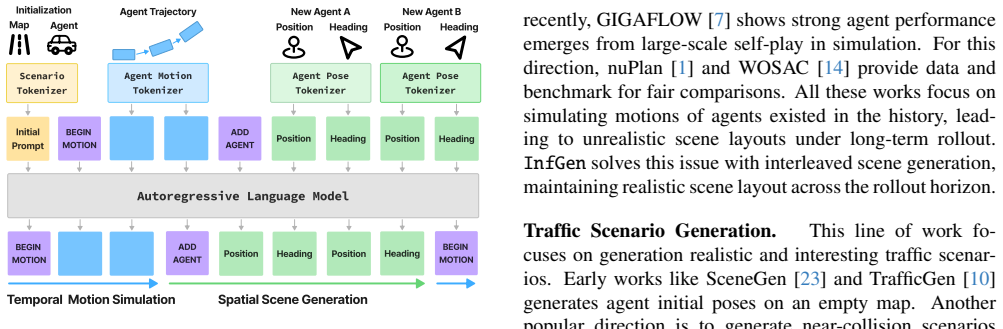
The dynamic agent matrix is the central object: rows are created when a new agent is inserted and deleted when an agent exits, while columns carry motion tokens over time. Motion simulation extends the matrix horizontally; scene generation extends it vertically with pose tokens sampled from a position grid and heading intervals, and removes rows marked <REMOVE AGENT>. The four mode-control tokens are the mechanism that makes both extensions trainable as a single ordered token sequence, so one next-token prediction loss supervises motion, placement, heading, and the timing of task switches. The agent query, which attends to an occupancy grid plus surrounding agents and map tokens, carries the scene-generation branch.
What would settle it
Re-seed the SMART and CatK baselines with a simple non-learned rule that spawns agents from the logged entry distribution whenever the scene becomes sparse, and compare their Mean ACE and placement-based likelihood scores to InfGen on the same validation split; if they match or beat InfGen, the measured advantage comes from density maintenance rather than realistic scene generation. A second check is a human audit of the paper's own failure cases--new agents standing on road boundaries or motionless in lanes--to see whether the placement-based metric actually penalizes those errors.
Extended reading notes
Core claim
InfGen's central claim is that fixed-agent motion simulation is the wrong unit for long horizons; the right unit is an interleaved token stream over a dynamic agent matrix whose rows are agent lifecycles and whose columns are timesteps. Four mode-control tokens--<BEGIN MOTION>, <ADD AGENT>, <KEEP AGENT>, <REMOVE AGENT>--let one decoder choose whether the next prediction is a motion token for an existing agent or a pose token for a new one, and when to switch. A motion step extends the matrix forward in time; a scene-generation step uses an agent query with grid attention over an occupancy grid to propose new agents autoregressively until <BEGIN MOTION> hands control back. Training is end-to-end next-token prediction on logged data, including the switching decision. With this, the paper reports a 30-second composite score of 0.6606 against 0.6584 for CatK and 0.6519 for SMART, a Mean Agent Count Error of 8.1 against 12.2 and 12.0, and an ACE slope of 0.15 against 0.32 and 0.31, while remaining competitive on the 9-second benchmark.
Load-bearing premise
The load-bearing premise is that scoring long rollouts against distributions estimated from the validation set, with the comparison radius for baselines tuned on that set, is a valid and sufficient measure of realism; if that scoring does not track realism, the claimed long-term superiority is not established.
Editorial extensions
If this is right
- Sustained rollouts no longer need a fixed agent set: trained on short logs, the model emits stable 30-second rollouts in which agents enter and exit as the ego moves.
- The same model works on the standard short-term benchmark without task-specific changes, scoring a WOSAC composite of 0.7514, close to CatK's 0.7603.
- Long-horizon evaluation can be done without one-to-one agent correspondence, using sliding-window likelihood scores and placement statistics against reference distributions instead of the original WOSAC matching assumption.
- Disabling insertion and removal makes all methods score about the same, which shows that scene depletion, not motion error, is the distinguishing long-horizon problem InfGen targets.
Reading between the lines
- Inference: the control-token recipe generalizes: any simulator with entering and exiting entities--crowds, mixed traffic, multi-agent fleets--could be recast as interleaved next-token prediction over a dynamic entity matrix.
- Inference: because the ACE slope gap is so large, a cheap baseline of wrapping existing simulators with a density-maintenance re-seeding rule would be a useful test of whether the advantage is learned scene generation or just agent-count maintenance.
- Inference: the paper names map size as the rollout ceiling, so the natural follow-up is to generate map tokens in the same autoregressive stream, turning the 30-second horizon into a trip-length one.
Signed reviews
Editorial analysis
A structured set of objections, weighed in public.
Referee Report
Summary. InfGen proposes a unified autoregressive transformer that interleaves closed-loop motion simulation with spatial scene generation for long-term traffic simulation. Motion and pose/control tokens are arranged into a single next-token-prediction sequence, trained on WOMD with a standard cross-entropy objective. The model is evaluated on the short-term WOSAC Sim Agent benchmark and on a newly introduced long-term (30 s) protocol with adapted sliding-window metrics, placement-based NLL statistics, and a new Agent Count Error (ACE) metric. The paper claims state-of-the-art short-term performance and significant superiority over SMART and CatK in long-term simulation.
Significance. The central idea--unifying agent insertion, removal, and motion within one autoregressive model--is timely and addresses a real limitation of existing closed-loop simulators, which empty out over long rollouts. The method is trained on real data with a standard objective rather than a bespoke adversarial procedure, and the code release is promised. If the long-term evaluation were supported by proper baselines and uncertainty quantification, the contribution could be useful for trip-level simulation research. The short-term results are competitive, though not state-of-the-art as claimed.
major comments (4)
- [§5.3, Table 2] The headline claim that InfGen 'significantly outperforms all other methods in long-term (30s) simulation' is not established, because the only baselines (SMART and CatK) are closed-loop motion simulators with no agent-insertion mechanism. Their long-term rollouts necessarily become sparse, so a model that adds agents will improve ACE and placement-based NLL almost by construction. The paper's own ablation in Table 5, which substitutes a heuristic agent-removal procedure when the REMOVE token is disabled, shows that the placement mechanism drives much of the reported gain. A scene-generation-capable baseline (e.g., LCTGen, SceneDiffuser++, ScenarioDreamer, or GPD-1, all cited in Related Work) or a clear explanation of why such a comparison is infeasible is needed before the superiority claim can be accepted.
- [§5.2, metrics] The long-term evaluation rests on three newly introduced components--sliding-window adaptation of WOSAC, placement-based NLL against empirical validation-set distributions, and ACE--whose validity is not demonstrated. In particular, computing NLL against global empirical marginals can reward a model that produces generic traffic statistics rather than scenario-conditioned rollouts. The placement-based baseline radius R is tuned on the validation set to maximize baseline scores, whereas InfGen uses its fixed tokenizer radius R=75 m, making the placement comparison asymmetric. No error bars, confidence intervals, or significance tests are reported; the composite margin over CatK is 0.0022 (0.6606 vs 0.6584), and InfGen is worse on map-based realism (0.8087 vs 0.8186). The phrase 'significantly outperforms' is therefore not supported by the numbers as reported.
- [§5.1, Table 1] The abstract states that InfGen 'performs at the state-of-the-art in short-term (9s) traffic simulation,' but Table 1 shows InfGen with composite 0.7514, below SMART-7M (0.7521) and CatK (0.7603). The claim should be softened to 'competitive' unless additional evidence (e.g., variance across seeds) is provided.
- [§5.3, Table 3] The motion-only analysis disables insertion and removal for all methods and reports that all methods perform similarly. This is presented as evidence that long-horizon motion simulation alone does not reveal long-term issues, but it also underscores that InfGen's advantage in Table 2 comes from the scene-generation component, which is exactly the component with no proper scene-generation baseline. The comparison should be framed accordingly.
minor comments (5)
- [§5.3] The text contains a placeholder 'Sec. ??' when referring to additional experiments in the Supplementary Material; this should be fixed to the actual section number.
- [Figure 3 caption] The caption contains a duplicated word: 'determines determines which task to execute next.'
- [§2, Related Work] The phrase 'In contract, InfGen conducts dynamic scenario layout generation' should read 'In contrast.'
- [Equation (8) and text] The loss notation is slightly confusing because L_pose is defined in the text as λ2 Lpos + λ3 Lhead, but the equation lists λ3 implicitly through the sum; please make the coefficient indices fully explicit.
- [Figure 5] The legend in Figure 5 (and the supplementary figures) uses colored markers for initially placed agents, new agents, and the ego agent, but the caption does not define all colors; please add a legend for each marker type.
Circularity Check
No significant circularity: InfGen is trained end-to-end on real logs and evaluated on held-out data; long-term metrics are author-proposed but not constructed from the model's outputs.
full rationale
The central derivation chain is self-contained rather than circular. InfGen is trained with a standard next-token cross-entropy objective (Eq. 7-8) on tokenized WOMD logs, where the motion, pose, and control tokens are all derived from ground-truth insertion/removal events in the real logs. The 30-second rollout is then generated autoregressively from the learned p(motion) and p(scene) distributions, and the long-term evaluation in Sec. 5.2 compares those rollouts against empirical statistics from the held-out WOMD validation split, not against the training labels or the model's own predictions. Neither of the two baselines has any agent-insertion mechanism, and the paper's Table 2 largely shows that a model explicitly trained to insert and remove agents scores better on metrics that were designed to measure insertion and removal. That is an evaluation-design and external-validity concern, not a circular reduction: the placement-based and ACE metrics are not defined in terms of InfGen's outputs, no fitted InfGen parameter is renamed as a prediction, and no equation in the paper reduces the reported long-term superiority to the training objective. The paper even reports a controlled motion-only analysis (Table 3) in which all methods perform similarly once scene generation is disabled, which is a decomposition rather than a hidden circular assumption. The self-citations in the paper (e.g., SceneDiffuser++, LCTGen, GIGAFLOW) are background or related-work references and are not load-bearing for the main claim. The short-term 'state-of-the-art' wording is unsupported by Table 1, but that is a correctness issue rather than circularity. Overall, the architecture and derivation are independent of the evaluation metrics. Score 2 reflects the minor presence of non-load-bearing self-citations and the metric-alignment concern, not a finding of construction-level circularity.
Assumptions & free parameters
free parameters (4)
- Loss weights lambda_1..lambda_6 =
lambda_1=1, lambda_2=10, lambda_3=1, lambda_4=10, lambda_5=0.2, lambda_6=5
- Position grid radius R and interval =
R=75 m, grid interval 3 m
- Motion vocabulary clusters =
|V_motion|=2048
- Evaluation radius R for placement metrics =
not stated; tuned on validation set for baselines
assumptions (3)
- domain assumption WOMD scenarios are representative of real-world traffic for training and evaluation.
- ad hoc to paper The factorization in Eq. 2, p(A'|M,A) = p_scene * p_motion, captures the joint distribution of motion and scene layout changes.
- ad hoc to paper Negative log-likelihood under empirical distributions estimated from the validation set is a valid proxy for simulation realism.
Cite this review
Pith. "Pith review of Long-term Traffic Simulation with Interleaved Autoregressive Motion and Scenario Generation." pith.science (2026). https://pith.science/paper/3JPOEUXQ
@misc{pith2026250617213,
  author       = {Pith},
  title        = {Pith review of: Long-term Traffic Simulation with Interleaved Autoregressive Motion and Scenario Generation},
  year         = {2026},
  howpublished = {\url{https://pith.science/paper/3JPOEUXQ}},
  note         = {Machine review of arXiv:2506.17213}
}
read the original abstract
An ideal traffic simulator replicates the realistic long-term point-to-point trip that a self-driving system experiences during deployment. Prior models and benchmarks focus on closed-loop motion simulation for initial agents in a scene. This is problematic for long-term simulation. Agents enter and exit the scene as the ego vehicle enters new regions. We propose InfGen, a unified next-token prediction model that performs interleaved closed-loop motion simulation and scene generation. InfGen automatically switches between closed-loop motion simulation and scene generation mode. It enables stable long-term rollout simulation. InfGen performs at the state-of-the-art in short-term (9s) traffic simulation, and significantly outperforms all other methods in long-term (30s) simulation. The code and model of InfGen will be released at https://orangesodahub.github.io/InfGen
Figures


Figures from the paper (8 more)


Reference graph
Works this paper leans on
-
[1]
nuplan: A closed-loop ml- based planning benchmark for autonomous vehicles
Holger Caesar, Juraj Kabzan, Kok Seang Tan, Whye Kit Fong, Eric M Wolff, Alex H Lang, Luke Fletcher, Oscar Beijbom, and Sammy Omari. nuplan: A closed-loop ml- based planning benchmark for autonomous vehicles. arXiv preprint arXiv:2106.11810, 2021. 1, 2
arXiv 2021
-
[2]
Implicit latent variable model for scene-consistent motion forecasting
Sergio Casas, Cole Gulino, Shuai Suo, Katie Luo, Renjie Liao, and Raquel Urtasun. Implicit latent variable model for scene-consistent motion forecasting. In European Confer- ence on Computer Vision (ECCV), 2020. 2
work page 2020
-
[3]
Chameleon: Mixed-Modal Early-Fusion Foundation Models
Chameleon Team. Chameleon: Mixed-Modal Early-Fusion Foundation Models. arXiv preprint arXiv:2405.09818, 2024. 2
arXiv 2024
-
[4]
Safe-sim: Safety-critical closed-loop traffic simulation with diffusion- controllable adversaries
Wei-Jer Chang, Francesco Pittaluga, Masayoshi Tomizuka, Wei Zhan, and Manmohan Chandraker. Safe-sim: Safety-critical closed-loop traffic simulation with diffusion- controllable adversaries. arXiv preprint arXiv:2401.00391,
-
[5]
Rift: Closed-loop rl fine-tuning for realistic and controllable traf- fic simulation, 2025
Keyu Chen, Wenchao Sun, Hao Cheng, and Sifa Zheng. Rift: Closed-loop rl fine-tuning for realistic and controllable traf- fic simulation, 2025. 8
work page 2025
-
[6]
Sledge: Synthesizing driving environments with generative models and rule-based traffic
Kashyap Chitta, Daniel Dauner, and Andreas Geiger. Sledge: Synthesizing driving environments with generative models and rule-based traffic. In European Conference on Computer Vision, pages 57–74. Springer, 2024. 2
work page 2024
-
[7]
Robust autonomy emerges from self-play
Marco Cusumano-Towner, David Hafner, Alex Hertzberg, Brody Huval, Aleksei Petrenko, Eugene Vinitsky, Erik Wi- jmans, Taylor Killian, Stuart Bowers, Ozan Sener, Philipp Krähenbühl, and Vladlen Koltun. Robust autonomy emerges from self-play. arXiv preprint arXiv:2502.03349, 2025. 1, 2
arXiv 2025
-
[8]
Realgen: Retrieval augmented gen- eration for controllable traffic scenarios
Wenhao Ding, Yulong Cao, Ding Zhao, Chaowei Xiao, and Marco Pavone. Realgen: Retrieval augmented gen- eration for controllable traffic scenarios. arXiv preprint arXiv:2312.13303, 2023. 2
arXiv 2023
Show all 56 references
-
[9]
Large scale interactive motion forecasting for autonomous driving: The waymo open mo- tion dataset
Scott Ettinger, Shuyang Cheng, Benjamin Caine, Chenxi Liu, Hang Zhao, Sabeek Pradhan, Yuning Chai, Ben Sapp, Charles R Qi, Yin Zhou, et al. Large scale interactive motion forecasting for autonomous driving: The waymo open mo- tion dataset. In Proceedings of the IEEE/CVF Intern...
2021
-
[10]
Trafficgen: Learning to generate diverse and re- alistic traffic scenarios
Lan Feng, Quanyi Li, Zhenghao Peng, Shuhan Tan, and Bolei Zhou. Trafficgen: Learning to generate diverse and re- alistic traffic scenarios. In 2023 IEEE International Confer- ence on Robotics and Automation (ICRA), pages 3567–3575,
2023
-
[11]
Solv- ing motion planning tasks with a scalable generative model
Yihan Hu, Siqi Chai, Zhening Yang, Jingyu Qian, Kun Li, Wenxin Shao, Haichao Zhang, Wei Xu, and Qiang Liu. Solv- ing motion planning tasks with a scalable generative model. In European Conference on Computer Vision , pages 386–
-
[12]
Orthus: Autoregressive Interleaved Image-Text Generation with Modality-Specific Heads
Siqi Kou, Jiachun Jin, Chang Liu, Ye Ma, Jian Jia, Quan Chen, Peng Jiang, and Zhijie Deng. Orthus: Autoregressive Interleaved Image-Text Generation with Modality-Specific Heads. arXiv preprint arXiv:2412.00127, 2024. 2
2024 arXiv
-
[13]
Metadrive: Composing diverse driving scenarios for generalizable reinforcement learning
Quanyi Li, Zhenghao Peng, Lan Feng, Qihang Zhang, Zhenghai Xue, and Bolei Zhou. Metadrive: Composing diverse driving scenarios for generalizable reinforcement learning. IEEE Transactions on Pattern Analysis and Ma- chine Intelligence, 2022. 1
2022
-
[14]
The waymo open sim agents challenge
Nico Montali, John Lambert, Paul Mougin, Alex Kuefler, Nicholas Rhinehart, Michelle Li, Cole Gulino, Tristan Em- rich, Zoey Yang, Shimon Whiteson, et al. The waymo open sim agents challenge. Advances in Neural Information Pro- cessing Systems, 36:59151–59171, 2023. 2, 3, 5, 6, 13, 17
2023
-
[15]
Refaat, and Benjamin Sapp
Nigamaa Nayakanti, Rami Al-Rfou, Aurick Zhou, Kratarth Goel, Khaled S. Refaat, and Benjamin Sapp. Wayformer: Motion forecasting via simple & efficient attention networks. In 2023 IEEE International Conference on Robotics and Au- tomation (ICRA), 2023. 2
2023
-
[16]
Trajeglish: Traffic modeling as next-token prediction
Jonah Philion, Xue Bin Peng, and Sanja Fidler. Trajeglish: Traffic modeling as next-token prediction. arXiv preprint arXiv:2312.04535, 2023. 2
2023 arXiv
-
[17]
Generating useful accident-prone driv- ing scenarios via a learned traffic prior
Davis Rempe, Jonah Philion, Leonidas J Guibas, Sanja Fi- dler, and Or Litany. Generating useful accident-prone driv- ing scenarios via a learned traffic prior. In Proceedings of the IEEE/CVF Conference on Computer Vision and Pattern Recognition, pages 17284–17294, 2022. 2
2022
-
[18]
Ctrl-sim: Reactive and controllable driving agents with offline reinforcement learning
Luke Rowe, Roger Girgis, Anthony Gosselin, Bruno Car- rez, Florian Golemo, Felix Heide, Liam Paull, and Christo- pher Pal. Ctrl-sim: Reactive and controllable driving agents with offline reinforcement learning. arXiv preprint arXiv:2403.19918, 2024. 2
2024 arXiv
-
[19]
Scenario dreamer: Vector- ized latent diffusion for generating driving simulation envi- ronments
Luke Rowe, Roger Girgis, Anthony Gosselin, Liam Paull, Christopher Pal, and Felix Heide. Scenario dreamer: Vector- ized latent diffusion for generating driving simulation envi- ronments. arXiv preprint arXiv:2503.22496, 2025. 2
2025 arXiv
-
[20]
Trajectron++: Dynamically-feasible trajec- tory forecasting with heterogeneous data
Tim Salzmann, Boris Ivanovic, Punarjay Chakravarty, and Marco Pavone. Trajectron++: Dynamically-feasible trajec- tory forecasting with heterogeneous data. In European Con- ference on Computer Vision (ECCV), 2020. 2
2020
-
[21]
Motionlm: Multi-agent motion forecast- ing as language modeling
Ari Seff, Brian Cera, Dian Chen, Mason Ng, Aurick Zhou, Nigamaa Nayakanti, Khaled S Refaat, Rami Al-Rfou, and Benjamin Sapp. Motionlm: Multi-agent motion forecast- ing as language modeling. In Proceedings of the IEEE/CVF International Conference on Computer Vision, pages 8579–...
2023
-
[22]
Trafficsim: Learning to simulate realistic multi- agent behaviors
Simon Suo, Sebastian Regalado, Sergio Casas, and Raquel Urtasun. Trafficsim: Learning to simulate realistic multi- agent behaviors. In Proceedings of the IEEE/CVF Confer- ence on Computer Vision and Pattern Recognition , pages 10400–10409, 2021. 2
2021
-
[23]
Scenegen: Learning to generate realistic traffic scenes
Shuhan Tan, Kelvin Wong, Shenlong Wang, Sivabalan Mani- vasagam, Mengye Ren, and Raquel Urtasun. Scenegen: Learning to generate realistic traffic scenes. In IEEE/CVF Conference on Computer Vision and Pattern Recognition (CVPR), 2021. 2
2021
-
[24]
Language conditioned traffic generation
Shuhan Tan, Boris Ivanovic, Xinshuo Weng, Marco Pavone, and Philipp Kraehenbuehl. Language conditioned traffic generation. In 7th Annual Conference on Robot Learning (CoRL), 2023. 2
2023
-
[25]
Promptable closed-loop traffic simulation
Shuhan Tan, Boris Ivanovic, Yuxiao Chen, Boyi Li, Xinshuo Weng, Yulong Cao, Philipp Krähenbühl, and Marco Pavone. Promptable closed-loop traffic simulation. In 8th Annual Conference on Robot Learning (CoRL), 2024. 2, 5, 16
2024
-
[26]
Interactive post-training for vision-language-action models
Shuhan Tan, Kairan Dou, Yue Zhao, and Philipp Krähen- bühl. Interactive post-training for vision-language-action models. arXiv preprint arXiv:2505.17016, 2025. 8
2025 arXiv
-
[27]
Scenediffuser++: City-scale traffic simulation via a generative world model
Shuhan Tan, John Lambert, Hong Jeon, Sakshum Kul- shrestha, Yijing Bai, Jing Luo, Dragomir Anguelov, Mingx- ing Tan, and Chiyu Max Jiang. Scenediffuser++: City-scale traffic simulation via a generative world model. In Proceed- ings of the Computer Vision and Pattern Recognitio...
2025
-
[28]
Mm-interleaved: Interleaved image-text generative model- ing via multi-modal feature synchronizer
Changyao Tian, Xizhou Zhu, Yuwen Xiong, Weiyun Wang, Zhe Chen, Wenhai Wang, Yuntao Chen, Lewei Lu, Tong Lu, Jie Zhou, Hongsheng Li, Yu Qiao, and Jifeng Dai. Mm-interleaved: Interleaved image-text generative model- ing via multi-modal feature synchronizer. arXiv preprint arXiv:...
2024 arXiv
-
[29]
Advsim: Generating safety-critical sce- narios for self-driving vehicles
Jingkang Wang, Ava Pun, James Tu, Sivabalan Mani- vasagam, Abbas Sadat, Sergio Casas, Mengye Ren, and Raquel Urtasun. Advsim: Generating safety-critical sce- narios for self-driving vehicles. In Proceedings of the IEEE/CVF Conference on Computer Vision and Pattern Recognition,...
2021
-
[30]
Flow: A modular learn- ing framework for mixed autonomy traffic
Cathy Wu, Abdelrahman Kreidieh, Karthik Parvate, Eugene Vinitsky, and Alexandre M Bayen. Flow: A modular learn- ing framework for mixed autonomy traffic. In IEEE Trans- actions on Robotics, pages 1677–1689, 2021. 1
2021
-
[31]
Smart: Scalable multi-agent real-time motion generation via next-token prediction
Wei Wu, Xiaoxin Feng, Ziyan Gao, and Yuheng KAN. Smart: Scalable multi-agent real-time motion generation via next-token prediction. In Advances in Neural Information Processing Systems , pages 114048–114071. Curran Asso- ciates, Inc., 2024. 1, 2, 3, 5, 6, 7, 8, 11, 13, 15
2024
-
[32]
Show-o: One single transformer to unify multimodal understanding and generation
Jinheng Xie, Weijia Mao, Zechen Bai, David Junhao Zhang, Weihao Wang, Kevin Qinghong Lin, Yuchao Gu, Zhijie Chen, Zhenheng Yang, and Mike Zheng Shou. Show-o: One single transformer to unify multimodal understanding and generation. arXiv preprint arXiv:2408.12528, 2024. 2
2024 arXiv
-
[33]
Advdiffuser: Generating adversarial safety- critical driving scenarios via guided diffusion.arXiv preprint arXiv:2410.08453, 2024
Yuting Xie, Xianda Guo, Cong Wang, Kunhua Liu, and Long Chen. Advdiffuser: Generating adversarial safety- critical driving scenarios via guided diffusion.arXiv preprint arXiv:2410.08453, 2024. 2
2024 arXiv
-
[34]
Gpd- 1: Generative pre-training for driving, 2024
Zixun Xie, Sicheng Zuo, Wenzhao Zheng, Yunpeng Zhang, Dalong Du, Jie Zhou, Jiwen Lu, and Shanghang Zhang. Gpd- 1: Generative pre-training for driving, 2024. 17
2024
-
[35]
Diffscene: Diffusion-based safety-critical sce- nario generation for autonomous vehicles
Chejian Xu, Ding Zhao, Alberto Sangiovanni-Vincentelli, and Bo Li. Diffscene: Diffusion-based safety-critical sce- nario generation for autonomous vehicles. AdvML-Frontiers 2023, 2023. 2
2023
-
[36]
Bits: Bi-level imitation for traffic simulation
Danfei Xu, Yuxiao Chen, Boris Ivanovic, and Marco Pavone. Bits: Bi-level imitation for traffic simulation. In 2023 IEEE International Conference on Robotics and Automation (ICRA), page 2929–2936. IEEE, 2023. 2
2023
-
[37]
Modality- specialized synergizers for interleaved vision-language gen- eralists
Zhiyang Xu, Minqian Liu, Ying Shen, Joy Rimchala, Jiaxin Zhang, Qifan Wang, Yu Cheng, and Lifu Huang. Modality- specialized synergizers for interleaved vision-language gen- eralists. In International Conference on Learning Represen- tations (ICLR), 2025. 2
2025
-
[38]
Rmmdet: Road-side multitype and multi- group sensor detection system for autonomous driving.arXiv preprint arXiv:2303.05203, 2023
Xiuyu Yang, Zhuangyan Zhang, Haikuo Du, Sui Yang, Feng- ping Sun, Yanbo Liu, Ling Pei, Wenchao Xu, Weiqi Sun, and Zhengyu Li. Rmmdet: Road-side multitype and multi- group sensor detection system for autonomous driving.arXiv preprint arXiv:2303.05203, 2023. 2
2023 arXiv
-
[39]
Learning realistic traffic agents in closed-loop
Chris Zhang, James Tu, Lunjun Zhang, Kelvin Wong, Simon Suo, and Raquel Urtasun. Learning realistic traffic agents in closed-loop. In 7th Annual Conference on Robot Learning ,
-
[40]
Traf- ficbots v1
Zhejun Zhang, Christos Sakaridis, and Luc Van Gool. Traf- ficbots v1. 5: Traffic simulation via conditional vaes and transformers with relative pose encoding. arXiv preprint arXiv:2406.10898, 2024. 2, 5, 6
2024 arXiv
-
[41]
Closed- loop supervised fine-tuning of tokenized traffic models
Zhejun Zhang, Peter Karkus, Maximilian Igl, Wenhao Ding, Yuxiao Chen, Boris Ivanovic, and Marco Pavone. Closed- loop supervised fine-tuning of tokenized traffic models. In Proceedings of the IEEE Conference on Computer Vision and Pattern Recognition (CVPR), 2025. 2, 3, 5, 6, 7...
2025
-
[42]
Kigras: Kinematic-driven generative model for realistic agent simulation
Jianbo Zhao, Jiaheng Zhuang, Qibin Zhou, Taiyu Ban, Ziyao Xu, Hangning Zhou, Junhe Wang, Guoan Wang, Zhiheng Li, and Bin Li. Kigras: Kinematic-driven generative model for realistic agent simulation. arXiv preprint arXiv:2407.12940,
-
[43]
Multi-agent tensor fusion for contextual trajectory predic- tion
Tianyang Zhao, Yuke Xu, Mathew Monfort, Wongun Choi, Chris Baker, Yibiao Zhao, Yizhou Wang, and Ying Nian Wu. Multi-agent tensor fusion for contextual trajectory predic- tion. In IEEE Conference on Computer Vision and Pattern Recognition (CVPR), 2019. 2
2019
-
[44]
Language-guided traffic simulation via scene-level diffusion
Ziyuan Zhong, Davis Rempe, Yuxiao Chen, Boris Ivanovic, Yulong Cao, Danfei Xu, Marco Pavone, and Baishakhi Ray. Language-guided traffic simulation via scene-level diffusion. In Conference on Robot Learning , pages 144–177. PMLR,
-
[45]
Guided conditional diffusion for controllable traffic simula- tion
Ziyuan Zhong, Davis Rempe, Danfei Xu, Yuxiao Chen, Sushant Veer, Tong Che, Baishakhi Ray, and Marco Pavone. Guided conditional diffusion for controllable traffic simula- tion. In 2023 IEEE International Conference on Robotics and Automation (ICRA), pages 3560–3566. IEEE, 2023. 2
2023
-
[46]
Behaviorgpt: Smart agent simulation for autonomous driving with next-patch prediction
Zikang Zhou, Haibo Hu, Xinhong Chen, Jianping Wang, Nan Guan, Kui Wu, Yung-Hui Li, Yu-Kai Huang, and Chun Jason Xue. Behaviorgpt: Smart agent simulation for autonomous driving with next-patch prediction. arXiv preprint arXiv:2405.17372, 2024. 2 Long-term Traffic Simulation wit...
2024 arXiv
-
[50]
Otherwise, the steps not satisfy the conditions above have Ms = 0, including the EOS
Ms =xv s−1·xv s·xv s+1,∀s, sBOS + 1<s<s EOS: the steps between the step after BOS and EOS (not included) only when the corresponding GT motions are valid. Otherwise, the steps not satisfy the conditions above have Ms = 0, including the EOS. LetXm :={ˆxm k}N−1 k=0 , then the to...
-
[51]
Ms<sBOS = 0: the steps before BOS (not included)
-
[53]
MsBOS+1 = xv sBOS+2 (with xv sBOS = xv sBOS+1 = 1 ): the next step after BOS
-
[55]
Then the total lossLct 1:N for the entire temporal control to- ken sequence is calculated similar to Equation 17 which takesY ct,Xct,M ct as inputs
Ms =xv s−1·xv s·xv s+1,∀s, sBOS + 1<s<s EOS: the steps between the step after BOS and EOS (not included) only when the corresponding GT motions are valid. Then the total lossLct 1:N for the entire temporal control to- ken sequence is calculated similar to Equation 17 which tak...
-
[56]
MsBOS = 1: the step of BOS
-
[57]
Ms≥sEOS = 0: the steps after EOS (included)
-
[58]
Then the total lossLcs 1:M′ for the spatial control tokens is ob- tained similar to Equation 17
Ms = 1,∀s, sBOS <s<s EOS: the steps between BOS and EOS (not included). Then the total lossLcs 1:M′ for the spatial control tokens is ob- tained similar to Equation 17. We also have label weights: w(<ADD AGENT> ) = 0.1 andw(<BEGIN MOTION> ) = 0.9 to deal with the class imbalan...
-
[59]
For those A′ agents that already exist, they will not be masked out:M ct hybrid[1:L′, 1:A] = 0L′×A
-
[60]
flickering
For those L′ agents to be predicted (may not all corre- spond to <ADD AGENT> ), we have M ct hybrid[1 :L′, A+1 : A+L′] to be a standard causal mask to exclude the fu- tures in attention layers. We can wite it as: M cs hybrid[i,j ] = ( 0, ifj≤i orj <A′ −∞, otherwise , (18) wher...
-
[404]
Springer, 2024. 2, 5, 6
2024
Reviewed August 15, 2026 · model on record in the stance chip above.
Discussion (0). Continue with ORCID to comment.