The quantum-gravitational imitation game
Pith reviewed 2026-06-28 09:58 UTC · model grok-4.3
The pith
Gravitational interactions among mechanical oscillators can teleport arbitrary quantum states and thereby test whether gravity is quantum in tabletop regimes.
A machine-rendered reading of the paper's core claim, the machinery that carries it, and where it could break.
Core claim
The paper claims that gravitational interactions among mechanical oscillators enable the teleportation of arbitrary quantum states and that framing these interactions as imitation games supplies a concrete route to fundamental tests of gravity's quantum character in laboratory settings.
What carries the argument
The quantum-gravitational imitation game, in which gravitational coupling between oscillators is used to transfer quantum states and thereby probe whether gravity can carry quantum information.
If this is right
- Gravity would function as a quantum communication channel between the oscillators.
- Tabletop setups could distinguish quantum gravity from any classical gravitational model.
- The same coupling that enables teleportation could generate entanglement as a witness of quantum gravity.
- Success in these protocols would demonstrate that gravity preserves quantum coherence over laboratory distances.
Where Pith is reading between the lines
- The imitation-game framing could be applied to other quantum tasks such as quantum gates or error correction mediated by gravity.
- It might guide the design of hybrid systems that combine mechanical oscillators with existing quantum networks.
- If gravity teleports states, similar protocols could test gravity's role in macroscopic quantum superposition.
- This line of work could connect to broader questions about whether gravity modifies quantum measurement or information flow.
Load-bearing premise
Gravitational coupling between mechanical oscillators is strong enough and remains quantum-coherent enough to mediate state teleportation under tabletop conditions.
What would settle it
An experiment or calculation that shows the gravitational force between feasible mechanical oscillators produces state-transfer fidelity no higher than what a classical channel can achieve.
Figures
read the original abstract
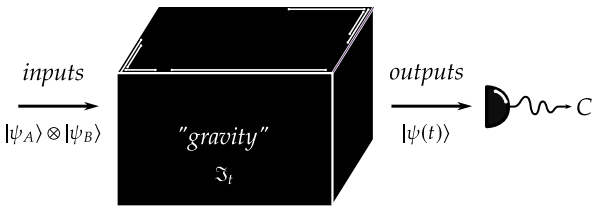
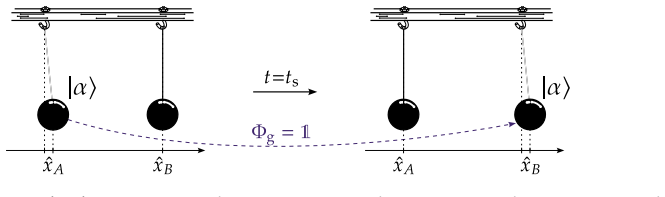
Gravity is the most apparent force in our everyday existence. Yet its fundamental nature remains the most opaque of the known interactions. This gap in our understanding is, in large part, due to the weakness of the gravitational interaction, which makes its empirical probing exceedingly hard. Nevertheless, on the backdrop of rapid advances in quantum technologies, hope has mounted that tests of the quantum nature of gravity could be realized in tabletop experiments. In this essay, we frame these recently proposed tests as quantum-gravitational imitation games. In particular, we examine how gravitational interactions among mechanical oscillators enable the teleportation of arbitrary quantum states and how this can inform fundamental tests of gravity.
Editorial analysis
A structured set of objections, weighed in public.
Referee Report
Summary. The manuscript is a conceptual essay that frames recently proposed tabletop tests of the quantum nature of gravity as 'quantum-gravitational imitation games.' It argues that gravitational interactions among mechanical oscillators enable the teleportation of arbitrary quantum states and that this framing can inform fundamental tests of gravity.
Significance. If the interpretive reframing holds, it might encourage cross-disciplinary thinking between quantum information and gravity research, but the absence of any new derivations, quantitative models, or falsifiable predictions means the work does not advance the technical frontier or resolve open questions in the field.
major comments (1)
- Abstract: the central claim that 'gravitational interactions among mechanical oscillators enable the teleportation of arbitrary quantum states' is asserted without any derivation, Hamiltonian, coupling strength estimate, or protocol, which is load-bearing for the thesis that this informs fundamental tests of gravity.
Simulated Author's Rebuttal
We thank the referee for their review. The manuscript is a conceptual essay that reinterprets existing proposals for tabletop quantum gravity tests. We address the single major comment below.
read point-by-point responses
-
Referee: [—] Abstract: the central claim that 'gravitational interactions among mechanical oscillators enable the teleportation of arbitrary quantum states' is asserted without any derivation, Hamiltonian, coupling strength estimate, or protocol, which is load-bearing for the thesis that this informs fundamental tests of gravity.
Authors: We agree the abstract states the claim without supporting technical details. The manuscript is explicitly positioned as a conceptual essay rather than a derivation of new protocols; the teleportation framing draws on and reinterprets prior literature on gravitational entanglement in mechanical systems (as referenced in the main text). The essay's contribution is interpretive, linking these ideas to imitation-game concepts to encourage cross-disciplinary perspectives. We will revise the abstract to clarify this scope and point to the relevant discussion in the body. revision: yes
Circularity Check
No circularity: purely conceptual essay with no derivations or equations
full rationale
The paper is described as a conceptual essay that reframes existing ideas about quantum gravity tests as 'imitation games' without any new derivations, calculations, quantitative models, or equations. With no technical apparatus, predictions, fitted parameters, or derivation chain present, no load-bearing step can reduce to its inputs by construction. The abstract and skeptic summary confirm the absence of any self-definitional, fitted-input, or self-citation mechanisms that would trigger the enumerated circularity patterns. This is the expected honest non-finding for a non-technical framing piece.
Axiom & Free-Parameter Ledger
Reference graph
Works this paper leans on
-
[1]
Routledge, 2005
Karl Popper.The logic of scientific discovery. Routledge, 2005
2005
-
[2]
Chen, Phil Halper, and Niayesh Afshordi.Copenhagen Survey on Black Holes and Fundamental Physics
Alice Y. Chen, Phil Halper, and Niayesh Afshordi.Copenhagen Survey on Black Holes and Fundamental Physics. 2025. arXiv:2503.15776 [gr-qc]
arXiv 2025
-
[3]
Definition of commutators via the uncertainty principle
Bryce S DeWitt. “Definition of commutators via the uncertainty principle”. In:Jour- nal of Mathematical Physics3.4 (1962), pp. 619–624
1962
-
[4]
The necessity of quantizing the gravitational field
Kenneth Eppley and Eric Hannah. “The necessity of quantizing the gravitational field”. In:Foundations of Physics7.1 (1977), pp. 51–68. 9
1977
-
[5]
Experiments testing macroscopic quantum superpositions must be slow
Andrea Mari, Giacomo De Palma, and Vittorio Giovannetti. “Experiments testing macroscopic quantum superpositions must be slow”. In:Scientific reports6.1 (2016), p. 22777
2016
-
[6]
Is it time to rethink quantum gravity?
Jonathan Oppenheim. “Is it time to rethink quantum gravity?” In:International Journal of Modern Physics D32.14 (2023), p. 2342024
2023
-
[7]
Computingmachineryandintelligence
AlanMTuring.“Computingmachineryandintelligence”.In:ParsingtheTuringtest: Philosophical and methodological issues in the quest for the thinking computer. Springer, 2007, pp. 23–65
2007
-
[8]
TestingtheQuantumness of Gravity without Entanglement
LudovicoLami,JulenS.Pedernales,andMartinB.Plenio.“TestingtheQuantumness of Gravity without Entanglement”. In:Phys. Rev. X14 (2 May 2024), p. 021022.doi: 10 . 1103 / PhysRevX . 14 . 021022.url:https : / / link . aps . org / doi / 10 . 1103 / PhysRevX.14.021022
2024
-
[9]
QuantumBenchmarkforStorageandTransmissionofCoherent States
K.Hammereretal.“QuantumBenchmarkforStorageandTransmissionofCoherent States”. In:Physical Review Letters94.15 (Apr. 2005).issn: 1079-7114.doi:10.1103/ physrevlett.94.150503
2005
-
[10]
Benchmarksfor quantum communication via gravity
KristianToccacelo,UlrikLundAndersen,andJonatanBohrBrask.“Benchmarksfor quantum communication via gravity”. In:Phys. Rev. A112 (2 Aug. 2025), p. 022218. doi:10.1103/7tfb-k2xh
-
[11]
and Ulbricht, Hendrik and Toroš, Marko and Paternostro, Mauro and Geraci, Andrew A
Sougato Bose et al. “Spin Entanglement Witness for Quantum Gravity”. In:Phys. Rev. Lett.119 (24 Dec. 2017), p. 240401.doi:10.1103/PhysRevLett.119.240401. url:https://link.aps.org/doi/10.1103/PhysRevLett.119.240401
-
[12]
Gravitationallyinducedentanglementbetween twomassiveparticlesissufficientevidenceofquantumeffectsingravity
ChiaraMarlettoandVlatkoVedral.“Gravitationallyinducedentanglementbetween twomassiveparticlesissufficientevidenceofquantumeffectsingravity”.In:Physical review letters119.24 (2017), p. 240402. 10
2017
-
[13]
What gravity mediated entangle- ment can really tell us about quantum gravity
Eduardo Martín-Martínez and T. Rick Perche. “What gravity mediated entangle- ment can really tell us about quantum gravity”. In:Phys. Rev. D108 (10 Nov. 2023), p. L101702.doi:10.1103/PhysRevD.108.L101702
-
[14]
On inference of quantization from gravitationally induced entanglement
Vasileios Fragkos, Michael Kopp, and Igor Pikovski. “On inference of quantization from gravitationally induced entanglement”. In:AVS Quantum Science4.4 (2022)
2022
-
[15]
Routledge, 2014
Karl Popper.Conjectures and refutations: The growth of scientific knowledge. Routledge, 2014. 11
2014
discussion (0)
Sign in with ORCID, Apple, or X to comment. Anyone can read and Pith papers without signing in.