Amnesia: A Stealthy Replay Attack on Continual Learning Dreams
Pith reviewed 2026-06-27 09:00 UTC · model grok-4.3
The pith
An insider controlling only replay index selection can degrade continual learning accuracy while respecting auditable distribution limits.
A machine-rendered reading of the paper's core claim, the machinery that carries it, and where it could break.
Core claim
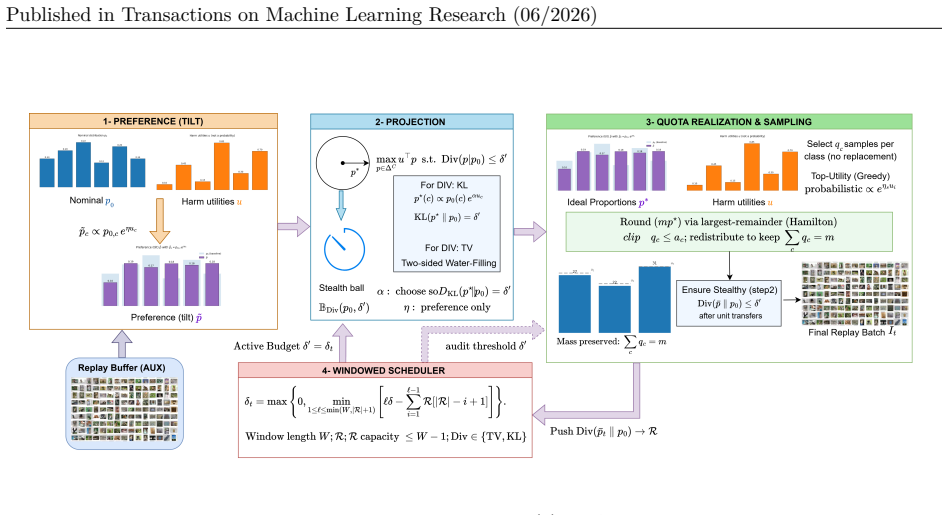
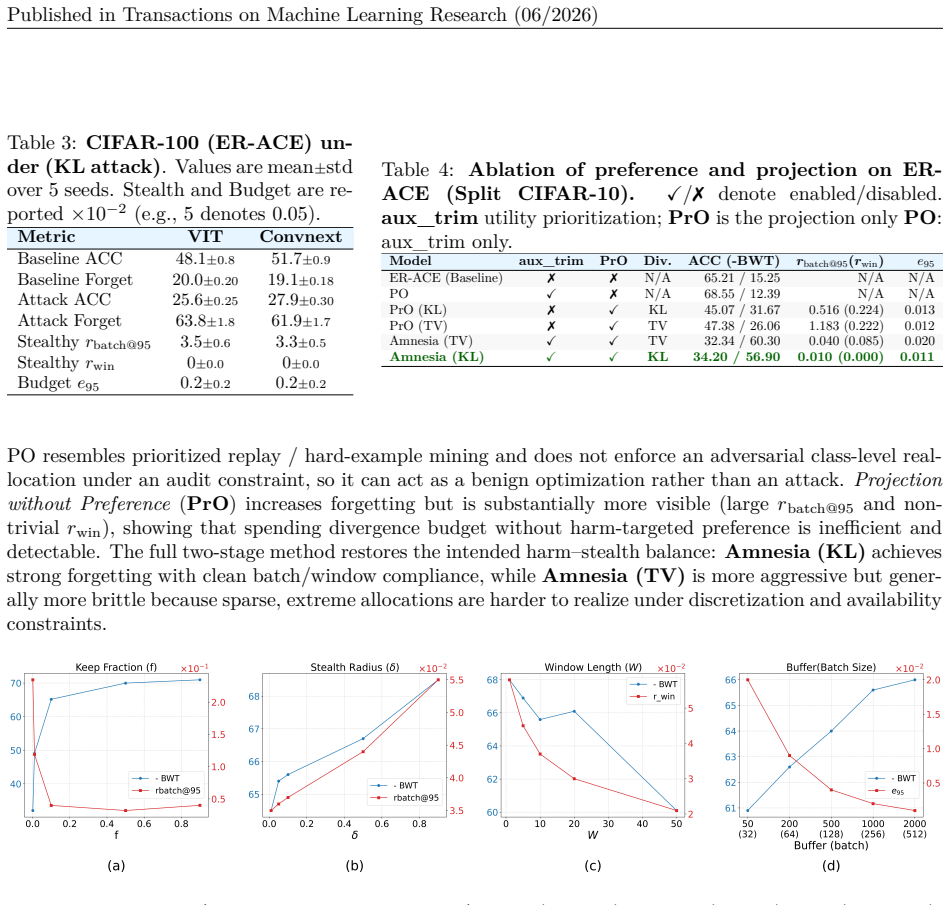
Amnesia is a replay composition attack that computes lightweight class utilities such as EMA loss or confidence to tilt a nominal replay histogram p0 toward harmful classes, then projects the tilt back into a delta-ball around p0 using either KL exponential tilt or TV balanced redistribution while respecting a fixed replay mass f. A windowed scheduler enforces compliance over rolling audits. Across challenging CL benchmarks and strong replay baselines the method lowers final accuracy and worsens backward transfer, with the KL variant delivering high impact while remaining largely undetected by per-batch and rolling-window histogram checks.
What carries the argument
The replay composition optimizer that tilts the nominal class histogram p0 using class utilities and projects the result into a divergence ball of radius delta around p0.
If this is right
- Replay-based continual learning systems become vulnerable to index-selection attacks that do not alter pixels or labels.
- The KL projection achieves performance degradation while passing multiple histogram-based audit schemes.
- The TV projection produces larger accuracy drops but is more readily detected under tight per-class constraints.
- Windowed rolling audits do not eliminate the degradation when the attacker uses the KL optimizer.
Where Pith is reading between the lines
- Audits that rely only on replay class histograms may need additional signals such as utility verification to close this surface.
- The same index-selection approach could be tested against other memory-augmented training loops beyond continual learning.
- Deployed CL systems might require randomized or utility-obfuscated sampling to reduce the effectiveness of such tilts.
Load-bearing premise
The insider can compute accurate class utilities from model outputs on replay samples while the system only enforces queue priorities and histogram audits on visible telemetry.
What would settle it
Applying the described KL or TV projection on a standard CL benchmark with the stated delta and f budgets and measuring no drop in final accuracy or worsening of backward transfer would falsify the central claim.
Figures
read the original abstract
Continual learning (CL) models often use experience replay to reduce catastrophic forgetting, but their robustness to replay sampling interference remains underexplored. Existing CL attacks alter inputs or training pipelines (poisoning/backdoors) and rarely include explicit auditable constraints, limiting realism. Here, auditability means a monitor can verify compliance from sampler-visible telemetry - e.g., logged replay index/label statistics - by checking that the realized replay class histogram stays close to a nominal baseline and that replay rate is unchanged per batch and/or over a rolling window. We study a limited-privilege insider who controls only replay index selection, not pixels, labels, or model parameters, while staying within auditable limits such as queue priorities. We introduce Amnesia, a replay composition attack that maximizes degradation under two budgets: a visibility budget delta bounding the TV/KL divergence from a nominal class histogram p0, and a mass budget f fixing the replay rate. Amnesia has two steps: (i) compute lightweight class utilities, such as EMA loss or confidence, to tilt p0 toward harmful classes; and (ii) project the tilt back into the delta-ball using efficient KL (exponential tilt) or TV (balanced mass redistribution) optimizers. A windowed scheduler enforces rolling audits. Across challenging CL benchmarks and strong replay baselines, Amnesia consistently lowers final accuracy (ACC) and worsens backward transfer (-BWT). The KL variant delivers high impact while remaining largely undetected under multiple audit schemes, including per-batch and rolling-window checks. The TV variant is more damaging but easier to detect, especially under tight per-class constraints. These results expose index-only replay control as a practical, auditable threat surface in CL systems and establish a principled impact-visibility trade-off.
Editorial analysis
A structured set of objections, weighed in public.
Referee Report
Summary. The paper claims that a limited-privilege insider controlling only replay index selection in continual learning (CL) systems can mount a stealthy replay composition attack (Amnesia) that degrades final accuracy (ACC) and worsens backward transfer (-BWT) while respecting explicit auditable constraints. The attack computes lightweight class utilities (EMA loss or confidence) to tilt a nominal replay histogram p0, then projects the tilt into a visibility ball of radius delta (via KL exponential tilt or TV balanced redistribution) under a fixed mass budget f; a windowed scheduler enforces rolling per-batch and histogram audits. Experiments across CL benchmarks and strong replay baselines show consistent degradation, with the KL variant achieving high impact while remaining largely undetected.
Significance. If the experimental results hold under the stated threat model, the work identifies index-only replay control as a practical and previously underexplored attack surface in auditable CL systems. It supplies a concrete impact-visibility trade-off parameterized by delta and f, together with two projection methods whose relative stealth/damage profiles are directly compared under multiple audit schemes. This is a substantive contribution to the security analysis of replay-based CL.
major comments (2)
- [§4.2] §4.2 (projection step): the KL exponential tilt is stated to remain inside the delta-ball while maximizing the utility objective, but the manuscript does not supply the explicit optimality condition or a short proof that the projected distribution satisfies the TV/KL constraint by construction; without this, it is unclear whether the reported undetectability is guaranteed or merely observed.
- [Table 3 / §5.1] Table 3 / §5.1 (audit results): the claim that the KL variant 'remains largely undetected' under rolling-window checks rests on specific histogram divergence thresholds; the paper should report the exact per-class and aggregate detection rates together with the number of independent runs and any statistical test used to establish that the difference from the nominal baseline is insignificant.
minor comments (3)
- [§3] The definition of the mass budget f and its interaction with per-batch replay rate should be stated once in a single equation or paragraph rather than distributed across §3 and §4.
- Figure captions for the audit plots should explicitly list the rolling-window length and the exact divergence metric (TV or KL) used for each panel.
- [§4] A short paragraph comparing the computational cost of the two projection methods (KL vs. TV) would help readers assess practicality under the limited-privilege assumption.
Simulated Author's Rebuttal
We thank the referee for the positive evaluation and constructive comments. We address each major point below and will revise the manuscript accordingly.
read point-by-point responses
-
Referee: [§4.2] §4.2 (projection step): the KL exponential tilt is stated to remain inside the delta-ball while maximizing the utility objective, but the manuscript does not supply the explicit optimality condition or a short proof that the projected distribution satisfies the TV/KL constraint by construction; without this, it is unclear whether the reported undetectability is guaranteed or merely observed.
Authors: We agree that an explicit optimality condition and derivation would strengthen the section. The KL exponential tilt solves the standard convex program max_p <u,p> s.t. KL(p||p0) ≤ δ, whose closed-form solution is p*_i ∝ p0_i exp(λ u_i) with λ chosen so that KL(p*||p0)=δ (equality at optimum for δ>0). This places p* on the boundary of the δ-ball by construction, guaranteeing compliance with the KL audit. We will add this short derivation and the KKT optimality condition to §4.2 in the revision. revision: yes
-
Referee: [Table 3 / §5.1] Table 3 / §5.1 (audit results): the claim that the KL variant 'remains largely undetected' under rolling-window checks rests on specific histogram divergence thresholds; the paper should report the exact per-class and aggregate detection rates together with the number of independent runs and any statistical test used to establish that the difference from the nominal baseline is insignificant.
Authors: We accept this request for more precise reporting. The revised manuscript will expand Table 3 and §5.1 to list exact per-class and aggregate detection rates (as fractions of windows exceeding each threshold), state that all figures are means over 5 independent runs with standard deviations, and add p-values from paired t-tests (or Wilcoxon signed-rank where appropriate) comparing KL-Amnesia to the nominal baseline to confirm statistical insignificance (p>0.05). revision: yes
Circularity Check
No significant circularity
full rationale
The manuscript describes an empirical replay attack constructed from explicit algorithmic steps (utility computation followed by KL/TV projection under explicit divergence and mass budgets) with no equations, derivations, or fitted parameters that reduce the claimed performance to the inputs by construction. No self-citation load-bearing steps, uniqueness theorems, or ansatz smuggling appear in the provided text. Results are presented as experimental outcomes on standard CL benchmarks against replay baselines, which are independently verifiable and do not collapse into self-definition.
Axiom & Free-Parameter Ledger
free parameters (2)
- delta
- f
axioms (2)
- domain assumption A monitor can verify compliance from sampler-visible telemetry such as logged replay index/label statistics.
- domain assumption The attacker can compute lightweight class utilities (EMA loss or confidence) without additional privileges.
Reference graph
Works this paper leans on
-
[1]
International Conference on Learning Representations , year =
Explaining and Harnessing Adversarial Examples , author =. International Conference on Learning Representations , year =
-
[2]
International Conference on Learning Representations , year =
Intriguing properties of neural networks , author =. International Conference on Learning Representations , year =
-
[3]
International Conference on Learning Representations , year =
Towards Deep Learning Models Resistant to Adversarial Attacks , author =. International Conference on Learning Representations , year =
-
[4]
2017 IEEE Symposium on Security and Privacy (SP) , pages =
Towards Evaluating the Robustness of Neural Networks , author =. 2017 IEEE Symposium on Security and Privacy (SP) , pages =. 2017 , organization =
2017
-
[5]
International Conference on Machine Learning , year =
Obfuscated Gradients Give a False Sense of Security: Circumventing Defenses to Adversarial Examples , author =. International Conference on Machine Learning , year =
-
[6]
International Conference on Machine Learning , year =
Synthesizing Robust Adversarial Examples , author =. International Conference on Machine Learning , year =
-
[7]
Proceedings of the IEEE Conference on Computer Vision and Pattern Recognition , year =
Robust Physical-World Attacks on Deep Learning Visual Classification , author =. Proceedings of the IEEE Conference on Computer Vision and Pattern Recognition , year =
-
[8]
arXiv preprint arXiv:1712.09665 , year =
Adversarial Patch , author =. arXiv preprint arXiv:1712.09665 , year =
-
[9]
Proceedings of the 29th International Conference on Machine Learning , year =
Poisoning Attacks against Support Vector Machines , author =. Proceedings of the 29th International Conference on Machine Learning , year =
-
[10]
Advances in Neural Information Processing Systems , year =
Certified Defenses for Data Poisoning Attacks , author =. Advances in Neural Information Processing Systems , year =
-
[11]
arXiv preprint arXiv:1708.06733 , year =
BadNets: Evaluating Backdooring Attacks on Deep Neural Networks , author =. arXiv preprint arXiv:1708.06733 , year =
-
[12]
arXiv preprint arXiv:1802.04633 , year =
Trojaning Attack on Neural Networks , author =. arXiv preprint arXiv:1802.04633 , year =
-
[13]
Pattern Recognition , volume =
Wild Patterns: Ten years after the rise of adversarial machine learning , author =. Pattern Recognition , volume =
-
[14]
Proceedings of the 34th International Conference on Machine Learning , year =
Understanding Black-box Predictions via Influence Functions , author =. Proceedings of the 34th International Conference on Machine Learning , year =
-
[15]
Proceedings of the 2017 ACM on Asia Conference on Computer and Communications Security , pages =
Practical Black-Box Attacks against Machine Learning , author =. Proceedings of the 2017 ACM on Asia Conference on Computer and Communications Security , pages =
2017
-
[16]
Proceedings of the 10th ACM Workshop on Artificial Intelligence and Security , pages =
ZOO: Zeroth Order Optimization based Black-box Attacks to Deep Neural Networks without Training Substitute Models , author =. Proceedings of the 10th ACM Workshop on Artificial Intelligence and Security , pages =
-
[17]
International Conference on Learning Representations , year =
Ensemble Adversarial Training: Attacks and Defenses , author =. International Conference on Learning Representations , year =
-
[18]
International Conference on Learning Representations , year =
Adam: A Method for Stochastic Optimization , author =. International Conference on Learning Representations , year =
-
[19]
International Conference on Learning Representations , year =
SGDR: Stochastic Gradient Descent with Warm Restarts , author =. International Conference on Learning Representations , year =
-
[20]
Proceedings of the IEEE Conference on Computer Vision and Pattern Recognition , year =
AutoAugment: Learning Augmentation Policies from Data , author =. Proceedings of the IEEE Conference on Computer Vision and Pattern Recognition , year =
-
[21]
Advances in Neural Information Processing Systems , year =
Gradient Episodic Memory for Continual Learning , author =. Advances in Neural Information Processing Systems , year =
-
[22]
International Conference on Learning Representations , year =
Efficient Lifelong Learning with A-GEM , author =. International Conference on Learning Representations , year =
-
[23]
Neural Networks , volume =
Continual Lifelong Learning with Neural Networks: A Review , author =. Neural Networks , volume =
-
[24]
IEEE Transactions on Pattern Analysis and Machine Intelligence , year =
A Continual Learning Survey: Defying Forgetting in Classification Tasks , author =. IEEE Transactions on Pattern Analysis and Machine Intelligence , year =
-
[25]
Advances in Neural Information Processing Systems (NeurIPS) , year =
Jacob Steinhardt and Pang Wei Koh and Percy Liang , title =. Advances in Neural Information Processing Systems (NeurIPS) , year =. 1706.03691 , archivePrefix =
-
[26]
Matthew Jagielski and Alina Oprea and Battista Biggio and Chang Liu and Cristina Nita. Manipulating Machine Learning: Poisoning Attacks and Countermeasures for Regression Learning , booktitle =. 2018 , pages =. doi:10.1109/SP.2018.00057 , url =
-
[27]
Duchi , title =
Hongseok Namkoong and John C. Duchi , title =. Advances in Neural Information Processing Systems (NeurIPS) , year =
-
[28]
Aman Sinha and Hongseok Namkoong and John C. Duchi , title =. International Conference on Learning Representations (ICLR) , year =. 1710.10571 , archivePrefix =
-
[29]
International Conference on Learning Representations Workshop , year =
Adversarial Examples in the Physical World , author =. International Conference on Learning Representations Workshop , year =
-
[30]
International Conference on Learning Representations , year =
Decision-Based Adversarial Attacks: Reliable Attacks Against Black-Box Machine Learning Models , author =. International Conference on Learning Representations , year =
-
[31]
Reliable Evaluation of Adversarial Robustness with
Croce, Francesco and Hein, Matthias , booktitle =. Reliable Evaluation of Adversarial Robustness with
-
[32]
USENIX Security Symposium , year =
Stealing Machine Learning Models via Prediction APIs , author =. USENIX Security Symposium , year =
-
[33]
arXiv preprint arXiv:1804.08598 , year =
Black-Box Adversarial Attacks with Limited Queries and Information , author =. arXiv preprint arXiv:1804.08598 , year =
-
[34]
International Conference on Learning Representations , year =
Prior Convictions: Black-Box Adversarial Attacks with Bandits and Priors , author =. International Conference on Learning Representations , year =
-
[35]
Advances in Neural Information Processing Systems , year =
Poison Frogs! Targeted Clean-Label Poisoning Attacks on Neural Networks , author =. Advances in Neural Information Processing Systems , year =
-
[36]
Advances in Neural Information Processing Systems , year =
Metapoison: Practical General-Purpose Clean-Label Data Poisoning , author =. Advances in Neural Information Processing Systems , year =
-
[37]
International Conference on Learning Representations , year =
Witches' Brew: Industrial Scale Data Poisoning via Gradient Matching , author =. International Conference on Learning Representations , year =
-
[38]
2023 , howpublished =
2023
-
[39]
Proceedings of the 34th International Conference on Machine Learning - Volume 70 , pages =
Zenke, Friedemann and Poole, Ben and Ganguli, Surya , title =. Proceedings of the 34th International Conference on Machine Learning - Volume 70 , pages =. 2017 , publisher =
2017
-
[40]
Tiny ImageNet Challenge (CS231n) , year =
-
[41]
Proceedings of the 1st Annual Conference on Robot Learning , pages =
CORe50: a New Dataset and Benchmark for Continuous Object Recognition , author =. Proceedings of the 1st Annual Conference on Robot Learning , pages =. 2017 , editor =
2017
-
[42]
International Conference on Learning Representations , year =
New insights on reducing abrupt representation change in online continual learning , author =. International Conference on Learning Representations , year =
-
[43]
Experience Replay for Continual Learning , url =
Rolnick, David and Ahuja, Arun and Schwarz, Jonathan and Lillicrap, Timothy and Wayne, Gregory , booktitle =. Experience Replay for Continual Learning , url =
-
[44]
Proceedings of the 34th International Conference on Neural Information Processing Systems , articleno =
Buzzega, Pietro and Boschini, Matteo and Porrello, Angelo and Abati, Davide and Calderara, Simone , title =. Proceedings of the 34th International Conference on Neural Information Processing Systems , articleno =. 2020 , isbn =
2020
-
[45]
Gradient Episodic Memory for Continual Learning , booktitle =
David Lopez. Gradient Episodic Memory for Continual Learning , booktitle =
-
[46]
Rusu and
James Kirkpatrick and Razvan Pascanu and Neil Rabinowitz and Joel Veness and Guillaume Desjardins and Andrei A. Rusu and. Overcoming catastrophic forgetting in neural networks , journal =
-
[47]
IEEE Trans
Matthias De Lange and Rahaf Aljundi and Marc Masana and Sarah Parisot and Xu Jia and Ales Leonardis and Gregory Slabaugh and Tinne Tuytelaars , title =. IEEE Trans. Pattern Anal. Mach. Intell. , year =
-
[48]
A Theory for Knowledge Transfer in Continual Learning , booktitle =
Diana Benavides. A Theory for Knowledge Transfer in Continual Learning , booktitle =. 2022 , publisher =
2022
-
[49]
van de Ven and Tinne Tuytelaars and Andreas S
Three types of incremental learning , author =. Nature Machine Intelligence , year =. doi:10.1038/s42256-022-00568-3 , url =
-
[50]
2019 , eprint=
On Tiny Episodic Memories in Continual Learning , author=. 2019 , eprint=
2019
-
[51]
Proceedings of the IEEE/CVF Conference on Computer Vision and Pattern Recognition (CVPR) , pages =
Ali Abbasi and Parsa Nooralinejad and Hamed Pirsiavash and Soheil Kolouri , title =. Proceedings of the IEEE/CVF Conference on Computer Vision and Pattern Recognition (CVPR) , pages =
-
[52]
Proceedings of the 2023 IEEE International Conference on Image Processing (ICIP) , pages =
Gyojin Han and Jaehyun Choi and Hyeong Gwon Hong and Junmo Kim , title =. Proceedings of the 2023 IEEE International Conference on Image Processing (ICIP) , pages =
2023
-
[53]
IEEE International Conference on Image Processing (ICIP) , pages =
Han, Gyojin and Choi, Jaehyun and Hong, Hyeong Gwon and Kim, Junmo , title =. IEEE International Conference on Image Processing (ICIP) , pages =
-
[54]
Proceedings of the 40th International Conference on Machine Learning (ICML) , pages =
Siteng Kang and Zhan Shi and Xinhua Zhang , title =. Proceedings of the 40th International Conference on Machine Learning (ICML) , pages =
-
[55]
arXiv preprint arXiv:2311.10919 , year =
Umer, Muhammad and Mian, Ajmal and others , title =. arXiv preprint arXiv:2311.10919 , year =
-
[56]
Proceedings of the International Joint Conference on Neural Networks (IJCNN) , pages =
Huayu Li and Gregory Ditzler , title =. Proceedings of the International Joint Conference on Neural Networks (IJCNN) , pages =
-
[57]
arXiv preprint arXiv:1810.13166 , year =
Don't forget, there is more than forgetting: new metrics for Continual Learning , author =. arXiv preprint arXiv:1810.13166 , year =
-
[58]
arXiv preprint arXiv:2308.08378 , year =
Advancing continual lifelong learning in neural information retrieval: definition, dataset, framework, and empirical evaluation , author =. arXiv preprint arXiv:2308.08378 , year =
-
[59]
2022 , url =
Iterative Relaxing Gradient Projection for Continual Learning , author =. 2022 , url =
2022
-
[60]
arXiv preprint arXiv:2506.03189 , year =
Continual Learning in Vision--Language Models via Aligned , author =. arXiv preprint arXiv:2506.03189 , year =
-
[61]
Advances in Neural Information Processing Systems , year =
Retrospective Adversarial Replay for Continual Learning , author =. Advances in Neural Information Processing Systems , year =
-
[62]
Frontiers in Artificial Intelligence , year =
Is Class-Incremental Enough for Continual Learning? , author =. Frontiers in Artificial Intelligence , year =. doi:10.3389/frai.2022.829842 , url =
-
[63]
Advances in Neural Information Processing Systems , year =
Gradient based sample selection for online continual learning , author =. Advances in Neural Information Processing Systems , year =
-
[64]
Advances in Neural Information Processing Systems , year =
Online Continual Learning with Maximal Interfered Retrieval , author =. Advances in Neural Information Processing Systems , year =
-
[65]
arXiv preprint arXiv:2404.10758 , year =
Watch Your Step: Optimal Retrieval for Continual Learning at Scale , author =. arXiv preprint arXiv:2404.10758 , year =
-
[66]
Proceedings of the AAAI Conference on Artificial Intelligence , year =
Online Class-Incremental Continual Learning with Adversarial Shapley Value , author =. Proceedings of the AAAI Conference on Artificial Intelligence , year =
-
[67]
2020 , url =
online-continual-learning (code repository) , author =. 2020 , url =
2020
-
[68]
Computer Vision -- ECCV 2020 , series =
GDumb: A Simple Approach that Questions Our Progress in Continual Learning , author =. Computer Vision -- ECCV 2020 , series =. 2020 , doi =
2020
-
[69]
arXiv preprint arXiv:2407.12375 , year =
FETCH: A Memory-Efficient Replay Approach for Continual Learning , author =. arXiv preprint arXiv:2407.12375 , year =
-
[70]
Neural Computation , year =
Reducing Catastrophic Forgetting With Associative Learning , author =. Neural Computation , year =
-
[71]
Proceedings of the National Academy of Sciences , year =
Note on the quadratic penalties in elastic weight consolidation , author =. Proceedings of the National Academy of Sciences , year =. doi:10.1073/pnas.1717042115 , url =
-
[72]
arXiv preprint arXiv:2312.09481 , year =
Continual Adversarial Defense , author =. arXiv preprint arXiv:2312.09481 , year =
-
[73]
2024 , doi =
Red Alarm: Controllable Backdoor Attack in Continual Learning , author =. 2024 , doi =
2024
-
[74]
Proceedings of the 34th USENIX Security Symposium (USENIX Security 2025) , year =
Persistent Backdoor Attacks in Continual Learning , author =. Proceedings of the 34th USENIX Security Symposium (USENIX Security 2025) , year =
2025
-
[75]
Neural Networks , year =
Red Alarm: Controllable Backdoor Attack in Continual Learning , author =. Neural Networks , year =
-
[76]
Targeted Data Poisoning Attacks Against Continual Learning Neural Networks , year=
Li, Huayu and Ditzler, Gregory , booktitle=. Targeted Data Poisoning Attacks Against Continual Learning Neural Networks , year=
-
[77]
Proceedings of the 35th International Conference on Machine Learning , series =
Overcoming Catastrophic Forgetting with Hard Attention to the Task , author =. Proceedings of the 35th International Conference on Machine Learning , series =. 2018 , url =
2018
-
[78]
2023 , url =
Forward Explanation: Why Catastrophic Forgetting Occurs , author =. 2023 , url =
2023
-
[79]
Proceedings of the IEEE/CVF Conference on Computer Vision and Pattern Recognition (CVPR) Workshops , month =
Zheda Mai and Ruiwen Li and Hyunwoo Kim and Scott Sanner , title =. Proceedings of the IEEE/CVF Conference on Computer Vision and Pattern Recognition (CVPR) Workshops , month =. 2021 , pages =
2021
-
[80]
Proceedings of the IEEE/CVF Conference on Computer Vision and Pattern Recognition (CVPR) , month =
Kaiming He and Xiangyu Zhang and Shaoqing Ren and Jian Sun , title =. Proceedings of the IEEE/CVF Conference on Computer Vision and Pattern Recognition (CVPR) , month =. 2016 , pages =
2016
discussion (0)
Sign in with ORCID, Apple, or X to comment. Anyone can read and Pith papers without signing in.