REVIEW 5 major objections 7 minor 2 cited by
Engagement-Driven Content Generation with Large Language Models
T0 review · 5 major / 7 minor · reviewed 2026-08-12 · deepseek-v4-flash
Pith's one-line read This paper claims that an LLM fine-tuned against a simulated cascade model can learn to generate content that maximizes engagement on social networks, adapting its sentiment to the network's opinions.
desk verdict A clean, well-documented proof-of-concept for RL fine-tuning against a simulated engagement model, but the paper overclaims transfer to real social networks; the evaluation is in-sample and the external validation is too thin. read the letter →
The pith
A machine-rendered reading of the paper's core claim, the machinery that carries it, and where it could break.
The reading
What carries the argument
The load-bearing object is the bounded-confidence cascade model M_epsilon, which couples the independent-cascade propagation mechanism with the bounded-confidence opinion rule: a node activates on a post exactly when |s_t - x_u| <= epsilon, with epsilon = 0.2, and activated nodes then pass the post to their followers until no new nodes activate. The reward fed to the LLM is the geometric mean of a Flesch-Kincaid fluency score and the number of activated users, R = (f_t * |A|)^(1/2), and the policy is updated with PPO while a KL penalty keeps generations near the reference model. The sentiment estimator is a plug-and-play DistilBERT model, and the entire simulated loop replaces human feedback, making the training fast, controllable, and adaptable to different engagement models.
What would settle it
Run the fine-tuned model on a live social platform: if posts selected by the simulated reward do not attract more real interactions than vanilla-model posts, or if posts with the simulated-optimal sentiment are outperformed by posts with other sentiments, the proxy fails. A cheaper offline test is to compute, on the full Brexit dataset rather than only the most popular tweets, the correlation between simulated activation |A| and actual retweets per post; a slope near zero would falsify the engagement model.
Extended reading notes
Core claim
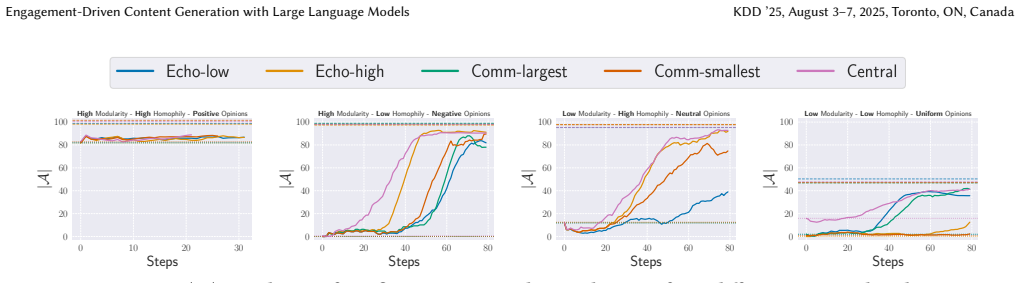
The paper's central claim is that reinforcement learning with simulated feedback from a formal engagement model is enough to teach an LLM to generate content that maximizes engagement in a social network. The engagement model couples the independent-cascade mechanism of information propagation with the bounded-confidence rule from opinion dynamics: a user activates on a post exactly when the post's sentiment score is within epsilon of the user's opinion. Fine-tuning Gemma-2B with PPO against this model, with reward R = (f_t * |A|)^(1/2), produces content whose sentiment converges to the optimal sentiment for the environment: positive in positive networks, negative in negative ones, and balanced in uniform ones. The authors report that the fine-tuned model reaches near-maximal simulated engagement in most configurations, outperforms BERT, GPT-2, LLaMA3.1-70B, and ChatGPT-4o in negative, neutral, and uniform opinion settings, and generates posts whose simulated engagement is comparable to that of real tweets on the Brexit and Italian Referendum networks.
Load-bearing premise
The load-bearing premise is that a user really does engage with a post whenever its sentiment is within 0.2 of their opinion, and that the simulated cascades this produces are faithful enough that maximizing them also maximizes real engagement.
Editorial extensions
If this is right
- If the claim holds, LLM agents can be steered to write content that matches the prevailing sentiment of a community, giving a direct lever for engagement in polarized networks.
- The same pipeline can be applied to any engagement or opinion-dynamics model, so the effect of different mechanisms such as zealots, stubborn users, or backfire effects on generated content can be studied without live experiments.
- Out-of-the-box LLMs cannot be assumed to optimize engagement: vanilla Gemma and larger models underperform in negative, neutral, and uniform opinion landscapes, so fine-tuning against the environment is the essential step.
- Generated posts reach simulated engagement levels close to real tweets, suggesting the method could pre-test content strategies before deployment on a platform.
- The framework's plug-and-play reward design means it can be redirected to other objectives beyond engagement, such as depolarization or promoting reliable information, without changing the training loop.
Reading between the lines
- A live A/B test is the missing check: if the fine-tuned model's posts do not attract more real interactions than vanilla or sentiment-matched posts, the bounded-confidence proxy is not capturing what drives human engagement.
- Because the reward reduces a post to one sentiment scalar, the optimizer may converge on sentiment shifts rather than substance; content quality, framing, and novelty are invisible to the reward, so the 'meaningful content' claim is only as strong as the sentiment abstraction.
- The same machinery could be repurposed for manipulation: in a polarized network, maximizing engagement by sentiment alignment can amplify divisive content, so reward design should be treated as an ethical choice, not a technical detail.
- A cheap extension would be to train on generation-from-scratch prompts and test whether the learned sentiment alignment transfers to open-ended posts, since the current results are limited to query completion.
Signed reviews
Editorial analysis
A structured set of objections, weighed in public.
Referee Report
Summary. The paper proposes an RL-based framework (RLSF) that fine-tunes an LLM to generate content that maximizes engagement on a social network. Engagement is modeled by a bounded-confidence cascade model M_epsilon (Algorithm 1), and the reward is the geometric mean of a Flesch–Kincaid readability score and the number of activated nodes |A| (Algorithm 2, line 5). The authors fine-tune Gemma-2B with PPO on synthetic LFR-style networks and on the Brexit and Italian Referendum networks, and compare against BERT, GPT-2, LLaMA3.1-70B, ChatGPT-4o, and the vanilla Gemma model. They report that the fine-tuned model approaches the maximum engagement allowed by M_epsilon, adapts the sentiment of generated content to the opinion distribution, and produces content with engagement comparable to real tweets. The central empirical claim is that the framework enables an LLM to generate content that maximizes user engagement on real social networks.
Significance. The paper addresses a timely and relevant problem at the intersection of LLM fine-tuning and opinion-dynamics-based social simulation. Its strengths are a clean plug-and-play formulation, public code, and a broad experimental matrix covering modularity, homophily, opinion distributions, and source placement. If the claims were restricted to the simulated engagement model, the demonstration that PPO can drive a small LLM to discover near-optimal sentiment under M_epsilon would be a useful proof-of-concept. However, the paper's central framing and Findings 5–7 go beyond the simulator, claiming realism and comparability to actual social-media engagement. The evidence for that transfer is a single weak RANSAC regression, so the real-world claim is not yet supported.
major comments (5)
- [Section 4, Algorithm 2; Section 6, Findings 1–3, 8] The paper's headline claims concern maximizing user engagement on real social networks, but the training reward and the evaluation metric are the same quantity: |A| produced by M_epsilon. Algorithm 2 line 5 defines R = (f_t * |A|)^{1/2}, and Figures 5–12 and Tables 1–2 evaluate |A| with the same Algorithm 1. Therefore Findings 1–3 and 8 demonstrate that PPO improves the objective defined by M_epsilon; they do not by themselves provide evidence about real engagement. This distinction is load-bearing because all baselines are also scored with M_epsilon, so the comparison in Finding 8 is an in-simulator comparison. The text should either restrict all conclusions to engagement under M_epsilon or supply validation on held-out real engagement data.
- [Appendix B, Figure 14] The only external evidence that M_epsilon tracks real engagement is a RANSAC regression fit to the most retweeted Brexit tweets. The fit has slope 0.04, an intercept of 123.74, and the authors state that the model tends to overestimate engagement. The sample is truncated to high-retweet posts, the fit is not evaluated on held-out posts or on generated content, and the reported R^2 = 0.86 is for the RANSAC inlier fit rather than predictive accuracy. This is too weak to support Finding 6 and the claim in RQ2 that generated content has engagement comparable to real tweets. At minimum, the paper should report held-out predictive performance and calibration on non-truncated data.
- [Figures 5–10; Finding 8] The empirical comparisons appear to be based on single runs: the learning curves in Figures 5–8 are moving averages of one trajectory, and the baseline bars in Figures 10–12 have no error bars, no multiple seeds, and no significance tests. Because PPO is stochastic and the reward depends on the sampled content, run-to-run variability could be substantial. The claim that the fine-tuned model significantly outperforms LLaMA3.1-70B and ChatGPT-4o in negative, neutral, and uniform settings needs repeated seeds and a paired statistical test before it can be taken as quantitative.
- [Section 6, Finding 7 and Figure 9] Finding 7, that produced engagement does not depend on content length, is presented as an empirical property of the data. But Figure 9 computes |A| through M_epsilon, which takes only the sentiment scalar s_t as input in Algorithm 1 and never uses post length. The absence of a length-engagement correlation is therefore a property of M_epsilon by construction, not an empirical finding about real engagement. This statement should be removed or explicitly labeled as a property of the simulator.
- [Section 6, Finding 3 and Appendix A, Figure 13] Finding 3 states that the framework enables the LLM to align the sentiment of generated content with the optimal sentiment for the environment. Under M_epsilon, this alignment is a direct consequence of the bounded-confidence rule: for a fixed injection point, the engagement-maximizing s_t is within epsilon of the opinions of nodes reachable from that point, as the authors themselves compute in Figure 13. The RL result is that the fine-tuned model discovers that optimum; calling this alignment a property of social networks is an overinterpretation. The discussion should distinguish between the structural optimum of the model and the LLM's ability to find it.
minor comments (7)
- [Section 1] The phrase 'It also allows to control over endogenous factors' should be rephrased, for example as 'It also allows control over endogenous factors' or 'It also allows us to control endogenous factors'.
- [Figure 5 caption] The dotted line is called the 'lower-bound', but it is the engagement of the non-fine-tuned LLM, not an analytic lower bound. A neutral label such as 'baseline' would be more accurate.
- [Section 5, Baselines] BERT is a masked language model and not a generative model; using it to complete prompts by masked-word prediction is nonstandard and deserves a sentence explaining why this is a meaningful comparison for content generation.
- [Figure 7 and Figure 8 captions] Figure 7 uses 'sc' while the text and Figure 8 use 's_t' for the sentiment value; the notation should be unified.
- [Section 6, Tables 1 and 2] The comparison of real versus generated content is based on two hand-picked examples per dataset. Reporting aggregate statistics over many generated and real posts, such as median and interquartile range of |A|, would strengthen the claim and avoid selection concerns.
- [Section 7, Limitations] The limitations paragraph should state prominently that all reported engagement values are produced by M_epsilon and are not actual retweet counts; this is the main limitation of the study and should not be deferred to a footnote or an appendix.
- [Section 4, Algorithm 2] The Flesch–Kincaid score is a readability/grade-level measure; referring to it as a 'fluency' score in Algorithm 2 and Section 4 conflates readability with semantic fluency. A neutral term such as 'readability score' would be more precise.
Circularity Check
Findings 3 and 7 are properties of the engagement model that also defines the RL reward; the real-engagement claim rests on the same unvalidated proxy.
-
self definitional
[Section 3 (Engagement maximization) and Section 6, Finding 3]
"Formally, given the set T of all possible texts that achieve an adequate level of fluency, we aim at finding 𝑡∗ = arg max𝑡∈TM𝜖(𝑠𝑡,𝑢 𝐿|G,®𝑥). ... Finding 3: Generated content aligns with the optimal sentiment. The framework enables the LLM agent to optimize engagement by aligning the sentiment of the generated content with the optimal sentiment for the environment."
In the bounded-confidence model, |A| is a deterministic function of the sentiment scalar s_t: a node activates iff |s_t - x_w| ≤ ε. The 'optimal sentiment for the environment' is therefore defined to be the argmax of M_epsilon over s_t, which is exactly the objective stated in Section 3. Algorithm 2 uses this same M_epsilon to compute the RL reward (R = (f_t·|A|)^{1/2}), so any reward-maximizing policy must drive s_t toward that argmax. Finding 3 is thus a restatement of the reward construction, not an independent empirical discovery about real social networks; the phrase 'for the environment' conflates the simulator with the real platform.
-
self definitional
[Section 6, Finding 7; Figure 9; Algorithm 1]
"Finding 7: The produced engagement does not depend on content length. ... However, as illustrated in Figure 9, our analysis on the Brexit dataset suggests no correlation between post length (measured in characters) and the number of users who engaged with it. This analysis stems from the intuition that longer content might increase the likelihood of user engagement."
Algorithm 1's activation rule is |s_t - x_w| ≤ ε: the text t enters only through the scalar s_t, and neither the propagation model nor the reward R=(f_t·|A|)^{1/2} contains a length term. Thus |A| is independent of post length by construction, regardless of what S(t) does. Reporting near-zero correlations (ρ=0.048, ρ=0.002) computed with M_epsilon is reporting a property of the simulator, not of real tweets. The stated 'intuition' about longer content is tested with a model that cannot represent that mechanism, so the finding is forced by the definition of the engagement model.
full rationale
The RL fine-tuning genuinely optimizes the reward it is given, so the convergence curves and baseline comparisons are legitimate demonstrations of optimization inside M_epsilon. The circularity is narrower: Findings 3 and 7 are true by construction because the same model that defines the reward also defines 'engagement' and 'optimal sentiment', and it contains no length mechanism. No load-bearing self-citation chain is present; the authors' prior work on synthetic generators and opinion preprocessing is not what forces the results. The external validation in Appendix B (RANSAC on the most popular Brexit tweets, slope 0.04, acknowledged overestimation) is weak evidence for real-world transfer and does not rescue the self-referential evaluation, but it is a validity concern rather than an additional circular step. The central claim about real social-network engagement therefore remains an unproven extrapolation from a simulator, not a derived consequence of external data.
Assumptions & free parameters
free parameters (3)
- epsilon (confidence bound) =
0.2
- beta (KL penalty coefficient) =
0.05
- Training steps / KL threshold =
80 synthetic, 500 real; tau=75
assumptions (4)
- domain assumption The engagement model M_epsilon faithfully approximates real user engagement in social networks.
- domain assumption The sentiment score s_t from DistilBERT is a sufficient statistic of a piece of content's 'leaning' for engagement.
- domain assumption Flesch-Kincaid grade level is a valid measure of fluency/meaningfulness for generated text.
- domain assumption The Independent Cascade abstraction with single activation per node is adequate for modeling content propagation.
Cite this review
Pith. "Pith review of Engagement-Driven Content Generation with Large Language Models." pith.science (2026). https://pith.science/paper/3LC3N4JQ
@misc{pith2026241113187,
  author       = {Pith},
  title        = {Pith review of: Engagement-Driven Content Generation with Large Language Models},
  year         = {2026},
  howpublished = {\url{https://pith.science/paper/3LC3N4JQ}},
  note         = {Machine review of arXiv:2411.13187}
}
read the original abstract
Large Language Models (LLMs) demonstrate significant persuasive capabilities in one-on-one interactions, but their influence within social networks, where interconnected users and complex opinion dynamics pose unique challenges, remains underexplored. This paper addresses the research question: \emph{Can LLMs generate meaningful content that maximizes user engagement on social networks?} To answer this, we propose a pipeline using reinforcement learning with simulated feedback, where the network's response to LLM-generated content (i.e., the reward) is simulated through a formal engagement model. This approach bypasses the temporal cost and complexity of live experiments, enabling an efficient feedback loop between the LLM and the network under study. It also allows to control over endogenous factors such as the LLM's position within the social network and the distribution of opinions on a given topic. Our approach is adaptive to the opinion distribution of the underlying network and agnostic to the specifics of the engagement model, which is embedded as a plug-and-play component. Such flexibility makes it suitable for more complex engagement tasks and interventions in computational social science. Using our framework, we analyze the performance of LLMs in generating social engagement under different conditions, showcasing their full potential in this task. The experimental code is publicly available at https://github.com/mminici/Engagement-Driven-Content-Generation.
Figures


Figures from the paper (10 more)



Forward citations
Cited by 2 Pith papers
-
Generative Exaggeration in LLM Social Agents: Consistency, Bias, and Toxicity
When LLMs are given more context about a real social media user, they become more ideologically consistent but also more extreme, toxic, and stereotyped than the user actually is.
-
Recalibrating the Compass: Integrating Large Language Models into Classical Research Methods
LLMs extend, rather than replace, classical social science methods, with a proposed three-tier bias framework for LLM-augmented surveys.
Reference graph
Works this paper leans on
-
[1]
Maryam Amirizaniani, Jihan Yao, Adrian Lavergne, Elizabeth Snell Okada, Aman Chadha, Tanya Roosta, and Chirag Shah. 2024. Developing a Framework for Auditing Large Language Models Using Human-in-the-Loop. arXiv preprint arXiv:2402.09346 (2024)
arXiv 2024
-
[2]
Hadi Askari, Anshuman Chhabra, Bernhard Clemm von Hohenberg, Michael Heseltine, and Magdalena Wojcieszak. 2024. Incentivizing news consumption on social media platforms using large language models and realistic bot accounts. PNAS nexus 3, 9 (2024), pgae368
work page 2024
-
[3]
Cigdem Aslay, Wei Lu, Francesco Bonchi, Amit Goyal, and Laks VS Lakshmanan
-
[4]
Nicola Barbieri and Francesco Bonchi. 2014. Influence maximization with viral product design. In Proceedings of the 2014 SIAM International Conference on Data Mining. 55–63
work page 2014
-
[5]
Nicola Barbieri, Francesco Bonchi, and Giuseppe Manco. 2013. Knowledge and Information Systems 37, 3 (2013), 555–584
work page 2013
-
[6]
Federico Bianchi, Patrick John Chia, Mert Yuksekgonul, Jacopo Tagliabue, Dan Jurafsky, and James Zou. [n. d.]. How Well Can LLMs Negotiate? Negotiation- Arena Platform and Analysis. In Forty-first International Conference on Machine Learning
-
[7]
Vincent D Blondel, Jean-Loup Guillaume, Renaud Lambiotte, and Etienne Lefeb- vre. 2008. Fast unfolding of communities in large networks. Journal of Statistical Mechanics: Theory and Experiment 2008, 10 (2008)
work page 2008
-
[8]
Meriem Boubdir, Edward Kim, Beyza Ermis, Marzieh Fadaee, and Sara Hooker
Show all 67 references
-
[9]
Simon Martin Breum, Daniel Vædele Egdal, Victor Gram Mortensen, Anders Gio- vanni Møller, and Luca Maria Aiello. 2024. The persuasive power of large language models. In Proceedings of the International AAAI Conference on Web and Social Media. 152–163
2024
-
[10]
Heather Z Brooks, Philip S Chodrow, and Mason A Porter. 2024. Emergence of polarization in a sigmoidal bounded-confidence model of opinion dynamics. SIAM Journal on Applied Dynamical Systems 23, 2 (2024), 1442–1470
2024
-
[11]
Helmut Cantzler. [n. d.]. Random Sample Consensus ( RANSAC )
-
[12]
Stephen Casper et al . 2024. Open Problems and Fundamental Limitations of Reinforcement Learning from Human Feedback. In Transactions on Machine Learning Research (TMLR)
2024
-
[13]
Kai Chen, Zihao He, Jun Yan, Taiwei Shi, and Kristina Lerman. [n. d.]. How Susceptible are Large Language Models to Ideological Manipulation?. In ICLR 2024 Workshop on Secure and Trustworthy Large Language Models
2024
-
[14]
Weize Chen, Yusheng Su, Jingwei Zuo, Cheng Yang, Chenfei Yuan, Chen Qian, Chi-Min Chan, Yujia Qin, Yaxi Lu, Ruobing Xie, et al. 2023. Agentverse: Facilitat- ing multi-agent collaboration and exploring emergent behaviors in agents. arXiv preprint arXiv:2308.10848 (2023)
2023 arXiv
-
[15]
Wei Chen, Chi Wang, and Yajun Wang. 2010. Scalable influence maximization for prevalent viral marketing in large-scale social networks. In Proceedings of the 16th ACM SIGKDD international conference on Knowledge discovery and data mining. 1029–1038
2010
-
[16]
Yun-Shiuan Chuang, Agam Goyal, Nikunj Harlalka, Siddharth Suresh, Robert Hawkins, Sijia Yang, Dhavan Shah, Junjie Hu, and Timothy Rogers. 2024. Simu- lating Opinion Dynamics with Networks of LLM-based Agents. In Findings of the Association for Computational Linguistics: NAACL ...
2024
-
[17]
Federico Cinus, Marco Minici, Luca Luceri, and Emilio Ferrara. 2024. Exposing Cross-Platform Coordinated Inauthentic Activity in the Run-Up to the 2024 US Election. arXiv preprint arXiv:2410.22716 (2024)
2024 arXiv
-
[18]
Federico Cinus, Marco Minici, Corrado Monti, and Francesco Bonchi. 2022. The effect of people recommenders on echo chambers and polarization. InProceedings of the International AAAI Conference on Web and Social Media , Vol. 16. 90–101
2022
-
[19]
Giordano De Marzo, Luciano Pietronero, and David Garcia. 2023. Emergence of scale-free networks in social interactions among large language models. arXiv preprint arXiv:2312.06619 (2023)
2023 arXiv
-
[20]
Guillaume Deffuant, David Neau, Frederic Amblard, and Gérard Weisbuch. 2000. Mixing beliefs among interacting agents. Advances in Complex Systems 3, 01n04 (2000), 87–98
2000
-
[21]
Emilio Ferrara, Onur Varol, Clayton Davis, Filippo Menczer, and Alessandro Flammini. 2016. The rise of social bots. Commun. ACM 59, 7 (2016), 96–104
2016
-
[22]
Nicoló Fontana, Francesco Pierri, and Luca Maria Aiello. 2024. Nicer Than Humans: How do Large Language Models Behave in the Prisoner’s Dilemma? arXiv preprint arXiv:2406.13605 (2024)
2024 arXiv
-
[23]
Jan-Philipp Fränken, Samuel Kwok, Peixuan Ye, Kanishk Gandhi, Dilip Aru- mugam, Jared Moore, Alex Tamkin, Tobias Gerstenberg, and Noah Goodman. [n. d.]. Social Contract AI: Aligning AI Assistants with Implicit Group Norms. In Socially Responsible Language Modelling Research
-
[24]
Yunfan Gao, Yun Xiong, Xinyu Gao, Kangxiang Jia, Jinliu Pan, Yuxi Bi, Yi Dai, Ji- awei Sun, Meng Wang, and Haofen Wang. 2024. Retrieval-Augmented Generation for Large Language Models: A Survey
2024
-
[25]
Javad Ghaderi and Rayadurgam Srikant. 2014. Opinion dynamics in social net- works with stubborn agents: Equilibrium and convergence rate. Automatica 50, 12 (2014), 3209–3215
2014
-
[26]
Hila Gonen, Srini Iyer, Terra Blevins, Noah Smith, and Luke Zettlemoyer. 2023. Demystifying Prompts in Language Models via Perplexity Estimation. InFindings of the Association for Computational Linguistics: EMNLP 2023
2023
-
[27]
Önder Gürcan. 2024. LLM-Augmented Agent-Based Modelling for Social Simula- tions: Challenges and Opportunities. HHAI 2024: Hybrid Human AI Systems for the Social Good (2024), 134–144
2024
-
[28]
Hui Huang, Yingqi Qu, Jing Liu, Muyun Yang, and Tiejun Zhao. 2024. An Empirical Study of LLM-as-a-Judge for LLM Evaluation: Fine-tuned Judge Models are Task-specific Classifiers. arXiv preprint arXiv:2403.02839 (2024)
2024 arXiv
-
[29]
Athul Paul Jacob, Yikang Shen, Gabriele Farina, and Jacob Andreas. 2024. The Consensus Game: Language Model Generation via Equilibrium Search. In The Twelfth International Conference on Learning Representations
2024
-
[30]
Wander Jager and Frédéric Amblard. 2005. Uniformity, bipolarization and pluri- formity captured as generic stylized behavior with an agent-based simulation model of attitude change. Computational & Mathematical Organization Theory 10 (2005), 295–303
2005
-
[31]
Jiang, Alexandre Sablayrolles, et al
Albert Q. Jiang, Alexandre Sablayrolles, et al. 2023. Mistral 7B
2023
-
[32]
Elise Karinshak, Sunny Xun Liu, Joon Sung Park, and Jeffrey T Hancock. 2023. Working with AI to persuade: Examining a large language model’s ability to generate pro-vaccination messages. Proceedings of the ACM on Human-Computer Interaction (2023), 1–29
2023
-
[33]
Timo Kaufmann, Paul Weng, Viktor Bengs, and Eyke Hüllermeier. 2023. A survey of reinforcement learning from human feedback. arXiv preprint arXiv:2312.14925 (2023)
2023
-
[34]
David Kempe, Jon Kleinberg, and Éva Tardos. 2003. Maximizing the spread of influence through a social network. In Proceedings of the ninth ACM SIGKDD international conference on Knowledge discovery and data mining . 137–146
2003
-
[35]
Jacob Devlin Ming-Wei Chang Kenton and Lee Kristina Toutanova. 2019. Bert: Pre-training of deep bidirectional transformers for language understanding. In Proceedings of naacL-HLT, Vol. 1. Minneapolis, Minnesota, 2
2019
-
[36]
Fishburne, Richard L
Peter Kincaid, Robert P. Fishburne, Richard L. Rogers, and Brad S. Chissom
-
[37]
Mirko Lai, Viviana Patti, Giancarlo Ruffo, and Paolo Rosso. 2018. Stance evolu- tion and twitter interactions in an italian political debate. In Natural Language Processing and Information Systems: 23rd International Conference on Applications of Natural Language to Informatio...
2018
-
[38]
Andrea Lancichinetti, Santo Fortunato, and Filippo Radicchi. 2008. Benchmark graphs for testing community detection algorithms.Physical Review E—Statistical, Nonlinear, and Soft Matter Physics (2008), 046110
2008
-
[39]
Jure Leskovec, Lada A Adamic, and Bernardo A Huberman. 2007. The dynamics of viral marketing. ACM Transactions on the Web (TWEB) 1, 1 (2007), 5–es
2007
-
[40]
Wei Lu, Francesco Bonchi, Amit Goyal, and Laks VS Lakshmanan. 2013. The bang for the buck: fair competitive viral marketing from the host perspective. In Proceedings of the 19th ACM SIGKDD international conference on Knowledge discovery and data mining . 928–936
2013
-
[41]
Matej Martinc, Senja Pollak, and Marko Robnik-Šikonja. 2021. Supervised and Unsupervised Neural Approaches to Text Readability. Computational Linguistics (2021), 141–179
2021
-
[42]
SC Matz, JD Teeny, Sumer S Vaid, H Peters, GM Harari, and M Cerf. 2024. The potential of generative AI for personalized persuasion at scale. Scientific Reports 14, 1 (2024), 4692
2024
-
[43]
Elyas Meguellati, Lei Han, Abraham Bernstein, Shazia Sadiq, and Gianluca De- martini. 2024. How Good are LLMs in Generating Personalized Advertisements?. In Companion Proceedings of the ACM on Web Conference 2024 . 826–829
2024
-
[44]
Alessio Miaschi, Chiara Alzetta, Dominique Brunato, Felice Dell’Orletta, and Giulia Venturi. 2020. Is Neural Language Model Perplexity Related to Readability?. In Proceedings of the Seventh Italian Conference on Computational Linguistics . Article 2020
2020
-
[45]
Marco Minici, Federico Cinus, Corrado Monti, Francesco Bonchi, and Giuseppe Manco. 2022. Cascade-based echo chamber detection. In Proceedings of the 31st ACM International Conference on Information & Knowledge Management . 1511– 1520
2022
-
[46]
Long Ouyang et al. 2024. Training language models to follow instructions with human feedback. In Proceedings of the 36th International Conference on Neural Information Processing Systems (NIPS ’22) . Article 2011
2024
-
[47]
Joon Sung Park, Joseph O’Brien, Carrie Jun Cai, Meredith Ringel Morris, Percy Liang, and Michael S Bernstein. 2023. Generative agents: Interactive simulacra of human behavior. In Proceedings of the 36th Annual ACM Symposium on User Interface Software and Technology. 1–22
2023
-
[48]
Chen Qian, Wei Liu, Hongzhang Liu, Nuo Chen, Yufan Dang, Jiahao Li, Cheng Yang, Weize Chen, Yusheng Su, Xin Cong, et al. 2024. Chatdev: Communicative agents for software development. InProceedings of the 62nd Annual Meeting of the Engagement-Driven Content Generation with Larg...
2024
-
[49]
Alec Radford, Jeff Wu, Rewon Child, David Luan, Dario Amodei, and Ilya Sutskever. 2019. Language Models are Unsupervised Multitask Learners
2019
-
[50]
Andrea Russo. 2024. AI device for deradicalization process. In Proceedings of the 11th Conference on computer-mediated communication and social media corpora . 65
2024
-
[51]
Abel Salinas and Fred Morstatter. 2024. The Butterfly Effect of Altering Prompts: How Small Changes and Jailbreaks Affect Large Language Model Performance
2024
-
[52]
Francesco Salvi, Manoel Horta Ribeiro, Riccardo Gallotti, and Robert West. 2024. On the conversational persuasiveness of large language models: A randomized controlled trial. arXiv preprint arXiv:2403.14380 (2024)
2024 arXiv
-
[53]
Victor Sanh, Lysandre Debut, Julien Chaumond, and Thomas Wolf. 2019. Dis- tilBERT, a distilled version of BERT: smaller, faster, cheaper and lighter.ArXiv abs/1910.01108 (2019)
2019 arXiv
-
[54]
John Schulman, Filip Wolski, Prafulla Dhariwal, Alec Radford, and Oleg Klimov
-
[55]
Gemma Team and Thomas Mesnard et. al. 2024. Gemma: Open Models Based on Gemini Research and Technology
2024
-
[56]
Michael Henry Tessler, Michiel A Bakker, Daniel Jarrett, Hannah Sheahan, Mar- tin J Chadwick, Raphael Koster, Georgina Evans, Lucy Campbell-Gillingham, Tantum Collins, David C Parkes, et al. 2024. AI can help humans find common ground in democratic deliberation. Science 386, 6...
2024
-
[57]
Hugo Touvron et al . 2023. Llama 2: Open Foundation and Fine-Tuned Chat Models
2023
-
[58]
Sijing Tu and Stefan Neumann. 2022. A viral marketing-based model for opinion dynamics in online social networks. In Proceedings of the ACM Web Conference
2022
-
[59]
Pat Verga, Sebastian Hofstatter, Sophia Althammer, Yixuan Su, Aleksandra Piktus, Arkady Arkhangorodsky, Minjie Xu, Naomi White, and Patrick Lewis. 2024. Replacing Judges with Juries: Evaluating LLM Generations with a Panel of Diverse Models. arXiv preprint arXiv:2404.18796 (2024)
2024 arXiv
-
[60]
Alexander Sasha Vezhnevets, John P Agapiou, Avia Aharon, Ron Ziv, Jayd Matyas, Edgar A Duéñez-Guzmán, William A Cunningham, Simon Osindero, Danny Karmon, and Joel Z Leibo. 2023. Generative agent-based modeling with actions grounded in physical, social, or digital space using C...
2023 arXiv
-
[61]
Jen Weedon, William Nuland, and Alex Stamos. 2017. Information operations and Facebook. Retrieved from Facebook: https://fbnewsroomus. files. wordpress. com/2017/04/facebook-and-information-operations-v1. pdf (2017)
2017
-
[62]
Kai-Cheng Yang and Filippo Menczer. 2024. Anatomy of an AI-powered malicious social botnet. Journal of Quantitative Description: Digital Media 4 (2024)
2024
-
[63]
Lixing Zhu, Yulan He, and Deyu Zhou. 2020. Neural opinion dynamics model for the prediction of user-level stance dynamics. Information Processing & Manage- ment (2020). A Engagement-Sentiment Correlation Figure 13 illustrates specific examples of engagement resulting from the ...
2020
-
[1975]
Derivation of New Readability Formulas (Automated Readability Index, Fog Count and Flesch Reading Ease Formula) for Navy Enlisted Personnel
-
[2015]
Proceedings of the VLDB Endowment (2015)
Viral Marketing Meets Social Advertising: Ad Allocation with Minimum Regret. Proceedings of the VLDB Endowment (2015)
2015
-
[2017]
Proximal Policy Optimization Algorithms
-
[2023]
arXiv preprint arXiv:2310.14424 (2023)
Which Prompts Make The Difference? Data Prioritization For Efficient Human LLM Evaluation. arXiv preprint arXiv:2310.14424 (2023)
2023 arXiv
Reviewed August 12, 2026 · model on record in the stance chip above.
Discussion (0). Continue with ORCID to comment.