REVIEW 3 major objections 6 minor 1 cited by
ChemBO: Bayesian Optimization of Small Organic Molecules with Synthesizable Recommendations
T0 review · 3 major / 6 minor · reviewed 2026-08-14 · deepseek-v4-flash
Pith's one-line read A Bayesian optimizer that explores the synthesis graph can find competitive drug-like molecules in about 100 objective evaluations.
desk verdict ChemBO is a genuinely useful BO-over-synthesis-graph idea, honestly presented, but the evaluation-budget inconsistency and the unexplained 18.39 outlier in Table 3 need fixing. read the letter →
The pith
A machine-rendered reading of the paper's core claim, the machinery that carries it, and where it could break.
The reading
What carries the argument
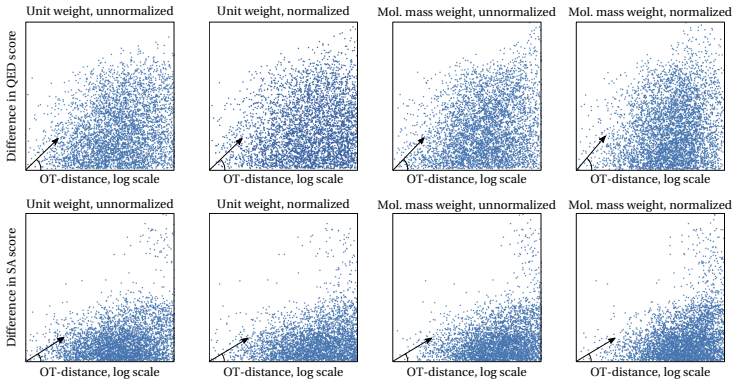
The central object is the synthesis graph, a directed graph whose nodes are molecules and whose edges are reactions, so that the parents of a molecule are the reagents and conditions that make it. ChemBO's optimizer performs a random walk on this graph, adding every predicted reaction product to the pool and, at the end, selecting the molecule with the largest acquisition value. The mechanism that makes this search quantitative is the Gaussian process kernel; the paper uses a topological fingerprint kernel and introduces a graph-based optimal-transport dissimilarity that solves a matching linear program to align atoms of two molecules, penalizing atom-type mismatches, bond-type mismatches, and unmatched atomic weight. Exponentiating this distance gives a kernel, and combining the fingerprint and optimal-transport distances as a sum kernel provides an adaptive compromise between the two. Together the reaction oracle and kernel let the Gaussian process see synthesizability through the search neighborhood and property similarity through the kernel.
What would settle it
Attempt in a laboratory to synthesize twenty ChemBO top-scoring molecules following the exact reaction paths the algorithm returned; if a substantial fraction do not produce the predicted product, say more than one in five, the paper's central synthesizability claim fails. A cheaper proxy is to measure the reaction predictor's top-1 accuracy on the same reaction classes the random walk encountered, since low accuracy would break the oracle premise that underlies Algorithm 2.
Extended reading notes
Core claim
At the paper's core is the claim that the search space for molecular optimization should be the synthesis graph, not a latent vector space or a string grammar. ChemBO couples a Gaussian process model of the property function with a random-walk acquisition optimizer over this graph: starting from a reagent pool, it repeatedly asks a learned reaction predictor what product would form under randomly selected conditions, adds that product to the pool, and after enough successful steps returns the candidate with the highest acquisition score. The paper reports that this procedure finds molecules with QED 0.941 and penalized logP 18.39 on standard benchmarks, matching or exceeding published values from reinforcement-learning and generative approaches that spend 5,000 to 275,000 objective evaluations, while every ChemBO molecule comes with a proposed reaction path. It also proposes a new optimal-transport dissimilarity between molecular graphs, matching atoms of the same element while penalizing bond-type mismatches and unmatched mass, and shows that a kernel formed from this distance can beat a standard fingerprint kernel on QED while remaining competitive on penalized logP.
Load-bearing premise
The learned reaction predictor must be accurate enough that molecules it labels synthesizable really can be made as described; the paper notes expressly that no perfect such oracle exists.
Editorial extensions
If this is right
- Every ChemBO recommendation includes a reaction recipe, so a chemist can go from a property measurement to the next candidate without manual retrosynthesis.
- With roughly 100 objective evaluations needed, ChemBO makes closed-loop optimization feasible when each evaluation is an expensive laboratory assay rather than a computer call.
- The method's synthesizability guarantee is tied to the reaction oracle's accuracy, so improvements in reaction prediction directly translate into more reliable recommendations.
- Because the Gaussian process and acquisition function are objective-agnostic, the same synthesis-graph walk can target other molecular properties whenever a suitable objective is available.
Reading between the lines
- If reaction predictors improve, ChemBO-style recipes could serve as planning priors for automated synthesis machines; the paper already frames this as a step toward automation, and the direct consequence is that a hardware platform could execute the proposed paths.
- The paper's budget comparison counts property evaluations but not the compute or data used to train the reaction predictor; a fuller accounting might change the efficiency picture, but it would not change the claim that lab evaluations can be made dramatically fewer.
- The optimal-transport kernel is blind to stereochemistry, as the paper's own D/L-glucose example shows; combining it with three-dimensional descriptors would be a natural next test, since chirality often decides drug behavior.
- Counting synthesis steps rather than property evaluations as the budget, which the conclusion flags as future work, would make ChemBO's cost model match reality when reaction steps are the bottleneck.
Signed reviews
Editorial analysis
A structured set of objections, weighed in public.
Referee Report
Summary. ChemBO is a Bayesian optimization (BO) framework for small organic molecules that couples a Gaussian process surrogate with a random-walk explorer over a synthesis graph. Given a starting reagent pool, the explorer repeatedly samples reagents and process conditions, queries a reaction-prediction oracle (Rexgen) to obtain candidate products, and returns the candidate with the highest acquisition value, so each recommended molecule comes with a synthesis recipe. The paper proposes an optimal-transport-based dissimilarity between molecular graphs (atom-type and bond-type matching costs with a non-matching penalty), converts it into a kernel via an exponential sum over four design variants, and compares it against a topological fingerprint Tanimoto kernel and a sum of both. Experiments on QED and penalized logP report that all three ChemBO instantiations outperform a random-walk explorer baseline over 5 runs, that the OT kernel and fingerprint kernel trade off across objectives, and that the best ChemBO values (QED 0.941, penalized logP 18.39 in Table 3) are competitive with generative and RL baselines at a fraction of the objective evaluations. The paper emphasizes that recommendations are synthesizable and provides recipe visualizations, while it also acknowledges the limitations of the reaction predictor in Sections 3.3 and Appendix C.
Significance. The core design idea, performing BO over a synthesis graph so that every acquisition is a reaction-predicted product with an associated recipe, is timely and well motivated, and the optimal-transport molecular kernel is a useful, reusable contribution that the authors evaluate with unusual honesty (including its positive-definiteness caveat and its blindness to stereoisomers). The main internal comparison (model-based search versus a random-walk explorer) supports the value of the GP guide, and the manuscript is transparent: Section 3.3 concedes that no perfect synthesis oracle exists and that ChemBO may recommend unsynthesizable molecules, and Appendix C displays implausible synthesis paths. The paper ships open-source code, and its empirical claims are in principle falsifiable; the requested per-trial data would settle them. However, the headline competitive-with-state-of-the-art claim currently rests on a single reported best penalized logP value whose audit trail is missing, so the significance of the comparison against prior work cannot yet be assessed from the paper alone.
major comments (3)
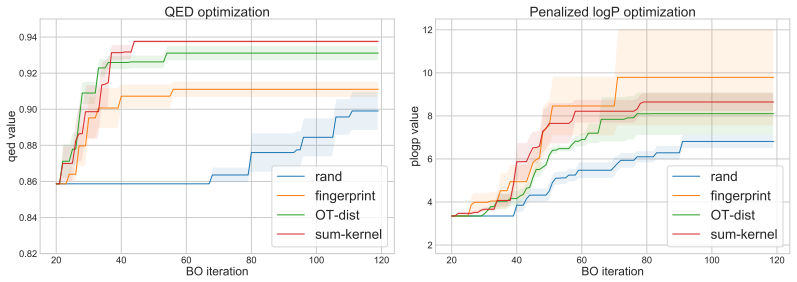
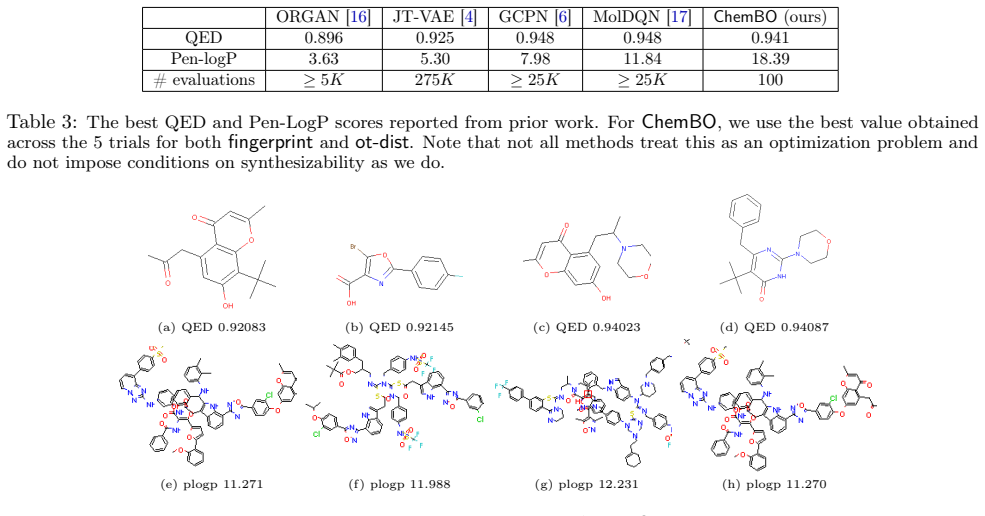
- [Section 4.1 / Table 3 / Section 4 setup] The claim that ChemBO's final values are competitive with state-of-the-art methods hinges on the penalized logP entry 18.39 in Table 3, but this number is not auditable from the manuscript. Table 1 reports means of 9.79 plus or minus 2.26 (fingerprint) and 8.10 plus or minus 1.01 (ot-dist) over 5 runs, and the largest molecule displayed in Figure 4 has penalized logP 12.231, yet no per-trial values, the identity of the 18.39 molecule, or its synthesis path are reported. The value is not mathematically impossible given the large dispersion implied by the standard errors, but nothing in the paper documents it. The evaluation budget is also stated inconsistently: the setup says '80 iterations, totaling 100 evaluations of f'; Section 4.1 says 'we ran 100 BO iterations ... totalling 1000 function evaluations'; Table 1's caption says 'over 80 eval-s'; Table 3 lists '# evaluations 100'; and Figure 3's x-axis extends to 120 iterations. Please report per-run best values and traces for all 10 runs, identify the molecule behind 18.39 and which kernel produced it, and replace the contradictory budget statements with a single consistent protocol. Without this, the state-of-the-art comparison in Table 3 and the corresponding abstract claim cannot be verified.
- [Section 3.3 / Abstract / Appendix C] The abstract states that ChemBO 'produces synthesizable candidates', and the introduction says the approach 'ensures that each recommended molecule is chemically valid', but the manuscript's own caveats undercut these claims as stated. Section 3.3 concedes that 'no perfect such oracle exists' and that 'ChemBO could end up recommending unsynthesizable molecules and/or incorrect synthesis recipes', while Appendix C documents implausible outputs, including a path in which two complex molecules react to methane and molecules with large rings that are described as hard to synthesize, with the blame attributed to Rexgen. Since the synthesizability guarantee is a central selling point and the reaction predictor is never validated by wet-lab synthesis or by a quantitative synthesizability filter applied to the final recommendations, the abstract and contribution claims should carry the same qualifications as the body text, or be supported by a numerical synthesizability check on the recommended molecules.
- [Section 4 / Table 1 / Figure 3] The sentence 'ChemBO methods ... all outperform the naive random walk strategy on both tasks' is asserted without a significance test, and the reported standard errors make the claim only partially supported. For penalized logP, ot-dist (8.10 plus or minus 1.01) exceeds rand (6.81 plus or minus 0.34) by a margin smaller than the pooled standard error, and fingerprint's 9.79 plus or minus 2.26 implies a run-to-run standard deviation of about 5, so its superiority over rand is not significant at conventional levels; the QED comparisons are more convincing, especially for sum-kernel. Please add paired significance tests or confidence intervals and report the per-trial values, so the reader can judge whether the dispersion in the fingerprint runs is driven by an outlier.
minor comments (6)
- [Section 4.1] The virtual screening results are said to be 'shown in Figure 4', but Figure 4 displays optimal molecules; the screening numbers are actually in Table 4.
- [Section 3.2 / Section 4] The 'sum-kernel' is defined as k(x,y) = alpha1 times fingerprint(x,y) plus alpha2 times ot-dist(x,y), which adds a similarity to a dissimilarity; presumably 'ot-dist' denotes the exponential-kernel form, but as written the expression is not a kernel, and the notation should be clarified.
- [Appendix A.1] The equivalence of program (1) to the optimal transport program is delegated to Theorem 2 of reference [40]; a short self-contained derivation would make the appendix self-sufficient and easier to verify.
- [Section 4 setup / Table 1 / Table 3] The counting of the budget should be unified: 20 initial evaluations plus 80 BO iterations equals 100 total evaluations, and this single convention should be used in the setup text, Table 1's caption, Section 4.1, and Table 3's '# evaluations' row.
- [Figure 3] The x-axis of both panels extends to 120 iterations although the described protocol runs 80 iterations after initialization; the axis range and the protocol should be harmonized.
- [Section 4 methods] For reproducibility, the paper should specify the Rexgen version or checkpoint, the exact 20 starting ChEMBL molecules, and the random seeds; the current description does not allow the experiments to be rerun from the paper alone.
Circularity Check
No significant circularity: ChemBO's empirical claims are not forced by fitted constants or by self-citations.
full rationale
The paper's central derivation is a GP-BO loop over a synthesis graph, and its claimed results are empirical benchmark outcomes against baseline methods. The GP hyperparameters, including the beta_i and alpha_i parameters of the kernels, are fitted by maximizing marginal likelihood on the objective evaluations observed during optimization; that is standard model fitting, not a fitted parameter being renamed as a prediction. The optimal-transport reformulation in Appendix A.1 cites the authors' prior work [40], and the acquisition ensemble in Appendix B cites [42]; these are published results with stated assumptions, and neither citation encodes the benchmark outcomes, so the central claims do not reduce to them. The 'synthesizable candidates' claim is explicitly conditional on the Synthesize oracle: Section 3.3 concedes that 'no perfect such oracle exists' and that ChemBO 'could end up recommending unsynthesizable molecules and/or incorrect synthesis recipes.' This is a stated limitation of an external reaction-prediction model, not a circular definition. The comparison with existing work uses the same benchmark functions and reports independently obtained best values; no equation in the paper defines a predicted quantity as the value of a fitted constant or as an output of the authors' own prior work. Accordingly, no step in the claimed derivation chain is circular. The unexplained Pen-logP value of 18.39 in Table 3 and the inconsistent evaluation budgets are correctness and verifiability concerns, not circularity.
Assumptions & free parameters
free parameters (4)
- beta_i (OT kernel weights) =
not reported
- alpha_i (sum-kernel coefficients) =
not reported
- GP hyperparameters =
not reported
- Explorer length n =
20 per BO iteration
assumptions (5)
- domain assumption Synthesize oracle (Rexgen) approximates true chemical reactivity
- domain assumption QED and penalized logP computed via RDKit are meaningful optimization targets
- domain assumption Graph representation captures molecular properties sufficiently
- standard math Optimal transport linear program reformulation is valid
- standard math Projection of the kernel matrix to the positive definite cone yields a usable GP covariance
Cite this review
Pith. "Pith review of ChemBO: Bayesian Optimization of Small Organic Molecules with Synthesizable Recommendations." pith.science (2026). https://pith.science/paper/3LSE5ZNW
@misc{pith2026190801425,
  author       = {Pith},
  title        = {Pith review of: ChemBO: Bayesian Optimization of Small Organic Molecules with Synthesizable Recommendations},
  year         = {2026},
  howpublished = {\url{https://pith.science/paper/3LSE5ZNW}},
  note         = {Machine review of arXiv:1908.01425}
}
read the original abstract
In applications such as molecule design or drug discovery, it is desirable to have an algorithm which recommends new candidate molecules based on the results of past tests. These molecules first need to be synthesized and then tested for objective properties. We describe ChemBO, a Bayesian optimization framework for generating and optimizing organic molecules for desired molecular properties. While most existing data-driven methods for this problem do not account for sample efficiency or fail to enforce realistic constraints on synthesizability, our approach explores the synthesis graph in a sample-efficient way and produces synthesizable candidates. We implement ChemBO as a Gaussian process model and explore existing molecular kernels for it. Moreover, we propose a novel optimal-transport based distance and kernel that accounts for graphical information explicitly. In our experiments, we demonstrate the efficacy of the proposed approach on several molecular optimization problems.
Figures

Figures from the paper (5 more)



Forward citations
Cited by 1 Pith paper
-
Bi-semantic Chemical Embedder for Joint Representation Learning of SMILES and Natural Language
A ModernBERT-based encoder trained with masked language modeling on SMILES-annotated scientific documents plus a contrastive stage yields embeddings that are competitive on both molecular property prediction and scien...
Reference graph
Works this paper leans on
-
[1]
Elton, Zois Boukouvalas, Mark D
Daniel C. Elton, Zois Boukouvalas, Mark D. Fuge, and Peter W. Chung. Deep learning for molecular generation and optimization - a review of the state of the art, 2019
work page 2019
-
[2]
Pavel G Polishchuk, Timur I Madzhidov, and Alexan- dre Varnek. Estimation of the size of drug-like chemical space based on gdb-17 data.Journal of computer-aided molecular design, 27(8):675–679, 2013
work page 2013
-
[3]
Rafael Gómez-Bombarelli, Jennifer N. Wei, David Duvenaud, José Miguel Hernández-Lobato, Benjamín Sánchez-Lengeling, Dennis Sheberla, Jorge Aguilera- Iparraguirre, Timothy D. Hirzel, Ryan P. Adams, and Alán Aspuru-Guzik. Automatic chemical de- sign using a data-driven continuous representation of molecules. ACS Central Science , 2018. doi: 10.1021/acscents...
-
[4]
Junction tree variational autoencoder for molecular graph generation, 2018
Wengong Jin, Regina Barzilay, and Tommi Jaakkola. Junction tree variational autoencoder for molecular graph generation, 2018
work page 2018
-
[5]
Deep reinforcement learning for de-novo drug de- sign
Mariya Popova, Olexandr Isayev, and Alexander Trop- sha. Deep reinforcement learning for de-novo drug de- sign. Science Advances, 2018, vol. 4, no. 7, eaap7885 ,
work page 2018
-
[6]
Graph convolutional policy network for goal-directed molecular graph generation, 2018
Jiaxuan You, Bowen Liu, Rex Ying, Vijay Pande, and Jure Leskovec. Graph convolutional policy network for goal-directed molecular graph generation, 2018
work page 2018
-
[7]
High-throughput machine-learning-driven synthesis of full-heusler compounds
Anton O Oliynyk, Erin Antono, Taylor D Sparks, Leila Ghadbeigi, Michael W Gaultois, Bryce Meredig, and Arthur Mar. High-throughput machine-learning-driven synthesis of full-heusler compounds. Chemistry of Materials, 28(20):7324–7331, 2016
work page 2016
-
[8]
Julia Ling, Maxwell Hutchinson, Erin Antono, Sean Paradiso, and Bryce Meredig. High-dimensional ma- terials and process optimization using data-driven ex- perimental design with well-calibrated uncertainty es- timates. Integrating Materials and Manufacturing In- novation, 6(3):207–217, 2017
work page 2017
Show all 49 references
-
[9]
Constrained bayesian optimization for au- tomatic chemical design, 2017
Ryan-Rhys Griffiths and José Miguel Hernández- Lobato. Constrained bayesian optimization for au- tomatic chemical design, 2017
2017
-
[10]
Graph kernels for chemical informatics
Liva Ralaivola, Sanjay J Swamidass, Hiroto Saigo, and Pierre Baldi. Graph kernels for chemical informatics. Neural networks, 18(8):1093–1110, 2005
2005
-
[11]
Graph kernels for chemical compounds using topological and three- dimensional local atom pair environments.Neurocom- puting, 74(1-3):219–229, 2010
Georg Hinselmann, Nikolas Fechner, Andreas Jahn, Matthias Eckert, and Andreas Zell. Graph kernels for chemical compounds using topological and three- dimensional local atom pair environments.Neurocom- puting, 74(1-3):219–229, 2010
2010
-
[12]
Eric Brochu, Vlad M Cora, and Nando De Freitas. A tutorial on bayesian optimization of expensive cost functions, with application to active user modeling and hierarchical reinforcement learning.arXiv preprint arXiv:1012.2599, 2010
2010 arXiv
-
[13]
Quantifying the chemical beauty of drugs.Nature chemistry, 4(2): 90, 2012
G Richard Bickerton, Gaia V Paolini, Jérémy Besnard, Sorel Muresan, and Andrew L Hopkins. Quantifying the chemical beauty of drugs.Nature chemistry, 4(2): 90, 2012
2012
-
[14]
Smiles: A line no- tation and computerized interpreter for chemical struc- tures
Weininger D Anderson E, Veith GD. Smiles: A line no- tation and computerized interpreter for chemical struc- tures. Technical Report EPA/600/M-87/021, EPA, Environmental Research Laboratory-Duluth, 1987
1987
-
[15]
Conditional molec- ular design with deep generative models
Seokho Kang and Kyunghyun Cho. Conditional molec- ular design with deep generative models. Journal of Chemical Information and Modeling 59(1): 43-52, 2019, 2018. doi: 10.1021/acs.jcim.8b00263
2019 doi
-
[16]
Objective-reinforced generative adver- sarial networks (organ) for sequence generation models, 2017
Gabriel Lima Guimaraes, Benjamin Sanchez-Lengeling, Carlos Outeiral, Pedro Luis Cunha Farias, and Alán Aspuru-Guzik. Objective-reinforced generative adver- sarial networks (organ) for sequence generation models, 2017
2017
-
[17]
Optimization of molecules via deep reinforcement learning
Zhenpeng Zhou, Steven Kearnes, Li Li, Richard N Zare, and Patrick Riley. Optimization of molecules via deep reinforcement learning. arXiv preprint arXiv:1810.08678, 2018
2018 arXiv
-
[18]
Learning multimodal graph-to-graph translation for molecular optimization, 2018
Wengong Jin, Kevin Yang, Regina Barzilay, and Tommi Jaakkola. Learning multimodal graph-to-graph translation for molecular optimization, 2018
2018
-
[19]
Predicting molec- ular properties with covariant compositional networks
Truong Son Hy, Shubhendu Trivedi, Horace Pan, Bran- don M Anderson, and Risi Kondor. Predicting molec- ular properties with covariant compositional networks. The Journal of chemical physics , 148(24):241745, 2018
2018
-
[20]
Contextual decision processes with low bellman rank are pac- learnable
Nan Jiang, Akshay Krishnamurthy, Alekh Agarwal, John Langford, and Robert E Schapire. Contextual decision processes with low bellman rank are pac- learnable. In Proceedings of the 34th International Conference on Machine Learning-Volume 70 , pages 1704–1713. JMLR. org, 2017
2017
-
[21]
Kusner, Brooks Paige, and José Miguel Hernández-Lobato
Matt J. Kusner, Brooks Paige, and José Miguel Hernández-Lobato. Grammar variational autoencoder, 2017
2017
-
[22]
Estimation of synthetic accessibility score of drug-like molecules based on molecular complexity and fragment contribu- tions
Peter Ertl and Ansgar Schuffenhauer. Estimation of synthetic accessibility score of drug-like molecules based on molecular complexity and fragment contribu- tions. Journal of cheminformatics , 1(1):8, 2009
2009
-
[23]
Route designer: a retrosynthetic analysis tool utilizing auto- mated retrosynthetic rule generation.Journal of chem- ical information and modeling , 49(3):593–602, 2009
James Law, Zsolt Zsoldos, Aniko Simon, Darryl Reid, Yang Liu, Sing Yoong Khew, A Peter Johnson, Sarah Major, Robert A Wade, and Howard Y Ando. Route designer: a retrosynthetic analysis tool utilizing auto- mated retrosynthetic rule generation.Journal of chem- ical information ...
2009
-
[24]
Molecu- lar transformer for chemical reaction prediction and un- certainty estimation
Philippe Schwaller, Teodoro Laino, Théophile Gaudin, Peter Bolgar, Costas Bekas, and Alpha A Lee. Molecu- lar transformer for chemical reaction prediction and un- certainty estimation. arXiv preprint arXiv:1811.02633, 2018
2018 arXiv
-
[25]
Neural networks for the prediction of organic chemistry reactions
Jennifer N Wei, David Duvenaud, and Alán Aspuru- Guzik. Neural networks for the prediction of organic chemistry reactions. ACS central science, 2(10):725– 732, 2016
2016
-
[26]
Coley, Wengong Jin, Luke Rogers, Tim- othy F
Connor W. Coley, Wengong Jin, Luke Rogers, Tim- othy F. Jamison, Tommi S. Jaakkola, William H. 9 Green, Regina Barzilay, and Klavs F. Jensen. A graph- convolutional neural network model for the prediction of chemical reactivity.Chem. Sci., 2019
2019
-
[27]
No electron left behind: a rule-based expert system to predict chem- ical reactions and reaction mechanisms
Jonathan H Chen and Pierre Baldi. No electron left behind: a rule-based expert system to predict chem- ical reactions and reaction mechanisms. Journal of chemical information and modeling , 49(9):2034–2043, 2009
2009
-
[28]
Computational prediction of chemical reactions: current status and outlook
Ola Engkvist, Per-Ola Norrby, Nidhal Selmi, Yu-hong Lam, Zhengwei Peng, Edward C Sherer, Willi Amberg, Thomas Erhard, and Lynette A Smyth. Computational prediction of chemical reactions: current status and outlook. Drug discovery today, 23(6):1203–1218, 2018
2018
-
[29]
Coley, Regina Barzilay, and Tommi Jaakkola
Wengong Jin, Connor W. Coley, Regina Barzilay, and Tommi Jaakkola. Predicting organic reaction outcomes with weisfeiler-lehman network, 2017
2017
-
[30]
found in transla- tion
Philippe Schwaller, Theophile Gaudin, David Lanyi, Costas Bekas, and Teodoro Laino. “found in transla- tion”: predicting outcomes of complex organic chem- istry reactions using neural sequence-to-sequence mod- els. Chemical science, 9(28):6091–6098, 2018
2018
-
[31]
Deriving neural architectures from sequence and graph kernels, 2017
Tao Lei, Wengong Jin, Regina Barzilay, and Tommi Jaakkola. Deriving neural architectures from sequence and graph kernels, 2017
2017
-
[32]
A model to search for synthesizable molecules
John Bradshaw, Brooks Paige, Matt J Kusner, Mar- win HS Segler, and José Miguel Hernández-Lobato. A model to search for synthesizable molecules. arXiv preprint arXiv:1906.05221, 2019
1906 arXiv
-
[33]
Graph distances using graph union.Pattern Recognition Letters, 22(6-7):701–704, 2001
Walter D Wallis, Peter Shoubridge, M Kraetz, and D Ray. Graph distances using graph union.Pattern Recognition Letters, 22(6-7):701–704, 2001
2001
-
[34]
Diffusion kernels on graphs and other discrete input spaces
Risi Imre Kondor and John Lafferty. Diffusion kernels on graphs and other discrete input spaces. InICML, volume 2, pages 315–322, 2002
2002
-
[35]
Scalable, Active and Flexible Learning on Distributions
Dougal J Sutherland. Scalable, Active and Flexible Learning on Distributions . PhD thesis, PhD thesis, Carnegie Mellon University Pittsburgh, PA, 2015
2015
-
[36]
Chemi-net: a graph convolutional network for accurate drug property prediction.arXiv preprint arXiv:1803.06236, 2018
Ke Liu, Xiangyan Sun, Lei Jia, Jun Ma, Haoming Xing, Junqiu Wu, Hua Gao, Yax Sun, Florian Boulnois, and Jie Fan. Chemi-net: a graph convolutional network for accurate drug property prediction.arXiv preprint arXiv:1803.06236, 2018
2018 arXiv
-
[37]
Graph convolutional neural networks for predicting drug-target interactions
Wen Torng and Russ B Altman. Graph convolutional neural networks for predicting drug-target interactions. bioRxiv, page 473074, 2018
2018
-
[38]
Molecular graph con- volutions: moving beyond fingerprints
Steven Kearnes, Kevin McCloskey, Marc Berndl, Vi- jay Pande, and Patrick Riley. Molecular graph con- volutions: moving beyond fingerprints. Journal of computer-aided molecular design, 30(8):595–608, 2016
2016
-
[39]
PhD thesis, 2014
Hong Yang Sun.Learning over molecules: Representa- tions and kernels . PhD thesis, 2014
2014
-
[40]
Neural Architecture Search with Bayesian Optimisation and Optimal Transport
Kirthevasan Kandasamy, Willie Neiswanger, Jeff Schneider, Barnabas Poczos, and Eric Xing. Neural Architecture Search with Bayesian Optimisation and Optimal Transport. InAdvances in Neural Information Processing Systems (NIPS), 2018
2018
-
[41]
Practical Bayesian Optimization of Machine Learn- ing Algorithms
Jasper Snoek, Hugo Larochelle, and Ryan P Adams. Practical Bayesian Optimization of Machine Learn- ing Algorithms. In Advances in Neural Information Processing Systems, 2012
2012
-
[42]
Collins, Jeff Schneider, Barnabas Poczos, and Eric P
Kirthevasan Kandasamy, Karun Raju Vysyaraju, Willie Neiswanger, Biswajit Paria, Christopher R. Collins, Jeff Schneider, Barnabas Poczos, and Eric P. Xing. Tuning hyperparameters without grad students: Scalable and robust bayesian optimisation with drag- onfly, 2019
2019
-
[43]
Cédric Villani.Optimal transport: old and new , volume
-
[44]
Relationships between octanol-water partition coefficient and aque- ous solubility
Michele M Miller, Stanley P Wasik, Guo Lan Huang, Wan Ying Shiu, and Donald Mackay. Relationships between octanol-water partition coefficient and aque- ous solubility. Environmental science & technology , 19 (6):522–529, 1985
1985
-
[45]
Rdkit: Open-source cheminfor- matics, 2006
Greg Landrum et al. Rdkit: Open-source cheminfor- matics, 2006
2006
-
[46]
Zinc- a free database of commercially available compounds for vir- tual screening
John J Irwin and Brian K Shoichet. Zinc- a free database of commercially available compounds for vir- tual screening. Journal of chemical information and modeling, 45(1):177–182, 2005
2005
-
[47]
Visu- alizing data using t-sne.Journal of machine learning research, 9(Nov):2579–2605, 2008
Laurens van der Maaten and Geoffrey Hinton. Visu- alizing data using t-sne.Journal of machine learning research, 9(Nov):2579–2605, 2008. 10 Appendix A Some Additional Details on the Dissimilarity Measure A.1 Solving (1) In this section, we describe how the linear program for co...
2008
-
[338]
Springer Science & Business Media, 2008
2008
-
[2017]
doi: 10.1126/sciadv.aap7885
Reviewed August 14, 2026 · model on record in the stance chip above.
Discussion (0). Continue with ORCID to comment.