REVIEW 3 major objections 6 minor 74 references
The paper argues that molecular design should optimise expectations over the Boltzmann ensemble of conformations, and that the DECAF loop — two coupled flows with an annealing acceptance rule — makes those ensemble statistics the design tar
Reviewed by Pith at T0; open to challenge. T0 means a machine referee read the full paper against a public rubric. the ladder, T0–T4 →
T0 review · deepseek-v4-flash
2026-08-01 12:29 UTC pith:3M7NMLW2
load-bearing objection DECAF is a genuinely new and promising way to make Boltzmann ensembles the design target, but its headline higher-moment result currently rests on the surrogate it was trained to satisfy; the MD validation is too thin to close the loop. the 3 major comments →
Boltzmann-Expected Molecular Design with Decoupled Annealing Flows
The pith
A machine-rendered reading of the paper's core claim, the machinery that carries it, and where it could break.
Core claim
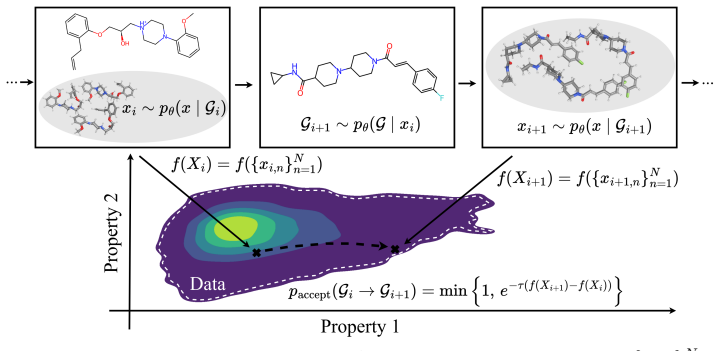
The central claim is that 3D molecular design should optimise expectations over the Boltzmann ensemble of conformations, and that the DECAF loop achieves this by factorising p(x,G) into pθ(x|G) — a Boltzmann emulator that samples conformations for a fixed graph — and pθ(G|x), a graph proposer that generates candidate graphs from coordinates. Sampling an ensemble X from the emulator, proposing G′ from each x∈X, and accepting G′ with probability min{1, exp(−τ(f(X′)−f(X)))} makes the ensemble statistic f(X) the design target, and changing objective requires no retraining, only a new scoring function. The experiments claim that on drug-like molecules, ensemble averaging recovers optimisation qua
What carries the argument
The load-bearing machinery is the pair of decoupled conditional flows. pθ(x|G) is a continuous normalising flow trained by conditional flow matching; it acts as a Boltzmann emulator, meaning it need only match the true Boltzmann distribution in expectation over the observables of interest (F-thermodynamic consistency), not pointwise. pθ(G|x) is a discrete flow trained by discrete flow matching; it proposes new graphs conditioned on a slightly perturbed set of coordinates. Alternating the two flows turns a random walk over graphs into a simulated-annealing optimisation: the score f is evaluated on an ensemble drawn from pθ(x|G), and acceptance uses the difference in ensemble scores, so the op
Load-bearing premise
The graph-conditioned flow p(x|G) is trained on static conformers that the authors state are not Boltzmann-distributed, and the paper's Limitations section concedes that its fidelity to the true Boltzmann distribution on the out-of-distribution graphs proposed during optimisation is not guaranteed in general; if this surrogate is wrong for a proposed graph, DECAF may shift surrogate statistics without shifting true Boltzmann ensemble statistics.
What would settle it
Take DECAF-optimised molecules that avoid amide bonds and stereocentres, simulate each with long, converged all-atom MD (or replica-exchange) initiated from multiple conformers, and compare MD-computed mean, variance, and skewness of Rg and SASA against pθ(x|G) estimates. If, for graphs whose conformations stay within the emulator's training-like distribution, MD systematically disagrees with the emulator's ensemble statistics — or if a single-conformer baseline matches MD targets at least as well — the central claim that ensemble-aware optimisation acts on Boltzmann expectations is falsified.
If this is right
- Ensemble-aware optimisation shifts mean Rg and SASA toward user targets on drug-like molecules, and moderately sized ensembles (10–50 conformers) recover performance where single-conformer optimisation fails on molecules above roughly 50 atoms.
- Because the objective is a plug-in scoring function on ensemble statistics, DECAF can switch between minimisation, maximisation, target-value matching, and multi-objective trade-offs with no retraining of either flow.
- Properties coupled through molecular geometry, such as Rg and SASA, can be traded against each other in all four optimisation directions; the attainable shifts reflect the physical correlation, with joint minimisation easiest and contrasting directions harder.
- Higher moments of conformational distributions are optimisable: maximising variance and skewness of Rg produces molecules whose MD-simulated distributions are broader and biased toward compact states, a capability not present in single-conformer generative models.
- Graphs optimised by the ensemble-aware loop keep their ensemble-level property predictions closer to all-atom MD estimates than graphs from single-conformer baselines, especially for in-distribution target values.
Where Pith is reading between the lines
- A direct testable extension would swap the static-conformer-trained emulator for one trained on long MD or replica-exchange trajectories; the modular loop predicts even closer MD agreement, especially for higher moments and amide-containing molecules.
- The noisy-MC acceptance rule places DECAF in the pseudo-marginal family: as ensemble size grows the acceptance bias shrinks, so pseudo-marginal MCMC convergence theory could characterise when the walk approximately samples a target distribution over graphs.
- The same Boltzmann-expected formulation should transfer to observables beyond Rg and SASA — for example solvation or binding free energies — but only once cheap, F-thermodynamically consistent emulators for those observables exist; DECAF's contribution is the optimisation loop, not the surrogate.
- Because the emulator is reflection-invariant, stereochemistry is not controlled; a stereochemistry-aware emulator or an added penalty term would be needed before using DECAF in chiral environments.
Editorial analysis
A structured set of objections, weighed in public.
Referee Report
Summary. The paper frames 3D molecular design as the optimisation of molecular graphs for expectations over the Boltzmann ensemble of 3D conformers. It introduces DECAF, which factorises the joint distribution over graphs and coordinates into a graph-conditioned Boltzmann emulator pθ(x|G) and a coordinate-conditioned graph proposer pθ(G|x). These are alternated in a simulated-annealing loop whose acceptance score is computed on ensembles sampled from pθ(x|G), allowing changes of objective without retraining. On GEOM-Drugs, the method is evaluated for shifting mean Rg/SASA, multi-objective trade-offs, target-value optimisation compared with PropMolFlow using MD validation, and higher-moment design (variance and skewness of Rg) with partial MD verification.
Significance. If the results hold, DECAF is a genuinely useful contribution: it explicitly targets ensemble properties rather than single conformers, the decoupled-flow formulation is modular and objective-agnostic, and the multi-objective and higher-moment experiments go beyond existing 3D generative models. The manuscript is unusually candid about limitations (non-Boltzmann training data, heuristic annealing, surrogate fidelity on out-of-distribution graphs, reflection invariance). It also provides independent grounding: Appendix C compares emulator moments with all-atom MD on a 500-molecule test set, and Table 1 reports MD-based MAE for target-value experiments. Those strengths are real. However, the central evaluation is largely carried by the same surrogate used inside the optimisation, and the distinctive higher-moment claim lacks a quantitative success rate from MD.
major comments (3)
- [§4.1–4.2, Figs. 2–3; Eq. (4)] The main single- and multi-objective results are evaluated with pθ(x|G), the same surrogate that scores the optimisation in Algorithm 1. Δlocal and Δglobal in Figs. 2–3 are therefore model-internal statistics. The paper acknowledges this in the Limitations section ('optimisation quality is bounded by the accuracy of this surrogate'), but the central claim that DECAF 'produces molecules whose mean Rg/SASA shift toward targets' needs independent confirmation on out-of-distribution graphs. Independent MD validation is provided only for the target-value experiment (Table 1) and for emulator mean agreement on the test set (Appendix C). Please add MD validation for a representative sample of the size-stratified and multi-objective optimisations, or explicitly restrict the claims to surrogate-verified shifts and state which parts remain emulator-internal.
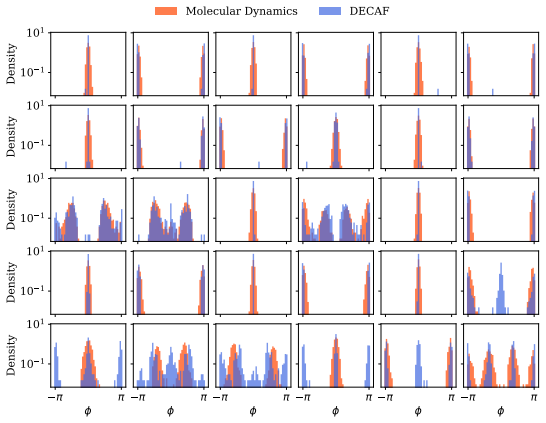
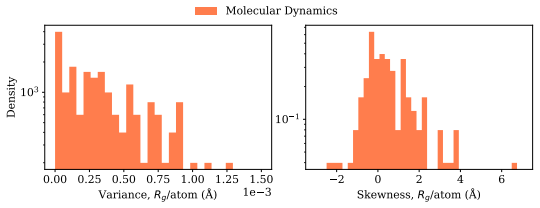
- [§4.4, Appendix E.1; Appendix C.1] The higher-moment design is the paper's stated unique contribution, but its MD validation is incomplete. Appendix C, Fig. 9 shows that pθ(x|G) overestimates the variance of Rg relative to 15 ns MD and that skewness histograms disagree, with the disagreement attributed to amide bonds. Appendix E.1 states that all 100 optimised graphs were simulated, yet Fig. 21 displays only 20 'successful examples', no explicit success criterion or pass/fail count is given, and Fig. 22 includes graphs 'not successfully validated due to the discussed limitation'. Without a success rate, the reader cannot tell whether DECAF shapes true Boltzmann variance and skewness or only the emulator's over-dispersed surrogate distribution on favourable cases. Please report the pass/fail count, the criterion used, and separate results for amide-containing and amide-free optimised graphs.
- [§4.3, Table 1; Appendix D.1] The PropMolFlow comparison is confounded. In all baseline experiments, DECAF is forced to reject graphs containing amide bonds ('we add a graph constraint to DECAF in all our baseline experiments'), while PropMolFlow is not similarly constrained. Since Appendix C identifies amide-containing molecules as the main source of emulator/MD discrepancy, this constraint likely inflates DECAF's apparent advantage in Table 1. The paper should apply the same constraint to both models, or report the comparison without the constraint and discuss the effect on the conclusion that DECAF 'consistently obtain[s] lower MAE' than PropMolFlow.
minor comments (6)
- [§2, Eq. (4)] The term 'F-thermodynamic consistency' is introduced via Eq. (4) but the observable class F is never defined. A one-sentence definition would help the reader understand the scope of the claim.
- [Algorithm 1 and Fig. 1] Algorithm 1 samples G_{i+1} before X_i, while the Fig. 1 caption describes sampling X_i first. Align the notation to avoid confusion about the sequencing.
- [§4.1] The N=1 baseline is described as 'single-configuration estimates', which conflates the ensemble-size ablation with the stochastic noise of a single-sample score. Clarify that N=1 is a one-sample Monte Carlo estimate, not a 'single conformer' property in the usual generative-model sense.
- [Appendix C.1] The text argues that the amide-bond discrepancy is due to slow MD mixing and that the emulator may be correct, but it also uses this argument to justify rejecting amide-containing DECAF graphs in the baseline comparison. Please state in the main text that MD validation of amide-containing optimised graphs is inconclusive by the authors' own analysis.
- [§4.4] The hypothesis that 'DECAF does not necessarily require exact moment estimates; rather, estimating the direction of improvement is sufficient' is testable by varying ensemble size N. Adding such an ablation would strengthen the higher-moment section.
- [General] No code or data availability statement is included despite detailed hyperparameters in Appendix F. A reproducibility statement would be valuable.
Circularity Check
Headline mean-shift and all-100 higher-moment figures are surrogate-internal; MD validation exists for target-value means, but the unique higher-moment verification is incomplete.
specific steps
-
fitted input called prediction
[Section 4, Algorithm 1; Fig. 3 caption; Fig. 4D; Section 6 Limitations]
"We evaluate each initial and optimised graph based on how well the Boltzmann emulator pθ(x|G) reproduces the target observables fk. ... Observables are computed from pθ(x|G) coordinates ... Both moments are computed on samples from pθ(x|G). ... Still, in our reported results we verify the distributional properties in the observable space aligns with those of the surrogate."
The quantity being optimised and the quantity reported as success are the same fitted surrogate. Algorithm 1 accepts transitions using f(Xi) with Xi ~ pθ(x|G), and Figs. 2-4 compute the headline shifts (Δlocal, Δglobal, variance, skewness) from pθ(x|G) samples. A run that improves the objective is therefore almost tautologically seen to shift those surrogate statistics; this is an evaluation of the optimiser on its own scoring distribution, not independent evidence about true Boltzmann expectations. The paper's own limitation passage concedes that the reported verification is 'against those of the surrogate', and that fidelity to µG on out-of-distribution graphs 'is not guaranteed'. Independent MD validation is provided for the target-value mean experiments (Table 1) and for test-set means
-
other
[Section 4.4 and Appendix E.1]
"If the MD samples show agreement with the predicted distribution of pθ(x|G), we consider validation of the optimisation trajectory G1 → Gimax successful. Fig. 21 shows 20 successful examples from this experiment ... including graphs that were not successfully validated due to the discussed limitation."
The abstract's unique higher-moment claim—'we verify the conformational distributions of these higher-moment designs with all-atom MD simulations'—rests on a validation criterion defined as agreement with the same surrogate pθ(x|G) that was used as the optimisation objective. No success count or explicit pass/fail criterion is reported; only 20 'successful examples' are shown, and the remaining graphs are attributed to the surrogate-vs-MD gap conceded in Section 6. This is not a formal equation-level reduction, but the paper itself flags that the verification is relative to the surrogate, making the higher-moment claim substantially supported by the model's own predictions rather than by independent Boltzmann statistics.
full rationale
The core DECAF derivation—factorising p(x,G) into two conditional flows and scoring graph proposals on ensembles from pθ(x|G)—is internally consistent and not derived from the conclusions. The circularity appears in the evidence chain rather than in the algorithm's definition. The headline demonstrations of mean-Rg and mean-SASA shifts (Figs. 2-3) and the all-100-graph higher-moment shifts (Fig. 4D) are computed from pθ(x|G), the very distribution used inside Algorithm 1's acceptance rule. Thus those plots show that the optimiser can move the surrogate's statistics—the expected consequence of the optimisation loop—rather than independently establishing that true Boltzmann ensemble statistics have moved. The paper candidly states this limitation: 'in our reported results we verify the distributional properties in the observable space aligns with those of the surrogate' and 'fidelity to µG on out-of-distribution graphs is not guaranteed in general.' There is real independent grounding: the emulator is benchmarked against all-atom MD on the GEOM-Drugs test distribution for means (Fig. 8), and the target-value experiments are MD-validated (Table 1). The higher-moment MD validation is incomplete—success is defined as agreement with the surrogate and no pass/fail rate is reported—so the distinctive higher-moment claim is only partially externally supported. No load-bearing self-citation chain was found; author-self citations (Semla architecture, Thermodynamic Interpolation) are background or architectural and do not force the paper's conclusions. Overall score 4: partial circularity in the central empirical demonstration, with sufficient independent MD checks to keep the framework from being merely a restatement of its inputs.
Axiom & Free-Parameter Ledger
free parameters (4)
- Observable normalisation bounds f_min, f_max per property =
not reported numerically; set by hand
- Objective weights r_k and energy regularisation weight =
e.g., 0.96/0.04 single-objective; 0.45/0.45/0.1 or 0.6/0.3/0.1 multi-objective; 0.64/0.32/0.04 higher-moment
- Annealing schedule =
tau_1 = 50, tau_imax in {500, 1000}, i_tau = 5
- Augmented Tchebycheff parameter rho =
0.1-0.5 depending on task
axioms (5)
- standard math Flow matching and discrete flow matching correctly transport a tractable prior to the data distribution (Eq. 1 and CFM/DFM background).
- domain assumption A flow trained on GEOM-Drugs conformers approximates the Boltzmann distribution for design-relevant observables, i.e. Eq. 4 holds approximately.
- domain assumption MD simulations with GAFF2 at 300 K provide an adequate reference for true Boltzmann ensemble statistics.
- ad hoc to paper The simulated-annealing loop without detailed balance or ergodic proposals is an acceptable graph-search heuristic.
- domain assumption Reflection invariance of the E(3)-equivariant emulator does not materially invalidate optimised property distributions.
read the original abstract
Most 3D properties relevant to molecular design, including free energies and shape descriptors, are $\textit{expectations}$ over the Boltzmann distribution over 3D configurations of a molecular graph. However, existing property-guided generative models tie each property to a single structure, ignoring the underlying ensemble. We recast 3D molecular design as $\textbf{Boltzmann-expected design}$ and realise it with $\textbf{DECAF}$ (Decoupled Annealing Flows), which factorise the joint distribution over graphs and coordinates into two conditional flow models: a graph-conditioned flow $p(x\mid\mathcal{G})$, acting as a $\textit{Boltzmann emulator}$, and a coordinate-conditioned flow $p(\mathcal{G}\mid x)$, proposing new graphs from 3D information. By alternating the two flows, DECAF optimises molecular graphs with a simulated-annealing acceptance rule whose scoring function is evaluated on ensembles drawn from $p(x\mid\mathcal{G})$, making ensemble statistics, not single-conformer properties, the design target. The resulting loop requires no retraining to change objectives. On GEOM-Drugs, we show that ensemble-aware optimisation produces graphs whose mean radius of gyration and solvent-accessible surface area consistently shift toward targets, while single-conformer optimisation degrades on larger drug-like molecules where Boltzmann distributions are broadest. DECAF extends to multi-objective trade-offs and, uniquely among 3D generative models, to $\textbf{higher-moment design}$: jointly optimising an ensemble property's variance and skewness to produce flexible molecules biased to a prescribed conformational regime: we verify the conformational distributions of these higher-moment designs with all-atom MD simulations.
Figures






Reference graph
Works this paper leans on
-
[1]
Denoising Diffusion Probabilistic Models
Jonathan Ho, Ajay Jain, and Pieter Abbeel. “Denoising Diffusion Probabilistic Models”. In: Advances in Neural Information Processing Systems. Ed. by H. Larochelle et al. V ol. 33. Curran Associates, Inc., 2020, pp. 6840–6851
2020
-
[2]
Score-Based Generative Modeling through Stochastic Differential Equa- tions
Yang Song et al. “Score-Based Generative Modeling through Stochastic Differential Equa- tions”. In:International Conference on Learning Representations. 2021
2021
-
[3]
Flow Straight and Fast: Learning to Generate and Transfer Data with Rectified Flow
Xingchao Liu, Chengyue Gong, and Qiang Liu. “Flow Straight and Fast: Learning to Generate and Transfer Data with Rectified Flow”. In:The Eleventh International Conference on Learning Representations. 2023
2023
-
[4]
Flow Matching for Generative Modeling
Yaron Lipman et al. “Flow Matching for Generative Modeling”. In:The Eleventh International Conference on Learning Representations. 2023
2023
-
[5]
Generative Flows on Discrete State-Spaces: Enabling Multimodal Flows with Applications to Protein Co-Design
Andrew Campbell et al. “Generative Flows on Discrete State-Spaces: Enabling Multimodal Flows with Applications to Protein Co-Design”. In:ICLR 2024 Workshop on Generative and Experimental Perspectives for Biomolecular Design. 2024
2024
-
[6]
Discrete Flow Matching
Itai Gat et al. “Discrete Flow Matching”. In:The Thirty-eighth Annual Conference on Neural Information Processing Systems. 2024
2024
-
[7]
SemlaFlow – Efficient 3D Molecular Generation with Latent Attention and Equivariant Flow Matching
Ross Irwin et al. “SemlaFlow – Efficient 3D Molecular Generation with Latent Attention and Equivariant Flow Matching”. In:The 28th International Conference on Artificial Intelligence and Statistics. 2025
2025
-
[8]
Ian Dunn and David Ryan Koes.Mixed Continuous and Categorical Flow Matching for 3D De Novo Molecule Generation. 2024. arXiv:2404.19739 [q-bio.BM]
Pith/arXiv arXiv 2024
-
[9]
Equivariant Diffusion for Molecule Generation in 3D
Emiel Hoogeboom et al. “Equivariant Diffusion for Molecule Generation in 3D”. In:Proceed- ings of the 39th International Conference on Machine Learning. Ed. by Kamalika Chaudhuri et al. V ol. 162. Proceedings of Machine Learning Research. PMLR, 17–23 Jul 2022, pp. 8867– 8887
2022
-
[10]
Equivariant Flow Matching with Hybrid Probability Transport for 3D Molecule Generation
Yuxuan Song et al. “Equivariant Flow Matching with Hybrid Probability Transport for 3D Molecule Generation”. In:Thirty-seventh Conference on Neural Information Processing Systems. 2023
2023
-
[11]
MiDi: Mixed Graph and 3D Denoising Diffusion for Molecule Genera- tion
Clement Vignac et al. “MiDi: Mixed Graph and 3D Denoising Diffusion for Molecule Genera- tion”. In:ICLR 2023 - Machine Learning for Drug Discovery workshop. 2023
2023
-
[12]
MUDiff: Unified Diffusion for Complete Molecule Generation
Chenqing Hua et al. “MUDiff: Unified Diffusion for Complete Molecule Generation”. In: Proceedings of the Second Learning on Graphs Conference. Ed. by Soledad Villar and Ben- jamin Chamberlain. V ol. 231. Proceedings of Machine Learning Research. PMLR, 27–30 Nov 2024, 33:1–33:26
2024
-
[13]
Geometry-complete diffusion for 3D molecule generation and optimization
Alex Morehead and Jianlin Cheng. “Geometry-complete diffusion for 3D molecule generation and optimization”. In:Communications Chemistry7.1 (2024), p. 150.ISSN: 2399-3669.DOI: 10.1038/s42004-024-01233-z
-
[14]
Geometric-Facilitated Denoising Diffusion Model for 3D Molecule Generation
Can Xu et al. “Geometric-Facilitated Denoising Diffusion Model for 3D Molecule Generation”. In:Proceedings of the AAAI Conference on Artificial Intelligence38.1 (Mar. 2024), pp. 338– 346.ISSN: 2159-5399.DOI:10.1609/aaai.v38i1.27787
-
[15]
Navigating the Design Space of Equivariant Diffusion-Based Generative Models for De Novo 3D Molecule Generation
Tuan Le et al. “Navigating the Design Space of Equivariant Diffusion-Based Generative Models for De Novo 3D Molecule Generation”. In:The Twelfth International Conference on Learning Representations. 2024
2024
-
[16]
TABASCO: A Fast, Simplified Model for Molecular Generation with Improved Physical Quality
Carlos V onessen et al. “TABASCO: A Fast, Simplified Model for Molecular Generation with Improved Physical Quality”. In:ICML 2025 Generative AI and Biology (GenBio) Workshop. 2025
2025
-
[17]
Koes.FlowMol3: Flow Matching for 3D De Novo Small-Molecule Generation
Ian Dunn and David R. Koes.FlowMol3: Flow Matching for 3D De Novo Small-Molecule Generation. 2025. arXiv:2508.12629 [cs.LG]
Pith/arXiv arXiv 2025
-
[18]
Riccardo Tedoldi et al.FlexiFlow: decomposable flow matching for generation of flexible molecular ensemble. 2025. arXiv:2511.17249 [cs.LG]
arXiv 2025
-
[19]
Simon Olsson. “Generative molecular dynamics”. In:Current Opinion in Structural Biology 96 (Feb. 2026), p. 103213.ISSN: 0959-440X.DOI:10.1016/j.sbi.2025.103213
arXiv 2026
-
[20]
Boltzmann generators: Sampling equilibrium states of many-body systems with deep learning
Frank Noé et al. “Boltzmann generators: Sampling equilibrium states of many-body systems with deep learning”. In:Science365.6457 (2019), eaaw1147.DOI: 10 . 1126 / science . aaw1147. eprint:https://www.science.org/doi/pdf/10.1126/science.aaw1147. 12
-
[21]
Transferable Boltzmann Generators
Leon Klein and Frank Noé. “Transferable Boltzmann Generators”. In:Advances in Neural Information Processing Systems. Ed. by A. Globerson et al. V ol. 37. Curran Associates, Inc., 2024, pp. 45281–45314
2024
-
[22]
Torsional Diffusion for Molecular Conformer Generation
Bowen Jing et al. “Torsional Diffusion for Molecular Conformer Generation”. In:Advances in Neural Information Processing Systems. Ed. by S. Koyejo et al. V ol. 35. Curran Associates, Inc., 2022, pp. 24240–24253
2022
-
[23]
Scalable emulation of protein equilibrium ensembles with generative deep learning
Sarah Lewis et al. “Scalable emulation of protein equilibrium ensembles with generative deep learning”. In:Science389.6761 (2025), eadv9817
2025
-
[24]
Juan Viguera Diez et al. “Generation of conformational ensembles of small molecules via surrogate model-assisted molecular dynamics”. In:Machine Learning: Science and Technology 5.2 (Apr. 2024), p. 025010.DOI:10.1088/2632-2153/ad3b64
-
[25]
Neural Ordinary Differential Equations
Ricky T. Q. Chen et al. “Neural Ordinary Differential Equations”. In:Advances in Neural Information Processing Systems. Ed. by S. Bengio et al. V ol. 31. Curran Associates, Inc., 2018
2018
-
[26]
Building Normalizing Flows with Stochas- tic Interpolants
Michael Samuel Albergo and Eric Vanden-Eijnden. “Building Normalizing Flows with Stochas- tic Interpolants”. In:The Eleventh International Conference on Learning Representations. 2023
2023
-
[27]
Development and testing of a general amber force field
Junmei Wang et al. “Development and testing of a general amber force field”. In:Journal of Computational Chemistry25.9 (2004), pp. 1157–1174.DOI: https://doi.org/10.1002/ jcc.20035 . eprint: https://onlinelibrary.wiley.com/doi/pdf/10.1002/jcc. 20035
doi:10.1002/jcc 2004
-
[28]
Neural Networks with Cheap Differential Opera- tors
Ricky T. Q. Chen and David K Duvenaud. “Neural Networks with Cheap Differential Opera- tors”. In:Advances in Neural Information Processing Systems. Ed. by H. Wallach et al. V ol. 32. Curran Associates, Inc., 2019
2019
-
[29]
HollowFlow: Efficient Sample Likelihood Eval- uation using Hollow Message Passing
Johann Flemming Gloy and Simon Olsson. “HollowFlow: Efficient Sample Likelihood Eval- uation using Hollow Message Passing”. In:The Thirty-ninth Annual Conference on Neural Information Processing Systems. 2026
2026
-
[30]
Ensuring thermodynamic consistency with invertible coarse-graining
Shriram Chennakesavalu, David J. Toomer, and Grant M. Rotskoff. “Ensuring thermodynamic consistency with invertible coarse-graining”. In:The Journal of Chemical Physics158.12 (Mar. 2023), p. 124126.ISSN: 0021-9606.DOI: 10 . 1063 / 5 . 0141888. eprint: https : // pubs.aip .org/ aip/jcp /article- pdf/doi /10. 1063/5 .0141888/ 19664228 / 124126_1_5.0141888.pdf
2023
-
[31]
W. G. Noid et al. “The multiscale coarse-graining method. I. A rigorous bridge between atomistic and coarse-grained models”. In:The Journal of Chemical Physics128.24 (2008). ISSN: 1089-7690.DOI:10.1063/1.2938860
-
[32]
Optimization by Simulated Annealing
S. Kirkpatrick, C. D. Gelatt, and M. P. Vecchi. “Optimization by Simulated Annealing”. In: Science220.4598 (1983), pp. 671–680.DOI: 10.1126/science.220.4598.671 . eprint: https://www.science.org/doi/pdf/10.1126/science.220.4598.671
-
[33]
An interactive weighted Tchebycheff procedure for multiple objective programming
Ralph E. Steuer and Eng-Ung Choo. “An interactive weighted Tchebycheff procedure for multiple objective programming”. In:Mathematical Programming26.3 (Oct. 1983), pp. 326– 344.DOI:10.1007/BF02591870
-
[34]
FLOWR – Flow Matching for Structure- and Interaction-Aware De Novo Ligand Generation
Julian Cremer et al. “FLOWR – Flow Matching for Structure- and Interaction-Aware De Novo Ligand Generation”. In:ICLR 2025 Workshop on Generative and Experimental Perspectives for Biomolecular Design. 2025
2025
-
[35]
GEOM, energy-annotated molecular confor- mations for property prediction and molecular generation
Simon Axelrod and Rafael Gómez-Bombarelli. “GEOM, energy-annotated molecular confor- mations for property prediction and molecular generation”. In:Scientific Data9.1 (2022).DOI: 10.1038/s41597-022-01288-4
-
[36]
Dominance statistics: Ordinal analyses to answer ordinal questions
Norman Cliff. “Dominance statistics: Ordinal analyses to answer ordinal questions”. In: Psychological Bulletin114.3 (1993), pp. 494–509.DOI:10.1037/0303-2909.114.3.494
-
[37]
Combining ex- periments and simulations using the maximum entropy principle
Wouter Boomsma, Jesper Ferkinghoff-Borg, and Kresten Lindorff-Larsen. “Combining ex- periments and simulations using the maximum entropy principle”. In:PLoS computational biology10.2 (2014), e1003406
2014
-
[38]
Combining experimental and simulation data of molecular processes via augmented Markov models
Simon Olsson et al. “Combining experimental and simulation data of molecular processes via augmented Markov models”. In:Proceedings of the National Academy of Sciences of the United States of America114.31 (2017), pp. 8265–8270.ISSN: 10916490
2017
-
[39]
Integrating molecular sim- ulation and experimental data: a Bayesian/maximum entropy reweighting approach
Sandro Bottaro, Tone Bengtsen, and Kresten Lindorff-Larsen. “Integrating molecular sim- ulation and experimental data: a Bayesian/maximum entropy reweighting approach”. In: Structural bioinformatics: methods and protocols(2020), pp. 219–240. 13
2020
-
[40]
Rescuing off-equilibrium simulation data through dynamic experimental data with dynAMMo
Christopher Kolloff and Simon Olsson. “Rescuing off-equilibrium simulation data through dynamic experimental data with dynAMMo”. In:Machine Learning: Science and Technology 4.4 (2023).ISSN: 26322153.DOI:10.1088/2632-2153/ad10ce
-
[41]
PropMolFlow: property-guided molecule generation with geometry- complete flow matching
Cheng Zeng et al. “PropMolFlow: property-guided molecule generation with geometry- complete flow matching”. en. In:Nature Computational Science(Jan. 2026), pp. 1–10.ISSN: 2662-8457.DOI:10.1038/s43588-025-00946-y
-
[42]
Scalable Equilibrium Sampling with Sequential Boltzmann Generators
Charlie B. Tan et al. “Scalable Equilibrium Sampling with Sequential Boltzmann Generators”. In:Proceedings of the 42nd International Conference on Machine Learning. Ed. by Aarti Singh et al. V ol. 267. Proceedings of Machine Learning Research. PMLR, 13–19 Jul 2025, pp. 58467–58498
2025
-
[43]
Scalable Boltzmann generators for equi- librium sampling of large-scale materials
Maximilian Schebek, Frank Noé, and Jutta Rogal. “Scalable Boltzmann generators for equi- librium sampling of large-scale materials”. In:Nature Communications17.1 (2026).ISSN: 2041-1723.DOI:10.1038/s41467-026-73900-9
-
[44]
Thermodynamic Interpolation: A Generative Approach to Molecular Thermodynamics and Kinetics
Selma Moqvist et al. “Thermodynamic Interpolation: A Generative Approach to Molecular Thermodynamics and Kinetics”. In:Journal of Chemical Theory and Computation21.5 (Feb. 2025), pp. 2535–2545.ISSN: 1549-9626.DOI:10.1021/acs.jctc.4c01557
-
[45]
Mathias Schreiner, Ole Winther, and Simon Olsson.Implicit Transfer Operator Learning: Multiple Time-Resolution Surrogates for Molecular Dynamics. 2023. arXiv: 2305.18046 [physics.chem-ph]
Pith/arXiv arXiv 2023
-
[46]
Transferable generative models bridge femtosecond to nanosecond time-step molecular dynamics
Juan Viguera Diez, Mathias Schreiner, and Simon Olsson. “Transferable generative models bridge femtosecond to nanosecond time-step molecular dynamics”. In:Science Advances 12.15 (Apr. 2026).ISSN: 2375-2548.DOI:10.1126/sciadv.aed2333
-
[47]
Boltzmann priors for Implicit Transfer Operators
Juan Viguera Diez et al. “Boltzmann priors for Implicit Transfer Operators”. In:The Thirteenth International Conference on Learning Representations. 2025
2025
-
[48]
Protein Language Model Embeddings Improve Generalization of Implicit Transfer Operators
Panagiotis Antoniadis et al. “Protein Language Model Embeddings Improve Generalization of Implicit Transfer Operators”. In:Forty-third International Conference on Machine Learning. 2026
2026
-
[49]
Timewarp: Transferable Acceleration of Molecular Dynamics by Learning Time-Coarsened Dynamics
Leon Klein et al. “Timewarp: Transferable Acceleration of Molecular Dynamics by Learning Time-Coarsened Dynamics”. In:Advances in Neural Information Processing Systems. Ed. by A. Oh et al. V ol. 36. Curran Associates, Inc., 2023, pp. 52863–52883
2023
-
[50]
High-Temperature Equation of State by a Perturbation Method. I. Non- polar Gases
Robert W. Zwanzig. “High-Temperature Equation of State by a Perturbation Method. I. Non- polar Gases”. In:The Journal of Chemical Physics22.8 (Aug. 1954), pp. 1420–1426.ISSN: 1089-7690.DOI:10.1063/1.1740409
-
[51]
Statistical Mechanics of Fluid Mixtures
John G. Kirkwood. “Statistical Mechanics of Fluid Mixtures”. In:The Journal of Chemical Physics3.5 (May 1935), pp. 300–313.ISSN: 1089-7690.DOI:10.1063/1.1749657
-
[52]
Chapter 4 Alchemical Free Energy Calculations: Ready for Prime Time?
Michael R. Shirts, David L. Mobley, and John D. Chodera. “Chapter 4 Alchemical Free Energy Calculations: Ready for Prime Time?” In:Annual Reports in Computational Chemistry. Elsevier, 2007, pp. 41–59.ISBN: 9780444530882.DOI: 10.1016/s1574-1400(07)03004- 6
-
[53]
Multistate approaches in computational protein design
James A. Davey and Roberto A. Chica. “Multistate approaches in computational protein design”. In:Protein Science21.9 (Aug. 2012), pp. 1241–1252.ISSN: 1469-896X.DOI: 10. 1002/pro.2128
2012
-
[54]
Ensemble-based enzyme design can recapitulate the effects of laboratory directed evolution in silico
Aron Broom et al. “Ensemble-based enzyme design can recapitulate the effects of laboratory directed evolution in silico”. In:Nature Communications11.1 (2020).ISSN: 2041-1723.DOI: 10.1038/s41467-020-18619-x
-
[55]
Robust deep learning–based protein sequence design using ProteinMPNN
J. Dauparas et al. “Robust deep learning–based protein sequence design using ProteinMPNN”. In:Science378.6615 (Oct. 2022), pp. 49–56.ISSN: 1095-9203.DOI: 10.1126/science. add2187
doi:10.1126/science 2022
-
[56]
Design of stimulus-responsive two-state hinge proteins
Florian Praetorius et al. “Design of stimulus-responsive two-state hinge proteins”. In:Science 381.6659 (Aug. 2023), pp. 754–760.ISSN: 1095-9203.DOI:10.1126/science.adg7731
-
[57]
Deep learning–guided design of dynamic proteins
Amy B. Guo et al. “Deep learning–guided design of dynamic proteins”. In:Science388.6749 (May 2025).ISSN: 1095-9203.DOI:10.1126/science.adr7094
-
[58]
Computational design of conformation-biasing mutations to alter pro- tein functions
Peter E. Cavanagh et al. “Computational design of conformation-biasing mutations to alter pro- tein functions”. In:Science391.6790 (2026), eadv7953.DOI: 10.1126/science.adv7953. eprint:https://www.science.org/doi/pdf/10.1126/science.adv7953. 14
-
[59]
Alex Abrudan et al.Multi-state Protein Design with DynamicMPNN. 2025. eprint: arXiv: 2507.21938
arXiv 2025
-
[60]
Design of intrinsically disordered protein variants with diverse structural properties
Francesco Pesce et al. “Design of intrinsically disordered protein variants with diverse structural properties”. In:Science Advances10.35 (Aug. 2024).ISSN: 2375-2548.DOI: 10 . 1126 / sciadv.adm9926
2024
-
[61]
Ryan K. Krueger, Michael P. Brenner, and Krishna Shrinivas. “Generalized design of se- quence–ensemble–function relationships for intrinsically disordered proteins”. In:Nature Computational Science(Oct. 2025).ISSN: 2662-8457.DOI: 10.1038/s43588-025-00881- y
-
[62]
GEOM-Drugs revisited: Toward more chemically accurate benchmarks for 3D molecule generation
Filipp Nikitin et al. “GEOM-Drugs revisited: Toward more chemically accurate benchmarks for 3D molecule generation”. In:Digital Discovery4.11 (2025), pp. 3282–3291
2025
-
[63]
Cooling Schedules for Optimal Annealing
Bruce Hajek. “Cooling Schedules for Optimal Annealing”. In:Mathematics of Operations Research13.2 (May 1988), pp. 311–329.ISSN: 1526-5471.DOI: 10.1287/moor.13.2.311
-
[64]
The pseudo-marginal approach for efficient Monte Carlo computations
Christophe Andrieu and Gareth O. Roberts. “The pseudo-marginal approach for efficient Monte Carlo computations”. In:The Annals of Statistics37.2 (Apr. 2009).ISSN: 0090-5364. DOI:10.1214/07-aos574
-
[65]
Adam: A Method for Stochastic Optimization
Diederik P. Kingma and Jimmy Ba. “Adam: A Method for Stochastic Optimization”. In: International Conference on Learning Representations (ICLR). 2015
2015
-
[66]
Merck molecular force field. I. Basis, form, scope, parameterization, and performance of MMFF94
Thomas A. Halgren. “Merck molecular force field. I. Basis, form, scope, parameterization, and performance of MMFF94”. In:Journal of Computational Chemistry17.5-6 (1996), pp. 490– 519.DOI: https://doi.org/10.1002/(SICI)1096-987X(199604)17:5/6<490::AID- JCC1>3.0.CO;2-P . eprint: https://onlinelibrary.wiley.com/doi/pdf/10.1002/ %28SICI%291096-987X%28199604%2...
-
[67]
Greg Landrum et al.RDKit: Open-Source Cheminformatics Software. Version Re- lease_2025_03_2. Apr. 2025.DOI:10.5281/zenodo.15286010
-
[68]
Replica Monte Carlo Simulation of Spin-Glasses
Robert H. Swendsen and Jian-Sheng Wang. “Replica Monte Carlo Simulation of Spin-Glasses”. In:Phys. Rev. Lett.57 (21 Nov. 1986), pp. 2607–2609.DOI: 10.1103/PhysRevLett.57. 2607
-
[69]
Modulations in restricted amide rotation by steric induced conformational trapping
VV Krishnan et al. “Modulations in restricted amide rotation by steric induced conformational trapping”. In:Chemical physics letters523.27 (Jan. 2012), pp. 124–127.ISSN: 0009-2614. DOI:10.1016/j.cplett.2011.11.058
-
[70]
Leon Klein, Andreas Krämer, and Frank Noé.Equivariant flow matching. 2023. arXiv: 2306. 15030 [stat.ML]
2023
-
[71]
Arne Schneuing et al.Structure-based Drug Design with Equivariant Diffusion Models. 2024. arXiv:2210.13695 [q-bio.BM]
Pith/arXiv arXiv 2024
-
[72]
Koes.Exploring Discrete Flow Matching for 3D De Novo Molecule Generation
Ian Dunn and David R. Koes.Exploring Discrete Flow Matching for 3D De Novo Molecule Generation. 2024. arXiv:2411.16644 [cs.LG]
Pith/arXiv arXiv 2024
-
[73]
OpenMM 7: Rapid development of high performance algorithms for molecular dynamics
Peter Eastman et al. “OpenMM 7: Rapid development of high performance algorithms for molecular dynamics”. In:PLoS Computational Biology13.7 (2017), e1005659
2017
-
[74]
Jason Ansel et al. “PyTorch 2: Faster Machine Learning Through Dynamic Python Bytecode Transformation and Graph Compilation”. In:Proceedings of the 29th ACM International Conference on Architectural Support for Programming Languages and Operating Systems, Volume 2. ASPLOS ’24. La Jolla, CA, USA: Association for Computing Machinery, 2024, pp. 929–947.ISBN:...
arXiv 2024
discussion (0)
Sign in with ORCID, Apple, or X to comment. Anyone can read and Pith papers without signing in.