REVIEW 3 major objections 5 minor 47 references
From Points to Edges: Edge-Conditioned Spectral Operators for Physics-Sensitive PDE Learning
T0 review · 3 major / 5 minor · reviewed 2026-08-10 · deepseek-v4-flash
Pith's one-line read This paper claims that spectral PDE operators should gate their global mode mixing on local neighbor differences, and reports state-of-the-art accuracy on nine benchmarks with such an edge-conditioned operator.
desk verdict Solid incremental neural operator paper; the edge-conditioned gate is a real idea, but the SOTA claim outruns the single-run evidence. read the letter →
The pith
A machine-rendered reading of the paper's core claim, the machinery that carries it, and where it could break.
The reading
What carries the argument
The load-bearing module is the Pairwise-Variation Modal Mixer (PVMM). For each point $x_i$, PVMM computes a signed shift statistic $D_{x_i}=\frac{1}{|\mathcal{N}(x_i)|}\sum_{x_j\in\mathcal{N}(x_i)}(v_t(x_j)-v_t(x_i))$ and an unsigned contrast statistic $Q_{x_i}=\frac{1}{|\mathcal{N}(x_i)|}\sum_{x_j\in\mathcal{N}(x_i)}(v_t(x_j)-v_t(x_i))^{\odot 2}$, then a gating network maps the concatenation of the center feature, $D$, and $Q$ to $K$ spectral-mode logits. These logits are blended with the point-conditioned logits, softmaxed to form an edge-conditioned score $\Pi^E$, and elementwise multiplied with the spectral basis $\Phi$; the mixed output is $\sigma(V_t W + \tilde{\Phi}^E R(\tilde{\Phi}^E)^\top V_t)$. The neighborhoods are logical grid stencils on structured meshes and k-nearest-neighbor graphs in Laplace-Beltrami spectral coordinates on unstructured meshes. Separately, PAR turns a task-available physical field into a local sensitivity score, normalizes it, and uses it to reweight the relative-$L^2$ training loss, complementing the architectural change with explicit supervision in physically important regions.
What would settle it
Re-run the nine benchmark comparisons with multiple random seeds and report the mean plus standard deviation. If seed variation makes the reported margins overlap, such as the Navier-Stokes gap of 4.77e-2 for ESO versus 4.84e-2 for LRSA or the Pipe Turbulence gap of 4.32e-3 versus 4.89e-3, then the consistent-state-of-the-art claim would not be supported by the evidence as reported.
Extended reading notes
Core claim
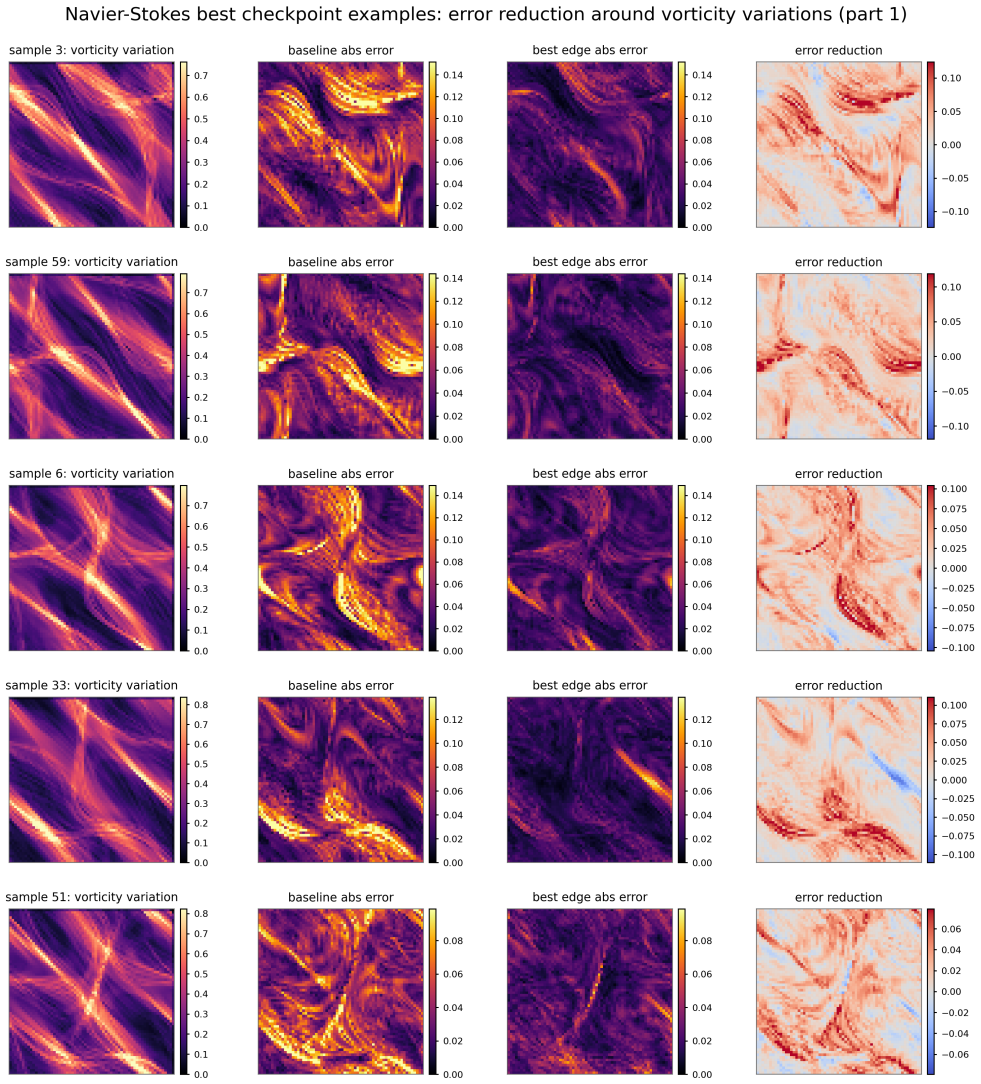
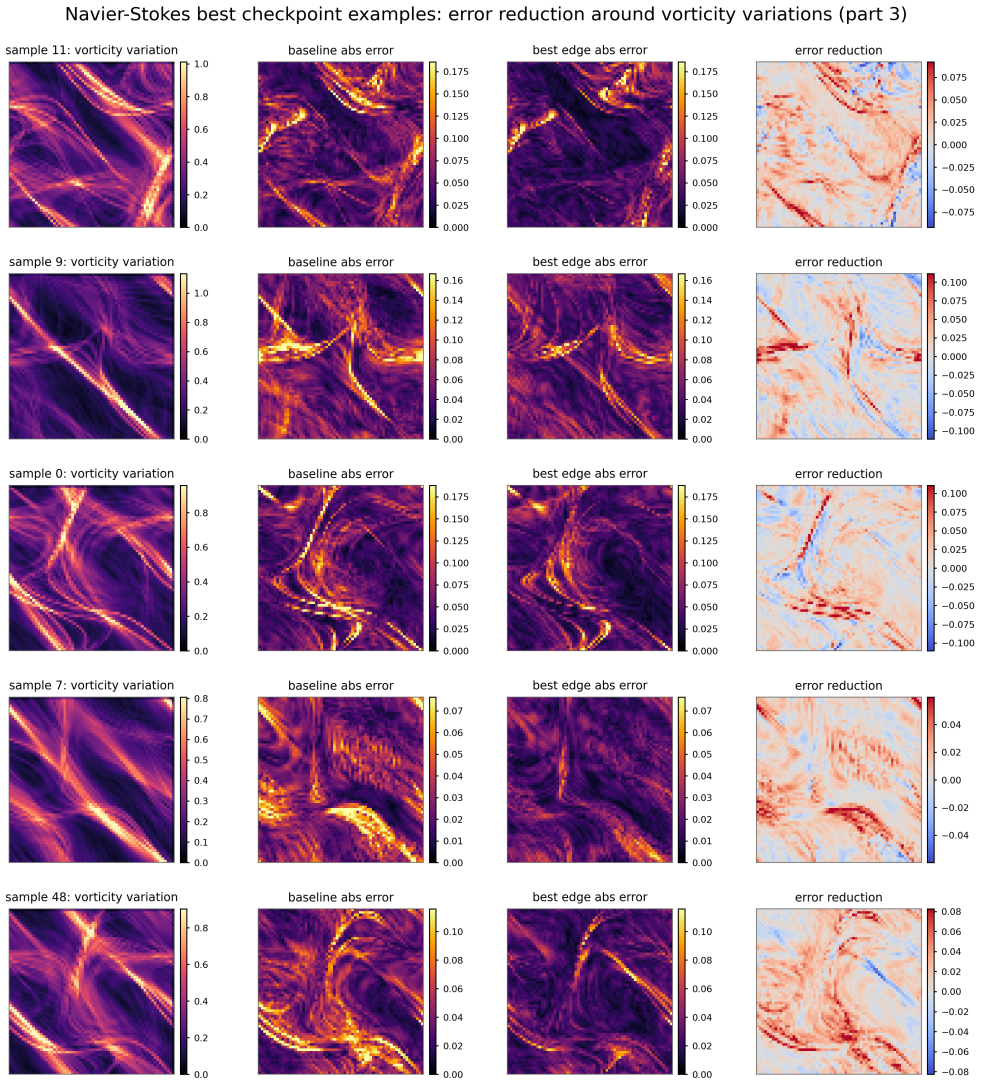
The central claim is that the dominant failure mode of adaptive spectral operators is not spectral resolution but the point-centered gate: when two inputs give the same latent feature at a node but differ in the neighboring field, a point-conditioned model is forced to give the same node-wise response, so it can be wrong by at least half the target gap on one input. ESO removes this indistinguishability by computing edge descriptors $D$ and $Q$ and letting them modulate the spectral basis; the paper's Theorem 1 shows the edge-conditioned class contains the point-conditioned class, so adding edges cannot hurt the best achievable risk, and its Theorem 4 states the separation lower bound for point-only gates. Empirically, the paper's claim is that this design consistently achieves state-of-the-art performance on nine PDE benchmarks, and that the gains concentrate near coefficient jumps, vortical structures, and deformation-localization regions.
Load-bearing premise
The claim that ESO is consistently state of the art assumes the baselines were given genuinely comparable parameter budgets and training configurations, and the paper reports a single run per model with no error bars, so the headline rests on the fairness and stability of the comparison procedure rather than on the architecture alone.
Editorial extensions
If this is right
- ESO improves relative $L^2$ error on all nine benchmarks in Tables 2 and 3, with gains such as from 7.34e-2 to 4.77e-2 on Navier-Stokes and from 1.84e-4 to 9.75e-5 on Heat Transfer.
- Because setting the edge coefficient to zero recovers the base point-conditioned spectral operator, the edge-conditioned class is at least as expressive, so adding edge conditioning cannot make the best achievable risk worse.
- For inputs distinguished only by neighboring structure, any point-only modal gate carries a guaranteed error lower bound of $\Delta/2$, whereas ESO can assign different mode weights to those inputs and is not subject to the bound.
- Ablations on Darcy Flow and Navier-Stokes show that both $D$ and $Q$ contribute, and that PAR adds a further improvement; dropping either component raises error.
- Resolution-generalization experiments on Darcy Flow show ESO's error growing more slowly than baselines beyond $85^2$ resolution, indicating that edge conditioning helps preserve fine-scale physics-sensitive structure.
Reading between the lines
- Editorial extension: the separation theorem is stated for modal gates, but the same reasoning applies to any per-node prediction rule that ignores neighbor context, so graph convolutions and local attention with explicit edge features could inherit a similar argument, a direction the paper does not explore.
- Editorial extension: a stress test not run in the paper would vary Darcy permeability contrast beyond the training range; if edge statistics carry the improvement, ESO's margin over the best point-centered baselines should widen as jumps sharpen and shrink as the field becomes smooth.
- Editorial extension: PAR's sensitivity maps are built from task-specific physical fields assumed available during training, so in applications with noisy or misspecified fields the reweighting could emphasize artifacts; the reported gains may depend on clean benchmark quantities.
- Editorial extension: the paper fixes the spectral basis and changes only the gate, so the benefit of edge conditioning under other global bases, such as wavelets or pure Laplace eigenfunctions, remains untested and is a natural next experiment.
Editorial analysis
A structured set of objections, weighed in public.
Referee Report
Summary. The paper proposes the Edge-Conditioned Spectral Operator (ESO), a neural operator that modulates spectral mode selection using local pairwise variation statistics (PVMM) and a task-adaptive Physics-Aware Reweighting (PAR) loss. ESO is evaluated on nine PDE benchmarks spanning structured and unstructured meshes, where it reports the lowest relative L2 error on every task, supported by ablations, qualitative visualizations, and a resolution-generalization experiment. The theoretical section claims a no-worse approximation guarantee and a separation result for point-conditioned versus edge-conditioned gates.
Significance. The central idea is natural and potentially useful: conditioning spectral modal gates on local pairwise variation statistics is a modest but plausible extension of point-conditioned spectral operators, and the evaluation scope is broad, covering both structured and unstructured mesh problems. The code release is a concrete asset, and the ablations clearly separate the contributions of PVMM and PAR. However, the headline claim of consistent state-of-the-art performance is not yet fully established: the empirical comparison is single-run, with no variance reporting, and the closest margins are small; the theoretical results are class-inclusion and existence statements rather than predictive guarantees. If the empirical comparison is strengthened with seed-level statistics and verifiable parameter-budget matching, the paper would make a useful contribution to operator learning.
major comments (3)
- [Experiments, Tables 2 and 3] The central claim of consistent state-of-the-art performance rests on single-run relative L2 numbers. On Navier–Stokes (Table 2), ESO is 4.77e-2 versus LRSA 4.84e-2, a margin of about 1.4%, which is small relative to typical seed-to-seed variation in neural operator training. Without multiple seeds, standard deviations, and a significance test, the headline claim is not supported to the usual empirical standard. Please report seed-level results, mean ± std, and ideally paired significance tests for the closest comparisons.
- [Experimental Setups, Metrics and Appendix Tables 7/8] The statement that "all baselines are matched with ESO under comparable parameter budgets and consistent training configurations" is not verifiable as written: Tables 2 and 3 contain no parameter counts, and the paper does not state whether each baseline was retrained under the same schedule or whether reported numbers are taken from original publications. Because the closest baseline LRSA is only marginally worse on several tasks, the fairness of the comparison is load-bearing. Provide a parameter-count table, the training schedule used for each baseline, and a statement of which numbers are reproduced versus cited.
- [Theoretical Perspective and Appendix Proofs, Theorems 1–2] The theoretical analysis is conditional rather than predictive. Theorem 1 (Eq. 21) follows from the class inclusion F_base ⊆ F_edge by setting the edge coefficient to zero (Appendix Eq. 25 with αE = 0), so it only shows no-worse approximation, not superiority. Theorem 2 assumes h_i(a) = h_i(ã) in Eq. (22), but in a multi-layer spectral operator the latent h_i has already passed through global mixing, so this premise is not guaranteed for the actual architecture; the constructed interpolation r(c) in the appendix is defined on descriptor pairs, not on the original input space, and the proof does not show that the target π* belongs to the class of gates realizable by ESO. Please state explicitly that the theorems are existence/class-inclusion results and avoid presenting them as explaining the empirical gains.
minor comments (5)
- [References] The MG-TFNO citation is incomplete: "Kossaifi, J.; ... ????" appears without a year or venue; supply the full bibliographic information.
- [Appendix Proofs] The appendix renumbers the main-text Theorems 1 and 2 as Theorems 3 and 4; use a single numbering scheme throughout the paper.
- [Task-adaptive Physics-Aware Reweighting, Eq. (14)] The expression for \tilde w_i would be clearer with explicit parentheses around (\bar{s}^τ + ε); as printed, the precedence is ambiguous.
- [Appendix PAR Implementation Details, Table 6] Several entries in the "Emphasized region" column are sentence fragments (e.g., "vortices and shear/high-gradient regions"); rewrite them as complete noun phrases or short clauses.
- [Method, Eq. (17)] The tensor contraction in R((Φ^E)ᵀVᵗ) should be spelled out, since R is a three-index tensor and the matrix notation is ambiguous as written.
Circularity Check
No significant circularity: the SOTA claim is an external empirical comparison; PAR is a disclosed loss-reweighting objective; the theorems are conditional and do not equate predictions with fitted inputs.
full rationale
The paper's load-bearing claim is empirical: ESO achieves the lowest relative L2 error on nine external PDE benchmarks (Tables 2 and 3). No equation defines a prediction in terms of the fitted values being reported. PAR is an explicit training-loss reweighting based on task-available physical fields; it is not a parameter fitted to test errors and then relabeled as a prediction, and the appendix discloses which fields are used and that next-step fields are training-only (Table 6). The theoretical results are conditional and self-contained: Theorem 1 proves F_base ⊆ F_edge by setting λ_E = 0, which is a trivial hypothesis-class inclusion rather than a circular derivation of performance; Theorem 2 is a separation argument assuming two inputs with equal center representations but different edge descriptors, and it concludes only that a gate using both can in principle distinguish them. The self-citations (Tan et al. 2026 survey and the Laplace–Beltrami basis choice 'Following (Yue, Yang, and Zhu 2025)') are not load-bearing; they do not import a uniqueness theorem or smuggle in an ansatz that is then presented as forced. The absence of error bars and the small margins versus LRSA concern empirical robustness and comparison fairness, not circularity. Overall, the central derivation chain is not circular, and the reported performance is not equivalent by construction to any input of the method.
Assumptions & free parameters
free parameters (4)
- PAR reweighting hyperparameters lambda_PAR and gamma =
lambda_PAR: 0.02 default, 5e-4 for Airfoil; gamma: 2.0 default, 0.5 for Airfoil
- Neighborhood size Kn for PVMM and PAR =
Kn=8 default; ablation shows Irregular Darcy favors Kn=12
- Spectral and architecture hyperparameters (K modes, layers, hidden, heads) =
see Tables 7 and 8
- Modal gate balance lambda_E / alpha_E =
not reported; alpha_E is learnable in the implementation
assumptions (4)
- domain assumption Laplace-Beltrami eigenfunctions provide a valid spectral basis on structured and unstructured meshes, and truncating to K modes preserves enough information for the PDE solutions.
- domain assumption There exist admissible input pairs with identical center latent representation but different local edge descriptors and target outputs separated by Delta > 0.
- domain assumption The PVMM gating network is sufficiently expressive and trainable to realize the descriptor-to-response map constructed in the Appendix proof.
- ad hoc to paper Baselines were matched under comparable parameter budgets and consistent training configurations, and single-run results are representative.
Cite this review
Pith. "Pith review of From Points to Edges: Edge-Conditioned Spectral Operators for Physics-Sensitive PDE Learning." pith.science (2026). https://pith.science/paper/3MR4ATBM
@misc{pith2026260806894,
  author       = {Pith},
  title        = {Pith review of: From Points to Edges: Edge-Conditioned Spectral Operators for Physics-Sensitive PDE Learning},
  year         = {2026},
  howpublished = {\url{https://pith.science/paper/3MR4ATBM}},
  note         = {Machine review of arXiv:2608.06894}
}
read the original abstract
Neural operators have become a central tool for solving partial differential equations (PDEs), with spectral operators offering efficient global mixing across spatial locations. However, many PDEs contain physics-sensitive local structures that are critical to the underlying physical behavior. For example, in Darcy flow, local material interfaces are often reflected by sharp changes in the permeability field and can strongly influence the solution. Existing spectral operators primarily adapt modal mixing based on center-point representations, making them insufficiently responsive to such localized structural variations. We propose the Edge-Conditioned Spectral Operator (ESO), a novel spectral operator framework that modulates global spectral mixing using local edge-wise variations. By incorporating the Pairwise-Variation Modal Mixer (PVMM) to inject local edge information into spectral mode selection, ESO preserves the global approximation capability of spectral neural operators while enabling the learned kernel to adapt to physics-sensitive local structures. Furthermore, we introduce a task-adaptive Physics-Aware Reweighting (PAR) that emphasizes physically important regions, identified by taskspecific physical quantities. Across nine PDE benchmarks, ESO consistently achieves state-of-the-art performance. Visual and region-wise analyses further demonstrate that ESO reduces solution errors near coefficient jumps, high-gradient flow structures, and other physically sensitive regions. The code is available at https://github.com/Tanpig-X/ESO.
Figures


Figures from the paper (9 more)




Reference graph
Works this paper leans on
-
[1]
Advances in Computational Methods and Technologies in Aeronautics and Industry , pages=
Inverse Aerodynamic Design Using Neural Networks , author=. Advances in Computational Methods and Technologies in Aeronautics and Industry , pages=. 2022 , publisher=
work page 2022
-
[2]
Computer Methods in Applied Mechanics and Engineering , volume=
A physics-informed deep learning framework for inversion and surrogate modeling in solid mechanics , author=. Computer Methods in Applied Mechanics and Engineering , volume=. 2021 , publisher=
work page 2021
-
[3]
National Science Open , volume=
Learning neural operators on riemannian manifolds , author=. National Science Open , volume=. 2024 , publisher=
2024
-
[4]
arXiv preprint arXiv:2010.08895 , year=
Fourier neural operator for parametric partial differential equations , author=. arXiv preprint arXiv:2010.08895 , year=
arXiv 2010
-
[5]
International Conference on Machine Learning , pages=
Holistic Physics Solver: Learning PDEs in a Unified Spectral-Physical Space , author=. International Conference on Machine Learning , pages=. 2025 , organization=
work page 2025
-
[6]
Journal of Machine Learning Research , volume=
Neural operator: Learning maps between function spaces with applications to pdes , author=. Journal of Machine Learning Research , volume=
-
[7]
arXiv preprint arXiv:2111.13587 , year=
Adaptive fourier neural operators: Efficient token mixers for transformers , author=. arXiv preprint arXiv:2111.13587 , year=
-
[8]
arXiv preprint arXiv:2402.02366 , year=
Transolver: A fast transformer solver for pdes on general geometries , author=. arXiv preprint arXiv:2402.02366 , year=
Show all 47 references
-
[9]
Advances in neural information processing systems , volume=
Imagenet classification with deep convolutional neural networks , author=. Advances in neural information processing systems , volume=
-
[10]
Neural computation , volume=
Laplacian eigenmaps for dimensionality reduction and data representation , author=. Neural computation , volume=. 2003 , publisher=
2003
-
[11]
2008 , publisher=
The mathematical theory of finite element methods , author=. 2008 , publisher=
2008
-
[12]
arXiv preprint arXiv:1910.03193 , year=
Deeponet: Learning nonlinear operators for identifying differential equations based on the universal approximation theorem of operators , author=. arXiv preprint arXiv:1910.03193 , year=
1910 arXiv
-
[13]
Nature machine intelligence , volume=
Learning nonlinear operators via DeepONet based on the universal approximation theorem of operators , author=. Nature machine intelligence , volume=. 2021 , publisher=
2021
-
[14]
ACM/IMS Journal of Data Science , volume=
Physics-informed neural operator for learning partial differential equations , author=. ACM/IMS Journal of Data Science , volume=. 2024 , publisher=
2024
-
[15]
Journal of Machine Learning Research , volume=
Fourier neural operator with learned deformations for pdes on general geometries , author=. Journal of Machine Learning Research , volume=
-
[16]
arXiv preprint arXiv:2111.13802 , year=
Factorized fourier neural operators , author=. arXiv preprint arXiv:2111.13802 , year=
-
[17]
Advances in Neural Information Processing Systems , volume=
Geometry-informed neural operator for large-scale 3d pdes , author=. Advances in Neural Information Processing Systems , volume=
-
[18]
Advances in Neural Information Processing Systems , volume=
Amortized fourier neural operators , author=. Advances in Neural Information Processing Systems , volume=
-
[19]
International Conference on Machine Learning , pages=
Solving High-Dimensional PDEs with Latent Spectral Models , author=. International Conference on Machine Learning , pages=. 2023 , organization=
2023
-
[20]
Proceedings of the AAAI Conference on Artificial Intelligence , volume=
Saot: An enhanced locality-aware spectral transformer for solving pdes , author=. Proceedings of the AAAI Conference on Artificial Intelligence , volume=
-
[21]
arXiv preprint arXiv:2604.03582 , year=
Simple yet Effective: Low-Rank Spatial Attention for Neural Operators , author=. arXiv preprint arXiv:2604.03582 , year=
-
[22]
International conference on machine learning , pages=
Spherical fourier neural operators: Learning stable dynamics on the sphere , author=. International conference on machine learning , pages=. 2023 , organization=
2023
-
[23]
Advances in Water Resources , volume=
U-FNO—An enhanced Fourier neural operator-based deep-learning model for multiphase flow , author=. Advances in Water Resources , volume=. 2022 , publisher=
2022
-
[24]
Multi-Grid Tensorized Fourier Neural Operator for High-Resolution PDEs , author=
-
[25]
Advances in neural information processing systems , volume=
Multiwavelet-based operator learning for differential equations , author=. Advances in neural information processing systems , volume=
-
[26]
Computer Methods in Applied Mechanics and Engineering , volume=
Wavelet neural operator for solving parametric partial differential equations in computational mechanics problems , author=. Computer Methods in Applied Mechanics and Engineering , volume=. 2023 , publisher=
2023
-
[27]
Nature Machine Intelligence , volume=
Laplace neural operator for solving differential equations , author=. Nature Machine Intelligence , volume=. 2024 , publisher=
2024
-
[28]
arXiv preprint arXiv:2602.12706 , year=
Physics-Informed Laplace Neural Operator for Solving Partial Differential Equations , author=. arXiv preprint arXiv:2602.12706 , year=
-
[29]
Advances in neural information processing systems , volume=
Choose a transformer: Fourier or galerkin , author=. Advances in neural information processing systems , volume=
-
[30]
arXiv preprint arXiv:2205.13671 , year=
Transformer for partial differential equations' operator learning , author=. arXiv preprint arXiv:2205.13671 , year=
-
[31]
International conference on machine learning , pages=
Gnot: A general neural operator transformer for operator learning , author=. International conference on machine learning , pages=. 2023 , organization=
2023
-
[32]
Advances in Neural Information Processing Systems , volume=
Scalable transformer for pde surrogate modeling , author=. Advances in Neural Information Processing Systems , volume=
-
[33]
arXiv preprint arXiv:2310.12487 , year=
Improved operator learning by orthogonal attention , author=. arXiv preprint arXiv:2310.12487 , year=
-
[34]
arXiv preprint arXiv:2505.01736 , year=
Pesanet: physics-encoded spectral attention network for simulating PDE-governed complex systems , author=. arXiv preprint arXiv:2505.01736 , year=
-
[35]
Advances in Neural Information Processing Systems , volume=
Rigno: A graph-based framework for robust and accurate operator learning for pdes on arbitrary domains , author=. Advances in Neural Information Processing Systems , volume=
-
[36]
Transformer for Partial Differential Equations’ Operator Learning , author=
-
[37]
Advances in neural information processing systems , volume=
Inductive representation learning on large graphs , author=. Advances in neural information processing systems , volume=
-
[38]
Computer Methods in Applied Mechanics and Engineering , volume=
A comprehensive and fair comparison of two neural operators (with practical extensions) based on fair data , author=. Computer Methods in Applied Mechanics and Engineering , volume=. 2022 , publisher=
2022
-
[39]
arXiv preprint arXiv:2403.03542 , year=
Dpot: Auto-regressive denoising operator transformer for large-scale pde pre-training , author=. arXiv preprint arXiv:2403.03542 , year=
-
[40]
Proceedings of the 2022 Conference of the north American chapter of the Association for Computational Linguistics: human language technologies , pages=
Fnet: Mixing tokens with fourier transforms , author=. Proceedings of the 2022 Conference of the north American chapter of the Association for Computational Linguistics: human language technologies , pages=
2022
-
[41]
arXiv preprint arXiv:2405.09285 , year=
Positional knowledge is all you need: Position-induced transformer (PiT) for operator learning , author=. arXiv preprint arXiv:2405.09285 , year=
-
[42]
arXiv preprint arXiv:2406.03919 , year=
Vectorized conditional neural fields: A framework for solving time-dependent parametric partial differential equations , author=. arXiv preprint arXiv:2406.03919 , year=
-
[43]
arXiv preprint arXiv:2405.13998 , year=
Cvit: Continuous vision transformer for operator learning , author=. arXiv preprint arXiv:2405.13998 , year=
-
[44]
arXiv preprint arXiv:2001.04451 , year=
Reformer: The efficient transformer , author=. arXiv preprint arXiv:2001.04451 , year=
2001 arXiv
-
[45]
Advances in neural information processing systems , volume=
Attention is all you need , author=. Advances in neural information processing systems , volume=
-
[46]
Proceedings of the AAAI Conference on Artificial Intelligence , volume=
Inducing point operator transformer: A flexible and scalable architecture for solving pdes , author=. Proceedings of the AAAI Conference on Artificial Intelligence , volume=
-
[47]
arXiv preprint arXiv:2605.16966 , year=
Harnessing AI for Inverse Partial Differential Equation Problems: Past, Present, and Prospects , author=. arXiv preprint arXiv:2605.16966 , year=
Reviewed August 10, 2026 · model on record in the stance chip above.
Discussion (0). Continue with ORCID to comment.