Theory of Electron Spin Resonance Scanning Tunneling Microscopy: The First Decade
Pith reviewed 2026-06-29 03:26 UTC · model grok-4.3
The pith
Electric fields drive atomic spin resonance in STM junctions via exchange and scattering mechanisms.
A machine-rendered reading of the paper's core claim, the machinery that carries it, and where it could break.
Core claim
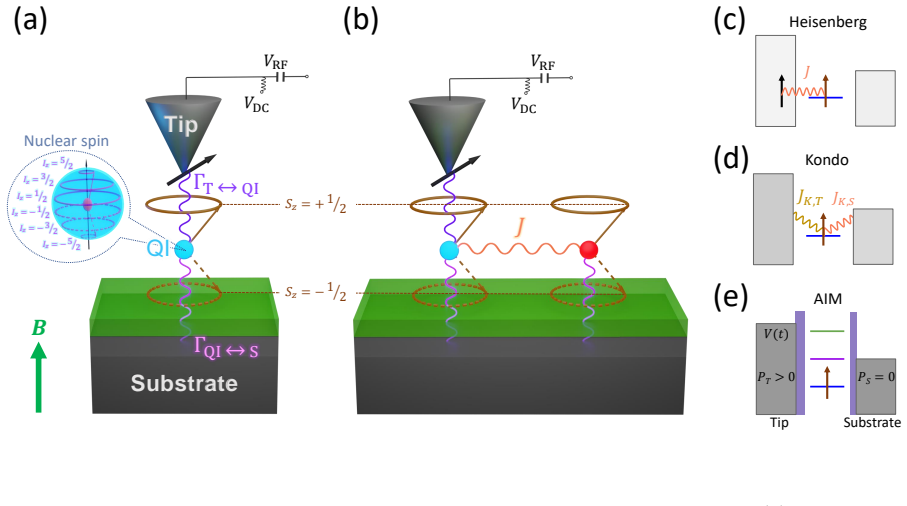
The theory of ESR-STM shows that the electric field drives spin transitions through Heisenberg exchange, Kondo scattering, and Anderson impurity models, allowing all-electrical coherent control of spins at the atomic scale without oscillating magnetic fields, with validation against experiments and extensions to multi-spin and electron-nuclear dynamics.
What carries the argument
Electric-field-driven spin resonance modeled by Heisenberg exchange, Kondo scattering, and Anderson impurity models.
If this is right
- Coherent manipulation of single spins becomes possible using only DC and RF voltages in the STM junction.
- Multi-spin interactions can be controlled to perform multiple-qubit operations at the atomic scale.
- Hyperfine-resolved spectroscopy reveals electron-nuclear coupling and enables driving of nuclear spins.
Where Pith is reading between the lines
- The same electric-field driving could be tested on different magnetic impurities or substrates to check model generality.
- Combining ESR-STM with existing STM-based atomic manipulation might allow on-demand assembly of spin arrays for quantum simulation.
- Time-resolved measurements of nuclear polarization could distinguish between direct driving and indirect relaxation pathways.
Load-bearing premise
The three models of Heisenberg exchange, Kondo scattering, and Anderson impurity capture the dominant driving mechanisms without major unmodeled contributions from tip geometry or surface environment.
What would settle it
An experiment that measures ESR-STM resonance signals whose dependence on bias, current, or magnetic field cannot be reproduced by any combination of the Heisenberg, Kondo, and Anderson models.
Figures
read the original abstract
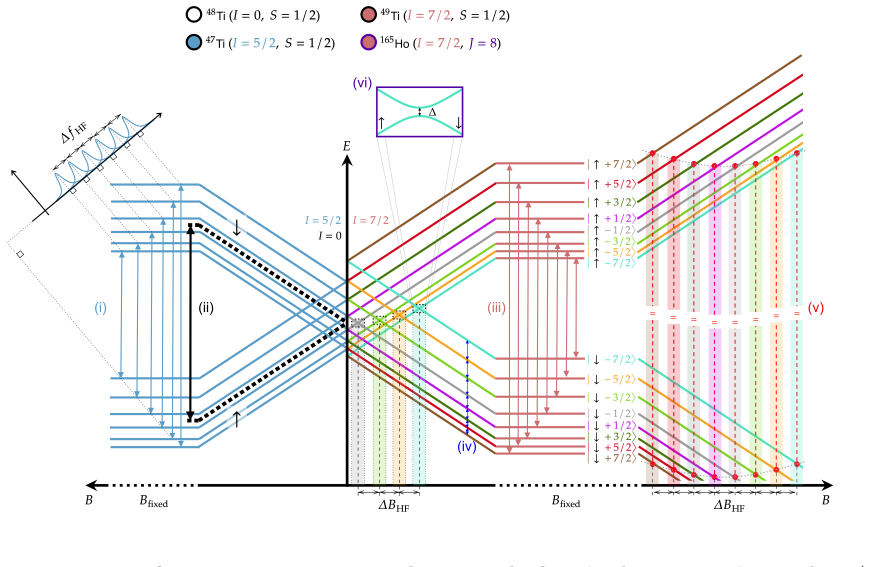
Electron spin resonance in scanning tunneling microscopy enabled the study of electronic transitions of magnetic impurities on surfaces at the atomic scale. This ESR-STM technique allows to spectroscopically probe and coherently manipulate spins using an all-electrical method without oscillating external magnetic driving fields. Here, we aim to review recent advancements in ESR-STM. We will discuss possible fundamental mechanisms by which the electric field drives spin resonance based on Heisenberg exchange, Kondo scattering, and Anderson impurity models. We validate theoretical predictions against experimental observations, to understand how electronic correlations, spin exchange, and many-body effects manifest in ESR-STM signals. After reviewing coherent spin control in the STM junction, we discuss potential applications of the ESR-STM method for coherent multi-spin control which enables multiple-qubit operations. Finally, we address recent developments in coupled electron-nuclear spin systems, including hyperfine-resolved ESR spectroscopy, and the driving and polarization of nuclear spins in ESR-STM.
Editorial analysis
A structured set of objections, weighed in public.
Referee Report
Summary. The manuscript is a review summarizing the first decade of theoretical developments in Electron Spin Resonance Scanning Tunneling Microscopy (ESR-STM). It covers driving mechanisms for all-electrical spin resonance based on Heisenberg exchange, Kondo scattering, and Anderson impurity models; validates theoretical predictions against experimental observations to illustrate manifestations of electronic correlations and many-body effects; reviews coherent spin control; discusses extensions to coherent multi-spin control for multiple-qubit operations; and addresses coupled electron-nuclear spin systems including hyperfine-resolved spectroscopy and nuclear spin driving/polarization.
Significance. If the review accurately aggregates and contextualizes the cited literature, it would be a significant contribution by providing a consolidated reference on atomic-scale all-electrical spin manipulation. The emphasis on model validations, coherent control, and multi-spin/electron-nuclear extensions highlights pathways for quantum information applications on surfaces and clarifies how many-body physics enters ESR-STM observables.
minor comments (1)
- [Abstract] The abstract states that predictions are validated against experiments, but the review would benefit from an explicit statement (e.g., in the introduction or a dedicated section) on the criteria used to select which experimental works are included as validations versus those left for future discussion.
Simulated Author's Rebuttal
We thank the referee for their positive assessment of our manuscript and for recommending acceptance. Their summary accurately captures the scope and structure of the review.
Circularity Check
Review aggregates external literature; no internal derivation reduces to self-inputs
full rationale
This is a review paper that summarizes mechanisms (Heisenberg exchange, Kondo scattering, Anderson impurity models) drawn from prior literature, validates them against external experimental observations, and discusses applications and extensions. No load-bearing step is shown to reduce by the paper's own equations or self-citation chain to its inputs; the abstract and description indicate aggregation of independent cited results rather than a self-contained derivation or fitted prediction presented as novel. Self-citations, if present, are not described as load-bearing for any uniqueness theorem or ansatz. The paper is therefore self-contained against external benchmarks.
Axiom & Free-Parameter Ledger
Reference graph
Works this paper leans on
-
[1]
Surface Studies by Scanning Tunneling Microscopy
G. Binnig et al. “Surface Studies by Scanning Tunneling Microscopy”. In:Phys. Rev. Lett.49 (1982), pp. 57–61.doi:10.1103/PhysRevLett.49.57
-
[2]
Recent progress in probing atomic and molecular quantum coherence with scanning tunneling microscopy
Liya Bi et al. “Recent progress in probing atomic and molecular quantum coherence with scanning tunneling microscopy”. In:Progress in Surface Science98.1 (2023), p. 100696. issn: 0079-6816.doi:https://doi.org/10.1016/j.progsurf.2022.100696.url: https://www.sciencedirect.com/science/article/pii/S0079681622000442
-
[3]
Electron spin resonance scanning tunneling microscopy beyond a single spin
Zixuan Guo, Jiajun Zhang, and Yi Chen. “Electron spin resonance scanning tunneling microscopy beyond a single spin”. In:Newton(Mar. 2026).issn: 2950-6360.doi:10. 1016/j.newton.2026.100413.url:https://doi.org/10.1016/j.newton.2026. 100413. 45
-
[4]
Photon emission of electrons tunneling in a scanning tunneling microscope
J. K. Gimzewski et al. “Photon emission of electrons tunneling in a scanning tunneling microscope”. In:Zeitschrift für Physik B Condensed Matter72 (1988), pp. 497–501.doi: 10.1007/BF01314531
-
[5]
Richard Berndt and James K. Gimzewski. “Photon emission in scanning tunneling mi- croscopy: Interpretation of photon maps of metallic systems”. In:Phys. Rev. B48 (7 Aug. 1993), pp. 4746–4754.doi:10.1103/PhysRevB.48.4746.url:https://link. aps.org/doi/10.1103/PhysRevB.48.4746
work page doi:10.1103/physrevb.48.4746.url:https://link 1993
-
[6]
Shot-noise measurements on mesoscopic contacts
H. Birk et al. “Shot-noise measurements on mesoscopic contacts”. In:Phys. Rev. Lett.75 (1995), pp. 1610–1613.doi:10.1103/PhysRevLett.75.1610
-
[7]
High-speed force sensor for force microscopy and profilometry utilizing a quartz tuning fork
Franz J. Giessibl. “High-speed force sensor for force microscopy and profilometry utilizing a quartz tuning fork”. In:Applied Physics Letters73.26 (1998), pp. 3956–3958.doi: 10.1063/1.122944
-
[8]
Subatomic Features on the Silicon (111)-(7x7) Surface Observed by Atomic Force Microscopy
Franz J. Giessibl et al. “Subatomic Features on the Silicon (111)-(7x7) Surface Observed by Atomic Force Microscopy”. In:Science289.5478 (2000), pp. 422–425.doi:10.1126/ science.289.5478.422
2000
-
[9]
Nanoscale chemical analysis by tip-enhanced Raman spectroscopy
R. M. Stöckle et al. “Nanoscale chemical analysis by tip-enhanced Raman spectroscopy”. In:Chem. Phys. Lett.318 (2000), pp. 131–136.doi:10.1016/S0009-2614(99)01451-7
-
[10]
An ultrafast terahertz scanning tunnelling microscope
T. L. Cocker et al. “An ultrafast terahertz scanning tunnelling microscope”. In:Nature Photonics7.8 (2013), pp. 620–625.doi:10.1038/nphoton.2013.151
-
[11]
Real-space imaging of transient carrier dynamics by nanoscale pump–probe microscopy
Yasuhiko Terada et al. “Real-space imaging of transient carrier dynamics by nanoscale pump–probe microscopy”. In:Nature Photonics4.12 (2010), pp. 869–874.doi:10.1038/ nphoton.2010.239
2010
-
[12]
Observation of vacuum tunneling of spin-polarized electrons with the scanning tunneling microscope
R. Wiesendanger et al. “Observation of vacuum tunneling of spin-polarized electrons with the scanning tunneling microscope”. In:Phys. Rev. Lett.65 (1990), pp. 247–250. doi:10.1103/PhysRevLett.65.247
-
[13]
Cambridge University Press, 1994
Roland Wiesendanger.Scanning Probe Microscopy and Spectroscopy: Methods and Ap- plications. Cambridge University Press, 1994
1994
-
[14]
Single-Atom Spin-Flip Spectroscopy
A. J. Heinrich et al. “Single-Atom Spin-Flip Spectroscopy”. In:Science306.5695 (2004), pp. 466–469.doi:10.1126/science.1101077
-
[15]
Direct observation of the Larmor precession of individual spins by scanning-tunneling microscopy
Y. Manassen et al. “Direct observation of the Larmor precession of individual spins by scanning-tunneling microscopy”. In:Phys. Rev. Lett.62 (21 1989), pp. 2531–2534.doi: 10.1103/PhysRevLett.62.2531
-
[16]
Electron paramagnetic resonance of individual atoms on a surface
Susanne Baumann et al. “Electron paramagnetic resonance of individual atoms on a surface”. In:Science350.6259 (2015), pp. 417–420.doi:10. 1126 /science .aac8703. url:https://www.science.org/doi/abs/10.1126/science.aac8703
-
[17]
Abragam and B
A. Abragam and B. Bleaney.Electron Paramagnetic Resonance of Transition Ions. Ox- ford Classic Texts in the Physical Sciences. Oxford University Press, 1970
1970
-
[18]
L. T. Hall et al. “Detection of nanoscale electron spin resonance spectra demonstrated us- ing nitrogen-vacancy centre probes in diamond”. In:Nature Communications7.1 (2016), p. 10211.doi:10.1038/ncomms10211.url:https://doi.org/10.1038/ncomms10211
work page doi:10.1038/ncomms10211.url:https://doi.org/10.1038/ncomms10211 2016
-
[19]
Andreas J. Heinrich et al. “Quantum-coherent nanoscience”. In:Nature Nanotechnology 16.12 (Dec. 2021), pp. 1318–1329.issn: 1748-3395.doi:10.1038/s41565-021-00994-1. url:https://doi.org/10.1038/s41565-021-00994-1
-
[20]
Molecular Vibration Spectra by Inelastic Electron Tun- neling
J. Lambe and R. C. Jaklevic. “Molecular Vibration Spectra by Inelastic Electron Tun- neling”. In:Phys. Rev.165 (3 Jan. 1968), pp. 821–832.doi:10.1103/PhysRev.165.821. url:https://link.aps.org/doi/10.1103/PhysRev.165.821. 46
-
[21]
High-resolution tunnelling spectroscopy of a graphene quartet
Young Jae Song et al. “High-resolution tunnelling spectroscopy of a graphene quartet”. In:Nature467.7312 (2010), pp. 185–189.doi:10 . 1038 / nature09330.url:https : //doi.org/10.1038/nature09330
-
[22]
Sensing the quantum limit in scanning tunnelling spectroscopy
Christian R. Ast et al. “Sensing the quantum limit in scanning tunnelling spectroscopy”. In:Nature Communications7.1 (2016), p. 13009.doi:10 . 1038 / ncomms13009.url: https://doi.org/10.1038/ncomms13009
-
[23]
Deung-Jang Choi et al. “Electron spin resonance with scanning tunneling microscopy: a tool for an on-surface quantum platform of identical qubits”. In:Nanoscale Advances7.15 (2025), pp. 4551–4558.issn: 2516-0230.doi:https://doi.org/10.1039/d5na00316d. url:https://www.sciencedirect.com/science/article/pii/S2516023025002588
-
[24]
Controlling Single-Molecule Negative Differential Resistance in a Double-Barrier Tunnel Junction
X. W. Tu, G. Mikaelian, and W. Ho. “Controlling Single-Molecule Negative Differential Resistance in a Double-Barrier Tunnel Junction”. In:Phys. Rev. Lett.100 (12 Mar. 2008), p. 126807.doi:10.1103/PhysRevLett.100.126807.url:https://link.aps.org/ doi/10.1103/PhysRevLett.100.126807
work page doi:10.1103/physrevlett.100.126807.url:https://link.aps.org/ 2008
-
[25]
Readingandwritingsingle-atommagnets
FabianD.Nattereretal.“Readingandwritingsingle-atommagnets”.In:Nature543.7644 (2017), pp. 226–228.doi:10.1038/nature21371.url:https://doi.org/10.1038/ nature21371
work page doi:10.1038/nature21371.url:https://doi.org/10.1038/ 2017
-
[26]
Atomic-scale sensing of the magnetic dipolar field from single atoms
Taeyoung Choi et al. “Atomic-scale sensing of the magnetic dipolar field from single atoms”. In:Nature Nanotechnology12.5 (2017), pp. 420–424.doi:10 . 1038 / nnano . 2017.18.url:https://doi.org/10.1038/nnano.2017.18
-
[27]
Engineering the Eigenstates of Coupled Spin-1/2Atoms on a Surface
Kai Yang et al. “Engineering the Eigenstates of Coupled Spin-1/2Atoms on a Surface”. In:Phys. Rev. Lett.119 (22 Nov. 2017), p. 227206.doi:10.1103/PhysRevLett.119. 227206.url:https://link.aps.org/doi/10.1103/PhysRevLett.119.227206
-
[28]
Probing quantum coherence in single-atom electron spin resonance
Philip Willke et al. “Probing quantum coherence in single-atom electron spin resonance”. In:Science Advances4.2 (2018), eaaq1543.doi:10.1126/sciadv.aaq1543.url:https: //www.science.org/doi/abs/10.1126/sciadv.aaq1543
-
[29]
Data-Driven Discovery of Partial Differential Equa- tions
Y. Bae et al. “Enhanced quantum coherence in exchange coupled spins via singlet- triplet transitions”. In:Science Advances4.11 (2018), eaau4159.doi:10.1126/sciadv. aau4159.url:https://www.science.org/doi/abs/10.1126/sciadv.aau4159
-
[30]
Hyperfine interaction of individual atoms on a surface
Philip Willke et al. “Hyperfine interaction of individual atoms on a surface”. In:Science 362.6412 (2018), pp. 336–339.doi:10.1126/science.aat7047.url:https://www. science.org/doi/abs/10.1126/science.aat7047
-
[31]
Electrically controlled nuclear polarization of individual atoms
Kai Yang et al. “Electrically controlled nuclear polarization of individual atoms”. In: Nature Nanotechnology13.12 (Nov. 2018), pp. 1120–1125.issn: 1748-3395.doi:10 . 1038/s41565-018-0296-7.url:http://dx.doi.org/10.1038/s41565-018-0296-7
-
[32]
Upgrade of a low-temperature scanning tunneling micro- scope for electron-spin resonance
Fabian D. Natterer et al. “Upgrade of a low-temperature scanning tunneling micro- scope for electron-spin resonance”. In:Review of Scientific Instruments90.1 (Jan. 2019), p. 013706.issn: 0034-6748.doi:10.1063/1.5065384. eprint:https://pubs.aip.org/ aip/rsi/article-pdf/doi/10.1063/1.5065384/14757622/013706_1_online.pdf. url:https://doi.org/10.1063/1.5065384
-
[33]
Tuning Single-Atom Electron Spin Resonance in a Vector Magnetic Field
Philip Willke et al. “Tuning Single-Atom Electron Spin Resonance in a Vector Magnetic Field”. In:Nano Letters19.11 (2019), pp. 8201–8206.doi:10 . 1021 / acs . nanolett . 9b03559.url:https://doi.org/10.1021/acs.nanolett.9b03559
-
[34]
Tuning the Exchange Bias on a Single Atom from 1 mT to 10 T
Kai Yang et al. “Tuning the Exchange Bias on a Single Atom from 1 mT to 10 T”. In: Phys. Rev. Lett.122(22June2019),p.227203.doi:10.1103/PhysRevLett.122.227203. url:https://link.aps.org/doi/10.1103/PhysRevLett.122.227203. 47
-
[35]
Magnetic Resonance Imaging of Single Atoms on a Surface
Philip Willke et al. “Magnetic Resonance Imaging of Single Atoms on a Surface”. In: Nature Physics15.10 (2019), pp. 1005–1010.doi:10.1038/s41567-019-0573-x.url: https://doi.org/10.1038/s41567-019-0573-x
-
[36]
Coherentspinmanipulationofindividualatomsonasurface
KaiYangetal.“Coherentspinmanipulationofindividualatomsonasurface”.In:Science 366.6464 (2019), pp. 509–512.doi:10.1126/science.aay6779.url:https://www. science.org/doi/abs/10.1126/science.aay6779
-
[37]
Werner M. J. van Weerdenburg et al. “A scanning tunneling microscope capable of elec- tron spin resonance and pump–probe spectroscopy at mK temperature and in vector magnetic field”. In:Review of Scientific Instruments92.3 (Mar. 2021), p. 033906.issn: 0034-6748.doi:10.1063/5.0040011.url:https://doi.org/10.1063/5.0040011
work page doi:10.1063/5.0040011.url:https://doi.org/10.1063/5.0040011 2021
-
[38]
Manuel Steinbrecher et al. “Quantifying the interplay between fine structure and ge- ometry of an individual molecule on a surface”. In:Phys. Rev. B103 (15 Apr. 2021), p. 155405.doi:10.1103/PhysRevB.103.155405.url:https://link.aps.org/doi/ 10.1103/PhysRevB.103.155405
work page doi:10.1103/physrevb.103.155405.url:https://link.aps.org/doi/ 2021
-
[39]
Spin resonance amplitude and frequency of a single atom on a surface in a vector magnetic field
Jinkyung Kim et al. “Spin resonance amplitude and frequency of a single atom on a surface in a vector magnetic field”. In:Phys. Rev. B104 (17 Nov. 2021), p. 174408. doi:10.1103/PhysRevB.104.174408.url:https://link.aps.org/doi/10.1103/ PhysRevB.104.174408
work page doi:10.1103/physrevb.104.174408.url:https://link.aps.org/doi/10.1103/ 2021
-
[40]
AnisotropicHyperfineInteractionofSurface-AdsorbedSingleAtoms
JinkyungKimetal.“AnisotropicHyperfineInteractionofSurface-AdsorbedSingleAtoms”. In:Nano Letters22.23 (2022), pp. 9766–9772.doi:10.1021/acs.nanolett.2c02782. url:https://doi.org/10.1021/acs.nanolett.2c02782
-
[41]
Experimental Determination of a Single Atom Ground State Orbital through Hyperfine Anisotropy
Laëtitia Farinacci et al. “Experimental Determination of a Single Atom Ground State Orbital through Hyperfine Anisotropy”. In:Nano Letters22.21 (Oct. 2022), pp. 8470– 8474.issn: 1530-6992.doi:10.1021/acs.nanolett.2c02783.url:http://dx.doi. org/10.1021/acs.nanolett.2c02783
work page doi:10.1021/acs.nanolett.2c02783.url:http://dx.doi 2022
-
[42]
Spin-state engineering of single titanium adsorbates on ultrathin magnesium oxide
Soo-hyon Phark et al. “Spin-state engineering of single titanium adsorbates on ultrathin magnesium oxide”. In:Nature Communications(2026).issn: 2041-1723.doi:10.1038/ s41467-026-68314-6.url:https://doi.org/10.1038/s41467-026-68314-6
-
[43]
Xue Zhang et al. “Electron spin resonance of single iron phthalocyanine molecules and role of their non-localized spins in magnetic interactions”. In:Nature Chemistry14.1 (2022), pp. 59–65.doi:10.1038/s41557-021-00827-7.url:https://doi.org/10. 1038/s41557-021-00827-7
work page doi:10.1038/s41557-021-00827-7.url:https://doi.org/10 2022
-
[44]
ESR-STMondiamagneticmolecule: C60 on graphene
ZionHazan,MichaelAverbukh,andYishayManassen.“ESR-STMondiamagneticmolecule: C60 on graphene”. In:Journal of Magnetic Resonance348 (2023), p. 107377.issn: 1090- 7807.doi:https : / / doi . org / 10 . 1016 / j . jmr . 2023 . 107377.url:https : / / www . sciencedirect.com/science/article/pii/S1090780723000125
2023
-
[45]
Coherent Spin Control of Single Molecules on a Surface
Philip Willke et al. “Coherent Spin Control of Single Molecules on a Surface”. In:ACS Nano15.11 (2021), pp. 17959–17965.doi:10.1021/acsnano.1c06394.url:https: //doi.org/10.1021/acsnano.1c06394
-
[46]
Probing resonating valence bond states in artificial quantum magnets
Kai Yang et al. “Probing resonating valence bond states in artificial quantum magnets”. In:Nature Communications12.1 (2021), p. 993.doi:10.1038/s41467-021-21274-5. url:https://doi.org/10.1038/s41467-021-21274-5
-
[47]
Free coherent evolution of a coupled atomic spin system ini- tialized by electron scattering
Lukas M. Veldman et al. “Free coherent evolution of a coupled atomic spin system ini- tialized by electron scattering”. In:Science372.6545 (2021), pp. 964–968.doi:10.1126/ science . abg8223.url:https : / / www . science . org / doi / abs / 10 . 1126 / science . abg8223. 48
2021
-
[48]
Robert Drost et al. “Combining electron spin resonance spectroscopy with scanning tun- neling microscopy at high magnetic fields”. In:Review of Scientific Instruments93.4 (Apr. 2022), p. 043705.issn: 0034-6748.doi:10 . 1063 / 5 . 0078137. eprint:https : / / pubs . aip . org / aip / rsi / article - pdf / doi / 10 . 1063 / 5 . 0078137 / 16660264 / 043705_1_...
-
[49]
Development of a scanning tunneling microscope for variable tem- perature electron spin resonance
Jiyoon Hwang et al. “Development of a scanning tunneling microscope for variable tem- perature electron spin resonance”. In:Review of Scientific Instruments93.9 (Sept. 2022), p. 093703.issn: 0034-6748.doi:10.1063/5.0096081. eprint:https://pubs.aip.org/ aip/rsi/article-pdf/doi/10.1063/5.0096081/16603984/093703_1_online.pdf. url:https://doi.org/10.1063/5.0096081
-
[50]
Electron Paramagnetic Resonance of Alkali Metal Atoms and Dimers on Ultrathin MgO
Stepan Kovarik et al. “Electron Paramagnetic Resonance of Alkali Metal Atoms and Dimers on Ultrathin MgO”. In:Nano Letters22.10 (2022), pp. 4176–4181.doi:10.1021/ acs.nanolett.2c00980.url:https://doi.org/10.1021/acs.nanolett.2c00980
-
[51]
Electric Control of Spin Transitions at the Atomic Scale
Piotr Kot et al. “Electric Control of Spin Transitions at the Atomic Scale”. In:Nature Communications14.1 (2023), p. 6612.doi:10 . 1038 / s41467 - 023 - 42287 - 2.url: https://doi.org/10.1038/s41467-023-42287-2
-
[52]
Universal quantum control of an atomic spin qubit on a surface
Yu Wang et al. “Universal quantum control of an atomic spin qubit on a surface”. In: npj Quantum Information9.1 (2023), p. 48.doi:10.1038/s41534-023-00737-9.url: https://doi.org/10.1038/s41534-023-00716-6
-
[53]
Electric-Field-Driven Spin Resonance by On-Surface Exchange Coupling to a Single-Atom Magnet
Soo-hyon Phark et al. “Electric-Field-Driven Spin Resonance by On-Surface Exchange Coupling to a Single-Atom Magnet”. In:Advanced Science10.27 (2023), p. 2302033. doi:https : / / doi . org / 10 . 1002 / advs . 202302033.url:https : / / advanced . onlinelibrary.wiley.com/doi/abs/10.1002/advs.202302033
-
[54]
Double-Resonance Spectroscopy of Coupled Electron Spins on a Surface
Soo-hyon Phark et al. “Double-Resonance Spectroscopy of Coupled Electron Spins on a Surface”. In:ACS Nano17.14 (2023), pp. 14144–14151.doi:10.1021/acsnano.3c04754. url:https://doi.org/10.1021/acsnano.3c04754
-
[55]
An atomic-scale multi-qubit platform
Yu Wang et al. “An atomic-scale multi-qubit platform”. In:Science382.6666 (2023), pp. 87–92.doi:10.1126/science.ade5050.url:https://www.science.org/doi/ abs/10.1126/science.ade5050
work page doi:10.1126/science.ade5050.url:https://www.science.org/doi/ 2023
-
[56]
Spatially Resolving Electron Spin Resonance ofπ-Radical in Single-Molecule Magnet
Ryo Kawaguchi et al. “Spatially Resolving Electron Spin Resonance ofπ-Radical in Single-Molecule Magnet”. In:Nano Letters23.1 (2023), pp. 213–219.doi:10.1021/acs. nanolett.2c04049.url:https://doi.org/10.1021/acs.nanolett.2c04049
work page doi:10.1021/acs 2023
-
[59]
All-Electrical Driving and Probing of Dressed States in a Single Spin
Hong T. Bui et al. “All-Electrical Driving and Probing of Dressed States in a Single Spin”. In:ACS Nano18.19 (2024), pp. 12187–12193.doi:10.1021/acsnano.4c00196. url:https://doi.org/10.1021/acsnano.4c00196
-
[60]
Spin torque–driven electron paramagnetic resonance of a single spin in a pentacene molecule
Stepan Kovarik et al. “Spin torque–driven electron paramagnetic resonance of a single spin in a pentacene molecule”. In:Science384.6702 (2024), pp. 1368–1373.doi:10.1126/ science . adh4753.url:https : / / www . science . org / doi / abs / 10 . 1126 / science . adh4753. 49
2024
-
[61]
A Quantum Sensor for Atomic-Scale Electric and Magnetic Fields
Taner Esat et al. “A Quantum Sensor for Atomic-Scale Electric and Magnetic Fields”. In:Nature Nanotechnology19.10 (2024), pp. 1466–1471.doi:10.1038/s41565- 024- 01724-z.url:https://doi.org/10.1038/s41565-024-01724-z
-
[62]
Construction of topological quantum magnets from atomic spins on surfaces
Hao Wang et al. “Construction of topological quantum magnets from atomic spins on surfaces”. In:Nature Nanotechnology19.12 (2024), pp. 1782–1788.issn: 1748-3395.doi: 10.1038/s41565-024-01775-2.url:https://doi.org/10.1038/s41565-024-01775- 2
work page doi:10.1038/s41565-024-01775-2.url:https://doi.org/10.1038/s41565-024-01775- 2024
-
[63]
Xue Zhang et al.Controlling the Exchange Field of Surface Spin Impurities via DC Voltages. 2025. arXiv:2412.03866 [cond-mat.mes-hall].url:https://arxiv.org/ abs/2412.03866
arXiv 2025
-
[64]
Paul Greule et al.Spin-Electric Control of Individual Molecules on Surfaces. 2025. arXiv: 2507.13699 [cond-mat.mes-hall].url:https://arxiv.org/abs/2507.13699
arXiv 2025
-
[65]
Electrically tunable quantum interference of atomic spins on surfaces
Hao Wang et al. “Electrically tunable quantum interference of atomic spins on surfaces”. In:Nature Communications16.1 (2025), p. 8988.doi:10.1038/s41467-025-64022-9. url:https://doi.org/10.1038/s41467-025-64022-9
-
[66]
Gregory Czap et al.Magnetic Resonance Imaging of Single Organic Radicals with Sub- Molecular Resolution. 2025. arXiv:2504 . 18043 [cond-mat.mes-hall].url:https : //arxiv.org/abs/2504.18043
arXiv 2025
-
[67]
Quantum Spin-Engineering in On-Surface Molecular Ferrimag- nets
Wantong Huang et al. “Quantum Spin-Engineering in On-Surface Molecular Ferrimag- nets”. In:Nature Communications16.1 (2025), p. 5208.doi:10. 1038 / s41467 - 025- 60409-w.url:https://doi.org/10.1038/s41467-025-60409-w
-
[68]
Single-shot readout of the nuclear spin of an on-surface atom
Evert W. Stolte et al. “Single-shot readout of the nuclear spin of an on-surface atom”. In:Nature Communications16.1 (2025), p. 7785.doi:10.1038/s41467-025-63232-5. url:https://doi.org/10.1038/s41467-025-63232-5
-
[69]
Fingerprints of single nuclear spin energy levels using STM – ENDOR
Yishay Manassen et al. “Fingerprints of single nuclear spin energy levels using STM – ENDOR”. In:Journal of Magnetic Resonance289 (Apr. 2018), pp. 107–112.issn: 1090- 7807.doi:10.1016/j.jmr.2018.02.005.url:http://dx.doi.org/10.1016/j.jmr. 2018.02.005
work page doi:10.1016/j.jmr.2018.02.005.url:http://dx.doi.org/10.1016/j.jmr 2018
-
[70]
Vennema et al.Nuclear magnetic resonance on a single atom with a local probe
Hester G. Vennema et al.Nuclear magnetic resonance on a single atom with a local probe. 2025.doi:10.48550/ARXIV.2512.11652.url:https://arxiv.org/abs/2512.11652
work page doi:10.48550/arxiv.2512.11652.url:https://arxiv.org/abs/2512.11652 2025
-
[71]
Kwan Ho Au-Yeung et al.Atomic-Scale Quantum Control of Single Spin Defects in a Two-Dimensional Semiconductor.2026.arXiv:2602.22301 [cond-mat.mes-hall].url: https://arxiv.org/abs/2602.22301
arXiv 2026
-
[72]
Relation between the Anderson and Kondo Hamiltoni- ans
J. R. Schrieffer and P. A. Wolff. “Relation between the Anderson and Kondo Hamiltoni- ans”. In:Phys. Rev.149 (2 Sept. 1966), pp. 491–492.doi:10.1103/PhysRev.149.491. url:https://link.aps.org/doi/10.1103/PhysRev.149.491
-
[73]
A theoretical review on the single-impurity elec- tron spin resonance on surfaces
Fernando Delgado and Nicolás Lorente. “A theoretical review on the single-impurity elec- tron spin resonance on surfaces”. In:Progress in Surface Science96.2 (2021), p. 100625. issn: 0079-6816.doi:https://doi.org/10.1016/j.progsurf.2021.100625.url: https://www.sciencedirect.com/science/article/pii/S0079681621000137
-
[74]
Jisoo Yu et al. “On the magnetic bistability of small iron clusters used in scanning tunneling microscopy tip preparation”. In:New Journal of Physics25.11 (Nov. 2023), p. 113035.doi:10.1088/1367-2630/ad0a4e.url:https://doi.org/10.1088/1367- 2630/ad0a4e
work page doi:10.1088/1367-2630/ad0a4e.url:https://doi.org/10.1088/1367- 2023
-
[75]
Jose Reina-Gálvez et al. “Contrasting exchange-field and spin-transfer torque driving mechanisms in all-electric electron spin resonance”. In:Phys. Rev. B112 (24 Dec. 2025), p.245408.doi:10.1103/nzhr-syhs.url:https://link.aps.org/doi/10.1103/nzhr- syhs. 50
work page doi:10.1103/nzhr-syhs.url:https://link.aps.org/doi/10.1103/nzhr- 2025
-
[76]
Amplifier for scanning tunneling microscopy at MHz frequencies
K. M. Bastiaans et al. “Amplifier for scanning tunneling microscopy at MHz frequencies”. In:Review of Scientific Instruments89.9 (Sept. 2018), p. 093709.issn: 0034-6748.doi: 10.1063/1.5043267. eprint:https://pubs.aip.org/aip/rsi/article-pdf/doi/10. 1063/1.5043267/16140624/093709_1_online.pdf.url:https://doi.org/10.1063/ 1.5043267
-
[77]
Harnessing the Quantum Behavior of Spins on Surfaces
Yi Chen, Yujeong Bae, and Andreas J. Heinrich. “Harnessing the Quantum Behavior of Spins on Surfaces”. In:Advanced Materials35.27 (2023), p. 2107534.doi:https://doi. org/10.1002/adma.202107534. eprint:https://advanced.onlinelibrary.wiley. com/doi/pdf/10.1002/adma.202107534.url:https://advanced.onlinelibrary. wiley.com/doi/abs/10.1002/adma.202107534
-
[79]
Exchange mechanism for electron paramagnetic resonance of individual adatoms
J. L. Lado, A. Ferrón, and J. Fernández-Rossier. “Exchange mechanism for electron paramagnetic resonance of individual adatoms”. In:Physical Review B96.20 (Nov. 2017), p. 205420.issn: 24699969.doi:10.1103/PhysRevB.96.205420.url:https://link. aps.org/doi/10.1103/PhysRevB.96.205420
work page doi:10.1103/physrevb.96.205420.url:https://link 2017
-
[81]
Longitudinal and transverse electron paramagnetic resonance in a scanning tunneling microscope
Tom S. Seifert et al. “Longitudinal and transverse electron paramagnetic resonance in a scanning tunneling microscope”. In:Science Advances6.40 (Oct. 2020), pp. 1–12.issn: 23752548.doi:10.1126/sciadv.abc5511.url:https://www.science.org/doi/abs/ 10.1126/sciadv.abc5511
work page doi:10.1126/sciadv.abc5511.url:https://www.science.org/doi/abs/ 2020
-
[82]
Spin excitations and correlations in scanning tunneling spectroscopy
Markus Ternes. “Spin excitations and correlations in scanning tunneling spectroscopy”. In:New Journal of Physics17.6 (June 2015), p. 063016.doi:10.1088/1367-2630/17/ 6/063016.url:https://doi.org/10.1088/1367-2630/17/6/063016
-
[83]
Theory of electron spin resonance in scanning tunneling mi- croscopy
Christian R. Ast et al. “Theory of electron spin resonance in scanning tunneling mi- croscopy”.In:Phys. Rev. Res.6(2May2024),p.023126.doi:10.1103/PhysRevResearch. 6.023126.url:https://link.aps.org/doi/10.1103/PhysRevResearch.6.023126
-
[84]
Spin transfer torque in- duced paramagnetic resonance
Alexey M. Shakirov, Alexey N. Rubtsov, and Pedro Ribeiro. “Spin transfer torque in- duced paramagnetic resonance”. In:Phys. Rev. B99 (5 Feb. 2019), p. 054434.doi: 10 . 1103 / PhysRevB . 99 . 054434.url:https : / / link . aps . org / doi / 10 . 1103 / PhysRevB.99.054434
2019
discussion (0)
Sign in with ORCID, Apple, or X to comment. Anyone can read and Pith papers without signing in.