Studying Ionosphere Using SKA-Low and SKA-Mid
Pith reviewed 2026-07-02 05:19 UTC · model grok-4.3
The pith
Observations from uGMRT, VLA, MWA and LOFAR allow forecasts of ionospheric turbulence effects on SKA-Low and SKA-Mid calibration and imaging.
A machine-rendered reading of the paper's core claim, the machinery that carries it, and where it could break.
Core claim
By analyzing observations from the uGMRT, VLA, MWA, and LOFAR across a wide range of geographic and geomagnetic conditions, the study quantifies ionospheric phase fluctuations, positional offsets and scintillation. The measured TEC gradients provide higher spatial and temporal sensitivity than GNSS data. Combining these multi-telescope results assesses the impact of turbulence on calibration and imaging fidelity and supplies forecasts for the expected ionospheric effects on SKA-Low and SKA-Mid observations.
What carries the argument
Comparative antenna-based and field-based quantification of TEC gradients, phase fluctuations and scintillation across pathfinder arrays at different magnetic latitudes.
If this is right
- Ionospheric turbulence will impose measurable limits on calibration accuracy and image fidelity for extended baselines at SKA frequencies.
- SKA-Low and SKA-Mid observations will require latitude-specific mitigation strategies derived from the pathfinder measurements.
- TEC gradient variations can be tracked at finer scales than GNSS allows, improving real-time correction models.
- Heightened geomagnetic activity will amplify positional offsets and scintillation in proportion to the patterns seen in the pathfinder data.
Where Pith is reading between the lines
- The same comparative method could be applied to other planned low-frequency arrays to generate site-specific ionospheric budgets before construction.
- If pathfinder data are archived with uniform calibration metadata, they could serve as a training set for machine-learning ionospheric predictors tailored to SKA.
- Extending the study across a full solar cycle would test whether the current forecasts remain stable under changing solar activity.
Load-bearing premise
The ionospheric regimes sampled by the pathfinder telescopes at their magnetic latitudes are representative of conditions at the SKA sites.
What would settle it
Direct SKA-Low or SKA-Mid observations that show TEC gradients, phase fluctuation statistics or scintillation indices differing substantially from the values extrapolated from the pathfinder data.
Figures
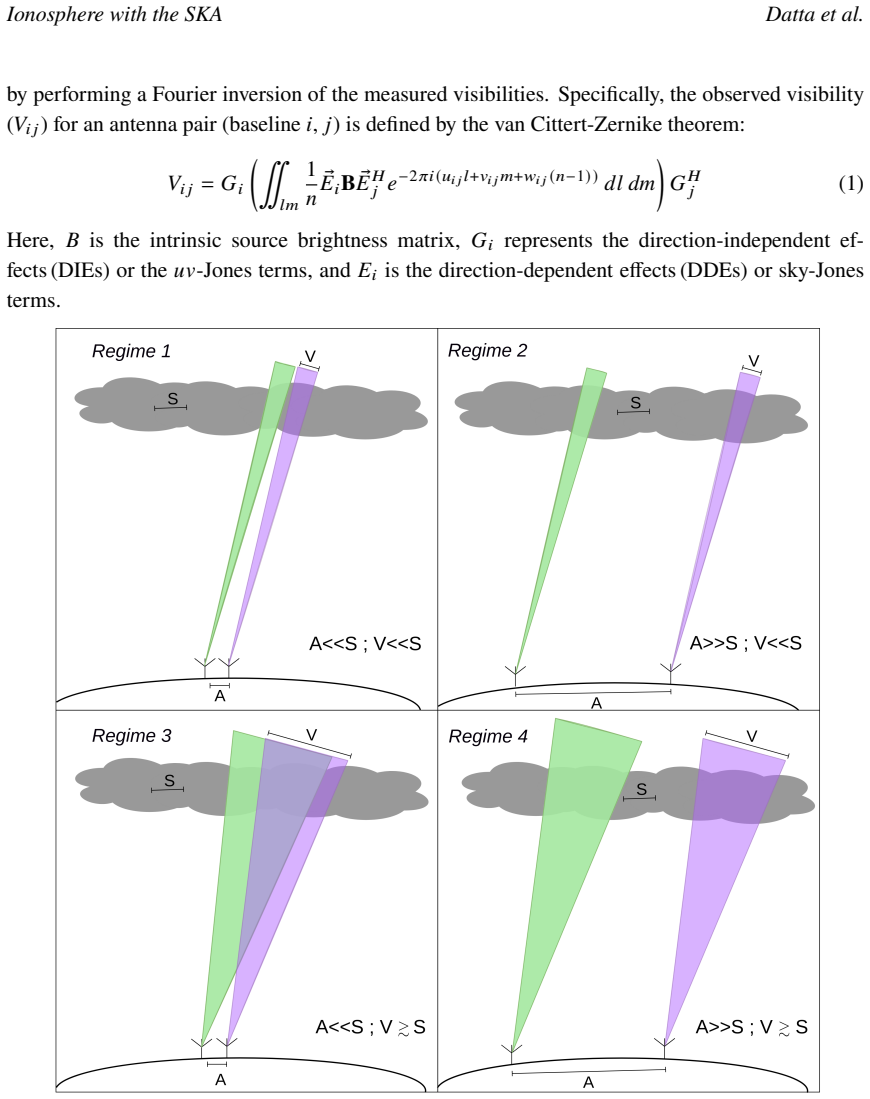
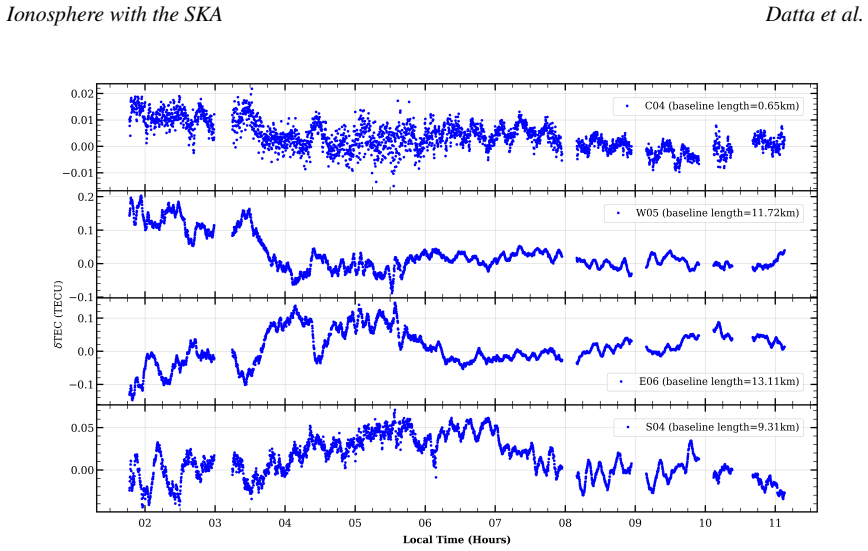
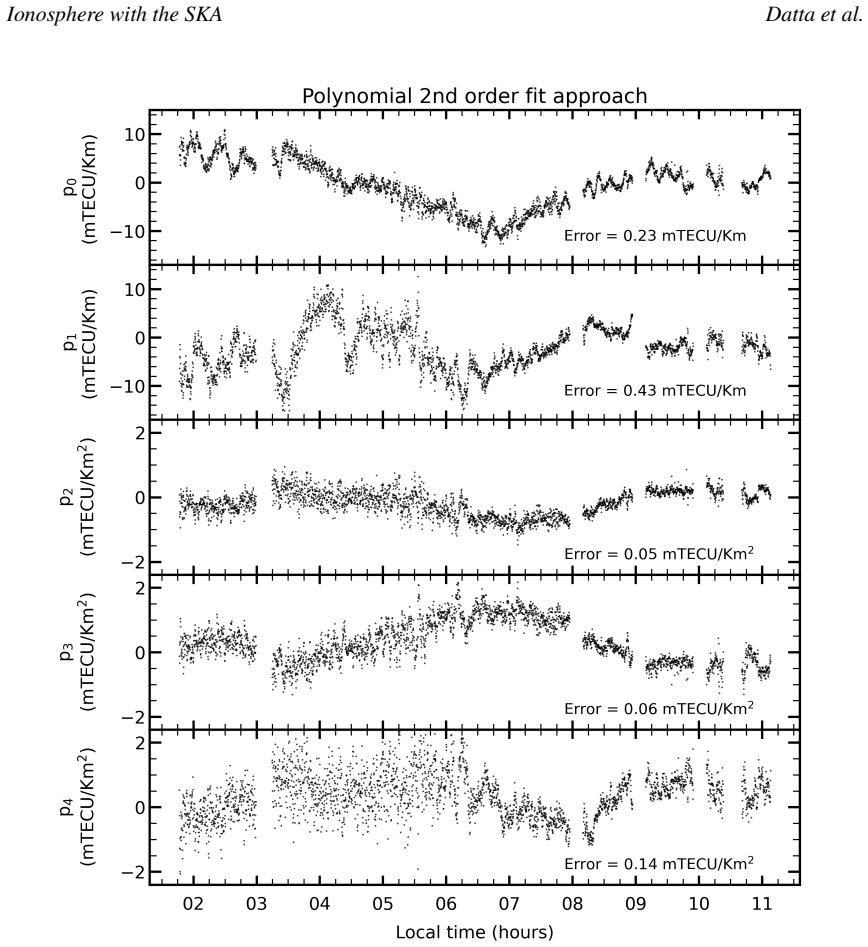
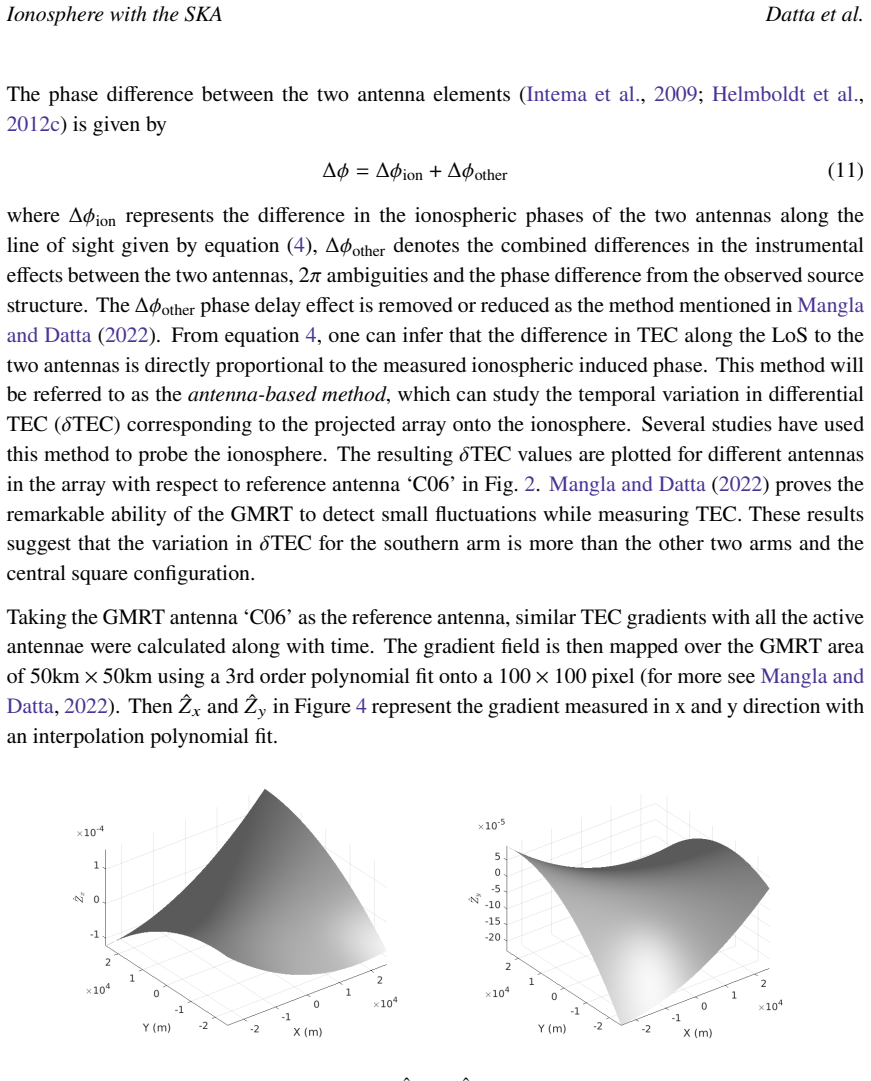
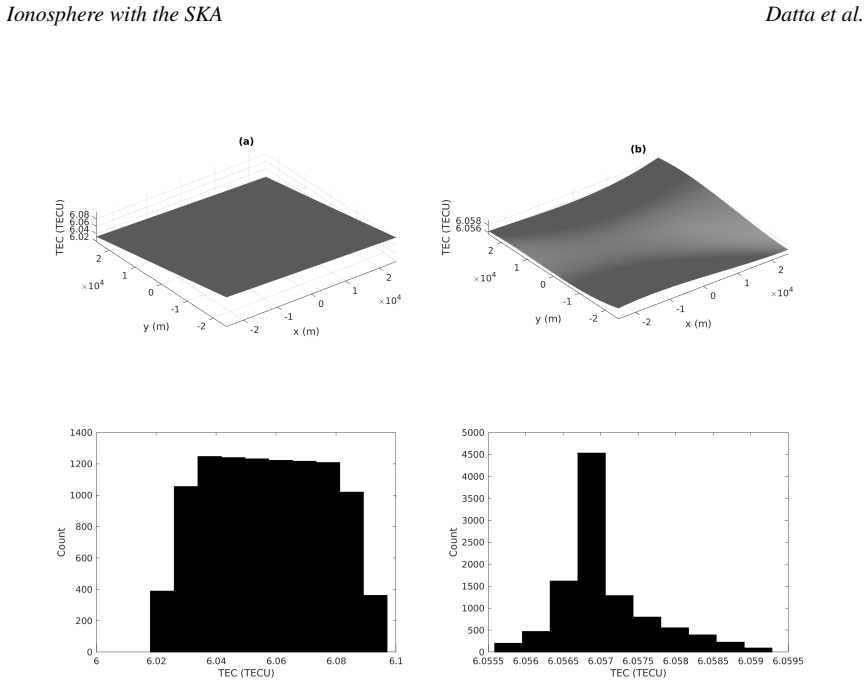
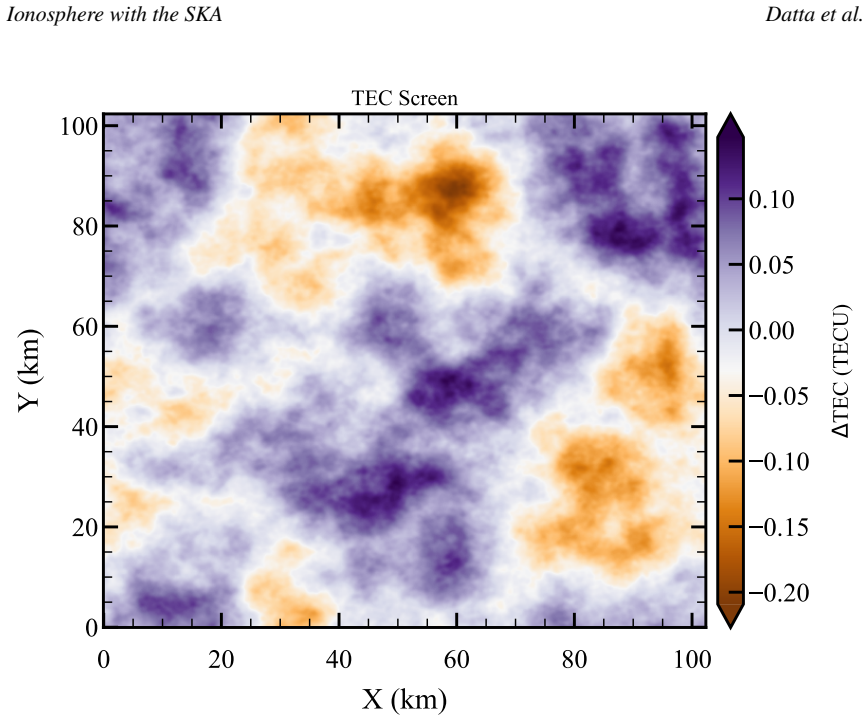
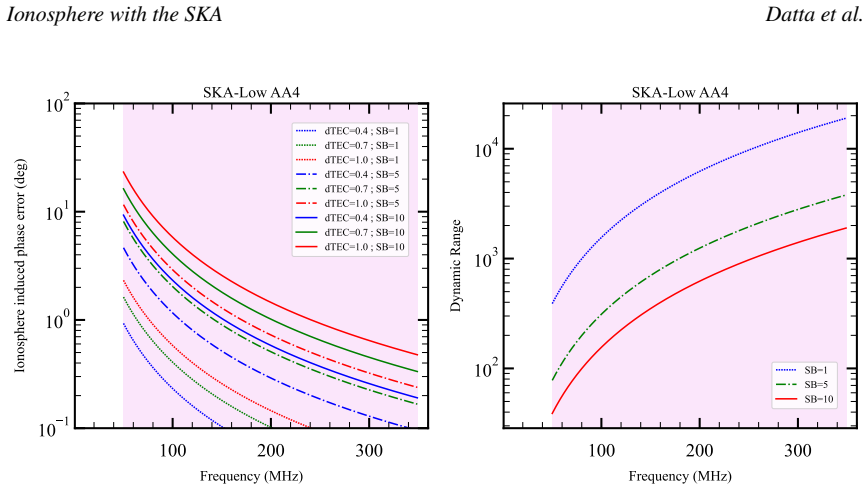
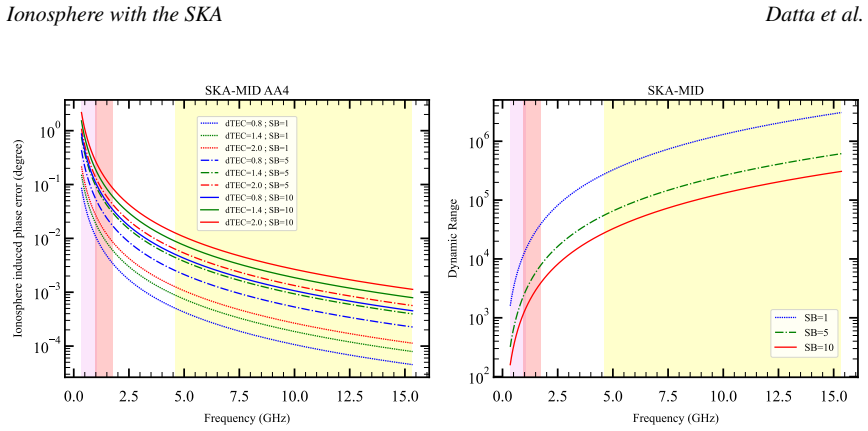
read the original abstract
The Earth's ionosphere introduces systematic effects that limit the performance of radio interferometers operating at low frequencies ($\lesssim 1$\,GHz). These ionospheric effects intensify during periods of heightened geomagnetic activity or for observations with extended baseline configurations. As each Pathfinder telescope operates at a different magnetic latitude, they experience distinct ionospheric regimes, offering complementary insights into ionospheric behaviour. In this work, we present a comparative study of ionospheric disturbances using observations from the uGMRT, VLA, MWA, and LOFAR, spanning a wide range of geographic and geomagnetic conditions. We present both antenna-based and field-based analyses to quantify phase fluctuations, positional offsets, and scintillation effects across these arrays. The measured total electron content (TEC) gradients reveal variations in spatial and temporal ionospheric structures with sensitivities that exceed those achievable with Global Navigation Satellite System (GNSS) measurements. By combining multi-telescope results, we assess the impact of ionospheric turbulence on calibration and imaging fidelity, and use these findings to forecast the expected ionospheric effects on observations with SKA-Low and SKA-Mid.
Editorial analysis
A structured set of objections, weighed in public.
Referee Report
Summary. The manuscript presents a comparative study of ionospheric disturbances observed with uGMRT, VLA, MWA, and LOFAR across a range of geographic and geomagnetic conditions. It reports both antenna-based and field-based analyses that quantify phase fluctuations, positional offsets, and scintillation, compares measured TEC gradients to GNSS sensitivities, evaluates impacts on calibration and imaging fidelity, and uses the combined results to forecast ionospheric effects expected for SKA-Low and SKA-Mid.
Significance. If the representativeness of the pathfinder regimes for SKA sites can be established, the multi-telescope comparison would supply useful empirical constraints on ionospheric turbulence statistics at low frequencies and aid SKA observing strategies. The emphasis on TEC gradients exceeding GNSS sensitivity is a concrete strength of the approach.
major comments (1)
- [Abstract] Abstract: the forecasting step for SKA-Low and SKA-Mid rests on the assumption that ionospheric turbulence statistics measured at the pathfinder sites can be mapped or extrapolated to the SKA sites. No quantitative comparison of geomagnetic latitudes, no adjustment via an ionospheric model (e.g., IRI or NeQuick) for latitude or solar-cycle differences, and no cross-validation against independent SKA-site data or simulations are described. This assumption is load-bearing for the central claim.
Simulated Author's Rebuttal
We thank the referee for highlighting this important point regarding the extrapolation to SKA sites. We address the concern directly below and will revise the manuscript to provide a clearer justification.
read point-by-point responses
-
Referee: [Abstract] Abstract: the forecasting step for SKA-Low and SKA-Mid rests on the assumption that ionospheric turbulence statistics measured at the pathfinder sites can be mapped or extrapolated to the SKA sites. No quantitative comparison of geomagnetic latitudes, no adjustment via an ionospheric model (e.g., IRI or NeQuick) for latitude or solar-cycle differences, and no cross-validation against independent SKA-site data or simulations are described. This assumption is load-bearing for the central claim.
Authors: We agree that the manuscript does not contain an explicit quantitative comparison of geomagnetic latitudes or model-based adjustments, and that this weakens the forecasting claim. The pathfinders were chosen to sample a range of latitudes and conditions (MWA at a latitude comparable to SKA-Low; LOFAR, VLA and uGMRT providing mid- and higher-latitude coverage), but we did not tabulate or scale the statistics accordingly. In revision we will add a concise comparison of geomagnetic latitudes for all sites versus the SKA locations, together with a short discussion of latitude-dependent ionospheric behaviour drawn from the literature. We will also note the solar-cycle phase of the observations. This will make the extrapolation step more transparent. We do not have access to independent SKA-site data or new simulations, so cross-validation of that form is not feasible at present. revision: yes
Circularity Check
No circularity; empirical comparison across independent instruments
full rationale
The paper describes a data-driven comparative analysis of ionospheric effects measured directly from uGMRT, VLA, MWA, and LOFAR observations at different latitudes. These measurements are used to assess impacts and forecast SKA effects via empirical combination. No equations, fitted parameters renamed as predictions, self-citations as load-bearing premises, or self-definitional steps appear in the provided text. The forecasting step relies on an external representativeness assumption rather than reducing to the input data by construction. This is a standard observational study with independent external benchmarks.
Axiom & Free-Parameter Ledger
Reference graph
Works this paper leans on
-
[1]
The Cosmic 21-cm Revolution , publisher =
Chapman, Emma and Jeli\'c, Vibor , title =. The Cosmic 21-cm Revolution , publisher =. 2019 , series =. doi:10.1088/2514-3433/ab4a73ch6 , isbn =
-
[2]
Mesarcik, Michael and Boonstra, Albert-Jan and Ranguelova, Elena and van Nieuwpoort, Rob V , title =. , volume =. 2022 , month =. doi:10.1093/mnras/stac2503 , url =
-
[3]
RFI detection with spiking neural networks. , keywords =. doi:10.1017/pasa.2024.27 , archivePrefix =. 2311.14303 , primaryClass =
-
[4]
Post-correlation radio frequency interference classification methods. MNRAS , keywords =. doi:10.1111/j.1365-2966.2010.16471.x , archivePrefix =. 1002.1957 , primaryClass =
-
[5]
Understanding Instrumental Stokes Leakage in Murchison Widefield Array Polarimetry
Understanding instrumental Stokes leakage in Murchison Widefield Array polarimetry. Radio Science , keywords =. doi:10.1002/2014RS005517 , archivePrefix =. 1412.4466 , primaryClass =
work page internal anchor Pith review Pith/arXiv arXiv doi:10.1002/2014rs005517
-
[6]
The Effects of Polarized Foregrounds on 21cm Epoch of Reionization Power Spectrum Measurements
The Effects of Polarized Foregrounds on 21 cm Epoch of Reionization Power Spectrum Measurements. , keywords =. doi:10.1088/0004-637X/769/2/154 , archivePrefix =. 1302.0876 , primaryClass =
work page internal anchor Pith review Pith/arXiv arXiv doi:10.1088/0004-637x/769/2/154
-
[7]
On the contamination of the global 21-cm signal from polarized foregrounds. , keywords =. doi:10.1093/mnras/stz2425 , archivePrefix =. 1908.05303 , primaryClass =
-
[8]
Simulations of Galactic polarized synchrotron emission for Epoch of Reionization observations
Simulations of Galactic polarized synchrotron emission for Epoch of Reionization observations. , keywords =. doi:10.1093/mnras/sty1457 , archivePrefix =. 1802.03060 , primaryClass =
work page internal anchor Pith review Pith/arXiv arXiv doi:10.1093/mnras/sty1457
-
[9]
Constraining Polarized Foregrounds for EoR Experiments. II. Polarization Leakage Simulations in the Avoidance Scheme. , keywords =. doi:10.3847/1538-4357/aa8b73 , archivePrefix =. 1707.04109 , primaryClass =
work page internal anchor Pith review Pith/arXiv arXiv doi:10.3847/1538-4357/aa8b73
-
[10]
Polarization leakage in epoch of reionization windows - III. Wide-field effects of narrow-field arrays. , keywords =. doi:10.1093/mnras/sty258 , archivePrefix =. 1706.00875 , primaryClass =
work page internal anchor Pith review Pith/arXiv arXiv doi:10.1093/mnras/sty258
-
[11]
Polarization leakage in epoch of reionization windows - II. Primary beam model and direction-dependent calibration. , keywords =. doi:10.1093/mnras/stw1863 , archivePrefix =. 1604.04534 , primaryClass =
work page internal anchor Pith review Pith/arXiv arXiv doi:10.1093/mnras/stw1863
-
[12]
Polarization leakage in Epoch of Reionization windows: I. LOFAR observations of the 3C196 field
Polarization leakage in epoch of reionization windows - I. Low Frequency Array observations of the 3C196 field. , keywords =. doi:10.1093/mnras/stv1107 , archivePrefix =. 1503.01644 , primaryClass =
work page internal anchor Pith review Pith/arXiv arXiv doi:10.1093/mnras/stv1107
-
[13]
A 189 MHz, 2400 deg ^ 2 Polarization Survey with the Murchison Widefield Array 32-element Prototype. , keywords =. doi:10.1088/0004-637X/771/2/105 , archivePrefix =. 1305.6047 , primaryClass =
work page internal anchor Pith review Pith/arXiv arXiv doi:10.1088/0004-637x/771/2/105
-
[14]
LOFAR Deep Fields: Probing faint Galactic polarised emission in ELAIS-N1. , keywords =. doi:10.1051/0004-6361/202245124 , archivePrefix =. 2303.13152 , primaryClass =
-
[15]
Faraday tomography of LoTSS-DR2 data. III. Revealing the Local Bubble and the complex of local interstellar clouds in the high-latitude inner Galaxy. , keywords =. doi:10.1051/0004-6361/202450082 , archivePrefix =. 2406.14679 , primaryClass =
-
[16]
Faraday tomography of LoTSS-DR2 data. I. Faraday moments in the high-latitude outer Galaxy and revealing Loop III in polarisation. , keywords =. doi:10.1051/0004-6361/202142244 , archivePrefix =. 2203.01351 , primaryClass =
-
[17]
Faraday Rotation Measure Synthesis
Faraday rotation measure synthesis. , keywords =. doi:10.1051/0004-6361:20052990 , archivePrefix =. astro-ph/0507349 , primaryClass =
work page internal anchor Pith review Pith/arXiv arXiv doi:10.1051/0004-6361:20052990
-
[18]
Low-frequency Observations of Linearly Polarized Structures in the Interstellar Medium near the South Galactic Pole. , keywords =. doi:10.3847/0004-637X/830/1/38 , archivePrefix =. 1607.05779 , primaryClass =
work page internal anchor Pith review Pith/arXiv arXiv doi:10.3847/0004-637x/830/1/38
-
[19]
The GMRT EoR experiment: limits on polarized sky brightness at 150 MHz. , keywords =. doi:10.1111/j.1365-2966.2009.14980.x , archivePrefix =. 0807.1056 , primaryClass =
-
[20]
Linear polarization structures in LOFAR observations of the interstellar medium in the 3C196 field
Linear polarization structures in LOFAR observations of the interstellar medium in the 3C 196 field. , keywords =. doi:10.1051/0004-6361/201526638 , archivePrefix =. 1508.06650 , primaryClass =
work page internal anchor Pith review Pith/arXiv arXiv doi:10.1051/0004-6361/201526638
-
[21]
Initial LOFAR observations of epoch of reionization windows. II. Diffuse polarized emission in the ELAIS-N1 field. , keywords =. doi:10.1051/0004-6361/201423998 , archivePrefix =. 1407.2093 , primaryClass =
work page internal anchor Pith review Pith/arXiv arXiv doi:10.1051/0004-6361/201423998 2093
-
[22]
Foregrounds for observations of the cosmological 21 cm line. II. Westerbork observations of the fields around 3C 196 and the North Celestial Pole. , keywords =. doi:10.1051/0004-6361/200913420 , archivePrefix =. 1002.4177 , primaryClass =
work page internal anchor Pith review Pith/arXiv arXiv doi:10.1051/0004-6361/200913420
-
[23]
Foregrounds for observations of the cosmological 21 cm line. I. First Westerbork measurements of Galactic emission at 150 MHz in a low latitude field. , keywords =. doi:10.1051/0004-6361/200911627 , archivePrefix =. 0904.0404 , primaryClass =
work page internal anchor Pith review Pith/arXiv arXiv doi:10.1051/0004-6361/200911627
-
[24]
and Lightman, Alan P
Rybicki, George B. and Lightman, Alan P. , title =. 1979 , address =
1979
-
[25]
, title =
Pacholczyk, Andrzej G. , title =. 1970 , address =
1970
-
[26]
Burn, B. J. , title =. , year =
-
[27]
Realistic simulations of the Galactic polarized foreground: consequences for 21-cm reionization detection experiments. , keywords =. doi:10.1111/j.1365-2966.2010.17407.x , archivePrefix =. 1007.4135 , primaryClass =
-
[28]
2015 , publisher=
Advancing Astrophysics with the Square Kilometre Array (AASKA14) , author=. 2015 , publisher=
2015
-
[29]
Wilensky, Michael J. and Morales, Miguel F. and Hazelton, Bryna J. and Star, Pyxie L. and Barry, Nichole and Byrne, Ruby and Jordan, C. H. and Jacobs, Daniel C. and Pober, Jonathan C. and Trott, C. M. , year=. Evidence of Ultrafaint Radio Frequency Interference in Deep 21 cm Epoch of Reionization Power Spectra with the Murchison Wide-field Array , volume=...
-
[30]
Wang, Yu and Zhang, Hai-Yan and Hu, Hao and Huang, Shi-Jie and Zhu, Wei-Wei and Zhi, Guo-Ping and Zhang, Tao and Fan, Zhan-Chun and Yang, Li , year =. Satellite. doi:10.1088/1674-4527/21/1/18 , journal =
-
[31]
Aggregate Interference Analysis of a LEO Satellite Constellation into the Radio Astronomy Observatory , year=
Yilmaz, Mustafa Harun , booktitle=. Aggregate Interference Analysis of a LEO Satellite Constellation into the Radio Astronomy Observatory , year=
-
[32]
Proceedings of the 4th URSI Atlantic Radio Science Conference (AT-RASC) , year =
Giorgio Siringo and Sean Dougherty , title =. Proceedings of the 4th URSI Atlantic Radio Science Conference (AT-RASC) , year =
-
[33]
Radio frequency interference from radio navigation satellite systems: simulations and comparison to
Engelbrecht, Brandon N and Santos, Mario G and Fonseca, José and Li, Yichao and Wang, Jingying and Irfan, Melis O and Harper, Stuart E and Grainge, Keith and Bull, Philip and Carucci, Isabella P and Cunnington, Steven and Pourtsidou, Alkistis and Spinelli, Marta and Wolz, Laura , year =. Radio frequency interference from radio navigation satellite systems...
-
[34]
Zhang, X. and Zarka, P. and Viou, C. and Loh, A. and Bassa, C. G. and Duchene, Q. and Tasse, C. and Grießmeier, J.-M. and Turner, J. D. and Ulyanov, O. and Koopmans, L. V. E. and Mertens, F. and Zakharenko, V. and Briand, C. and Cecconi, B. and Vermeulen, R. and Konovalenko, O. and Girard, J. N. and Corbel, S. , year=. Broadband polarized radio emission d...
-
[35]
Nhan, Bang D. and De Pree, Christopher G. and Iverson, Matt and Gregory, Brenne and Dueri, Daniel and Beasley, Anthony and Schepis, Brian , year =. Toward. doi:10.3847/2041-8213/ad6b24 , journal =
-
[36]
Astronomy & Astrophysics , keywords =
Unintended electromagnetic radiation from Starlink satellites detected with LOFAR between 110 and 188 MHz. Astronomy & Astrophysics , keywords =. doi:10.1051/0004-6361/202346374 , archivePrefix =. 2307.02316 , primaryClass =
-
[37]
Comparing foreground removal techniques for recovery of the LOFAR-EoR 21 cm power spectrum. , keywords =. doi:10.1093/mnras/staa3446 , archivePrefix =. 2011.01284 , primaryClass =
-
[38]
A.Tripathi,A.Datta,A.Mazumder,andS.Majumdar.J.Cosmol.Astropart.Phys.,2025(10):035, Oct
Comparing sampling techniques to chart parameter space of 21 cm global signal with Artificial Neural Networks. , keywords =. doi:10.1088/1475-7516/2024/10/041 , archivePrefix =. 2406.15832 , primaryClass =
-
[39]
Tripathi, Anshuman and Datta, Abhirup and Choudhury, Madhurima and Majumdar, Suman , title = ". , volume =. 2024 , month =. doi:10.1093/mnras/stae078 , url =
-
[40]
Extracting the 21 cm Global signal using artificial neural networks. , keywords =. doi:10.1093/mnras/stz3107 , archivePrefix =. 1911.02580 , primaryClass =
-
[41]
Using artificial neural networks to extract the 21-cm global signal from the EDGES data. , keywords =. doi:10.1093/mnras/stab180 , archivePrefix =. 2012.00028 , primaryClass =
-
[42]
The Tiered Radio Extragalactic Continuum Simulation (T-RECS)
The Tiered Radio Extragalactic Continuum Simulation (T-RECS). , keywords =. doi:10.1093/mnras/sty2603 , archivePrefix =. 1805.05222 , primaryClass =
work page internal anchor Pith review Pith/arXiv arXiv doi:10.1093/mnras/sty2603
-
[43]
Observing the reionization: effect of calibration and position errors on realistic observation conditions. , keywords =. doi:10.1093/mnras/stac1994 , archivePrefix =. 2207.06169 , primaryClass =
-
[44]
Extracting the 21-cm power spectrum and the reionization parameters from mock data sets using artificial neural networks. , keywords =. doi:10.1093/mnras/stac736 , archivePrefix =. 2112.13866 , primaryClass =
-
[45]
Impact of Calibration and Position Errors on Astrophysical Parameters of the 21cm Signal. arXiv e-prints , keywords =. doi:10.48550/arXiv.2502.20962 , archivePrefix =. 2502.20962 , primaryClass =
-
[46]
image recovery , author=
Deep learning approach for identification of Hii regions during reionization in 21-cm observations--III. image recovery , author=. , pages=. 2025 , publisher=
2025
-
[47]
Foreground contamination , author=
Deep learning approach for identification of h ii regions during reionization in 21-cm observations--II. Foreground contamination , author=. , volume=. 2024 , publisher=
2024
-
[48]
, volume=
Deep learning approach for identification of H II regions during reionization in 21-cm observations , author=. , volume=. 2021 , publisher=
2021
-
[49]
arXiv preprint arXiv:2508.13265 , year=
Field-level Reconstruction from Foreground-Contaminated 21-cm Maps , author=. arXiv preprint arXiv:2508.13265 , year=
-
[50]
, volume=
Recovering the wedge modes lost to 21-cm foregrounds , author=. , volume=. 2021 , publisher=
2021
-
[51]
Physical Review D , volume=
21-cm foreground removal using AI and the frequency-difference technique , author=. Physical Review D , volume=. 2024 , publisher=
2024
-
[52]
Journal of Cosmology and Astroparticle Physics , volume=
deep21: a deep learning method for 21 cm foreground removal , author=. Journal of Cosmology and Astroparticle Physics , volume=. 2021 , publisher=
2021
-
[53]
, volume=
Separating the EoR signal with a convolutional denoising autoencoder: a deep-learning-based method , author=. , volume=. 2019 , publisher=
2019
-
[54]
The Astrophysical Journal , volume=
Extracting the Epoch of Reionization Signal with 3D U-Net Neural Networks Using a Data-driven Systematic Effect Model , author=. The Astrophysical Journal , volume=. 2025 , publisher=
2025
-
[55]
, volume=
Retrieving the 21-cm signal from the Epoch of Reionization with learnt Gaussian process kernels , author=. , volume=. 2024 , publisher=
2024
-
[56]
, volume=
21-cm signal from the Epoch of Reionization: a machine learning upgrade to foreground removal with Gaussian process regression , author=. , volume=. 2024 , publisher=
2024
-
[57]
, volume=
Optimal identification of H II regions during reionization in 21-cm observations , author=. , volume=. 2018 , publisher=
2018
-
[58]
arXiv preprint arXiv:2505.06350 , year=
Mapping neutral islands during end stages of reionization with photometric intergalactic medium tomography , author=. arXiv preprint arXiv:2505.06350 , year=
-
[59]
1990 , publisher=
Ionospheric radio , author=. 1990 , publisher=
1990
-
[60]
Hernández-Pajares, M. and Juan, J. M. and Sanz, J. , title =. Journal of Geophysical Research: Space Physics , volume =. doi:10.1029/2005JA011474 , abstract =
-
[61]
Synthesis Imaging in Radio Astronomy II , year = 1999, editor =
Fundamentals of Radio Interferometry. Synthesis Imaging in Radio Astronomy II , year = 1999, editor =
1999
-
[62]
Estimate of higher order ionospheric errors in GNSS positioning. Radio Science , keywords =. doi:10.1029/2007RS003817 , adsurl =
-
[63]
A. S. Cohen and H. J. A. Röttgering , title =. The Astronomical Journal , abstract =. doi:10.1088/0004-6256/138/2/439 , url =
-
[64]
A new technique for spectral analysis of ionospheric TEC fluctuations observed with the Very Large Array VHF system: From QP echoes to MSTIDs. Radio Science , keywords =. doi:10.1029/2011RS004787 , archivePrefix =. 1201.3874 , primaryClass =
work page internal anchor Pith review Pith/arXiv arXiv doi:10.1029/2011rs004787
-
[65]
Power spectrum analysis of ionospheric fluctuations with the Murchison Widefield Array
Power spectrum analysis of ionospheric fluctuations with the Murchison Widefield Array. Radio Science , keywords =. doi:10.1002/2015RS005711 , archivePrefix =. 1506.01798 , primaryClass =
work page internal anchor Pith review Pith/arXiv arXiv doi:10.1002/2015rs005711
-
[66]
Current Science , year = 1991, month = jan, volume =
The Giant Metre-Wave Radio Telescope. Current Science , year = 1991, month = jan, volume =
1991
-
[67]
Current Science , year = 2017, month = aug, volume =
The upgraded GMRT: opening new windows on the radio Universe. Current Science , year = 2017, month = aug, volume =. doi:10.18520/cs/v113/i04/707-714 , adsurl =
-
[68]
Nature , year = 1946, month = may, volume =
Two Anomalies in the Ionosphere. Nature , year = 1946, month = may, volume =. doi:10.1038/157691a0 , adsurl =
-
[69]
Ionospheric Irregularities Observed During the GLEAM Survey. Radio Science , keywords =. doi:10.1029/2020RS007106 , adsurl =
-
[70]
A study of precursors to equatorial spread F using the Giant Meterwave Radio Telescope. Radio Science , keywords =. doi:10.1029/2007RS003667 , adsurl =
-
[71]
Mevius, M. and van der Tol, S. and Pandey, V. N. and Vedantham, H. K. and Brentjens, M. A. and de Bruyn, A. G. and Abdalla, F. B. and Asad, K. M. B. and Bregman, J. D. and Brouw, W. N. and Bus, S. and Chapman, E. and Ciardi, B. and Fernandez, E. R. and Ghosh, A. and Harker, G. and Iliev, I. T. and Jelić, V. and Kazemi, S. and Koopmans, L. V. E. and Noorda...
-
[72]
The effect of the ionosphere on ultra-low-frequency radio-interferometric observations , DOI= "10.1051/0004-6361/201833012", url= "https://doi.org/10.1051/0004-6361/201833012", journal =
-
[73]
Wayth, R. B. and Lenc, E. and Bell, M. E. and Callingham, J. R. and Dwarakanath, K. S. and Franzen, T. M. O. and For, B.-Q. and Gaensler, B. and Hancock, P. and Hindson, L. and et al. , year=. GLEAM: The GaLactic and Extragalactic All-Sky MWA Survey , volume=. doi:10.1017/pasa.2015.26 , journal=
-
[74]
Climatology of midlatitude ionospheric disturbances from the Very Large Array Low-frequency Sky Survey. Radio Science , keywords =. doi:10.1029/2012RS005025 , archivePrefix =. 1209.1030 , primaryClass =
work page internal anchor Pith review Pith/arXiv arXiv doi:10.1029/2012rs005025
-
[75]
Bounding higher-order ionosphere errors for the dual-frequency GPS user. Radio Science , keywords =. doi:10.1029/2007RS003772 , adsurl =
-
[76]
Synthesis Imaging in Radio Astronomy II , year = 1999, editor =
Self-Calibration. Synthesis Imaging in Radio Astronomy II , year = 1999, editor =
1999
-
[77]
Advances in Space Research , keywords =
Performance of NavIC for studying the ionosphere at an EIA region in India. Advances in Space Research , keywords =. doi:10.1016/j.asr.2019.12.019 , archivePrefix =. 2001.02964 , primaryClass =
-
[78]
LOFAR Facet Calibration. ApJS , keywords =. doi:10.3847/0067-0049/223/1/2 , archivePrefix =. 1601.05422 , primaryClass =
work page internal anchor Pith review Pith/arXiv arXiv doi:10.3847/0067-0049/223/1/2
-
[79]
Fejer, B. G and Kelley, M. C. , title =. Reviews of Geophysics , volume =. doi:https://doi.org/10.1029/RG018i002p00401 , url =. https://agupubs.onlinelibrary.wiley.com/doi/pdf/10.1029/RG018i002p00401 , abstract =
-
[80]
Woodman, Ronald F. and La Hoz, César , title =. Journal of Geophysical Research (1896-1977) , volume =. doi:https://doi.org/10.1029/JA081i031p05447 , abstract =
discussion (0)
Sign in with ORCID, Apple, or X to comment. Anyone can read and Pith papers without signing in.