Indigenizing the Drake Equation: how Indigenous methods can help us understand life in the Milky Way Galaxy
Pith reviewed 2026-06-26 00:58 UTC · model grok-4.3
The pith
The Drake Equation yields a dramatically different view of galactic life when viewed through Indigenous methods.
A machine-rendered reading of the paper's core claim, the machinery that carries it, and where it could break.
Core claim
The Drake Equation, when considered through the lens of Indigenous methods and sciences, leads to a dramatically different view of life in our Galaxy than the one produced by traditional scientific approaches and their associated biases.
What carries the argument
The Drake Equation reinterpreted using Indigenous methods and sciences
Load-bearing premise
Traditional Drake Equation discussions contain identifiable biases that Indigenous methods address as a distinct framework capable of producing a fundamentally altered understanding.
What would settle it
A term-by-term application of specific Indigenous methods to the Drake Equation that produces estimates and search priorities indistinguishable from conventional scientific results.
Figures
read the original abstract
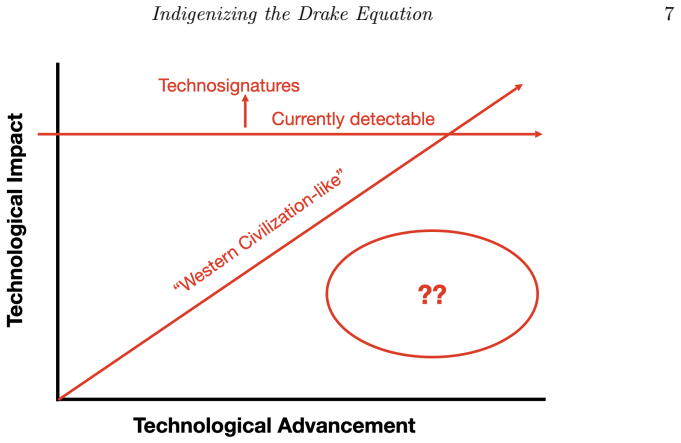
The Drake Equation is a thought experiment whose purpose is to understand the ingredients necessary for life and advanced technological civilizations to exist on other worlds in our galaxy. However, beyond reflecting on life on Earth, we have no knowledge of many of these ingredients, such as the number of planets that have life, the number with intelligent life, the number with advanced civilizations, and the lifetimes of these civilizations. In this work, I will review the Drake Equation and the biases that scientists have traditionally had in discussing this equation and how it has led to the current searches of biological and technological signatures. I will discuss how the Drake Equation looks different if we consider it through the lens of Indigenous methods and sciences and how these methods would lead to a dramatically different view of life in our Galaxy.
Editorial analysis
A structured set of objections, weighed in public.
Referee Report
Summary. The paper reviews the Drake Equation as a framework for estimating the number of advanced civilizations in the Milky Way, identifies biases in conventional scientific discussions of its parameters, and argues that applying Indigenous methods and sciences would produce a dramatically different perspective on the distribution of life and technological civilizations in the galaxy.
Significance. If substantiated, the work could encourage epistemological diversity in astrobiology by integrating non-Western knowledge systems into discussions of extraterrestrial life. The manuscript does not supply machine-checked proofs, reproducible code, parameter-free derivations, or falsifiable predictions, so its contribution remains conceptual rather than quantitative.
major comments (2)
- [Abstract] Abstract: The assertion that an Indigenous lens 'would lead to a dramatically different view of life in our Galaxy' is not accompanied by any explicit redefinition, re-prioritization, or numerical shift in the standard Drake parameters (R*, fp, ne, fl, fi, fc, L) or by a worked example demonstrating how Indigenous frameworks alter a term's value, prior, or interpretation in a falsifiable manner.
- [Abstract] Abstract and introduction: The claim that traditional approaches contain identifiable biases that Indigenous methods can correct rests on the premise that these methods constitute a distinct, applicable framework, yet no external benchmark, independent grounding, or comparative analysis is supplied to establish this distinction or its corrective effect.
Simulated Author's Rebuttal
We thank the referee for their constructive comments. Our manuscript is a conceptual exploration of how Indigenous methods might reframe discussions of the Drake Equation and astrobiology, rather than a quantitative model. We respond to each major comment below.
read point-by-point responses
-
Referee: [Abstract] Abstract: The assertion that an Indigenous lens 'would lead to a dramatically different view of life in our Galaxy' is not accompanied by any explicit redefinition, re-prioritization, or numerical shift in the standard Drake parameters (R*, fp, ne, fl, fi, fc, L) or by a worked example demonstrating how Indigenous frameworks alter a term's value, prior, or interpretation in a falsifiable manner.
Authors: The manuscript identifies that Indigenous approaches, which center relationality, long-term ecological balance, and non-technological expressions of intelligence, would re-prioritize parameters such as L and fc away from assumptions of expansionist technological civilizations. We agree an explicit qualitative example would clarify the claim and will revise the abstract and relevant sections to include one, for instance showing how fl could be interpreted through Indigenous ecological observations rather than probabilistic occurrence. No numerical shifts are provided, as the work remains conceptual and does not aim to assign values. revision: partial
-
Referee: [Abstract] Abstract and introduction: The claim that traditional approaches contain identifiable biases that Indigenous methods can correct rests on the premise that these methods constitute a distinct, applicable framework, yet no external benchmark, independent grounding, or comparative analysis is supplied to establish this distinction or its corrective effect.
Authors: The introduction and body discuss specific biases, including assumptions of linear technological progress and prioritization of detectable signatures. To address the need for grounding, we will revise to incorporate references to documented Indigenous science frameworks, enabling the requested comparative analysis of distinctions and corrective potential. revision: yes
Circularity Check
No circularity; conceptual perspective without load-bearing derivations or self-referential reductions.
full rationale
The supplied abstract and description contain no equations, parameter fits, uniqueness theorems, or self-citations. The paper states an intention to review biases and apply an Indigenous lens to produce a 'dramatically different view,' but this is presented as a forward-looking discussion rather than a derivation that reduces to its own inputs by construction. No steps match the enumerated circularity patterns; the text is self-contained as a perspective piece with no fitted predictions or ansatzes smuggled via citation.
Axiom & Free-Parameter Ledger
axioms (2)
- domain assumption Traditional scientific approaches to the Drake Equation contain biases that limit understanding of life in the galaxy.
- domain assumption Indigenous methods and sciences provide a distinct and valid alternative framework that alters the interpretation of the Drake Equation.
Reference graph
Works this paper leans on
-
[1]
B., Archer, A., et al
Acharyya, A., Adams, C. B., Archer, A., et al. 2023, AJ, 166, 3,
2023
-
[3]
M., Wang, J., Zinn, J
Boley, K. M., Wang, J., Zinn, J. C., et al. 2021, AJ, 162, 3,
2021
-
[4]
doi:10.3847/1538-3881/ac0e2d Borucki, W. J., Koch, D., Basri, G., et al. 2010, Science, 327, 5968,
-
[5]
doi:10.1126/science.1185402 Brown, M. E., Holman, M. J., & Batygin, K. 2024, AJ, 167, 4,
-
[8]
Neilson Deloria, V
8 Hilding R. Neilson Deloria, V. 1997 Red earth, white lies: Native Americans and the myth of scientific fact. Fulcrum Publishing Denning, K.,
1997
-
[9]
New York, Macmillan [1962]
Intelligent life in space.. New York, Macmillan [1962]. Elia, D., Molinari, S., Schisano, E., et al. 2022, ApJ, 941, 2,
1962
-
[10]
doi:10.3847/1538-4357/aca27d Ellis, J. and Humble, N. eds.,
-
[11]
University of Calgary Press
Mythologies of Outer Space. University of Calgary Press. Hart, M. H. 1975, QJRAS, 16,
1975
-
[12]
2018, Journal of Astrophysics and Astronomy, 39, 6,
Hippke, M. 2018, Journal of Astrophysics and Astronomy, 39, 6,
2018
-
[13]
doi:10.1007/s12036-018- 9566-x Jensen, D
-
[14]
U of Minnesota Press
The fourth world: An Indian reality. U of Minnesota Press. Ment, K. & Charbonneau, D. 2023, AJ, 165, 6,
2023
-
[15]
2023, AJ, 165, 265, doi: 10.3847/1538-3881/acd175
doi:10.3847/1538-3881/acd175 Neilson, H. & Lawler, S. 2019, Canadian Long Range Plan for Astronomy and Astrophysics White Papers, 2020,
-
[16]
doi:10.5281/zenodo.3754717 Noon, K., & De Napoli, K
-
[17]
First knowledges astronomy: Sky country. Thames & Hudson Australia. Prescod-Weinstein, C., Walkowicz, L. M., Tuttle, S., et al. 2020, arXiv:2001.00674. doi:10.48550/arXiv.2001.00674 Ricker, G. R., Vanderspek, R., Winn, J., et al. 2016, SPIE, 9904, 99042B. doi:10.1117/12.2232071 Saini, A.,
-
[18]
In If the Universe Is Teeming with Aliens
Of Fermi and paradox. In If the Universe Is Teeming with Aliens... WHERE IS EVERYBODY? Seventy-Five Solutions to the Fermi Paradox and the Problem of Ex- traterrestrial Life. Cham: Springer International Publishing. Zhu, W., Petrovich, C., Wu, Y., et al. 2018, ApJ, 860, 2,
2018
-
[19]
2018, ApJ, 860, 101, doi: 10.3847/1538-4357/aac6d5
doi:10.3847/1538-4357/aac6d5 Zuckerman, A., Ko, Z., Isaacson, H., et al. 2023, AJ, 165, 3,
-
[20]
doi:10.3847/1538-3881/acb342 Zuckerman, A., Davenport, J. R. A., Croft, S., et al. 2024, AJ, 167, 1,
-
[21]
doi:10.3847/1538- 3881/acfa6c
discussion (0)
Sign in with ORCID, Apple, or X to comment. Anyone can read and Pith papers without signing in.