IUU+DB: Tracking Illegal, Unreported, and Unregulated Fishing, Seafood Fraud, and Labor Abuse through LLM-driven Information Extraction
Pith reviewed 2026-06-26 22:12 UTC · model grok-4.3
The pith
Large language models can organize scattered documents into a structured global database of illegal fishing, fraud, and labor abuse.
A machine-rendered reading of the paper's core claim, the machinery that carries it, and where it could break.
Core claim
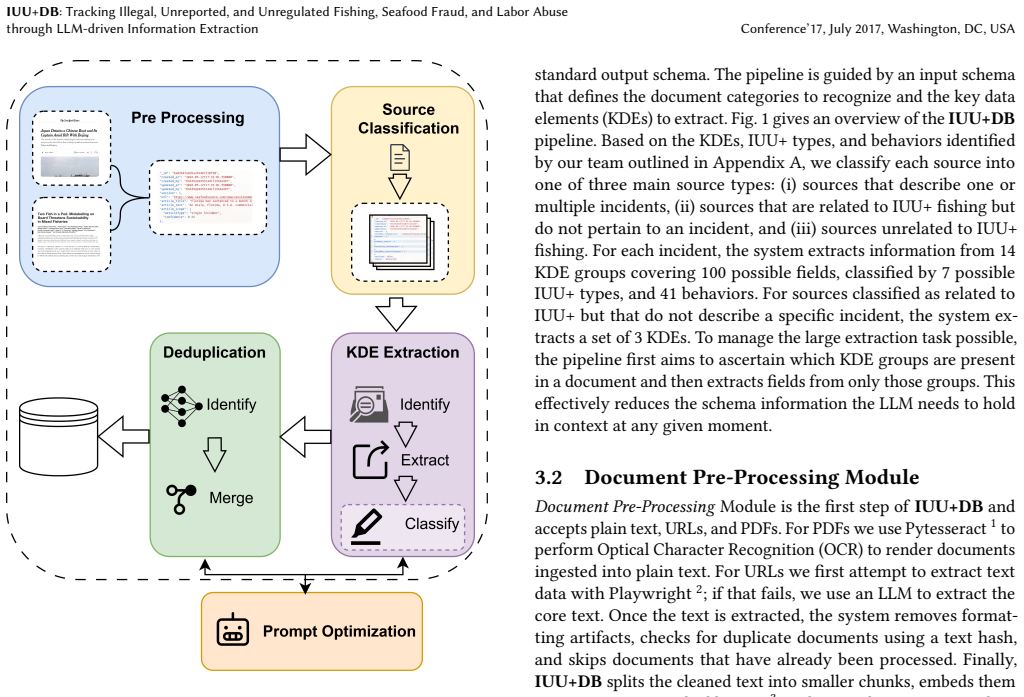
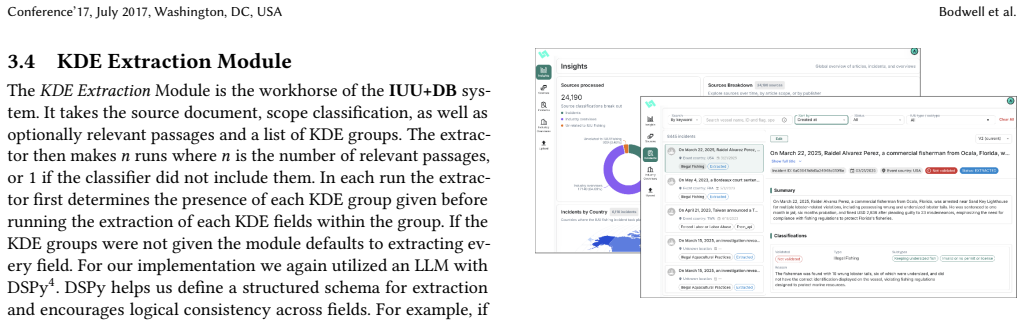
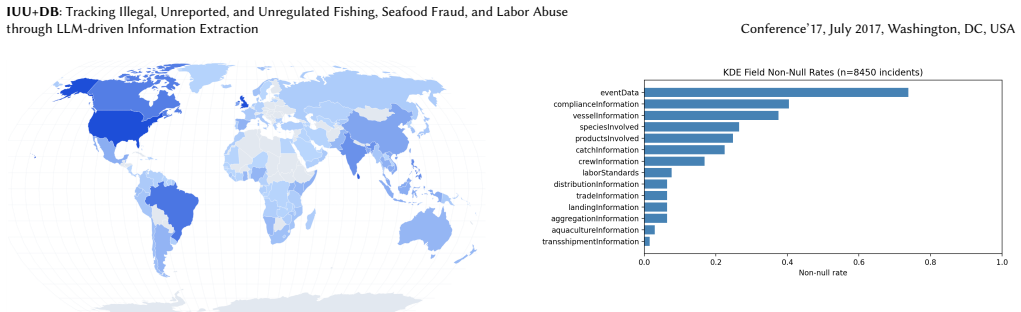
IUU+DB is a large language model driven system for building a global incident database of IUU+ activity. The system ingests heterogeneous documents, classifies whether they describe relevant incidents, extracts key data elements such as actors, locations, species, vessels, violations, and enforcement outcomes, and supports deduplication and trend analysis. Case studies and validation results show that IUU+DB can help organize fragmented evidence, surface geographic and behavioral hotspots, support fisheries-domain specific research in academia and non-government organizations, assist source and species risk assessments for industry, and provide support for policy implementation and targeted
What carries the argument
LLM pipeline that classifies documents for relevance and extracts structured fields (actors, locations, species, vessels, violations, enforcement outcomes) from heterogeneous sources.
If this is right
- Organizes fragmented evidence of IUU+ incidents into a coherent, queryable database.
- Surfaces geographic and behavioral hotspots in fishing violations and related crimes.
- Supports domain-specific research by academia and non-government organizations.
- Assists industry with source and species risk assessments.
- Aids government agencies in policy implementation and targeted enforcement.
Where Pith is reading between the lines
- Linking the database to ongoing news or satellite feeds could enable earlier detection of emerging incidents.
- Patterns across extracted fields might reveal previously unquantified connections between fishing violations and labor or fraud cases.
- The same extraction approach could be tested on documents about other environmental or trade crimes.
Load-bearing premise
Large language models can classify documents and extract accurate structured details about complex incidents from varied sources without substantial errors or biases.
What would settle it
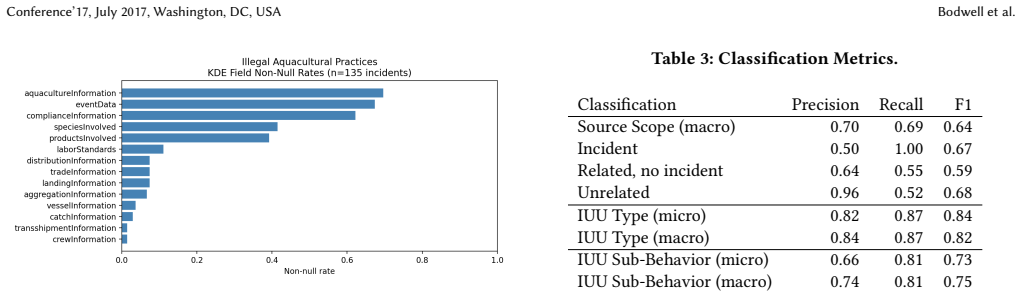
A side-by-side comparison of the system's classifications and extracted fields against human labels on a held-out sample of documents, measuring error rates in incident detection and field accuracy.
Figures
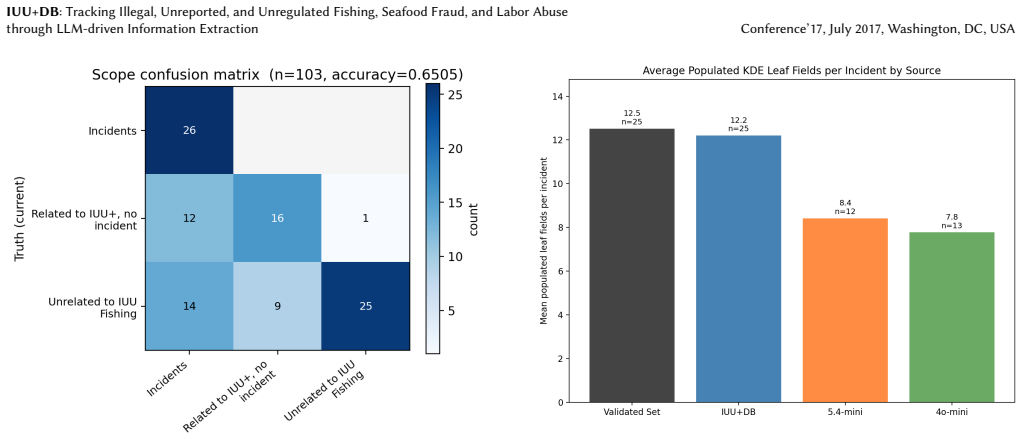
read the original abstract
Illegal, unreported, and unregulated fishing (IUU) traditionally refers to fishing activities that violate applicable laws or occur in areas that lack applicable laws. We propose the term IUU+ to capture a broader suite of fisheries sector environmental and associated supply chain trade-related crimes and behaviors. Although IUU+ activity is widely recognized as a serious threat to marine ecosystems, markets, and livelihoods, a quantitative understanding of these incidents, e.g., their frequency, geography, species, actors, and patterns in the type of illicit activity, remains difficult to obtain. We propose IUU+DB, a large language model driven system for building a global incident database of IUU+ activity. The system ingests heterogeneous documents, classifies whether they describe relevant incidents, extracts key data elements such as actors, locations, species, vessels, violations, and enforcement outcomes, and supports deduplication and trend analysis. Case studies and validation results show that IUU+DB can help organize fragmented evidence, surface geographic and behavioral hotspots, support fisheries-domain specific research in academia and non-government organizations, assist source and species risk assessments for industry, and provide support for policy implementation and targeted enforcement efforts to government agencies.
Editorial analysis
A structured set of objections, weighed in public.
Referee Report
Summary. The paper proposes IUU+DB, an LLM-driven pipeline that ingests heterogeneous documents on IUU+ activities (illegal, unreported, and unregulated fishing plus seafood fraud and labor abuse), classifies relevant incidents, extracts structured fields including actors, locations, species, vessels, violations, and enforcement outcomes, performs deduplication, and supports trend analysis. It asserts that case studies and validation results demonstrate the system's ability to organize evidence, identify geographic and behavioral hotspots, and aid research, industry risk assessments, and government policy/enforcement.
Significance. A reliable system for structuring fragmented IUU+ data would address a recognized gap in quantitative fisheries-crime research and could support evidence-based interventions in marine conservation and supply-chain governance. The manuscript's contribution is difficult to assess, however, because the central utility claims rest on unquantified extraction performance.
major comments (1)
- [Abstract] Abstract: the claim that 'case studies and validation results show that IUU+DB can help organize fragmented evidence, surface geographic and behavioral hotspots, support fisheries-domain specific research...' is unsupported by any reported quantitative metrics (precision, recall, F1, error rates), validation-set size, annotation protocol, or comparison to human gold labels. This is load-bearing because all downstream uses (deduplication, hotspot detection, risk assessment) presuppose reliable classification and extraction from heterogeneous sources.
Simulated Author's Rebuttal
We thank the referee for their review and the opportunity to clarify the manuscript. We address the concern about unsupported claims in the abstract below.
read point-by-point responses
-
Referee: [Abstract] Abstract: the claim that 'case studies and validation results show that IUU+DB can help organize fragmented evidence, surface geographic and behavioral hotspots, support fisheries-domain specific research...' is unsupported by any reported quantitative metrics (precision, recall, F1, error rates), validation-set size, annotation protocol, or comparison to human gold labels. This is load-bearing because all downstream uses (deduplication, hotspot detection, risk assessment) presuppose reliable classification and extraction from heterogeneous sources.
Authors: We agree that the abstract's language implies quantitative validation results that are not provided in the manuscript. The presented case studies are qualitative illustrations of the pipeline's outputs on real documents rather than a formal evaluation against gold labels. In the revision we will edit the abstract to remove the reference to 'validation results' and describe the case studies more precisely as demonstrations of functionality. We will also add an explicit limitations statement noting the absence of quantitative extraction metrics in this work. revision: yes
Circularity Check
No circularity; descriptive systems paper with no derivations or fitted parameters
full rationale
This is a systems-description paper proposing IUU+DB for LLM-driven document classification and extraction. No equations, mathematical derivations, parameter fittings, or prediction steps appear in the abstract or described content. Central claims rest on case studies and validation results whose accuracy is an empirical question, not a reduction to inputs by construction. Absence of quantitative metrics is a validation gap rather than circularity. No self-citation chains or ansatzes are invoked to justify any derivation.
Axiom & Free-Parameter Ledger
axioms (1)
- domain assumption Large language models can be prompted to accurately classify documents and extract structured information such as actors, locations, species, vessels, violations, and enforcement outcomes from heterogeneous sources.
Reference graph
Works this paper leans on
-
[1]
AFP. 2022. Fish trade’s murky waters cloud double murder in Ama- zon. https://www.digitaljournal.com/world/fish-trades-murky-waters-cloud- double-murder-in-amazon/article Accessed: 13 May 2026
2022
-
[2]
PLOS ONE7(6), 38869 (2012) https://doi.org/10.1371/journal.pone
David J. Agnew, John Pearce, Ganapathiraju Pramod, Tom Peatman, Reg Watson, John R. Beddington, and Tony J. Pitcher. 2009. Estimating the Worldwide Extent of Illegal Fishing.PLOS ONE4, 2 (Feb. 2009), e4570. doi:10.1371/journal.pone. 0004570
-
[3]
Kathleen Auld, Raphael Baumler, Deukhoon Peter Han, and Francis Neat. 2023. The collective effort of the United Nations Specialised Agencies to tackle the global problem of illegal, unreported and unregulated (IUU) fishing.Ocean & Coastal Management243 (Sept. 2023), 106720. doi:10.1016/j.ocecoaman.2023. 106720
-
[4]
Dyhia Belhabib. 2026. Spyglass: Global Fishing Crimes Map. http://spyglass.fish/ IUU+DB: Tracking Illegal, Unreported, and Unregulated Fishing, Seafood Fraud, and Labor Abuse through LLM-driven Information Extraction Conference’17, July 2017, Washington, DC, USA
2026
-
[5]
Talisic, Tito P
Benjie B. Talisic, Tito P. Tan. 2022. 3 nabbed for illegal fishing in Bohol. https:// www.sunstar.com.ph/cebu/local-news/3-nabbed-for-illegal-fishing-in-bohol Ac- cessed: 13 May 2026
2022
-
[6]
F. Blaha, A. Vincent, and Y. Piedrahita. 2023.Guidance document: Advancing end-to-end traceability. Critical tracking events and key data elements along capture fisheries and aquaculture value chains. FAO, Rome, Italy. doi:10.4060/cc5484en
-
[7]
Anthea Dathe, Kiran Hoffmann, and Aline Mangold. 2026. Useful for Ex- ploration, Risky for Precision: Evaluating AI Tools in Academic Research. arXiv:2605.10125 [cs.AI] https://arxiv.org/abs/2605.10125
Pith/arXiv arXiv 2026
-
[8]
Environment Agency of the United Kingdom. 2024. 4 licence dodgers receive fines of £710 for fishing illegally. https://www.gov.uk/government/news/4-licence- dodgers-receive-fines-of-690-for-fishing-illegally Accessed: 13 May 2026
2024
-
[9]
2025.Import control schemes in major seafood markets: a com- parative study of key data elements in the European Union, the United States, Japan and the Republic of Korea
EU IUU Coalition. 2025.Import control schemes in major seafood markets: a com- parative study of key data elements in the European Union, the United States, Japan and the Republic of Korea. Technical Report. EU IUU Coalition. 33 pages. https: //www.iuuwatch.eu/wp-content/uploads/2025/09/CDS-KDE-Study-FINAL.pdf
2025
-
[10]
European Commission. 2026. EU rules to combat IUU fishing. https://oceans- and-fisheries.ec.europa.eu/fisheries/rules/illegal-fishing_en
2026
-
[11]
Firstpost.com. 2023. Sri Lanka arrests 14 Indian fishermen for ’poaching’ in its waters, in all 240 so far this year. https://www.firstpost.com/world/sri- lanka-arrests-14-indian-fishermen-for-poaching-in-its-waters-in-all-240-so- far-this-year-13516332.html Accessed: 13 May 2026
2023
-
[12]
Fisheries and Oceans Canada. 2023. Owners of Canadian fishing vessel Ocean Provider fined and over 30,000 pounds of tuna seized. https://www.canada.ca/en/fisheries-oceans/news/2023/09/owners-of- canadian-fishing-vessel-ocean-provider-fined-and-over-30000-pounds- of-tuna-seized.html Accessed: 13 May 2026
2023
-
[13]
GDST. 2026. Global Dialogue on Seafood Traceability. https://thegdst.org/
2026
-
[14]
Sarah M. Glaser, Paige M. Roberts, and Kaija J. Hurlburt. 2019. Foreign Illegal, Unreported, and Unregulated Fishing in Somali Waters Perpetuates Conflict. Frontiers in Marine Science6 (Dec. 2019). doi:10.3389/fmars.2019.00704
-
[15]
Harry Caufield, Dalal E
Ryan Y Hodgson, Steven A Robinson, Amélie C Boutin, Felix K Chan, Joseph R Bennett, Rachel T Buxton, J. Harry Caufield, Dalal E. L Hanna, and Tim Alamen- ciak. 2026. Assessing the effectiveness of ontology-grounded AI term extraction using OntoGPT for environmental evidence synthesis.Environmental Evidence (2026)
2026
-
[16]
Gilles E. Hosch and Shelley C. Clarke. 2025. Advancing the Crucial Notion of “Interoperability” in Catch Documentation Schemes.Fisheries Management and Ecology(2025). doi:10.1111/fme.12812
-
[17]
Ian Urbina. 2024. Two men charged with getting early illegal jump on floridas spiny lobster season. https://www.theglobeandmail.com/world/article-saya-de- malha-bank-seagrass-carbon-sink-fishing-threats/ Accessed: 13 May 2026
2024
-
[18]
Island.lk. 2023. Navy detain two Indian trawlers 25 fisherman poaching in Sri Lankan waters. https://island.lk/navy-detain-two-indian-trawlers-25- fishermen-poaching-in-sri-lanka-waters/ Accessed: 13 May 2026
2023
-
[19]
Keith Doucette. 2023. Officers seize $500,000 worth of baby eels outside Halifax amid fishery closure. https://www.thecanadianpressnews.ca/atlantic/officers- seize-500-000-worth-of-baby-eels-outside-halifax-amid-fishery-closure/ article_0d2c90ef-b7b5-5074-bdf6-c2ae340bcbe0.html Accessed: 13 May 2026
2023
-
[20]
Petr Knoth, Drahomira Herrmannova, Matteo Cancellieri, Lucas Anastasiou, Nancy Pontika, Samuel Pearce, Bikash Gyawali, and David Pride. 2023. CORE: A global aggregation service for open access papers.Nature Scientific Data10, 1 (June 2023), 366
2023
-
[21]
Sha Li, Ayush Sadekar, Nathan Self, Yiqi Su, Lars Andersland, Mira Chaplin, Annabel Zhang, Hyoju Yang, James B Henderson, Krista Wigginton, et al. 2025. Exploring LLMs for Scientific Information Extraction Using The SciEx Framework. arXiv preprint arXiv:2512.10004(2025). doi:10.1186/s13750-026-00381-0
-
[22]
Gloria M. Luque and C. Josh Donlan. 2019. The characterization of seafood mislabeling: A global meta-analysis.Biological Conservation236 (Aug. 2019), 556–570. doi:10.1016/j.biocon.2019.04.006
-
[23]
Benjamin M. Marshall, Colin T. Strine, Meredith L. Gore, Evan A. Eskew, Oliver C. Stringham, Pedro Cardoso, Sebastian Chekunov, Freyja Watters, Caro- line Fukushima, Pablo García-Díaz, James S. Sinclair, Michael F. Tlusty, Ryan J. Almeida, Jose W. Valdez, and Alice C. Hughes. 2025. Mapping the global dimen- sions of US wildlife imports.Current Biology35, ...
-
[24]
2017.Transnational Crime and the Developing World
Channing May-Mavrellis. 2017.Transnational Crime and the Developing World. Technical Report. Global Financial Integrity. 166 pages. https://gfintegrity.org/ report/transnational-crime-and-the-developing-world/
2017
-
[25]
MongaBay. 2026. https://mongabay.org/ Accessed: 2 November 2025
2026
-
[26]
NewsAPI.ai. 2026. Real-time and Historical News Data. https://newsapi.ai Accessed: 2 November 2025
2026
-
[27]
2024.Action Plan to Improve the U.S
NOAA Fisheries. 2024.Action Plan to Improve the U.S. Seafood Import Monitoring Program. Technical Report. NOAA. 4 pages. https://www.fisheries.noaa.gov/s3/ 2024-11/SIMP-Action-Plan_final.pdf
2024
-
[28]
NOAA Fisheries. 2025. Seafood Import Monitoring Program (SIMP). https://www.fisheries.noaa.gov/international/international-affairs/seafood- import-monitoring-program Archive Location: International
2025
-
[29]
NOAA Fisheries. 2026. United States National Oceanic and Atmostsperic Admin- istration National Marine Fisheries Service. https://fisheries.noaa.gov Accessed: 2 November 2025
2026
-
[30]
Oceana. 2026. https://oceana.org Accessed: 2 November 2025
2026
-
[31]
Goucher, Adam Perelman, and Aditya Ramesh; et al
OpenAI, Aaron Hurst, Adam Lerer, Adam P. Goucher, Adam Perelman, and Aditya Ramesh; et al. 2024. GPT-4o System Card. arXiv:2410.21276 [cs.CL] https://arxiv.org/abs/2410.21276
Pith/arXiv arXiv 2024
-
[32]
OpenAI, Aaditya Singh, Adam Fry, Adam Perelman, Adam Tart, Adi Ganesh, Ahmed El-Kishky, Aidan McLaughlin, and Aiden Low; et al. 2026. OpenAI GPT-5 System Card. arXiv:2601.03267 [cs.CL] https://arxiv.org/abs/2601.03267
Pith/arXiv arXiv 2026
-
[33]
Krista Opsahl-Ong, Michael J Ryan, Josh Purtell, David Broman, Christo- pher Potts, Matei Zaharia, and Omar Khattab. 2024. Optimizing In- structions and Demonstrations for Multi-Stage Language Model Programs. arXiv:2406.11695 [cs.CL] https://arxiv.org/abs/2406.11695
arXiv 2024
-
[34]
Patrick Gouldsbrough. 2022. County Durham man fined for killing fish with spear in River Wear. https://www.thenorthernecho.co.uk/news/20069085.county- durham-man-fined-killing-fish-spear-river-wear/ Accessed: 13 May 2026
arXiv 2022
-
[35]
Schnurr, Myles de Jong, Maya Duff, and Kate Swanson
Daniel Salas, Abdirahim Sheik Heile, Matthew A. Schnurr, Myles de Jong, Maya Duff, and Kate Swanson. 2026. Seas of unfreedom: A scoping review of labour exploitation as a structural feature of global fisheries.Marine Policy191 (Sept. 2026), 107147. doi:10.1016/j.marpol.2026.107147
-
[36]
SerpAPI.com. 2025. Google Scholar API. https://serpapi.com/ Accessed: 2 November 2025
2025
-
[37]
2018.Casting a Wider Net: The Security Implications of Illegal, Unreported, and Unregulated Fishing
Amanda Shaver and Sally Yozell. 2018.Casting a Wider Net: The Security Implications of Illegal, Unreported, and Unregulated Fishing. Technical Report. The Stimson Center. 40 pages. https://ethz.ch/content/dam/ethz/special- interest/gess/cis/center-for-securities-studies/resources/docs/Stimson- %20Casting%20a%20Wider%20Net.pdf
2018
-
[38]
John C. Simeone. 2026.U.S. Imports of Fish and Seafood: An Evaluation of Coverage under the Seafood Import Monitoring Program. Technical Report. U.S. IUU Fishing & Labor Rights Coalition. 64 pages. https://www.iuufishing-laborrights.org/ simp-coverage-report
2026
-
[39]
Spillias, K
S. Spillias, K. M. Ollerhead, M. Andreotta, R. Annand-Jones, F. Boschetti, J. Duggan, D. B. Karcher, C. Paris, R. J. Shellock, and R. Trebilco. 2025. Evaluating generative AI for qualitative data extraction in community-based fisheries management literature.Environmental Evidence(2025)
2025
-
[40]
Stringham, Stephanie Moncayo, Eilish Thomas, Sarah Heinrich, Adam Toomes, Jacob Maher, Katherine G
Oliver C. Stringham, Stephanie Moncayo, Eilish Thomas, Sarah Heinrich, Adam Toomes, Jacob Maher, Katherine G. W. Hill, Lewis Mitchell, Joshua V. Ross, Chris R. Shepherd, and Phillip Cassey. 2021. Dataset of seized wildlife and their intended uses.Data in Brief39 (Dec. 2021), 107531. doi:10.1016/j.dib.2021.107531
-
[41]
Andrew J. Temple, Daniel J. Skerritt, Philippa E. C. Howarth, John Pearce, and Stephen C. Mangi. 2022. Illegal, unregulated and unreported fishing impacts: A systematic review of evidence and proposed future agenda.Marine Policy139 (2022), 105033. doi:10.1016/j.marpol.2022.105033
-
[42]
TRAFFIC. 2026. Wildlife Trade Portal. https://www.wildlifetradeportal.org/
2026
-
[43]
UN FAO. 2023.Quantifying IUU fishing. UN FAO. doi:10.4060/cc6434en
-
[44]
UN FAO. 2026. Agreement on Port State Measures (PSMA). https://www.fao. org/port-state-measures/background/en/
2026
-
[45]
UN FAO. 2026. Monitoring, control and surveillance systems to combat illegal, unreported and unregulated fishing. https://elearning.fao.org/course/view.php? id=1128
2026
-
[46]
Undercurrent News. 2022. Two men charged with getting early illegal jump on floridas spiny lobster season. https://www.undercurrentnews.com/2022/06/15/ two-men-charged-with-getting-early-illegal-jump-on-floridas-spiny-lobster- season/ Accessed: 13 May 2026
2022
-
[47]
Undercurrent News. 2024. Mexican drug cartel linked to illegal red snapper harvests in US waters. https://www.undercurrentnews.com/2024/11/28/mexican- drug-cartel-turns-to-lucrative-side-hustle-illegally-harvests-red-snapper-in- us/ Accessed: 13 May 2026
2024
-
[48]
Undercurrent News. 2025. Canadian man gets CAD 1m fine, six years in jail for illegal fishing. https://www.undercurrentnews.com/2025/07/29/canadian-man- gets-cad-1-0m-fine-six-years-in-jail-for-illegal-fishing/ Accessed: 13 May 2026
2025
-
[49]
Undercurrent News. 2026. https://undercurrentnews.com Accessed: 2 November 2025
2026
-
[50]
Undercurrent News. 2026. North Star faces $53,000 fine over Alaska viola- tions. https://www.undercurrentnews.com/2026/02/24/north-star-faces-53000- fine-over-alaska-violations/ Accessed: 13 May 2026
2026
-
[51]
US DOJ. 2026. United States Department of Justice. https://doj.gov Accessed: 2 November 2025
2026
-
[52]
Bruce J. Weissgold. 2024. US wildlife trade data lack quality control nec- essary for accurate scientific interpretation and policy application.Con- servation Letters17, 2 (2024), e13005. doi:10.1111/conl.13005 _eprint: https://conbio.onlinelibrary.wiley.com/doi/pdf/10.1111/conl.13005
-
[53]
2014.Illegal Russian Crab: An Investigation of Trade Flow
WWF. 2014.Illegal Russian Crab: An Investigation of Trade Flow. Technical Report. World Wildlife Fund. 40 pages. https://www.worldwildlife.org/publications/ illegal-russian-crab-an-investigation-of-trade-flow/
2014
-
[54]
Zikang Zhang, Wangjie You, Tianci Wu, Xinrui Wang, Juntao Li, and Min Zhang
-
[55]
InProceedings of the Conference’17, July 2017, Washington, DC, USA Bodwell et al
A Survey of Generative Information Extraction. InProceedings of the Conference’17, July 2017, Washington, DC, USA Bodwell et al. 31st International Conference on Computational Linguistics, Owen Rambow, Leo Wanner, Marianna Apidianaki, Hend Al-Khalifa, Barbara Di Eugenio, and Steven Schockaert (Eds.). Association for Computational Linguistics, Abu Dhabi, U...
2017
discussion (0)
Sign in with ORCID, Apple, or X to comment. Anyone can read and Pith papers without signing in.